Nothing kills a morning faster than cranking over a frozen diesel battery that barely clicks. Between parasitic draws from your winch, lights, and ECU, your truck’s battery is constantly draining—even when parked. A capable charger needs to not just top off the voltage but pulse sulfur off the plates and detect lithium chemistry without frying the BMS. That’s the difference between a unit that’s just a box of wires and one that actually preserves your starting power.
I’m Amir — the founder and writer behind Four Wheel Ask. I’ve spent years analyzing battery charger specs, scrutinizing amperage curves, thermal compensation accuracy, and AGM/LiFePO4 compatibility across hundreds of field reports from fleet operators, diesel owners, and weekend wheelers.
For this guide I have stacked seven of the most versatile units side-by-side — from smart maintainers to industrial jump boxes — to help you match real charging needs to real hardware. After this read, you will know exactly which truck battery charger fits your garage and your powertrain.
How To Choose The Best Truck Battery Charger
Selecting the right charger goes far beyond grabbing the biggest peak-amp number. Your truck’s battery chemistry, the depth of discharge, and even the ambient temperature of your garage all dictate which unit will safely restore and maintain voltage without damaging the cells.
Output Amperage vs. Peak Amps
Many units advertise “2000 peak amps” for engine start, which is only a momentary surge to crank the starter. For actual charging, you need the sustained output — typically 10 to 15 amps for a standard automotive charger. A 10-amp unit can fully recharge a 75Ah battery in about eight hours. Higher sustained amperage means faster recovery, but using a very high-rate charger (30A+) on a small battery can overheat it.
Chemistry Compatibility: AGM, Wet, Gel, and Lithium
A modern charger must switch voltage thresholds for different battery types. AGM cells need a higher absorption voltage (14.6–14.8V) than flooded lead-acid (14.4–14.7V), while LiFePO4 requires an entirely different profile and a strict cutoff near 14.6V. If the charger doesn’t offer a dedicated lithium mode, connecting it to a LiFePO4 battery can trigger the BMS protection or cause cell damage.
Multi-Stage Charging and Desulfation
Basic chargers simply dump current until voltage rises; smart units use seven-stage profiles (desulfation, bulk, absorption, recondition, float, pulse maintenance) that break down sulfate crystals on the plates. A built-in desulfation mode is a key feature if your truck sits for weeks between drives — it can restore up to 20 percent of lost capacity on an old battery.
Quick Comparison
On smaller screens, swipe sideways to see the full table.
| Model | Category | Best For | Key Spec | Amazon |
|---|---|---|---|---|
| Clore PL2310 | Smart Maintainer | Garage 6V/12V maintenance | 10A charge, temp compensation | Amazon |
| CRAFTSMAN CMXCESM258 | 4-in-1 Smart | Multi-chemistry testing | 12A charge, LiFePO4 mode | Amazon |
| PZ.P WD-315 | Manual Adjustable | 12V/24V deep-cycle repair | 0–15A adjustable, desulfator | Amazon |
| NOCO Boost GB40 | Portable Jump Box | Emergency starts on 6.0L gas | 1000A peak, 2.4 lbs | Amazon |
| Schumacher SC1446 | Wheeled 2-in-1 | Deep discharge recovery | 200A engine start, 40A boost | Amazon |
| DEWALT DXAEPS14 | Power Station | Jobsites with compressor needs | 2000A peak, 500W inverter | Amazon |
| Clore JNC1224 | Industrial Jump | Diesel & heavy equipment | 3400A peak 12V, #2 AWG leads | Amazon |
In‑Depth Reviews
1. Clore Automotive PL2310 10-Amp Smart Charger
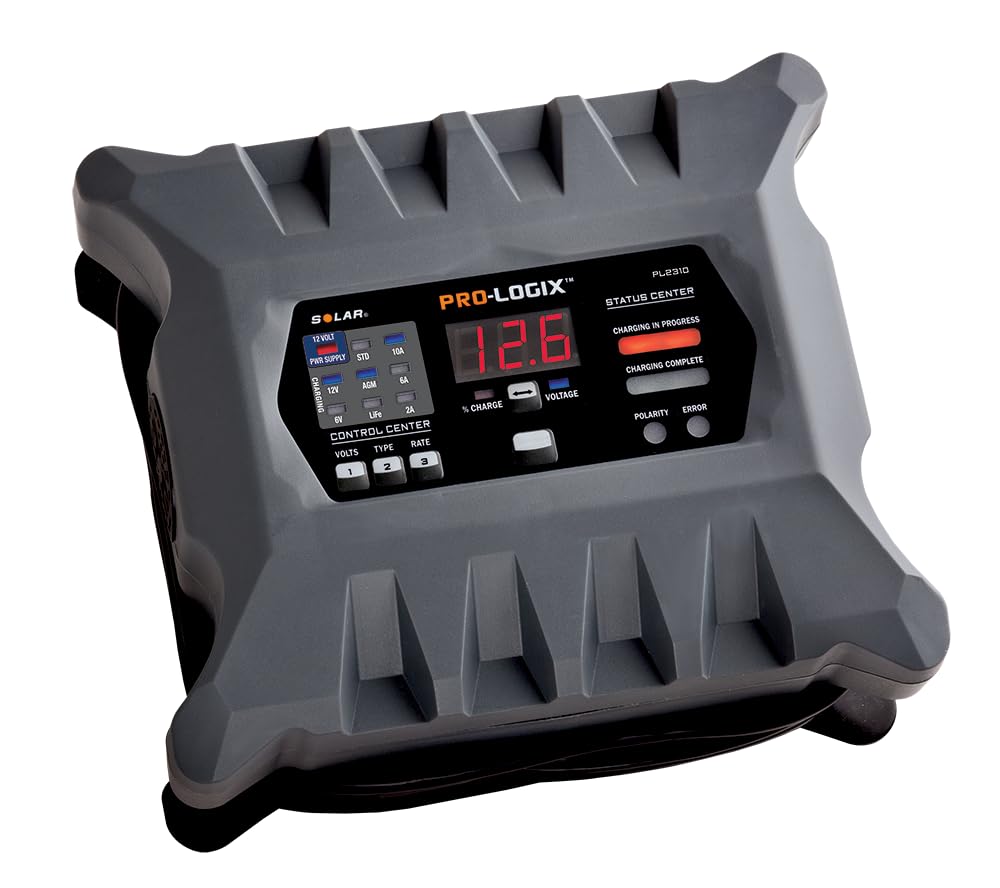
The PL2310 runs a multi-phase charging process that detects ambient temperature and adjusts the voltage accordingly—critical for sealed AGM batteries housed in cold engine bays. Its stable power supply mode acts as a bench power source during diagnostics, feeding a steady 13.6V to keep the ECU alive while you swap parts.
With three selectable charge rates (2A, 6A, 10A) the unit can trickle-maintain a motorcycle battery or fully restore a F-250’s depleted Group 65 battery overnight. The microprocessor prevents overcharging by switching to float once the battery reaches full saturation, a must for leaving it connected days at a time.
The desulfation feature uses high-frequency pulses to break down lead sulfate crystals, extending the lifespan of a battery that has been sitting for months. Competitors at this level often omit temperature compensation—here it’s standard, making this the most balanced choice for a do-everything garage unit.
What works
- Temperature compensation adjusts voltage for cold or hot garages
- Power supply mode supports diagnostic work without a separate bench supply
What doesn’t
- Lacks a built-in battery tester
- No lithium mode for LiFePO4 batteries
2. CRAFTSMAN CMXCESM258 12A Charger
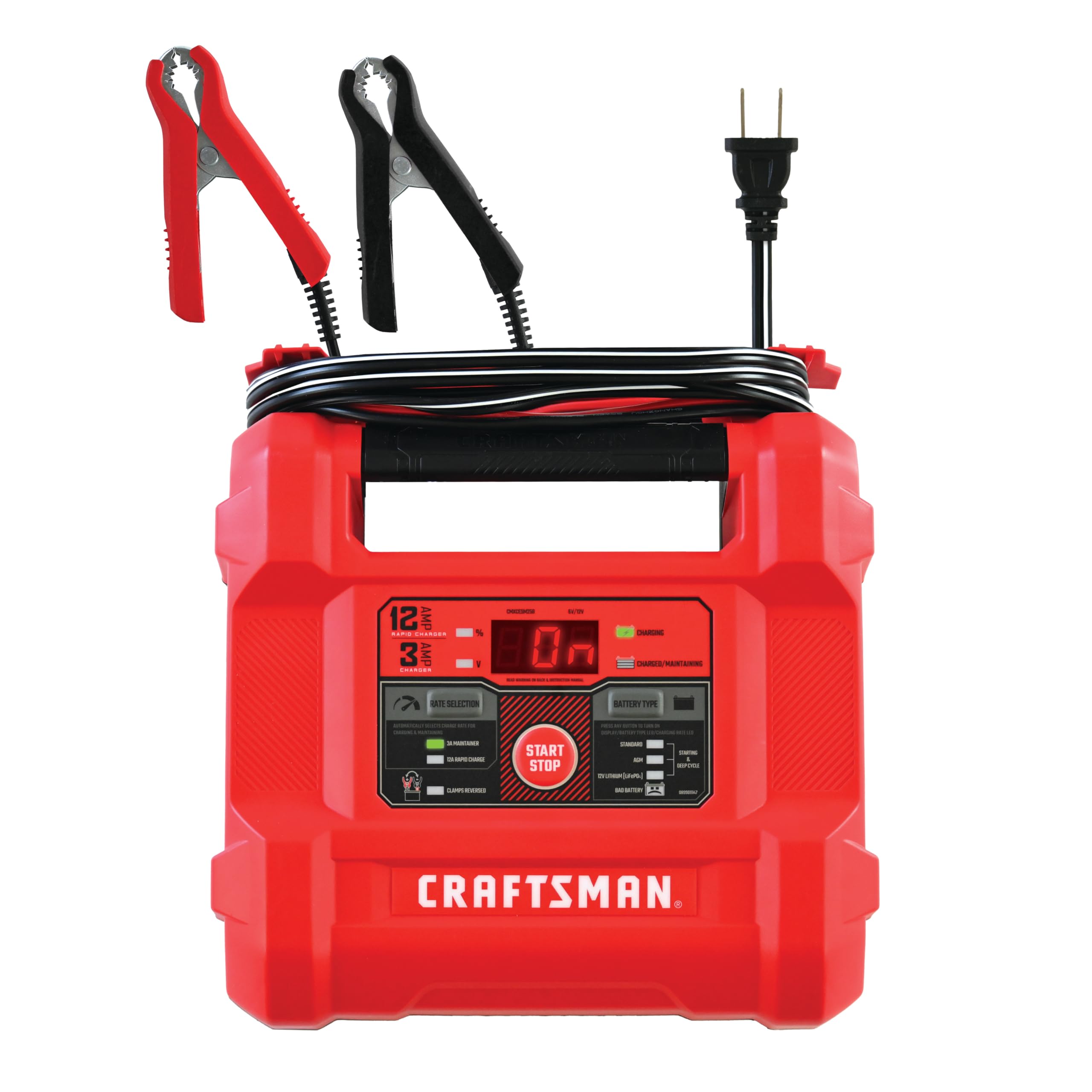
The CRAFTSMAN 12A unit stands out because it packs a full battery tester into the same housing that delivers charging and maintenance. The built-in diagnostics read out battery health in seconds — spotting failing cells before they strand you — which is especially useful for trucks with dual-battery setups where one bank often degrades faster.
It is one of the few mid-range chargers that explicitly supports lithium (LiFePO4) batteries, with a dedicated charge profile that respects the lower absorption voltage and prevents BMS disconnects. The 3-amp 12V maintenance mode is safe for AGM and gel batteries over long storage periods without gassing the electrolyte.
The reconditioning mode applies a controlled over-voltage to break down sulfation on standard lead-acid batteries. Combined with the reverse polarity protection and spark-proof clamps, this is a low-worry solution for a mixed fleet of trucks, SUVs, and powersport vehicles.
What works
- Integrated battery tester provides instant health readouts
- Dedicated LiFePO4 charge mode for newer lithium batteries
What doesn’t
- No adjustable current or voltage control
- AC cord is only 6 feet long, limiting garage placement
3. PZ.P WD-315 0–15A Adjustable Charger

The PZ.P WD-315 sets itself apart with fully adjustable voltage (12–30V) and current (0–15A), allowing you to charge a 12V starter battery at a gentle 1A trickle or recover a 24V deep-cycle bank at the full 7.5A rate. The manual knobs offer granular control that fully automated units simply don’t provide.
The 7-stage profile covers desulfation, bulk, absorption, recondition, and pulse maintenance, with a specific recondition cycle that applies elevated voltage for breaking stubborn sulfate layers on AGM and gel cells. The LED display shows real-time voltage and current, and it can read residual battery voltage without being plugged into AC power.
Multiple safety protections (reverse polarity, over-voltage, over-current, over-heat) are built in. The included alligator clips and terminal connectors cover both standard posts and side-terminal batteries common in General Motors trucks. Pair it with a deep-cycle battery bank for a camper or RV setup and the adjustability becomes indispensable.
What works
- Fully adjustable voltage and current for both 12V and 24V systems
- 7-stage charge profile with dedicated recondition cycle
What doesn’t
- Cannot activate a completely dead battery below detection threshold
- Manual knobs require attention; not fully automatic
4. NOCO Boost GB40 1000A Jump Starter

The GB40 packs 1000 peak amps of lithium discharge into a 2.4-pound enclosure that fits in the center console of a Ram 1500. It is designed for emergency starts of 6.0L gas and 3.0L diesel engines, providing up to 20 jump starts per charge. The UltraSafe technology blocks the clamps if reverse polarity is detected, making it safe even for a novice user.
Recharging through the USB-C port takes about three hours, and the integrated 100-lumen LED flashlight with SOS and strobe modes doubles as an emergency light. The IP65 rating resists water ingress and dust, so it can live in a truck bed without being ruined by rain or mud.
While the GB40 works as a power bank for phones and tablets, it does not function as a battery maintainer; it is purely a jump starter. Users with very large V8 diesels above 6.0L will need the higher-capacity GB150 or a unit with more than 2000 peak amps.
What works
- Extremely compact for glove-box storage
- Spark-proof and reverse-polarity protected clamps
What doesn’t
- No AC wall charger included; uses USB-C cable only
- Not powerful enough for very large diesel engines above 6.0L
5. Schumacher SC1446 Wheeled 200A Charger

The SC1446 is a wheeled 2-in-1 that delivers 200 cranking amps for engine start and 40 amps for boost charging, alongside a 10-amp charging rate for slower recovery. The 135-minute manual timer gives you precise control over the charge cycle — essential when working with deeply discharged batteries that need a careful ramp-up.
Its analog ammeter gives a visual readout of current flow, letting you see when the battery is accepting charge versus when it’s fully saturated. The heavy-duty steel case, retractable handle, and solid wheels mean you can roll this across a workshop floor without straining your back — a 30-pound unit is not for carrying up stairs.
Compatibility spans 6V and 12V standard, AGM, gel, and deep-cycle batteries. The 40-amp boost mode is especially useful for adding enough charge to a deeply depleted battery so the 10A circuit can take over. The unit does not include a microprocessor-selectable lithium profile, but it excels on lead-based batteries.
What works
- 200A engine start works on large gas and small diesel engines
- Wheeled design and retractable handle minimize physical strain
What doesn’t
- Timer mechanism can be finicky according to field reports
- No dedicated lithium or LiFePO4 charge profile
6. DEWALT DXAEPS14 Jump Starter Power Station

The DXAEPS14 is a sealed lead-acid jump starter that delivers 2000 peak amps — enough to fire most V8 gas trucks and many diesel applications. The built-in 120 PSI digital air compressor includes an AUTO STOP function that inflates tires to a preset pressure, making roadside puncture repairs faster and more accurate.
It provides AC power through a 500-watt inverter, letting you run small power tools, a work light, or a laptop from the job site. The 15W USB-A and 25W USB-C ports support fast device charging without needing a separate power brick, a big advantage when you’re already managing extension cords.
Reverse polarity alarm ensures the clamps are connected correctly before releasing the boost. At 17 pounds, it is heavier than modern lithium units but still portable enough to move between work trucks. The manual notes it is tailored for passenger cars and trucks up to V8; heavy-duty diesels will benefit from stepping up to a higher-amperage unit.
What works
- 500W AC inverter powers small tools and equipment
- 120 PSI air compressor with AUTO STOP for tire inflation
What doesn’t
- Sealed lead-acid battery is substantially heavier than lithium units
- Not ideal as a multi-day battery maintainer
7. Clore Jump-N-Carry JNC1224 3400A Jump

The JNC1224 is the most physically substantial unit in this guide — 40 pounds of industrial-grade jump starting power with 46-inch leads made from #2 AWG welding cable. It delivers 3400 peak amps in 12-volt mode and 1700 peak amps in 24-volt mode, making it capable of starting a dead heavy-duty diesel dump truck or a fleet box truck without breaking a sweat.
The Hot Jaw Clamps provide high surface pressure for solid electrical contact even on corroded battery terminals. The unit uses a sealed AGM battery internally and features a built-in automatic charger that keeps the internal battery topped off when connected to AC power. The 15-by-17-inch footprint sits firmly on a shop floor or service truck bed.
User reports from dealerships and towing companies highlight that it holds charge for months between uses and starts dead batteries without needing to wait for an internal recharge. The main trade-off is size and weight — this is not a tool you keep in a personal vehicle’s trunk, but rather a dedicated piece of equipment for a garage or fleet operation.
What works
- 3400A peak handles large V8 gas and diesel engines repeatedly
- Welding-cable leads and Industrial clamps maximize conductivity
What doesn’t
- At 40 pounds, it is impractical for personal vehicle portability
- Cases of premature internal battery failure reported by some users
Hardware & Specs Guide
Amperage and Boost Thresholds
A truck charger’s sustained output rating (usually 10A to 15A) determines how fast it can replace a discharged battery. Boost or engine-start cranking amps (peaks from 200A to 3400A) provide the momentary surge needed to spin a starter when the battery voltage is too low to do it alone. For a typical diesel truck, you need at least 2000 peak amps for reliable starting in cold weather.
Battery Chemistry Profiles
Different truck batteries demand different absorption voltages: flooded lead-acid wants 14.4–14.7V, AGM requires 14.6–14.8V with tighter regulation, and LiFePO4 needs an absolute cutoff near 14.6V to avoid BMS damage. Chargers that lack a lithium profile cannot safely charge a drop-in lithium starter battery. Some units also detect residual voltage and won’t engage if the battery is below a certain threshold, requiring a manual override.
FAQ
Can I use a truck battery charger on a LiFePO4 battery without a lithium mode?
What should I do if my truck battery charger won’t start charging a dead battery?
How many amps do I need to charge a large dual-battery truck system?
Final Thoughts: The Verdict
For most buyers, the truck battery charger winner is the Clore Automotive PL2310 because it combines temperature-compensated 10-amp charging, desulfation, and a stable power supply mode — everything a single-truck owner needs for maintenance and deep recovery. If you switch between flooded, AGM, and LiFePO4 batteries, grab the CRAFTSMAN CMXCESM258 for its built-in tester and lithium compatibility. And for fleet operators or diesel-heavy shops that need to start a dead rig immediately, nothing beats the Clore Jump-N-Carry JNC1224.

Certification: BSc in Mechanical Engineering
Education: Mechanical engineer
Lives In: 539 W Commerce St, Dallas, TX 75208, USA
Md Amir is an auto mechanic student and writer with over half a decade of experience in the automotive field. He has worked with top automotive brands such as Lexus, Quantum, and also owns two automotive blogs autocarneed.com and taxiwiz.com.