Nothing kills a wheel swap faster than discovering your aftermarket lug nut key doesn’t match the 10-spline pattern on your wheels. That precise spline count — exactly ten raised ridges around the fastener’s outer diameter — determines whether you’re swapping tires in twenty minutes or hunting down a specialty socket while your project sits on jack stands. Misidentifying a 10-spline key for a similar 12-spline design is the most common headache in this category, and the result is always the same: a stripped tool, damaged lug nuts, and a delayed job.
I’m Amir — the founder and writer behind Four Wheel Ask. I’ve spent years analyzing wheel lock specifications, cross-referencing OEM and aftermarket spline patterns, and cataloging the real-world failure points that matter most when you’re one stripped spline away from a headache.
This guide isolates the key factors — thread pitch compatibility, hex drive size, material hardness, and corrosion resistance — that separate a reliable tool from a frustrating misfire. Whether you drive a lifted truck, a lowered import, or a daily-driven SUV, choosing the right 10 spline lug nut key comes down to matching your exact fastener geometry rather than guessing by brand or price.
How To Choose The Best 10 Spline Lug Nut Key
Buying the wrong 10-spline key usually happens because buyers assume all 10-spline fasteners share the same dimensions. They don’t. The spline count is fixed at ten, but the outside diameter of the splined profile varies — typically 0.67 inches (roughly 17mm) for smaller passenger fasteners and 0.86 inches (roughly 22mm) for larger-duty applications. Measuring yours beforehand prevents the most common return reason in this category.
Thread Pitch and Diameter Compatibility
The key itself does not thread onto the stud, but the inner diameter of the splined portion must clear the stud while engaging the full depth of the outer spline grooves. Check your lug nut’s thread size — common variants include 1/2″-20, M12x1.25, M12x1.5, M14x1.5, and 7/16″-20. A key listed for M14x1.5 will not seat correctly on a 1/2″-20 nut because the bore depth and shoulder geometry differ.
Material Hardness and Finish
Cold-forged alloy steel (often CR-MO or 4140-grade) delivers the highest torque capacity without deforming the spline teeth. Zinc-plated or brushed finishes resist surface rust during storage, while black electrophoretic coating offers superior corrosion resistance in wet or salty environments. Avoid keys made from standard low-carbon steel stampings — these round off after a few high-torque uses.
Hex Drive Size
Most 10-spline keys include two hex sizes on the same tool — common pairs are 3/4-inch with 13/16-inch (SAE) or 17mm with 19mm (metric). Some premium tools add a 7/8-inch hex for extra clearance with larger socket adapters. Match the hex to your breaker bar or torque wrench; a loose fit between the key and your socket causes rounding on the key’s hex flats.
Torque Capacity
Lug nut torque for passenger cars typically ranges from 80 to 100 foot-pounds, while trucks and SUVs can exceed 140 foot-pounds. A key rated for at least 150 foot-pounds of torque provides a safety margin against sudden twisting force. Keys rated below 100 foot-pounds should only be used with a hand wrench, never with an impact gun.
Quick Comparison
On smaller screens, swipe sideways to see the full table.
| Model | Category | Best For | Key Spec | Amazon |
|---|---|---|---|---|
| White Knight 3800A10 | Passenger | Dual hex compatibility | 200 ft-lbs torque, 3/4″ & 13/16″ hex | Amazon |
| SUCOSO 10 Spline Key | Large Spline | M14 and 9/16 UNF nuts | 3.5″ length, 13/16″ & 7/8″ hex | Amazon |
| Thinkpro TP3039 | Universal | Hex and square dual drive | CR-MO steel, 22mm OD spline | Amazon |
| Bimecc TA20-19/21 | Passenger | OEM fitment Bimecc nuts | Alloy steel, 3/4″ & 13/16″ hex | Amazon |
In‑Depth Reviews
1. White Knight 3800A10 Ten Spline Key Adapter
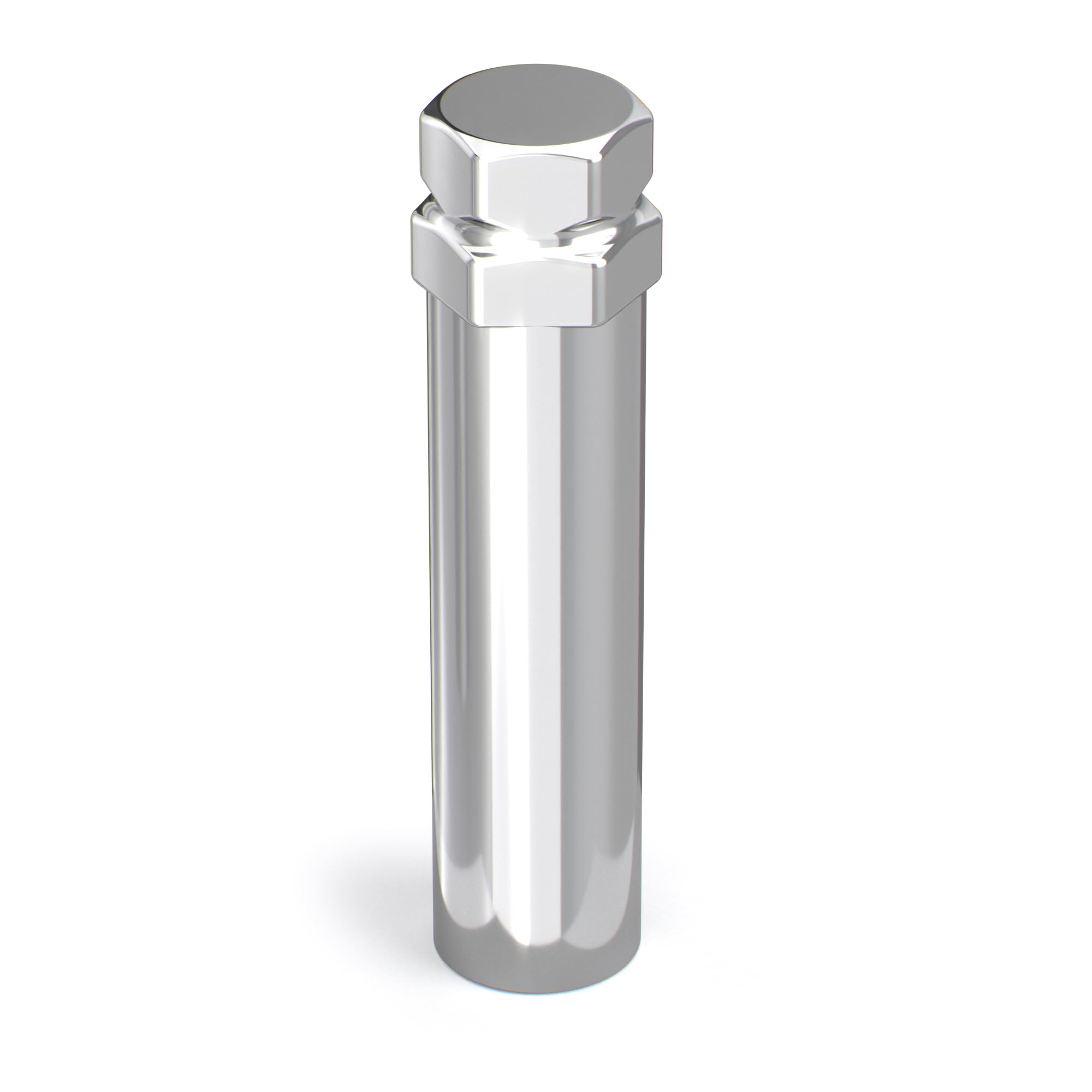
The White Knight 3800A10 earns the top spot because it bridges passenger-car and light-SUV applications with a torque rating that comfortably exceeds most factory and aftermarket lug nut specifications. Its 200 foot-pound capacity means you can break loose stubborn nuts without worrying about the spline teeth rounding off. The zinc construction keeps surface rust at bay during storage, and the brushed finish won’t flake like painted coatings tend to do after repeated socket contact.
Fitment spans three common thread pitches — 7/16″-20, 1/2″-20, and M12 — which covers the majority of Bimecc-compatible 10-spline nuts found on passenger cars and smaller crossovers. The 0.8-inch outside diameter matches the smaller passenger profile, so owners of larger 0.86-inch fasteners should measure first. The dual hex sizes (3/4 inch and 13/16 inch) give you two options to match your breaker bar or torque wrench without needing an adapter.
The included one-year manufacturer warranty adds peace of mind, and the 3.5-inch length provides enough leverage without forcing you to reach awkwardly behind oversized wheels. Owners consistently report this key seats fully into the spline grooves with no wobble, a sign of consistent manufacturing tolerances that budget options sometimes lack.
What works
- Generous 200 ft-lbs torque ceiling handles stubborn nuts
- Dual hex sizes add flexibility at the tool end
- Zinc finish resists corrosion without adding thickness
What doesn’t
- 0.8-inch OD fits only the smaller passenger spline profile
- Not impact-rated — hand tools only
2. SUCOSO 10 Spline Lug Nut Key
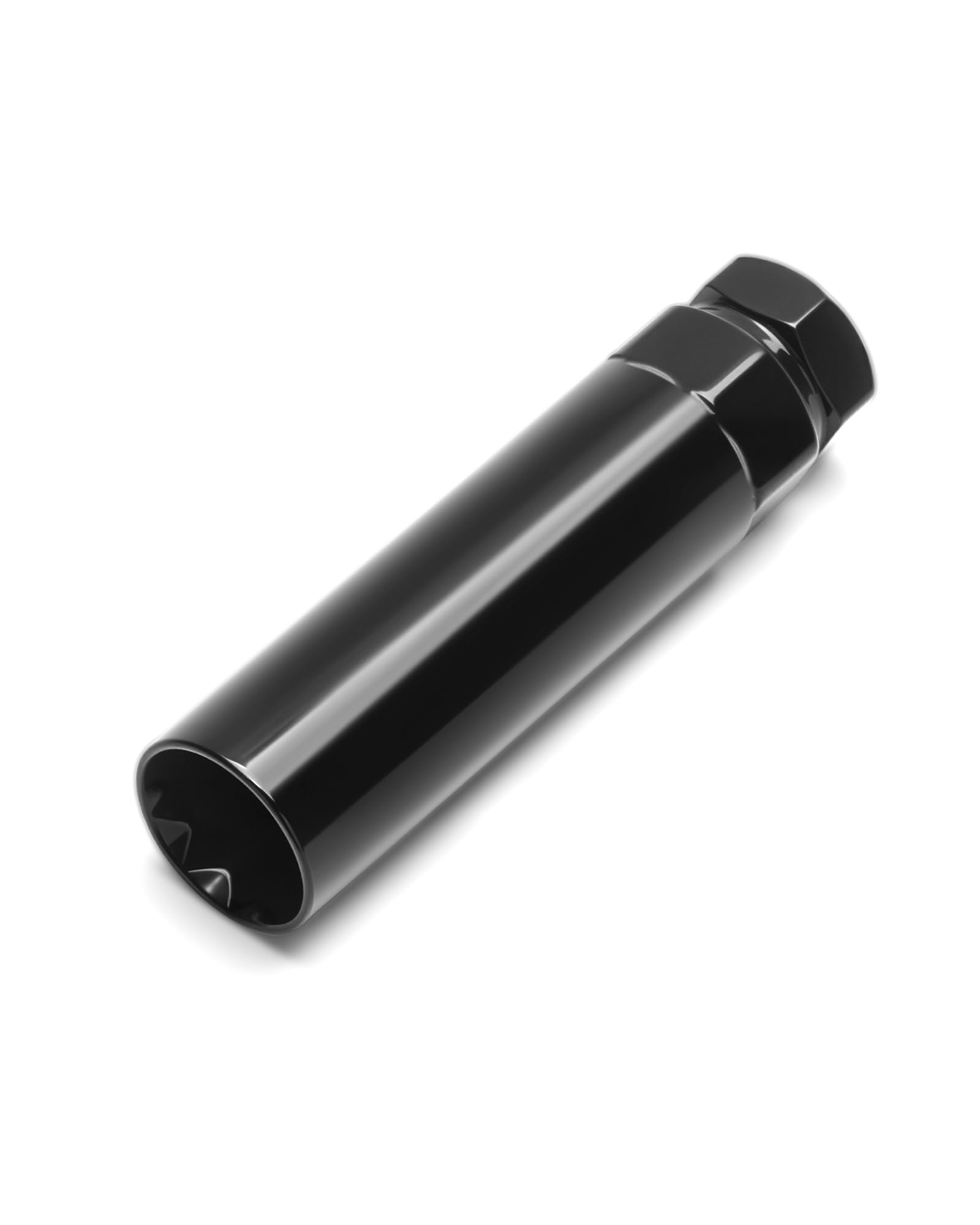
The SUCOSO key targets owners of larger 10-spline fasteners specifically — the M14x1.5, M14x2.0, and 9/16 UNF thread patterns that show up on trucks, heavy SUVs, and some aftermarket wheel setups. Its 0.86-inch outside diameter spline profile correctly matches the larger Bimecc TA23-series nuts, which the smaller passenger key cannot engage. The black electrophoretic coating survives a 72-hour salt spray test, making this a strong choice for vehicles exposed to winter road salt or coastal air.
Cold-forging and alloy steel construction give this key the hardness to resist deformation under high torque, though the manufacturer explicitly warns against impact wrench use — stick to hand tools. The dual hex sizes (13/16 inch and 7/8 inch) are wider than typical passenger keys, accommodating larger socket drives without slop. Multiple verified reviews confirm this key fits the splines on Jeep and Yukon factory locking nuts that other tools failed to engage.
The 3.5-inch length mirrors the White Knight but with a wider hex range. One downside is the lack of a torque rating printed on the tool itself — the 200 foot-pound ceiling is implied by material quality but not officially stated. Still, for a dedicated large-spline tool at a entry-level price point, the SUCOSO delivers reliable engagement where smaller keys slip.
What works
- Fits the larger 0.86-inch 10-spline profile correctly
- Black electrophoretic coating passes 72-hour salt spray test
- Handles M14x1.5 and 9/16 UNF thread sizes accurately
What doesn’t
- No explicit torque rating listed on the product
- Not usable with impact wrenches per manufacturer instruction
3. Thinkpro TP3039 10 Spline Lug Nut Socket
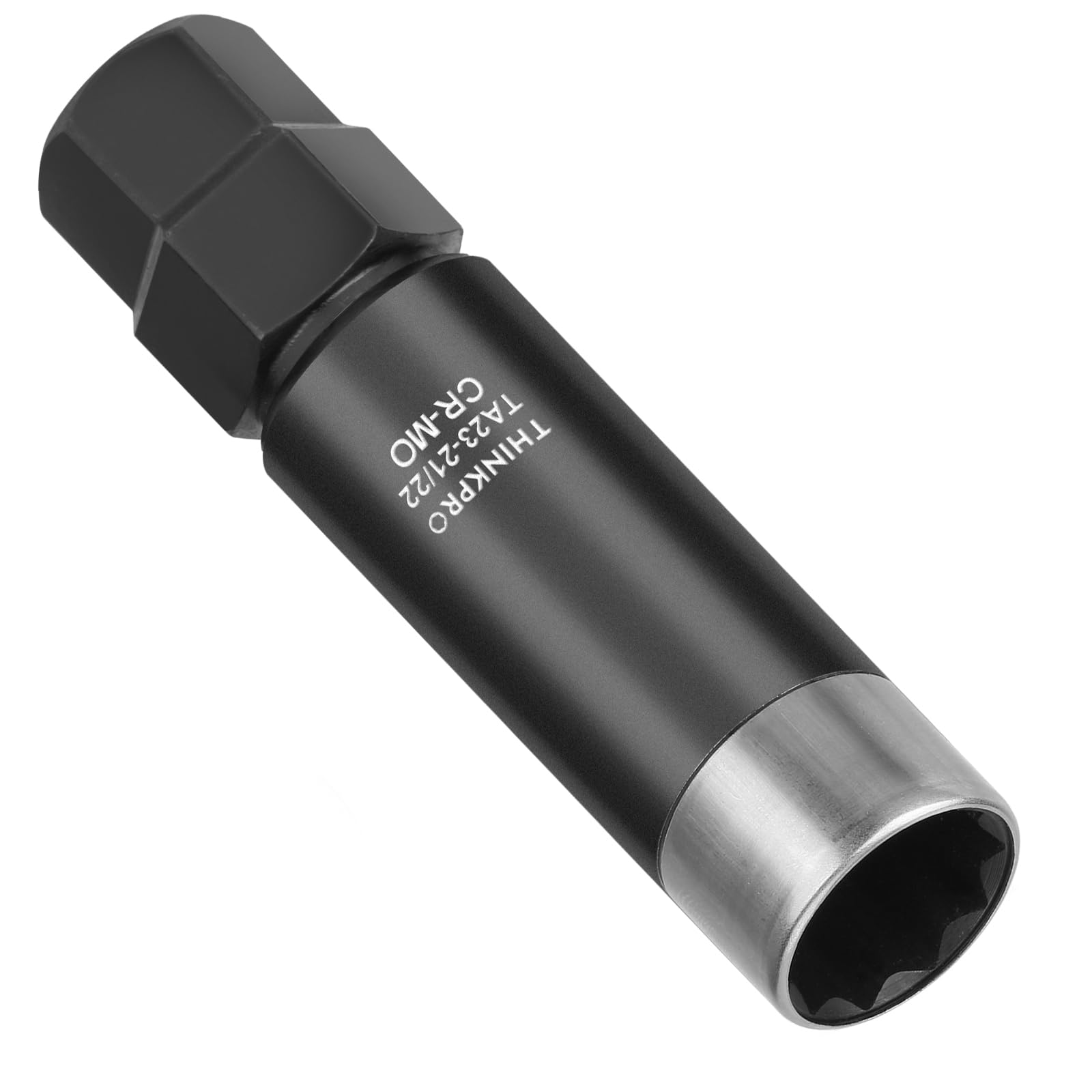
The Thinkpro TP3039 stands out for its dual drive design — both a hex outer profile and a square inner drive that accepts a ratchet or breaker bar directly. This eliminates the need for a separate socket adapter, which is handy when working in tight wheel wells where every inch of tool length matters. The chrome-molybdenum steel (CR-MO) construction offers superior toughness compared to standard carbon steel, and cold forging ensures the spline teeth maintain their shape under repeated load cycles.
This key is designed as a replacement for the Bimecc TA23-21/22, placing it in the larger 0.86-inch spline category. It fits M14x1.5 and M14x2.0 thread patterns, making it suitable for SUVs and light trucks running aftermarket wheels. The dual drive compatibility gives it a versatility edge — you can use a 21mm or 22mm socket on the hex side or insert a 3/8-inch or 1/2-inch drive ratchet into the square bore depending on your preference and available tools.
Owners report consistent fitment on Honda aftermarket wheels and replacement uses where the original Bimecc key was lost. The one-cavity storage case included with the tool prevents the key from rolling under the seat or getting mixed with other sockets. The only practical limitation is that the square drive accommodates only a single ratchet size — 1/2-inch — so owners with 3/8-inch drive sets will rely on the hex side instead.
What works
- Hex and square dual drive eliminates socket adapter needs
- CR-MO steel with cold forging maximizes spline tooth durability
- Includes storage case for organized tool storage
What doesn’t
- Square drive accepts 1/2-inch only, not 3/8-inch
- Fits only the larger 0.86-inch spline profile
4. Bimecc TA20-19/21 10-Spline Lug Nut Tool Key

The Bimecc TA20-19/21 is the OEM reference tool for the Bimecc 10-spline ecosystem, meaning it’s the exact geometry that aftermarket brands attempt to replicate. If your wheels came with Bimecc-branded locking lug nuts, this key is virtually guaranteed to seat correctly because Bimecc controls the spline profile tolerances in-house. The alloy steel construction with a polished zinc finish provides good corrosion resistance, and the 3/4-inch and 13/16-inch hex drives match standard SAE socket sizes.
This key is sized for the smaller 0.67-inch passenger profile, compatible with 7/16″-20, 1/2″-20, and M12 thread patterns commonly found on sedans, coupes, and small crossovers. Multiple long-term owners report this key surviving two to three years of seasonal tire rotations with no visible wear on the spline teeth, a testament to Bimecc’s heat-treatment process. The 3-inch length is slightly shorter than some competitors, but that rarely matters in practice since the key is always used with an extension or breaker bar anyway.
One nuance noted by owners is that one side of the splined bore is marginally thinner than the other, likely a result of the hex broaching process. This does not affect function as long as you insert the key fully onto the nut, but it’s worth checking before applying full torque. For anyone replacing a lost Bimecc key or outfitting a set of Bimecc-equipped wheels, this is the benchmark tool others are measured against.
What works
- OEM Bimecc tool guarantees correct spline fitment
- Polished zinc finish resists storage corrosion
- Consistent heat treatment delivers multi-year durability
What doesn’t
- Splined bore has slight asymmetry on one side
- Shorter 3-inch length compared to some aftermarket keys
5. Bimecc TA20-17/19 10-Spline Lug Nut Tool Key
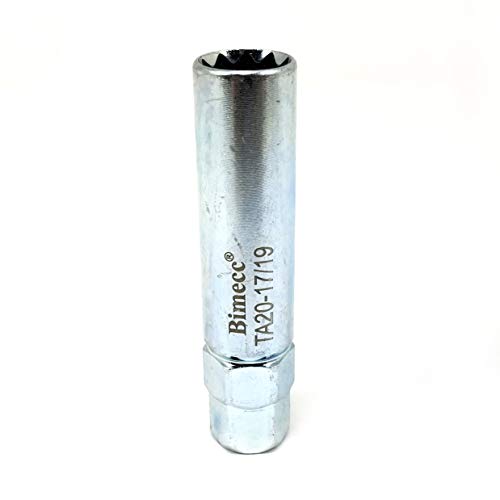
The Bimecc TA20-17/19 is the metric counterpart to the TA20-19/21, swapping SAE hex sizes for a 17mm and 19mm configuration that matches European and Asian socket sets. This is the most natural fit for owners working primarily with metric tools, eliminating the need to carry an SAE socket just for the lug nut key. The powder-coated black finish provides a thicker corrosion barrier than zinc plating, and the alloy steel base material maintains the same heat-treatment quality as the rest of Bimecc’s lineup.
This key uses the same small passenger spline profile (0.67-inch OD) as the TA20-19/21, so it fits the same 7/16″-20, 1/2″-20, and M12 thread ranges. The dual metric hexes are machined to the same tolerance as the SAE version, meaning the tool seats squarely on standard sockets without wobble. For owners with an all-metric toolbox who need a 10-spline key for occasional wheel work, this version prevents the annoyance of swapping socket sets mid-job.
The powder coating is thicker than paint but can chip if dropped onto concrete or if the tool is frequently knocked against wheel studs. That aside, this key delivers the same OEM-guaranteed fitment as the SAE model, making it a straightforward choice if metric sockets dominate your setup.
What works
- Metric 17mm and 19mm hex fits Euro and Asian socket sets
- Powder-coated finish adds thicker corrosion protection
- Same heat-treated alloy steel as the standard Bimecc key
What doesn’t
- Powder coating can chip on hard impacts, exposing steel
- Same small passenger profile — does not fit large 0.86-inch nuts
Hardware & Specs Guide
Spline Profile Diameter
The single most critical dimension is the outside diameter of the splined portion of the key. The small passenger profile measures roughly 0.67 inches (approximately 17mm) and fits nuts with threads ranging from 7/16″-20 to M12. The large truck/SUV profile measures roughly 0.86 inches (approximately 22mm) and fits M14 and 9/16 UNF fasteners. Measuring your lug nut’s splined collar diameter with a digital caliper before ordering eliminates 90 percent of fitment issues.
Hex Drive Configuration
Most 10-spline keys include two hex sizes on opposite ends. Common SAE pairs are 3/4-inch with 13/16-inch, while metric pairs are 17mm with 19mm. Some premium keys add a 7/8-inch hex for compatibility with larger sockets. The hex size determines which socket or wrench drives the key — a mismatched hex leads to rounded corners and tool slippage. For the best torque transfer, use a six-point socket rather than a 12-point socket on the key’s hex.
Material and Hardness
Cold-forged alloy steel (4140 or chrome-molybdenum variants) provides the highest yield strength for spline tools. Zinc plating offers adequate corrosion resistance for occasional indoor storage, while black electrophoretic coating or powder coating provides superior protection for tools kept in roadside kits exposed to humidity. Standard low-carbon steel keys are prone to spline tooth deformation at torque levels above 100 foot-pounds and should be avoided for impact use.
Torque Capacity and Tool Safety
Quality 10-spline keys are typically rated between 150 and 200 foot-pounds of torque — sufficient for passenger car and light truck lug nuts. No 10-spline key available in this price range is rated for impact wrench use; the sudden hammering action of an impact gun deforms the spline teeth almost instantly. Always use a hand wrench or breaker bar, and apply steady rotational force rather than jerking motions to preserve the tool’s spline geometry.
FAQ
How do I measure my 10-spline lug nut to know which key fits?
Can I use a 10-spline key with an impact wrench?
What is the difference between a 10-spline and a 12-spline lug nut key?
My 10-spline key feels loose on the lug nut. Is it the wrong size?
Final Thoughts: The Verdict
For most buyers, the 10 spline lug nut key winner is the White Knight 3800A10 because it combines a 200 foot-pound torque ceiling with dual SAE hex compatibility at a price that undercuts most competitors while still including a manufacturer warranty. If your fasteners use the larger M14 or 9/16 UNF thread pattern, grab the SUCOSO 10 Spline Lug Nut Key for its correct 0.86-inch spline engagement and corrosion-resistant black coating. And for metric socket users who want the peace of mind of OEM Bimecc tooling, nothing beats the Bimecc TA20-17/19 with its dedicated 17mm and 19mm hex drives.

Certification: BSc in Mechanical Engineering
Education: Mechanical engineer
Lives In: 539 W Commerce St, Dallas, TX 75208, USA
Md Amir is an auto mechanic student and writer with over half a decade of experience in the automotive field. He has worked with top automotive brands such as Lexus, Quantum, and also owns two automotive blogs autocarneed.com and taxiwiz.com.