Torquing a bolt by hand and a prayer is how wheel studs snap, cylinder heads warp, and brake calipers bind. A precise click-type wrench eliminates the guesswork, delivering a repeatable clamping force that protects both your components and your safety. The right unit for your arsenal depends on the torque range you need and the drive size your sockets accept.
I’m Amir — the founder and writer behind Four Wheel Ask. I’ve spent months combing through calibration certificates, measuring handle deflection, and aggregating feedback from professional mechanics and seasoned DIYers to separate the wrenches that hold their setpoint from those that drift after a dozen cycles.
Whether you’re torquing suspension bolts, engine head fasteners, or lug nuts, selecting the right automotive torque wrench comes down to balancing accuracy, build material, and the mechanism that triggers the release — a decision that keeps your fasteners safe and your threads intact.
How To Choose The Best Automotive Torque Wrench
Torque wrenches are precision‑adjustable tools, not general‑purpose break‑over bars. Three variables define whether one suits your workflow: the drive size, the internal mechanism, and the torque range that covers the critical fasteners on your vehicle.
Drive Size & Torque Range
1/4‑inch drive wrenches are meant for small fasteners such as valve covers, intake manifolds, and engine electronics — typically spanning 20‑200 in‑lb. 3/8‑inch drive units cover the sweet spot of 10‑100 ft‑lb, which handles most suspension, brake caliper, and engine accessory bolts. 1/2‑inch drive wrenches go from 40‑250 ft‑lb and are mandatory for wheel lugs, axle nuts, and differential ring‑gear bolts. Buying a wrench whose minimum torque exceeds your lightest fastener guarantees you’ll over‑torque from the first use.
Click‑Type vs. Split‑Beam Mechanisms
Click‑type wrenches use an internal spring that compresses against a hardened steel ball until it pops out with a tactile snap at the preset torque. They are simple, affordable, and reliable, but must be stored at the lowest setting to avoid fatigue on the internal spring. Split‑beam designs use two independent beams; a micrometer thumbscrew deflects the secondary beam, and when the main beam aligns with it, the handle releases. Split‑beam wrenches can be stored at any setting without losing calibration, which eliminates one frequent source of user error.
Calibration & Material Integrity
Look for a wrench calibrated to ASME B107.300‑2010, which guarantees ±4% accuracy across the working range, or better. The beam and ratchet head should be forged from Chrome Vanadium or Chrome‑Molybdenum alloy steel — these handle the cyclical loading of thousands of clicks without developing slop in the internal mechanism. A calibration certificate with a serialized test report is the only way to verify that your wrench left the factory within spec.
Quick Comparison
On smaller screens, swipe sideways to see the full table.
| Model | Category | Best For | Key Spec | Amazon |
|---|---|---|---|---|
| TEKTON TRQ62203 | Premium | Heavy‑duty lug nuts & axle nuts | 40‑250 ft‑lb, Split‑Beam | Amazon |
| TEKTON TRQ62103 | Premium | Mid‑range engine & suspension work | 20‑100 ft‑lb, Split‑Beam | Amazon |
| DEWALT DWMT75463 | Mid-Range | Versatile shop use with locking trigger | 20‑100 ft‑lb, Click‑Type | Amazon |
| LEXIVON LX‑182 | Mid-Range | Budget‑friendly precision for DIY jobs | 10‑80 ft‑lb, Click‑Type | Amazon |
| EPAuto ST‑10A‑3 | Budget | First purchase with included extension bar | 10‑150 ft‑lb, Click‑Type | Amazon |
In‑Depth Reviews
1. TEKTON 1/2-Inch Drive Split Beam Torque Wrench (40‑250 ft‑lb) TRQ62203

The TEKTON TRQ62203 is a 1/2‑inch drive split‑beam wrench with a 40‑250 ft‑lb range that covers every heavy fastener on a full‑size truck or SUV, from wheel lugs to control‑arm bolts. Unlike click‑type wrenches, it can be stored at any torque setting, so you never need to remember to dial it back after a job. The polished alloy‑steel beam and 72‑tooth ratchet head provide a smooth, positive engagement with every pull.
The flip‑up cover locks the thumbscrew setting during use, preventing accidental drift while you’re working in a tight wheel well. Each unit ships with a calibration certificate showing the test results for the entire range, giving you documented traceability to the ASME B107.300‑2010 standard. The scale on the beam also includes newton‑meter conversions, saving you the time of flipping through a chart.
For a pro who needs a single wrench that handles lug nuts and suspension hardware without periodic spring‑relaxation worry, this split‑beam design is the most maintenance‑free choice at the top of the market. The only trade‑off is the price point, which is justified by the elimination of calibration drift risk over years of shop use.
What works
- Split‑beam mechanism can be stored at any setting
- 72‑tooth ratchet head for fine swing arc
- Serialized calibration certificate included
What doesn’t
- Premium price bracket
- Heavier than a click‑type equivalent
2. TEKTON 3/8-Inch Drive Split Beam Torque Wrench (20‑100 ft‑lb) TRQ62103

The 3/8‑inch TEKTON TRQ62103 covers the most frequently used torque range in any automotive shop — 20‑100 ft‑lb covers intake manifolds, valve covers, brake caliper brackets, and suspension pivot bolts. The split‑beam mechanism eliminates the storage‑setting discipline required by click‑type wrenches, so you can toss it in a drawer at 75 ft‑lb and grab it a month later without worrying about spring fatigue.
The wrench weighs only 2.1 pounds and measures 18.8 inches, making it maneuverable under a hood or inside a wheel arch. The smooth‑turning thumbscrew sets torque values quickly, and the flip‑up cover locks the adjustment firmly. The dual scale on the beam reads foot‑pounds and newton‑meters simultaneously, which is handy when following a service manual that lists specifications in metric.
For the buyer who wants the mechanical advantage of split‑beam reliability but needs a lighter, shorter wrench for engine‑bay work, this is the perfect middle sibling. The 3/8‑inch drive is also compatible with most standard socket sets, so you won’t need a separate set of 1/2‑inch sockets for mid‑range bolt torquing.
What works
- Split‑beam design holds calibration longer
- Light enough for engine‑bay maneuvering
- Dual scale metric/SAE conversion
What doesn’t
- Not meant for heavy lug nut applications
- Higher initial outlay than click‑type options
3. DEWALT Torque Wrench, 3/8-Inch Drive, 20‑100 FT‑LB, Micro Adjust (DWMT75463)
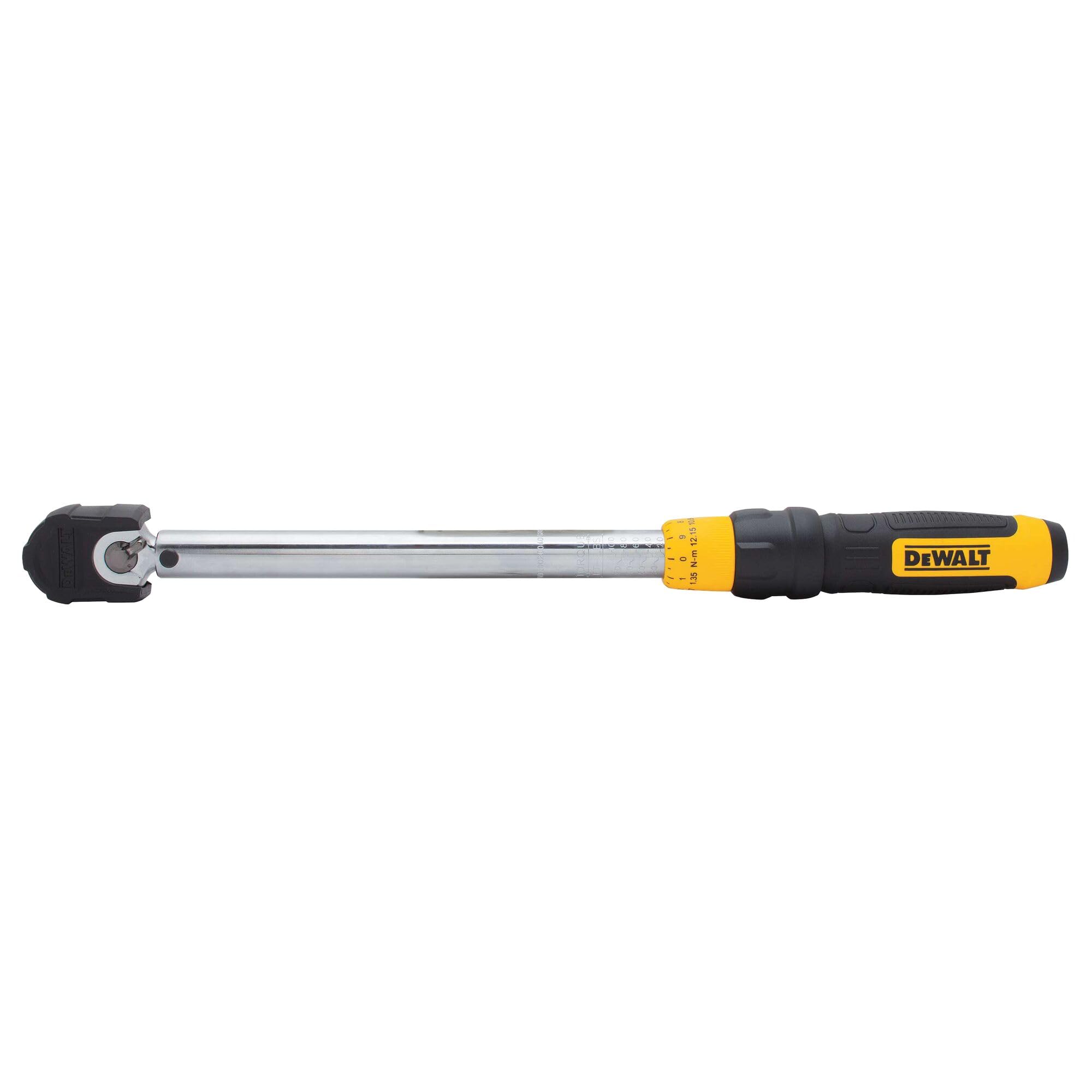
The DEWALT DWMT75463 is a 3/8‑inch drive click‑type torque wrench that covers the same 20‑100 ft‑lb range as the TEKTON but uses a traditional spring‑release mechanism. The standout feature here is the locking trigger — a ring on the handle that prevents accidental torque‑setting changes while in use. The bi‑material grip provides cushioning during extended sessions, and the protective head bumper shields the ratchet head if the wrench is dropped.
The wrench ships in a heavy‑duty storage case, which is essential for any click‑type tool because it encourages you to return the setting to its lowest value before storage — a step many DIYers forget. The brushed finish resists surface rust, and the dual range scale is marked in both foot‑pounds and newton‑meter increments of 1.35 Nm for fine adjustments. DEWALT also certifies compliance with ASME/ISO/TAA standards.
For a mid‑range budget, this wrench delivers the reliability of a tier‑one tool brand with the safety of a locking adjustment ring. It lacks the mechanical advantages of a split‑beam design, but for a weekend mechanic who stores tools in the included case, the click‑type mechanism is perfectly adequate and far more affordable.
What works
- Locking trigger prevents setting drift
- Bi‑material grip adds comfort
- Includes protective storage case
What doesn’t
- Must be stored at lowest setting
- Head bumper may wear over time
4. LEXIVON 3/8-Inch Drive Click Torque Wrench 10‑80 Ft‑Lb (LX‑182)

The LEXIVON LX‑182 is a 3/8‑inch drive click‑type torque wrench with a range of 10‑80 ft‑lb, making it ideal for jobs that require lower torque values such as engine cover bolts, brake line fittings, and interior fastener applications. The reinforced ratchet gear head is forged from heat‑treated Chrome‑Molybdenum alloy steel, which provides better impact resistance than Chrome Vanadium in a tool subjected to heavy use cycles.
LEXIVON applies an Electro‑Black finish treatment that offers superior corrosion protection compared to standard satin or powder‑coated surfaces. The dual‑range scale features highlighted yellow print, improving readability in dim garage lighting. The wrench ships pre‑calibrated to ±4% accuracy with a traceable serial number and calibration certificate — a detail normally seen only on wrenches costing considerably more.
For the home mechanic who needs a reliable, budget‑friendly wrench for lower‑torque maintenance tasks and values a documented calibration history, the LX‑182 punches well above its price point. The 3/8‑inch drive is the most versatile size for general automotive work, and the low minimum torque allows you to safely tighten small bolts that a 1/2‑inch wrench would over‑torque.
What works
- Durable Chrome‑Molybdenum alloy head
- Corrosion‑resistant Electro‑Black finish
- Calibration certificate included
What doesn’t
- Max torque of 80 ft‑lb limits larger fasteners
- Fixed head design reduces swing space
5. EPAuto 1/2-Inch Drive Click Torque Wrench, 10‑150 ft‑lb (ST‑10A‑3)

The EPAuto ST‑10A‑3 is a 1/2‑inch drive click‑type wrench covering 10‑150 ft‑lb, which spans brake calipers and suspension bolts at the low end up to most passenger‑car lug nuts at the high end. The body is built from hardened Chrome Vanadium steel with a satin finish that resists shop oils and garage moisture. The knurled handle provides a non‑slip grip even with greasy hands, and the dual‑range scale shows both foot‑pound and newton‑meter markings.
EPAuto includes a 5‑inch extension bar and a 1/2‑inch to 3/8‑inch reducer, which adds immediate versatility without requiring a separate purchase. The pre‑calibrated ±4% accuracy is competitive with wrenches twice its price, and the click signal is crisp enough to feel through a heavy work glove. A sturdy plastic storage case keeps the wrench, extension bar, and reducer organized.
For a first‑time buyer assembling a starter tool set, this package delivers a fully functional 1/2‑inch torque wrench plus two accessories that cover the most common automotive fasteners. The single‑ratchet head design limits swing arc, but the included reducer lets you use 3/8‑inch sockets without needing a separate adapter, reducing the upfront investment.
What works
- Includes extension bar and reducer adapter
- Wide 10‑150 ft‑lb range
- Knurled handle for positive grip
What doesn’t
- Fixed head limits access in tight spaces
- Plastic storage case feels less durable
Hardware & Specs Guide
Split‑Beam Mechanism
Unlike click‑type wrenches that rely on a spring‑loaded ball, split‑beam designs use a secondary beam that deflects independently from the main beam. When the preset torque value is reached, the two beams realign and the handle pivots, creating a tactile and audible release. The key advantage is that the internal beam does not undergo cyclical spring fatigue, so the wrench can be stored at any torque setting without needing to be dialed back. This makes split‑beam wrenches ideal for users who rotate between multiple torque values throughout a single job and want zero calibration drift over months of storage.
Click‑Type Mechanism
The internal mechanism consists of a hardened steel ball pressed into a detent by a calibrated spring. As torque rises, the ball climbs out of the detent until it snaps past the lip, producing the audible click and hand‑feel break. The spring must be compressed whenever the wrench is set above its minimum value, and storing it under tension for weeks or months can cause the spring to take a set — permanently shifting the calibration. Click‑type wrenches should always be stored at their lowest torque setting, which is a discipline many DIYers overlook. Despite this quirk, they remain the most affordable and widely available type of automotive torque wrench.
FAQ
Should I store a click‑type torque wrench at its lowest setting every time?
What does the ±4% accuracy rating mean in real‑world torque?
Final Thoughts: The Verdict
For most buyers, the automotive torque wrench winner is the TEKTON 1/2-Inch Drive TRQ62203 because its split‑beam design eliminates calibration drift from improper storage and covers the full heavy‑fastener torque range. If you want a compact split‑beam for engine‑bay work, grab the TEKTON 3/8-Inch Drive TRQ62103. And for a budget‑friendly click‑type that still ships with a calibration certificate, nothing beats the LEXIVON LX‑182.

Certification: BSc in Mechanical Engineering
Education: Mechanical engineer
Lives In: 539 W Commerce St, Dallas, TX 75208, USA
Md Amir is an auto mechanic student and writer with over half a decade of experience in the automotive field. He has worked with top automotive brands such as Lexus, Quantum, and also owns two automotive blogs autocarneed.com and taxiwiz.com.