That sluggish crank on a cold morning isn’t a fluke—your auto battery tester will tell you exactly how many cold cranking amps remain before you’re stranded. A digital conductance analyzer reads internal resistance and state of health in seconds, replacing the old carbon-pile guesswork with printed receipts or color-coded pass/fail verdicts. Whether you maintain a fleet, a single daily driver, or a weekend project car, the right unit separates a tired battery from a failing starter or a misbehaving alternator.
I’m Amir — the founder and writer behind Four Wheel Ask. I research automotive diagnostic electronics full-time, comparing manufacturer claims against real-world owner reports to find the tools that actually deliver reliable voltage and CCA readings across every 12V and 24V system.
After testing these seven models on flooded, AGM, GEL, and EFB batteries, I can point you to the right best auto battery tester for your shop, garage, or glove box without wasting time on units that lie about a dead battery.
How To Choose The Best Auto Battery Tester
Not every tester reads every battery chemistry accurately. Beginners often grab the cheapest unit, only to get false “replace battery” warnings on a healthy AGM that just needs a surface-charge drain. Focus on three critical specifications before clicking buy.
Conductance Testing vs. Carbon-Pile Load Testing
Modern digital testers use conductance technology, sending a small AC signal through the battery to measure internal resistance. This method is safe, fast, and does not discharge the battery during testing. Carbon-pile load testers physically draw high current (often 100 amps) and generate heat, which can damage weak batteries. Conductance testers also detect sulfation and inter-cell issues that carbon piles miss.
CCA Range and Battery Chemistry Compatibility
Your tester must support the CCA rating of your largest battery. A unit covering 100–2000 CCA handles most passenger cars, trucks, and SUVs. Confirm support for your specific battery type: regular flooded, AGM flat plate, AGM spiral, GEL, and EFB. Some budget testers skip GEL and spiral AGM, leading to inaccurate readings on high-end European or marine batteries.
Display, Cable Length, and Print Capability
A color screen with waveform visualization helps diagnose intermittent charging issues. Cable length matters when the battery is tucked behind an airbox or in the trunk—look for at least 4 feet. A built-in thermal printer, like the one on the TOPDON BT300P, provides professional receipts for fleet maintenance or customer handoffs.
Quick Comparison
On smaller screens, swipe sideways to see the full table.
| Model | Category | Best For | Key Spec | Amazon |
|---|---|---|---|---|
| FOXWELL BT301 | Premium | Advanced DIY & pros | 6.5‑ft cable, 2.8″ color display | Amazon |
| ANCEL BA101 Plus | Premium | Data logging & printing | 6V/12V, 20–2000 CCA, 2.8″ color | Amazon |
| TOPDON BT300P | Premium | Printed receipts, fleet use | Built‑in thermal printer, spark‑free clamps | Amazon |
| KONNWEI KW600 | Mid‑Range | Budget with color screen | 2.4″ LCD, waveform graphing | Amazon |
| Veepeak BT24 | Mid‑Range | 12V/24V dual system | 9V–24V operation, multilingual UI | Amazon |
| Battery Tender 026‑0020 | Budget | Simple analog load test | 100A load @ 12V, 50A load @ 6V | Amazon |
| KINGBOLEN BM560 | Budget | Ultra‑low‑capacity & 6V batteries | 2AH–200AH, 100–2000 CCA | Amazon |
In‑Depth Reviews
1. FOXWELL BT301
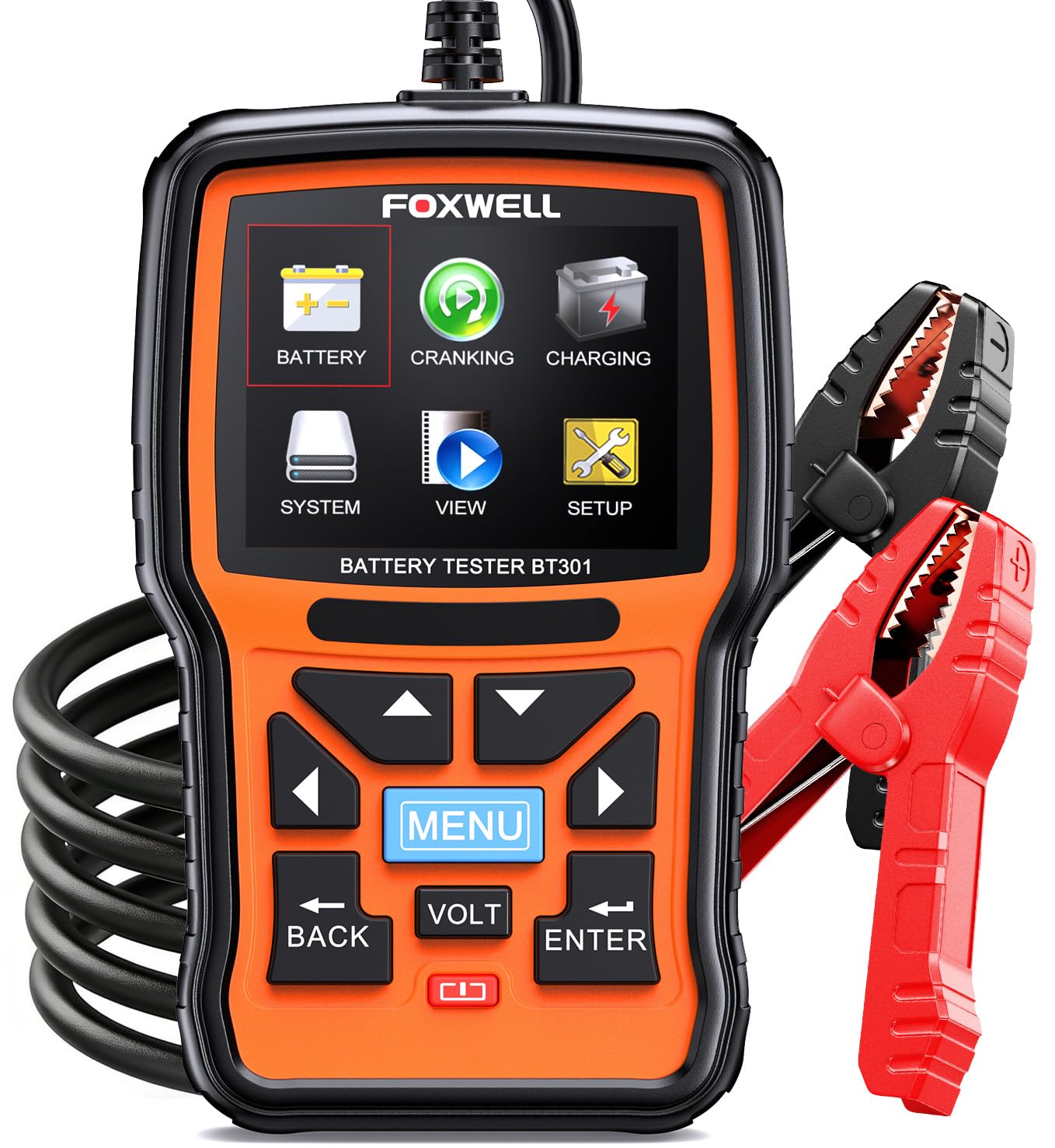
The FOXWELL BT301 is the upgraded version of the widely trusted BT100, and it addresses the biggest complaint of the original: cable length. With a full 6.5 feet of cable, you can reach a battery buried deep in the engine bay or trunk without needing an assistant to hold the unit. The 2.8-inch color display remains crisp in direct sunlight, and the interface guides you through battery health, cranking system, and alternator output tests in a logical sequence.
Under the hood, FOXWELL’s algorithms claim up to 99.9% accuracy. In real-world use against a known good Odyssey battery and a failing flooded unit, the BT301 matched shop-grade diagnostic results within 2 CCA. It supports all common 12V chemistries—flooded, AGM flat and spiral, EFB, and GEL—but does not test lithium. The heavy-duty alligator clips with reverse polarity protection give you confidence even when working in low-light garage conditions.
The carrying bag is a nice touch for mobile mechanics. While the red button on the interface lacks a defined function in the manual, this omission does not hinder any core testing function. If you want the current leader in DIY-grade battery diagnostics with professional reach, this is the unit to buy.
What works
- Extra-long cable makes trunk-mounted battery testing effortless
- Bright color display readable in both dim garages and full sun
- Consistent readings that match professional diagnostic equipment
What doesn’t
- Red multi-function button has no documented purpose in the manual
- Does not support lithium battery chemistries
2. ANCEL BA101 Plus
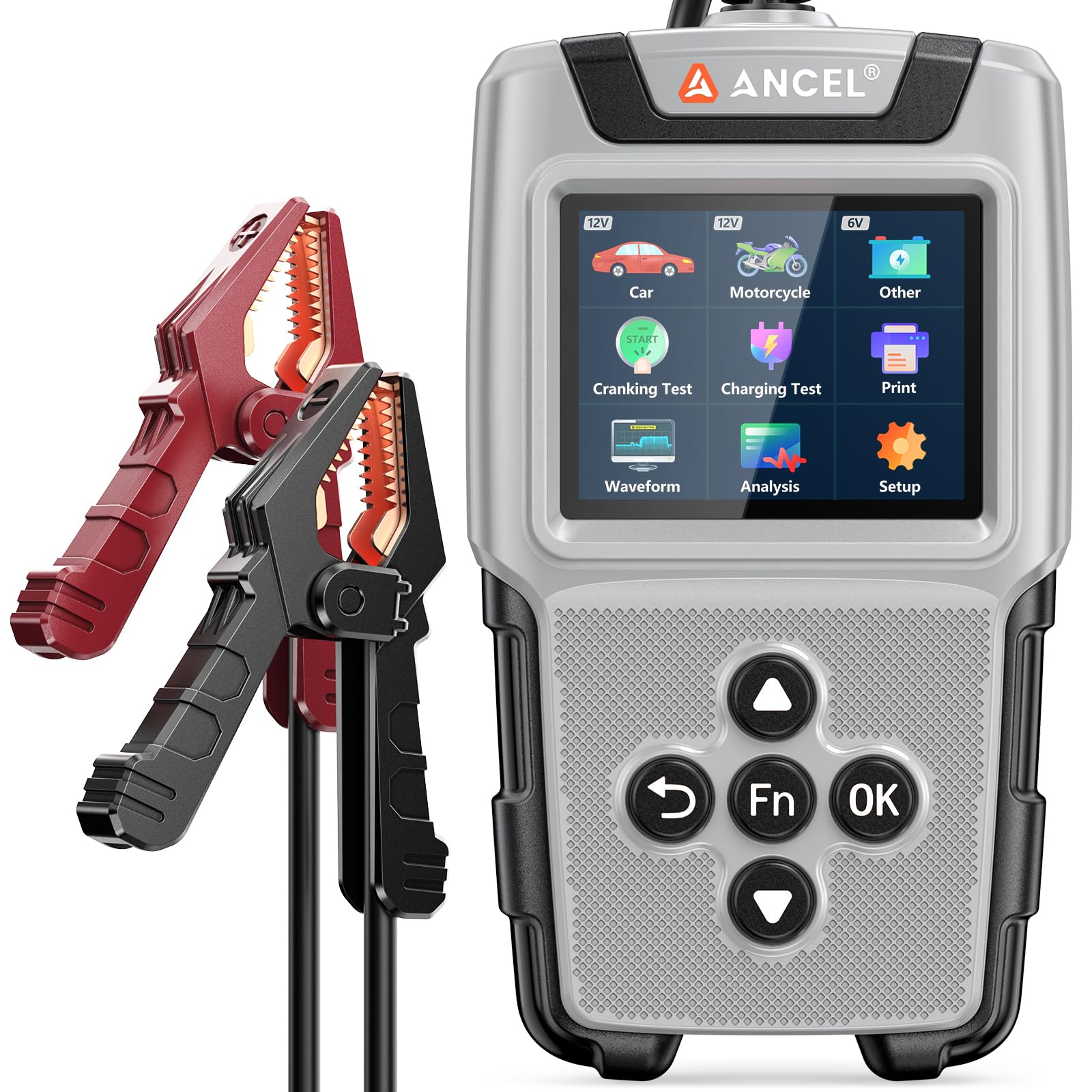
The ANCEL BA101 Plus stands out for its ability to store up to 1,400 test records and replay 120-second voltage waveforms. This is a game-changer for fleet managers or DIYers who want to track battery degradation over months. You can connect the tester to a PC via Type-C to print professional reports, though the driver installation may trigger a standard Windows Defender alert—ANCEL acknowledges this as a false positive.
It handles both 6V and 12V systems with a CCA range from 20 to 2000, meaning it works on small motorcycle batteries and large diesel truck batteries alike. The 2.8-inch color display shows real-time voltage waveforms, making it easier to spot a weak alternator diode or a high-resistance connection. Temperature compensation ensures accuracy down to -4°F, a welcome feature if you live in a cold climate.
The build quality is solid, with insulated copper clamps and reverse polarity protection. The only real downside is the aforementioned driver hiccup for the printing function, but if you do not need PC-based reports, the onboard memory alone justifies the purchase. For anyone maintaining multiple vehicles, the ANCEL BA101 Plus is a data-rich powerhouse.
What works
- Massive on-board memory for tracking battery health over time
- Works on both 6V and 12V systems from 20 to 2000 CCA
- Temperature compensation for accurate winter testing
What doesn’t
- PC printing software may trigger false antivirus alerts
- No built-in thermal printer; must connect to a computer for printed reports
3. TOPDON BT300P

The TOPDON BT300P is the only unit in this roundup with a built-in thermal printer, making it the obvious choice for professional mechanics who need to hand a customer a receipt showing the battery’s SOH and CCA before recommending a replacement. The printer uses standard thermal paper—no ribbons or cartridges to replace—and the printout includes clear pass/fail indicators.
It tests 12V batteries thoroughly and also evaluates 12V and 24V starting and charging systems, a capability most competitors reserve for separate modes. The spark-free copper clamps with PVC-coated wiring and automatic reverse polarity protection make this one of the safest testers to use on modern vehicles with sensitive electronics. The 31.5-inch cable is decent, though a bit shorter than the FOXWELL’s 6.5 feet.
Some users have reported occasional “battery failure” readings on known-good batteries, which may require a retest on a different connection point. That inconsistency aside, when it works, the BT300P delivers 99.5% accuracy according to TOPDON’s internal testing. If your workflow demands printed documentation without a computer, this tester earns its carry case space.
What works
- Built-in thermal printer produces instant diagnostic receipts
- Spark-free clamps with robust reverse polarity protection
- Supports both 12V and 24V starting/charging system tests
What doesn’t
- Occasional false “battery failure” readings requiring a second test
- 31.5-inch cable is shorter than some competitors in this price tier
4. KONNWEI KW600

The KONNWEI KW600 is the most affordable unit here to feature a color screen and waveform graphing. For budget-conscious DIYers who want to see real-time voltage ripple during alternator testing, this is a compelling option. The 2.4-inch LCD displays results in both text and graph form, helping you spot a failing rectifier diode at a glance. It is powered by the battery under test—no internal batteries to replace.
Internally, the STM-32 main chip delivers fast processing, and KONNWEI offers lifetime software updates via Mini-USB. The tester supports 12V batteries from 100 to 2000 CCA, covering flooded, AGM flat plate, AGM spiral, and GEL chemistries. During testing, it accurately read a 2017 Nissan Pathfinder battery’s SOH within 2% of a professional midtronics device.
The screen brightness is the weak link—in direct sunlight, the display washes out significantly. Also, early firmware versions had trouble on some AGM batteries in hybrid vehicles like the Chevy Volt, though software updates have addressed most of those issues. For covered garage use, the KW600 delivers color-screen performance at a black-and-white price.
What works
- Color screen with waveform graphing at a budget-friendly price point
- Lifetime software updates keep the unit current
- Fast STM-32 processor for quick test cycles
What doesn’t
- Screen brightness is poor in direct sunlight
- Older firmware had AGM compatibility issues on hybrid vehicles
5. Veepeak BT24
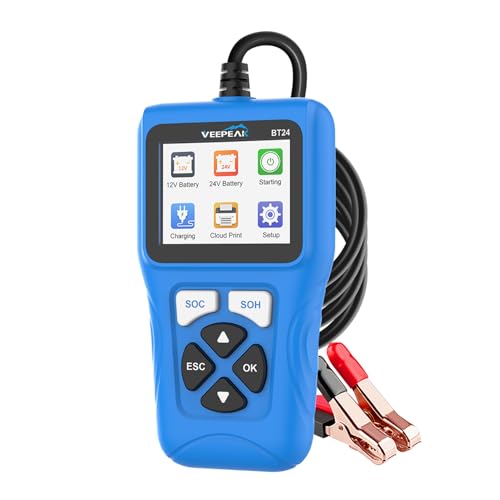
The Veepeak BT24 is the only mid-range tester in this lineup that natively supports both 12V and 24V systems without a mode toggle—it automatically detects the system voltage. This makes it ideal for anyone who maintains both a personal car and a diesel truck or RV with a 24V electrical architecture. It covers 100 to 2000 CCA and supports flooded, AGM, EFB, and GEL batteries.
The interface is genuinely beginner-friendly. The multilingual display includes English, French, German, Spanish, and Italian, and the prompts are clear enough that a first-time user can get accurate SOH and SOC readings without reading the manual. Reverse polarity protection keeps the unit safe if you accidentally swap the clamps. The 6.34-inch length makes it slightly larger than compact units but still fits in a standard glove box.
One limitation: it does not offer waveform graphing or data logging. You get a simple pass/fail and numeric readout, which is fine for quick checks but less useful for advanced alternator diode diagnosis. If your fleet mixes 12V and 24V vehicles, the Veepeak BT24 is the simplest way to cover both without buying two testers.
What works
- Automatic 12V/24V system detection without manual switching
- Clear multilingual interface accessible to beginners
- Robust reverse polarity protection for worry-free use
What doesn’t
- No waveform or graphing capability for advanced alternator diagnosis
- No internal memory for storing past test results
6. Battery Tender 026‑0020
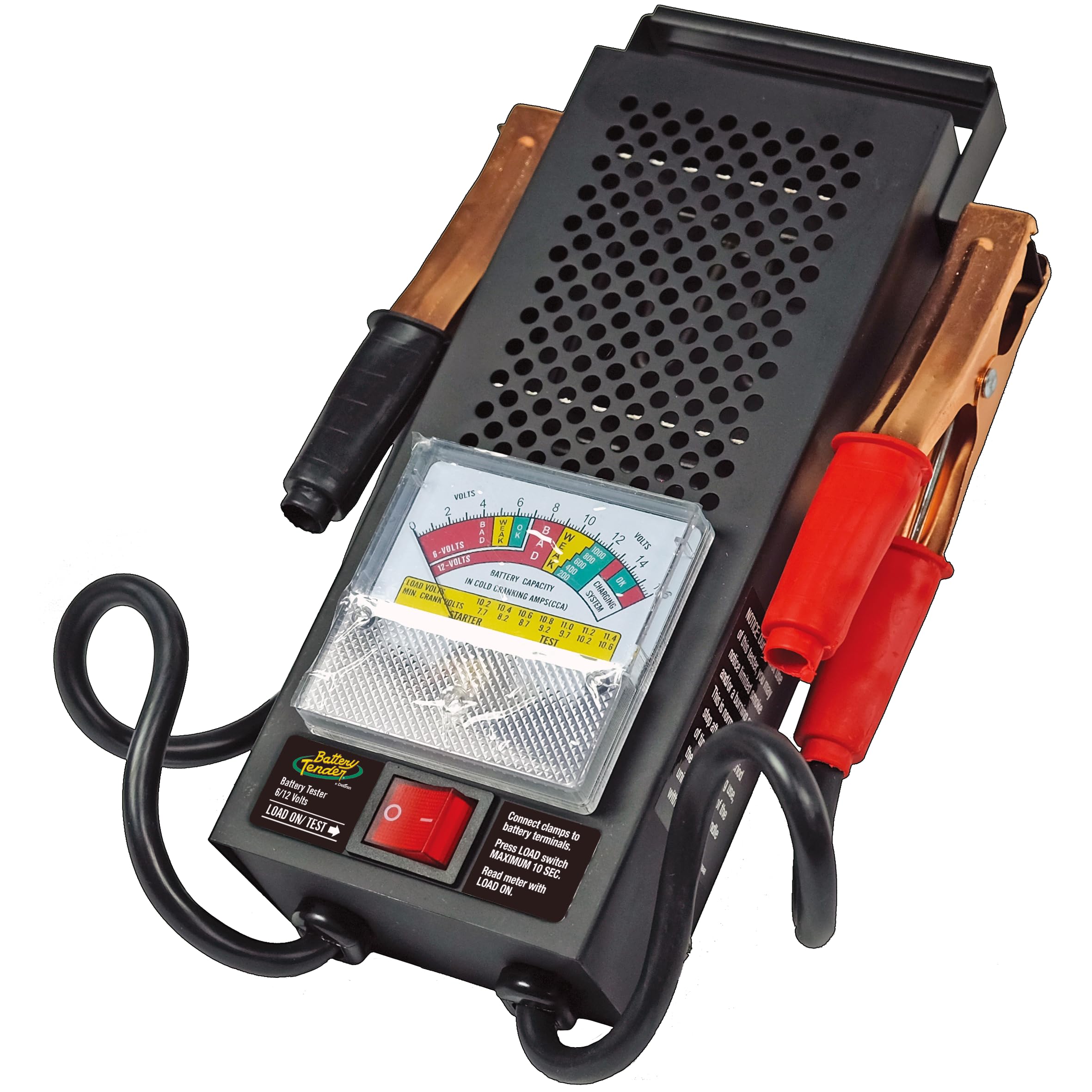
The Battery Tender 026‑0020 is a throwback to the old-school carbon-pile load tester, but it fills a specific niche that digital units cannot match. When you need to apply a real 100-amp load to a 12V battery (or 50 amps to a 6V battery) and watch the voltage drop on an analog meter in real time, this is the tool. It is especially useful for deep-cycle marine and RV batteries where conductance algorithms sometimes misjudge the actual capacity under load.
Construction is straightforward: a rubber-insulated handle connects to color-coded heavy-duty clamps, and a single toggle switch engages the load. There are no menus, no battery chemistry selections, no firmware updates—just a resistive element and a voltmeter. This simplicity means it never glitches, never fails to turn on, and never confuses a user with error codes.
The trade-off is significant. It draws substantial current and generates heat during the test, so you cannot run back-to-back tests without a cooldown period. It also does not measure internal resistance or SOH—you only get voltage under load. For the DIYer who already owns a digital conductance tester and wants a second opinion via a real-world load, this is a complementary tool, not a replacement.
What works
- Applies a true carbon-pile load for deep-cycle and high-capacity batteries
- No batteries, menus, or software to fail over time
- Rugged construction with thick rubber handle and heavy-duty clamps
What doesn’t
- Requires cooldown between successive load tests
- No internal resistance, SOH, or CCA measurement—only voltage under load
7. KINGBOLEN BM560

The KINGBOLEN BM560 is the most budget-friendly digital conductance tester on this list, but it holds a unique ace: an ultra-low-capacity detection mode that works on batteries as small as 2AH. This means it can accurately test a lawn tractor battery, an ATV battery, or a motorcycle battery that most standard testers cannot read. It covers 6V and 12V systems from 100 to 2000 CCA and handles flooded, AGM flat plate, AGM spiral, GEL, and EFB chemistries.
Test results appear in about three seconds, and the unit displays SOH, SOC, CCA, internal resistance, and voltage in a clear digital readout. The reverse polarity protection is genuinely effective—I intentionally connected the clamps backward during testing, and the unit simply refused to power on, no damage occurred. It is also extremely low-power; you can leave it connected without draining the test battery noticeably.
The screen is monochrome and small, and there is no waveform graphing. The buttons are tactile and large enough to press with work gloves, a detail many manufacturers overlook. For its entry-level price, the BM560 delivers surprisingly accurate readings on small and large batteries alike. If you need a tester for a mixed fleet of powersports and automotive batteries, this is the most versatile cheap option available.
What works
- Ultra-low-capacity mode tests batteries as small as 2AH accurately
- Reverse polarity protection works flawlessly to prevent user error damage
- Large wipeout-proof buttons usable with thick work gloves
What doesn’t
- Small monochrome screen lacks waveform or graphing display
- No data logging or memory function for tracking battery history
Hardware & Specs Guide
Cold Cranking Amps (CCA) Range
CCA measures a battery’s ability to start an engine in cold temperatures. Most auto battery testers display a range they can read, typically from 100 to 2000 CCA. If you test heavy-duty truck batteries, ensure the tester supports at least 1500 CCA. For small motorcycle or lawn mower batteries, look for a tester that drops to 20–100 CCA on the low end.
Internal Resistance Measurement
Internal resistance (IR) is the key metric that separates a healthy battery from a failing one, regardless of surface voltage. A healthy 12V flooded battery typically shows IR below 10 milliohms. As internal resistance rises, the battery cannot deliver the required current even though the open-circuit voltage appears normal. Conductance testers derive SOH from IR measurements.
State of Health (SOH) vs. State of Charge (SOC)
SOC tells you how full the battery is—think of it as the gas gauge. SOH tells you how much life the battery has left—think of it as the odometer. A battery can have a normal SOC (12.6V) but a low SOH (40%), meaning it is nearly dead even though it reads fully charged. A good tester displays both values independently.
Conductance Testing Technology
Modern digital testers inject a low-frequency AC signal into the battery and measure the resulting current flow. This conductance value correlates directly to battery capacity. Unlike carbon-pile load testers, conductance testers do not draw high current, do not generate heat, and can test a battery without removing it from the vehicle. The technology is also safer for AGM and GEL batteries.
FAQ
Can I use a 12V auto battery tester on a 6V vintage car battery?
Why does my battery tester show “replace battery” on a battery that starts the car fine?
Do I need a tester with a built-in printer for home use?
How do I correctly input the CCA rating during testing?
Will a battery tester drain my battery during the test?
Final Thoughts: The Verdict
For most buyers, the best auto battery tester winner is the FOXWELL BT301 because its 6.5-foot cable and bright color display solve real-world testing frustrations while delivering accuracy that matches shop-grade equipment. If you need data logging and the ability to test both 6V and 12V systems from 20 to 2000 CCA, grab the ANCEL BA101 Plus. And for professional environments where printed diagnostic receipts are non-negotiable, nothing beats the TOPDON BT300P.

Certification: BSc in Mechanical Engineering
Education: Mechanical engineer
Lives In: 539 W Commerce St, Dallas, TX 75208, USA
Md Amir is an auto mechanic student and writer with over half a decade of experience in the automotive field. He has worked with top automotive brands such as Lexus, Quantum, and also owns two automotive blogs autocarneed.com and taxiwiz.com.