If your car’s audio sounds muddy, harsh, or just lacks that live-instrument clarity, the factory head unit is almost certainly the bottleneck. A dedicated equalizer gives you the surgical control to fix resonant peaks, tame shrill tweeters, and dial in a soundstage that matches your exact musical taste—whether you are chasing SPL numbers or studio-grade fidelity.
I’m Amir — the founder and writer behind Four Wheel Ask. I’ve spent thousands of hours analyzing signal processors, comparing circuit board layouts, and studying owner reports to separate gear that actually cleans up your audio signal from gear that only adds noise.
From budget-friendly 7-band units to full digital signal processors, this guide breaks down the specs that matter. Here is my curated list of the best car radio equalizer options available right now for any system build.
How To Choose The Best Car Radio Equalizer
Selecting the right equalizer for your vehicle means understanding your signal chain. A basic 7-band graphic EQ is perfect for toning down harsh highs or adding low-end punch, while a DSP-based unit can set crossover slopes and time-align your entire stage. The choice hinges on your system’s complexity and your willingness to tune.
Graphic EQ vs. Digital Signal Processor (DSP)
A graphic EQ uses fixed frequency sliders or knobs (like 50Hz, 125Hz, 2.2kHz) with a standard boost/cut range, usually ±12dB. A DSP uses software or a digital interface to offer parametric filters, adjustable Q-factors (bandwidth), and independent crossover points per channel. If you have separate amplifiers for subwoofers, mid-bass, and tweeters, a DSP is essential to blend them correctly. For a simple factory-speaker upgrade, a 7-band graphic unit is far easier to set.
Output Voltage and Signal-to-Noise Ratio
The output voltage (measured in volts, e.g., 4V, 8V, 9V) determines how strong the signal sent to your amplifier is. Higher voltage lets you keep the amp’s gain lower, which reduces hiss and background noise. Look for a signal-to-noise ratio (SNR) above 100dB. A unit with a weak output or low SNR will introduce audible floor noise, especially when the music stops or during quiet passages.
Band Count and Frequency Centers
More bands give you finer control, but only if the center frequencies are useful for your setup. A 7-band with centers at 50Hz, 125Hz, 315Hz, 750Hz, 2.2kHz, 12kHz covers the critical spectrum for typical coaxial and component speakers. A 9-band or 15-band DSP adds finer mid-range control (1kHz-4kHz), where vocal presence and instrument attack live. Avoid units that cluster bands only at the extremes and leave the critical midrange untouched.
Quick Comparison
On smaller screens, swipe sideways to see the full table.
| Model | Category | Best For | Key Spec | Amazon |
|---|---|---|---|---|
| Taramp’s Pro 2.4S | DSP | Full system tuning with crossover control | 15-Band EQ + Parametric Input EQ | Amazon |
| PRV AUDIO DSP 2.4X | DSP | Real-time adjustments via intuitive display | 15-Band Graphic + 12 Presets | Amazon |
| Clarion EQS755V | Graphic EQ | Clean integration with factory systems | 7-Band / 8-Volt RCA Outputs | Amazon |
| Audiopipe EQ-909X | Graphic EQ | 9-band precision with subwoofer control | 9-Band / 9V Max Output | Amazon |
| Taramps TEQ 7.4 | Graphic EQ | Three output zones with fader control | 7-Band / SNR > 100dB | Amazon |
| CT Sounds CT-7EQ | Graphic EQ | Quick parametric-style EQ at low cost | 7-Band Parametric / ±10dB | Amazon |
| Decibelvibe TNZ SGE6 | Visualizer/EQ | Aesthetic visual display with EQ function | 15-Band + BT/USB Input | Amazon |
In‑Depth Reviews
1. Taramp’s Pro 2.4S DSP Crossover and Equalizer

The Taramp’s Pro 2.4S delivers a full DSP experience without a dedicated laptop required, thanks to its onboard interface and 12 preset EQ curves. It provides 15 bands of ISO-standard graphic equalization acting on both input channels simultaneously, plus a fully adjustable parametric EQ for fine-tuning problem frequencies. The crossover section supports Butterworth, Bessel, and Linkwitz-Riley filters with slopes up to -48dB/octave, giving you professional-grade control over your system’s transition points.
Owners report a crisp, clean sound floor with no added hiss when properly set, and the ability to correct factory head unit deficiencies—especially in BMW E60 and similar complicated factory systems—is a major win. The 2-channel input and 4-channel output configuration is ideal for a front-stage plus subwoofer setup. The only limitation is the 2-volt preamp output, which may require slightly higher amplifier gain settings compared to 8-volt units.
For anyone building a multi-amp system who wants time alignment and precise crossover slopes without spending four figures, the Pro 2.4S is the most value-dense DSP on the market. Its 12 music-style presets make initial tuning fast, and the manual parametric EQ gives depth for advanced users.
What works
- 15 graphic bands plus parametric input EQ
- Multiple crossover filter types and slopes
- 12 onboard presets for quick setup
What doesn’t
- Only 2V preamp output limits signal strength
- Manual tuning requires some audio knowledge
2. PRV AUDIO DSP 2.4X Digital Crossover and Equalizer

The PRV AUDIO DSP 2.4X competes directly with the Taramp’s but adds an intuitive LCD interface that makes real-time adjustments significantly easier. It features 2 audio inputs (A and B) with 4 independent crossover outputs, each configurable for source selection—perfect for running separate front, rear, and sub channels. The 15-band graphic equalizer comes with 12 factory presets ranging from Flat to Pancadão, plus a parametric equalizer on both input and output for granular filter shaping.
User feedback emphasizes how easy it is to program once you understand your target frequencies. The built-in sequencer function allows you to trigger additional PRV devices in a daisy chain, which is a unique feature for growing systems. The digital crossover supports various filter slopes, and the overall signal clarity receives consistent praise. Some users noted that the interface, while intuitive, still requires a few cycles to learn if you are new to DSPs.
This unit is a strong recommend for those who prefer a knob-and-button interface over software tuning. The combination of graphic bands, parametric filters, and remote trigger sequencing makes it a versatile hub for a advanced sound system build.
What works
- LCD interface simplifies live tuning
- Input and output parametric EQ
- Sequencer trigger for add-on components
What doesn’t
- Learning curve for new DSP users
- No Bluetooth or wireless control
3. Clarion EQS755V 7-Band Graphic Equalizer/Crossover

The Clarion EQS755V is a return to the classic half-DIN graphic equalizer format, but built with modern conveniences. Its 7-band EQ covers 50Hz to 16kHz, and the standout feature is the massive 8-volt RCA outputs on front, rear, and subwoofer channels—giving your amplifiers a strong, noise-resistant signal. The unit also includes a built-in low-pass filter with selectable 60Hz or 90Hz crossover for the sub output, a ground loop isolation circuit to fight alternator whine, and both high-level speaker inputs and 3.5mm front auxiliary input.
Real-world owners love the build quality and the clean sound improvement, with several noting it effectively tames harsh tweeters from aftermarket speakers. The high-level inputs make it easy to integrate with factory head units that lack RCA outputs, saving the cost of a separate line output converter. The blue illumination is bright, so mounting it away from the driver’s direct line of sight is a smart choice. The two-channel RCA AUX input with variable gain is incredibly handy for adding a phone or DAP.
If you want a straightforward, high-output analog equalizer that integrates seamlessly with both aftermarket and factory systems, the Clarion EQS755V is a premium classic that does exactly what it promises.
What works
- 8-volt RCA outputs for low noise floor
- High-level inputs eliminate need for LOC
- Ground loop isolation for quiet operation
What doesn’t
- Blue LED is very bright at night
- Only two crossover slope options
4. Audiopipe 9 Band Graphic Equalizer (EQ-909X)

The Audiopipe EQ-909X provides a full 9-band graphic equalizer plus a built-in 9-volt line driver, giving you exceptional voltage swing to overdrive your amplifier’s input stage cleanly. Each band supports ±12dB cut or boost, and the center frequencies span from 50Hz to 16kHz—with an additional 1kHz and 4kHz band over a standard 7-band unit, offering finer mid-range control. The subwoofer output has independent level control and a selectable 60Hz/90Hz low-pass filter.
Users consistently report that this unit cleaned up their sound significantly, especially when used after a basic head unit. The nickel-plated locking knobs feel solid and resist vibration-induced movement, a genuine concern in a vehicle. Individual left and right sensitivity controls for the auxiliary input are a rare and welcome feature for balancing input sources that have different output levels. The main complaint is the crossover is limited to just two fixed frequencies, so it is not a replacement for a full DSP if you need steep slopes.
For a system that needs more equalization bands than a 7-band can offer but does not require a full DSP, the Audiopipe EQ-909X is a near-perfect analog bridge. The 9V output is a powerful tool for reducing noise floor in high-gain setups.
What works
- 9-band EQ for detailed mid-range shaping
- 9V line driver reduces amplifier noise
- Locking knobs stay in place
What doesn’t
- Sub crossover limited to 60Hz or 90Hz
- No front-to-rear fader control
5. Taramps TEQ 7.4 Stereo 7-Band Graphic Equalizer

The Taramps TEQ 7.4 stands out for its three dedicated output zones—Front, Rear, and Sub—each with its own RCA output, making it incredibly easy to integrate into a multi-amplifier system while retaining fader control. The 7-band graphic EQ adjusts frequencies from 50Hz to 12kHz with a ±12dB range, and the signal-to-noise ratio exceeds 100dB, which is excellent for the price tier. The unit also features two stereo inputs (Main and Aux) with a switchable selector.
Owner reports confirm that the TEQ 7.4 provides clean, clear sound that allows for substantially louder volume without distortion. The blue LED lighting adds a modern aesthetic. Some users have reported that the potentiometer knobs can develop a scratchy sound after a month of use, which suggests variable QC on the physical components. However, most buyers find the sound quality improvement and the output voltage sufficient for a major system upgrade.
For those building a three-zone system on a budget, the TEQ 7.4 offers dedicated front/rear/sub routing that is usually only found in more expensive units. Just be prepared to potentially swap the knobs if scratchiness appears.
What works
- Dedicated Front/Rear/Sub RCA outputs
- High SNR for clean signal transmission
- Two switchable input sources
What doesn’t
- Knobs may develop scratchy feel over time
- Physical build feels entry-level
6. CT Sounds CT-7EQ 7-Band Parametric Car Audio Equalizer

The CT Sounds CT-7EQ is one of the few analog equalizers in this price range that uses parametric-style sliders with dedicated center frequencies (50Hz, 125Hz, 315Hz, 750Hz, 2.2KHz, 12KHz), plus independent Bass, Mid, and Treble adjustments (±10dB each) and a selectable Sub Bass frequency (43Hz or 60Hz). This gives you more surgical control than a standard graphic EQ, especially for targeting specific resonant frequencies in your vehicle cabin.
Users report a dramatic improvement in audio clarity and the ability to shape the sound to their exact preference. The installation hardware is included, making it a straightforward upgrade. The main complaint from some users is the unit can introduce a slight floor noise in certain setups, possibly due to grounding or signal chain issues. It also does not work well as a signal processor for subwoofers alone—its strength is in shaping mids and highs.
For an entry-level price, the CT-7EQ offers parametric control that typically costs more. It is best used in a system where you need to dial out a specific cabin resonance peak or boost a flat factory tune.
What works
- Parametric controls for targeted frequency shaping
- Separate sub bass frequency selector
- Great price for the control offered
What doesn’t
- May introduce faint floor noise in some systems
- Not ideal for subwoofer-only tuning
7. Decibelvibe TNZ SGE6 Audio Graphic Equalizer
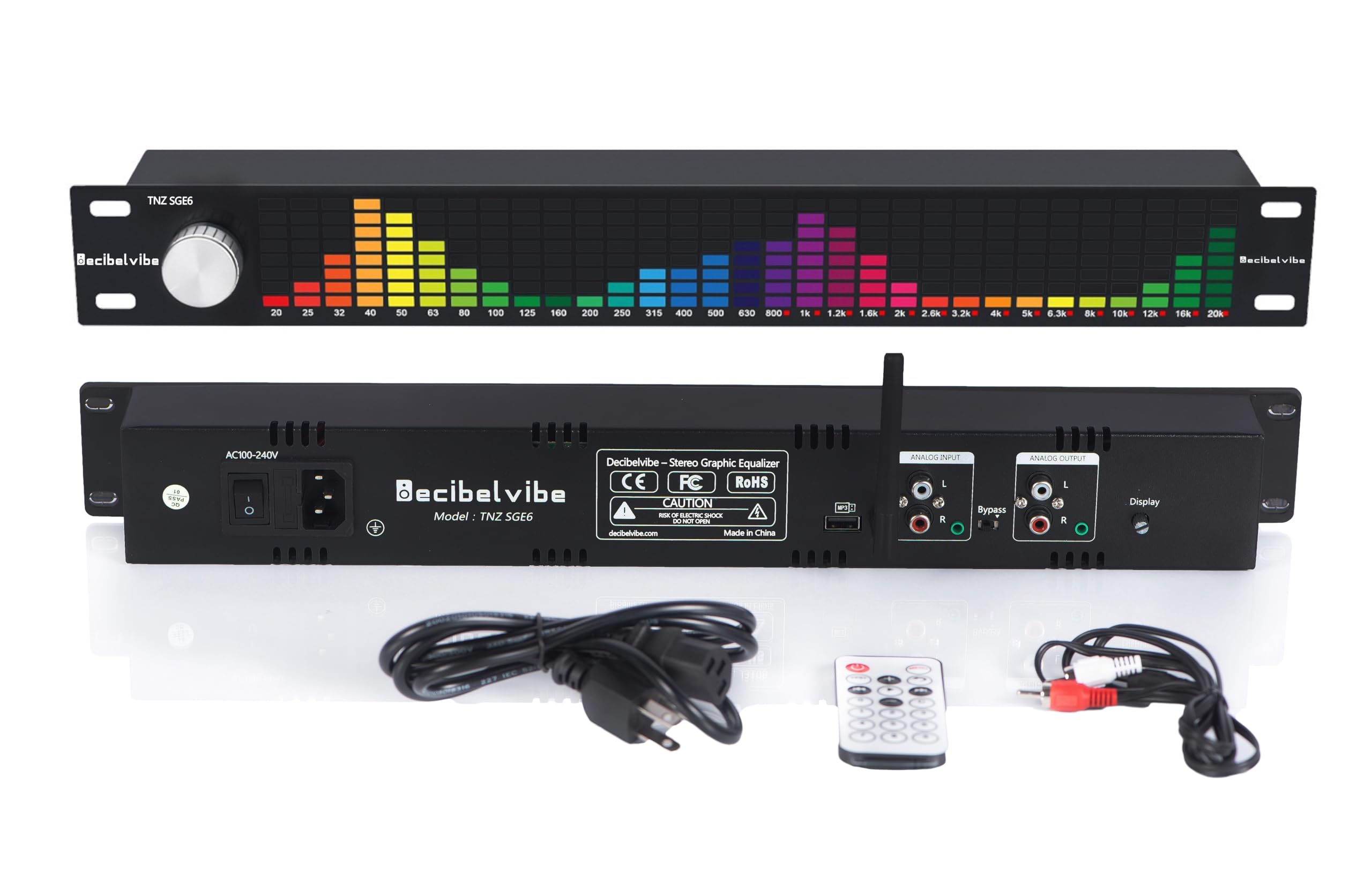
The Decibelvibe TNZ SGE6 is a dual-purpose device that functions as a 15-band stereo equalizer and a real-time audio visualizer with 16 color options. It includes Bluetooth 5.0 and USB input for wireless streaming, plus a built-in microphone that allows the visualizer to react to sound even without a direct audio cable connection. This is a niche unit that prioritizes the aesthetic experience as much as the audio tuning.
Owners who are into retro or modern audiophile rack setups love the visual feedback and the ability to integrate it as the centerpiece of a home or car audio system. The equalizer works effectively, with the ability to adjust output gain and frequency bands to shape the sound. However, many buyers confess they bought it primarily for the visuals, not for critical EQ duty. The built-in microphone mode is particularly fun for showing the spectrum of the room’s sound.
If your goal is to add a dramatic visual element to your system and you also need basic equalization, the TNZ SGE6 delivers. It is not a replacement for a high-end DSP or a clean analog EQ, but it offers a unique combination of form and function.
What works
- Stunning 16-color live spectrum display
- Bluetooth and USB audio inputs
- Built-in microphone for visualizer mode
What doesn’t
- EQ function is basic compared to dedicated units
- Large form factor for in-dash installation
Hardware & Specs Guide
Preamp Output Voltage (V)
This spec determines how hot the signal leaving the EQ is before it hits your amplifier. A higher voltage (4V-9V) allows your amplifier to run at a lower gain setting, which directly reduces system noise floor and hiss. Look for a minimum of 4V for most systems; 8V or 9V units like the Clarion EQS755V or Audiopipe EQ-909X give you the cleanest headroom.
Filter Slope and Type (DSP Only)
For digital signal processors, the crossover filter slope (measured in dB per octave) controls how aggressively frequencies are cut after the crossover point. Slopes like -12dB, -24dB, and -48dB per octave let you blend speakers without overlap. The filter type (Butterworth, Linkwitz-Riley, Bessel) changes the phase response and is critical for time alignment in active systems.
FAQ
Will a car audio equalizer fix a bad head unit?
Do I need a DSP or a graphic EQ for my system?
Why does my equalizer add noise to the system?
Final Thoughts: The Verdict
For most buyers, the best car radio equalizer winner is the Taramp’s Pro 2.4S because it offers true DSP functionality—crossover slopes, parametric EQ, and 15 graphic bands—at a price that undercuts most alternatives. If you want a classic analog unit with the highest clean output, grab the Clarion EQS755V. And for a pure aesthetic visualizer that also works as an equalizer, nothing beats the Decibelvibe TNZ SGE6.

Certification: BSc in Mechanical Engineering
Education: Mechanical engineer
Lives In: 539 W Commerce St, Dallas, TX 75208, USA
Md Amir is an auto mechanic student and writer with over half a decade of experience in the automotive field. He has worked with top automotive brands such as Lexus, Quantum, and also owns two automotive blogs autocarneed.com and taxiwiz.com.