Those tiny orange specks embedded in your clear coat aren’t paint defects—they’re iron fallout bonding to your finish. A standard wash leaves them untouched, and aggressive claying risks marring the surface. An iron remover chemically dissolves these ferrous particles on contact, turning purple as it lifts contamination from the pores of your paint.
I’m Amir — the founder and writer behind Four Wheel Ask. I’ve spent years analyzing automotive detailing chemistry, studying surfactant systems, pH buffers, and reaction kinetics so you don’t have to guess which formula actually breaks down embedded oxides without stripping your ceramic coating.
Every product in this guide has been evaluated for activation speed, color-change clarity, rinsability, and surface safety. We’ve sorted through the options to identify the best car detailing iron remover for your specific paint prep workflow.
How To Choose The Best Car Detailing Iron Remover
Not all iron removers share the same chemistry. Some rely on aggressive acids that can etch clear coats or stain plastic trim. Others use pH-neutral thiol-based formulas that react selectively with iron. The right choice depends on your paint condition, whether you run a ceramic coating, and how much dwell time you’re willing to wait.
Color-Change Reliability
The reaction that turns iron remover purple or red is your only real-time confirmation that it’s working. Products with weak color-change thresholds can leave you guessing whether iron was actually dissolved. Look for formulas that shift aggressively on contact so you can see exactly where contamination remains.
Viscosity and Vertical Cling
Liquid sprays run off vertical panels before they’ve had time to react, wasting product. A gel-thickened formula clings to doors, fenders, and bumpers, extending dwell time so the chemical reaction fully saturates embedded particles. This matters most on large SUVs and trucks where panel surfaces are tall.
Surface Safety Spectrum
Some iron removers contain ammonium bifluoride or other aggressive agents that can etch glass, stain uncoated aluminum, or strip wax in seconds. A pH-balanced formula with a buffered carrier is safe on clear coat, single-stage paint, chrome, and stainless trim. Check the label for warnings about bare metal or anodized surfaces before spraying.
Quick Comparison
On smaller screens, swipe sideways to see the full table.
| Model | Category | Best For | Key Spec | Amazon |
|---|---|---|---|---|
| Griot’s Garage Iron and Fallout Remover | Gel Spray | Vertical panel dwell time | 25 oz gel formula, citrus scent | Amazon |
| Adam’s Iron Remover | Liquid Spray | Budget-friendly decon | 16 oz pH-neutral, orange color | Amazon |
| Auto Finesse Iron Out | Liquid Spray | Showroom prep | 500 ml, blood-red color change | Amazon |
| Optimum FerreX | Liquid Spray | Ceramic coating prep | 17 oz, wax-stripping formula | Amazon |
| Superior Products Dark Fury | Liquid Spray | Heavy fallout removal | 16 oz, industrial-strength | Amazon |
In‑Depth Reviews
1. Griot’s Garage Iron and Fallout Remover
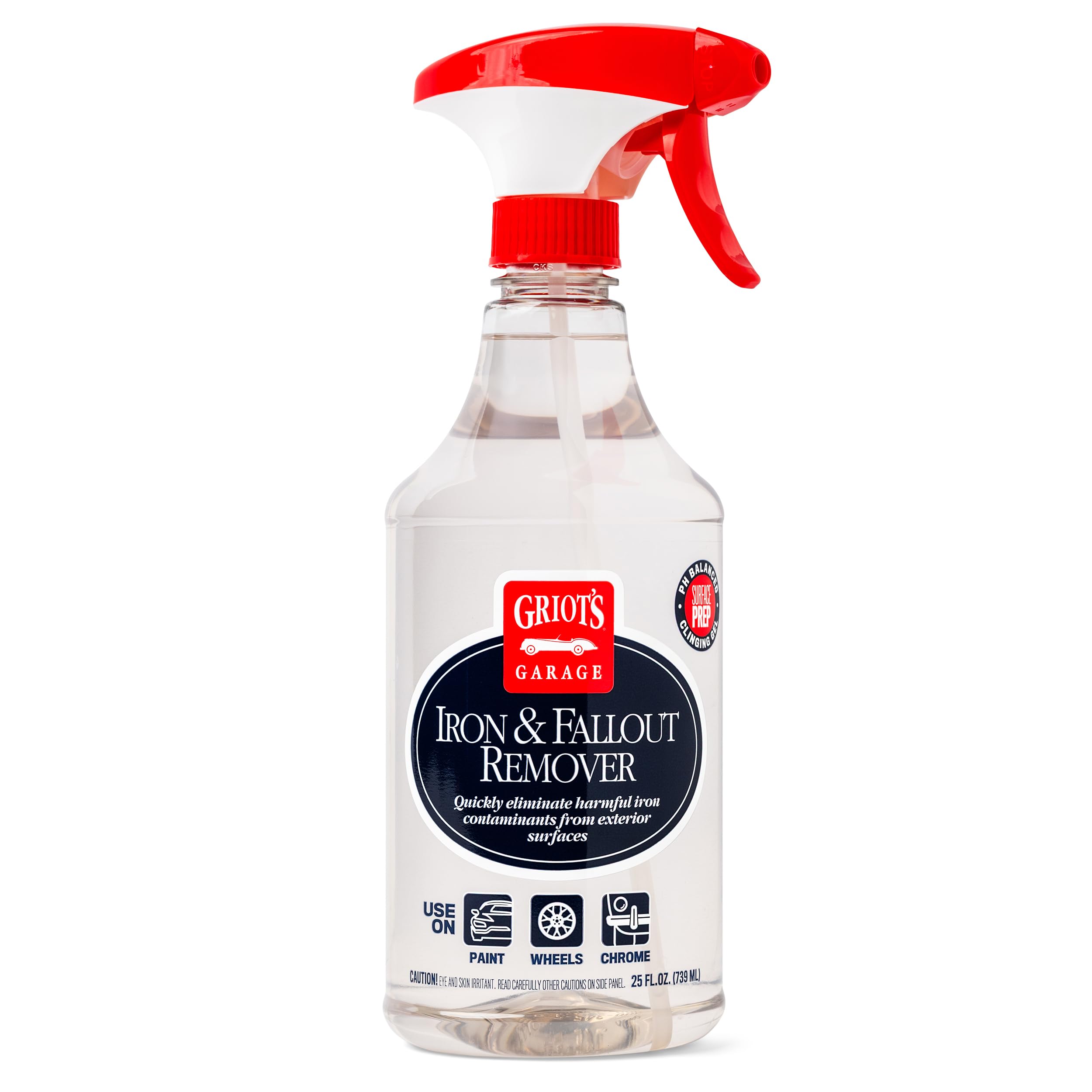
Griot’s Garage has formulated this iron remover as a gel rather than a thin liquid, which is a major advantage when decontaminating tall SUV doors or vertical bumpers. The gel clings to the panel without running, giving the thiol chemistry more time to break through embedded iron particles. The color-change reaction is pronounced and fast, shifting visibly within seconds of contact, so you can track your coverage accurately.
At 25 ounces, this bottle holds more working solution than most competitors, and the pH-balanced formula is safe on clear coat, glass, chrome, and stainless trim. The fresh citrus scent is a welcome departure from the sulfur-like odors common to many iron removers, making extended use far more pleasant. Rinsing is clean and leaves no sticky residue behind.
The only real consideration is that the thicker consistency requires a slightly more deliberate spray pattern—you won’t be misting this on like water, but the controlled application reduces waste. For detailers who work on larger vehicles or want a product that stays where it’s sprayed, this gel formula delivers the best balance of chemistry and usability.
What works
- Gel viscosity clings to vertical panels without dripping
- Fast, vivid color-change reaction confirms decon progress
- Safe on paint, glass, chrome, and stainless trim
What doesn’t
- Thicker formula requires a deliberate spray pattern
2. Adam’s Iron Remover

Adam’s Polishes has been a staple in the detailing community for years, and their Iron Remover holds up well against higher-priced competition. The pH-neutral formula is safe on clear coat and single-stage paint, and the rich orange color makes it easy to see where you’ve already sprayed. Activation is quick, with the typical purple bleed appearing within a minute on most contaminated surfaces.
The reduced scent formulation is a meaningful improvement over older iron removers—the chemical smell is present but nowhere near as overpowering as some industrial-grade alternatives. It rinses clean without leaving hazy residue on glass or trim, and it serves as an excellent step before claying or applying a ceramic coating. The 16-ounce bottle is compact enough for a weekend detailer’s kit.
Where this product falls short of the gel-based options is on vertical panels. The liquid consistency runs off quickly, requiring heavier overspray and more product to cover tall sections. It’s also worth noting that older batches had a reputation for staining light-colored trim—Adam’s claims to have resolved this, but overspray on unpainted plastic should still be avoided.
What works
- Affordable entry point for high-quality iron decon
- Mild citrus scent reduces chemical fatigue
- Safe on clear coat and single-stage finishes
What doesn’t
- Thin liquid runs off vertical panels quickly
- Potential trim staining if not rinsed thoroughly
3. Auto Finesse Iron Out

Auto Finesse brings a distinctly British approach to iron decontamination with Iron Out, a formula that shifts to a deep blood red when it contacts ferrous particles. The color-change intensity is among the most dramatic in this category, giving you unmistakable visual confirmation of contamination removal. It’s effective on paint, wheels, and glass, dissolving brake dust clusters without requiring heavy agitation.
The pH-neutral chemistry means it won’t etch sensitive finishes or damage ceramic coatings if used as a prep step. Professional detailers appreciate the predictable reaction window—Iron Out needs about two minutes to peak, then rinses cleanly without leaving a chemical film. The 500-milliliter bottle is smaller than the US-standard 16- or 25-ounce options, but the concentrated performance means you use less per panel.
The downside is purely logistical for American buyers: the bottle is imported, so pricing sits at a premium tier, and availability can occasionally fluctuate. The thin liquid consistency also demands careful handling on vertical panels—it’s best applied with a pump sprayer for controlled coverage. For show-car level decon where every detail matters, the visual drama of the red shift is hard to beat.
What works
- Dramatic blood-red color-change reaction
- Safe on ceramic coatings and clear coat
- Concentrated formula requires less product per panel
What doesn’t
- Premium pricing from an imported brand
- Thin liquid runs on vertical surfaces
4. Optimum FerreX Iron Remover

Optimum’s FerreX is engineered specifically for the detailer who needs a one-step decon solution that also strips old wax. The proprietary formula turns purple as it bonds with iron elements, but it also lifts and dissolves existing wax layers simultaneously, saving an extra stripping step before coating application. This dual-action capability is unique among the products here.
The formula works equally well on painted surfaces and wheels, aggressively breaking down baked-on brake dust and tar deposits. The application process is straightforward—spray on a dry or rinsed panel, allow 60 to 90 seconds for the reaction to peak, then agitate lightly and rinse. The 17-ounce bottle offers decent coverage, though the liquid consistency means you’ll use more on larger vehicles compared to a gel formula.
The primary trade-off is that the wax-stripping action makes FerreX less suitable as a maintenance decon between wax applications—if you’ve just applied a fresh coat of sealant, this will remove it. It’s also among the more expensive options per ounce. For dedicated coating prep or full paint correction workflows, the ability to strip wax and remove iron in one step justifies the premium.
What works
- Strips wax and removes iron in a single step
- Effective on brake dust and tar deposits
- Clear purple color-change reaction
What doesn’t
- Removes existing wax and sealants
- Higher cost per ounce than value alternatives
5. Superior Products Dark Fury

Superior Products’ Dark Fury—formerly known as RAGE—positions itself as the most aggressive iron remover in this lineup. The chemistry is designed for heavy industrial fallout situations, such as vehicles that sit near railways, factories, or coastal environments where airborne iron particles accumulate rapidly. The color-change reaction is intense and near-instantaneous on heavily contaminated surfaces.
The 16-ounce bottle comes in a professional-grade packaging format with no excess branding, reflecting its target audience of detailers who buy by the case. It handles brake dust on alloy wheels with one spray and rinse cycle, reducing the need for wheel-specific cleaners. The formula does not contain the same odor-masking agents as consumer-focused brands, so you’ll notice the characteristic sulfur smell of active thiol chemistry.
Where Dark Fury asks for caution is on sensitive surfaces. The aggressive formula can stain light-colored plastic trim and may etch bare aluminum if left to dwell too long. It’s also not recommended for use on ceramic-coated paint as a maintenance cleaner, as the chemical strength can degrade the coating’s hydrophobic layer over repeated applications. For a dedicated heavy decon session on neglected paint before correction, it gets the job done fast.
What works
- Aggressive chemistry for heavy industrial fallout
- Quick reaction time on brake dust
- Professional-grade performance at a lower price point
What doesn’t
- Strong sulfur odor common to thiol formulas
- Can stain light trim and etch bare aluminum
Hardware & Specs Guide
pH Balance
A pH-neutral iron remover (typically pH 6.5–7.5) will not etch clear coat or single-stage paint during the dwell time. Acidic formulas accelerate reaction speed but increase the risk of permanent surface damage. Most premium consumer iron removers today are buffered to neutrality, balancing reactivity with safety for all paint types.
Color-Change Indicator
The color change is a visual cue from the chelating agent binding to iron ions. A rapid, vivid shift indicates strong affinity and high concentration of active chemistry. Weak or delayed color changes may mean the formula is diluted or past its shelf life. Products that shift to deep purple or blood red are generally preferred for their clear feedback.
Viscosity and Dwell Time
Gel iron removers use a thickening agent to increase surface cling, allowing the chemical reaction more time to penetrate embedded particles. Liquid sprays rely on higher water content and typically require more product and a slower application technique to prevent runoff. For tall vehicles like trucks and SUVs, gel formulations reduce waste and improve coverage consistency.
Surface Application Range
Not all iron removers are safe on all surfaces. Some formulas can stain uncoated aluminum wheels, etch chrome, or strip ceramic coatings. Check for explicit compatibility statements regarding clear coat, single-stage paint, powder-coated wheels, chrome, glass, and stainless steel trim. Multi-surface safe formulas typically use milder chelating agents and avoid ammonium bifluoride.
FAQ
Can I use an iron remover on a ceramic coated car?
How long should I let iron remover sit before rinsing?
Does iron remover damage clear coat or single-stage paint?
Final Thoughts: The Verdict
For most buyers, the best car detailing iron remover winner is the Griot’s Garage Iron and Fallout Remover because the gel formula clings to vertical panels and delivers a fast, vivid color-change reaction without the runoff issues of thin liquids. If you want a dedicated wax-stripping decon for coating prep, grab the Optimum FerreX. And for heavy industrial fallout that requires aggressive chemistry, nothing beats the Superior Products Dark Fury.

Certification: BSc in Mechanical Engineering
Education: Mechanical engineer
Lives In: 539 W Commerce St, Dallas, TX 75208, USA
Md Amir is an auto mechanic student and writer with over half a decade of experience in the automotive field. He has worked with top automotive brands such as Lexus, Quantum, and also owns two automotive blogs autocarneed.com and taxiwiz.com.