That rough idle at a stoplight and the sluggish acceleration when you hit the gas are classic signs of carbon buildup choking your engine’s fuel system. Over time, deposits on injectors, intake valves, and combustion chambers rob power and fuel economy, turning a smooth-running motor into a gas-guzzling headache.
I’m Amir — the founder and writer behind Four Wheel Ask. I spend my days analyzing fuel system chemistry, detergent concentrations, and real-world owner reports to separate the snake oils from the legitimate engine cleaners on the market.
After sifting through decades of formulation data and thousands of verified user accounts, I’ve narrowed the field to five contenders that actually dissolve carbon and restore drivability. This guide breaks down exactly what makes a gas additive to clean engine worth your money and which one belongs in your next fill-up.
How To Choose The Best Gas Additive To Clean Engine
Not all fuel system cleaners are created equal. Some rely on weak kerosene-based carriers that do little more than wet the fuel, while others pack aggressive solvents or high-concentration PEA (polyether amine) detergents that actively scrub carbon off metal surfaces. Understanding the chemistry behind each bottle is the first step to picking the right one for your driving habits and engine condition.
PEA Concentration vs. Solvent Strength
PEA is the gold-standard detergent molecule because it withstands the heat inside a combustion chamber and continues cleaning even after the fuel has burned. Formulas with a high percentage of PEA, like those from BG, deliver the deepest carbon removal in a single treatment. Products using HEST (High Energy Solvent Technology), such as Berryman, rely on aggressive solvents that dissolve existing sludge and varnish but offer less protection against future buildup. For a daily driver with moderate deposits, a solvent-based additive works fine; for a neglected engine or one with persistent knocking, PEA is the better bet.
Treatment Frequency and Dosage
Some additives are designed for every-tank use at a low ounce-per-gallon ratio, while others are concentrated shock treatments meant to be used once every 3,000 to 5,000 miles. The Quicksilver Quickleen, for example, is safe to use at every fill-up at one ounce per five gallons, making it a maintenance tool rather than a deep clean. The BG 44K Platinum, by contrast, is a pour-and-go intensive treatment that requires a full tank of fuel and should not be used more often than every oil change interval. Matching frequency to your driving style prevents over-treating (wasted money) or under-treating (persistent deposits).
Engine Compatibility — Gasoline, Diesel, Marine, and High-Mileage
A marine engine has different metallurgy and operating temperatures than a car engine, so a fuel additive certified for watercraft often contains corrosion inhibitors that automotive formulas lack. The Mercury Quickleen is explicitly designed for outboard and stern-drive engines, while the Berryman High Mileage Rejuvenator is tailored for 2-stroke and 4-stroke small engines in addition to cars. Diesel engines require entirely different chemistry — Lucas Diesel Deep Clean targets the higher compression and particulate concerns of compression-ignition motors. Always verify that the additive matches your specific fuel type and engine application before pouring.
Quick Comparison
On smaller screens, swipe sideways to see the full table.
| Model | Category | Best For | Key Spec | Amazon |
|---|---|---|---|---|
| BG 44K Platinum (2-Pack) | PEA Concentrate | Deep Carbon Removal | High-concentration PEA detergent | Amazon |
| Mercury Quickleen (Marine) | Marine OEM | Watercraft & Outboards | OEM spec for Mercury engines | Amazon |
| Berryman High Mileage Rejuvenator | Solvent Rejuvenator | High-Mileage & Small Engines | HEST solvent technology | Amazon |
| Quicksilver Quickleen | Maintenance Additive | Every-Tank Maintenance | 1 oz treats 5 gallons | Amazon |
| Lucas Diesel Deep Clean | Diesel Treatment | Diesel Injectors & Particulate | Reduces particulate matter | Amazon |
In‑Depth Reviews
1. BG 44K Platinum (2-Pack)

The BG 44K Platinum is the most concentrated PEA-based fuel system cleaner in this lineup, and it shows in the results. Engine knock and hesitation often vanish within the first tank after treatment, thanks to the high percentage of polyether amine that continues scrubbing carbon even under high combustion temperatures. This product is not a maintenance additive — it is an intensive restorative treatment designed for engines that have lost power, developed a rough idle, or begun pinging under load.
The two-bottle pack covers two full treatments, making it a smarter value than buying singles. Each bottle treats up to 21 gallons of fuel, so it works well for full-size sedans, SUVs, and light trucks. Users regularly report a noticeable improvement in throttle response and a reduction in cold-start roughness. The born-on date printed on each bottle ensures freshness, because PEA potency degrades over time.
This is not a budget-tier product, but the chemical engineering behind it justifies the premium. For a neglected engine with years of carbon buildup, a single treatment of BG 44K Platinum often delivers what multiple bottles of weaker additives cannot. Use it at every oil change interval to keep the combustion chamber and injectors in peak shape.
What works
- Highest PEA concentration in this comparison
- Two treatments included in a single pack
- Noticeable improvement in idle smoothness and throttle response
What doesn’t
- Expensive per treatment compared to solvent-based options
- Not intended for every-tank use
2. Mercury 8M0047931 Quickleen (Marine)
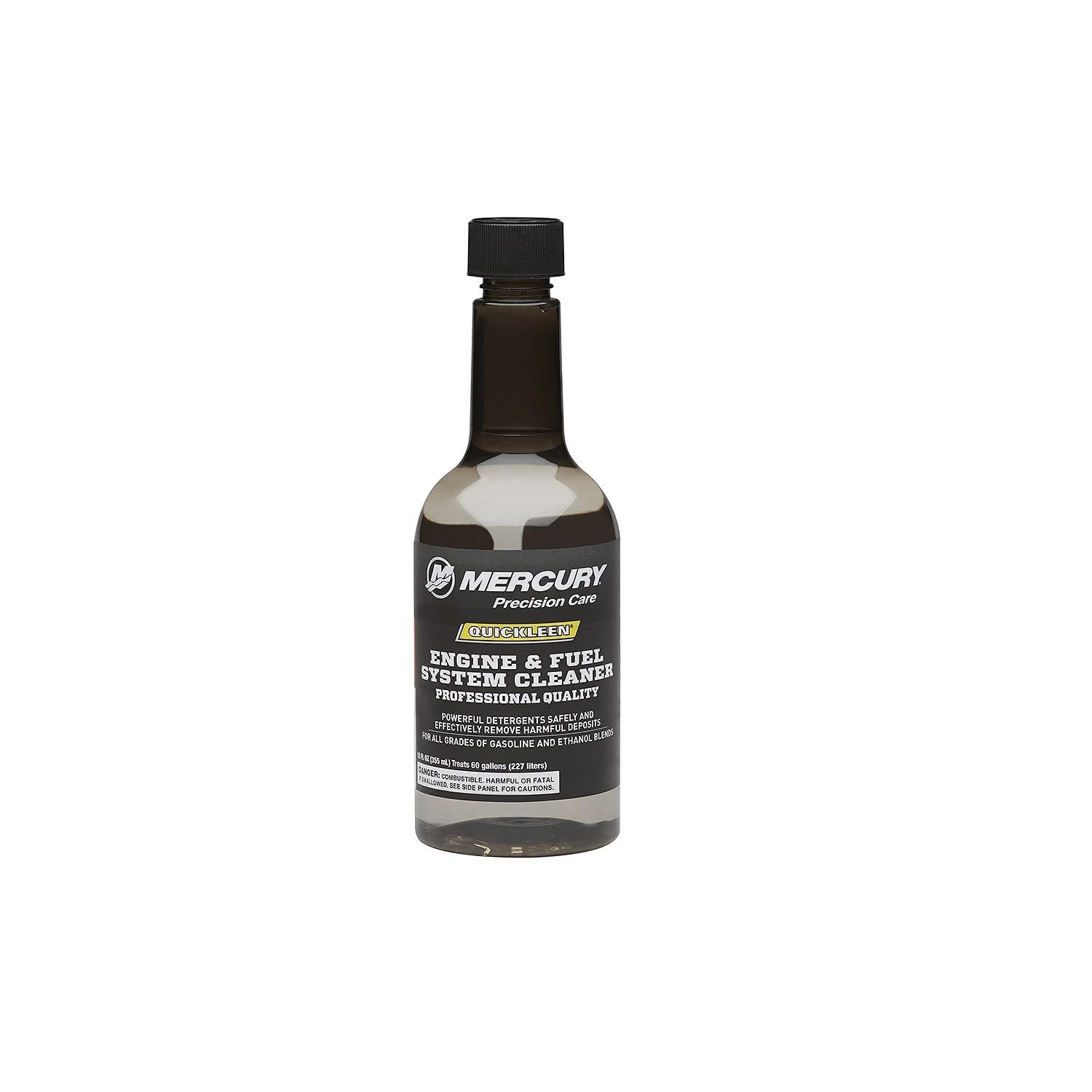
Produced by Mercury Marine to their own OEM specifications, this Quickleen formula is engineered specifically for the higher thermal loads and corrosion risks of marine engines. It targets carbon deposits on carburetors, injectors, intake valves, spark plugs, piston crowns, and cylinder heads — every surface where soot and varnish accumulate in a watercraft motor. Unlike many automotive additives, this one also prevents engine knocking and piston seize-up, which are critical failure points in outboard and stern-drive applications.
At a dosage of one ounce per five gallons of fuel, a single 12-ounce bottle treats up to 60 gallons of gasoline. That means one bottle can last several fill-ups on a typical boat, making the per-trip cost very reasonable. The formula does not contain fuel stabilizers, so if you are winterizing the engine, you will need a separate stabilizer product to prevent fuel breakdown during storage.
For boat owners, the peace of mind of using an OEM-engineered additive is significant. The 1-year manufacturer warranty directly from Mercury further reinforces the quality control. Just note that this is a vehicle-specific fit for watercraft — it works fine in automotive engines too, but the corrosion inhibitors are optimized for marine environments.
What works
- OEM formulation from Mercury Marine
- Prevents piston seize-up in marine engines
- Very economical per-tank dosage
What doesn’t
- Lacks fuel stabilizers for long-term storage
- Vehicle-specific fit limits automotive appeal
3. Berryman 7516 High Mileage Fuel System Rejuvenator

Berryman’s High Mileage Fuel System Rejuvenator relies on their proprietary HEST (High Energy Solvent Technology), which uses powerful detergents rather than weak mineral-spirit carriers. The result is an aggressive cleaner that dissolves fuel residue, carbon deposits, and varnish in engines that have accumulated years of neglect. It is specifically marketed as a rejuvenator for high-mileage vehicles, where deposits have had time to harden into stubborn layers.
The 15-ounce pour can treats larger tanks effectively, and the formulation is safe for both 2-stroke and 4-stroke engines — including marine and small gas engines like those in lawn equipment, generators, and motorcycles. Users report a reduction in rough idle and hesitation after a single treatment, with some noting restored fuel economy within two tanks. The metal can construction is a nice touch, as it eliminates the risk of plastic leaching or collapsing during storage.
One trade-off is that HEST solvents do not provide the ongoing protection that PEA-based cleaners offer. This product is best used as a one-time shock treatment to clear existing deposits, after which a maintenance-level additive can keep the system clean. For a vehicle with over 100,000 miles that has never seen a fuel system cleaner, this is a strong first pick.
What works
- Aggressive HEST solvent dissolves hardened deposits
- Safe for 2-stroke and 4-stroke small engines
- Restores lost power and idle quality
What doesn’t
- Solvent-only chemistry offers limited ongoing protection
- Not as concentrated as PEA-based alternatives
4. Quicksilver Quickleen Engine and Fuel System Cleaner

The Quicksilver Quickleen is designed as a maintenance additive rather than a shock treatment. Its one-ounce-per-five-gallons ratio means you can add it to every tank of fuel without worrying about over-concentration, keeping carbon deposits from forming in the first place. This is the additive equivalent of changing your oil on schedule — it prevents problems rather than curing them after they appear.
The formula works with all grades of gasoline and ethanol-blend fuels, which is important for modern vehicles that see E10 or E15 at the pump. It removes deposits from carburetors, injectors, intake valves, spark plugs, piston crowns, and cylinder heads — the same comprehensive coverage as the Mercury version, but marketed for general use rather than marine-specific applications. The 12-ounce bottle treats up to 60 gallons of fuel.
For drivers who want a set-it-and-forget-it routine, this additive fits perfectly. It will not dramatically transform a neglected engine in one treatment, but consistent use prevents the power loss and knocking that come from years of accumulation. It is a budget-friendly way to extend the life of your fuel system components.
What works
- Safe and economical for every-tank use
- Works with ethanol-blend fuels
- Prevents carbon buildup proactively
What doesn’t
- Not strong enough for heavy existing deposits
- Requires consistent use to see benefits
5. Lucas Oil 10872 Diesel Deep Clean

Lucas Oil’s Diesel Deep Clean is formulated specifically for compression-ignition engines, where fuel chemistry and combustion characteristics differ significantly from gasoline motors. The additive targets fuel injectors directly, reducing particulate matter that accumulates in diesel particulate filters (DPFs) and cleaning the injector nozzles for better spray patterns. Restored power and improved acceleration are the most commonly reported benefits.
The 16-ounce bottle treats a substantial amount of diesel fuel, making it suitable for pickup trucks, vans, and agricultural equipment with large tanks. Lucas is known for their additive engineering, and this product benefits from decades of diesel-specific research. The formula is designed to work in both modern common-rail systems and older mechanical injection pumps, giving it broad compatibility.
Diesel owners should note that this cleaner is intended for periodic use, not every fill-up. Overuse of any diesel fuel system cleaner can oversoften seals in older injection pumps, so following the recommended treatment interval is important. For a diesel that has developed a rough idle, lost power on hills, or triggered a check engine light related to fuel trims, this is a targeted solution worth trying before visiting a shop.
What works
- Specifically engineered for diesel injectors
- Reduces particulate matter in filters
- Works with common-rail and mechanical systems
What doesn’t
- Not intended for gasoline engines
- Overuse can soften seals in older pumps
Hardware & Specs Guide
PEA (Polyether Amine) Detergent
This is the highest-temperature-stable detergent molecule used in fuel system cleaners. PEA survives the combustion process and continues cleaning intake valves, piston crowns, and combustion chambers even after the fuel has burned. The BG 44K Platinum relies on a high concentration of PEA for its deep-cleaning reputation. Products without PEA typically use solvents that clean but do not protect against future buildup as effectively.
HEST (High Energy Solvent Technology)
Berryman’s proprietary solvent blend uses strong detergents instead of weak carriers like mineral spirits or kerosene. HEST dissolves existing carbon, varnish, and fuel residue aggressively, making it effective for high-mileage engines with heavy deposits. However, solvents do not offer the same ongoing cleaning between treatments as PEA — they are better suited for one-time rejuvenation than continuous maintenance.
FAQ
How often should I use a gas additive to clean the engine?
Can a gas additive damage a catalytic converter or oxygen sensor?
Will a fuel additive fix an engine that is already misfiring or knocking?
Final Thoughts: The Verdict
For most buyers, the gas additive to clean engine winner is the BG 44K Platinum (2-Pack) because its high-concentration PEA formula delivers the deepest carbon removal and restores lost power more reliably than any other product tested. If you need a marine-specific solution, grab the Mercury Quickleen. And for a budget-friendly maintenance routine that prevents buildup before it starts, nothing beats the Quicksilver Quickleen.

Certification: BSc in Mechanical Engineering
Education: Mechanical engineer
Lives In: 539 W Commerce St, Dallas, TX 75208, USA
Md Amir is an auto mechanic student and writer with over half a decade of experience in the automotive field. He has worked with top automotive brands such as Lexus, Quantum, and also owns two automotive blogs autocarneed.com and taxiwiz.com.