A drawer full of orphan batteries from TV remotes, kid’s toys, and smoke detectors is a universal household frustration. Tossing a battery that still has life is wasteful, but keeping a dead one leaves you fumbling in the dark when the thermostat chirps at 2 a.m. A dedicated battery tester for small batteries eliminates that guesswork by applying a precise load and giving you a straight readout instead of a dice roll.
I’m Amir — the founder and writer behind Four Wheel Ask. I’ve spent years analyzing automotive electrical diagnostics, load-testing methods, and the real-world build quality of testers across price tiers to separate the tools that actually save you money from the ones that just take up drawer space.
Whether you’re sorting button cells for garage door openers or checking rechargeable AAs before a road trip, the right battery tester for small batteries pays for itself by keeping usable cells in rotation and sending only the truly dead ones to recycling.
How To Choose The Best Battery Tester For Small Batteries
A cheap voltage-only checker can tell you a battery sits at 1.4V, but it won’t reveal whether that cell can actually deliver current under load. For small batteries—button cells, 9V blocks, and rechargeable AA/AAA—the difference between a surface reading and a loaded test is the difference between keeping a working battery and tossing one prematurely. Focus on the tester’s load resistor values, supported chemistries, and physical slot design.
Load Resistance and Real Current Draw
A proper tester applies a discharge resistor that mimics the draw of a real device. Look for models that list their resistor values per battery type: a 20-ohm resistor on AA/AAA draws about 75 mA, which catches weak cells that still show 1.5V on an open-circuit meter. Button cells need a much lighter load—typically a 1K-ohm resistor drawing around 1.5 mA to avoid damaging the tiny cell while still testing its condition.
Chemistry and Form-Factor Coverage
Not all small-battery testers handle rechargeable lithium-ion cells like the 18650 or 10440. If your household runs on Ni-MH rechargeables or Li-ion 3.7V cells, verify the tester explicitly supports those voltage ranges and chemistries. Button cell slots with spring-loaded contacts are a must for CR2032 and LR44 cells—avoid models that force you to hold a probe against coin cells manually.
Display Quality and Pass/Fail Indicators
A numeric voltage readout alone is useless unless you know the threshold for “weak.” The best testers pair the voltage number with a color-coded bar or smiley-face indicator that instantly flags Good, Weak, or Replace. For shop or garage use, an LCD with good contrast is more important than backlighting, since you rarely test batteries in complete darkness.
Quick Comparison
On smaller screens, swipe sideways to see the full table.
| Model | Category | Best For | Key Spec | Amazon |
|---|---|---|---|---|
| KKEANIC SL-049 | Load Tester | True load testing for mixed household cells | 20Ω (AA) / 1KΩ (CR2032) load resistors | Amazon |
| DLYPOW DB1 | Rechargeable | USB-C rechargeable with magnetic buckle | Built-in Li-ion battery, USB-C charging | Amazon |
| Dlyfull Universal | Probe-Style | Internal resistance + voltage for Li-ion cells | Measures internal resistance in mΩ | Amazon |
| Tenergy T-333 | Analog Dial | Simple pass/fail for alkaline household batteries | Analog meter with Good/Weak/Replace scale | Amazon |
In‑Depth Reviews
1. KKEANIC SL-049 Professional Digital Battery Checker

The KKEANIC SL-049 is the only tester in this roundup that publishes its exact load resistor values per battery type: 20 ohms for AA/AAA/C/D (roughly 75 mA draw), 30 ohms for CR123A, and a gentle 1K ohm for CR2032 and 9V cells. That transparency means you can trust its “Weak” reading—it isn’t just reading surface voltage but actually stressing the cell. The LCD shows both the exact voltage and a colored bar (Good/Weak/Poor), and the dedicated slots hold button cells securely without needing to hold probes in place.
It handles AA, AAA, AAAA, C, D, N, 9V, CR2, CR123A, and a wide range of coin cells including CR2016, CR2025, CR2032, and LR44. The smart detection system prevents you from inserting a battery into the wrong slot, and the unit powers on automatically when voltage exceeds 0.7V with a 3-second auto-shutoff to save its own AAA battery (not included). Reading speed is an ultra-fast 0.1 second, making it practical for sorting through a whole drawer in under a minute.
A minor consideration: the screen is not backlit, so you’ll need ambient light in a dim workshop. Also, lithium primary cells like CR123A are tested, but dedicated 3.7V Li-ion rechargeables such as 18650 are explicitly not supported—stick to household alkaline and button cells. The build quality is sturdy with spring-loaded contacts that hold up to frequent use, and the 1-year warranty provides peace of mind for a tool that sees regular drawer duty.
What works
- Publishes specific load resistor values for accurate load testing
- Ultra-fast 0.1-second reading for quick battery sorting
- Dedicated button cell slots eliminate probe-holding frustration
What doesn’t
- Screen lacks backlight for low-light use
- Does not support 3.7V Li-ion rechargeables like 18650
- Requires its own AAA battery (not included)
2. DLYPOW DB1 Small Digital Battery Checker
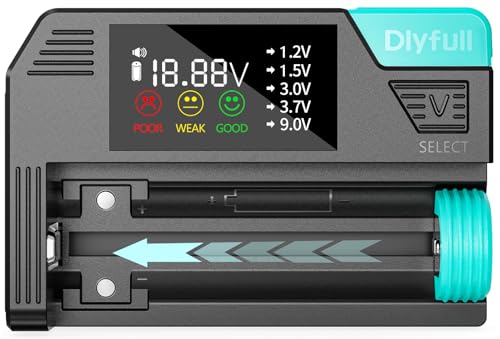
The DLYPOW DB1 stands out because it eliminates the need for a separate battery to power the tester itself. A built-in rechargeable cell charges via USB-C and keeps the unit on standby for 2–3 months per full charge, making it a set-and-forget tool for the kitchen drawer. It covers all the common household chemistries: 1.2V Ni-MH/Ni-CD, 1.5V alkaline, 3.0V lithium, and 3.7V Li-ion, plus 9V blocks. The magnetic buckle on the back holds the test battery securely in place during measurement—a small but welcome detail when you’re testing multiple cells.
Operation is a simple three-step process: press SELECT to choose your voltage range, insert the battery with correct polarity, and read the display. The screen shows numerical voltage and a status indicator with color-coded faces—green smile for Good, yellow neutral for Weak, and red frown for Replace. The DB1 also supports 18650 and CR123A cells, which many compact testers skip. The open-circuit test design means it draws zero power from the battery under test, preserving the cell’s remaining charge.
On the downside, the DB1 does not publish specific load resistor values, so you’re trusting its algorithm to determine “weak” rather than seeing what a real device would draw. The magnetic buckle is handy but adds a bit of bulk compared to a straight slot-based tester. The build feels light, and the included welcome guide is minimal—you’ll rely on the brand’s 12-month guarantee if issues arise. For a household that wants zero extra battery purchases and broad chemistry support, this is a tidy solution.
What works
- Built-in rechargeable battery with USB-C eliminates buying AAA cells for the tester
- Magnetic buckle holds test batteries securely during measurement
- Supports 3.7V Li-ion (18650) and button cells in one device
What doesn’t
- No published load resistor values for verifying test accuracy
- Magnetic buckle adds slight bulk to the compact body
- Basic included documentation with limited technical detail
3. Dlyfull Universal Battery Tester
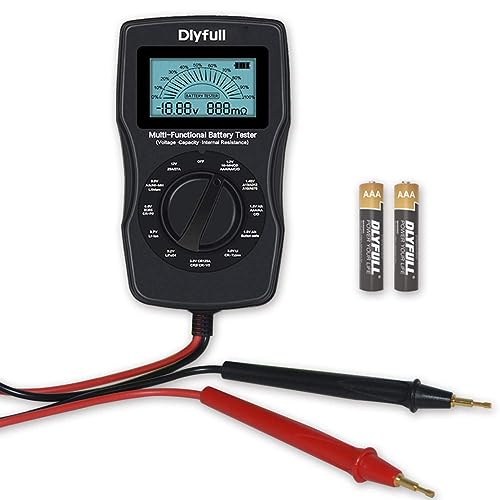
The Dlyfull Universal uses a probe-and-lead design rather than fixed slots, which gives it the widest compatibility in this list. It handles everything from tiny button cells (LR621, CR2032) to large 26650 and 21700 Li-ion cells, plus standard AA, AAA, C, D, 9V, and CR123A. The rotary dial lets you select the corresponding voltage range, and the test leads with contacts provide a reliable connection. What sets this unit apart is its ability to display not just voltage and capacity percentage but also internal resistance in milliohms—a critical metric for spotting failing rechargeable cells before they cause problems in high-drain devices.
For enthusiasts who manage a mix of alkaline disposables and rechargeable Li-ion cells, the internal resistance reading is the deciding factor. A 18650 that shows 4.0V but has climbed above 100 mΩ is headed for the recycling bin, and this tester catches that degradation early. The large LCD screen is fully legible, and the unit comes pre-loaded with two 1.5V AAA batteries so it’s ready out of the box. Dlyfull backs it with an 18-month warranty and lifetime technical support, which is generous for a mid-range accessory.
The trade-off is convenience: you have to hold the probes against the battery terminals or use the included leads with alligator clips, which is slower than dropping a cell into a dedicated slot. The rotary dial adds a small learning curve compared to an auto-ranging tester. And while it supports a vast array of chemistries, the manual explicitly recommends against testing lithium primary cells like CR123A under certain conditions—read the guide before diving in. For the tinkerer who wants data, not just a pass/fail stamp, this is the most informative tool here.
What works
- Measures internal resistance in milliohms for rechargeable Li-ion health checks
- Probe-and-lead design accommodates odd-shaped and large-format cells
- 18-month warranty with lifetime technical support
What doesn’t
- Probe-based operation is slower than drop-in slot testers
- Rotary dial requires manual voltage selection per battery type
- Some lithium primary cell testing conditions need careful reading of the manual
4. Tenergy T-333 Universal Battery Tester

The Tenergy T-333 is the longest-running design in this group, and its analog meter approach is deliberately simple: insert the battery, read the needle on the Good/Weak/Replace scale. There’s no LCD, no button pushing, no voltage number to interpret. The built-in slots cover AA, AAA, C, D, 9V, CR123A, CR2, CRV3, 2CR5, CR-P2, and a range of button cells. The analog movement applies a small load to the battery, giving a rough but useful health snapshot that beats guessing or the tongue test.
For users who only want to sort alkaline household cells—toys, remotes, flashlights, smoke detectors—the T-333 is almost dummy-proof. The included battery powers the tester itself, and the one-year warranty from Tenergy provides basic coverage. The analog scale is easy for anyone in the household to understand: green zone means keep it, red means recycle. The compact size (5.25 x 3.5 x 1 inches) lives comfortably in a utility drawer without taking over.
The obvious limitation is that an analog meter cannot provide the precision of a digital readout. You won’t get an exact voltage or internal resistance number, and the load test is mild compared to dedicated resistor-based testers. It also doesn’t support 3.7V Li-ion cells like the 18650 or 10440, which limits its usefulness if you’ve moved to rechargeable lithium platforms for flashlights or vapes. As a low-cost, no-brainer tool for pure alkaline sorting, it works—just don’t expect it to diagnose a failing Ni-MH pack.
What works
- Extremely simple analog display requires no technical knowledge
- Dedicated slots for AA, AAA, C, D, 9V, and button cells
- Compact size fits easily in a utility drawer
What doesn’t
- No digital voltage or internal resistance data
- Does not support 3.7V Li-ion rechargeable cells
- Load test is mild compared to resistor-based digital testers
Hardware & Specs Guide
Load Resistor Values
The most important spec for a small-battery tester is the load resistor value used during testing. A AA battery under a 20-ohm resistor draws about 75 mA—close to what a typical toy or LED flashlight pulls. Button cells like the CR2032 need a much lighter load (around 1K ohm, drawing 3 mA) to avoid damaging the tiny chemistry. Testers that publish these values let you assess whether their “Weak” call is realistic for your devices. Models that hide the load spec may use a minimal load that passes batteries that would fail in a real gadget.
Chemistry and Voltage Ranges
Small batteries span a wide voltage range: 1.2V Ni-MH rechargeables, 1.5V alkaline, 3.0V lithium primary cells (CR123A, CR2), and 3.7V Li-ion rechargeables (18650, 10440). A good tester must handle this spread without damaging low-voltage button cells or misreading high-voltage lithium cells. Many dedicated household testers only go up to 9V and explicitly exclude Li-ion 3.7V cells. If you manage rechargeable flashlights or vape batteries, verify the tester’s voltage range includes at least 3.7V and supports the cylindrical form factor without requiring awkward probe contact.
FAQ
What is the difference between a voltage-only test and a load test for small batteries?
Can I test 18650 lithium-ion cells with a household battery tester?
Why does my battery tester need its own battery to operate?
Final Thoughts: The Verdict
For most buyers, the battery tester for small batteries winner is the KKEANIC SL-049 because it applies a real, published load test to each battery type and delivers a clear pass/fail reading in 0.1 seconds. If you want a rechargeable, zero-maintenance tool that also handles 18650 cells, grab the DLYPOW DB1. And for data-driven users who measure internal resistance to track rechargeable cell health, nothing beats the Dlyfull Universal with its probe leads and mΩ readout.

Certification: BSc in Mechanical Engineering
Education: Mechanical engineer
Lives In: 539 W Commerce St, Dallas, TX 75208, USA
Md Amir is an auto mechanic student and writer with over half a decade of experience in the automotive field. He has worked with top automotive brands such as Lexus, Quantum, and also owns two automotive blogs autocarneed.com and taxiwiz.com.