A set of motorbike gloves sits between your control inputs and the machine—the only barrier against road rash, fractured knuckles, and a sudden loss of fine motor control at speed. The wrong pair sacrifices dexterity for bulk or prioritizes style over slide resistance, turning a fall into a serious hand injury. Riders shopping for protective handgear need to balance armor placement, material grade, and thermal performance for their specific riding environment, whether that’s a summer canyon carve or a sub-zero commute.
I’m Amir — the founder and writer behind Four Wheel Ask. After analyzing hundreds of leather, textile, and heated glove models across dozens of abrasion tests, owner feedback threads, and seasonal riding forums, I’ve broken down the seven most competitive options for real-world street and trail use.
Every pair on this list passed a minimum bar for knuckle impact protection and palm reinforcement, but the criteria that separate a good glove from a great one differ by season and terrain. This review is your hands-on reference for choosing the most effective gloves for motorbike to match your specific riding demands without overpaying for features you’ll never use.
How To Choose The Best Gloves For Motorbike
Motorcycle gloves are safety equipment first, comfort gear second. The wrong material or armor layout can turn a minor slide into a reconstructive surgery case. Focus on these four pillars before considering color or branding.
Leather Grade and Abrasion Resistance
Goatskin leather is the gold standard for motorbike gloves—it offers the highest tensile strength per millimeter thickness while remaining supple after break-in. Cowhide is thicker and cheaper but stiffer, reducing tactile feedback from the controls. Sheepskin provides excellent cold-weather insulation but sacrifices some tear resistance. Avoid pure synthetic gloves for any riding above parking-lot speeds; they melt at lower friction temperatures than natural hide.
Knuckle and Palm Armor Construction
Carbon fiber knuckle caps distribute impact force across a wide surface without adding the weight of plastic or metal guards. TPR (thermoplastic rubber) armor offers good flex at a lower price point but can transfer more shock energy to the hand in a direct strike. For the palm, look for a separate slider panel—a smooth, hard patch that lets the hand skid rather than grip the asphalt during a fall. A pinky bridge or connecting strap prevents finger hyperextension and is a strong indicator of a safety-oriented design.
Ventilation vs. Thermal Management
Perforated leather panels or 3D mesh inserts are essential for warm-weather riding to prevent sweat buildup that softens the hide and reduces grip. For cold-weather use, heated gloves must have at least a 7.4V battery system rated at 2200mAh or higher to sustain high heat for more than two hours. Passive insulation like fleece lining or a windproof membrane adds bulk that can compromise dexterity, so test the throttle and brake lever feel before committing to a heavily insulated pair.
Touchscreen Compatibility and Wrist Closure
Capacitive touch fingertips save the hassle of removing gloves at every gas stop or navigation check, but the sensor material must be precise—some cheaper gloves require a hard press that makes typing on a phone impossible. A hook-and-loop wrist strap with a gauntlet-style cuff is the most secure closure for street riding, preventing the glove from sliding off in a crash. Elastic only closures are insufficient for impact scenarios.
Quick Comparison
On smaller screens, swipe sideways to see the full table.
| Model | Category | Best For | Key Spec | Amazon |
|---|---|---|---|---|
| Alpinestars SMX-2 Air Carbon V2 | Premium Sport | Aggressive street riding & track days | Full-grain leather + carbon knuckle | Amazon |
| DAY WOLF Heated Gloves | Heated Winter | Sub-freezing commuting & snow riding | 7.4V 2200mAh battery system | Amazon |
| ScorpionEXO SGS MKII | All-Season Touring | Long-distance touring & mixed weather | Mesh chassis + leather palm | Amazon |
| Harssidanzar KM045 | Mid-Range Sport | Weekend sport riding & commuting | Goatskin + TPR/carbon hybrid knuckle | Amazon |
| INBIKE Leather Gloves | Value Street | Budget-conscious daily riders | Goat leather + carbon fiber knuckle | Amazon |
| KEMIMOTO Sheepskin Gloves | Entry Level | New riders & light off-road use | Sheepskin + carbon fiber shell | Amazon |
| Milwaukee Leather MG7514 | Cruiser Commuter | Casual street cruising & daily wear | Distressed cowhide + gel palm pad | Amazon |
In‑Depth Reviews
1. Alpinestars SMX-2 Air Carbon V2 Gloves

Alpinestars built the SMX-2 Air Carbon V2 around a multi-panel main shell that fuses full-grain leather with 3D mesh panels. The full-grain leather sections handle abrasion where it matters most—the palm, outer edge, and finger backs—while the mesh breathes out heat during aggressive summer rides. The carbon fiber knuckle guard sits under a thin leather overlay, so it doesn’t catch wind or snag on the tank, and the pre-curved finger chassis mirrors a natural grip position on the throttle.
The microfiber and PU grip insert on the palm and thumb provides a sticky connection to the bars without the bulk of a separate leather palm patch. Alpinestars’ exclusive ergonomic stretch insert between the palm and thumb eliminates binding when you roll the throttle open or feather the front brake. The touchscreen-compatible fingertip on the index finger works with most modern phone screens without requiring a forceful jab.
Stretch finger sidewalls improve dexterity for zipper pulls, turn-signal taps, and key fob operation—details that matter on long days in the saddle. The hook-and-loop wrist closure with a gauntlet-style cuff ensures the glove stays seated during a slide. If you ride a sportbike or naked bike and want a do-it-all summer glove that doesn’t compromise protection for ventilation, this is the benchmark.
What works
- Full-grain leather offers superior slide durability versus split leather alternatives
- Carbon knuckle guard feels lightweight and doesn’t restrict wrist rotation
- Ergonomic stretch insert eliminates palm binding during throttle roll-on
What doesn’t
- 3D mesh panels limit cold-weather use; not suitable below 50°F without liners
- Touchscreen tip accuracy varies between phone models and screen protectors
2. DAY WOLF Heated Motorcycle Gloves

DAY WOLF targets cold-weather riders who refuse to let frozen fingers compromise clutch control. The outer shell combines sheep leather on the palm and waterproof nylon fabric on the back, with a cotton fill layer and velvet lining to wick sweat and trap heat. The carbon fiber knuckle protection shell adds impact coverage that passive winter gloves often skip due to bulk concerns—a welcome safety feature for winter commuters who still hit twisty backroads.
The 7.4V 2200mAh battery system delivers three heat settings that reach full temperature within thirty seconds of pressing the switch. On high, the heating elements cover the entire back of the hand and all five fingers, not just the palm. The rated six-hour runtime on low is realistic for a full day of riding with periodic stops, but expect two to three hours on the high setting when ambient temps drop below freezing.
Windproof buckles at the wrist seal out drafts, and the touchscreen sensor fabric on the thumb and index finger lets you operate a phone or GPS without exposing skin to the wind chill. For riders who face genuine winter conditions and want a single heated glove that works for both snowmobiling and motorcycle commuting, this is the most practical option on the list.
What works
- Full five-finger heating coverage with 30-second warm-up time
- 7.4V battery system provides genuine high heat output, not just mild warmth
- Carbon fiber knuckle shell adds impact protection rare in heated glove designs
What doesn’t
- Bulkier than unheated sport gloves; clutch feel is slightly muted
- Battery life on high setting drops to roughly 2.5 hours in actual sub-freezing use
3. ScorpionEXO SGS MKII Gloves
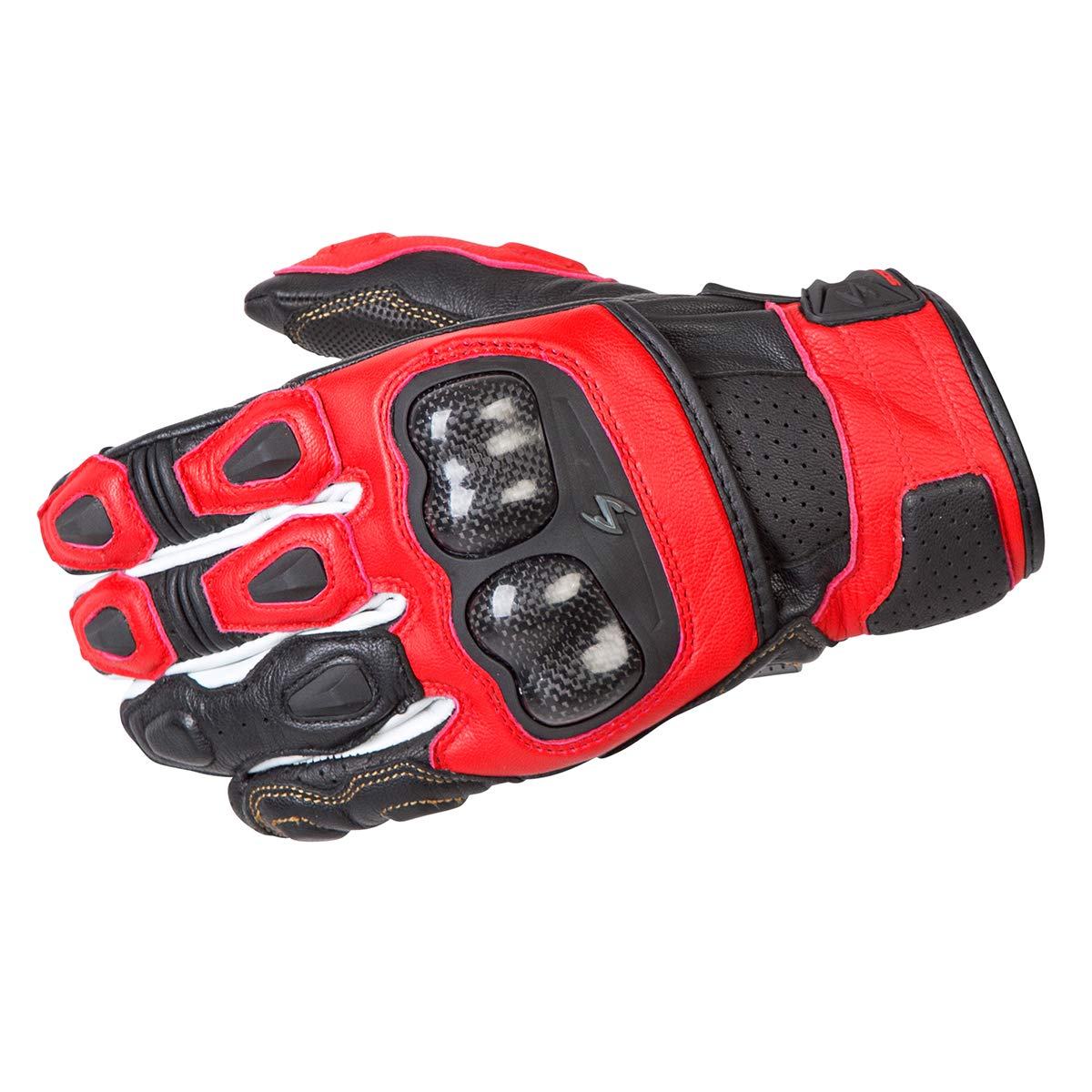
ScorpionEXO’s SGS MKII has been a reliable mid-tier touring glove for years, and the reason is its balanced combination of ventilation and coverage. The chassis uses a mesh back that moves enough air to keep hands dry during 90-degree summer highway slogs, while the leather palm provides abrasion resistance where your hand will hit the pavement first. ScorpionEXO doesn’t disclose the specific leather grade, but owner feedback across five years indicates consistent durability without premature tearing at the seams.
The glove incorporates a padded knuckle protector rather than a hard carbon or TPR cap, which makes it less confidence-inspiring in a direct punch impact but more comfortable for all-day wear without pressure points. The pre-curved finger shape reduces fatigue during multi-state touring days, and the hook-and-loop closure with a short gauntlet cuff fits neatly under most jacket sleeves. Touchscreen compatibility is available on the index fingertip, though the sensitivity is average—you’ll need a firm press for most phone functions.
The SGS MKII lacks the aggressive armor layout of the Alpinestars SMX-2 or the heated hardware of the DAY WOLF, but it doesn’t try to be either. It’s designed for riders who cover distance in warm weather and want a glove that disappears on the hand—minimal bulk, adequate protection, and reliable zipper-pull dexterity. If your rides are predominantly above 60°F and you prioritize airflow over carbon fiber armor, this is a proven choice.
What works
- Mesh back offers excellent airflow for hot-weather touring
- Pre-curved finger shape reduces hand fatigue during long days in the saddle
- Proven ownership base with consistent sizing across multiple production years
What doesn’t
- Knuckle protection is padded rather than hard-shell; less impact dispersal than carbon caps
- Touchscreen tip requires deliberate pressure, not suitable for quick taps
4. Harssidanzar Leather Gloves KM045

The Harssidanzar KM045 sits in a sweet spot between entry-level value and premium protection by using genuine goatskin leather—a material that offers higher tensile strength and better flexibility than the cowhide found on budget gloves at similar price points. The goatskin is soft from the first wear and doesn’t require the extended break-in period that stiffer hides need. The 11.8-inch gauntlet length reaches past the wrist to the lower forearm, providing coverage that standard short-cuff gloves miss.
The knuckle protection uses a hybrid layout: TPR (thermoplastic rubber) surrounds a carbon fiber insert, combining the impact absorption of soft armor with the hard shell deflection of carbon. This two-layer approach is rare at this price tier and gives the KM045 a genuine safety advantage over single-material knuckle guards. Abrasion-resistant TPR on the palm slider provides a smooth glide surface during a low-side slide, and the elastic wrist strap with hook closure keeps the glove locked on under crash forces.
Touchscreen compatibility is present on the thumb and index fingertips, and the accuracy is above average for the mid-range segment—you can type short messages without removing the glove. The ambidextrous fit description in the specs is misleading; the gloves are shaped for left and right hands separately. Use the manufacturer size chart carefully, as the goatskin stretches minimally over time. This is a strong pick for sport riders who want near-premium materials without crossing into the three-digit price territory.
What works
- Genuine goatskin leather offers excellent abrasion resistance and a short break-in period
- Hybrid TPR-carbon knuckle guard provides dual-layer impact protection
- Extended gauntlet length protects the lower forearm during slides
What doesn’t
- Sizing can be inconsistent; careful measurement required before ordering
- Palm TPR slider is effective but adds slight bulk to grip feel
5. INBIKE Leather Motorcycle Gloves

INBIKE delivers a surprising feature set at its price point: genuine goat leather panels on the palm and finger sections, carbon fiber knuckle caps, and a non-slip silicone grip pattern on the palm. The goat leather provides better sensitivity and durability than the budget cowhide or synthetic blends found in sub-fifty-dollar competitors. The carbon fiber knuckle guard is a hard-shell piece, not a padded insert, so it offers genuine impact deflection during a strike or slide.
The palm features both carbon fiber padding and anti-shock silicone strips that help dampen vibration from handlebars on long rides—a detail that reduces hand numbness on bikes without heavy bar-end weights. The three-finger touchscreen tips use microfiber that can wipe sweat from sunglasses and still register phone inputs. The hook-and-loop strap closure is functional but shorter than ideal; riders with thicker wrists may find the strap reaches its limit before achieving a snug fit.
The reflective design elements on the fingers provide a small but useful visibility boost at night, and the breathable nylon panels on the back of the hand prevent sweat buildup during spring and fall riding. The universal fit sizing runs slightly smaller than US standard, so consider ordering one size up if you’re between sizes. For a budget-conscious rider who refuses to compromise on carbon fiber knuckle coverage and genuine leather construction, the INBIKE gloves represent serious value.
What works
- Carbon fiber knuckle guard at this price point is rare and effective
- Goat leather palm offers natural grip and better abrasion resistance than synthetic options
- Silicone palm strips reduce handlebar vibration and improve control feel
What doesn’t
- Wrist strap length is short; large-wristed riders may struggle with secure closure
- Sizing runs small; ordering up one size is necessary for most riders
6. KEMIMOTO Sheepskin Leather Gloves
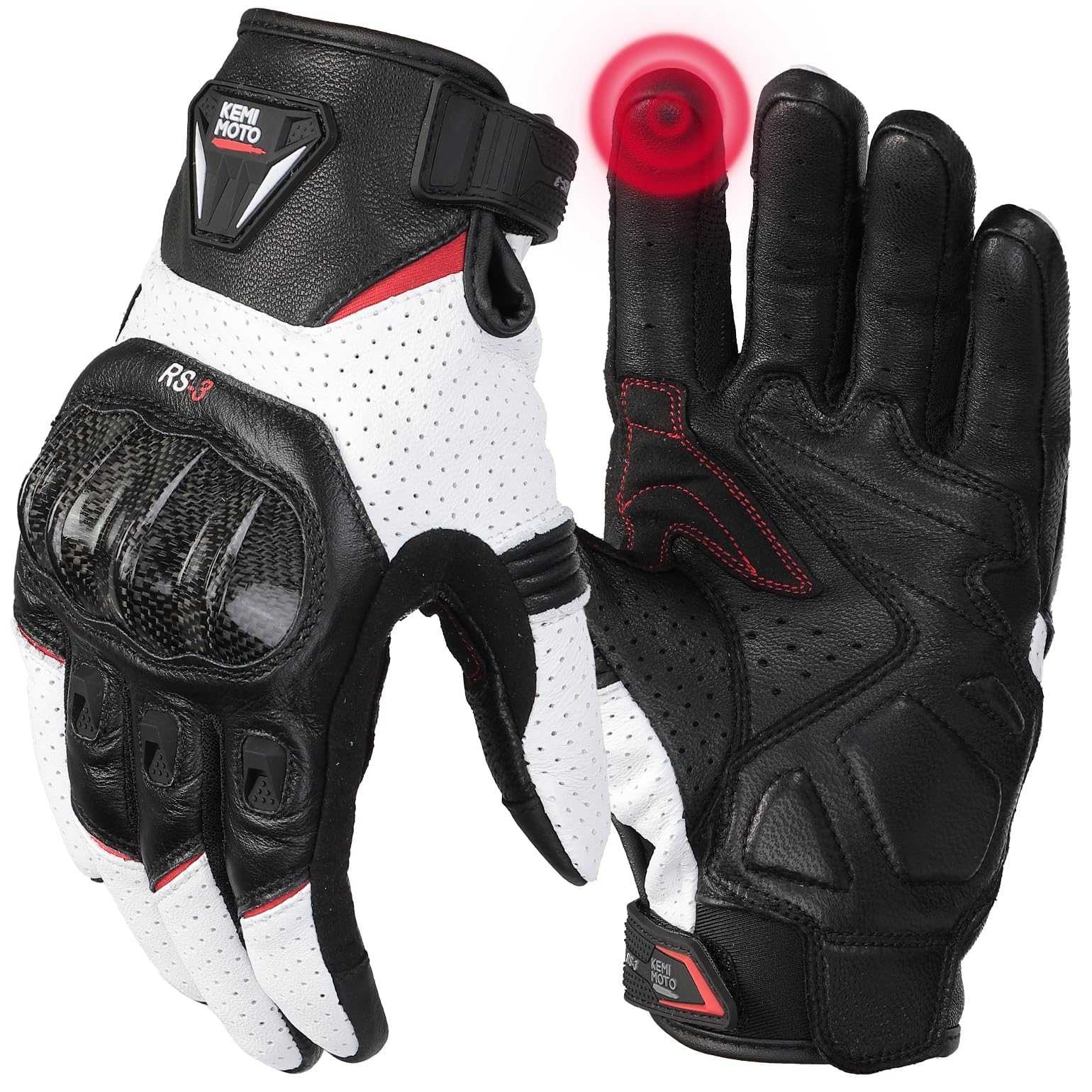
KEMIMOTO uses sheepskin leather for its palm and main body, a material choice that prioritizes cold-weather comfort and initial softness over maximum abrasion resistance. Sheepskin runs a bit thinner and tears more easily than goatskin or cowhide, but for entry-level riders who mostly commute in cool conditions and rarely exceed highway speeds, the trade-off is acceptable. The carbon fiber hard shells on the back of the hand add impact coverage that partially compensates for the leather’s lower tear strength.
The EVA foam padding between the sheepskin and nylon lining in the palm area offers cushioning against road vibration, and the perforated design on the back of the hand helps regulate temperature during moderate exertion. The two-finger touchscreen tips on the thumb and index finger are responsive enough for quick interactions without removing the glove. The hook closure strap is functional but basic—no gauntlet extension or secondary retention strap.
KEMIMOTO markets these gloves as suitable for dirt biking, ATV riding, and motocross in addition to street use. The ambidextrous hand orientation listed in the specs is technically incorrect; the gloves are shaped for left and right separately. If you’re a new rider on a budget who needs a glove that works across cool fall mornings, spring evenings, and light off-road trails, the KEMIMOTO offers decent coverage at an entry-level cost without the flimsy feel of pure nylon gloves.
What works
- Sheepskin leather is comfortable from day one with minimal break-in required
- Carbon fiber back shell provides hard impact protection at a budget-friendly price
- Perforated back panel prevents overheating during moderate activity levels
What doesn’t
- Sheepskin is less abrasion-resistant than goatskin or cowhide for high-speed slides
- Closure system is basic; no gauntlet or secondary strap for crash security
7. Milwaukee Leather MG7514 Distressed Gloves

Milwaukee Leather’s MG7514 takes a cruiser-commuter approach to glove design, prioritizing comfort, style, and basic protection over track-ready armor. The distressed cowhide leather is pre-worn in appearance and offers reasonable abrasion resistance for street cruising speeds, though cowhide at this thickness is stiffer than goatskin and requires a longer break-in period to reach full flexibility. The gel palm pad is the standout feature—it absorbs road vibration through the handlebars, reducing hand fatigue during long straight highway sections on a heavy cruiser.
The knuckle protectors are padded rather than hard-shell, which means they offer some impact absorption but zero impact deflection. For riders who stick to posted speed limits and paved roads, this is acceptable; for anyone pushing higher speeds or leaning into corners, the lack of hard armor is a genuine limitation. The hook-and-loop wrist closure is standard and secure, though the distressed leather aesthetic may not appeal to sport bike or ADV riders who prefer a clean, technical look.
Touchscreen compatibility is not listed in the specifications, and owner reports indicate that the fingertips are not sensor-friendly—you will need to remove the gloves for phone use. The gel pad does add noticeable warmth retention, making these a decent option for spring and fall riding in moderate climates. If your riding is strictly casual cruising on a Harley or metric cruiser and you value vibration damping over slide protection, the MG7514 is a cost-effective choice.
What works
- Gel palm pad effectively reduces vibration-induced hand numbness on long straight rides
- Distressed cowhide offers a classic cruiser aesthetic with adequate street-level durability
- Secure hook-and-loop closure keeps the glove in place during normal riding conditions
What doesn’t
- No hard knuckle armor; padded knuckles provide limited impact protection
- No touchscreen compatibility; phone use requires removing the glove entirely
Hardware & Specs Guide
Leather Grades and Abrasion Performance
Goatskin offers the highest abrasion resistance among common motorcycle glove leathers, followed by cowhide, then sheepskin. A full-grain goatskin glove at 1.0mm thickness typically withstands a four-second slide at 50 mph without tearing through, while sheepskin at the same thickness may breach at three seconds. Riders who prioritize crash protection should default to goatskin or full-grain cowhide, while cold-weather riders who require insulation may accept sheepskin’s lower tear resistance in exchange for its superior warmth and flexibility.
Carbon Fiber vs. TPR vs. Foam Knuckle Armor
Carbon fiber knuckle caps spread impact force across a wide surface area and deflect sharp objects without cracking. TPR (thermoplastic rubber) absorbs impact energy by deforming and rebounding, but transfers more blunt-force energy to the hand than carbon. Foam or padded knuckle protectors offer negligible impact deflection and are considered insufficient for any riding above 35 mph. The safest layout is a carbon cap over a TPR base layer, as seen on the Harssidanzar KM045—this combines deflection and absorption in one system.
Heated Glove Battery Ratings and Runtime
Heated motorcycle gloves use lithium-ion battery packs rated by voltage and milliampere-hours. A 7.4V 2200mAh system, as found in the DAY WOLF, delivers approximately 16 watt-hours of energy. On the high heat setting (around 140°F), this translates to 2 to 3 hours of actual runtime in freezing ambient temperatures. On low heat (around 100°F), runtime extends to 5 to 6 hours. Buyers should disregard inflated runtime claims that assume the lowest heat setting in a 50°F garage—real-world winter use cuts all numbers by roughly 30%.
Palm Slider Design and Slide Mechanics
A dedicated palm slider is a smooth, hard panel stitched to the palm pad that allows the hand to skid across asphalt rather than grab and roll the rider’s arm during a low-side crash. Gloves with a separate palm slider reduce the risk of wrist fractures and collar bone breaks by enabling a controlled slide. Gloves without a designated slider rely on the leather itself to skid, which can catch and torque the wrist. For street riding at any speed above 30 mph, a visible palm slider is a non-negotiable safety feature.
FAQ
How much should I spend on motorcycle gloves for street riding?
Can I use heated motorcycle gloves for snowmobiling or skiing?
What does a pinky bridge on motorcycle gloves do?
How do I properly break in stiff cowhide or goatskin motorcycle gloves?
Final Thoughts: The Verdict
For most buyers, the gloves for motorbike winner is the Alpinestars SMX-2 Air Carbon V2 because it delivers full-grain leather durability, a proper carbon fiber knuckle cap, and excellent ventilation for warm-weather sport riding without crossing into three-digit pricing. If you ride through genuine winter conditions and need active heating, grab the DAY WOLF Heated Gloves for their 7.4V battery system and full-finger heating coverage. And for maximum protection at a mid-range price that punches above its tier, nothing beats the Harssidanzar KM045 with its hybrid TPR-carbon knuckle guard and genuine goatskin construction.

Certification: BSc in Mechanical Engineering
Education: Mechanical engineer
Lives In: 539 W Commerce St, Dallas, TX 75208, USA
Md Amir is an auto mechanic student and writer with over half a decade of experience in the automotive field. He has worked with top automotive brands such as Lexus, Quantum, and also owns two automotive blogs autocarneed.com and taxiwiz.com.