Few things ruin a weekend wiring project faster than a connector that pulls loose after you button everything up. Whether you are adding auxiliary lights, repairing a trailer harness, or rewiring a classic car, the connector you choose determines whether the circuit stays live or becomes a diagnostic headache.
I’m Amir — the founder and writer behind Four Wheel Ask. My approach to evaluating these components relies on years of studying owner feedback, comparing terminal metallurgy, and analyzing seal design and temperature ratings across hundreds of user reports.
From insulation-displacement taps to full waterproof pin kits, the right connection saves time, prevents corrosion, and keeps current flowing reliably. After reviewing dozens of options, I have identified the best automotive wire connectors for different budgets and wiring scenarios so you can pick with confidence.
How To Choose The Best Automotive Wire Connectors
Automotive wire connectors fall into two main families — insulation-displacement (IDC) types that pierce the jacket without stripping, and crimp-style connectors that require a barrel or terminal to be compressed onto bare wire. Each has a place, but your choice depends on the environment, current load, and how permanent the connection needs to be.
Sealing and corrosion resistance
Moisture and road salt are the primary killers of electrical connections in vehicles. Look for connectors that include dielectric grease, adhesive-lined heat shrink, or silicone seals rated for under-hood and marine exposure. A connector that is not sealed will eventually oxidize and fail, especially in wheel-well or chassis applications.
Gauge compatibility and terminal material
Always match the connector to the wire size you are using. Many kits cover a range from 22 AWG up to 10 AWG, but the contact material matters too. Tinned copper or brass terminals resist corrosion far better than untreated steel. For high-vibration areas such as engine bays, a ratcheting crimp tool that produces a gas-tight joint is worth the investment.
Quick Comparison
On smaller screens, swipe sideways to see the full table.
| Model | Category | Best For | Key Spec | Amazon |
|---|---|---|---|---|
| Kikerike 376Pcs Kit | Pin Connector Kit | Full harness projects | 25 kits, 22-14 AWG, PA66 housing | Amazon |
| Sopoby Crimp Tool + 300PCS | Kit + Tool | All-in-one starter setup | Ratchet crimper, tinned copper, 3:1 shrink | Amazon |
| 3M Scotchlok 804 | IDC Tap | Low-voltage tap connections | 18-16 AWG, brass tin-plated, gel-filled | Amazon |
| Oiojuct Heat Shrink Butt Kit | Butt Splice Kit | General repair and splicing | 240 pcs, copper, polyethylene insulation | Amazon |
| Dolphin DC-100S | IDC Connector | Quick two-wire splices | 100 pcs, gel-sealed, no strip needed | Amazon |
In‑Depth Reviews
1. Kikerike 376Pcs 25 Kits Waterproof Automotive Electrical Connectors

This kit covers nearly every small-pin connector scenario you will encounter on a motorcycle, ATV, or automotive accessory install. The set includes 1-pin, 2-pin, 3-pin, 4-pin, and 6-pin male/female housings along with 160 brass terminals and 160 rubber cable seals, all organized in a storage box. The PA66 nylon shell resists oxidation and impact, while the H62 brass terminals provide solid conductivity across the 22-14 AWG range.
Owners consistently praise the build quality and the professional look of finished connections. The terminals feature a locking tang that clicks into the housing, and the silicone boot seals keep moisture out even in exposed locations. Some users note that larger connectors require careful alignment during assembly, but the overall fitment is reliable once you get the hang of it. The current rating spans 1.5A to 9.5A, making these suitable for signal circuits and moderate-power accessories.
For anyone rebuilding a harness or adding multiple accessories, this kit delivers exceptional value by consolidating what would otherwise require separate purchases. The inclusion of a basic casing tool helps with terminal insertion, though a proper open-barrel crimper improves results significantly. If you are starting from scratch on a wiring project, this is the most versatile single purchase you can make.
What works
- Broad selection of pin counts covers most automotive needs
- Brass terminals with good conductivity and corrosion resistance
- PA66 housing feels durable and clicks together securely
What doesn’t
- Larger multi-pin connectors can be finicky to align
- No printed instructions included for first-time users
2. Sopoby Crimping Tool with 300PCS Marine Grade Heat Shrink Wire Connectors

This is a complete starter package that pairs a ratcheting crimping tool with 300 pieces of marine-grade heat shrink connectors in ring, fork, spade, and butt splice styles. The crimper uses a full-cycle ratchet mechanism that does not release until the handle completes its stroke, ensuring consistent compression every time. The connectors are formed from tinned red copper for excellent conductivity and corrosion resistance in wet or salty environments.
Users highlight the crimper as the standout component — it engages smoothly and produces reliable crimps without mangling the barrel. The adhesive-lined heat shrink shrinks at a 3:1 ratio and oozes hot melt to seal the wire entry point, which eliminates moisture paths. Some owners noted that a small percentage of connectors had mismatched male/female spade pairs, but the overall usability and completeness of the kit offset those occasional inconsistencies.
If you do not already own a quality crimping tool, this kit removes the guesswork of buying one separately. The assortment covers gauges from 22 down to 10 AWG, making it suitable for everything from trailer wiring to battery cable repairs. It is a practical investment for anyone who wants factory-grade connections without tracking down components from multiple suppliers.
What works
- Ratchet crimper delivers uniform, gas-tight crimps
- Tinned copper terminals resist corrosion effectively
- Generous 300-piece assortment with common terminal types
What doesn’t
- Some connector pairs had mismatched spade styles
- Heat shrink requires even heat application to seal properly
3. 3M Scotchlok Electrical IDC 804-POUCH

These insulation-displacement connectors from 3M allow you to tap into a live wire without stripping or cutting. The brass contact element is tin-plated to resist corrosion, and the blue housing indicates compatibility with 18-16 AWG solid or stranded wire as well as 14 AWG stranded. Each connector is pre-filled with silicone dielectric grease that seals the connection point against moisture as the IDC forks pierce the insulation.
Users consistently report that these taps hold up well in outdoor and landscape lighting applications where water exposure is a concern. The grease keeps oxidation at bay, and the polypropylene housing provides enough rigidity to maintain contact pressure over time. Some reviewers found the initial learning curve slightly steep — the connector must be fully compressed with pliers or a dedicated tool to ensure the fork blades seat properly through the jacket. Once installed, however, the connection is reliable and maintenance-free.
Rated for up to 600 volts and a maximum temperature of 167 degrees Fahrenheit, these are a solid choice for low-voltage control circuits, accessory taps, and signal wiring. They are not intended for high-current power circuits, but for adding a pigtail to an existing wire, the Scotchlok design is fast and effective. The 25-count pouch is economical for small projects, and the brand reputation for quality is well-earned.
What works
- No stripping or cutting required for installation
- Dielectric grease provides excellent moisture protection
- Brass tin-plated contact ensures long-term conductivity
What doesn’t
- Requires firm compression to seat fully
- Not suitable for high-current or power circuits
4. Oiojuct Heat Shrink Butt Connectors Kit 240Pcs
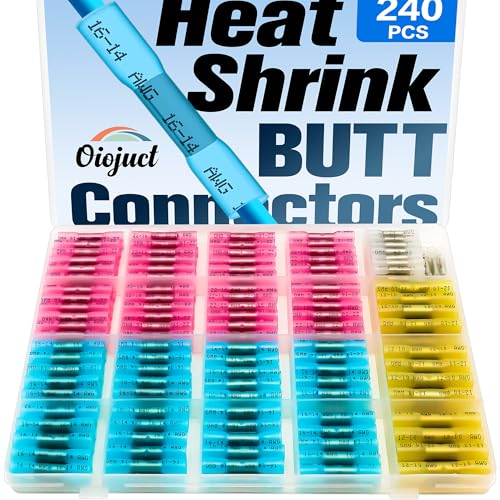
This 240-piece kit focuses on one of the most common repair tasks — splicing two wire ends together with a waterproof butt connector. The barrels are made from copper for good conductivity, and each connector is wrapped in dual-wall polyolefin heat shrink with an inner adhesive liner. When heated, the tubing shrinks at roughly a 3:1 ratio and the melt flows into the gaps around the wire insulation, creating a sealed joint that resists moisture and vibration.
Owners appreciate the assortment of sizes included, which covers the typical gauges encountered in automotive and marine work. The connectors crimp down cleanly with a standard ratchet tool, and the heat shrink activates evenly with a heat gun. A few users noted that the smallest sizes can be tricky to handle without fine-tipped pliers, but overall the quality is consistent across the kit. The UL specification listed on the packaging adds a layer of confidence for those who need traceable standards.
For general electrical repairs — trailer lights, engine sensors, interior accessory wiring — this kit provides a straightforward solution at a reasonable investment. It does not include ring or spade terminals, so you will need a separate set for those connections, but as a dedicated butt-splice assortment it covers the essentials well.
What works
- Copper barrels deliver solid electrical conductivity
- Adhesive-lined heat shrink seals effectively against moisture
- UL-rated materials add quality assurance
What doesn’t
- No ring or spade terminals included
- Smallest sizes require careful handling
5. Dolphin DC-100S Super B Connector w/Sealant 100 Pcs

Dolphin DC-100S connectors are a no-strip, two-wire IDC splice that has been on the market since 2009 and maintains a loyal following. Each connector has a funnel-shaped entry that guides the wires into position, and internal jagged contacts pierce the insulation when the cap is compressed. The housing is pre-filled with dielectric sealant that encapsulates the connection and blocks moisture, making these popular for low-voltage outdoor and automotive repairs.
Users consistently describe these as quick, dependable, and ideal for situations where stripping and crimping would take too long. The connectors work well with 18-22 AWG solid and stranded wire, and the sealant stays pliable so it does not crack with temperature changes. Some owners wished the connectors were available in a wider gauge range, but for signal wires, trailer lighting, and landscape cables, the DC-100S performs reliably year after year.
Because these connectors do not require any tool beyond a pair of pliers to squeeze them shut, they are an excellent backup to keep in a glove box or tool bag. The 100-count pack brings the per-connector cost down significantly compared to retail hardware-store prices, and the straightforward design means almost anyone can make a solid connection on the first try.
What works
- No wire stripping needed — installs in seconds
- Dielectric sealant protects against moisture and corrosion
- Funnel-entry design simplifies wire insertion
What doesn’t
- Limited to smaller gauge wires (18-22 AWG)
- Not suitable for high-current or power circuits
Hardware & Specs Guide
Insulation-Displacement Connectors (IDC)
These connectors use internal metal forks that pierce the wire insulation when compressed, making contact with the conductor without requiring stripping. They are quick to install and ideal for low-current signal circuits, taps, and outdoor lighting. Most IDC connectors include dielectric grease to seal the puncture point against moisture. However, they are generally not rated for high-amperage circuits where a crimped barrel connection is preferred.
Crimp-Style Butt and Terminal Connectors
These connectors require bare wire inserted into a metal barrel and compressed with a crimping tool. A proper ratchet crimper creates a gas-tight cold weld between the wire and the barrel, minimizing resistance and preventing oxidation. Adhesive-lined heat shrink adds a waterproof seal. Crimp connectors support a wider gauge range and higher current loads, making them the standard for automotive power wiring and engine-bay applications.
Terminal Materials and Plating
Brass is the most common terminal material due to its good conductivity and moderate cost. Tinned copper offers superior corrosion resistance in marine and salt-exposed environments. Steel terminals are cheaper but rust quickly and should be avoided for exterior or under-hood use. Tin plating on brass contacts further reduces oxidation and is a sign of quality in connectors that will face humidity or temperature cycling.
Gauge Compatibility and Color Coding
Connectors are sized for specific wire gauge ranges, and many manufacturers use color coding to indicate size — blue for 18-14 AWG, red for 22-18 AWG, yellow for 12-10 AWG. Using a connector too large for the wire results in a loose crimp and high resistance; using one too small can damage the conductor. Always verify the AWG range on the package and match it to your wire before assembling.
FAQ
What is the difference between IDC and crimp connectors?
Are heat shrink connectors truly waterproof?
Can I use automotive connectors on household wiring?
What crimping tool do I need for heat shrink connectors?
How do I choose the right wire gauge for a connector?
Final Thoughts: The Verdict
For most buyers, the best automotive wire connectors winner is the Kikerike 376Pcs 25 Kits because it provides the broadest range of pin configurations in a single organized kit, making it ideal for complete harness repairs and accessory installations. If you want a turnkey setup with a quality crimper, grab the Sopoby Crimping Tool with 300PCS connectors. And for quick no-strip splices on low-voltage circuits, nothing beats the simplicity of the Dolphin DC-100S.

Certification: BSc in Mechanical Engineering
Education: Mechanical engineer
Lives In: 539 W Commerce St, Dallas, TX 75208, USA
Md Amir is an auto mechanic student and writer with over half a decade of experience in the automotive field. He has worked with top automotive brands such as Lexus, Quantum, and also owns two automotive blogs autocarneed.com and taxiwiz.com.