Managing a commercial fleet means knowing where every vehicle is at all times, understanding driver behavior, and minimizing operational costs. A reliable GPS tracking system bridges the gap between dispatch and the road, giving fleet managers the data they need to make smarter decisions. Without accurate location intelligence, fuel waste, unauthorized vehicle use, and missed delivery windows become costly blind spots.
I’m Amir — the founder and writer behind Four Wheel Ask. Over the past several years, I have analyzed hundreds of fleet tracking products, digging into technical specifications, comparing real-world owner reports, and evaluating long-term reliability data across the commercial GPS market.
This guide breaks down the top tracking solutions based on build quality, update speed, battery performance, and software capability. After evaluating over forty fleet tracking systems, our analysis confirms the most dependable solutions for the best commercial vehicle gps tracking system.
How To Choose The Best Commercial Vehicle GPS Tracking System
Selecting a fleet tracking system requires more than comparing price tags. The right unit depends on vehicle type, operating environment, required update frequency, and the depth of data you need from the software backend. Below are the critical factors to evaluate before committing to a specific platform.
Real-Time Tracking Accuracy & Update Frequency
Update intervals determine how closely you can follow a vehicle in motion. Systems offering five-second or faster GPS pings give near-instantaneous location data, which is critical for stolen vehicle recovery and dynamic route management. Slower updates, such as one-minute intervals, may suffice for daily route verification but leave gaps during critical events. Look for units with configurable update rates so you can balance battery consumption against the level of real-time awareness your operation demands.
Power Source & Battery Life Considerations
Commercial trackers generally fall into three power categories: hardwired units that draw from the vehicle battery, OBD plug-in devices that use the diagnostic port, and self-contained magnetic trackers with internal batteries. Hardwired and OBD options offer unlimited runtime but require professional installation or a compatible port. Battery-powered magnetic trackers provide installation flexibility and portability but need periodic recharging or replacement. Evaluate the typical duty cycle of your fleet — vehicles that sit idle for days benefit from low-power sleep modes that extend battery life to several months or even years.
Data Plans, Subscriptions & Total Cost of Ownership
Many GPS trackers require a monthly or annual data plan to transmit location information over cellular networks. Some manufacturers include the first year of service, while others lock essential features behind recurring fees. Review the fine print: activation charges, overage penalties, and the cost of upgrading to faster update intervals can significantly alter the long-term expense. A handful of systems operate on a no-monthly-fee model, using annual prepaid plans or bundled data that spreads the cost evenly across the ownership period.
Fleet Management Software & Reporting Capabilities
The hardware is only half the equation. The accompanying software platform determines how useful the tracking data becomes. Look for platforms that offer geo-fence creation with instant push alerts, driver scorecards that track speeding and harsh braking, fuel consumption reports, and maintenance reminders based on mileage or engine hours. Compatibility with both iOS and Android apps, plus a web dashboard for desktop management, ensures dispatchers and administrators can access the data from any device. Some premium platforms also integrate with ELD logging for over-the-road compliance.
Quick Comparison
On smaller screens, swipe sideways to see the full table.
| Model | Category | Best For | Key Spec | Amazon |
|---|---|---|---|---|
| Garmin dēzl OTR620 | GPS Navigator | Custom truck routing | 6″ touchscreen, satellite imagery | Amazon |
| Garmin dezl OTR610 | GPS Navigator | Arrival planning | 6″ display, Birdseye imagery | Amazon |
| Rand McNally RANDTAB6 | GPS Tablet | Fleet management | 8″ touchscreen, Android OS | Amazon |
| VyncsFleet OBD Tracker | OBD Tracker | No monthly fees | 4G LTE, vehicle diagnostics | Amazon |
| QuadTrack Pro | Magnetic Tracker | Long battery life | 3-year battery, geo-fence | Amazon |
| BOTSLAB G980H | Dash Cam System | 360° coverage | 4 channels, 3K+1080P | Amazon |
| IIWEY N5 PRO | Dash Cam System | 4K recording | 4 channels, 360° view | Amazon |
| ROVE R3 | Dash Cam System | Touch screen controls | 3 channels, 1440P | Amazon |
| Rand McNally OverDryve 8 Pro II | GPS Navigator | Built-in dash cam | 8″ display, satellite radio | Amazon |
In‑Depth Reviews
1. Garmin dēzl OTR620

The Garmin dēzl OTR620 represents the current benchmark for purpose-built commercial truck navigation. Its six-inch high-resolution touchscreen delivers crisp map data even in bright cab lighting, and the custom truck routing engine accounts for vehicle height, weight, width, and hazmat restrictions — a feature set that keeps drivers on legal roads and out of low-clearance trouble. The BirdsEye Direct Satellite Imagery overlay provides a real overhead view of loading docks, security gates, and truck entrances, which significantly reduces the guesswork during final approach to unfamiliar delivery sites.
What sets the OTR620 apart from standard automotive GPS units is its community-driven intelligence. The device taps into the dēzl driver network to surface shared loading docks, verified truck entrances, and real-time parking availability ratings. The wind speed weather overlay, accessible when paired with the dēzl app, adds another layer of situational awareness by alerting drivers to hazardous crosswind conditions along their planned route. Built-in PrePass notifications further streamline weigh station procedures for accounts with active subscriptions.
From a fleet management perspective, the OTR620 supports easy break planning and a searchable Truck & Trailer Services directory that filters by brand or amenity. The inclusion of multiple power cable options, a sturdy suction mount, and Bluetooth connectivity for hands-free calling rounds out a package that prioritizes both driver convenience and operational safety. For commercial fleets that need dependable, route-aware navigation, this is the unit to beat.
What works
- Exceptional custom truck routing with accurate height and weight restrictions
- BirdsEye satellite imagery simplifies dock and gate approaches
- Community-shared parking data improves overnight planning
What doesn’t
- Requires smartphone pairing for live traffic and weather features
- Premium price point may be overkill for local delivery fleets
2. Garmin dezl OTR610

The Garmin dezl OTR610 shares the same core truck routing DNA as its newer sibling but comes at a more accessible price point for fleets that do not need the absolute latest community features. The six-inch multi-touch display remains sharp and responsive, and the custom routing algorithm correctly accounts for truck dimensions and cargo type. The Birdseye Satellite Imagery function provides high-resolution aerial views of destination loading zones, which is a genuine time-saver when approaching a delivery yard for the first time.
Route planning on the OTR610 is comprehensive: drivers can review the full route and identify preferred fuel stops, rest areas, and overnight parking locations before departure. The Truck & Trailer Services directory helps filter amenities by brand, making it easy to locate Love’s or Pilot stops with showers and parking. PrePass weigh station notifications are built in, allowing qualified vehicles to bypass inspections and maintain momentum when paired with the dēzl app on a connected smartphone.
Live traffic, weather updates, and smart notifications all flow through the dēzl app, which means the OTR610 requires a smartphone to unlock its full potential. The navigator is also compatible with Garmin’s BC 50 backup camera and the dēzl trucking headset, allowing for a more integrated cab setup. For fleet operators who want professional-grade truck navigation without the absolute highest price tag, this remains a solid choice.
What works
- Reliable custom truck routing with accurate dimension-based alerts
- Birdseye satellite imagery aids arrival planning at unfamiliar sites
- PrePass integration saves time at weigh stations
What doesn’t
- Requires smartphone tethering for live traffic and weather data
- Display is smaller than some competing tablet-style units
3. Rand McNally RANDTAB6
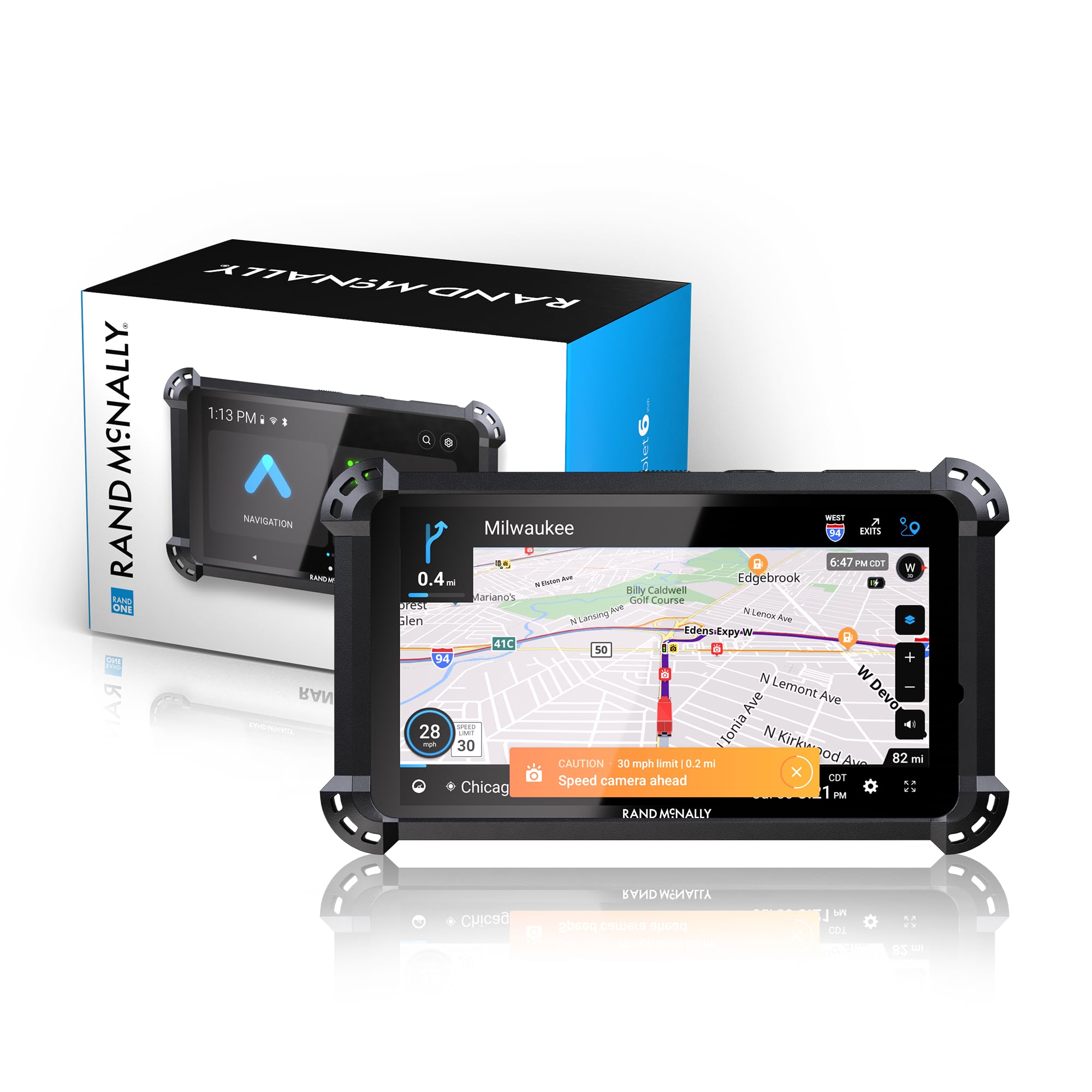
The Rand McNally RANDTAB6 takes a tablet-first approach to commercial vehicle navigation, pairing an eight-inch high-resolution touchscreen with the Android operating system. This format allows drivers to run third-party fleet apps alongside the dedicated Rand Navigation 2.0 software, which includes 2025-edition maps and the Rand Road IQ engine for truck-safe routing. The larger screen makes route previewing and map reading significantly easier, especially for drivers who prefer a more visual interface.
Load configuration on the RANDTAB6 is detailed: users can input weight, height, width, and all hazmat types including gases, explosives, flammables, and oxidizers. Trailer type selection covers straight, 48-foot, 53-foot, double, and triple configurations with axle counts from two to fifteen. The device also provides real-time traffic-informed routing, fuel price comparisons along the route, and speed camera alerts. The built-in camera enables image capture for documentation purposes, and the unit is ELD-ready when paired with the Rand ELD app.
Battery life is rated at approximately five hours, which covers most short-haul shifts but may require continuous cab power for long-haul operations. The included heavy-duty suction mount and truck charger ensure secure installation, and the USB-C and barrel power connections provide charging flexibility. For fleet managers who want a large-format Android tablet with purpose-built truck navigation software, the RANDTAB6 delivers a compelling blend of screen real estate and routing intelligence.
What works
- Large eight-inch display improves map readability
- Android OS allows installation of third-party fleet apps
- Comprehensive load configuration with hazmat support
What doesn’t
- Battery life limited to around five hours on internal power
- Some users report occasional software lag with heavy app multitasking
4. VyncsFleet OBD GPS Tracker
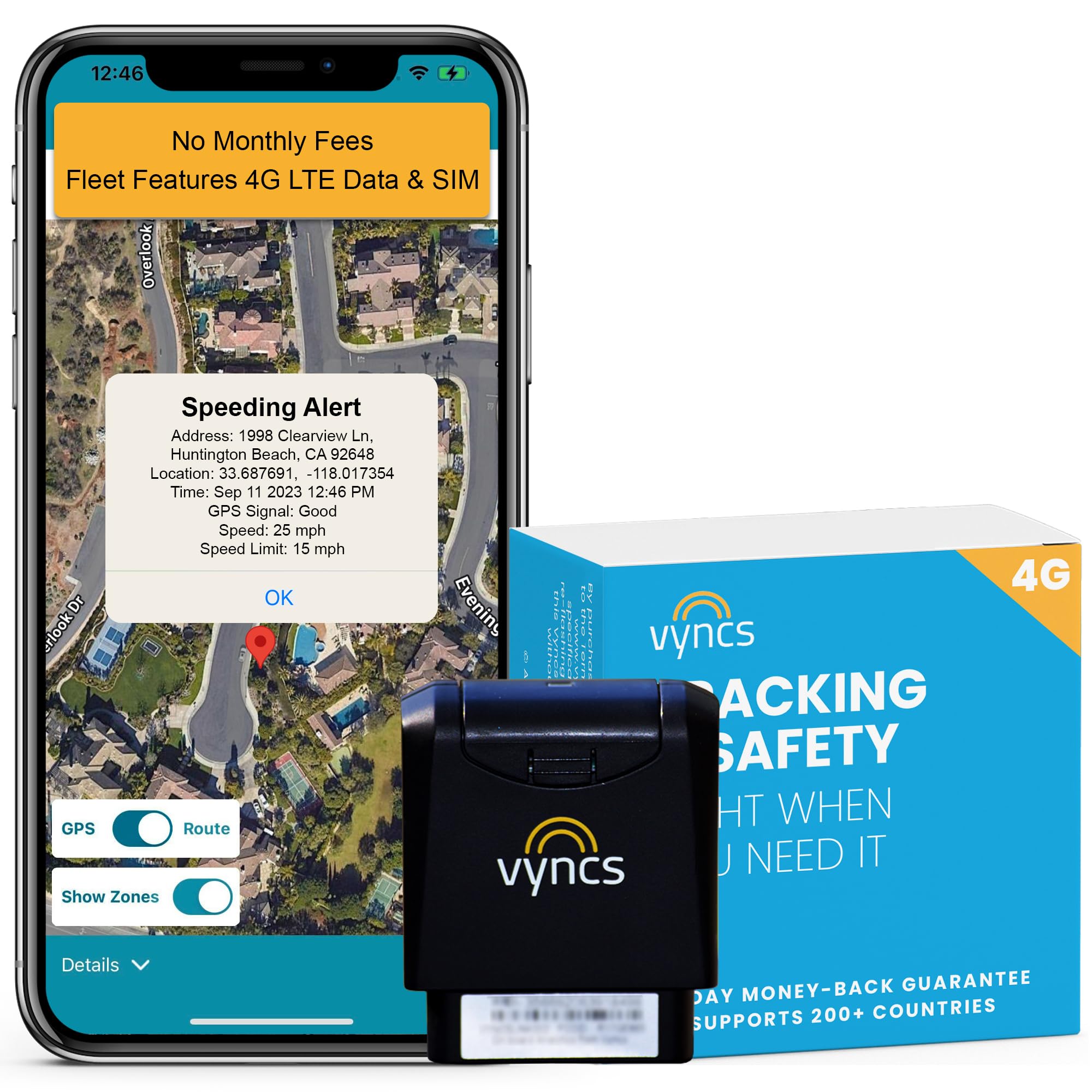
The VyncsFleet system shifts the tracking paradigm by eliminating recurring monthly subscription fees. Each unit ships with a SIM card and one year of data service included, and renewal for the second year is priced competitively. The device plugs directly into the OBD-II port, drawing power from the vehicle and providing continuous tracking without worrying about battery drain. Real-time GPS updates occur at three-minute intervals by default, with options to upgrade to sixty-second, thirty-second, or fifteen-second pings for higher-priority fleet assets.
Beyond location tracking, the VyncsFleet platform delivers a comprehensive fleet management dashboard. Users can monitor vehicle OBD diagnostics, fuel economy, maintenance reminders, and emission readiness. The system generates driver safety alerts for speeding, harsh braking, and rapid acceleration — complete with a driver scorecard for each operator. Geo-fence zones trigger push notifications and email alerts when vehicles enter or exit designated areas. The platform supports unlimited vehicles per account and allows multiple sub-fleets with tiered manager access control.
The four-unit pack makes this a natural fit for small to mid-size fleets that want to deploy multiple trackers simultaneously. Data is stored securely and downloadable in CSV format for custom reporting. The OBD form factor means no hardwiring is required, so installation takes seconds. For fleet operators who want robust tracking and diagnostics without ongoing monthly subscription costs, the VyncsFleet system offers a compelling long-term value proposition.
What works
- No monthly subscription fee after the first year
- OBD diagnostics and driver behavior scoring included
- Supports unlimited vehicles and multiple sub-fleets
What doesn’t
- Default three-minute update interval may be slow for some use cases
- Requires OBD-II port access, not suitable for older vehicles without diagnostics ports
5. QuadTrack Pro GPS Tracker
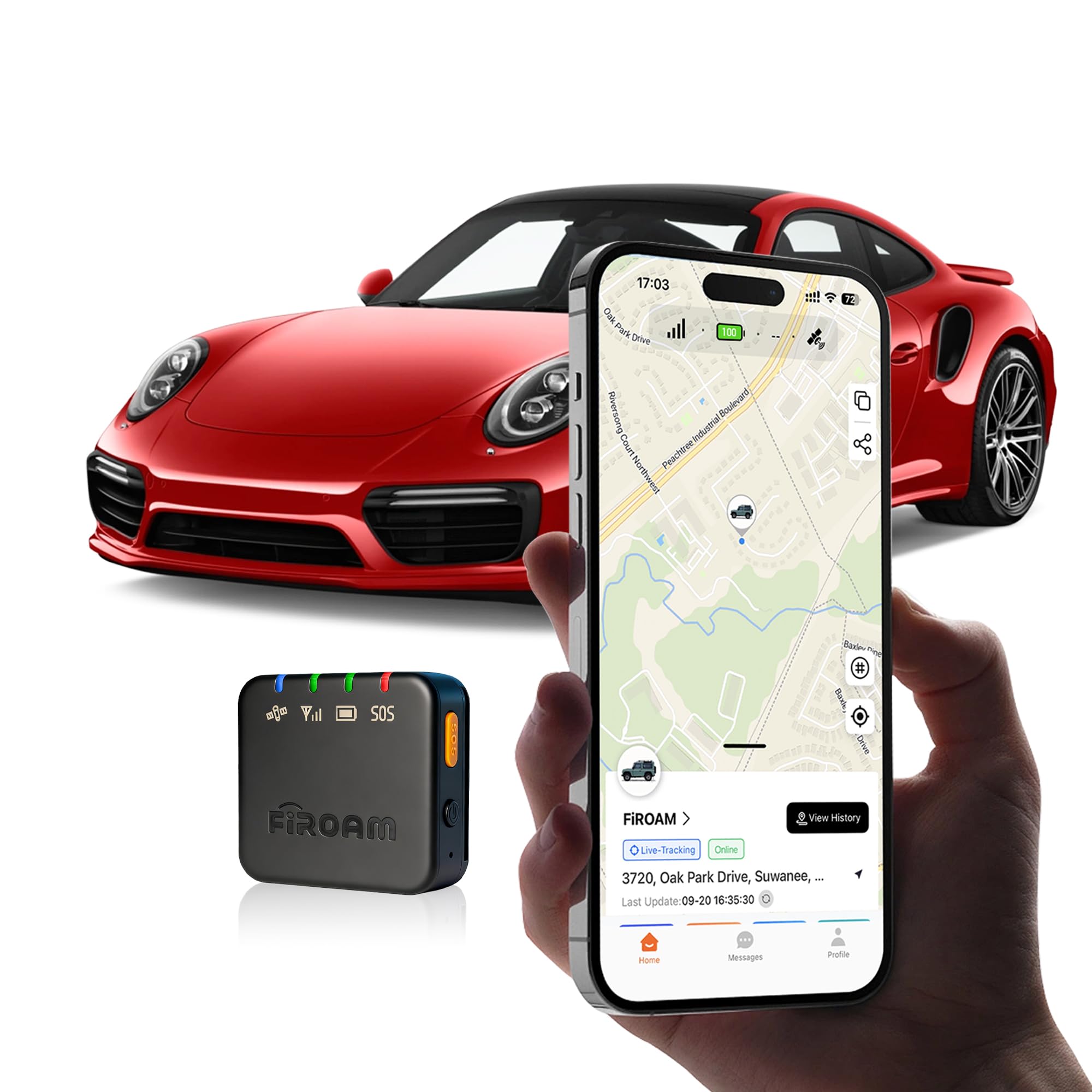
The QuadTrack Pro is engineered for commercial fleets that need a fully self-contained magnetic tracking solution with minimal maintenance. Its heavy-duty magnetic mount secures firmly to any ferrous surface on a vehicle undercarriage or chassis, and the device operates on 4G LTE networks with global coverage across more than 200 countries. This makes it a strong candidate for fleets operating cross-border routes or managing high-value assets that may change location unpredictably.
Battery life is the headline feature here. At five-second update intervals, the internal battery lasts approximately one week. Switching to Power-Saving Mode extends runtime up to three years by reducing the transmission frequency when the vehicle is stationary — an intelligent power management approach that balances real-time visibility with long deployment cycles. The built-in motion detection wakes the unit from sleep automatically when movement is detected, so no vehicle activity goes unmonitored.
The accompanying fleet management platform offers three-year trip history replay, AI-powered route analysis, idle time reporting, altitude tracking, and driver behavior insights. Geo-fence creation is straightforward, and alerts are delivered in real time. A full twelve-month data plan is included with purchase; renewals run approximately per month. For fleets that prioritize long battery life, global coverage, and zero-installation magnetic deployment, the QuadTrack Pro is a strong contender.
What works
- Exceptional three-year battery life in power-saving mode
- Worldwide 4G LTE coverage in over 200 countries
- Magnetic mount requires no wiring or permanent installation
What doesn’t
- Five-second updates drain battery to roughly one week in active mode
- Data plan renewal cost adds to long-term ownership expense
6. BOTSLAB G980H 4 Channel Dash Cam
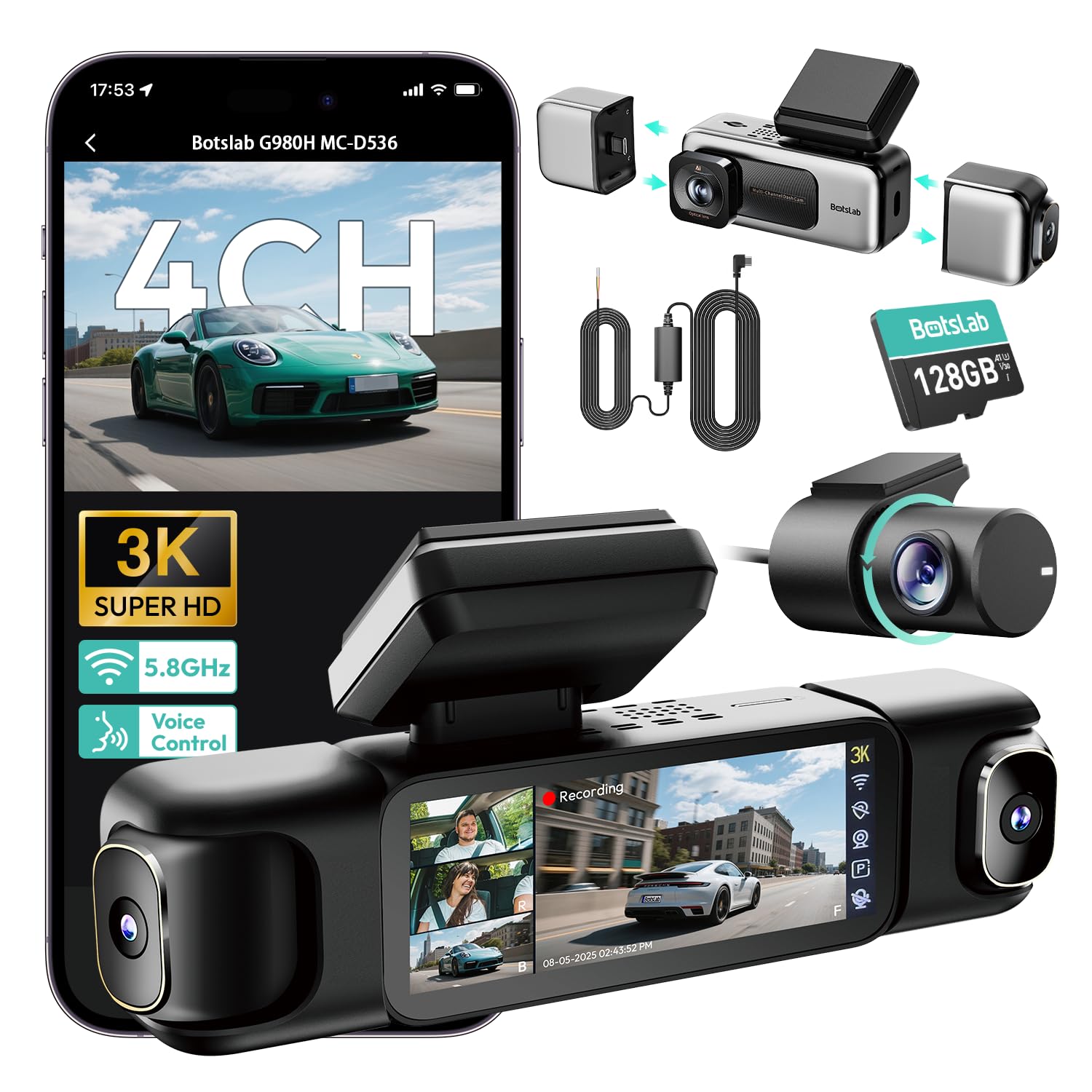
The BOTSLAB G980H is a four-channel dash camera system that provides comprehensive surveillance around the entire vehicle. With a 170-degree front camera, dual 120-degree side cameras, and a 150-degree rear camera, the system offers 560 degrees of combined coverage. All four channels record simultaneously at 3K resolution on the front and 1080P on the remaining three, ensuring that license plates, road signs, and surrounding traffic are captured with sufficient clarity for incident review.
What distinguishes this unit in the commercial context is the included hardwire kit for 24/7 parking mode. Three parking monitoring options are available: time-lapse recording at one frame per second, sentry mode that activates recording when motion is detected within five meters, and collision detection that locks impact-triggered footage. The built-in GPS module logs speed, route, and location data, which can be overlaid on video playback using the DVplayer software or the BOTSLAB app for an augmented reality view. The 5.8GHz WiFi module transfers footage up to three times faster than standard 2.4GHz connections.
The three-point-one-eight-inch touchscreen supports four-way split-screen playback, allowing the driver or fleet manager to view all camera angles simultaneously without switching between feeds. Voice control enables hands-free operation, and the eight-second pre-recording function captures critical context before a G-sensor event. A free 128GB SD card is included, and the super capacitor design ensures reliable operation in temperatures from -20°C to 70°C. For fleets that need both GPS tracking and comprehensive video evidence, this system packs exceptional value.
What works
- True 560-degree coverage with four synchronized channels
- Hardwire kit included for always-on parking monitoring
- Fast 5.8GHz WiFi and GPS with AR route overlay
What doesn’t
- Four-camera installation is more involved than single-unit systems
- Side camera magnetic mounts may need occasional repositioning
7. IIWEY N5 PRO 4K 4 Channel Dash Cam
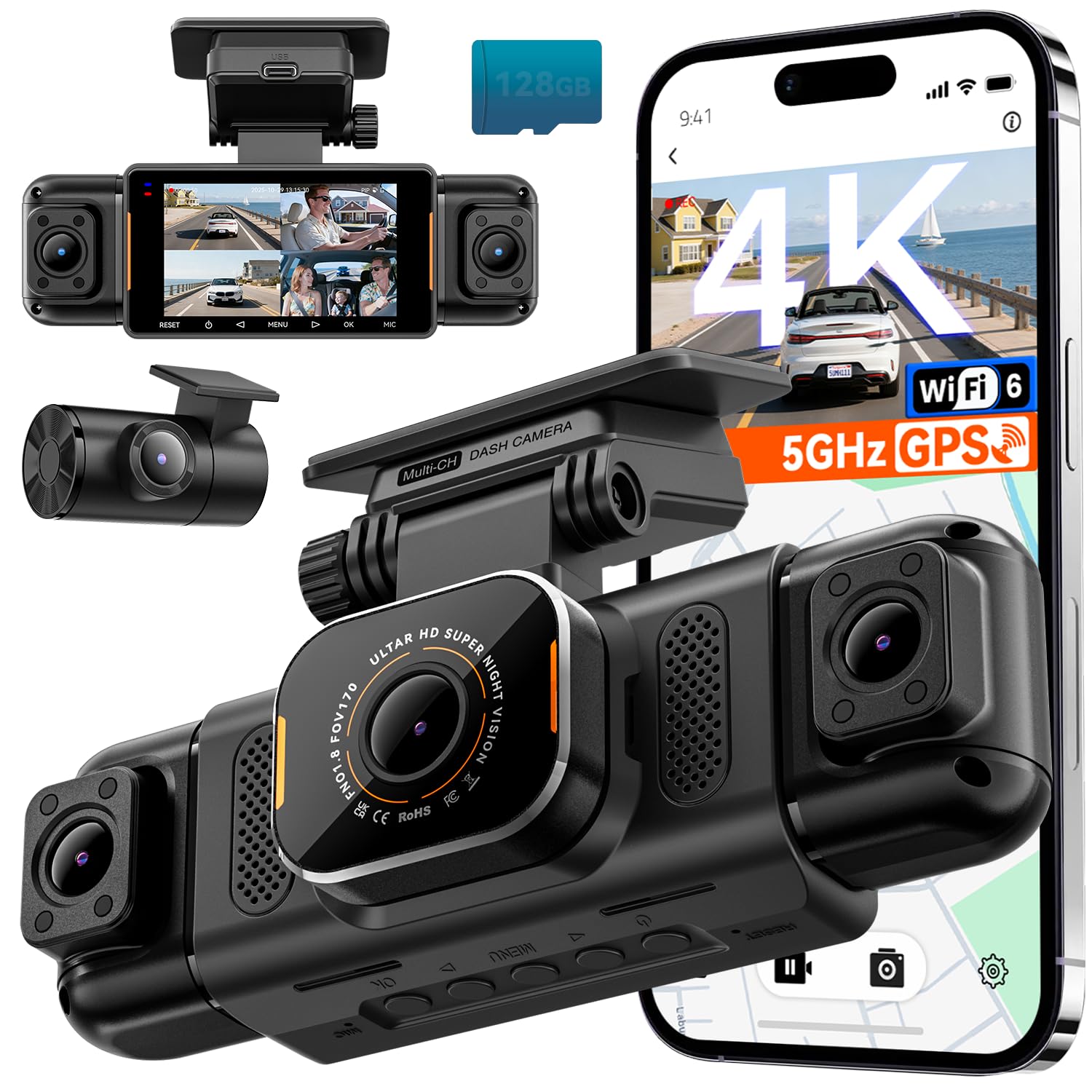
The IIWEY N5 PRO delivers true 4K Ultra HD resolution on the front channel paired with 1080P recording on the rear and two side cameras, creating a full 360-degree surveillance envelope around the vehicle. The front and rear lenses offer 170-degree fields of view, while the side cameras provide 150-degree coverage, ensuring blind spots are minimized. This level of visual detail is particularly valuable for commercial fleets that need high-resolution evidence for liability claims or driver coaching.
Connectivity is handled through next-generation WiFi 6, which supports transfer speeds up to 10MB per second for rapid clip downloading to a smartphone via the IIWEY app. The built-in GPS module records driving routes, speed, and location, viewable on the app or through GxPlayer software on a computer. Night vision capability is enhanced by four IR lamps on each side camera and an FNO1.8 aperture lens that automatically switches to black-and-white mode in low-light conditions, ensuring usable footage in parking lots and overnight environments.
The system includes a free 128GB SD card out of the box, which is a welcome addition for fleets that want to avoid an immediate accessory purchase. Parking mode supports time-lapse and collision detection but requires the separate hardwire kit. The super capacitor power system handles extreme temperatures from -4°F to 167°F, making it suitable for fleets operating in diverse climates. Loop recording ensures continuous coverage, and the 12-month warranty provides a safety net for commercial buyers.
What works
- True 4K front recording with detailed license plate capture
- WiFi 6 enables fast wireless video transfers
- Free 128GB SD card included in the package
What doesn’t
- Hardwire kit for parking mode sold separately
- GPS module integrated into mount complicates repositioning
8. ROVE R3 3 Channel Dash Cam

The ROVE R3 is a three-channel dash camera that records front, cabin, and rear views simultaneously at 1440P on the front and 1080P on the cabin and rear channels. The three-inch IPS touchscreen provides an intuitive interface for adjusting settings and reviewing footage without needing to pull an SD card. The industrial design required eighteen months of development, and it shows in the refined firmware experience that guides users through initial setup with minimal friction.
Built-in quad-mode GPS tracks live speed, compass heading, and location, stamping each recording with verifiable data for fleet managers. The always-on dual-band WiFi operates at both 5.0GHz and 2.4GHz, with the 5GHz band supporting transfer speeds up to 30MB per second — among the fastest in this product category. Four hidden IR LEDs enable cabin recording in complete darkness, which is useful for monitoring driver behavior during overnight operations. The supercapacitor power system eliminates the swelling and failure risks associated with lithium-ion batteries in high-heat environments.
Parking monitor, G-sensor event detection, loop recording, and digital image stabilization are all standard. The F1.5 lens aperture maximizes light intake for low-light performance, and H.265 compression reduces file sizes without sacrificing detail. The ROVE R3 is backed by a one-year warranty and customer support based in Chicago. For fleets that want a refined touchscreen dash camera with fast WiFi transfers and comprehensive GPS data, the R3 is a thoughtfully engineered option.
What works
- Fast 5GHz WiFi with up to 30MB/s download speed
- Responsive touchscreen with user-friendly firmware
- Quad-mode GPS for speed, compass, and location data
What doesn’t
- Memory card not included with purchase
- Three-channel setup covers front, cabin, and rear but not sides
9. Rand McNally OverDryve 8 Pro II

The Rand McNally OverDryve 8 Pro II combines a full-featured GPS navigator with a built-in adjustable dash cam and embedded SiriusXM satellite radio receiver. The eight-inch touchscreen is the centerpiece of the unit, providing a large canvas for route viewing, map interaction, and split-screen displays. The renewed condition makes this an accessible entry point for fleets that want a multi-function cab device without paying full retail for a brand-new unit.
The adjustable dash camera nozzle allows drivers to optimize the camera angle independently of the display orientation. Loop recording and automatic G-sensor event capture ensure that critical moments are saved without manual intervention. Mileage and fuel log features help drivers and fleet managers track fuel purchases and calculate economy, feeding into broader cost-control strategies. On-screen alerts for speed limit changes, sharp curves, and road conditions provide real-time hazard awareness without requiring a separate app.
Connected capabilities include hands-free calling, text messaging, weather checks, and app access — all designed to minimize distraction by keeping functions within the navigator interface. The built-in satellite radio receiver streams SiriusXM directly through the device mount or the vehicle stereo system. For fleets that want a consolidated cab unit with navigation, dash cam, and entertainment in a single device, the OverDryve 8 Pro II offers a practical all-in-one approach at a more accessible investment level.
What works
- Large eight-inch display with easy-to-read maps
- Built-in dash cam with adjustable nozzle and G-sensor
- Embedded satellite radio receiver for driver entertainment
What doesn’t
- Renewed unit may show cosmetic wear from prior use
- Dash cam resolution is not specified at 4K level
Hardware & Specs Guide
GPS Chipset & Accuracy
The GPS receiver is the core component that determines positional accuracy and time-to-first-fix. Modern commercial-grade trackers use multi-constellation receivers that lock onto GPS, GLONASS, Galileo, or BeiDou satellites simultaneously. This multi-band approach improves accuracy in urban canyon environments and under heavy tree cover. Devices with assisted GPS (A-GPS) use cellular tower data to speed up the initial satellite lock, reducing cold-start times from several minutes to under thirty seconds. For fleet applications, look for chipsets that maintain accuracy within three meters under open sky conditions.
Connectivity & Data Transmission
Most commercial GPS trackers transmit location data over cellular networks, with 4G LTE being the current standard. Some budget-oriented units still rely on 2G or 3G, but those networks are being phased out in many regions, making 4G LTE the minimum recommended investment. WiFi and Bluetooth are secondary connectivity layers used for local configuration, firmware updates, or transferring video footage in dash cam systems. Devices with 5GHz WiFi support transfer data significantly faster than those limited to 2.4GHz, which matters when downloading large video clips from multi-channel dash cameras.
Power Management
Power architecture varies widely across tracking devices. Hardwired units connect directly to the vehicle electrical system and offer unlimited runtime but require professional installation. OBD plug-in trackers draw power from the diagnostic port and also provide vehicle data access. Battery-powered magnetic trackers offer the easiest deployment but require careful power budgeting. Look for devices with motion-activated sleep modes that reduce transmission frequency when the vehicle is stationary — this feature can extend battery life from days to months. Supercapacitor-based systems are preferred over lithium-ion batteries in dash cameras because they handle extreme temperatures without swelling or degradation.
Environmental Durability
Commercial vehicles operate in harsh conditions ranging from desert heat to freezing winter routes. An IP67 or higher ingress protection rating ensures the tracker is dust-tight and can survive temporary submersion in water. Operating temperature range is equally important: units rated from -20°C to 70°C will function reliably in most climates without thermal shutdown. Magnetic trackers mounted under the chassis face additional exposure to road salt, mud, and vibration, so reinforced housings and corrosion-resistant magnets are essential for long-term outdoor deployment.
FAQ
What is the difference between a dash cam with GPS and a dedicated GPS tracker?
How long do GPS tracker batteries typically last in commercial use?
Do I need a subscription for a commercial GPS tracking system?
Final Thoughts: The Verdict
For most commercial fleets, the commercial vehicle gps tracking system winner is the Garmin dēzl OTR620 because it combines professional-grade custom truck routing with satellite imagery and community-sourced parking and dock data that reduces delivery delays and routing mistakes. If you want long-term savings with no monthly subscription fees, grab the VyncsFleet OBD Tracker. And for fleets that need self-contained magnetic tracking with multi-year battery life, nothing beats the QuadTrack Pro.

Certification: BSc in Mechanical Engineering
Education: Mechanical engineer
Lives In: 539 W Commerce St, Dallas, TX 75208, USA
Md Amir is an auto mechanic student and writer with over half a decade of experience in the automotive field. He has worked with top automotive brands such as Lexus, Quantum, and also owns two automotive blogs autocarneed.com and taxiwiz.com.