Heat soak from an exposed fuel tank doesn’t just rob your engine of consistent fuel temperature — it accelerates vapor lock, degrades fuel over time, and turns your daily driver into a temperamental machine that stumbles on warm restarts. A proper heat shield is the difference between predictable performance and chasing intermittent drivability issues.
I’m Amir — the founder and writer behind Four Wheel Ask. I’ve spent years analyzing product specifications, build quality data, and real owner feedback across thousands of automotive aftermarket components to separate marketing claims from engineering reality.
Whether you are restoring a classic truck or upgrading a modern off-roader, choosing the right thermal barrier protects your fuel system from radiant exhaust heat. After evaluating dozens of options based on material science, real-world temperature ratings, and installation demands, the best fuel tank heat shield must deliver lasting insulation without adding unnecessary weight or complexity to your undercarriage.
How To Choose The Best Fuel Tank Heat Shield
Selecting a heat shield for your fuel tank goes beyond grabbing the first sheet of aluminized material you see. The undercarriage environment combines constant vibration, moisture exposure, and concentrated radiant heat from the exhaust path. A shield that works well on a firewall may fail prematurely when mounted near a fuel tank. Understanding material construction, temperature tolerance, and attachment method saves you from a repeat job in six months.
Temperature Rating and Material Layering
The continuous operating temperature rating tells you whether the shield can handle sustained exhaust proximity. Ceramic fiber cores handle higher sustained heat than compressed fiberglass, while the outer aluminum foil reflects radiant energy back toward the source. Look for a minimum continuous rating of 1000°F if the shield sits near the exhaust manifold or catalytic converter. For tank-side locations farther from direct exhaust, 500°F continuous may suffice, but a higher ceiling provides a safety margin against heat spikes during sustained climbs or towing.
Attachment Method and Mechanical Security
Adhesive-backed heat shields offer quick installation but rely entirely on surface cleanliness and bond strength. On an off-road vehicle or in regions with freeze-thaw cycles, adhesive can degrade. Mechanical fastening — stainless steel zip ties, rivets, or bolting through pre-drilled holes — provides redundant security. The best universal kits include both adhesive options and mechanical fasteners so you can choose the method that matches your environment and driving habits.
Quick Comparison
On smaller screens, swipe sideways to see the full table.
| Model | Category | Best For | Key Spec | Amazon |
|---|---|---|---|---|
| Dorman 999-986 | Direct Replacement | OEM-fit restoration | Vehicle-specific bolt-on design | Amazon |
| Thermo-Tec 14130 | Thermal Barrier | Sound & heat insulation | 1/4 in. thick, 1500°F rated | Amazon |
| AggSound 16×80 in. | Universal Wrap | Custom DIY coverage | 0.5mm embossed aluminum, 1022°F | Amazon |
| FOURUB 36×24 in. | Heat Shield Mat | High-temp barrier | 195mil, 2300°F ceramic fiber | Amazon |
| Kreem 19-103 | Tank Liner | Rust & leak prevention | 3-step coating system | Amazon |
In‑Depth Reviews
1. Dorman 999-986 Fuel Tank Heat Shield

The Dorman 999-986 is a direct-replacement fuel tank heat shield engineered to match the original equipment fitment on select Toyota models, including the Corolla, Matrix, and Pontiac Vibe. Rather than trimming a universal sheet and hoping the contours line up, this part drops in using the factory mounting points, which means no guesswork, no excess material flapping in the airstream, and no gaps that let radiant heat bypass the shield. The stamped steel construction with a corrosion-resistant coating mirrors the durability of the OE part while addressing the common failure point of rusted-out originals.
From a spec-analysis standpoint, the Dorman 999-986 eliminates the variables that plague DIY solutions. The precise geometry covers the tank bottom and sides where exhaust crossmembers radiate heat upward during prolonged idling or stop-and-go driving. Owner feedback across forums consistently notes that the installation takes less than an hour with basic hand tools, and the shield stays rigid over years of thermal cycling. For anyone restoring a vehicle with a missing or rusted factory shield, this is the most efficient path to restoring the thermal management system as the engineers intended.
The trade-off is that this shield only fits the specific vehicles listed in the fitment guide. If you own something outside that range, you will need to look at universal options. Also, the steel construction adds more weight than an aluminum or ceramic-fiber wrap, though the structural rigidity is a worthwhile exchange for the durability it provides in harsh undercarriage environments.
What works
- Factory-grade direct fit eliminates trimming and alignment issues
- Stamped steel resists deformation from road debris impacts
- Restores full OE heat protection in under an hour
- Backed by Dorman’s century of automotive parts experience
What doesn’t
- Limited to specific Toyota and Pontiac model years
- Heavier than aluminum or fiber-based universal sheets
2. Thermo-Tec 14130 24″ X 48″ One Sided Thermo Guard

Thermo-Tec has built a decades-long reputation in the automotive thermal management space, and the 14130 Thermo Guard sheet reflects that engineering focus. At a quarter-inch thick, this dual-purpose barrier combines 100% synthetic fiber felt with a foil heat reflector that blocks more than 90% of radiant heat up to 1500°F. The fiber layer does double duty as a vibration absorber, which makes it unusually effective at reducing fuel tank drumming and exhaust resonance transmitted through the chassis.
What sets the Thermo-Tec 14130 apart from commodity heat shields is the material integrity. The synthetic felt does not absorb moisture like fiberglass alternatives, so it resists sagging and delamination over time. Cutting it to shape with scissors or a utility knife leaves clean edges that do not fray, and the lightweight construction means you can mount it with adhesive, mechanical fasteners, or both. For fuel tank applications where the shield sits between the tank and a heat source, the combination of reflection and absorption provides a more complete thermal solution than a simple reflective sheet alone.
The primary limitation is the one-sided foil design — only the reflective layer faces the heat source. If you need double-sided reflectivity for tight spaces where heat radiates from multiple directions, this may not be the ideal choice. Additionally, the 24 by 48-inch size requires careful layout planning if you are covering an unusually large or oddly shaped tank.
What works
- Synthetic fiber felt resists moisture and maintains shape over time
- Reduces both radiant heat and structure-borne vibration
- Lightweight enough for adhesive-only mounting in low-vibration areas
- Cuts cleanly without fraying edges or loose fibers
What doesn’t
- One-sided foil limits reflective coverage in tight multi-direction heat zones
- Sheet size may require piecing together for larger fuel tanks
3. AggSound Exhaust Heat Shield 16″ x 80″ Roll
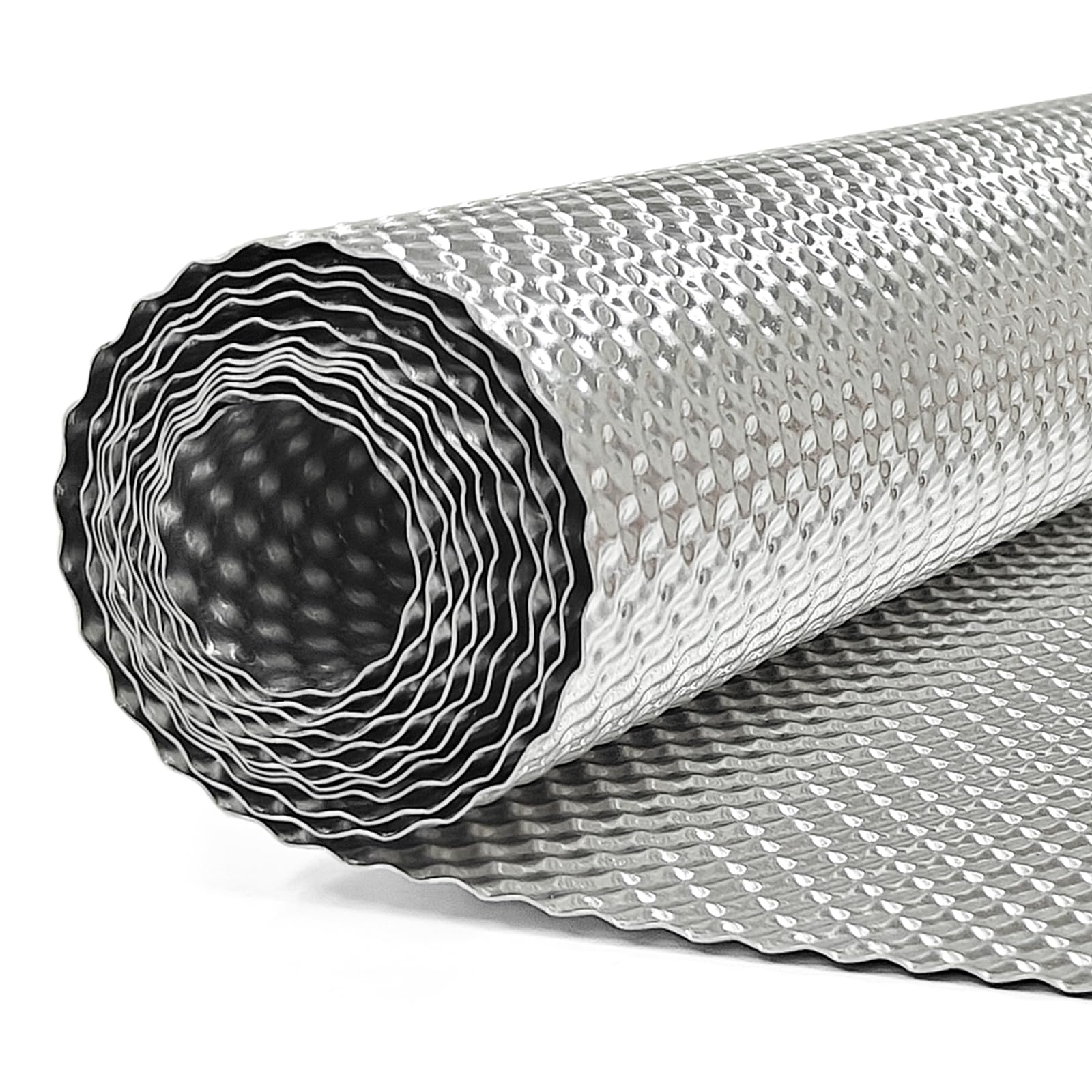
The AggSound exhaust heat shield roll delivers 16 inches by 80 inches of embossed aluminum thermal barrier, providing enough material to wrap a full fuel tank, exhaust pipe sections, and still have leftover for firewall or turbo shielding. The 0.5mm thickness strikes a balance between rigidity and flexibility — the embossing adds structural stiffness while allowing the sheet to be hand-formed around compound curves on tank corners and muffler contours. It includes 40 stainless steel zip ties, so the mechanical fastening hardware is ready out of the package without a separate trip to the hardware store.
From a material science perspective, the embossed texture increases surface area for heat dissipation while reducing direct contact between the shield and the underlying surface. This air gap effect improves the thermal barrier performance compared to a flat sheet pressed directly against the tank. The 1022°F continuous rating covers the vast majority of undercarriage exhaust environments, including turbocharged setups where exhaust housing temperatures run high. Owner reports across repair forums note that the material trims easily with standard household scissors and holds its shape over years of exposure to road salt and moisture.
The main drawback is that the shield material has no adhesive backing, so you must rely entirely on the included zip ties or your own fastening method. In areas where the shield must sit flush against a flat tank face, additional adhesive or mechanical clips may be needed to prevent flutter at highway speeds. Also, cut edges can be sharp — handling with gloves is mandatory to avoid cuts during installation.
What works
- Large 80-inch length covers full tank and exhaust sections in one roll
- Embossed aluminum adds rigidity and improves heat dissipation
- Includes 40 stainless steel zip ties for immediate installation
- Pliable enough to hand-form around complex undercarriage shapes
What doesn’t
- No adhesive layer requires mechanical fastening for a secure fit
- Cut edges are sharp and demand protective gloves during handling
4. FOURUB Automotive Aluminized Heat Shield 36″ x 24″
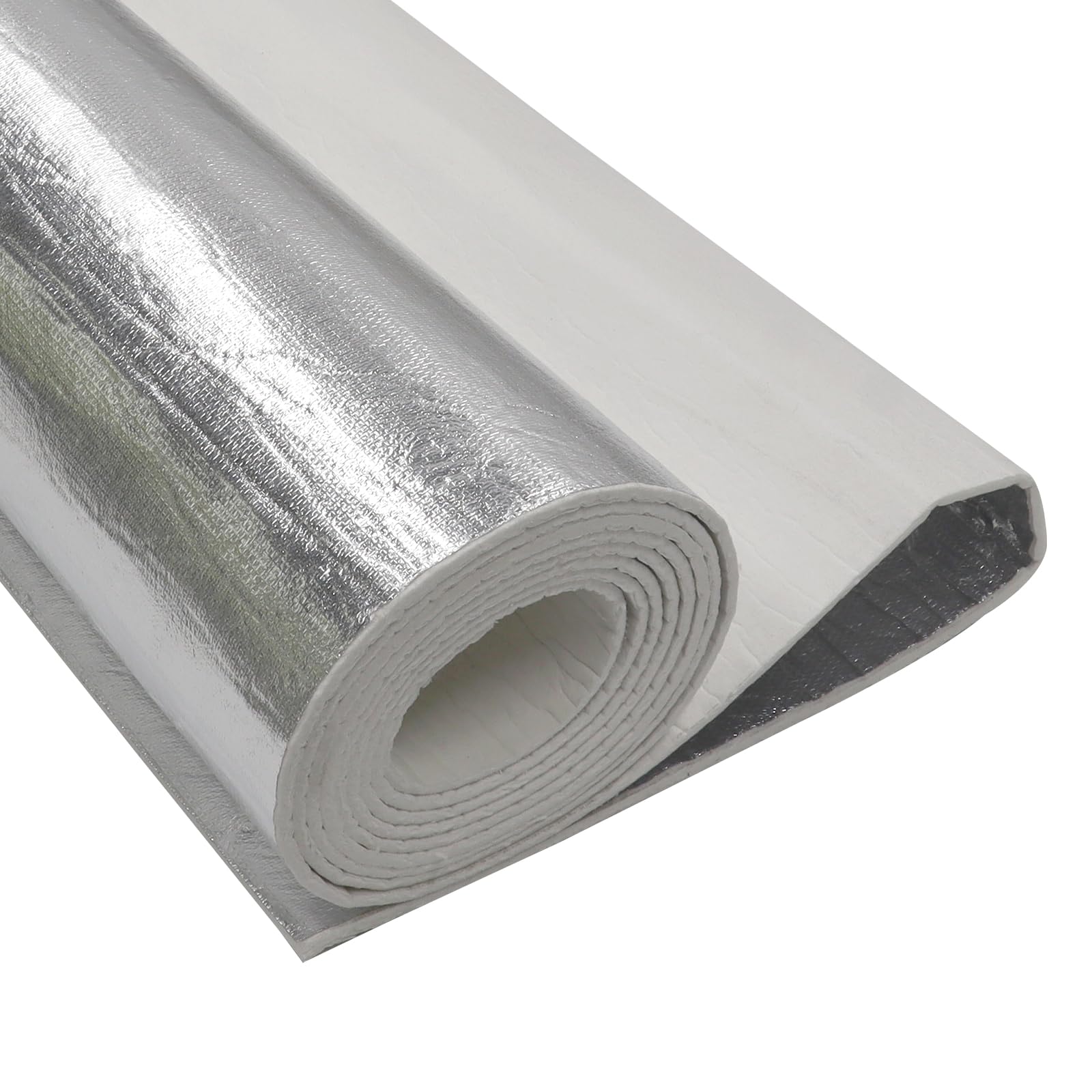
The FOURUB heat shield mat uses a ceramic fiber core laminated with an aluminum foil face to achieve a continuous temperature rating of 2300°F, which places it in a different performance tier than standard fiberglass-based barriers. The 195-mil (approximately 5mm) thickness provides substantial insulation depth while remaining lightweight enough to avoid adding measurable weight to the vehicle. This makes it a strong candidate for applications where the heat source is extremely close to the fuel tank, such as in engine-swapped vehicles or custom exhaust routing where clearances are tight.
Ceramic fiber offers superior thermal stability compared to compressed fiberglass or mineral wool. It does not melt, drip, or emit smoke at high temperatures, and it maintains its insulating properties through thousands of thermal cycles. The aluminum foil reflects up to 97% of radiant heat back toward the source, which means the fuel tank side of the shield stays significantly cooler than the exhaust-facing side. Owner feedback from diesel heater installations and custom automotive builds confirms that the material holds up well even in continuous high-heat scenarios without degradation or delamination.
The non-adhesive version requires careful mechanical fastening to keep it in place, and the ceramic fiber can be slightly irritating to handle without gloves. Some users have noted that the aluminum foil layer can peel away from the ceramic core if the material is repeatedly flexed in the same spot, so pre-forming the shape before final installation is recommended. Additionally, the 36 by 24-inch sheet size may require multiple pieces for full tank coverage on larger vehicles.
What works
- 2300°F continuous rating handles extreme exhaust proximity
- Ceramic fiber core maintains performance through thermal cycling
- Reflects up to 97% of radiant heat back toward the source
- Lightweight construction adds minimal undercarriage weight
What doesn’t
- Aluminum foil can separate from ceramic core with repeated flexing
- Non-adhesive design requires careful mechanical fastening
- Sheet size may not cover large fuel tanks in a single piece
5. Kreem Products 19-103 Fuel Tank Liner Combo Pack

The Kreem 19-103 Fuel Tank Liner Combo Pack takes a fundamentally different approach to fuel tank protection — instead of blocking heat from the outside, it seals and protects the tank interior from rust and corrosion that can lead to pinhole leaks and fuel contamination. This three-step system includes a tank wash to remove old fuel residue and rust particles, a conditioner to etch the metal surface for adhesion, and the liner itself, which forms a continuous polymer barrier inside the tank. While not a heat shield in the traditional sense, a properly lined fuel tank resists the internal condensation that accelerates rust in vehicles that sit for extended periods.
For owners of classic cars, motorcycles, or seasonal-use vehicles, the Kreem liner addresses a failure mode that external heat shields cannot fix: corrosion from within. When a fuel tank develops rust, the debris clogs fuel filters and injectors, and the eventual pinhole leaks create fire hazards that no heat shield can mitigate. By sealing the interior surface, the Kreem system stops the rust cycle at its source. The three-part process takes about a day to complete, with each step requiring proper ventilation and drying time between applications.
The liner works best on tanks that are structurally sound but surface-rusted internally. Tanks with active leaks or heavy scaling require mechanical cleaning or replacement before the liner can bond properly. Some users have reported that ethanol-blended fuels can gradually soften the liner over years of exposure, so it is worth confirming compatibility with the fuel you plan to use. Additionally, the Kreem system is a one-time treatment — if the liner fails, removal is extremely labor-intensive compared to replacing the tank or adding an external heat shield.
What works
- Three-step system thoroughly prepares and seals the tank interior
- Prevents rust and corrosion from within the fuel tank
- Stops small leaks without replacing the entire tank
- Suitable for motorcycles, generators, and classic car restorations
What doesn’t
- Not a heat shield — addresses corrosion, not radiant heat
- Ethanol fuels may degrade the liner over extended exposure
- Installation requires full day with proper ventilation and drying
Hardware & Specs Guide
Temperature Rating
Continuous operating temperature defines the upper limit at which the heat shield maintains its structural and reflective properties without degradation. Ceramic fiber cores like those in the FOURUB shield handle up to 2300°F, while embossed aluminum sheets such as the AggSound roll are rated for 1022°F. Fiber-based barriers with foil facings, including the Thermo-Tec 14130, typically fall in the 1500°F range. Always match the continuous rating to the closest heat source — not the average temperature — because thermal spikes during hard acceleration or towing can exceed ambient exhaust readings by several hundred degrees.
Thickness and Density
Thicker materials provide greater thermal mass and insulation depth but add weight and may be harder to form around tight curves. The FOURUB 195-mil ceramic fiber mat offers substantial insulation for tight-clearance applications, while the 0.5mm AggSound aluminum sheet relies on the air gap created by its embossed texture rather than bulk material. The Thermo-Tec 14130 uses a quarter-inch synthetic felt core that absorbs vibration while insulating. For fuel tank applications, a balance between 3mm and 6mm thickness is generally sufficient for effective heat rejection without installation difficulty.
Reflectivity and Emissivity
Aluminum foil facings reflect radiant heat back toward the source, which is the primary mechanism by which heat shields protect the fuel tank. High-quality aluminized barriers reflect up to 97% of radiant heat, as seen in the FOURUB and Thermo-Tec designs. Embossed aluminum surfaces, like the AggSound roll, create micro air gaps that improve dissipation while maintaining reflectivity. The reflective coating must remain intact — delamination or oxidation reduces performance over time. Mechanical fastening prevents the foil from rubbing against adjacent surfaces and wearing through.
Attachment and Mounting Considerations
Direct-replacement shields like the Dorman 999-986 use factory bolt holes and require no additional hardware. Universal sheets rely on stainless steel zip ties, adhesive backing, or custom brackets. Zip ties offer quick installation and easy repositioning but should be rated for exhaust-environment temperatures. Adhesive mounting works best on clean, flat surfaces in low-vibration areas — under a fuel tank on a paved-road vehicle rather than an off-road rig. For maximum long-term reliability, combine adhesive with mechanical fasteners to create redundancy against thermal cycling and moisture intrusion.
FAQ
What temperature rating do I need for a fuel tank heat shield?
Can I install a fuel tank heat shield without welding or special tools?
How do I know if I need a universal sheet or a vehicle-specific shield?
Will a heat shield completely eliminate fuel vapor lock?
Final Thoughts: The Verdict
For most buyers, the best fuel tank heat shield winner is the Dorman 999-986 because it eliminates fitment guesswork with a direct OEM-replacement design that installs quickly and lasts. If you prioritize maximum temperature headroom and a lightweight ceramic core for custom applications, grab the FOURUB 36×24. And for a budget-friendly universal solution that covers large areas with plenty of mounting hardware included, nothing beats the AggSound 16×80 roll.

Certification: BSc in Mechanical Engineering
Education: Mechanical engineer
Lives In: 539 W Commerce St, Dallas, TX 75208, USA
Md Amir is an auto mechanic student and writer with over half a decade of experience in the automotive field. He has worked with top automotive brands such as Lexus, Quantum, and also owns two automotive blogs autocarneed.com and taxiwiz.com.