Blown fuses leave you stranded with a dead circuit and a pocketful of spares that never seem to be the right amperage. A breaker fuse replaces that headache with a simple trip-and-reset mechanism that restores power without hunting for replacements.
I’m Amir — the founder and writer behind Four Wheel Ask. I’ve spent years analyzing circuit protection specifications, comparing build quality across brands, and aggregating owner feedback to identify which breaker fuses deliver consistent performance in demanding automotive and marine environments.
Whether you are wiring a winch, a trolling motor, or an auxiliary light bar, the right breaker saves time and money. A high-quality best automotive breaker fuse delivers dependable circuit protection for cars, trucks, boats and off-road rigs without constant fuse changes.
How To Choose The Best Automotive Breaker Fuse
Selecting the right breaker fuse comes down to understanding how your circuit behaves under load and what environment it operates in. Here are the key factors that separate a reliable setup from one that leaves you troubleshooting at the worst moment.
Automatic vs. Manual Reset
Automatic reset breakers reconnect power as soon as the fault clears, which is convenient for remote circuits like fuel pumps where you want the system to self-recover. Manual reset breakers require a physical push to reset, giving you full control and preventing the circuit from cycling on and off repeatedly — critical for sensitive electronics or high-amp audio systems.
Amperage and Voltage Ratings
Every breaker has a continuous current rating and a maximum voltage. Exceeding either risks nuisance tripping or component failure. A 50-amp breaker on a 40-amp draw provides a safe buffer, while the voltage rating must match or exceed your system voltage — 12V for most cars, 24V for trucks, and up to 72V for high-performance marine setups.
Build Quality and Environmental Sealing
Moisture, vibration, and temperature swings are the enemies of electrical connections. Look for waterproof housings, stainless steel or plated terminals, and UL-rated materials. A sealed breaker prevents corrosion inside the contacts, which is the primary cause of intermittent faults in vehicles and boats.
Mounting and Terminal Types
Panel-mount breakers bolt into a pre-drilled hole and are ideal for dashboards or fuse panels. Surface-mount breakers attach directly to any flat surface and are easier to retrofit. Stud terminals (10-32 or 5/16-18) handle high current without overheating, while blade or spade terminals suit lower-amp accessory circuits.
Quick Comparison
On smaller screens, swipe sideways to see the full table.
| Model | Category | Best For | Key Spec | Amazon |
|---|---|---|---|---|
| Blue Sea Systems 5191 | Terminal Block | Heavy-Duty Marine & Inverter Circuits | 30-300A, 58V DC Max | Amazon |
| Erayco 50A | Manual Reset | Marine & Automotive Audio | 50A, 12V-48V DC | Amazon |
| RED WOLF 50A | Manual Reset | Solar & Battery Disconnect | 50A, 12V-48V DC | Amazon |
| E9 Tocas 60A | Manual Reset | Trolling Motors & High-Voltage Marine | 60A, 12V-72V DC | Amazon |
| BBTO 4-Pack 30A | Auto Reset | Budget Multi-Install Projects | 30A, 12V-24V DC | Amazon |
In‑Depth Reviews
1. Blue Sea Systems 5191 Fuse Block Terminal

The Blue Sea Systems 5191 is a terminal fuse block designed for DC main circuits, inverters, windlasses, and bow thrusters where current demands can spike well beyond what standard blade fuses handle. Its compact footprint accepts MRBF fuses from 30A up to 300A, making it one of the most versatile high-amp protection solutions available for both marine and automotive environments.
Weatherproof construction and an insulating cap prevent accidental shorts, which matters when the block is mounted near batteries or in open-cockpit boats. Ignition protection compliance (S.A.E. J1171) means it can be installed in engine compartments without fire risk. The 5/16-18 stud terminals accommodate heavy-gauge cable lugs securely.
Note that fuses are sold separately, so factor that into the upfront cost. The block itself is built to last, with a UL-rated plastic housing that resists heat and corrosion. For anyone running high-draw accessories or a secondary battery bank, this is the benchmark for clean, safe power distribution.
What works
- Handles up to 300A per block for heavy-duty circuits
- Weatherproof design with insulating cap prevents shorts
- Ignition protected for safe engine-bay installation
What doesn’t
- Fuses are not included in the purchase
- Terminal stud size may require adapters for smaller lugs
2. Erayco 50 Amp Circuit Breaker with Manual Reset
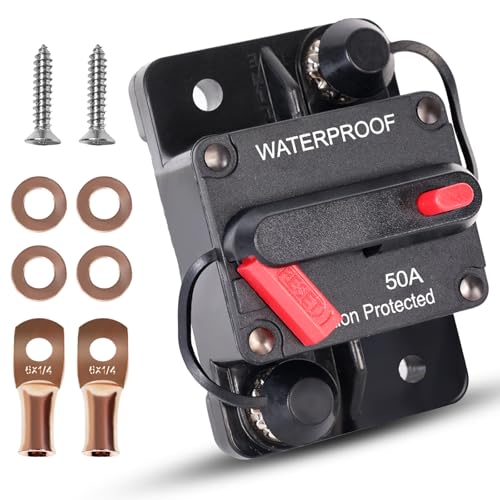
The Erayco 50A breaker brings a manual reset push button that doubles as a kill switch, giving you positive control over power delivery. Rated for 12V to 48V DC, it covers standard automotive systems as well as higher-voltage marine and RV setups. The waterproof cover prevents rust on the metal terminals, a common failure point in saltwater or humid environments.
Ignition protection certifications (S.A.E. J1625, J1171, UL1500) confirm it can be used safely in engine bays and fuel areas. The surface-mount design makes installation straightforward on any flat panel or firewall. It is well-suited for trolling motors, DC audio amplifiers, winches, and battery charger circuits where you want to manually interrupt power without disconnecting cables.
Some users note that the included hardware could be more robust, but the breaker itself trips cleanly and resets with a firm press. The wide voltage range and solid sealing make it a versatile mid-range option for anyone who needs reliable manual-reset protection without stepping up to marine-specific pricing.
What works
- Manual reset doubles as a convenient kill switch
- Waterproof cover protects terminals from corrosion
- Ignition protected for safe use in fuel areas
What doesn’t
- Mounting hardware quality feels basic
- Push button can be stiff on first few cycles
3. RED WOLF 50A Amp Circuit Breaker
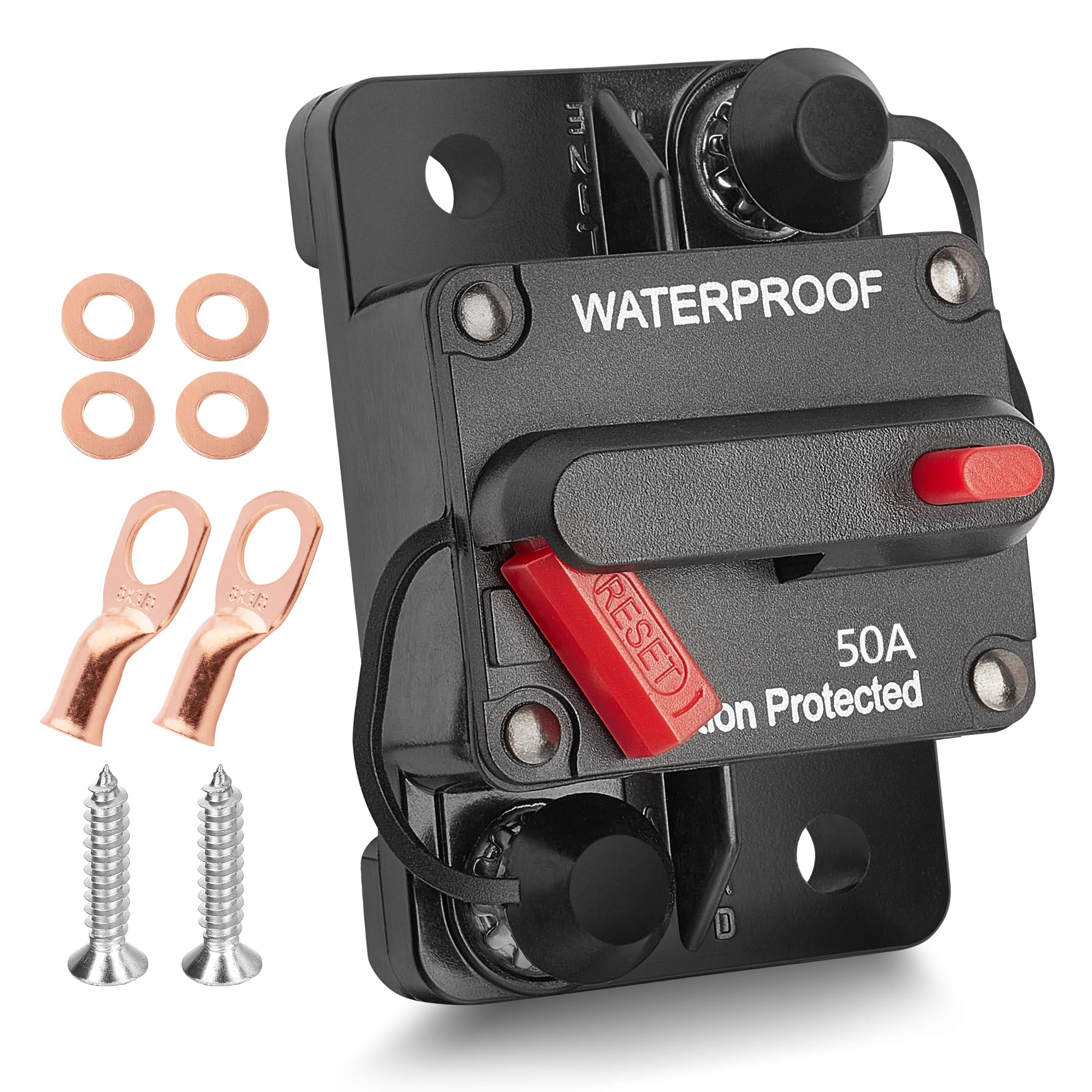
The RED WOLF 50A breaker is essentially a solid all-rounder for DC systems that require manual reset capability. Its waterproof-resistant housing and copper-core internals are designed to pass electrical performance and aging tests, providing consistent trip behavior over repeated cycles. The included copper ring terminals save you a trip to the hardware store during installation.
This model works as both a circuit breaker and a battery disconnect switch, allowing you to charge or maintain a battery without unhooking all the wiring. Applications range from boat trolling motors and RV auxiliary circuits to car stereo amplifiers and solar battery banks. The 12V-48V DC range covers most common setups.
Build quality is good for the price point, though the plastic housing does not carry an ignition protection rating, so it is best mounted away from fuel sources. The switch action is smooth out of the box, and the surface-mount format fits neatly on panels or firewalls. For budget-conscious buyers who still want manual reset control, this delivers strong value.
What works
- Includes copper ring terminals for quick install
- Functions as both breaker and battery disconnect
- Smooth on/off switch action with reliable trip
What doesn’t
- No ignition protection rating for engine bays
- Plastic housing feels less premium than marine-grade alternatives
4. E9 Tocas 60A Manual Reset Circuit Breaker

The E9 Tocas 60A breaker stands out for its wide voltage range of 12V to 72V DC, covering everything from standard car systems to high-voltage trolling motor setups that run on 48V or even 72V. It meets S.A.E. J1625, J1171, and UL1500 ignition protection standards, making it one of the safest choices for installation in engine compartments and fuel-likely areas.
The housing is molded from UL-rated 94V0 thermalplastic, which resists flame and high temperatures. The manual reset button also functions as an on/off switch, giving you the ability to kill power to a circuit instantly. Its compact surface-mount design fits easily into tight spaces on boats, RVs, trucks, and off-road vehicles.
A six-month warranty against manufacturer defects provides a small safety net, though most owners report trouble-free operation well beyond that window. The 60A rating hits a sweet spot for larger trolling motors, auxiliary battery chargers, and high-output DC audio systems. If you need a breaker that can handle 72V without sacrificing safety certifications, this is a top candidate.
What works
- Wide voltage range supports 12V up to 72V systems
- Ignition protected and UL-rated 94V0 housing
- Compact size fits tight installation areas
What doesn’t
- Only six-month warranty included
- No terminal covers provided for extra protection
5. BBTO 4-Pack 30A Automatic Reset Circuit Breaker

The BBTO 4-pack delivers automatic reset circuit breakers at a per-unit cost that makes them ideal for projects requiring multiple protection points. Each breaker uses a thermal automatic reset mechanism that reconnects power once the overload condition clears, which is convenient for circuits that are hard to access — such as fuel pumps or hidden auxiliary feeds.
Waterproof red protective covers shield the 10-32 stud terminals from moisture and debris, reducing corrosion risk. The plastic rustproof housing is lightweight and suitable for automotive, marine, off-road, and small equipment applications. Rated for 12V to 24V DC at 30A, these fit standard car, truck, and boat accessory circuits.
Because these are automatic reset, they are not ideal for sensitive electronics that could be damaged by repeated cycling. For basic protection on lighting, fans, or pumps where you want the system to self-recover, the BBTO pack offers solid value. The 4-pack format also means you can keep spares on hand or outfit multiple vehicles at once.
What works
- Four breakers in one pack for multi-project use
- Waterproof covers prevent terminal corrosion
- Automatic reset ideal for hard-to-reach circuits
What doesn’t
- Automatic reset can cycle repeatedly on persistent faults
- Limited to 30A and 24V maximum input
Hardware & Specs Guide
Automatic Reset
Automatic reset breakers use a bimetal strip that heats up and trips under overload, then cools and reconnects power once the fault clears. This is useful for remote or unattended circuits like fuel pumps or bilge blowers where you want the system to self-recover without manual intervention. The downside is that if the fault persists, the breaker will cycle on and off repeatedly, which can damage sensitive electronics.
Manual Reset
Manual reset breakers incorporate a push-button that must be physically pressed to restore power after a trip event. This gives the operator full awareness of the fault and prevents automatic reconnection that could lead to component damage or fire. Most manual-reset breakers also double as a kill switch, allowing you to intentionally disconnect power for maintenance or storage.
Amperage Selection
Selecting the correct amperage rating is critical. A breaker should be sized at 125% of the continuous load current to avoid nuisance tripping, but never exceed the wire gauge rating. Common automotive sizes include 30A for lighting and accessories, 50A for winches and audio amplifiers, and 60A-300A for main supply circuits, inverters, and trolling motors.
Voltage Compatibility
Most automotive breakers are rated for 12V-24V DC systems, but marine and off-road applications frequently require 48V or even 72V support. Using a breaker with a voltage rating lower than your system voltage can cause internal arcing and premature failure. Always verify the breaker’s maximum voltage exceeds your system’s nominal voltage.
FAQ
Can I replace a standard blade fuse with a breaker fuse?
What does ignition protected mean for a breaker fuse?
How do I know if I need automatic or manual reset?
Can I use a 12V breaker on a 24V system?
Final Thoughts: The Verdict
For most buyers, the best automotive breaker fuse winner is the Blue Sea Systems 5191 because it handles the widest current range with marine-grade weatherproofing and ignition protection. If you want a manual reset breaker with safety certifications, grab the E9 Tocas 60A. And for affordable multi-install projects, nothing beats the BBTO 4-pack.

Certification: BSc in Mechanical Engineering
Education: Mechanical engineer
Lives In: 539 W Commerce St, Dallas, TX 75208, USA
Md Amir is an auto mechanic student and writer with over half a decade of experience in the automotive field. He has worked with top automotive brands such as Lexus, Quantum, and also owns two automotive blogs autocarneed.com and taxiwiz.com.