A dead battery on the trail or in a cold parking lot isn’t just an inconvenience — it’s a failure point that can end your day before it starts. The 3.6L Pentastar in the JK generation demands a reliable burst of current every time, and the growing list of aftermarket accessories only increases the electrical load. Choosing the wrong replacement can lead to sluggish cranks, shortened lifespan, or outright fitment issues.
I’m Amir — the founder and writer behind Four Wheel Ask. I’ve spent years digging through battery manufacturer data sheets, comparing cold cranking amp claims against real-world owner reports, and analyzing how different chemistries and plate designs hold up under the vibration and temperature swings that define Wrangler ownership.
After studying owner reports and technical data, finding the best 2013 jeep wrangler battery comes down to your electrical needs and driving style.
How To Choose The Best 2013 Jeep Wrangler Battery
The 2013 Wrangler JK shipped with a Group 34 or Group 65 battery from the factory, but many owners successfully upgrade to Group 35 or Group 94R for improved capacity. Before buying, understand three core factors: battery chemistry, physical dimensions, and electrical output numbers.
AGM vs Flooded: Why Chemistry Matters
The JK platform is known for transmitting road and trail vibration directly to the battery tray. Absorbent Glass Mat (AGM) batteries use compressed glass mats to hold electrolyte, making them significantly more resistant to vibration damage than traditional flooded batteries. AGM also handles deep discharges better — important if you run a winch, lights, or an air compressor without the engine running. If your Wrangler originally came with an AGM battery, you must replace it with another AGM; the charging system is calibrated for it.
Group Size and Physical Fitment
Group 34 batteries measure roughly 10.25 x 6.8 x 7.9 inches and fit the factory tray with the stock hold-down. Group 35 is slightly shorter at 9.06 inches in length but still fits many JK trays with minor adjustments. Group 94R (also called H7) is longer at 12.4 inches and may require aftermarket tray hardware or modifications. Always verify terminal orientation — positive on the right, negative on the left — before committing to a purchase.
Cold Cranking Amps and Reserve Capacity
The 3.6L Pentastar needs at least 650 CCA for reliable cold starts, though 750 CCA or higher provides a comfortable margin in subzero conditions. Reserve Capacity (RC) measures how long the battery can run essential electronics if the alternator fails. A rating of 100 minutes or higher is ideal for Wranglers with aftermarket accessories. Higher CCA and RC numbers generally come from denser plate packs, which also improve cycle life.
Quick Comparison
On smaller screens, swipe sideways to see the full table.
| Model | Category | Best For | Key Spec | Amazon |
|---|---|---|---|---|
| OPTIMA D34 YELLOWTOP | Dual Purpose | Accessories & starting | 750 CCA, 55 Ah, 120 min RC | Amazon |
| OPTIMA 34 REDTOP | Starting | Pure starting power | 800 CCA, 50 Ah, 100 min RC | Amazon |
| Interstate MTX-34 | AGM Premium | Daily driver reliability | 740 CCA, 60 Ah, 115 min RC | Amazon |
| Weize Platinum AGM 94R | High CCA | Maximum cold weather | 850 CCA, 80 Ah, 140 min RC | Amazon |
| Goodyear 35-AGM | Branded AGM | Trusted name value | 650 CCA, 55 Ah, 100 min RC | Amazon |
| Weize Platinum AGM 35 | Budget AGM | Entry-level upgrade | 650 CCA, 55 Ah, 100 min RC | Amazon |
| Autocessking Group 35 | Start-Stop | Basic AGM replacement | 650 CCA, 55 Ah, 100 min RC | Amazon |
| Polaris Heavy Duty AGM | Sealed AGM | Niche Polaris fitment | Sealed, vibration resistant | Amazon |
| MARXON Group 34 | Budget AGM | Low-cost start-stop | 650 CCA, 55 Ah | Amazon |
In‑Depth Reviews
1. OPTIMA D34 YELLOWTOP Dual Purpose Battery
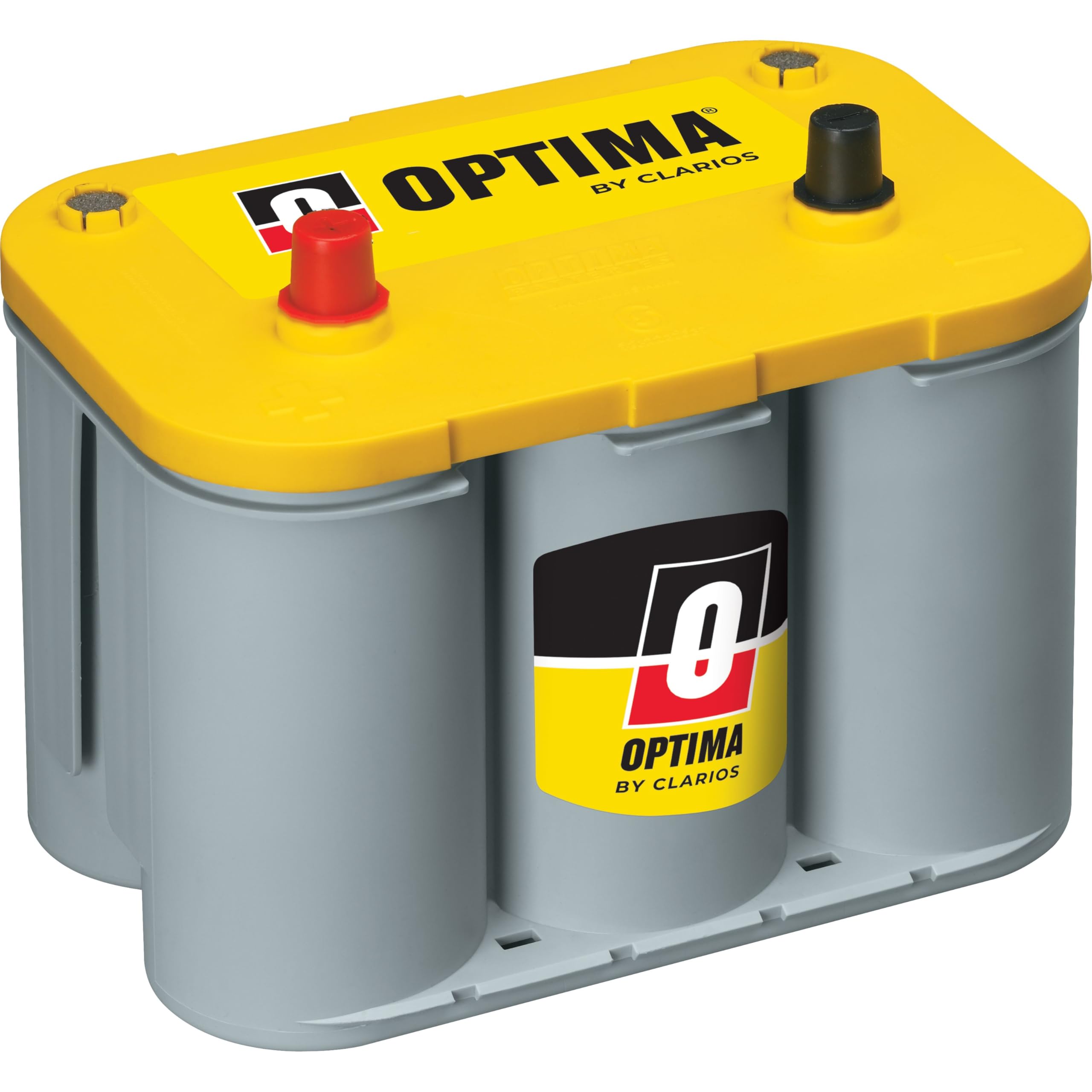
The D34 YELLOWTOP sits at the top of this list because it balances starting power with deep-cycle capability — a combination that directly addresses the dual role most Wranglers play as daily drivers and weekend trail rigs. With 750 CCA and 55 Ah capacity, it cranks the Pentastar reliably while also supporting winch pulls, accessory loads, and extended idling periods without suffering the rapid voltage drop that plagues pure starting batteries. The SpiralCell design uses 99.99 percent pure lead wrapped in tight spirals, which delivers consistent power across a wide temperature range and resists the vibration that kills flat-plate batteries in off-road use.
At 120 minutes of reserve capacity, the YELLOWTOP provides nearly twenty minutes more backup power than the REDTOP, making it the better choice for owners who run lights, radios, or air compressors. The sealed AGM construction allows mounting in multiple positions — though not upside down — which helps when routing battery cables or fitting aftermarket trays. Owner feedback consistently highlights the longevity advantage, with many reporting five to seven years of service in daily-driven Wranglers before replacement is needed.
The primary trade-off is the higher upfront investment, but the cost per year of service often works out favorably compared to budget batteries that need replacement every two to three years. The SAE post terminals make installation straightforward with standard cable ends, and the Group 34 dimensions fit the factory tray without modification. For Wrangler owners who want one battery that handles both starting and accessory demands without compromise, this is the reference standard.
What works
- SpiralCell technology delivers exceptional vibration resistance for off-road use
- 120-minute reserve capacity supports winches and accessories
- Sealed AGM design allows flexible mounting positions
What doesn’t
- Premium pricing places it above budget-oriented buyers
- Slightly lower CCA than REDTOP for pure cold-start scenarios
2. OPTIMA 34 REDTOP Starting Battery

The REDTOP is optimized specifically for engine starting, and the numbers reflect that focus: 800 CCA and a 100-minute reserve capacity make it one of the strongest pure starting batteries in the Group 34 size. The 800-CCA rating provides a generous buffer for the 3.6L Pentastar, ensuring quick cranking even when temperatures drop below zero or after the engine has sat for weeks. Like the YELLOWTOP, it uses SpiralCell construction with pure lead wrapped in spiral plates, which delivers 15 times the vibration resistance of standard flooded batteries.
Where the REDTOP differs is in its deep-cycle capability. It can handle occasional accessory loads, but it is not designed for repeated deep discharges — the plate count and chemistry prioritize high burst current over sustained draw. For Wrangler owners who use their vehicle primarily on pavement and rarely run accessories with the engine off, the REDTOP delivers exceptional starting reliability and typically lasts three to five years in service. The faster charging acceptance compared to conventional AGM batteries means it recovers quickly after short trips.
The SAE terminal layout matches the stock Wrangler cable configuration, and the Group 34 dimensions drop into the factory tray with no modifications required. Owner reports note that the REDTOP handles extreme cold particularly well, with minimal voltage sag even after multiple start attempts. The main consideration is that owners with winches, high-power audio systems, or camping accessories will quickly find the 100-minute reserve capacity limiting compared to dual-purpose alternatives.
What works
- 800 CCA provides industry-leading cold-start power
- SpiralCell design resists vibration damage on rough roads
- Faster charging acceptance than standard AGM batteries
What doesn’t
- Not designed for repeated deep-cycle accessory use
- Lower reserve capacity than dual-purpose alternatives
3. Interstate Batteries MTX-34 AGM
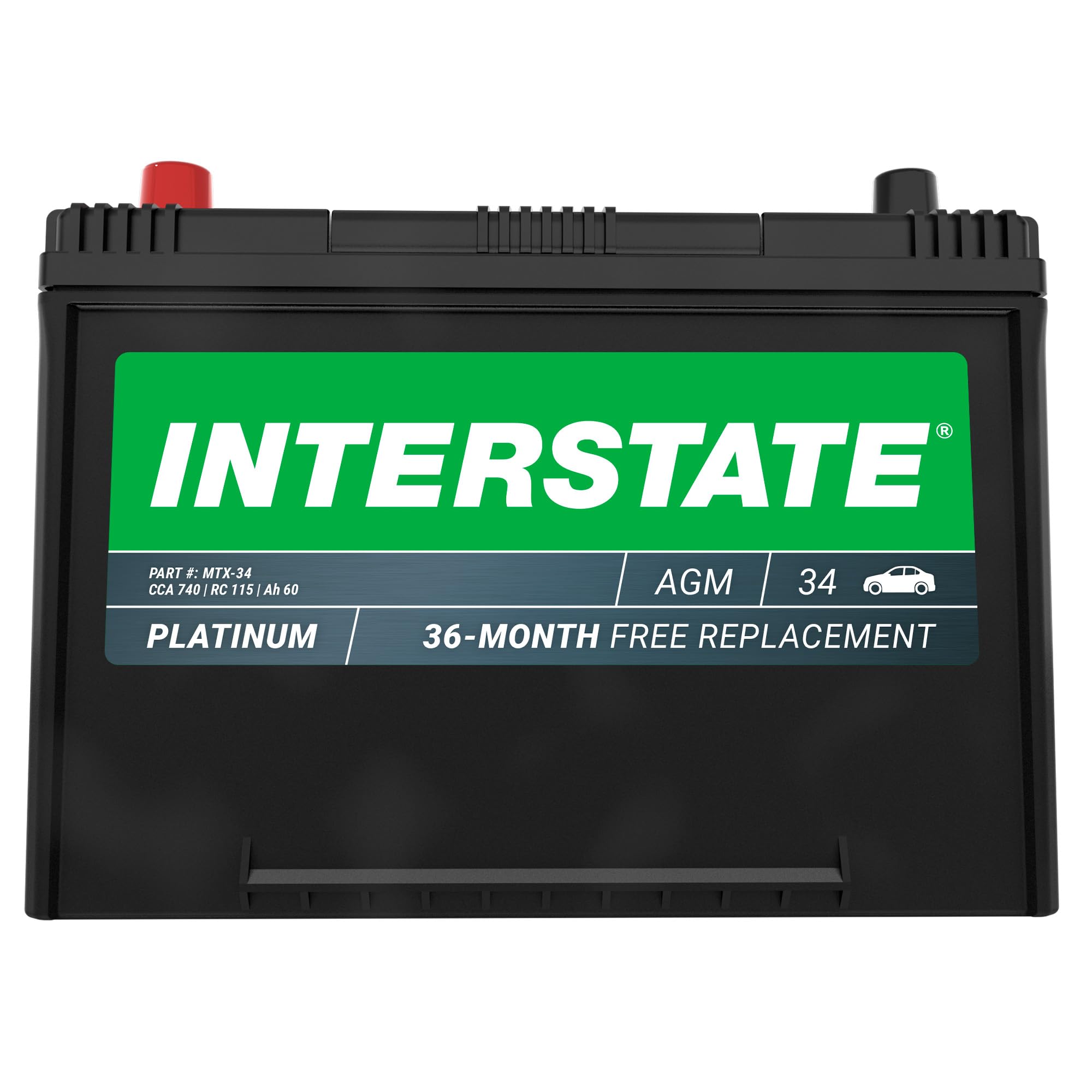
Interstate Batteries brings decades of automotive battery manufacturing experience to the MTX-34, an AGM design that delivers 740 CCA and 115 minutes of reserve capacity in a Group 34 package. The MTX series is positioned as a premium upgrade over conventional flooded batteries, offering twice the cycle life at 80 percent depth of discharge compared to standard lead-acid designs. For a Wrangler owner, that translates to longer service intervals and better tolerance for the parasitic drain from onboard electronics.
The 60 Ah capacity provides a solid power reservoir for moderate accessory loads, and the AGM construction eliminates the risk of acid spills during off-camber trail driving. The dimensions — 10.25 inches long, 6.81 inches wide, and 7.75 inches tall — align closely with the factory Group 34 specification, so the factory hold-down hardware works without adjustment. Terminal orientation follows the standard positive-right, negative-left layout that the JK wiring harness expects.
Interstate backs the MTX-34 with a 36-month warranty, which is competitive for the premium AGM segment. Owner feedback emphasizes the consistent cranking performance across temperature extremes and the battery’s ability to hold a charge during periods of infrequent use. The primary drawback is the price point, which sits near the top of the mid-range segment but below the Optima options. For buyers who trust the Interstate brand and want a drop-in AGM upgrade without modifying the tray, this is a solid contender.
What works
- Double the cycle life of conventional flooded batteries
- Direct Group 34 fitment with factory hold-down
- 36-month warranty provides long-term coverage
What doesn’t
- Premium pricing limits appeal to budget-conscious buyers
- Not available in Group 35 size for alternate fitments
4. Weize Platinum AGM BCI Group 94R

The Weize Platinum AGM Group 94R stands out for its raw output numbers: 850 CCA, 80 Ah capacity, and 140 minutes of reserve capacity. These are the highest figures in this comparison, making it the battery of choice for Wrangler owners in extreme cold climates or those who run heavy electrical loads. The Group 94R form factor is longer than Group 34 or 35 — 12.4 inches from terminal to terminal — so it requires either a compatible aftermarket tray or minor modification to the stock battery location.
The 80 Ah capacity and 140-minute reserve capacity mean this battery can run a winch, lighting array, or refrigerator for extended periods without dropping below safe voltage levels. The AGM construction handles the vibration profile of the JK platform well, and the sealed design prevents corrosion in the engine bay. Weize specifies a wide operating temperature range from minus 22 to 158 degrees Fahrenheit, which covers everything from winter trail rides to summer desert trips.
The 36-month warranty is standard for this tier, and owner feedback points to strong cold-weather performance and consistent voltage stability. The trade-off is the physical size — not every Wrangler battery tray will accommodate a 94R without work. Measure your available space and check terminal orientation before purchasing. For owners willing to address the fitment, the Weize 94R delivers premium specs at a mid-range price point that undercuts many competitors.
What works
- 850 CCA provides class-leading cold-start margin
- 140-minute reserve capacity handles heavy accessory loads
- 80 Ah capacity supports extended engine-off use
What doesn’t
- Group 94R length requires tray modification for many Wranglers
- Heavier than Group 34 or 35 alternatives
5. Goodyear 35-AGM Platinum Series
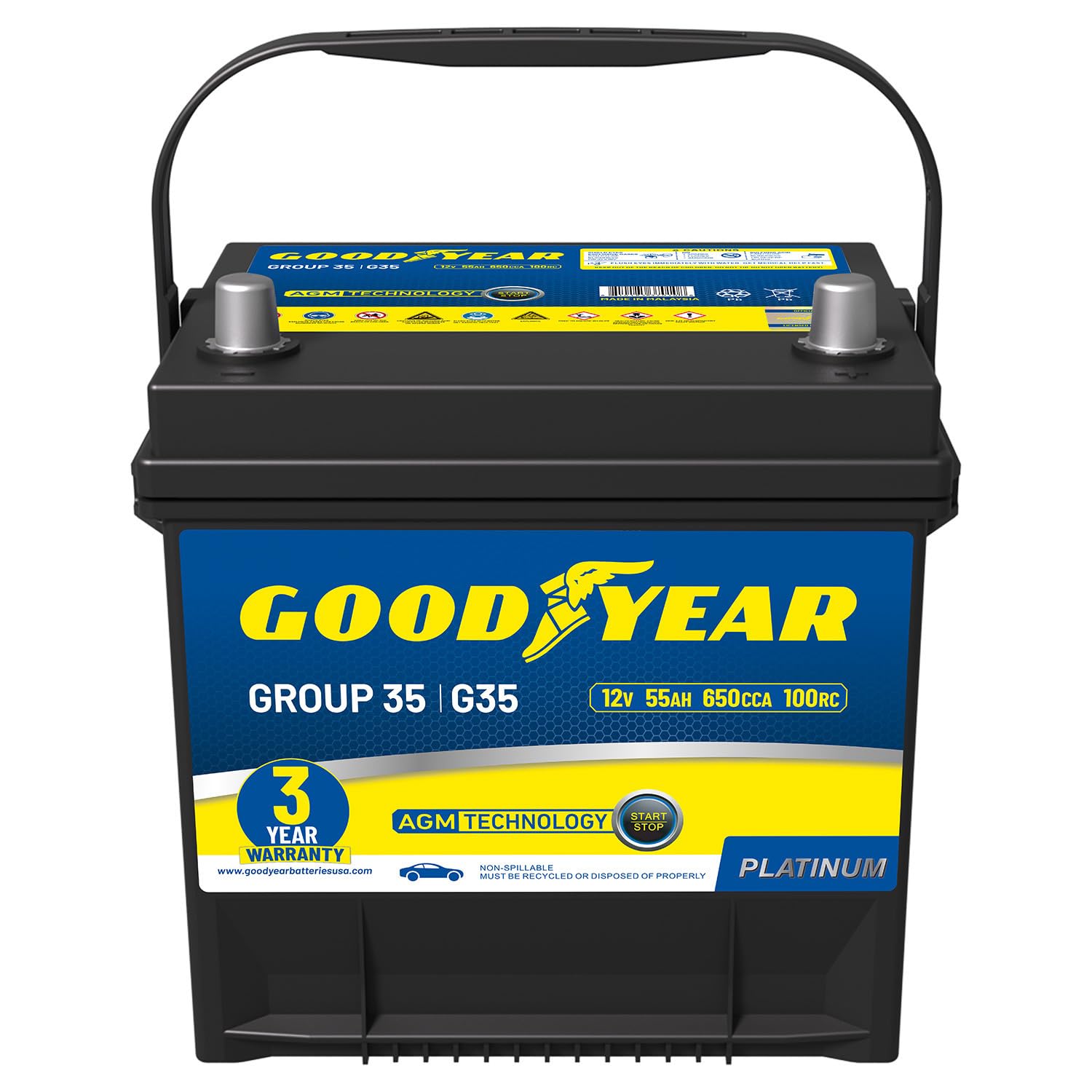
The Goodyear 35-AGM brings a well-known tire and automotive brand into the battery space, and the Platinum series specification sheet justifies the badge. With 650 CCA, 55 Ah capacity, and 100 minutes of reserve capacity, it meets the minimum recommended specs for the 3.6L Pentastar while providing a reasonable buffer for moderate accessory loads. The Group 35 dimensions — 9 inches long, 7 inches wide, and 8.87 inches tall — fit many JK battery trays with the stock hold-down.
The AGM construction delivers the usual benefits: spill-proof operation, vibration resistance, and maintenance-free service. Goodyear claims up to twice the cycle life of conventional flooded batteries, which aligns with AGM chemistry best practices. The 100-minute reserve capacity is adequate for typical daily driving and occasional accessory use, though owners with winches or high-draw audio systems may want more margin. The battery is CE certified and built in an ISO-certified facility, which adds a layer of quality assurance.
The 36-month manufacturer warranty is competitive, and the universal fit designation means it works across multiple vehicle platforms. Owner reports note that the battery delivers consistent starting performance and holds charge well during periods of infrequent use. The main limitation is the 650 CCA rating — adequate for most climates but not ideal for extreme cold environments where higher cold cranking amps provide a more comfortable starting margin.
What works
- Trusted Goodyear brand with strong quality certifications
- Group 35 size fits many JK trays without modification
- 36-month warranty provides solid coverage
What doesn’t
- 650 CCA offers minimal margin in extreme cold
- Not ideal for heavy accessory loads or deep cycling
6. Weize Platinum AGM BCI Group 35

The Weize Platinum AGM Group 35 offers the core AGM advantages — spill-proof operation, vibration resistance, and maintenance-free service — at a price point that undercuts most premium brands. The 650 CCA and 55 Ah capacity meet the baseline requirements for the 3.6L Pentastar, and the 100 minutes of reserve capacity covers typical daily driving scenarios. The Group 35 dimensions of 9.06 x 6.89 x 8.82 inches fit the factory tray on many JK models without adjustment.
Weize specifies up to twice the cycle life of conventional flooded batteries, and the low self-discharge rate — under 8 percent after 90 days of storage — makes it a practical choice for Wranglers that see seasonal or intermittent use. The battery handles operating temperatures from minus 22 to 158 degrees Fahrenheit, which covers the full range of conditions a Wrangler might encounter. The tapered terminal layout with left negative and right positive matches the stock JK cable routing.
The 36-month warranty is on par with more expensive alternatives, and Weize maintains a US-based customer service team for warranty claims. Owner feedback emphasizes the strong value proposition — getting AGM performance without paying Optima or Interstate prices. The trade-off is that the 650 CCA rating provides less cold-weather margin than higher-amperage options, and the reserve capacity is adequate rather than generous for accessory-heavy builds.
What works
- Strong value for AGM construction at a competitive price
- Low self-discharge suits seasonal or infrequent driving
- Group 35 dimensions fit many JK trays with no modifications
What doesn’t
- 650 CCA provides limited buffer in extreme cold climates
- 100-minute reserve capacity is modest for high-accessory builds
7. Autocessking Group Size 35 AGM
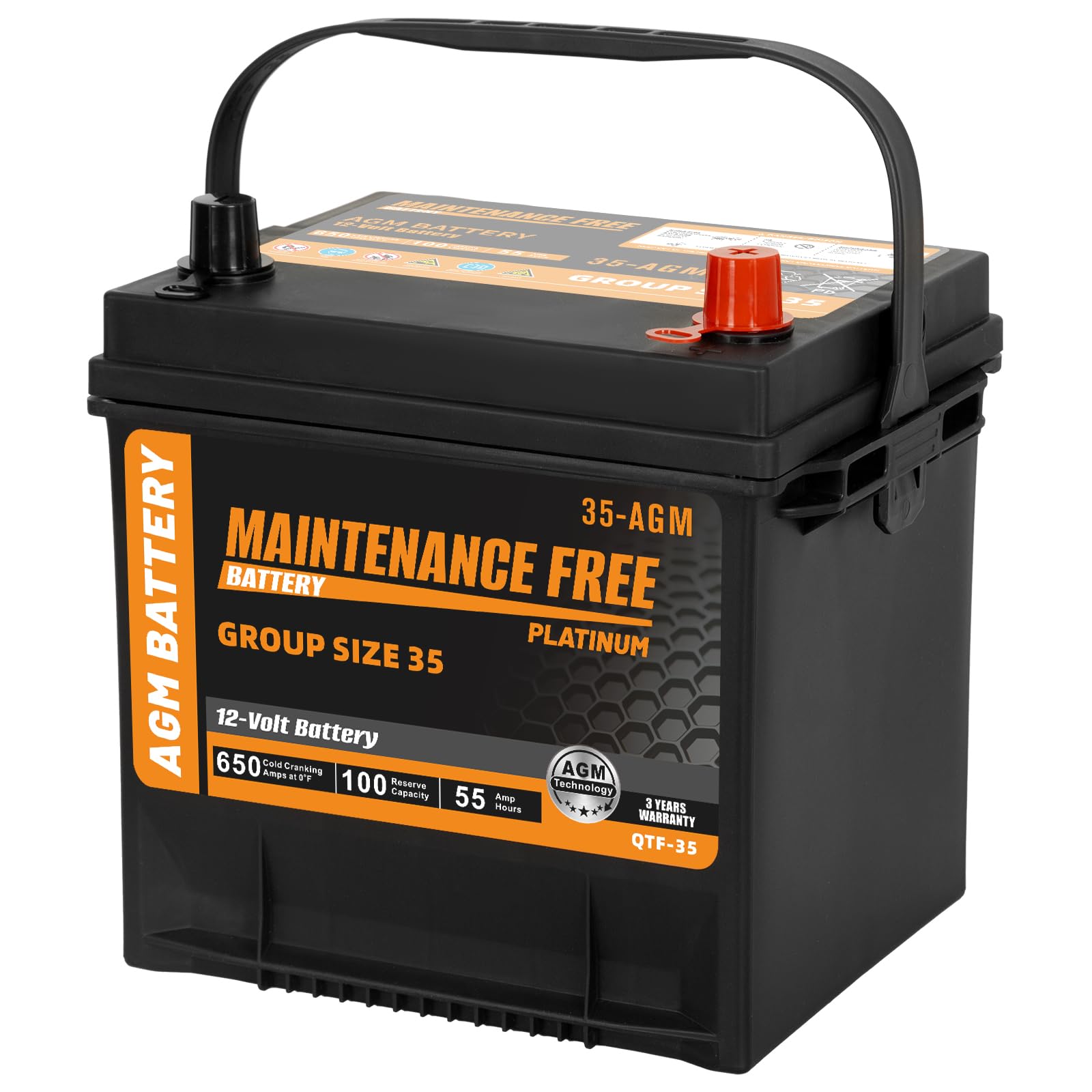
The Autocessking Group 35 AGM battery delivers the essential AGM feature set — leak-proof construction, vibration resistance, and extended cycle life — focused on the start-stop applications common in modern vehicles. With 650 CCA and 55 Ah capacity, it meets the minimum requirements for the 2013 Wrangler’s Pentastar engine, and the 100-minute reserve capacity provides a baseline level of accessory support. The Group 35 dimensions match the Weize and Goodyear entries in this category.
The manufacturer emphasizes the extreme temperature resistance of the glass mat separators, which help maintain performance in both hot and cold environments. The low self-discharge rate makes it suitable for Wranglers that sit unused for days or weeks between drives. The three-year warranty is consistent with the segment standard, and the battery is classified as a starting battery — not intended for deep-cycle solar or marine applications, which is an important distinction for owners planning heavy accessory use.
Owner feedback on this newer entry is limited compared to established brands, but the early reports point to reliable starting performance and proper fitment in Group 35 applications. The primary consideration is that the CCA and RC numbers are entry-level, so owners with winches, snowplows, or extensive lighting systems should look toward higher-capacity options. For a daily-driven Wrangler with minimal accessories, this battery gets the job done at a reasonable investment.
What works
- AGM construction with leak-proof and vibration-resistant design
- Low self-discharge suits intermittent driving patterns
- Three-year warranty provides standard coverage
What doesn’t
- Limited owner history compared to established brands
- Entry-level CCA and RC for accessory-heavy builds
8. Polaris Heavy Duty AGM Battery (Part 4081481)
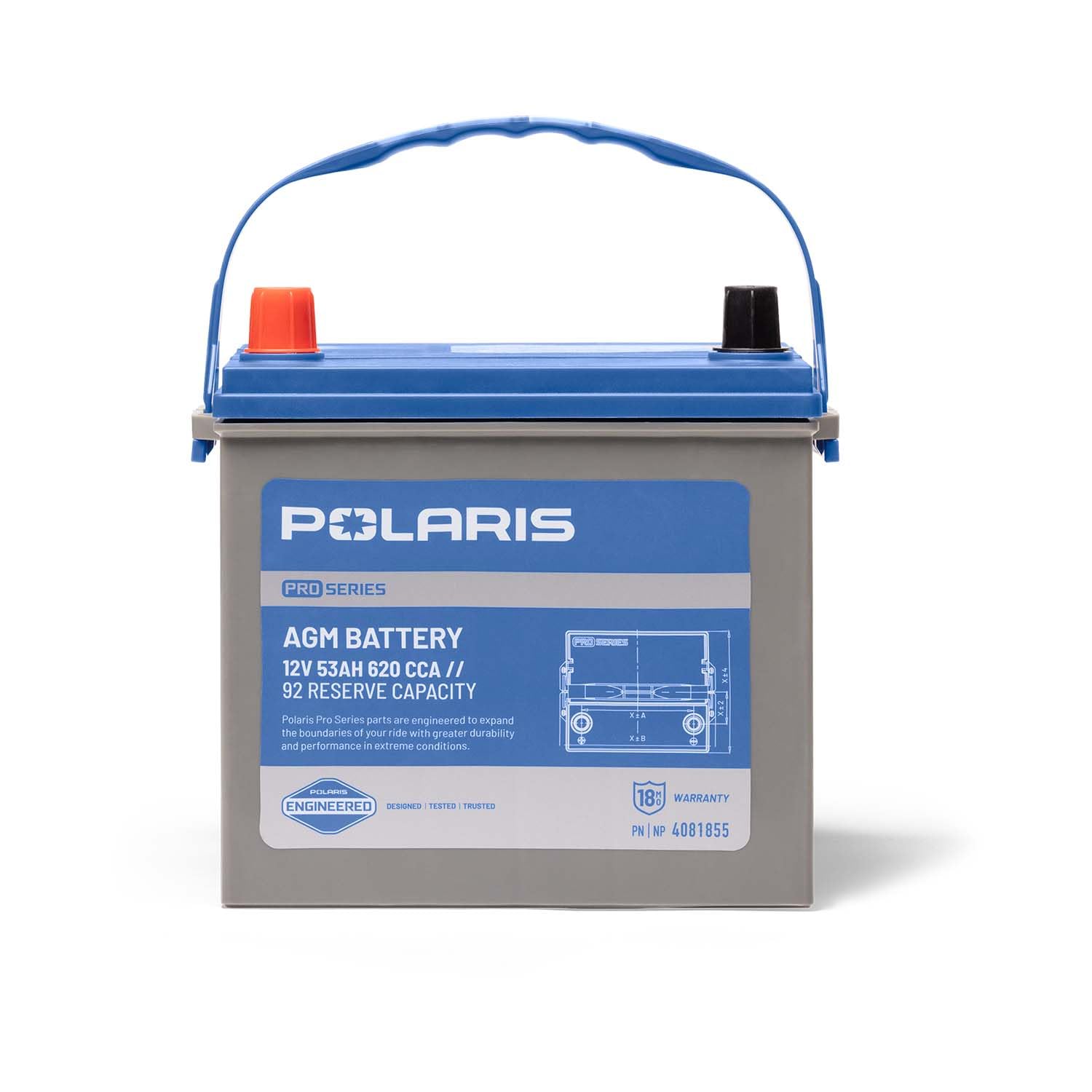
The Polaris Heavy Duty AGM battery is engineered specifically for Polaris off-road vehicles — RZR, General, Ranger platforms — where vibration, shock loads, and exposure to the elements are extreme. The sealed AGM construction is fully leak-proof and designed to hold charge longer in all conditions, with faster charging acceptance than conventional flooded batteries. For a Wrangler owner, this battery is a niche consideration and only relevant if you are replacing a battery in a Polaris vehicle that shares your garage.
The 36.6-pound weight and compact form factor differ from standard automotive Group 34 or Group 35 dimensions, so fitment in a Jeep Wrangler battery tray is not guaranteed. The terminal configuration and hold-down compatibility would need to be verified against the factory JK setup. Polaris specifies this battery for highly accessorized vehicles, indicating it can handle additional electrical loads common in UTV applications like light bars, winches, and audio systems.
For the 2013 Wrangler audience specifically, this battery is not a primary recommendation due to fitment uncertainty and the Polaris-specific engineering focus. Owners who also run a Polaris UTV might consider it for that application, but the Wrangler has more suitable options elsewhere in this guide. The build quality is consistent with OEM-grade Polaris parts, but the application mismatch limits its usefulness for JK owners.
What works
- Heavy-duty AGM construction designed for extreme vibration
- Leak-proof and maintenance-free sealed design
- Faster charging acceptance than flooded batteries
What doesn’t
- Designed for Polaris vehicles, not Jeep Wrangler fitment
- Dimensions and terminal layout may not match JK tray
9. MARXON Group 34 Start and Stop AGM

The MARXON Group 34 AGM battery is positioned as an entry-level AGM solution for start-stop vehicles, offering 650 CCA and 55 Ah capacity in the Group 34 form factor that matches the factory Wrangler specification. The dimensions of 10.87 x 6.61 x 6.89 inches and the A1 terminal layout are designed to fit standard Group 34 trays, making this one of the more straightforward drop-in options for JK owners who want AGM benefits without a premium investment.
MARXON claims a 40 percent faster charging time compared to SLA batteries through the use of improved materials, and the patented alloy construction aims to enhance corrosion resistance and leak-proof performance. The maintenance-free design eliminates the need for water top-ups, and the battery is built for start-stop functionality, which can save fuel in stop-and-go driving. The 55 Ah capacity and 650 CCA rating meet the minimum requirement for the Pentastar, but leave limited headroom for accessory loads or extreme cold.
The three-year warranty includes US-based customer service with a stated 12-hour response window, which adds confidence for a budget-tier purchase. Owner feedback is limited but generally positive regarding fitment and initial performance. The primary trade-off is that the materials and construction quality typically do not match premium brands in terms of cycle life and long-term durability. For budget-conscious owners who need an AGM battery and prioritize the correct Group 34 fitment over maximum performance, this is the most accessible entry point.
What works
- Group 34 size fits factory JK tray without modifications
- AGM construction at a budget-friendly investment level
- Three-year warranty with US-based support
What doesn’t
- 650 CCA provides minimal cold-weather starting margin
- 55 Ah capacity limits accessory load capability
- Build quality and cycle life may trail premium brands
Hardware & Specs Guide
AGM Battery Construction
Absorbent Glass Mat batteries use fiberglass separators to hold electrolyte in suspension between the lead plates. This design eliminates free liquid electrolyte, making the battery spill-proof and significantly more resistant to vibration damage — critical for a Wrangler that sees off-road use. AGM batteries also have lower internal resistance than flooded batteries, which translates to faster charging and higher burst current delivery during engine start. The sealed construction prevents corrosion in the engine bay and allows mounting in multiple orientations.
Group Size and Physical Fitment
The 2013 Wrangler JK typically uses a Group 34 battery tray measuring approximately 10.25 x 6.8 x 7.9 inches. Group 34 is the safest drop-in choice. Group 35 (9.06 inches long) fits many JK trays but may require the use of foam spacers or aftermarket hold-downs to prevent movement. Group 94R is 12.4 inches long and generally requires an aftermarket tray or bracket modification. Terminal orientation is critical — the JK uses positive on the right, negative on the left when facing the battery from the front of the vehicle.
Cold Cranking Amps Explained
CCA measures a battery’s ability to start an engine at 0 degrees Fahrenheit. The 3.6L Pentastar engine requires a minimum of 650 CCA for reliable cold starts, though 750 CCA or higher provides a safer margin in subzero conditions. Higher CCA numbers come from denser plate packs and increased plate surface area. While higher CCA is generally better, the law of diminishing returns applies — the difference between 800 CCA and 850 CCA is marginal in most real-world conditions. Focus on meeting or moderately exceeding the OEM specification rather than chasing maximum numbers.
Reserve Capacity and Accessory Load
Reserve Capacity (RC) measures how many minutes a battery can deliver 25 amps at 80 degrees Fahrenheit before dropping below 10.5 volts. A rating of 100 minutes is adequate for daily driving with minimal accessories. Wranglers with winches, aftermarket lighting, air compressors, or audio systems benefit from 120 minutes or higher. Each accessory adds to the parasitic draw when the engine is off. Dual-purpose batteries like the OPTIMA D34 YELLOWTOP balance starting CCA with deep-cycle RC capability, making them the preferred choice for modified Wranglers.
FAQ
What group size battery does a 2013 Jeep Wrangler use?
Can I use a flooded battery instead of AGM in my Wrangler?
How many CCA do I need for a 2013 Jeep Wrangler?
Will a Group 94R battery fit my 2013 Jeep Wrangler?
How often should I replace the battery in a 2013 Wrangler?
Final Thoughts: The Verdict
For most buyers, the best 2013 jeep wrangler battery winner is the OPTIMA D34 YELLOWTOP because it delivers the ideal combination of starting power and deep-cycle reserve capacity for Wranglers that see both daily driving and trail use. If you want pure cold-starting performance without the need for deep-cycle capability, grab the OPTIMA 34 REDTOP with its 800 CCA burst. And for budget-conscious owners who still want AGM reliability, the Weize Platinum AGM Group 35 provides the essential features at a significantly lower investment.

Certification: BSc in Mechanical Engineering
Education: Mechanical engineer
Lives In: 539 W Commerce St, Dallas, TX 75208, USA
Md Amir is an auto mechanic student and writer with over half a decade of experience in the automotive field. He has worked with top automotive brands such as Lexus, Quantum, and also owns two automotive blogs autocarneed.com and taxiwiz.com.