A flat basketball, a soft soccer ball, or a deflated exercise ball can kill a practice session before it starts. The right hand air pump eliminates the guesswork, the wasted strokes, and the frustration of under-inflated gear, letting you get back to the game or workout without delay.
I’m Amir — the founder and writer behind Four Wheel Ask. I’ve spent countless hours breaking down product specifications, comparing build materials, and cross-referencing owner feedback across dozens of inflation devices to separate the pumps that actually hold up from those that falter after a few uses.
After researching dozens of models across all price points, I narrowed the field to five pumps that deliver consistent performance for best hand air pump.
How To Choose The Best Hand Air Pump
Not all hand pumps are built the same. Some rely on a single-action stroke that forces air only when you push down, while others use a dual-action mechanism that delivers air on both the push and the pull. The difference adds up fast when you are inflating multiple balls or a large exercise ball. Beyond the pumping action, the accuracy of the built-in pressure gauge, the material of the barrel and handle, the type of valve compatibility, and how the needles are stored all determine whether a pump becomes a permanent fixture in your gear bag or a frustrating disposable tool.
Dual-Action vs. Single-Action Pumping
A single-action pump forces air into the ball only when you press down, meaning every pull stroke does nothing. A dual-action pump, by contrast, forces air on both the push and the pull, effectively doubling the volume of air moved per full cycle. For large-volume items like yoga balls or stability balls, a dual-action mechanism can cut inflation time by nearly half. Most premium hand pumps now incorporate this design, and it is worth prioritizing if you regularly inflate multiple balls or larger-diameter inflatables.
Pressure Gauge Quality and Range
A built-in pressure gauge removes the need for a separate measuring tool, but not all gauges are equally precise. Lower-cost pumps often use a spring-style gauge that can drift by two or more PSI, which is enough to make a basketball feel dead or a volleyball too hard. Look for pumps with a gauge that covers at least the 4 to 15 PSI range commonly used for sports balls, and check owner feedback regarding long-term accuracy. Some pumps also include a deflation valve on the gauge, letting you fine-tune pressure downward without removing the needle.
Needle Compatibility and Storage
The standard inflation needle used for basketballs, soccer balls, volleyballs, and footballs is the same size, but needles can bend or break if the pump pushes air at an awkward angle. Pumps that store the needle inside the handle or in a dedicated compartment protect the needle from damage and keep it from getting lost in a bag. Some kits also include tapered plastic nozzles for larger valve openings on pool toys or air beds, which adds versatility. Make sure the pump you choose includes at least one metal needle and that the needle seats snugly without air leakage.
Quick Comparison
On smaller screens, swipe sideways to see the full table.
| Model | Category | Best For | Key Spec | Amazon |
|---|---|---|---|---|
| Franklin Sports Ball Pump + Pressure Gauge | Hand Pump | Dual-action with integrated gauge | Dual-action, 30 PSI max, gauge with deflation valve | Amazon |
| AUXITO AS1 Tire Inflator | Electric | Multi-purpose auto-shutoff inflator | 150 PSI, 26 L/min, dual-screen, 5200 mAh battery | Amazon |
| SPORTBIT Ball Pump | Hand Pump | Exercise ball and large-volume inflation | Push-pull system, includes 5 needles | Amazon |
| HYVOHEX Electric Ball Pump | Electric | Quick digital inflation with auto-stop | 2–17 PSI range, 1500 mAh, USB-C, digital LED | Amazon |
| AppleRound Ball Pump Kit | Hand Pump | Budget pack for multiple balls or kits | Pack of 3, 8-inch pump, flexible hose, 5 nozzles | Amazon |
In‑Depth Reviews
1. Franklin Sports Ball Pump + Pressure Gauge

The Franklin Sports Ball Pump earns the top spot because it combines a true dual-action pumping mechanism with an integrated pressure gauge and deflation valve in a compact, thoughtfully designed package. The dual-action design forces air into the ball on both the push and the pull stroke, which noticeably speeds up inflation compared to single-action pumps. Owner reports consistently highlight how much faster and more efficient the process feels, especially when inflating multiple balls before practice or a game.
The built-in gauge measures pressure up to 30 PSI and includes a small deflation valve, allowing you to release air without pulling the needle out. This level of control is rare in hand pumps at this tier and makes a real difference when you need an exact PSI for match play. The handle also houses a storage well that secures the needle when not in use, reducing the chance of bending or losing it between sessions.
Some users note that the gauge reads slightly imprecise at very low pressures, typically under 4 PSI, but for the standard range used by basketballs, soccer balls, and volleyballs, the accuracy is more than sufficient. The barrel and handle feel sturdy for a plastic-bodied pump, and the compact size fits easily into a coaching bag or gym locker. For anyone looking for a reliable, full-featured hand pump without stepping up to an electric model, this is the benchmark.
What works
- Dual-action pumping cuts inflation time noticeably
- Integrated gauge with deflation valve gives precise control
- Needle stores securely inside the handle
What doesn’t
- Gauge accuracy can drift at very low pressures
- Plastic body may not survive heavy drops on pavement
2. AUXITO AS1 Tire Inflator Portable Air Compressor
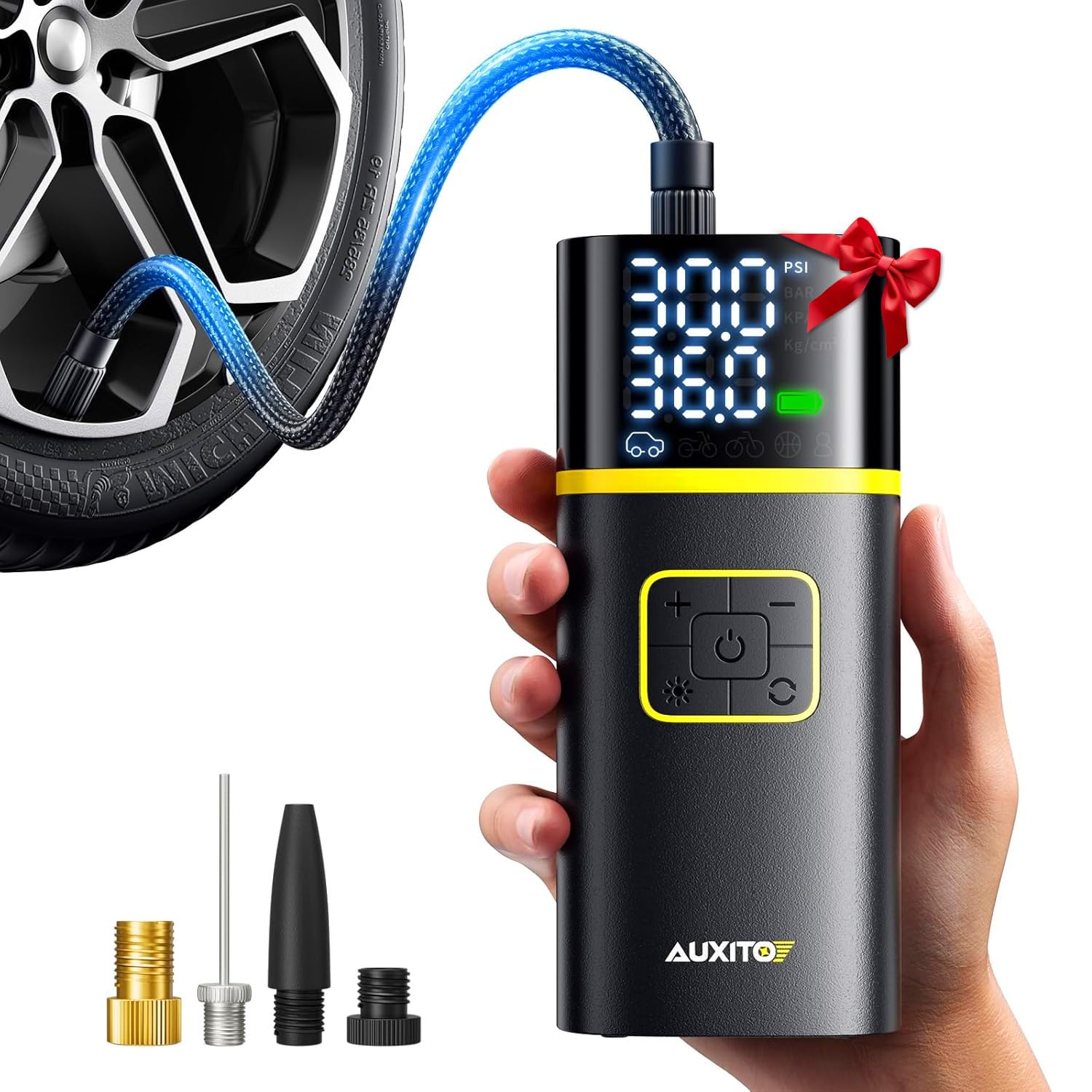
The AUXITO AS1 is an electric tire inflator that also serves as a powerful ball pump, making it a versatile addition to any garage or gear collection. It delivers up to 150 PSI with a flow rate of 26 liters per minute, which is roughly three times faster than most compact inflators. The unit includes four preset modes — Car, Motorcycle, Bike, and Ball — along with a custom mode for complete pressure control, and the auto-shutoff function stops inflation the instant the target pressure is reached.
A dual-screen display shows both the real-time pressure and the preset value simultaneously, and the screens are large enough to read in direct sunlight. The 5200 mAh rechargeable battery provides enough capacity for multiple tire top-offs or dozens of ball inflations on a single charge. Beyond inflation, the device includes a three-mode LED flashlight and a 5V/2A USB output for charging a phone in an emergency, adding genuine utility for roadside or trailhead situations.
The unit comes with a Schrader valve hose, Presta and Woods adapters, a ball needle, and a swim ring nozzle, covering virtually every inflation need. At this price point, the combination of speed, precision, and multi-function capability is hard to match. The hose length is shorter than some full-size compressors, and the unit is heavier than a manual pump, but the trade-off in convenience and performance is justified for anyone who values speed and precision across multiple use cases.
What works
- Extremely fast inflation with 26 L/min flow rate
- Auto-shutoff eliminates over-inflation guesswork
- Dual-screen display is sunlight-readable
- Includes adapters for tires, balls, and pool toys
What doesn’t
- Heavier and bulkier than a manual hand pump
- Short hose length requires close proximity to the valve
3. SPORTBIT Ball Pump for Sports Balls

The SPORTBIT Ball Pump is built around a push-pull inflating system that moves air on both strokes, making it an efficient choice for larger items like exercise balls, yoga balls, and stability balls. The dual-action mechanism is particularly helpful when you need to inflate a 55- or 65-centimeter fitness ball, which can require dozens of strokes with a single-action pump. The red-and-black barrel design is straightforward and functional, with a comfortable grip that reduces hand fatigue during extended use.
The pump comes with a set of five needles, which is more than most kits offer, and the needles are standard size for basketballs, volleyballs, soccer balls, and footballs. The kit does not include a pressure gauge, so you will need to rely on feel or a separate gauge if precise PSI matters for your sport. The pump body is made of plastic with a metal cylinder interior, striking a balance between weight and durability that suits casual and regular use alike.
Owner feedback indicates that the pump handles the higher volume demands of fitness balls well, with the dual-action system noticeably reducing the total number of strokes needed. The lack of a gauge keeps the price accessible, and the extra needles mean you have backups when one inevitably bends or gets misplaced. For gym-goers or home fitness users who need a dedicated pump for large-diameter balls, this is a practical, no-fuss solution.
What works
- Push-pull dual-action inflates large balls faster
- Includes five needles for backup and sharing
- Comfortable grip reduces hand fatigue
What doesn’t
- No built-in pressure gauge for precise inflation
- Plastic body may not withstand heavy abuse
4. HYVOHEX Electric Ball Pump

The HYVOHEX Electric Ball Pump brings digital precision to sports ball inflation without the cord or bulk of a full-size compressor. The palm-sized unit houses a 1500 mAh rechargeable battery that delivers enough power for multiple inflations on a single charge, and the USB-C port ensures fast top-ups. A digital LED screen displays the current pressure and allows you to set a target between 2 and 17 PSI, after which the pump automatically stops when the ball reaches the preset level.
The auto-stop feature is the standout capability here: it removes the need to keep checking pressure manually, which is especially useful when inflating a batch of balls for a team practice or tournament. The pump includes a hidden needle storage compartment in the top cap, solving the common problem of lost or bent needles. The compact size — roughly palm-sized — means it slips into a gym bag or even a large pocket without adding noticeable weight.
Some users mention that the pump runs slightly louder than expected for its size, and the maximum pressure of 17 PSI limits its use to sports balls rather than high-pressure tires or air shocks. The unit also lacks a manual override, so if the sensor malfunctions, you cannot inflate manually. For coaches, parents, and recreational players who inflate balls regularly and want speed without the arm work, this is a convenient upgrade over a manual pump.
What works
- Auto-shutoff at preset pressure is highly convenient
- Compact size fits easily in a gym bag or pocket
- Hidden needle storage prevents loss and damage
What doesn’t
- Maximum 17 PSI limits use to sports balls only
- Operating noise is noticeable for its size
5. AppleRound Ball Pump Kit (Pack of 3)

The AppleRound Ball Pump Kit delivers three complete hand pumps in a single package, making it a practical choice for coaches, classrooms, or families who need pump backups or want to spread them across multiple bags. Each pump measures 8 inches unextended and includes a flexible extension hose, three metal needle nozzles, and two plastic tapered nozzles. The flexible hose is a thoughtful detail that reduces stress on the valve stem and makes it easier to reach recessed valves on some balls.
Each pump is rated for a maximum pressure of 15 PSI, which covers the typical range for basketballs, footballs, volleyballs, and soccer balls. The manufacturer specifically advises against using these pumps for items larger than 15 inches in diameter, such as yoga balls or exercise balls, because the single-action design and smaller barrel volume make large-volume inflation tedious. The plastic construction is basic but functional for occasional use, and the included nozzle variety adds versatility for balloons, balance pods, and smaller inflatables.
Owner reviews consistently highlight the value proposition: you get three functional pumps for the cost of a single mid-range pump, and the quality is more than adequate for the intended use. The pumps are single-action, meaning air flows only on the push stroke, which makes inflating multiple balls slightly slower than a dual-action model. For anyone stocking a school gym, a youth league, or a church recreation room, this kit offers the lowest per-unit cost and easily replaceable spares.
What works
- Excellent value with three pumps in one kit
- Flexible extension hose reduces valve stress
- Comes with multiple needle and nozzle types
What doesn’t
- Single-action pumping is slower than dual-action
- Not suitable for large exercise balls or yoga balls
Hardware & Specs Guide
Dual-Action Pumping Mechanism
A dual-action pump forces air into the ball on both the compression and extension strokes, effectively doubling the air volume moved per full cycle compared to a single-action pump. This is especially beneficial when inflating large-diameter fitness balls that require significant air volume. Most pumps in the mid-to-premium range use a dual-action design, while budget models typically rely on single-action. The difference becomes apparent after a dozen or more strokes, making dual-action a strong priority for regular or high-volume use.
Pressure Gauge Types and Accuracy
Built-in pressure gauges on hand pumps commonly use either a spring-loaded needle mechanism or a digital sensor. Spring gauges are more affordable and found on most manual pumps, but they can drift by one to two PSI over time or if the pump is dropped. Digital gauges, found on electric models, offer higher precision and auto-shutoff integration. A gauge that includes a deflation valve, like the Franklin Sports model, gives you fine control to bleed off excess pressure without removing the needle — a small but meaningful feature for match-ready consistency.
Needle Material and Storage Solutions
The standard inflation needle is made of either nickel-plated brass or hardened steel. Brass needles are more common and work well, but they can bend under repeated angled force. Steel needles are more durable but slightly heavier. Storage solutions range from a simple clip on the pump body to a fully enclosed compartment inside the handle or top cap. Enclosed storage, as seen on the HYVOHEX and Franklin pumps, protects the needle from bending and prevents it from puncturing other items in a bag.
Maximum Pressure and Volume Ratings
Most hand pumps for sports balls operate in the 8 to 30 PSI range, with basketballs typically needing 7 to 9 PSI and soccer balls around 8 to 12 PSI. A pump rated for a higher maximum pressure, such as 30 PSI, usually indicates a more robust barrel seal and better overall build quality. For electric pumps, the flow rate measured in liters per minute determines how quickly air moves. A rate of 20 L/min or higher is considered fast, while manual pump speed depends entirely on the dual-action capability and barrel diameter.
FAQ
What PSI should I use for a basketball, soccer ball, and volleyball?
Can I use a ball pump needle on a tire valve?
How do I know when a ball is fully inflated without a gauge?
Why does my hand pump feel like it is pushing air back out?
Final Thoughts: The Verdict
For most buyers, the best hand air pump winner is the Franklin Sports Ball Pump + Pressure Gauge because it combines dual-action efficiency, an integrated gauge with deflation valve, and secure needle storage in a compact, durable package. If you want the speed and precision of digital auto-shutoff, grab the AUXITO AS1 Tire Inflator. And for a budget-friendly three-pack that covers multiple bags or teams, nothing beats the AppleRound Ball Pump Kit.

Certification: BSc in Mechanical Engineering
Education: Mechanical engineer
Lives In: 539 W Commerce St, Dallas, TX 75208, USA
Md Amir is an auto mechanic student and writer with over half a decade of experience in the automotive field. He has worked with top automotive brands such as Lexus, Quantum, and also owns two automotive blogs autocarneed.com and taxiwiz.com.