Draining engine oil usually means hunting for jack stands, sliding under a dirty chassis, and wrestling a drain plug while balancing a catch pan. A quality fluid extractor flips the entire process — you work from above, feed a tube down the dipstick, pump a handle, and watch the old oil transfer into a sealed container. No ramps, no spills, no skinned knuckles.
I’m Amir — the founder and writer behind Four Wheel Ask. I have spent years studying product specifications, reading owner feedback across forums, and comparing build quality data to identify which tools actually hold up under regular use.
After comparing dozens of models across price tiers, the best oil extractor balances build quality, suction performance, and tube reach for clean changes.
How To Choose The Best Oil Extractor
An oil extractor looks simple — a tank, a pump mechanism, and a hose — but small differences in construction, tube sizing, and seal quality determine whether it works reliably for years or fails halfway through a job. Understanding the three main decision points helps you pick the right tool for your garage, boat, or shop.
Manual vs. Pneumatic Operation
Manual extractors rely on a hand pump to create vacuum inside the tank. They require about ten to fifteen strokes to build pressure, then gravity and suction pull the fluid through the tube. Manual units are portable, need no power source, and are simpler to maintain. Pneumatic models use compressed air to generate vacuum much faster — typically extracting at rates around 1.8 liters per minute — which is useful when servicing multiple vehicles or working in a professional setting. Some extractors offer both modes, giving you flexibility depending on whether an air compressor is available.
Tube Length, Diameter, and Reach
The tube that goes down the dipstick tube must be long enough to reach the bottom of the oil pan and thin enough to fit inside tight factory dipstick guides. Most passenger cars need a tube at least 40 inches long with an outer diameter of 4 to 5 millimeters. Trucks, boats, and large equipment may require longer or thicker tubes. Extractor kits that include multiple tube sizes and a flexible hose cover more vehicle types without requiring additional purchases.
Tank Capacity and Build Materials
A 6-liter tank handles the oil change for most passenger cars in one pull. Larger capacities — 6.5 or 7 liters — are useful for trucks, marine engines, or jobs where you drain multiple fluids. High-density polyethylene tanks resist heat up to around 140°F and hold up against common automotive fluids. Steel or aluminum construction adds durability but increases weight. Check that the sealing cap and pressure release valve are well-made, because air leaks are the most common failure point on budget extractors.
Quick Comparison
On smaller screens, swipe sideways to see the full table.
| Model | Category | Best For | Key Spec | Amazon |
|---|---|---|---|---|
| EWK 6.5L Manual | Manual | Overall home garage use | 102-inch suction tube, 10-pump prime | Amazon |
| FIRSTINFO A1102USY5 | Pneumatic/Manual | Professional & heavy-duty | Patented safety valve, 1.8 L/min flow | Amazon |
| SWANLAKE 7L | Pneumatic/Manual | Speed & high capacity | 7-liter tank, 5 tube sizes included | Amazon |
| SUPERFASTRACING 6.5L | Manual | Budget-friendly mid-range | Metal foot pedal, 70–170 PSI range | Amazon |
| Powerbuilt 647570 | Manual | Stability & brand reliability | 42-inch metal probe, extra-wide base | Amazon |
| FOUR UNCLES 6L | Manual | Entry-level & light duty | 6-liter tank, brake bleed hose included | Amazon |
| VEVOR 6.5L Manual | Manual | Budget multi-fluid extraction | 4 suction tubes, 1.74-gal tank | Amazon |
In‑Depth Reviews
1. EWK 6.5L Manual Oil Extractor Pump
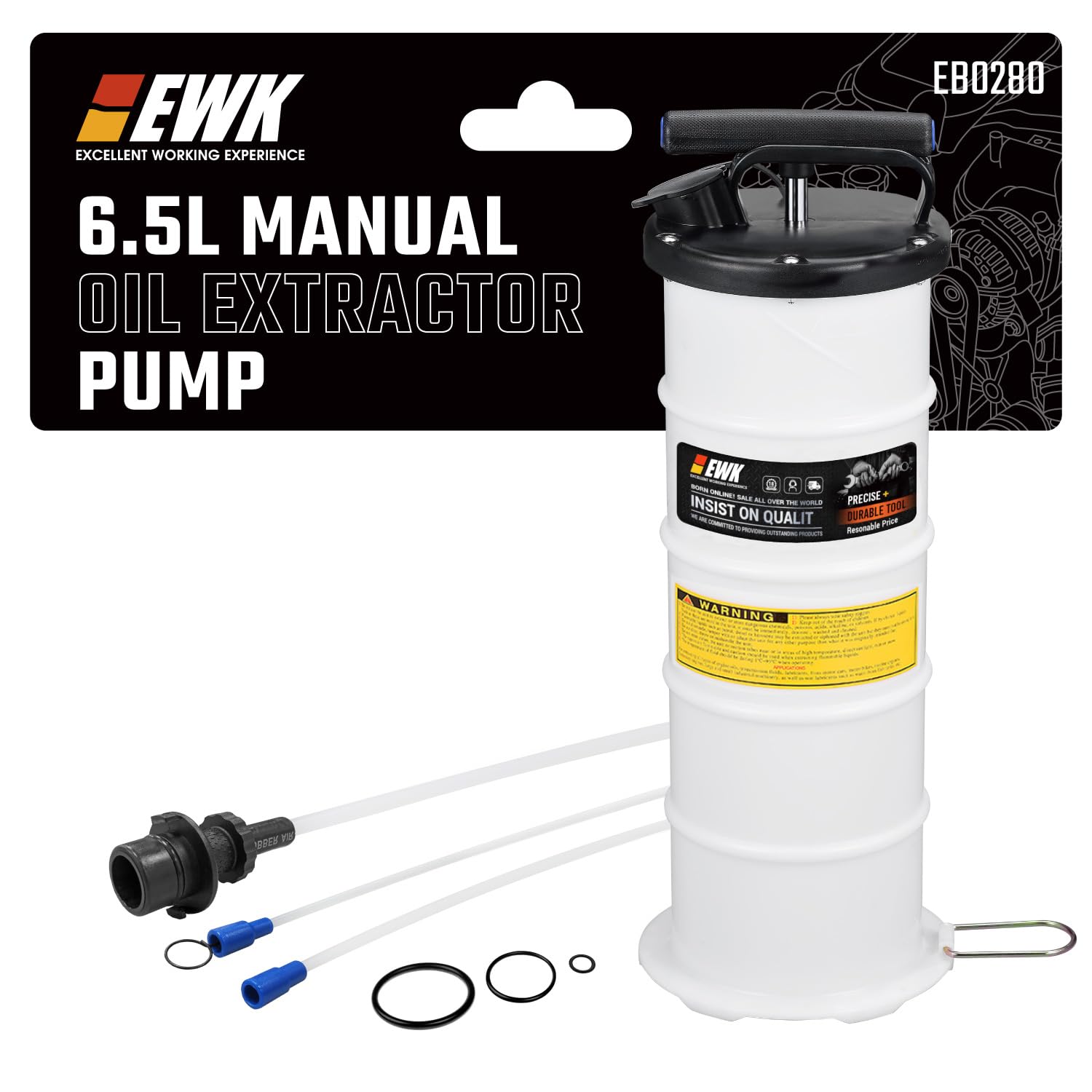
The EWK 6.5L hits the sweet spot between build quality, ease of use, and real-world suction performance. The tank is made from high-density heat-resistant polyethylene that handles fluids up to 140°F, and the sealing cap keeps the system airtight during operation. Owner reports consistently highlight that the pump builds vacuum quickly — around ten solid strokes are enough to start siphoning oil from a warm engine — and the transparent hose lets you monitor fluid color and flow as it fills.
What separates this extractor from cheaper alternatives is the 102-inch suction tube. That extra length reaches the bottom of deep sumps on low-clearance cars, boats, and small engines without requiring you to position the tank directly under the dipstick. The kit includes multiple tube diameters so you can match the fit to different dipstick guides. Users also appreciate that the tank is compact enough to store in a garage cabinet or boat locker yet large enough to swallow the full oil capacity of most passenger cars in one go.
For the DIY owner who wants a reliable, no-compromise manual extractor that works across multiple vehicle types, the EWK delivers consistent performance without requiring compressed air or electricity. The all-manual operation means one less thing to break, and the materials inspire confidence that the tool will last through dozens of oil changes.
What works
- Extra-long 102-inch tube reaches deep sumps easily
- Heat-resistant polyethylene handles hot oil safely
- Sealed design prevents leaks during transport
What doesn’t
- Manual only — no pneumatic option for faster extraction
- Tube storage could be more organized inside the kit
2. FIRSTINFO A1102USY5 Patented 6.5L Pneumatic/Manual Extractor

The FIRSTINFO A1102USY5 is the most technically refined extractor on this list, backed by a US patent (No. 8360741) and a 22-month warranty that signals confidence in the design. Its dual-mode operation lets you switch between manual pumping and pneumatic extraction using compressed air. In pneumatic mode, the unit achieves a suction rate of 1.8 liters per minute — enough to drain a typical four-cylinder engine in under two minutes without any hand fatigue.
A precision-engineered vacuum safety valve prevents overpressure inside the tank, which is a genuine safety advantage over cheaper units that rely on a simple pressure-relief hole. The kit includes three precision-ground tubes of varying diameters plus an extension that brings total reach to 142 inches — the longest in this comparison. That makes the FIRSTINFO particularly well-suited for deep oil pans on trucks, vans, and marine engines where shorter tubes come up short. The sealed-bottom design eliminates drips during storage and transport.
For the buyer who wants the fastest, safest extraction experience and values dual-mode flexibility, the FIRSTINFO justifies its higher position through superior engineering and warranty support. It is overbuilt in the right places — the valve, the seals, and the tube selection — and feels noticeably more substantial than mid-range competitors.
What works
- Pneumatic mode extracts at 1.8 L/min — very fast
- 142-inch total tube reach for deep sumps
- Patented safety valve prevents overpressure
What doesn’t
- Requires air compressor to use pneumatic mode
- Higher investment than manual-only extractors
3. SWANLAKE 7 Liter Pneumatic/Manual Fluid Extractor

The SWANLAKE 7L stands out immediately because of its larger-than-average tank capacity. Most extractors in this class top out at 6.5 liters, but the SWANLAKE gives you an extra half-liter — enough to handle larger engines, transmission fluid changes, or multiple small-engine services before needing to empty the tank. The dual-mode operation works identically to the FIRSTINFO: manual pump when you are working without air, and pneumatic mode when you connect a compressor for high-speed extraction.
Five different tube diameters are included in the kit, which is more than most competitors offer. The 3.2-foot flexible hose and three additional dipstick hoses give you options for different dipstick tube sizes and access angles. Owners report that the sealing cap stays tight during transport, preventing the mess that cheaper extractors sometimes create when you carry the tank to a recycling center. The suction rate in pneumatic mode matches the FIRSTINFO at 1.8 liters per minute, so extraction speed is essentially identical between the two dual-mode units.
For anyone who needs extra capacity — whether for a truck that holds 7 quarts or for draining multiple systems in one session — the SWANLAKE delivers that headroom without sacrificing the flexibility of dual-mode operation. The tube selection is generous, and the build quality feels solid for the price point.
What works
- 7-liter tank is the largest in this comparison
- Five tube diameters cover many vehicle types
- Dual-mode operation adds workflow flexibility
What doesn’t
- Manual mode requires more strokes to build vacuum than some rivals
- Tube storage clips could be more durable
4. SUPERFASTRACING 6.5L Manual Vacuum Oil Extractor

The SUPERFASTRACING 6.5L occupies the middle ground between budget offerings and premium dual-mode units, and it earns its spot through thoughtful design details that matter during actual use. The metal foot pedal is a notable upgrade over the plastic pedals found on cheaper extractors — it provides stable footing while you pump, preventing the tank from sliding across the garage floor. The working pressure range of 70 to 170 PSI gives a clear target for how many strokes are needed before extraction starts.
The transparent hose allows visual inspection of fluid quality as it flows into the tank, which is useful for spotting contamination or water in the oil. The tank dimensions (68 x 24 x 22 cm) make it compact enough to fit under a workbench or in a service cart drawer. Owners mention that the pump handle operates smoothly right out of the box and that the suction holds reliably once vacuum is established. The kit includes extra hose placement for organized storage after use.
For the buyer who wants a manual extractor with premium touches — specifically the metal pedal and clear pressure specs — without stepping up to a dual-mode price, the SUPERFASTRACING offers a well-rounded package. It is not the cheapest option, but the construction details suggest it will hold up better than rock-bottom alternatives.
What works
- Metal foot pedal provides stable operation on smooth floors
- Clear working pressure range helps gauge pump strokes
- Transparent hose allows visual fluid inspection
What doesn’t
- No pneumatic mode for faster extraction
- Tube selection is more limited than premium kits
5. Powerbuilt Oil and Fluid Extractor 6.3 Quart (647570)

Powerbuilt is a well-established name in automotive tools, and the 647570 extractor reflects the brand’s focus on functional design and user safety. The most immediately noticeable feature is the extra-wide base, which provides exceptional stability during pumping — you can plant your foot on the base while pulling the handle without worrying about tipping the tank over. The 59-inch transparent main tube gives you clear visibility of the fluid being extracted, and the flexible 42-inch metal suction probe is rigid enough to push past obstructions in the dipstick tube.
The sealing cap keeps the tank airtight during use and prevents leaks when you carry the filled extractor to a disposal point. The pour spout is well-designed for clean transfer into waste containers without dribbling. Powerbuilt backs this unit with a one-year unlimited warranty, which adds peace of mind for a tool that sees regular use. Owners note that the pump builds vacuum reliably and that the metal probe reaches the bottom of most passenger car oil pans without difficulty.
For the DIYer who prioritizes stability and a trusted brand name, the Powerbuilt delivers a well-engineered manual extractor with thoughtful safety touches. The metal probe and wide base set it apart from generic alternatives, and the warranty support from an established manufacturer is a genuine advantage.
What works
- Extra-wide base provides excellent stability during pumping
- 42-inch metal probe reaches deep into oil pans
- One-year warranty from a known tool brand
What doesn’t
- 6.3-quart capacity is slightly smaller than 6.5L competitors
- No pneumatic option for faster extraction
6. FOUR UNCLES 6L Oil Extractor Pump

The FOUR UNCLES 6L extractor is positioned as an entry-level tool that still includes thoughtful touches often missing from the cheapest options. The 59-inch transparent main hose lets you see the oil as it flows, and the kit includes three 41-inch extension tubes plus a dedicated 19-inch brake bleeding hose. That brake bleed hose is a genuine bonus — most extractors in this price range do not include it, which means you can use the same tool for brake fluid changes without buying additional attachments.
The upgraded aluminum pressure release plug is more durable than the plastic plugs found on some low-cost extractors, and the replacement rubber plug included in the kit adds longevity. Side markings on the tank make it easy to measure how much fluid you have removed, which is useful for tracking oil consumption or verifying you extracted the full sump volume. The wide base provides decent stability, though it is not as broad as the Powerbuilt’s base. Owners mention that the pump handle operates smoothly and that the vacuum holds well once established.
For the budget-conscious buyer who wants more than just a bare-bones extractor, the FOUR UNCLES offers a well-rounded kit with the brake bleed functionality as a standout extra. It is a capable entry point into topside fluid extraction without feeling cheap or flimsy in the hand.
What works
- Includes brake bleeding hose for added versatility
- Aluminum pressure release plug is more durable than plastic
- Tank volume markings help track extracted fluid
What doesn’t
- 6-liter capacity is slightly smaller than 6.5L competitors
- Base stability is adequate but not exceptional
7. VEVOR 6.5L Manual Fluid Extractor Pump

VEVOR has built a reputation for offering functional tools at aggressive price points, and this 6.5L manual extractor follows that formula. The kit includes four different suction tubes in varying diameters and lengths, giving you flexibility to match the tube to the dipstick guide. The main tube measures 39.37 inches, with two extension tubes at 47.24 inches each and a suction hose at 58.27 inches — enough total reach to access most passenger car and small truck oil pans from above.
The tank is made from plastic with a 1.74-gallon (6.5-liter) capacity, and the manual pump operation is straightforward: attach the appropriate tube, pump to create vacuum, and let suction do the work. The kit also includes two sealing rings to maintain an airtight seal, which is critical for building and holding vacuum. Owners appreciate that the extractor handles engine oil, gear oil, power steering fluid, and brake fluid without issues, and the universal fit means it works across cars, motorcycles, tractors, boats, and lawnmowers.
For the buyer who needs a no-frills manual extractor that gets the job done at a minimal investment, the VEVOR delivers adequate performance and tube variety. It lacks the premium touches of higher-priced models — the build materials feel more basic, and the pedal is plastic rather than metal — but it provides a functional entry point into topside fluid extraction for occasional use.
What works
- Four tube sizes cover many vehicle types out of the box
- Universal fit works across cars, boats, and small engines
- Very accessible price point for entry-level buyers
What doesn’t
- Plastic pedal feels less durable than metal alternatives
- Build quality feels basic compared to mid-range options
Hardware & Specs Guide
Tank Capacity and Materials
Tank capacity determines how much fluid you can extract before needing to empty the container. Most passenger cars hold between 4 and 6 quarts of engine oil, so a 6.5-liter (roughly 6.9-quart) tank handles a full oil change with room to spare. Larger tanks — 7 liters and above — are useful for trucks, boats, or jobs where you drain multiple fluids in one session. High-density polyethylene is the standard material because it resists heat up to around 140°F and holds up against oil, coolant, and transmission fluid. Steel tanks are more durable but heavier and less common at accessible price points.
Tube Length and Diameter
The tube that goes down the dipstick must be long enough to reach the bottom of the oil pan and thin enough to fit inside the dipstick guide tube. Cars typically need a tube at least 40 inches long with an outer diameter of 4 to 5 millimeters. Trucks, vans, and marine engines may require 50 inches or more of reach. Kits that include multiple tube diameters — usually ranging from 3.5 mm to 8 mm — give you the best chance of fitting different vehicles without buying separate accessories. Flexible hoses help navigate bends in the dipstick tube but may not push past obstructions as well as rigid metal probes.
Pump Mechanism and Vacuum Performance
Manual extractors use a hand pump to create vacuum inside the sealed tank. The number of strokes needed to build usable vacuum varies by design — quality units typically reach extraction pressure within 10 to 15 strokes. Pneumatic extractors connect to an air compressor and create vacuum continuously, achieving suction rates of 1.5 to 1.8 liters per minute. Dual-mode units offer both options. The sealing cap and pressure release valve are critical components: any air leak prevents vacuum from holding, so check that these parts are well-made and include replacement seals if available.
Fluid Compatibility and Safety
Manual and pneumatic extractors are designed for engine oil, transmission fluid, coolant, power steering fluid, and brake fluid. They are NOT suitable for gasoline, diesel, highly volatile solvents, strong acids or alkalis, or fluids above 140°F. Using incompatible fluids can damage the tank, hoses, and seals, and may create a safety hazard. Always check the manufacturer’s fluid compatibility list before use. After extraction, transfer the used fluid to an appropriate waste container and recycle it according to local regulations — most auto parts stores accept used oil and coolant free of charge.
FAQ
Will an oil extractor remove all the old oil from the engine?
Can I use an oil extractor on a motorcycle or lawnmower?
Do I need to warm the engine before using an extractor?
How do I clean and maintain the extractor after use?
Why is my extractor not building vacuum or holding suction?
Final Thoughts: The Verdict
For most buyers, the best oil extractor winner is the EWK 6.5L Manual because it combines a 102-inch tube, heat-resistant polyethylene construction, and consistent vacuum performance at a price that undercuts premium dual-mode units while outperforming budget alternatives. If you need the fastest extraction speed and dual-mode flexibility, grab the FIRSTINFO A1102USY5 with its patented safety valve and 1.8 L/min pneumatic flow. And for those who prioritize extra capacity and the largest tube selection, the SWANLAKE 7L gives you room to handle bigger jobs without stopping to empty the tank.

Certification: BSc in Mechanical Engineering
Education: Mechanical engineer
Lives In: 539 W Commerce St, Dallas, TX 75208, USA
Md Amir is an auto mechanic student and writer with over half a decade of experience in the automotive field. He has worked with top automotive brands such as Lexus, Quantum, and also owns two automotive blogs autocarneed.com and taxiwiz.com.