The market for deep-cycle energy storage has shifted massively. Where once a lead-acid block weighing over 60 pounds was the only option, modern lithium chemistry now delivers the same usable capacity at less than half the weight, with ten times the cycle life. Picking the wrong one means carrying dead weight for years.
I’m Amir — the founder and writer behind Four Wheel Ask. My approach relies on cross-referencing manufacturer spec sheets, teardown reports, and long-term owner field data to separate genuine engineering from surface-level marketing claims.
Whether you are powering a camper van, a trolling motor, or an off-grid solar array, the core decision comes down to chemistry, build quality, and BMS intelligence. This guide compares nine of the top contenders so you can confidently choose the best 100 ah battery for your platform and budget.
How To Choose The Best 100 Ah Battery
Choosing the right battery involves more than just matching amp-hours. You need to consider chemistry, physical dimensions, how many cycles you actually need, and the type of protection circuitry built in. Understanding these four factors will help you avoid a costly mismatch.
Chemistry: LiFePO4 vs. Lead-Acid
Lithium iron phosphate (LiFePO4) is the dominant chemistry for modern deep-cycle use. It offers roughly 4,000 to 15,000 cycles depending on depth of discharge, weighs about one-third of an equivalent lead-acid battery, and maintains stable voltage throughout the discharge curve. Lead-acid (AGM or flooded) is cheaper upfront but heavier, has a shorter lifespan (200–500 cycles), and suffers from voltage sag under load. For any application that cycles regularly, LiFePO4 wins long-term value.
BMS Intelligence and Protection Features
The Battery Management System is the brain of any lithium pack. A quality BMS prevents overcharge, over-discharge, short circuits, and overheating. Critical features to look for include low-temperature charging cutoff (stops charging below ~32°F to prevent cell damage) and high-temperature protection. Some premium units now include Bluetooth monitoring, which gives real-time voltage, current, and state of charge data to your phone.
Physical Fit and Terminal Configuration
Batteries come in standard BCI group sizes — Group 24, Group 27, and Group 31 are the most common for 100 Ah capacities. Measure your battery tray or box before purchasing. Group 31 units are larger and typically offer more terminal space, while Group 24 units are more compact. Weight is also relevant: a typical LiFePO4 100 Ah weighs between 19 and 25 pounds, while a lead-acid equivalent can exceed 60 pounds.
Cycle Life and Depth of Discharge
A battery’s cycle life is always quoted at a specific depth of discharge (DoD). At 100% DoD, most LiFePO4 cells are rated for 4,000 cycles. At 80% DoD, that figure rises to 6,000 cycles, and at 60% DoD, some premium cells claim 15,000 cycles. If you only cycle the battery to 50% each day, the lifespan increases dramatically. For occasional camping use, a 4,000-cycle battery will last many years; for daily off-grid living, look for higher cycle ratings and larger capacity banks.
Quick Comparison
On smaller screens, swipe sideways to see the full table.
| Model | Category | Best For | Key Spec | Amazon |
|---|---|---|---|---|
| Battle Born BB10012 | Premium | RV & Marine – non-stop dependability | 31 lbs, 10yr warranty | Amazon |
| Litime 12V 100Ah TM | Premium | Trolling motor & marine salt resistance | 22 lbs, ABYC E-13 | Amazon |
| Power Queen 12V 100Ah | Performance | Solar & RV – high cycle life | 24 lbs, 15000 cycles | Amazon |
| Redodo 12V 100Ah | Performance | All-around deep cycle value | 22 lbs, 4000-15000 cycles | Amazon |
| ECO-WORTHY 12V 100Ah | Design | Tech-focused monitoring & control | 25 lbs, Bluetooth/SOC panel | Amazon |
| Wattcycle 12V 100Ah | Performance | Compact fit (Group 24) & high cycles | 23 lbs, 15000 cycles | Amazon |
| HumsiENK 12V 100Ah | Battery | IP67 weatherproof & outdoor durability | 19 lbs, IP67, 15000 cycles | Amazon |
| DUNFUME 12V 100Ah | Value | Budget entry into LiFePO4 | 21 lbs, 100A BMS | Amazon |
| WEIZE 12V 100Ah SLA | Value | Budget lead-acid for light duty | 59 lbs, high surge current | Amazon |
In‑Depth Reviews
1. Battle Born Batteries BB10012 100Ah LiFePO4
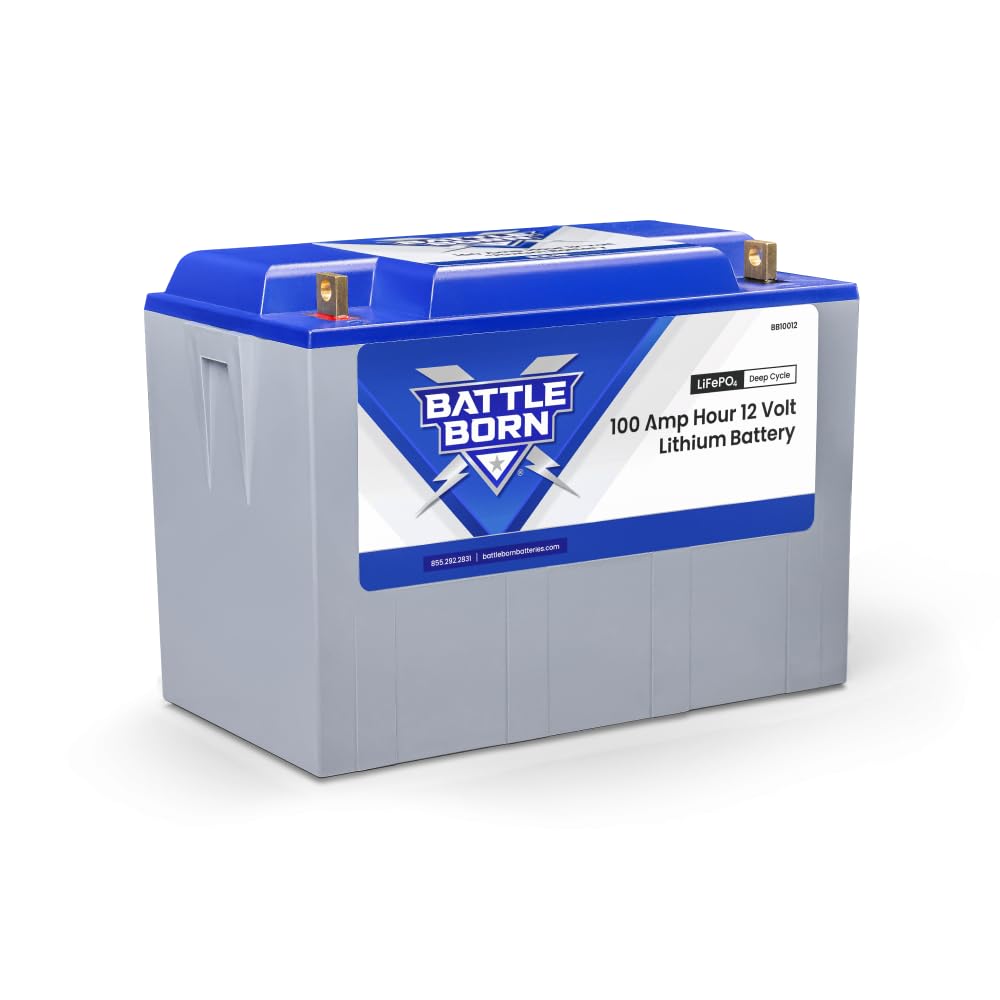
The Battle Born BB10012 is widely regarded as a benchmark in the drop-in lithium market. Built around a robust LiFePO4 chemistry and an internal BMS that covers low-temperature, high-voltage, and short-circuit protection, this 31-pound unit is a direct replacement for Group 27 and Group 31 lead-acid batteries. The manufacturer backs it with a 10-year warranty, which signals confidence in the cell quality.
From a spec-analysis perspective, the BB10012 delivers 100 Ah of usable power with a flat discharge curve, meaning your appliances see consistent voltage until the battery is nearly depleted. It supports both series and parallel wiring, allowing system expansion up to 48V or higher capacity banks. The case is rugged and vibration-resistant, making it suitable for RV travel and marine environments.
Owner feedback frequently highlights the reliable support from Battle Born and the battery’s ability to handle repeated deep discharges without capacity fade. The trade-off is a higher entry cost compared to newer brands. However, for buyers who prioritize long-term support and proven reliability, the BB10012 remains a top-tier reference point.
What works
- Exceptional build quality and rugged case
- Long 10-year warranty with strong support
- Reliable low-temperature BMS protection
- Consistent voltage output under load
What doesn’t
- Premium pricing relative to newer competitors
- No Bluetooth monitoring included
- Heavier than some 100Ah lithium packs
2. Litime 12V 100Ah Trolling Motor LiFePO4 Battery

Litime built this 100 Ah pack specifically to meet the ABYC E-13 standard for marine electrical systems. The extra triple-layer protection against dust, water, and salt spray makes it a strong candidate for trolling motors and saltwater boat applications. The Group 31 footprint (13 x 6.77 x 8.43 inches) and 22.16-pound weight offer a 64% weight reduction over lead-acid.
The built-in BMS includes a TVS (transient voltage suppressor) to shield sensitive electronics from voltage spikes, which is critical when running a trolling motor in choppy waters. It also features smart low-temperature protection—charging stops below 32°F and discharging stops below -4°F. The battery supports up to 4P4S expansion for a maximum of 51.2V and 400 Ah.
Reports from owners show consistent performance over multiple seasons, with no capacity sag when used for long days of trolling. The Litime also appeals to RV owners because of its low self-discharge rate. The main limitation is that the BMS does not include Bluetooth, so you won’t get real-time data without an external monitor.
What works
- ABYC E-13 certification for marine safety
- Excellent salt-spray and vibration resistance
- Lightweight for easier boat handling
- Robust low-temp cutoff circuitry
What doesn’t
- No Bluetooth monitoring built in
- Priced above mid-range options
- Terminal bolts could be longer for thick cables
3. Power Queen 12V 100Ah LiFePO4 Battery
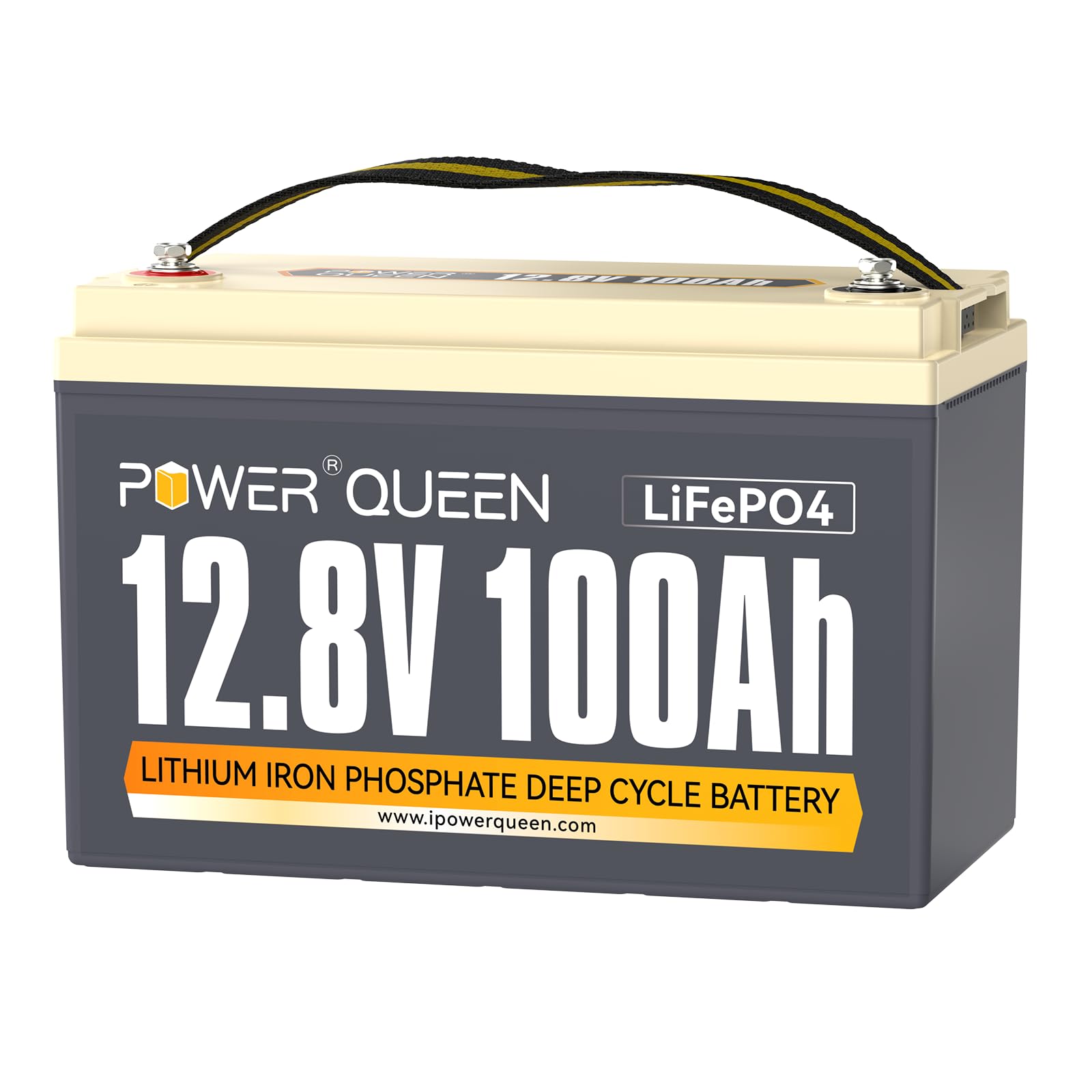
Power Queen’s 12V 100 Ah pack is engineered for users who need high cycle life in a standard Group 31 size. With Grade-A LiFePO4 cells and a 100A BMS that guards against overcharge, over-discharge, short circuits, and overheating, it is a solid performer for solar arrays, RV house banks, and trolling motors up to 70 pounds of thrust.
At 24 pounds, it is still light enough for portable applications yet fits the standard Group 31 tray without modification. The battery supports series/parallel connections up to 4S4P, giving you the flexibility to build a 400 Ah, 51.2V system. The low self-discharge rate of around 3% per month makes it suitable for seasonal storage.
Feedback from solar and van-life users emphasizes the battery’s consistent voltage delivery and the fact that it rarely trips the BMS under normal loads. The 5-year warranty is welcome, though some owners note that the included terminal hardware could be improved. Overall, it is a balanced high-cycle option without the premium of flagship brands.
What works
- High cycle rating with Grade-A cells
- Lightweight for a Group 31 unit
- Supports 4S4P expansion
- Good value for long-term investment
What doesn’t
- Terminal bolts feel basic
- No low-temp charging cutoff mentioned
- Bluetooth not available
4. Redodo 12V 100Ah LiFePO4 Battery

Redodo uses automotive-grade LiFePO4 cells that deliver a cycle-life range of 4,000 cycles at 100% DoD up to 15,000 cycles at 60% DoD. Weighing only 22.04 pounds, it measures 13 x 6.77 x 8.43 inches—Group 31 compatible—and is 60% lighter than a comparable lead-acid battery. The built-in 100A BMS provides the standard suite of protections.
This battery is designed as a true drop-in replacement, requiring no wiring changes when swapping from lead-acid. It supports series and parallel configurations up to 4S or 4P, enabling 48V or 400 Ah banks. The low self-discharge rate of 3% per month and the 10-year expected lifetime make it a strong contender for solar, RV, and trolling motor applications.
In owner reports, the Redodo is praised for its balance of cost and build quality. It is often compared favorably to higher-priced units, with similar internal components. The main drawback is the lack of Bluetooth or SOC display—you will need an external monitor to know the exact state of charge. The warranty is 5 years, which is generous for this price tier.
What works
- Excellent value in the mid-premium range
- Lightweight, easy to install
- Long cycle life at lower DoD
- 5-year warranty builds confidence
What doesn’t
- No Bluetooth or local SOC display
- Not recommended for starter duty
- Terminal hardware could be sturdier
5. ECO-WORTHY 12V 100Ah LiFePO4 with Bluetooth
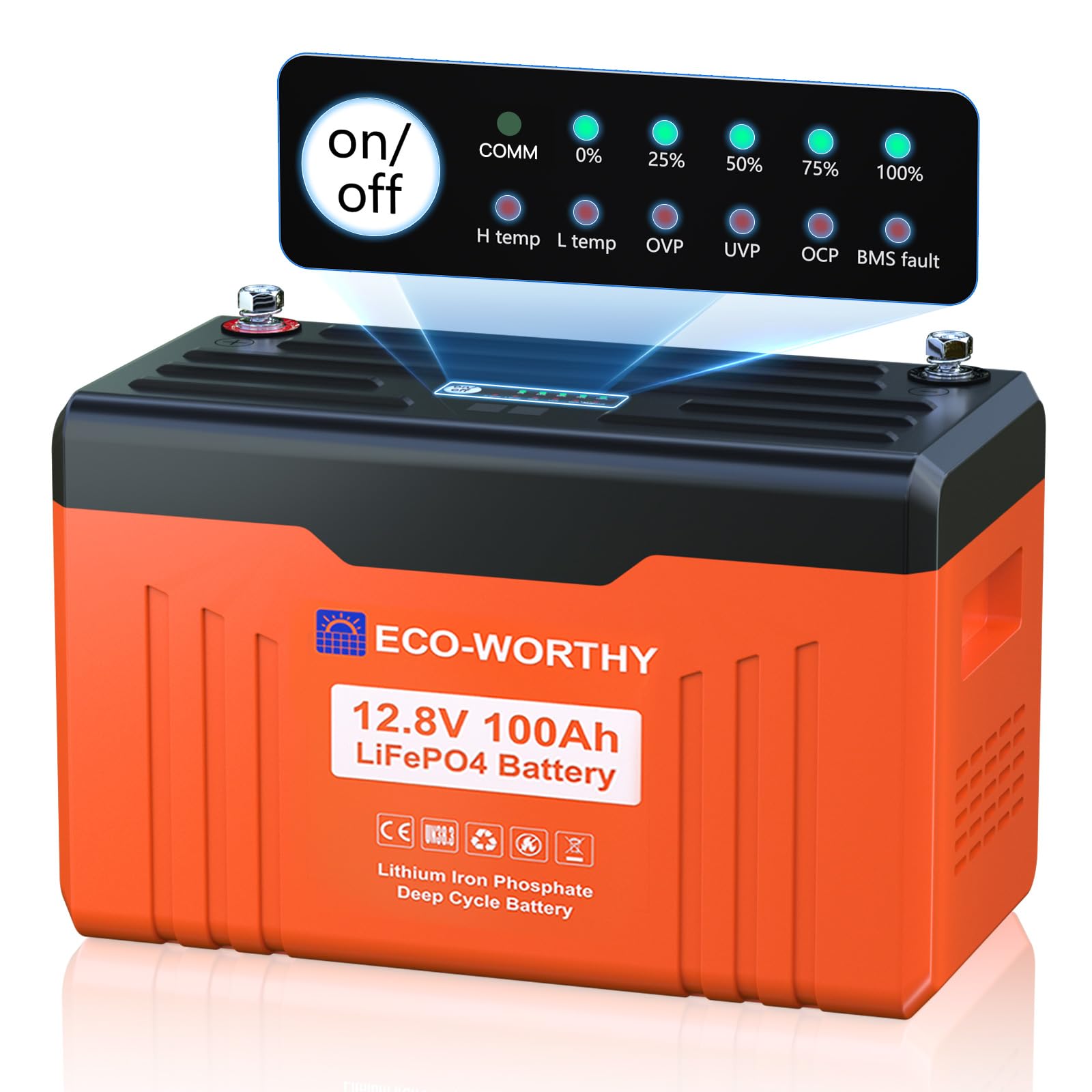
ECO-WORTHY’s upgraded 100 Ah pack stands out with its dual-monitoring approach: a built-in LED panel for instant SOC status and an integrated Bluetooth module that streams real-time voltage, current, and individual cell balance data to your smartphone within a 98-foot range. The smart app also logs performance history and can sound a buzzer alert for BMS faults.
The Group 27 case (11.8 x 6.9 x 8.7 inches) weighs 25.12 pounds and includes a metal fixture that mechanically secures the cells, reducing the risk of expansion and internal shorts. The battery supports 4P2S expansion for up to 10.24 kWh of storage. It also passes 15 different factory tests for electrical safety and cell consistency.
User feedback highlights the convenience of the app for checking remaining capacity without needing a separate shunt. The buzzer alarm for abnormal conditions gives peace of mind for unattended installations. The 3-year warranty is shorter than some competitors, but the feature integration makes it a compelling choice for tech-oriented users.
What works
- Integrated Bluetooth and SOC panel
- Buzzer alarm for BMS faults
- Metal fixings to stabilize cells
- Run 4P2S for larger systems
What doesn’t
- 3-year warranty is below average
- Group 27 size may not fit all trays
- App interface can be clunky initially
6. Wattcycle 12V 100Ah LiFePO4 Battery
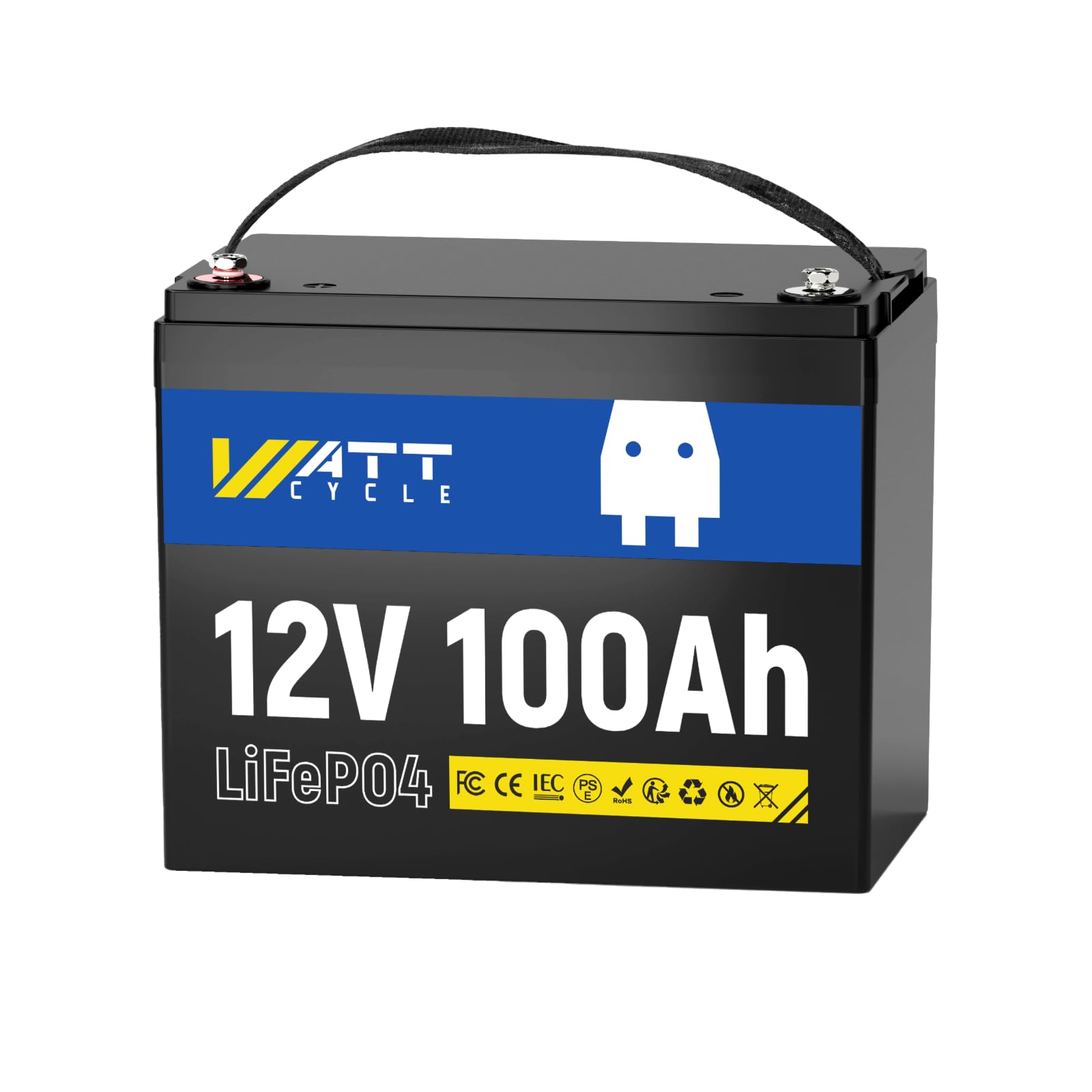
The Wattcycle 12V 100 Ah battery is built to BCI Group 24 dimensions (10.2 x 6.6 x 8.2 inches) and weighs 23.2 pounds, making it one of the more compact 100 Ah options on the market. This smaller footprint is ideal for installations where tray space is limited, such as in smaller campers, boats, or as a portable power station battery.
It uses A+ grade cells with a rated cycle life of up to 15,000 cycles (presumably at 60% DoD). The built-in 100A BMS includes low-temperature protection that halts charging below -4°F for safety. The battery meets SDS, UN38.3, FCC, CE, and ROHS certifications, reflecting solid quality control. Series/parallel configurations up to 4S4P are supported.
Owners appreciate the snug fit into standard Group 24 boxes and the low weight for the capacity. The watt-cycle is often used in solar generator builds and marine trolling setups. The lack of Bluetooth or a visible state-of-charge indicator means you will need an external BMS monitor to track real-time data accurately.
What works
- Compact Group 24 size saves space
- Lightweight at 23.2 lbs
- High cycle rating with Grade-A cells
- Comprehensive safety certifications
What doesn’t
- No built-in display or Bluetooth
- Warranty details not prominently listed
- Terminal bolts could be more robust
7. HumsiENK 12V 100Ah LiFePO4 Battery

The HumsiENK 100 Ah battery is one of the lightest in this comparison at 19.73 pounds, while still providing a full 1,280 Wh of energy. Its standout feature is the IP67 rating, meaning it is dust-tight and can withstand submersion in up to one meter of water for 30 minutes. That makes it a top choice for marine, off-road, and harsh outdoor environments where moisture is a constant threat.
The battery adheres to Group 24 dimensions (8.4 x 6.6 x 10.2 inches) and includes a nylon handle for easier carrying. The built-in 100A BMS provides standard protections plus a high-current disconnect at 300±50 amps. It also includes low-temperature protection that shuts the battery down below -4°F. Fast charging is supported—capable of a full recharge in about 2 hours with a suitable charger.
Feedback from owners frequently mentions the ruggedness of the IP67 seal and the convenience of the handle for portable use. It is compatible with solar, generator, and grid charging. The 5-year warranty is competitive. The main downside is that the BMS reset procedure can be tricky if the battery enters protection mode after prolonged storage.
What works
- IP67 waterproof and dustproof
- Very light at under 20 lbs
- Nylon handle for portability
- Fast 2-hour recharge capability
What doesn’t
- BMS reset requires careful steps
- Group 24 box may not fit Group 31 trays
- No Bluetooth monitoring
8. DUNFUME 12V 100Ah LiFePO4 Battery
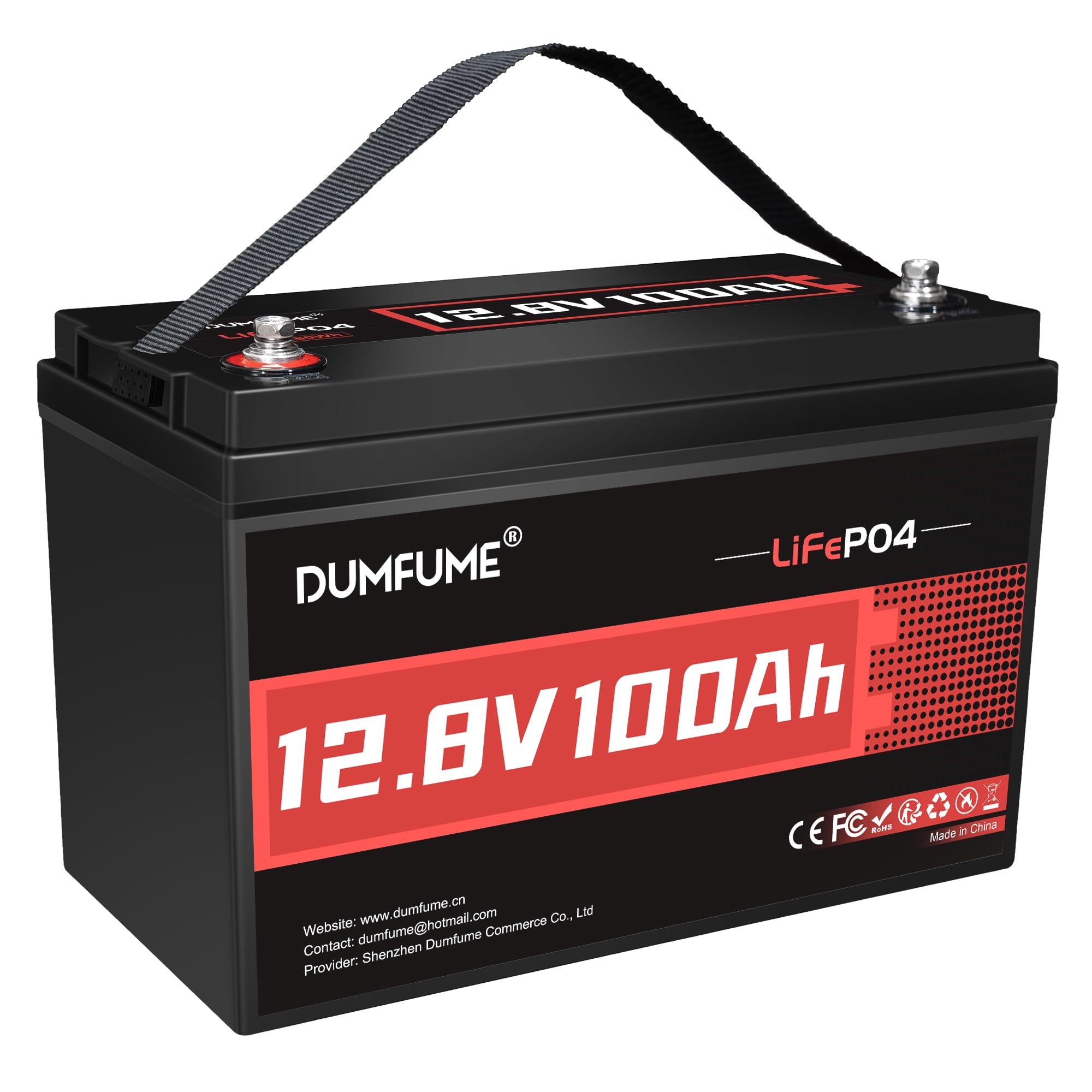
DUNFUME positions this 100 Ah battery as a direct lead-acid replacement with a 25% size reduction and 1.28 kWh of stored energy. Weighing just 21.6 pounds, it is 67% lighter than a typical 100 Ah AGM unit. The ABS plastic casing offers dust and weather resistance, though it is not fully waterproof. It supports series and parallel configurations up to 4S4P for a 400 Ah, 51.2V system.
The integrated 100A BMS covers all standard protections. The Grade-A cells are rated for up to 4,000 cycles at 100% DoD and 6,000 cycles at 80% DoD, which is a solid performance for the entry-level price tier. The 5-year warranty is generous at this price point. Note that the battery is not intended for starting engines or golf cart applications.
Community reviews from RV users highlight the good value proposition. Many owners use the DUNFUME as a starter battery for their solar conversion, appreciating the low upfront cost relative to premium brands. The main feedback is that the terminal bolts feel a bit light for high-amperage connections and there is no visual state-of-charge indicator.
What works
- Very attractive entry-level price
- Light and compact for easy installation
- 5-year warranty
- Clean drop-in replacement
What doesn’t
- No SOC display or Bluetooth
- ABS case is weather-resistant, not waterproof
- Terminal bolts could be larger
9. WEIZE 12V 100Ah Deep Cycle Lead-Acid Battery

The WEIZE 12V 100 Ah is a sealed lead-acid (SLA) AGM battery that provides 100 Ah of capacity with a 1,150A max discharge current. It measures 12.99 x 6.73 x 8.34 inches and weighs roughly 60 pounds, making it the heaviest option in this guide. It is a true drop-in for applications that require high surge current, such as starting auxiliary motors or running high-draw inverters for short bursts.
This battery is maintenance-free, spill-proof, and can be mounted in any orientation (except inverted). It is commonly used for scooters, lawn tractors, UPS systems, and emergency lighting. The self-discharge rate is about 3–5% per month when stored at room temperature. It is compatible with standard lead-acid chargers and does not require a lithium-specific charging profile.
Buyers who have tight budgets or who are building systems that cannot accommodate lithium charging profiles find this SLA option practical. The main trade-off is the weight, the much shorter cycle life (200–500 cycles), and the significant voltage drop under sustained load. For occasional use or traditional setups, it remains a reliable workhorse.
What works
- Lowest upfront investment
- High surge current capability
- Works with standard SLA chargers
- Maintenance-free sealed design
What doesn’t
- Very heavy at about 60 lbs
- Short lifespan (200–500 cycles)
- Voltage sag under continuous load
- Lower energy density than lithium
Hardware & Specs Guide
Chemistry Selection
LiFePO4 (lithium iron phosphate) batteries offer a cycle life of 4,000–15,000 cycles, weigh 19–31 lbs, and maintain a steady voltage output. Lead-acid (AGM) batteries are heavier, weigh around 60 lbs, and last only 200–500 cycles. The LiFePO4 chemistry is safer and more efficient for deep-cycle use.
BMS Essentials
A high-quality BMS protects against overcharge, over-discharge, short circuits, and extreme temperatures. Look for low-temperature charging cutoff below 32°F to prevent permanent cell damage. Some premium BMS units include Bluetooth for real-time monitoring and fault alerts.
Physical Fit and Group Size
Group 31 (approx. 13 x 6.8 x 8.4 inches) is common for 100 Ah packs. Group 24 (approx. 10.2 x 6.6 x 8.2 inches) offers a smaller footprint. Always measure your battery tray before purchasing. Weight ranges from 19 to 25 lbs for lithium, and about 60 lbs for lead-acid.
Series and Parallel Expansion
Most LiFePO4 batteries allow up to 4S4P configurations (4 in series, 4 in parallel), enabling 48V systems or up to 400 Ah capacity. Verify that the BMS supports the required topology. Lead-acid batteries can also be banked, but they require matched age and capacity for best performance.
FAQ
Should I choose LiFePO4 or lead-acid for my 100 Ah battery?
What does the BMS do in a 100 Ah battery?
Can I connect multiple 100 Ah batteries together?
Does a 100 Ah lithium battery work in cold weather?
Final Thoughts: The Verdict
For most buyers, the best 100 ah battery winner is the Battle Born BB10012 because of its proven build quality, 10-year warranty, and robust BMS that handles deep cycles reliably. If you want the best balance of features and price, the Redodo 12V 100Ah offers similar performance at a more accessible investment. And for tech-focused users who want real-time monitoring, the ECO-WORTHY with Bluetooth is the clear pick.

Certification: BSc in Mechanical Engineering
Education: Mechanical engineer
Lives In: 539 W Commerce St, Dallas, TX 75208, USA
Md Amir is an auto mechanic student and writer with over half a decade of experience in the automotive field. He has worked with top automotive brands such as Lexus, Quantum, and also owns two automotive blogs autocarneed.com and taxiwiz.com.