Nothing erodes the confidence of a daily driver faster than a dashboard that stays dark when you turn the key. A dead battery at the wrong moment — a cold morning, a late shift, a remote trailhead — turns a routine trip into a scramble for jumper cables and a willing stranger. A dedicated jump starter eliminates that dependency by putting the rescue power directly in your hands, but the gap between a tool that works and one that merely occupies trunk space comes down to peak amperage, battery chemistry, and the safety protections built into the clamps.
I’m Amir — the founder and writer behind Four Wheel Ask. I’ve spent years analyzing jump starter specifications, battery chemistries, and real-world owner feedback to understand what separates a reliable emergency tool from an expensive paperweight.
Peak current ratings, cycle life, and standby retention vary wildly across the market, making it easy to overpay for numbers that don’t translate to real performance. After analyzing hundreds of owner testimonials and performance specs, I’ve identified the models that deliver true reliability when you need a best battery charger for jump start.
How To Choose The Best Battery Charger For Jump Start
Choosing a jump starter requires more than just looking at the highest number on the box. Peak amperage, battery chemistry, safety circuits, and standby retention all play a role in whether the device works when you actually need it. Understanding these factors helps you match the tool to your vehicle and your driving environment.
Peak Amperage vs. Engine Size
The peak current rating — often advertised in bold on the front of the package — indicates the maximum burst the unit can deliver during cranking. A compact four-cylinder engine typically starts reliably with 600 to 1000 peak amps, while a large V8 or diesel requires 2000 amps or more. Overshooting the rating does not hurt, but undershooting leaves you stranded. Always match the peak amperage to the largest engine in your household fleet.
Safety Protections That Matter
Reverse polarity protection, spark-proof circuitry, and over-temperature shutoff prevent damage to the vehicle’s electronics and injury to the user. These features are especially important for drivers who may need to connect the clamps in low-light or stressful roadside conditions. Units with spark-proof clamps and audible or visual connection indicators reduce the learning curve significantly.
Additional Features and Trade-Offs
Built-in air compressors, USB power banks, and LED flashlights add versatility but increase weight and cost. A unit with a compressor is valuable for drivers who frequently deal with slow leaks, while a minimalist unit prioritizes compact size and longer standby time. Evaluate your typical roadside scenarios to decide whether an all-in-one solution or a dedicated jump starter better serves your needs.
Quick Comparison
On smaller screens, swipe sideways to see the full table.
| Model | Category | Best For | Key Spec | Amazon |
|---|---|---|---|---|
| NOCO Boost GB40 | Jump Starter | Compact reliability | 1000A peak, 6.0L gas | Amazon |
| ANFLAG BD60 | 10-in-1 | Diesel & large engines | 8000A peak, 160PSI | Amazon |
| AIMAPOW A40 | Jump Starter + Compressor | Extreme cold weather | 8000A peak, 27000mAh | Amazon |
| Joltekon VP10 | Jump Starter + Compressor | Fast tire inflation | 5000A peak, 45L/min | Amazon |
| TREKURE Beta06 | 8-in-1 | Power bank + jump start | 6000A peak, 23800mAh | Amazon |
| UTRAI JS-9 | Jump Starter + Compressor | Budget all-in-one | 4000A peak, 150PSI | Amazon |
| AstroAI S8 | Jump Starter | Budget emergency kit | 1500A peak, 6.0L gas | Amazon |
In‑Depth Reviews
1. NOCO Boost GB40

The NOCO GB40 has earned its reputation as the benchmark for portable jump starters through a decade of consistent owner reports and a design philosophy that prioritizes safety above raw peak numbers. Its 1000-amp peak rating handles six-cylinder gasoline engines and smaller V8s without hesitation, while the UltraSafe circuitry eliminates spark risk even when the clamps are connected in reverse. The IP65-rated housing with rubberized over-molding resists dust and water ingress, making it a reliable companion for vehicles stored outdoors or in coastal environments.
Owner feedback consistently highlights the unit’s ability to hold a charge for six months or more between uses, a critical factor for an emergency tool that may sit untouched for long stretches. The integrated 100-lumen LED with seven modes — including strobe and SOS — adds nighttime utility without adding bulk. Weighing just over two pounds, the GB40 fits neatly into a glove box or under a seat, which explains why it appears in so many dedicated emergency kits.
The primary trade-off is the lack of an air compressor, meaning this unit focuses entirely on jump starting and device charging. The 2150mAh internal battery is modest by modern standards but sufficient for multiple jump cycles on a single charge. For drivers who want a proven, no-compromise jump starter without extra frills, the GB40 remains the reference point that other designs attempt to match.
What works
- UltraSafe spark-proof and reverse polarity protection
- Holds charge for months in standby
- Compact, rugged IP65 housing
What doesn’t
- Lower peak amps limit large diesel compatibility
- No built-in air compressor
- Wall charger not included in the box
2. ANFLAG BD60
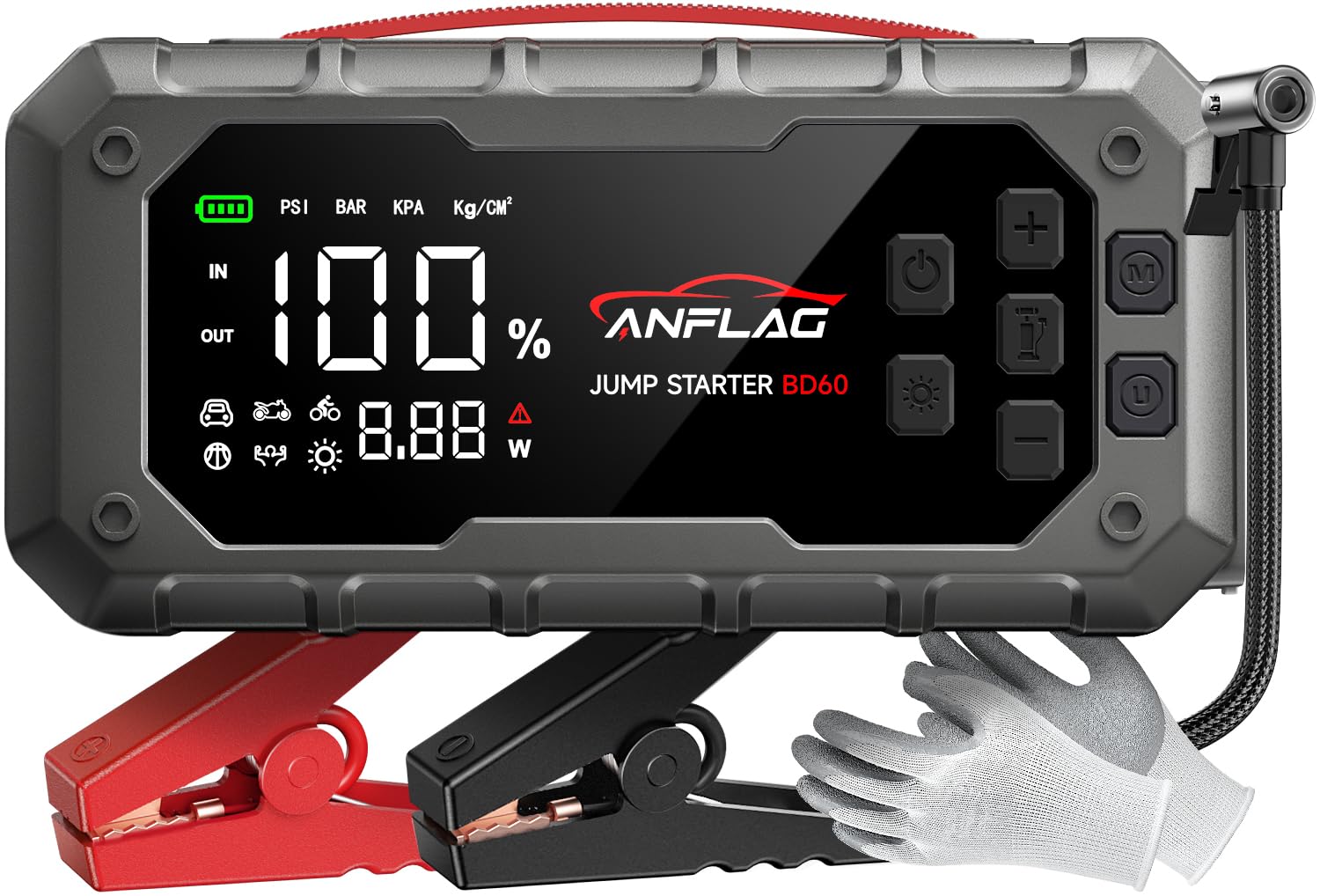
The ANFLAG BD60 represents the current high-water mark for all-in-one jump starters, packing ten distinct functions into a single unit without compromising on peak current delivery. Its 8000-amp peak rating is sufficient for large-displacement gasoline engines and diesel power plants up to 14 liters, making it one of the few portable units that can confidently handle a heavy-duty pickup or a large marine engine. The 160PSI air compressor with a 45L/min turbo pump inflates a passenger car tire from flat to drivable pressure in roughly two minutes, with automatic shut-off at the preset target.
What sets the BD60 apart from other high-capacity units is its PD65W bidirectional USB-C charging, which replenishes the 26800mAh internal battery from zero to full in about 90 minutes using a compatible adapter. The 600-lumen four-mode LED — flashlight, white strobe, red strobe, and SOS — is substantially brighter than the typical jump starter light, and the included 400V insulated gloves add a layer of safety that few competitors offer. Owner reports consistently praise the unit’s ability to start engines in freezing temperatures after extended storage periods.
The main downside is the physical footprint; at roughly 11 by 6 inches, the BD60 requires dedicated trunk space rather than glove-box storage. The wall charger is also sold separately, which adds an incremental cost for buyers who do not already own a 65W USB-C adapter. For drivers of large trucks, diesel SUVs, or fleet vehicles who want a single device that handles both jump starting and tire inflation, the BD60 delivers exceptional breadth of capability.
What works
- 8000A peak handles large diesel engines
- PD65W fast charging replenishes in 90 minutes
- 160PSI compressor with auto shut-off
What doesn’t
- Bulky for compact vehicle storage
- Wall charger not included
- More features than some users need
3. AIMAPOW A40
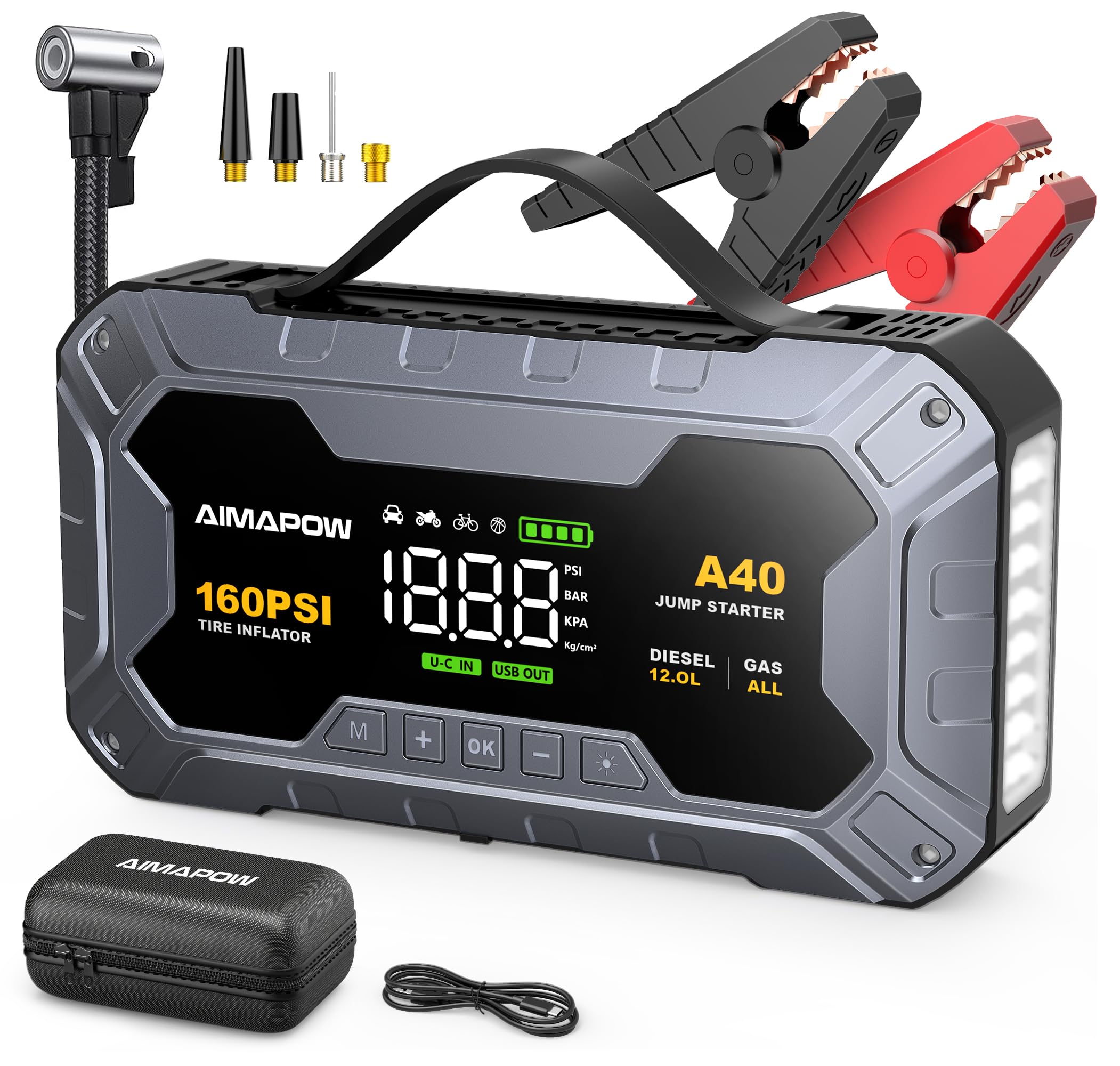
The AIMAPOW A40 carves out a specific niche for drivers who regularly face extreme cold or batteries that have been drained to zero voltage. Its 8000-amp peak current is matched with a dedicated force start button that bypasses the standard safety logic to deliver power directly to a completely depleted battery — a feature that few competitors offer at this price tier. The 27000mAh capacity provides substantial reserve power for multiple jump cycles, and the unit’s performance in sub-freezing temperatures is backed by numerous owner accounts of successful starts in blizzard conditions.
The integrated 160PSI air compressor uses a 45L/min turbo pump and includes five inflation modes — car, motorcycle, bicycle, balloon, and custom — with a 2.5-inch LCD display that shows real-time pressure readings and battery status. The 12 protection technologies cover overcurrent, short circuit, reverse polarity, and temperature extremes, giving the unit a safety profile that matches more expensive competitors. Owners consistently note that the A40 starts engines on the first attempt, even after the vehicle has sat for weeks in cold weather.
The trade-off for this performance is a slightly larger form factor and a brand that is less established than NOCO. Some owners noted that the instruction manual could be clearer about the force start procedure. For drivers in northern climates or those who own vehicles with known parasitic drain issues, the A40’s force start capability and cold-weather reliability make it a standout choice in the mid-range segment.
What works
- Force start handles completely dead batteries
- Exceptional cold-weather performance
- High 27000mAh capacity for multiple jumps
What doesn’t
- Brand less established than competitors
- Instructions could be more detailed
- Larger than minimalist jump starters
4. Joltekon VP10
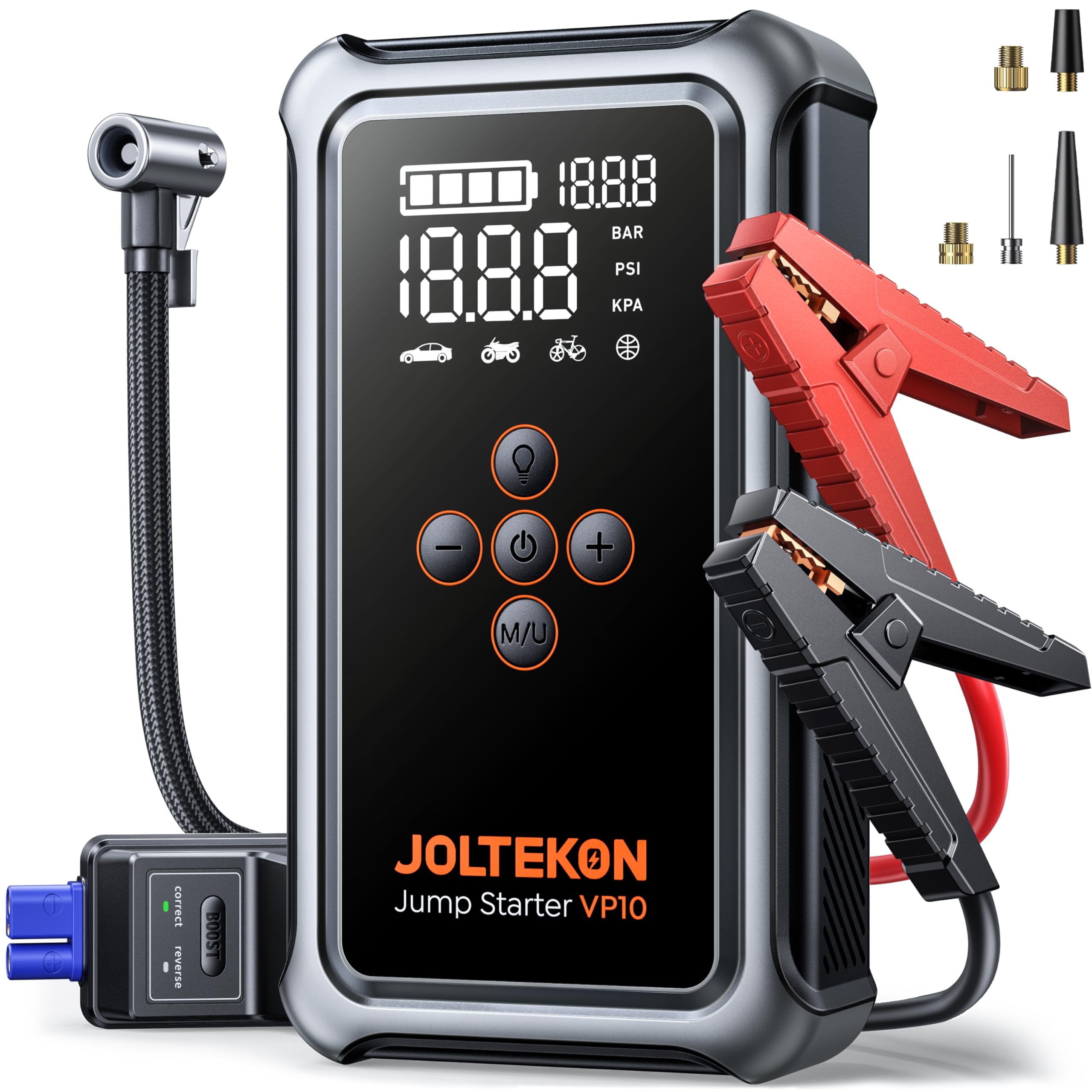
The Joltekon VP10 targets the value-conscious buyer who wants both jump starting and tire inflation capability without paying a premium for brand recognition. Its 5000-amp peak current is sufficient for all gasoline engines up to 10 liters and most diesel engines, while the 150PSI air compressor with a 45L/min turbo pump delivers inflation speeds that rival units costing significantly more. The V0-rated flame-retardant housing and 10-layer safety protection system provide peace of mind for storage in hot vehicle interiors.
Owner feedback emphasizes the accuracy of the auto-shutoff inflation system, which matches within one PSI of a standalone tire gauge. The sunlight-readable LCD screen displays real-time battery status and air pressure clearly, and the 37Wh battery capacity delivers enough reserve for multiple jump cycles plus full device charging. The VP10 also includes a boost button for starting deeply discharged batteries, giving it a capability set that overlaps with higher-priced competitors.
The main limitation is the 10000mAh battery capacity, which is lower than some all-in-one units and may require recharging after extensive compressor use — one owner reported needing two recharge cycles to inflate four travel trailer tires. The brand’s warranty support is less proven than established players like NOCO. For everyday drivers who want a capable two-in-one unit at a competitive price, the VP10 offers strong performance per dollar.
What works
- Fast inflation with ±1 PSI accuracy
- V0 fireproof housing for safe storage
- Strong value for a two-in-one unit
What doesn’t
- Battery capacity limits extended compressor use
- Brand warranty support unproven
- Not glove-box sized
5. TREKURE Beta06

The TREKURE Beta06 stands out for its thoughtful integration of eight functions into a package that includes a 160W EC5 cigarette lighter socket — a feature rarely found in this price range. The 6000-amp peak current handles gasoline engines and diesels up to 10 liters, while the 150PSI air compressor with a 35L/min turbo pump supports intelligent preset pressure and automatic shut-off. The V0-rated fireproof shell is rated for safe storage in high-temperature vehicle interiors, addressing a genuine concern for owners in hot climates.
The 23800mAh battery provides enough capacity for extended use, and the inclusion of dual USB ports plus the EC5 socket means the Beta06 can power 12V accessories like handheld vacuums or portable coolers. The three-mode LED light — flashlight, strobe, and orange SOS — includes a comfortable side handle for handheld use during roadside repairs. Owners consistently rate the build quality highly, noting that the unit feels substantially constructed without being overly heavy.
A few owners noted that the air hose lacks a swivel connector, which can make inflation slightly more awkward on certain valve stem positions. The EC5 connector is non-standard, which limits replacement cable options. For drivers who want a versatile emergency kit that can jump start, inflate tires, and power 12V accessories from a single device, the Beta06 delivers an impressive feature set at a competitive price.
What works
- EC5 socket powers 12V accessories
- V0 fireproof housing for hot climates
- High 23800mAh capacity
What doesn’t
- Air hose lacks swivel connector
- Non-standard EC5 connector limits cable options
- Slower compressor than dedicated units
6. UTRAI JS-9
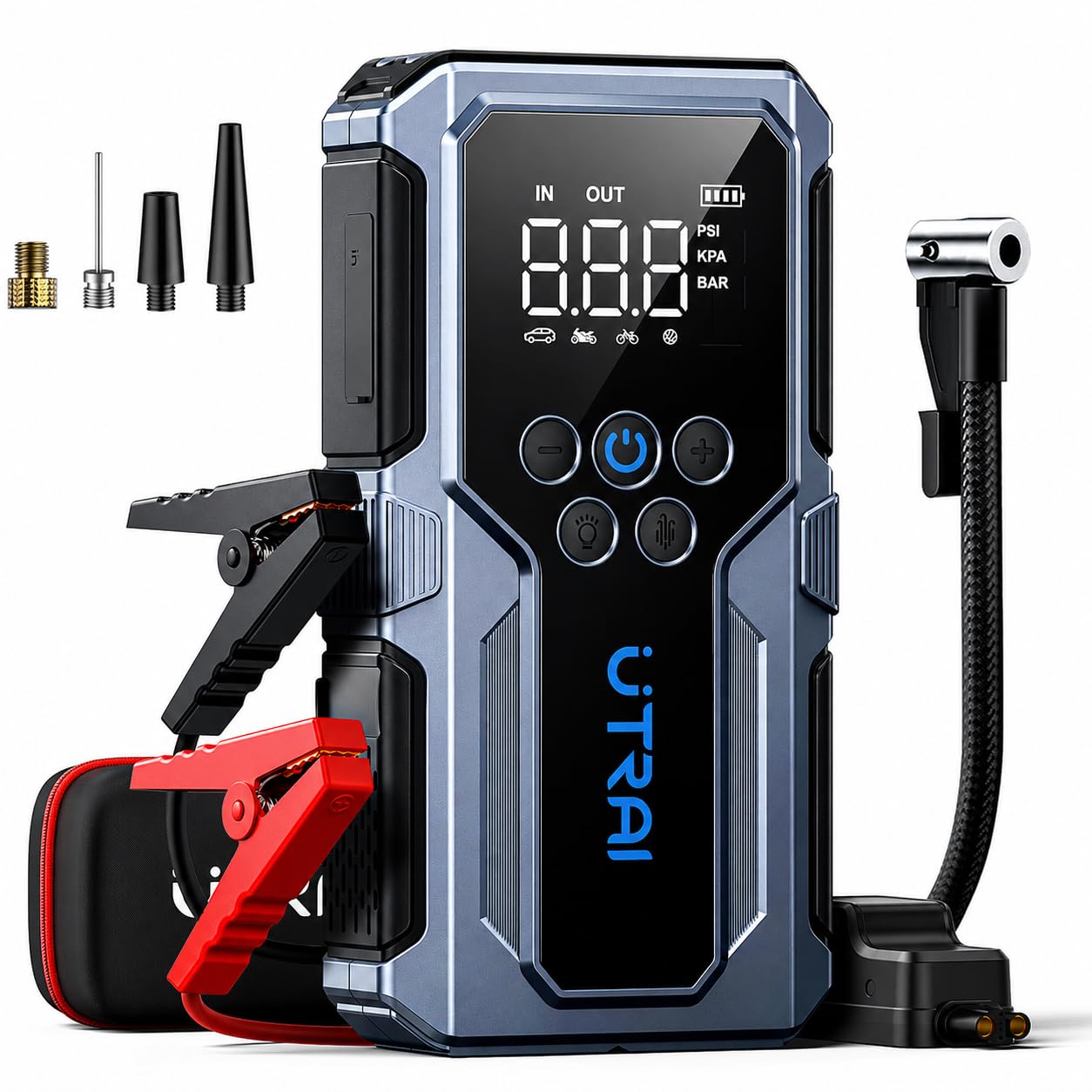
The UTRAI JS-9 delivers a well-rounded combination of jump starting and tire inflation at an entry-level price point that makes it accessible for budget-conscious buyers. Its 4000-amp peak current is adequate for most gasoline engines up to 8.5 liters and smaller diesel engines, while the 150PSI air compressor with digital LCD meter and auto-shutoff provides reliable inflation for car tires, bike tires, and inflatables. The included EVA carrying case keeps everything organized in the trunk.
Owner reports consistently praise the JS-9’s ability to hold a charge for extended periods — one owner reported successful starts after nine months of standby storage. The smart clamp design includes a visual indicator that confirms proper connection before the jump sequence begins, reducing the risk of user error. The three-mode LED light (flashlight, strobe, SOS) covers basic emergency lighting needs, and the 15000mAh battery provides enough reserve for multiple jump cycles plus device charging.
The primary compromises are the lower peak amperage, which limits compatibility with large diesel engines, and instruction manuals that some owners found unclear. The unit also lacks a forced start button for completely dead batteries, meaning it may not work in every scenario. For drivers with standard gasoline vehicles who want a dependable two-in-one unit with a strong warranty, the JS-9 offers compelling value.
What works
- Excellent standby charge retention
- EVA case keeps everything organized
- Good value for a two-in-one unit
What doesn’t
- 4000A peak limits large diesel use
- Instructions could be clearer
- No force start for dead batteries
7. AstroAI S8
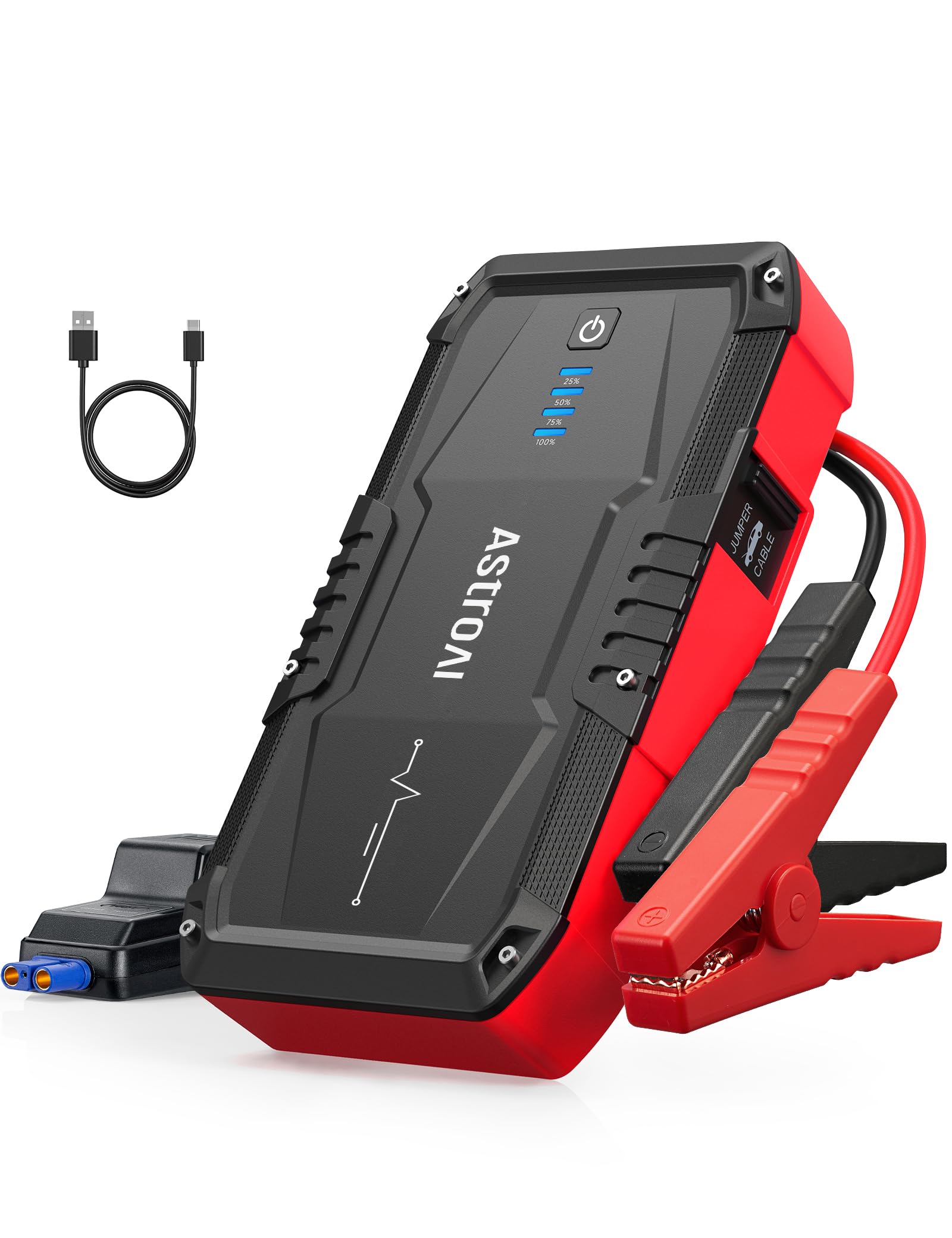
The AstroAI S8 strips the jump starter concept down to its essentials — a compact, lightweight unit that fits in a glove box and delivers reliable starting power for standard gasoline vehicles. Its 1500-amp peak current handles engines up to 6.0 liters gasoline and 3.0 liters diesel, covering the vast majority of passenger cars and light SUVs. The 37Wh lithium-NMC battery provides enough reserve for multiple jump cycles, and the unit weighs just 12.6 ounces — light enough to carry in a backpack or center console.
Owner feedback consistently highlights the S8’s ability to hold a charge for months and start a dead battery on the first attempt. The smart boost mode detects battery voltage below 9 volts and requires pressing a separate boost button to engage, adding a layer of user awareness. The three-mode LED flashlight — steady, strobe, and SOS — covers basic emergency lighting, and the safety metal clamps include eight integrated protections for reverse polarity, overcurrent, and short circuit prevention.
The S8 does not include an air compressor or high-capacity power bank functionality, and its 1500-amp rating means it cannot handle large diesel engines or heavy commercial vehicles. The NMC battery chemistry has a shorter cycle life than some lithium-polymer alternatives. For drivers who want a minimalist, ultra-portable jump starter that prioritizes reliability and low weight over extra features, the S8 is a pragmatic choice that delivers exactly what it promises.
What works
- Extremely lightweight and compact
- Reliable starts on standard gasoline engines
- Good standby charge retention
What doesn’t
- No air compressor or power bank features
- 1500A peak limits large diesel use
- NMC battery has shorter cycle life
Hardware & Specs Guide
Battery Chemistry
Most modern jump starters use lithium-nickel manganese cobalt oxide (NMC) or lithium polymer (LiPo) cells. NMC batteries typically offer higher energy density and longer standby retention, while LiPo cells can deliver higher peak discharge rates and tolerate more charge cycles. The choice affects both the physical size of the unit and its cold-weather performance. Units with LiPo batteries generally perform better in sub-freezing temperatures, making them the preferred choice for northern climates.
Peak vs. Rated Amperage
Peak amperage represents the absolute maximum current the unit can deliver in a very short burst — typically less than one second — during the initial cranking event. Some manufacturers use peak ratings in their advertising because the numbers are larger, but the sustained current delivery during the actual starting sequence is more relevant for real-world performance. Look for units that clearly state both peak and rated amperage, and match the rated figure to your engine’s starting requirements for consistent reliability.
FAQ
Can a jump starter charge a completely dead battery?
How often should I recharge my jump starter?
What is the difference between a jump starter and a battery charger?
Final Thoughts: The Verdict
For most buyers, the best battery charger for jump start winner is the NOCO Boost GB40 because it combines proven reliability, compact size, and best-in-class safety features that work for the vast majority of passenger vehicles. If you need to start large diesel engines and want an air compressor in one package, grab the ANFLAG BD60. And for extreme cold weather or vehicles with fully drained batteries, nothing beats the AIMAPOW A40 with its force start capability.

Certification: BSc in Mechanical Engineering
Education: Mechanical engineer
Lives In: 539 W Commerce St, Dallas, TX 75208, USA
Md Amir is an auto mechanic student and writer with over half a decade of experience in the automotive field. He has worked with top automotive brands such as Lexus, Quantum, and also owns two automotive blogs autocarneed.com and taxiwiz.com.