Headlight glare at night is more than an annoyance — it is a real safety hazard that forces drivers to squint, hesitate, and sometimes miss obstacles entirely. For those who already wear prescription eyewear, the solution is not a second pair of bulky goggles but a precision clip-on that snaps directly onto existing frames.
I’m Amir — the founder and writer behind Four Wheel Ask. I study consumer feedback and technical specifications across hundreds of eyewear models to pinpoint which clip-on lenses actually cut glare without washing out detail.
Night driving glare and headlight bloom diminish when you select the best clip on night driving glasses engineered for your frames.
How To Choose The Best Clip On Night Driving Glasses
Selecting the right clip-on for nighttime driving comes down to three factors that directly affect how much glare you block and how well the lens stays put on your frames. Ignoring any one of them can leave you with a pair that either slides off mid-drive or fails to cut the harsh blue-white bloom of modern headlights.
Lens Color and Coating Technology
Yellow-tinted lenses are the industry standard for night driving because they filter out the high-frequency blue light that causes the most scatter in low-light conditions. A quality yellow lens should also carry an anti-reflective coating on the back surface to prevent internal reflections between the clip-on and your prescription lens. Polarization is a bonus in wet conditions, but it is not strictly necessary for night use — some drivers even report that polarized lenses dim the road too much in very dark areas.
Clip Mechanism and Frame Compatibility
The clip mechanism determines whether the lens stays centered over your eye or shifts with every bump. Look for a metal spring clip with rubberized tips that grip the frame without scratching. Measure the width of your prescription frames before buying — many clip-ons are designed for standard rectangular or oval shapes and will not seat properly on oversized, cat-eye, or very thick plastic frames.
Build Quality and Long-Term Durability
A night driving clip-on lives in a glovebox or center console where temperatures swing from freezing to scorching. Lenses with scratch-resistant coatings and hinges that do not loosen after repeated use justify a slightly higher investment. Multi-pack options offer flexibility — keep one dedicated pair in the car and a backup at home — but only if the individual lenses meet the same optical standards as a single high-end unit.
Quick Comparison
On smaller screens, swipe sideways to see the full table.
| Model | Category | Best For | Key Spec | Amazon |
|---|---|---|---|---|
| FIMOSON 2-Pack | Yellow Lens | Headlight glare and rain | HD polarized, anti-reflective, 2-pack | Amazon |
| CAXMAN Night | Yellow Lens | Astigmatism and cataract glare | Non-flip, compact fit, unisex | Amazon |
| Each Cool Flip-Up | Flip-Up | Alternating day/night driving | UV400, polarized, hard case included | Amazon |
| Konohan 5-Pair | Multi-Color | Variety of lighting conditions | 5 color options, flip-up, polarized | Amazon |
| Night Driving Clip-On | Dual-Use | Daytime sun and evening commute | Polarized, UV400, slim case | Amazon |
In‑Depth Reviews
1. FIMOSON Night Driving Glasses Clip On 2-Pack

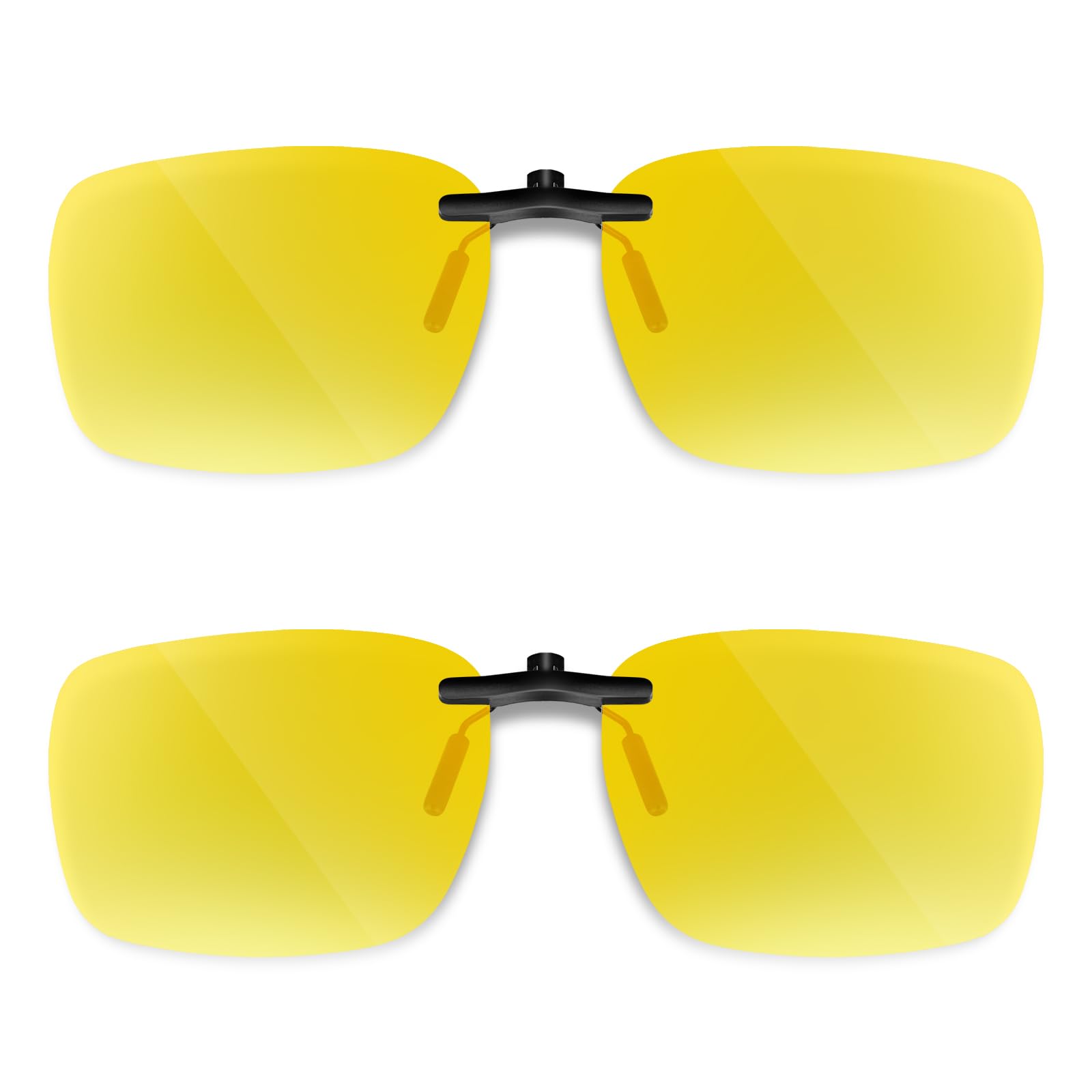
The FIMOSON 2-pack delivers what most single-pair options charge a premium for — a dedicated set for the car and a backup for home or a second vehicle. The HD polarized yellow lenses carry a special anti-reflective coating that specifically targets the blue-white glare from halogen and LED headlights. Owner reports consistently praise the way these lenses cut road glare in dark and rainy conditions without adding noticeable weight to existing frames.
Build quality stands out in this price tier. The metal clip uses a strong spring with rubberized tips that grip frame arms securely, and the silicone frame material keeps the lens light against the bridge. Multiple verified buyers note that the lenses resist scratches better than other clip-ons they have tried, and the included storage bag and cleaning cloth add practical value. The rectangular shape suits most standard prescription frames without overhang.
One recurring caveat involves halos caused by cataracts — several users report that while headlight glare is reduced, the concentric ring effect around lights remains largely unchanged. Additionally, the lenses tend to collect fingerprints easily, and the soft silicone arms can occasionally shift on very thin wire frames. For drivers who do not have advanced cataract issues, however, these clip-ons represent a well-engineered solution at a fair price.
What works
- Effectively cuts headlight glare in rain and darkness
- Two pairs provide excellent backup or split-use value
- Strong spring clip with rubberized grip stays secure
What doesn’t
- Does not reduce halo rings caused by cataracts
- Prone to visible fingerprint smudges
- Soft arms can slip on extremely thin wire frames
2. CAXMAN Night Driving Glasses Clip On

The CAXMAN clip-on earns its reputation from a singular focus: eliminating the blinding glare of oncoming headlights for drivers with astigmatism, corneal nodules, or early cataracts. Verified buyers consistently describe a noticeable reduction in the “star burst” and “halo” effects that make night driving painful. The yellow HD polarized lens is designed as a non-flip permanent clip-on, meaning it sits flush against the prescription lens without the extra hinge that can add bulk or rattle.
Fit precision is a standout feature here. Multiple owners note that the CAXMAN covers the prescription lens and frame edge without extending beyond the outer boundary, creating a clean profile that does not interfere with peripheral vision. The clip mechanism installs easily, though several users mention they prefer to attach it with the glasses off to ensure perfect alignment. The lens color works well for twilight, fog, and heavy overcast conditions in addition to pure night driving.
Not every driver experiences the same benefit. One verified review from a user whose wife tried the same pair reports that results can vary based on individual vision conditions. Another owner notes that while the clip-on is effective for headlight glare, it does not sharpen overall contrast or make pedestrians more visible in pitch-black rural roads. For urban and suburban drivers battling high-beam glare, though, the CAXMAN delivers one of the most targeted glare-reduction performances available.
What works
- Exceptional glare reduction for astigmatism and corneal issues
- Sits flush with frame edge, no peripheral obstruction
- Works well in fog, twilight, and overcast conditions
What doesn’t
- Effectiveness varies based on individual vision conditions
- Does not improve contrast or visibility on unlit roads
- Non-flip design means you cannot tilt up without removing
3. Each Cool Polarized Clip-On & Flip-Up Driving Glasses
The Each Cool flip-up brings a level of versatility that fixed clip-ons cannot match — the ability to pivot the tinted lens up when you pull into a well-lit parking lot or need to read a street sign without the yellow filter. This model is polarized and rated UV400, making it equally functional as a daytime sunglass clip-on. Owners report that it clips close to the prescription lens to minimize light gaps, a detail that significantly reduces the annoying side-glare that can slip through poorly fitted designs.
Build quality is a clear step above entry-level offerings. The included hard case, microfiber cloth, and storage bag provide protection that keeps lenses scratch-free during glovebox storage. Multiple verified buyers highlight how the lightweight, thin profile works especially well with metal frames, where the clip sits neatly without adding noticeable bulk. The glare reduction is real — owners with night blindness, astigmatism, and even PVD (posterior vitreous detachment) report meaningful improvement in comfort behind the wheel.
A minority of owners wish the glare reduction went further. One review describes the effect as noticeable but not dramatic — the yellow tint cuts some oncoming light intensity but can still leave bright LEDs feeling uncomfortably intense. Another buyer notes that the lens dims the overall scene slightly, making pedestrians harder to spot in very dark conditions. The flip-up hinge is well built but adds a small amount of thickness versus a non-flip design. For drivers who frequently alternate between day and night driving, however, the convenience of the flip mechanism is worth the trade-off.
What works
- Flip-up design allows instant switching between conditions
- Includes hard case, cloth, and storage bag for protection
- Reduces glare for night blindness, astigmatism, and PVD
What doesn’t
- Glare reduction may feel insufficient against intense LEDs
- Overall dimming can reduce pedestrian visibility in darkness
- Flip mechanism adds slight thickness vs. non-flip designs
4. Konohan 5 Pairs Clip on Sunglasses for Men
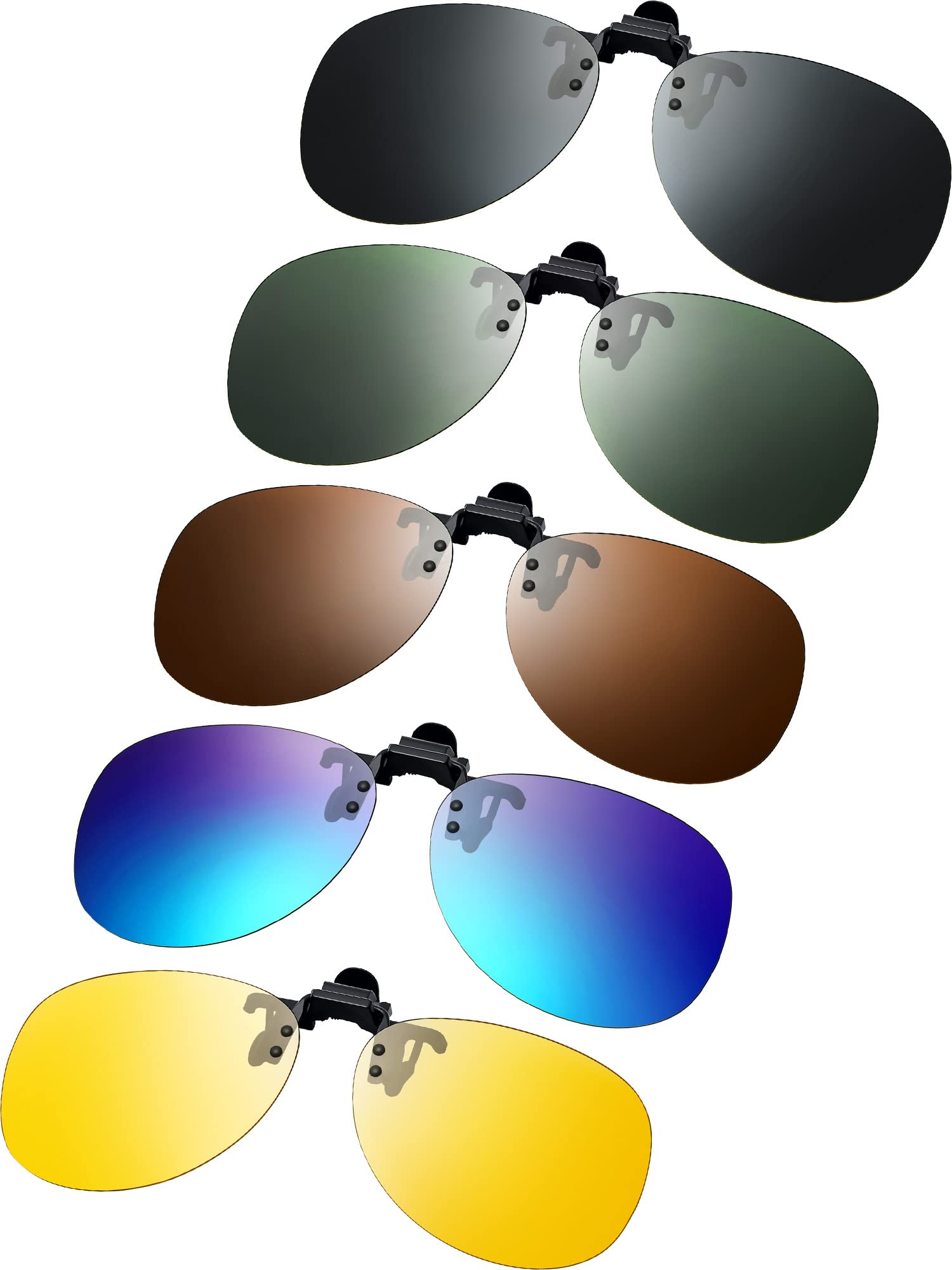
The Konohan 5-pair set is less a single product and more an optical toolkit — five distinct lens colors including a dedicated yellow night/fog pair that lets you dial in the tint for whatever conditions you face. This approach makes sense for drivers who want one clip-on for bright daylight, another for overcast afternoons, and a yellow option specifically for nighttime glare reduction. Verified buyers describe the set as a “Swiss Army knife of clip-ons” and appreciate having spares to leave in different vehicles or bags.
Clip quality punches above the price point. The metal hinge mechanism feels solid according to multiple owners, and the clip is oversized to accommodate larger prescription frames without slipping off. The yellow lens specifically receives positive feedback for night and fog use, while the grey and brown options work well for general sun protection. The flip-up design on each pair adds convenience, allowing you to tilt the lens away without removing the entire clip.
Consistency across the five lenses is the main compromise. One reviewer notes that the brown lens was too dark for their preference, and another found that the dark shades attract fingerprints that are difficult to clean without smearing. A third owner reports using only the yellow lens long-term, suggesting the other colors may not get equal use. For drivers who want one dedicated night lens with four backups for different scenarios, the Konohan set delivers exceptional flexibility at a minimal investment.
What works
- Five lens colors cover day, night, and fog conditions
- Solid metal clip with oversized fit for larger frames
- Flip-up hinge on each pair adds instant flexibility
What doesn’t
- Color quality varies — some tints are darker than ideal
- Dark lenses show fingerprints and are hard to keep clean
- Most users end up relying on only the yellow pair
5. Night Driving Glasses and Sunglasses Clip-On, Polarized

This clip-on positions itself as a dual-purpose accessory — a polarized lens that works for both daytime sun and nighttime driving, with a slim profile that integrates with prescription frames. Verified buyers praise the overall aesthetic and the way the clip-on earns compliments when tilted up on the frame. The included slim case is a practical bonus for drivers who want to keep the lens in a door pocket without taking up much space.
Daytime performance is strong. Owners report excellent glare blocking in full sun, and the ability to see phone screens clearly through the polarized lens is a commonly mentioned convenience. The clip itself uses a pinch mechanism that opens the grabbers for attachment — some users find it tricky on the first try, but once seated, the lens stays put. The lightweight construction means you barely notice the extra layer on your glasses.
Evening use is where opinions diverge. Multiple owners explicitly warn that this lens is too dark for true night driving — one review states it is “definitely not good for drive during the evening” and describes visibility as compromised even at 4 PM in overcast conditions. Another buyer notes that while glare is blocked, there is no contrast enhancement, meaning dark areas become even harder to read. This clip-on is best treated as a daytime polarized accessory that can occasionally serve in twilight, rather than a dedicated night-driving tool.
What works
- Strong daytime polarization with clear phone screen visibility
- Slim, lightweight design that looks good tilted up
- Includes compact case for easy storage
What doesn’t
- Too dark for safe use after sunset or in overcast conditions
- No contrast enhancement for low-light environments
- Clip mechanism requires practice to attach smoothly
Hardware & Specs Guide
Yellow Lens Technology
Yellow-tinted lenses block high-frequency blue light between 380 and 500 nanometers, which is the primary wavelength responsible for the scattering effect that creates headlight glare. By filtering this band, yellow lenses improve contrast in fog, rain, and twilight without significantly reducing overall light transmission. The best examples also incorporate a scratch-resistant hard coat and an anti-reflective back layer that prevents the clip-on from creating its own internal reflections against the prescription lens. Not all yellow lenses are equal — density varies between manufacturers, and a lens that is too dark will compromise peripheral hazard detection at night.
Anti-Reflective Coatings
An anti-reflective (AR) coating on the rear surface of a clip-on lens serves a critical purpose: it eliminates the ghost image that can occur when light bounces between the clip-on and the prescription lens beneath. Without AR treatment, drivers may see double reflections of oncoming headlights, which defeats the purpose of glare reduction. Premium clip-ons apply multiple layers of metal oxide compounds to achieve less than one percent residual reflection. This coating is fragile — cleaning with dry cloths or abrasive lens wipes can degrade it over time, so manufacturers recommend using the included microfiber cloth and a gentle cleaning spray.
Clip Mechanisms and Frame Fit
The mechanical interface between the clip-on and your prescription frame is the most failure-prone component. Spring-loaded metal clips with rubber or silicone contact pads offer the best grip across different frame materials — acetate, metal, and TR-90 nylon. The clip must apply enough pressure to stay in place during sudden head movements but not so much that it scratches or distorts the frame arm. Non-flip designs are thinner and more stable because they eliminate the hinge, while flip-up designs add convenience at the cost of a slightly thicker profile and one additional mechanical joint that can loosen over time.
Polarization vs. Tint for Night Use
Polarization filters horizontal light waves, which is excellent for cutting glare off wet pavement and car hoods during the day. At night, however, polarized lenses reduce total light transmission by about 30 to 40 percent, which can make unlit roads and pedestrians harder to detect. Many dedicated night-driving clip-ons therefore use a yellow tint without polarization, relying on spectral filtering rather than brightness reduction. A polarized yellow lens can work well in well-lit urban environments but may feel too dim on rural roads. Understanding the difference helps you match the lens to your specific driving conditions.
FAQ
Do clip-on night driving glasses work for astigmatism and cataracts?
Can I use yellow clip-on lenses during the day as sunglasses?
How do I clean clip-on night driving glasses without scratching them?
Will a clip-on fit my oversized or thick prescription frames?
What is the difference between flip-up and non-flip clip-on designs?
Final Thoughts: The Verdict
For most buyers, the best clip on night driving glasses winner is the FIMOSON 2-Pack because it combines proven glare reduction, a strong clip mechanism, and the practical value of two pairs at a reasonable investment. If you want the most targeted performance for astigmatism or sensitivity, grab the CAXMAN Night Driving Clip-On. And for drivers who need the convenience of a flip-up lens to alternate between day and night conditions, nothing beats the Each Cool Flip-Up with its included hard case and UV400 protection.

Certification: BSc in Mechanical Engineering
Education: Mechanical engineer
Lives In: 539 W Commerce St, Dallas, TX 75208, USA
Md Amir is an auto mechanic student and writer with over half a decade of experience in the automotive field. He has worked with top automotive brands such as Lexus, Quantum, and also owns two automotive blogs autocarneed.com and taxiwiz.com.