A portable power station that fits in a bag changes how you plan a trip, handle a workday, or prep for an outage. The decision comes down to real-world capacity — not just the number on the label — and whether the ports and cables actually match the devices you carry every day. Most people overestimate how much wattage they need and underestimate how fast a degraded cell loses usefulness after fifty cycles.
I’m Amir — the founder and writer behind Four Wheel Ask. I focus on deep market research, analyzing product specifications, build quality metrics, and aggregating owner feedback to separate genuine performance from marketing claims.
Need a weekend away from outlets or your daily backup? The best big portable battery charger balances capacity, speed, and build quality with care.
How To Choose The Best Big Portable Battery Charger
Selecting a high-capacity battery pack means looking past the headline number. Capacity rating methods vary between brands, and real-world output depends on voltage conversion efficiency, cable quality, and the device’s own charging curve. Knowing which specs actually matter saves money and frustration.
Capacity vs. Usable Energy
The milliamp-hour (mAh) figure on a power bank is measured at the cell voltage — typically 3.6–3.7V. Devices charge at 5V or higher, so the actual usable capacity is roughly 60–70 percent of the advertised number. A 20,000 mAh bank typically delivers about 12,000–14,000 mAh to a phone after conversion losses. High-quality units with efficient circuitry and low internal resistance hold closer to that upper bound.
Power Delivery Wattage and Device Compatibility
USB-C Power Delivery (PD) has become the standard for fast charging laptops, tablets, and recent smartphones. A charger must output at least 30W to meaningfully charge a MacBook Air, while a 16-inch MacBook Pro benefits from 100W or more. Phones typically peak at 20–45W. Matching the bank’s PD profile to your primary device ensures you aren’t left waiting for a slow trickle when you need a quick top-off.
Built-in Cables vs. Separate Ports
Built-in cables reduce clutter and eliminate the “forgot the cord” problem, but they also create a fixed point of failure. If the embedded cable frays, the entire bank may become unusable for that device type. Separate high-quality USB-C and USB-A ports offer more flexibility and easier cable replacement, though they require you to carry cords. Some of the best designs combine a durable built-in cable for the most common device with additional ports for other gear.
Quick Comparison
On smaller screens, swipe sideways to see the full table.
| Model | Category | Best For | Key Spec | Amazon |
|---|---|---|---|---|
| Anker Zolo Power Bank 20K 45W | Mid-Range | Everyday carry with fast iPhone charging | 20,000mAh, 45W max, built-in USB-C cable | Amazon |
| Baseus 100W Power Bank 20K | Performance | Laptop and phone dual charging | 20,000mAh, 100W PD, dual built-in USB-C cables | Amazon |
| Anker Prime Power Bank 20K 220W | Premium | High-wattage laptop and multi-device charging | 20,100mAh, 220W total, 140W max output, app control | Amazon |
| UGREEN 300W 48,000mAh Power Bank | High Capacity | Extended off-grid power for laptops and gear | 48,000mAh, 300W total, 140W PD, LED light | Amazon |
| AONIMI 50,800mAh Portable Charger | Value | Maximum capacity at a budget-friendly price | 50,800mAh, 25W PD, 3 built-in cables, 6 outputs | Amazon |
| Ffnpua 20,000mAh Wall Plug Charger | Entry-Level | Travelers who want a built-in wall plug | 20,000mAh, 22.5W fast charge, AC wall plug, 5 outputs | Amazon |
| aonidi 20,000mAh Wall Plug Charger | Slim Design | Lightweight daily backup with integrated wall prongs | 20,000mAh, 20W PD, built-in cables, AC wall plug | Amazon |
In‑Depth Reviews
1. Anker Zolo Power Bank 20K 45W

The Anker Zolo strikes a rare balance between compact footprint and genuine 45W fast charging capability. Its 20,000mAh capacity delivers roughly three full charges for an iPhone 17 Pro, and the built-in USB-C cable is rated to survive over 10,000 bends — a detail that matters more than any marketing number. ActiveShield 2.0 temperature monitoring checks conditions millions of times daily, automatically adjusting output to prevent overheating. Owner reports consistently note that the bank charges devices noticeably faster than their older packs, with several reviewers highlighting that it topped an iPhone 17 from under ten percent to eighty percent in about half an hour.
The 5.98-inch built-in cable is short enough to keep the assembly tidy but long enough to reach a phone in a bag or cup holder. An additional USB-C port and USB-A port expand compatibility, so you can charge three devices simultaneously. At 12.48 ounces and roughly the size of two stacked smartphones, it slides into a daypack pocket without dominating the bag. Some users found the form factor slightly bulkier than slimmer competitors, but the trade-off is a higher sustained power output that does not throttle during extended use.
Where the Zolo really earns its position is in the combination of build integrity, thermal management, and brand reliability. Anker’s warranty and customer service track record add a layer of confidence that budget-oriented options often lack. For anyone who needs a daily-carry bank that can also juice a laptop in a pinch, this is the reference point that other mid-range packs are measured against.
What works
- Fast 45W charging for phones and small laptops
- Durable built-in USB-C cable with high bend rating
- Active temperature monitoring prevents heat damage
- Compact enough for everyday carry
What doesn’t
- Slightly thicker than ultra-slim alternatives
- No charging-speed indicator on the unit
- Wall charger not included in the box
2. Baseus 100W Power Bank 20,000mAh
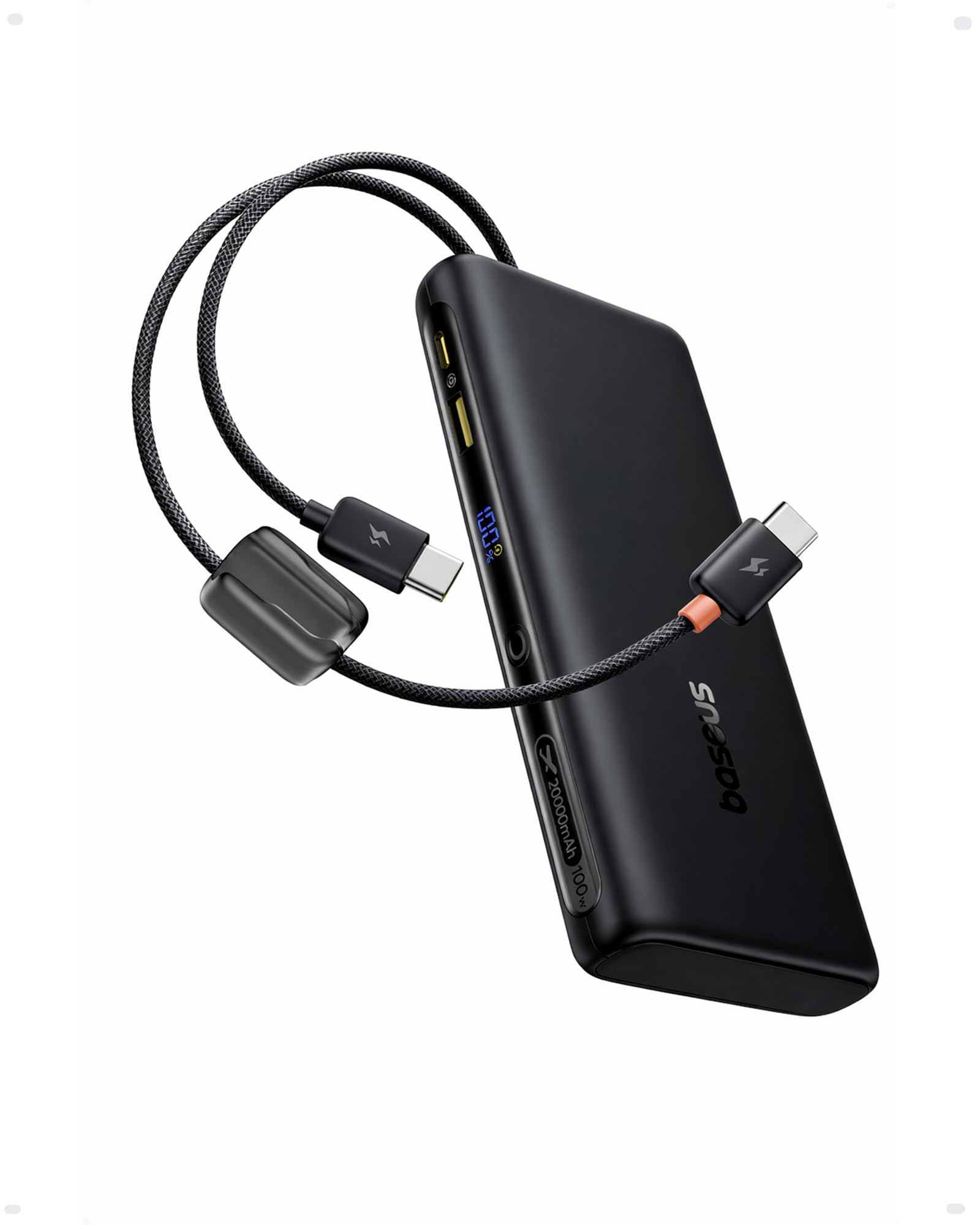
The Baseus 100W power bank targets users who need to charge a laptop and a phone simultaneously without waiting. Its 20,000mAh capacity, built around automotive-grade battery cells with graphene cooling, can push a MacBook Air to fifty percent in about thirty minutes. Two built-in USB-C cables eliminate the single-cable bottleneck, and both are braided for added durability while doubling as a carrying strap. Owner feedback emphasizes that the unit feels thinner and lighter than previous Baseus models, and the 5D curved body provides a secure grip that many rectangular banks lack.
With a total output of 100W across its ports, this bank handles a 14-inch laptop plus a phone at full speed. The smart digital display shows real-time charging information, so you know exactly how much power each device is drawing. Pass-through charging support means you can recharge the bank while it simultaneously charges your devices — no downtime during a busy travel day. Several reviewers noted that the bank can fully charge an iPhone 17 Pro about four times or an iPad Pro twice before needing a refill, making it a strong match for extended business trips or long flights.
Where the Baseus differs from more expensive options is in its single-minded focus on high-wattage delivery at a moderate price point. It does not include the app connectivity or multi-port wattage allocation of the Anker Prime, but for straightforward laptop-plus-phone charging, it delivers consistently. The graphene cooling layer and AI temperature control chip keep the internals stable even under sustained 100W load, a reliability factor that matters when you depend on the bank for work equipment.
What works
- Genuine 100W PD output for fast laptop charging
- Dual built-in braided USB-C cables reduce cord clutter
- Pass-through charging for simultaneous refuel and use
- Smart display shows real-time power delivery data
What doesn’t
- Cannot deliver full 100W to all ports simultaneously
- Heavier than standard 20K banks due to cooling materials
- No USB-A port for older accessory cables
3. Anker Prime Power Bank 20K 220W
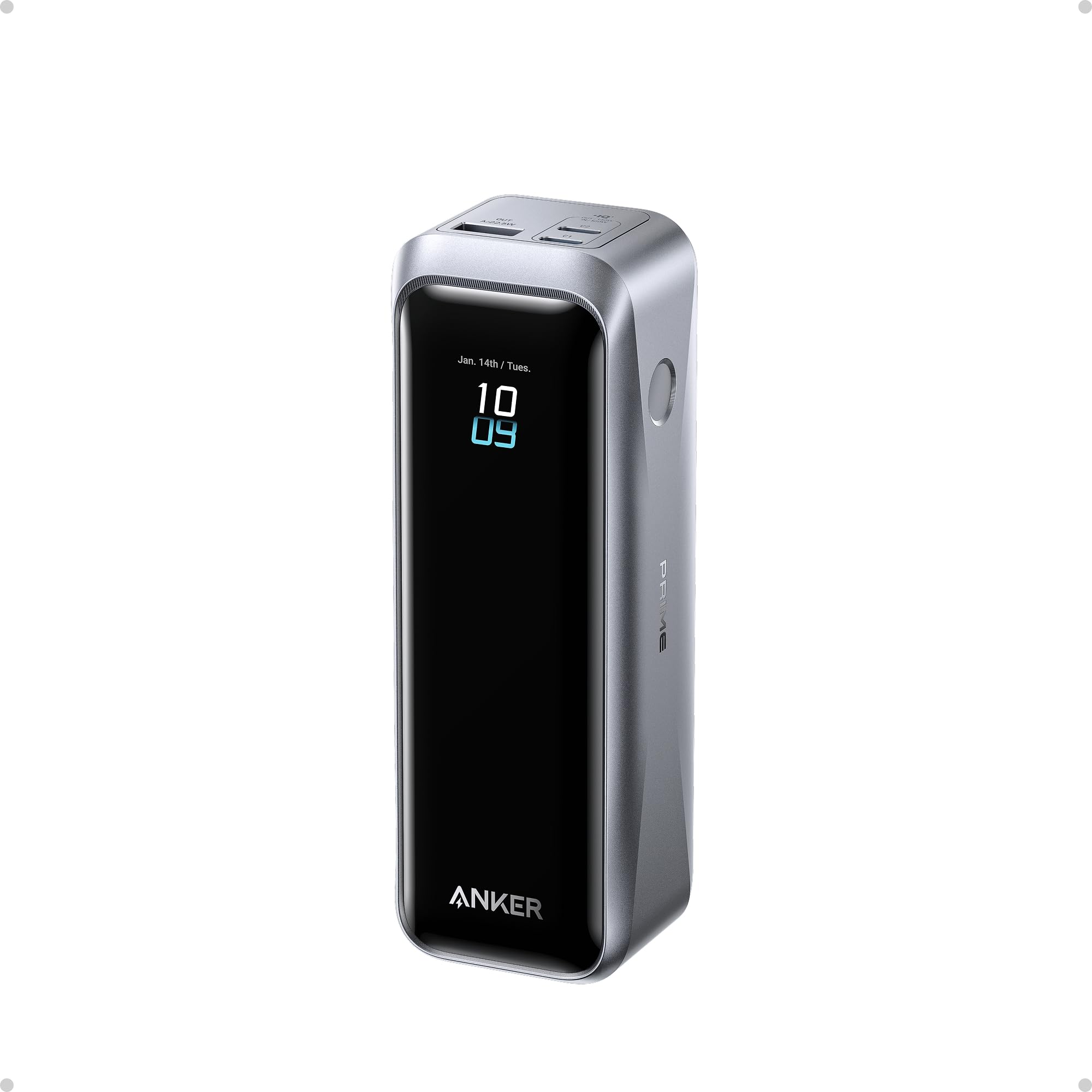
The Anker Prime redefines what a 20,000mAh power bank can deliver by pushing total system output to 220W across two USB-C ports and one USB-A port. The 140W single-port maximum means a 16-inch MacBook Pro hits fifty percent in under half an hour, and the bank itself recharges to fifty percent in 25 minutes when fed with a 100W USB-C input. A smart digital display shows real-time wattage per port, and the Bluetooth app provides battery health monitoring, charge tracking, and firmware updates — features typically reserved for much larger power stations. Owner reports consistently praise the build quality, with one reviewer noting that it finally solved their “picky” laptop’s PD negotiation issues that cheaper banks could not handle.
At 20,100mAh (72.36Wh), the Prime stays within TSA carry-on limits while delivering enough energy for roughly four days of video streaming on an iPhone 17 Pro Max. The compact upright design — 5.78 by 1.75 by 1.96 inches — fits neatly into a tech pouch or briefcase pocket without the flat-slab footprint of traditional banks. The included travel pouch and 240W-rated USB-C cable show that Anker designed this for users who treat their gear seriously. Multiple reviewers confirmed that the bank can charge a Surface Pro or Galaxy Book without negotiation issues, a known pain point with many high-wattage portable chargers.
The premium price reflects not just the hardware but the engineering behind the power allocation algorithm. The Prime intelligently distributes wattage across ports based on device demand, so plugging in a laptop does not starve a connected phone. The 24-month warranty and Anker’s customer service reputation further justify the investment for professionals who rely on their portable power daily. If you need the highest output available in a TSA-friendly form factor, this is the benchmark.
What works
- 220W total output charges laptop and phone at full speed
- 140W single-port max for demanding laptops
- Bluetooth app with battery health and charge tracking
- Quick self-recharge to 50% in 25 minutes
What doesn’t
- Premium price well above mid-range competitors
- No built-in cables — requires separate cords
- Only 20K capacity for the price point
4. UGREEN 300W 48,000mAh Power Bank

The UGREEN 300W power bank steps into a category between portable charger and mini power station. Its 48,000mAh (153Wh) capacity uses automotive-grade LiFePO4 cells, which offer superior safety and a cycle life rated at over 3,000 charges before capacity drops below eighty percent — roughly six times the lifespan of standard lithium-polymer packs. The 300W total output, anchored by a PD 3.1 140W bidirectional USB-C port, can run a 15-inch MacBook Air twice over or keep an iPhone 15 Pro charged for nearly ten full cycles. Owner feedback highlights the practical value: users report powering Samsung projectors through three movies, keeping a ROG Ally gaming for extended sessions, and maintaining phone service over multi-day camping trips.
A thoughtful design package sets this apart from raw-capacity competitors. The built-in carrying handle makes transport easy despite the 3.97-pound weight, and the LED light offers high, low, and SOS modes — a genuine emergency feature rather than a gimmick. Five ports — three USB-C and two USB-A — allow simultaneous charging of a laptop, tablet, phone, and accessories. The smart digital display shows both battery percentage and real-time power flow, so you can monitor draw as you connect devices. The bank also supports pass-through charging, acting as a hub that charges its own cells while powering your gear.
Some early production units showed a quirk where plugging a third USB-C device could interrupt power to the first port, though UGREEN appears to have addressed this in later firmware iterations. The weight and 153Wh capacity mean this bank exceeds typical TSA limits for lithium-ion batteries (which cap at 100Wh without approval), so air travelers need to check carrier policies. For car camping, road trips, home backup, or any scenario where outlets are scarce and multiple devices need sustained power, the UGREEN delivers a compelling balance of capacity, speed, and durability that few portable chargers can match.
What works
- LiFePO4 cells last 3,000+ cycles with minimal degradation
- 300W total output powers laptops, projectors, and gaming handhelds
- PD 3.1 140W bidirectional charging for fast self-refuel
- LED light with SOS mode for emergency use
What doesn’t
- Heavy at nearly 4 pounds
- Exceeds 100Wh TSA limit for standard carry-on approval
- Some port allocation quirks in early firmware versions
5. AONIMI 50,800mAh Portable Charger
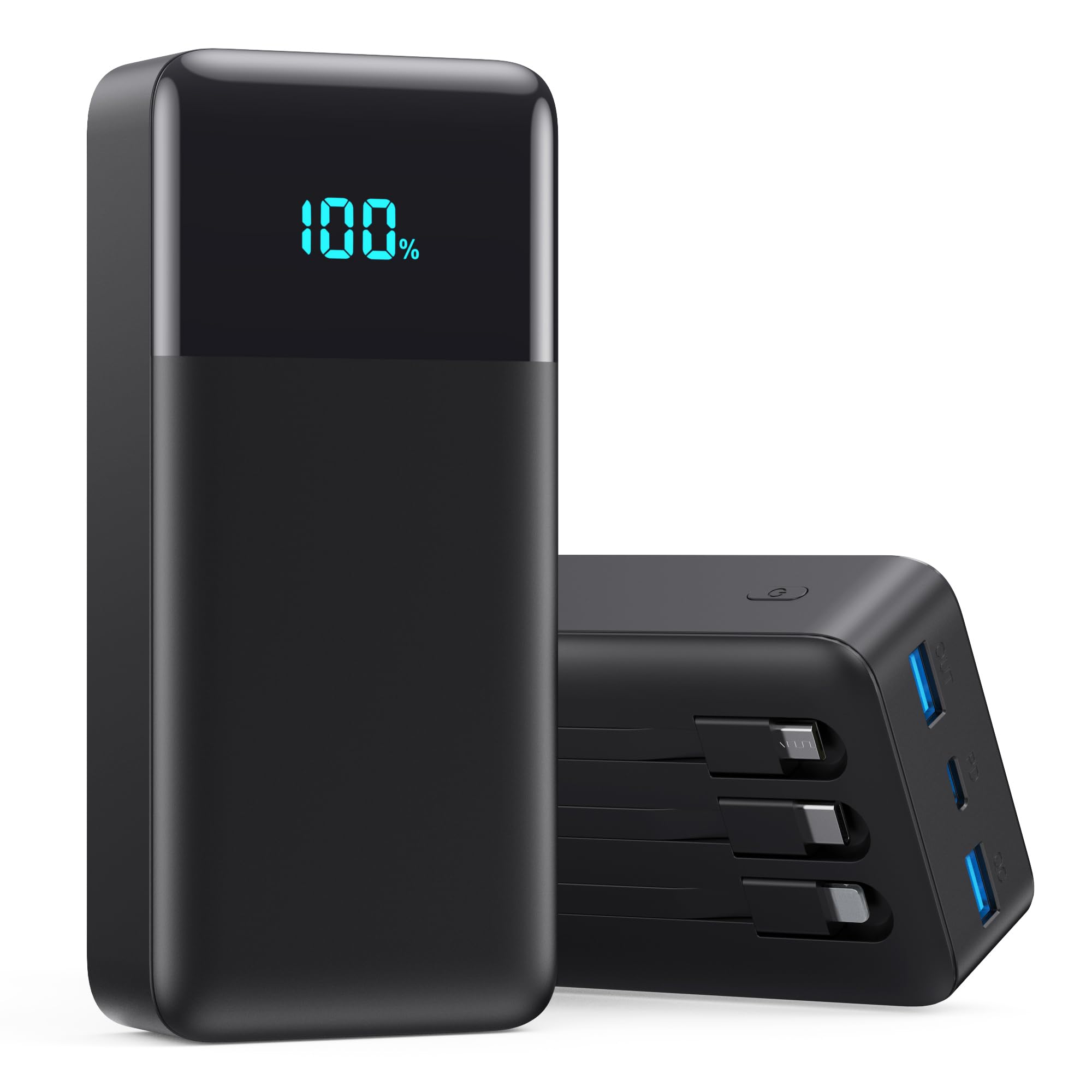
The AONIMI 50,800mAh power bank delivers the highest raw capacity in this lineup at a price that undercuts most 20K premium models by a wide margin. Three built-in cables — USB-C, Lightning, and Micro USB — cover the three dominant device ecosystems without requiring any additional cords. Six output options (the three cables plus two USB-A ports and one USB-C port) let six devices charge simultaneously, which is useful for group travel or family trips. The smart LCD display shows remaining charge clearly, and the 25W PD support refuels an iPhone 16 to fifty percent in about 30 minutes. Owner reviews consistently highlight the sheer endurance: multiple users report going through four-day camping trips without depleting the bank, charging phones, tablets, and Bluetooth speakers daily.
At 1.42 pounds and dimensions of 6.02 by 2.76 by 1.69 inches, this is not a pocket-friendly device. It belongs in a backpack or duffel, not a jacket. The 25W PD speed is adequate for phones but too slow for meaningful laptop charging — a deliberate trade-off to keep the price accessible. Several reviewers noted that the built-in cables cannot charge two different devices simultaneously if both use the same cable type; you may need separate cords to achieve full six-device charging. The low-temperature ice core and multi-layer protection system have drawn positive comments for keeping the unit cool even during extended high-drain sessions.
Where this charger truly excels is in value per milliamp-hour. No other product in this comparison offers 50,800mAh at this entry-level price point. The included two-year warranty adds a layer of protection that is rare in the budget category. If your priority is maximizing charge cycles for a household of devices and you do not need laptop-level wattage, the AONIMI provides an enormous safety net for extended time away from wall outlets.
What works
- Massive 50,800mAh capacity for multi-day trips
- Three built-in cables reduce cord clutter
- Six simultaneous outputs for group charging
- Two-year warranty at a budget-friendly price
What doesn’t
- 25W PD too slow for laptop charging
- Heavy and bulky for daily carry
- Built-in cables may not charge same-type devices together
- Not TSA-compatible for air travel
6. Ffnpua 20,000mAh Wall Plug Charger
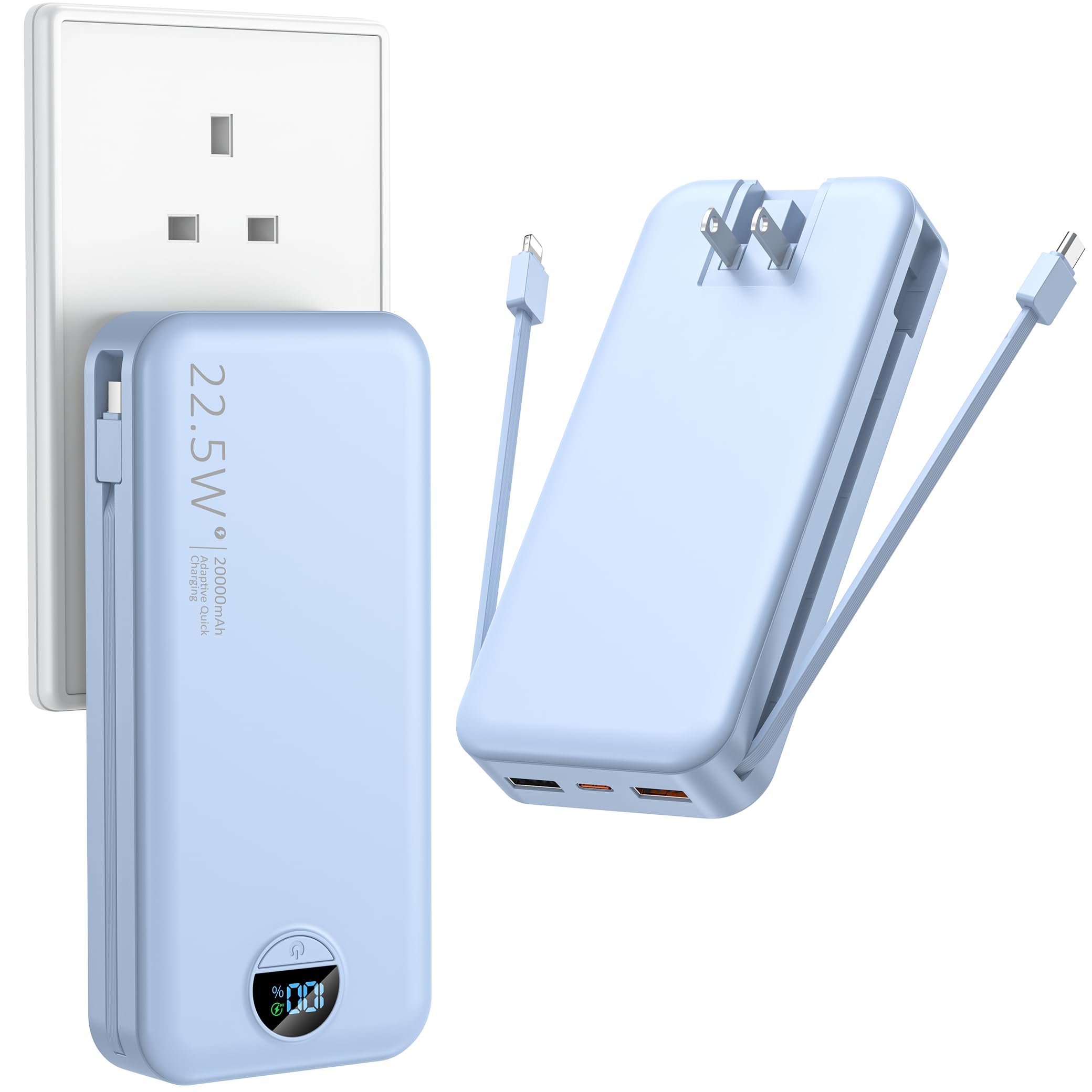
The Ffnpua power bank solves a specific annoyance: remembering to pack a charger for the charger. A retractable AC wall plug built directly into the unit lets you refuel the bank from any wall outlet without carrying a separate adapter or cable. The 20,000mAh capacity delivers roughly three full charges for an iPhone 15 Pro Max or about 2.8 charges for a Samsung Galaxy S22 Ultra, and the 22.5W USB-A output speeds up phone charging significantly compared to standard 5W bricks. Owner feedback emphasizes how convenient the integrated plug is for travel — users mention using it in airport terminals, hotel rooms, and college dorms without hunting for a free outlet to charge the bank separately.
Five total outputs — built-in USB-C cable, built-in Lightning cable, USB-C port, and two USB-A ports — accommodate a range of devices simultaneously. The smart LED digital screen shows remaining charge to the nearest percent, and the comprehensive protection chip covers over-charge, short circuit, over-voltage, and over-temperature scenarios. At 5.9 by 2.67 by 1.02 inches and 12.8 ounces, it is compact enough for a carry-on toiletries bag or a work backpack. Multiple reviewers praised the build durability, with one calling it the most durable portable charger they have owned, noting that it survived daily commutes and multiple drops without issue.
The trade-off is that the bank itself recharges slowly via the wall plug — about ten hours for a full charge — while the USB-C input cuts that to roughly six hours. The built-in Lightning cable uses an older connector profile, so iPhone 15 and later models with USB-C will need the separate cable. Despite these caveats, the convenience of never forgetting a charger for your charger makes this a strong pick for travelers who want one device that handles both roles without extra accessories.
What works
- Built-in AC wall plug eliminates the need for a separate charger
- Compact and lightweight for travel bags
- Multiple output options including built-in cables
- Durable construction praised in owner reviews
What doesn’t
- Slow self-charge via wall plug (up to 10 hours)
- Built-in Lightning cable does not fit newer USB-C iPhones
- Only 22.5W max — not suitable for laptop charging
7. aonidi 20,000mAh Wall Plug Charger
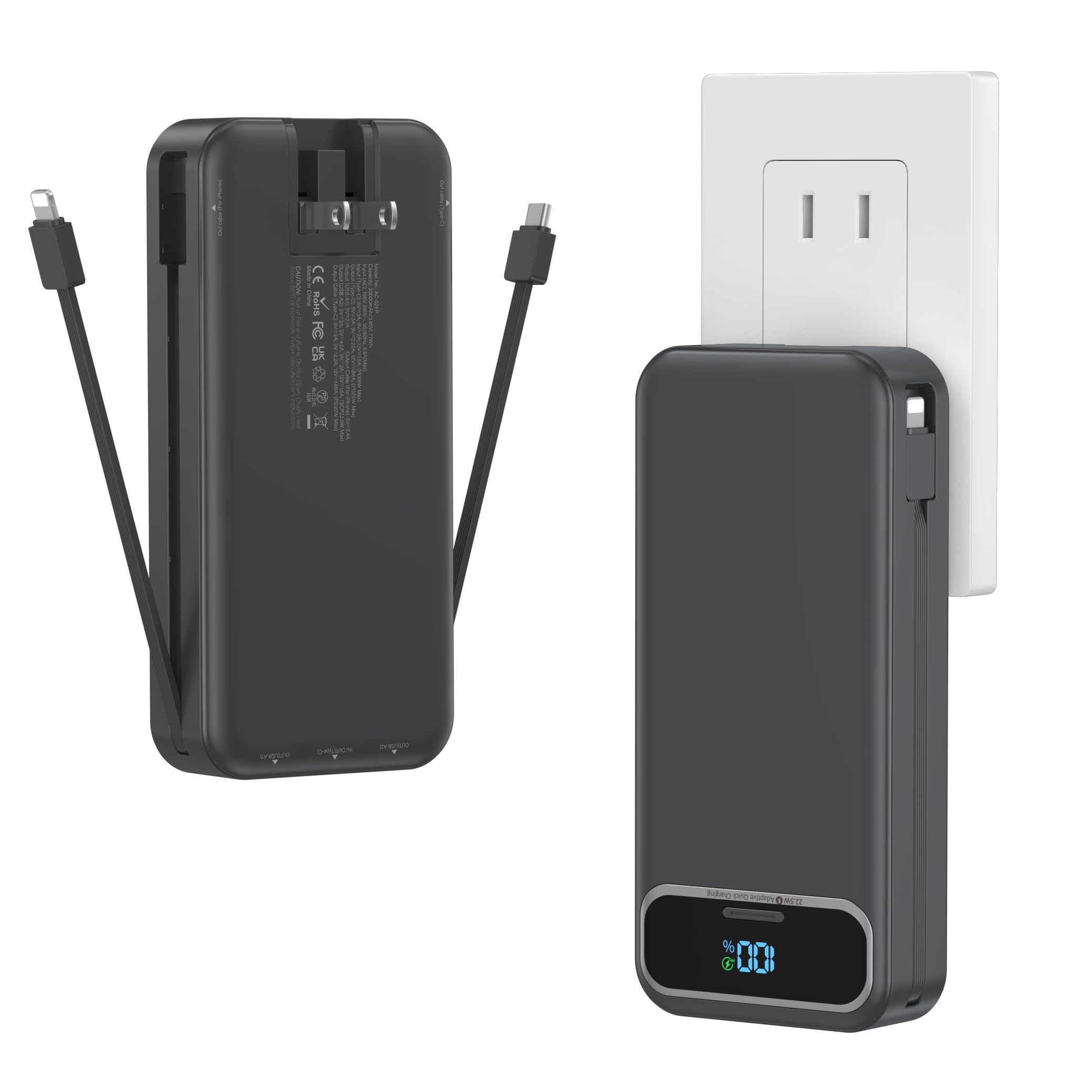
The aonidi 20,000mAh power bank competes directly with the Ffnpua by offering the same integrated AC wall plug concept in a slightly lighter package. At 12.96 ounces and dimensions of 5.91 by 2.71 by 1.17 inches, it slides into a purse or backpack pocket without adding noticeable bulk. Built-in USB-C and Lightning cables handle the two most common phone connector types, and the USB-A port adds fast charging support for Android devices that use Qualcomm Quick Charge. The elegant digital display shows remaining charge to one percent accuracy, a detail that carries genuine utility when rationing power during a multi-day outing. Owner reviews consistently note the fast charging speed and the convenience of having everything built into one unit.
The 20W PD support via the USB-C port provides adequate charging speed for most smartphones, refueling an iPhone 16 to about fifty percent in 30 minutes. The integrated wall plug recharges the bank in roughly five hours — faster than the Ffnpua’s ten-hour estimate — and the bank can charge devices while simultaneously recharging itself via the wall outlet. Two built-in cables plus two additional ports (USB-C and USB-A) allow up to four devices to charge at once. Several buyers highlighted the pink color option as a welcome departure from the usual black and gray, and the slim profile drew praise for fitting into small bag compartments.
Some owner reports indicate that the unit and wall socket can become hot during charging, which warrants attention if you plan to leave it plugged in overnight. The 12-month support window is shorter than some competitors offer, though the responsive customer service mentioned in reviews partially offsets that concern. For users who prioritize a slim profile, integrated wall prongs, and reliable daily charging performance without needing laptop-level power, the aonidi delivers a polished package that covers the essentials well.
What works
- Slim, lightweight design with integrated wall plug
- Digital display shows remaining charge to 1% accuracy
- Built-in USB-C and Lightning cables included
- Recharges itself in about 5 hours via integrated plug
What doesn’t
- Can become hot during prolonged charging sessions
- Only 20W PD — limited to phone charging
- 12-month support window shorter than some rivals
Hardware & Specs Guide
Battery Cell Chemistry
Most portable chargers use lithium-polymer (Li-Po) cells for their balance of energy density and cost. Higher-end models increasingly adopt lithium iron phosphate (LiFePO4), which trades a slight weight penalty for dramatically longer cycle life — often 3,000 charges before significant degradation versus 500 for standard Li-Po. Automotive-grade cells typically include stricter manufacturing tolerances and better thermal stability, which translates to safer operation under high load and a lower risk of swelling over years of use.
Power Delivery (PD) Profiles
USB-C PD negotiates voltage and current between the bank and the device. Common profiles include 5V/3A (15W), 9V/3A (27W), 15V/3A (45W), and 20V/5A (100W). A charger that supports 20V output can fast-charge laptops directly. The PD 3.1 standard extends this to 28V, 36V, and 48V profiles, enabling up to 240W — though most portable banks top out at 140W in the current generation. Matching the PD profile to your laptop’s requirements ensures you get the fastest possible charge without triggering fallback to slower universal protocols.
Built-in Cables vs. Modular Ports
Integrated cables reduce the number of items you need to carry and guarantee compatibility with the intended device type. The downsides include fixed cable length, potential failure of the embedded cord that could render the port useless, and the inability to use higher-quality aftermarket cables for faster charging. Modular ports require separate cables but offer more flexibility for different device combinations and easier replacement if a cord frays. The best designs in the mid-range category often include one robust built-in cable for the most common device plus full-size ports for everything else.
Self-Charge Speed and Pass-Through
How fast a power bank recharges itself matters when you have limited access to wall outlets. Models with 100W USB-C input can refill a 20,000mAh battery from empty to full in about an hour and a half, while budget units with 18W input may take six to ten hours. Pass-through charging allows the bank to power devices while it is itself being recharged, effectively turning it into a UPS for your gear during a power outage or a shared hotel room outlet situation. Not all banks support this feature, so check the specifications if uninterrupted power is critical for your use case.
FAQ
Can I take a 48,000mAh power bank on an airplane?
How many full charges can I expect from a 20,000mAh power bank?
Is a higher wattage power bank always better?
What does “pass-through charging” mean for a power bank?
Final Thoughts: The Verdict
For most buyers, the best big portable battery charger winner is the Anker Zolo Power Bank 20K 45W because it delivers the broadest combination of fast charging, build quality, portable size, and brand reliability at a moderate investment. If you need enough wattage to charge a laptop at full speed, grab the Baseus 100W Power Bank 20K for its excellent 100W PD output and dual built-in cables. And for maximum off-grid endurance where weight is not the primary concern, nothing beats the UGREEN 300W 48,000mAh Power Bank with its LiFePO4 cells that will outlast every other pack in this comparison by years.

Certification: BSc in Mechanical Engineering
Education: Mechanical engineer
Lives In: 539 W Commerce St, Dallas, TX 75208, USA
Md Amir is an auto mechanic student and writer with over half a decade of experience in the automotive field. He has worked with top automotive brands such as Lexus, Quantum, and also owns two automotive blogs autocarneed.com and taxiwiz.com.