A brake controller that hesitates, pulses unevenly, or fails to sync with your tow vehicle turns a routine haul into a white-knuckle event. The difference between a smooth stop and a trailer that shoves you through an intersection comes down to the accelerometer, the processing logic, and how the unit interprets your pedal input in real time.
I’m Amir — the founder and writer behind Four Wheel Ask. Over the past several years, I’ve spent thousands of hours dissecting product specifications, analyzing build quality data, and aggregating owner-reported performance across dozens of brake controller models to understand what truly separates a reliable unit from a problematic one.
After researching dozens of models and analyzing owner feedback, I narrowed the field to find the best wireless brake controller for reliable towing in any scenario.
How To Choose The Best Wireless Brake Controller
Selecting the right brake controller means understanding how the unit senses deceleration, how it communicates with your trailer brakes, and how it fits into your vehicle’s cabin. Three factors separate a well-matched controller from one that causes constant adjustment headaches.
Proportional vs. Time-Delay Modulation
Proportional controllers use an internal accelerometer to measure the tow vehicle’s deceleration and apply the trailer brakes in direct proportion. Time-delay controllers apply a preset amount of power for a fixed duration regardless of how hard you stop. For everyday towing on paved roads, proportional braking delivers far smoother stops and reduces the risk of trailer push or jackknifing.
Accelerometer Quality and Axis Count
Single-axis accelerometers measure fore-aft motion only. Triple-axis units also detect lateral and vertical movement, allowing the controller to adjust brake force dynamically when going up or down a hill or when the trailer experiences sway. Higher-end controllers with triple-axis sensors require less manual gain adjustment over varying terrain.
Mounting and Cabin Integration
Traditional boxes mount under the dash and can interfere with the driver’s knee. Split-design and remote-head controllers let you hide the main module and mount only a small dial or display in the cabin. This creates a cleaner, factory-like appearance and frees up legroom.
Quick Comparison
On smaller screens, swipe sideways to see the full table.
| Model | Category | Best For | Key Spec | Amazon |
|---|---|---|---|---|
| CURT 51146 TriFlex Next | Proportional | Smooth daily towing | Triple-axis accelerometer | Amazon |
| REDARC Tow-Pro Liberty | Proportional | Compact dash integration | Remote rotary dial | Amazon |
| CURT 51170 Spectrum | Proportional | OEM-style LED display | 10 tri-color LEDs | Amazon |
| REDARC Tow-Pro Elite | Proportional | Off-road and rugged use | Self-programming learning mode | Amazon |
| Kohree KR3588 | Split Design | Windshield display visibility | 9-level boost adjustment | Amazon |
| Tekonsha P3 Toyota Kit | Proportional | Toyota / Lexus plug-and-play | Customizable display colors | Amazon |
| Tekonsha P3 Dodge Kit | Proportional | Dodge / Ram plug-and-play | Diagnostic fault display | Amazon |
| IPA 9107B Force Meter | Diagnostic | Trailer brake system testing | Dynamic load simulation | Amazon |
| Hopkins 47295 Agility | Proportional | Budget-friendly entry | 5 sensitivity adjustments | Amazon |
In‑Depth Reviews
1. CURT 51146 TriFlex Next

The TriFlex Next uses a triple-axis motion-sensing accelerometer that measures fore-aft, lateral, and vertical movement to deliver proportional braking that adapts to grade changes in real time. This third-axis compensation means the controller automatically applies more braking force on downhill sections and reduces it on uphill pulls without the driver needing to adjust the gain manually. The slim profile sits flush against the dash and the unique bracket system improves clearance for the driver’s knee compared to bulkier box-style units.
Owner reports from 2022–2024 Silverado and Trail Boss owners consistently highlight the ease of installation when paired with a vehicle-specific plug-and-play patch cord. Multiple users describe a 30-minute install with no wire cutting, and the long control cable routes cleanly under the dash without requiring zip ties. The unit supports two to eight trailer brakes across one to four axles, making it suitable for everything from small campers to heavy equipment trailers.
Reviewers who tested the unit with loaded trailers report a significant improvement in stopping smoothness compared to older time-delay controllers. One owner noted that the difference in braking control was immediately noticeable on the first test drive. The TriFlex Next does require purchasing a separate vehicle-specific harness for true plug-and-play operation, but the overall package delivers strong value given the accelerometer technology and build quality at this tier.
What works
- Triple-axis accelerometer provides smooth, grade-adjusted braking
- Slim profile improves knee clearance under the dash
- Quick install with vehicle-specific patch cord
What doesn’t
- Vehicle-specific harness sold separately
- Some users report occasional trailer recognition issues requiring reconnect
2. REDARC Tow-Pro Liberty
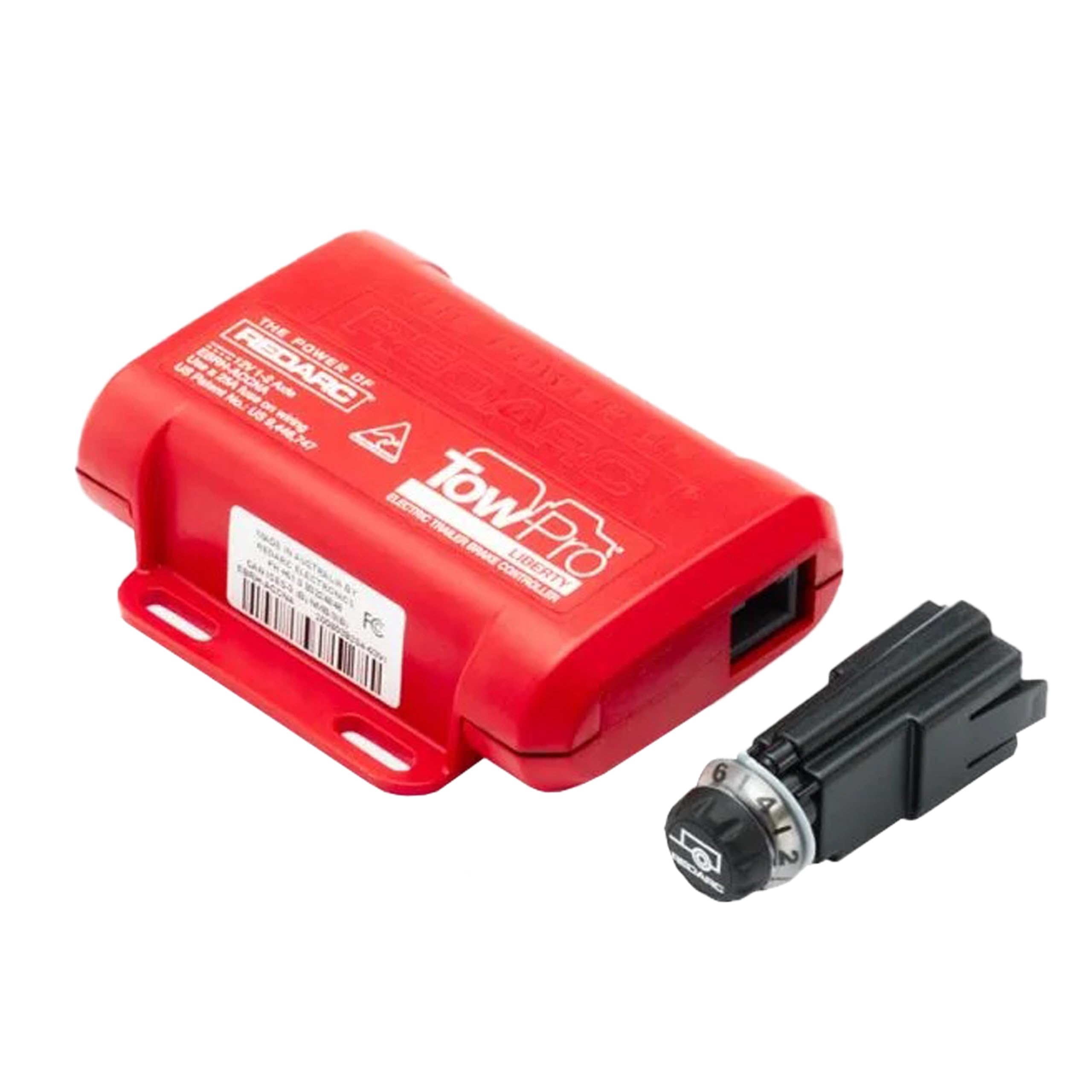
The Tow-Pro Liberty separates the control electronics from the user interface, allowing the main module to be hidden behind the dash while only a compact rotary dial protrudes into the cabin. This design philosophy prioritizes a clean, factory-installed appearance and eliminates the knee clearance issues common with larger under-dash boxes. The dial assembly uses an RJ45 connector that simplifies replacement if the remote head is ever damaged.
Active Calibration and built-in sway control work together to maintain stability during highway towing. The unit supports one to two axles and is compatible with 12V systems on cars, trucks, and SUVs. Owners who installed the Liberty in first-generation Nissan Titans and 2018 RAM 1500s report that the dial mounts neatly into existing blank switch plates, creating an OEM look. Some users noted that the dial neck is relatively deep at about an inch and a half, so thin dashes may require a small spacer for proper button engagement.
The proportional mode delivers smooth, linear braking that reduces push and pull during stops. REDARC torture-tests these units in the Australian Outback, and the two-year limited warranty reflects confidence in the build. A universal pigtail harness is included, but vehicle-specific harnesses and switch inserts are sold separately for those who want a true plug-and-play installation.
What works
- Compact remote head hides main module for clean cabin integration
- Active calibration and sway control enhance highway stability
- RJ45 connector makes remote head replacement simple
What doesn’t
- Vehicle-specific harness sold separately
- Dial neck depth may interfere with thin dash panels
3. CURT 51170 Spectrum
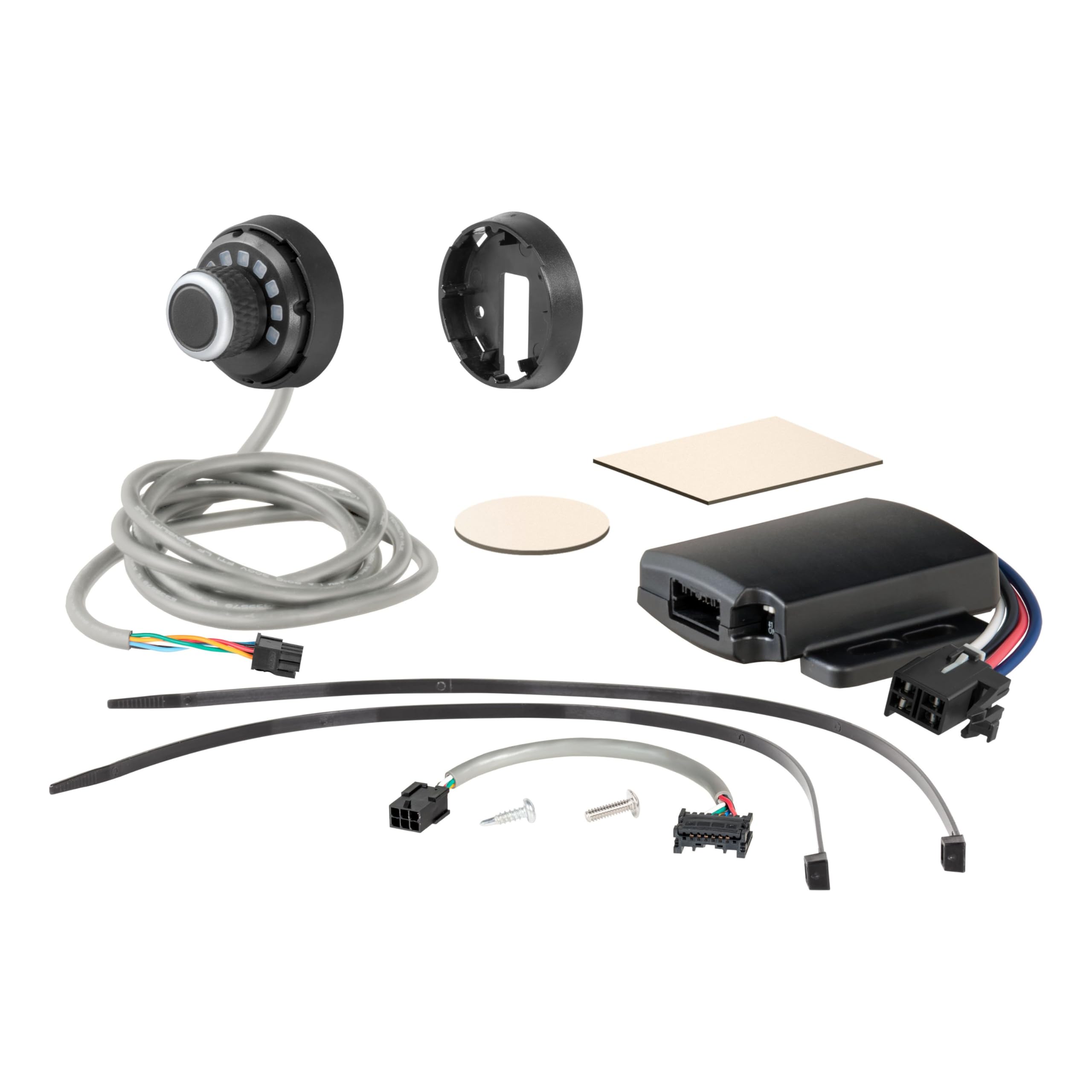
The Spectrum uses a triple-axis accelerometer and a push-button rotary knob to control all brake settings through an OEM-style dash-mounted interface. Ten tri-color LEDs provide real-time visual feedback on braking force and system status, with adjustable brightness to reduce distraction during nighttime driving. The main control module can be hidden completely out of sight, leaving only the clean LED bezel visible in the cabin.
Long-term owner reports indicate that the Spectrum requires minimal adjustment after initial setup. One user with over a thousand miles of towing reported setting the gain once, making a single tweak early on, and then never touching it again regardless of braking intensity. The manual override button provides immediate trailer brake application without moving the foot to the pedal, useful for preventing sway before it escalates.
Installation is straightforward with a vehicle-specific wiring adapter, and owners of 2008 Silverados and Jeep Wranglers report that the unit fits without interfering with the driver’s knees. The LEDs briefly illuminate blue when the trailer disconnects, which some owners initially mistook for a fault, but manufacturer support confirmed it is normal behavior. The limited lifetime warranty adds long-term peace of mind.
What works
- Tri-color LEDs provide clear visual force feedback
- Minimal gain adjustment needed after initial setup
- Limited lifetime warranty backs the purchase
What doesn’t
- Vehicle-specific adapter required for plug-and-play
- LED brightness could be auto-adjusting rather than manual
4. REDARC Tow-Pro Elite

The Tow-Pro Elite takes the remote-head concept further with a self-programming learning mode that automatically calibrates braking response during the first drive. The unit monitors the tow vehicle’s deceleration characteristics and sets the proportional curve accordingly, removing the guesswork from initial gain setup. The control knob and LED indicator are the only visible components once installed, with the main electronics module tucked away behind the dash or center console.
Owners of 2014 JKU Wranglers and 2016 Colorados praise the tiny footprint and the ability to mount the knob in the center console or a blank switch plate for a factory look. The learning mode takes about twenty minutes of driving to complete, and multiple users report that after calibration, the Elite handled emergency braking scenarios without any trailer brake lockup or wheel chatter. The LED also provides diagnostic feedback for troubleshooting wiring faults.
Installation on vehicles pre-wired for brake controllers is straightforward, though drilling a clean hole for the knob requires care — one experienced installer recommended practicing on a piece of Tupperware before drilling into the vehicle’s trim. The Elite supports one to two axles and carries the same Outback torture-test pedigree as the Liberty. A vehicle-specific harness is recommended for the cleanest install.
What works
- Self-programming learning mode eliminates manual guesswork
- Extremely compact knob leaves minimal cabin footprint
- Diagnostic LED aids troubleshooting
What doesn’t
- Knob mounting requires precise hole drilling
- Vehicle-specific harness sold separately
5. Kohree KR3588 Split Design
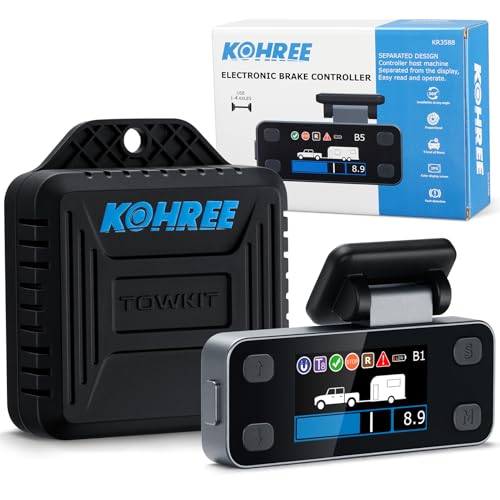
The Kohree KR3588 uses a split-design architecture where the LCD display mounts on the windshield or dash and the brake controller module installs in the rear interior panel at any angle. This separation allows the driver to position the readout for maximum visibility while hiding the control hardware out of sight. The system uses four 32-bit processor chips — two in each module — that independently process and validate braking signals for what Kohree describes as linear, comfortable braking delivery.
Nine levels of boost adjustment let the driver dial in sensitivity from light response for empty trailers to aggressive braking for heavy loads. The proportional braking algorithm includes automatic leveling that eliminates manual setup procedures. Owners who installed the KR3588 in 2024 Ram HD trucks report that the control module hid easily and the display pad fit neatly into existing dash slots when paired with an adapter harness.
Reviewers consistently note the responsive braking and the useful instant-on button for manual trailer brake application. The display remains active at all times, which some owners found distracting at night, and the included 3M tape held well even in Florida heat. The kit comes with a Type-C data cable and wiring connections, though the instruction video could be more detailed for first-time installers.
What works
- Split design allows flexible display and module placement
- Four processor chips provide redundant signal validation
- Nine boost levels cover light to heavy trailer loads
What doesn’t
- Display stays on continuously, potential nighttime distraction
- Instruction video lacks detail for beginners
6. Tekonsha P3 Toyota / Lexus Kit

This bundle pairs the Tekonsha Prodigy P3 brake controller with a vehicle-specific plug-and-play wiring harness designed for Toyota 4Runner, Land Cruiser, Sequoia, Tacoma, Tundra, and Lexus GX/LX models from 2003 through 2021. The P3 is one of the most established proportional controllers on the market, featuring a digital display with customizable color options, boost settings, and a diagnostic mode that reads out brake voltage and fault codes directly on the screen.
Owners towing three-horse bumper pull trailers and 7,000-pound loads report that the P3 delivers consistent, reliable braking with easy adjustment. The plug-and-play harness eliminates wire splicing for compatible vehicles, and users of 2007 Sequoias and 2015 Tacomas completed the install in under an hour. The display shows real-time brake output and can detect a disconnected trailer brake wire, flashing a warning that simplifies troubleshooting on the side of the road.
Customizable screen colors let the driver match the display to the vehicle’s interior lighting, though some owners note that the screen cannot be fully turned off and lacks an auto-brightness feature. The manual control knob is useful for applying trailer brakes independently of the tow vehicle’s pedal. For Toyota and Lexus owners who want a true plug-and-play solution with a proven track record, this bundle removes the guesswork from wiring.
What works
- Vehicle-specific harness included for true plug-and-play install
- Diagnostic display detects wiring faults and brake voltage
- Customizable screen colors match cabin lighting
What doesn’t
- Screen cannot be powered off completely
- No auto-brightness for nighttime driving
7. Tekonsha P3 Dodge / Ram Kit
This bundle covers Dodge Ram 1500, 2500, 3500, Dakota, Durango, and Aspen models from 1995 through 2009, providing a hardwire kit and a truck-specific connector for a clean install. The P3’s proportional braking algorithm uses an internal accelerometer to match trailer brake application to the tow vehicle’s deceleration rate, and the unit supports up to three axles, making it suitable for heavy tandem-axle trailers and enclosed haulers.
Owners of 2001 Dodge 2500 and 2006 Durango report install times as short as five to ten minutes when using the included harness. The LED screen auto-times out after a brief period to reduce battery drain, though one owner noted that leaving the unit plugged in for extended periods without driving could drain a single battery. The manual override lever provides immediate trailer brake application for sway control without moving your foot to the pedal.
Long-term reliability is a recurring theme in owner feedback — one user reported running the same P3 since 2017 across multiple trailers with zero issues. The diagnostic display helps identify faulty brake connections before they become a safety problem, and the boost settings allow fine-tuning for different trailer weights. For owners of older Dodge and Ram trucks who want a controller that integrates without adapter hunting, this kit delivers a proven solution.
What works
- Truck-specific harness and hardwire kit included
- Supports up to three axles for heavy trailers
- Proven long-term reliability reported by owners
What doesn’t
- May drain battery if left plugged in long-term
- Display brightness not auto-adjusting
8. IPA 9107B Electric Brake Force Meter
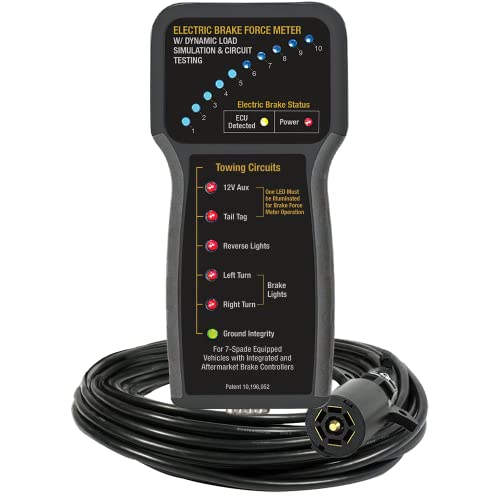
The IPA 9107B is not a brake controller but a diagnostic tool that simulates trailer brake loads so you can test the tow vehicle’s brake controller, lighting circuits, and wiring without connecting an actual trailer. It uses patented technology to replicate the electrical load of electric trailer brakes, allowing you to measure brake force application and latency through the controller’s output. This is especially valuable for diagnosing “Check Trailer Wiring” warnings that can appear on modern trucks when the controller detects an open or high-resistance circuit.
A 25-foot cable lets you operate the unit from the driver’s seat, either in Park or during a test drive, to verify that the brake controller is applying the correct voltage and that all lighting circuits function properly. Owners of GMC 3500s and 2019 Ford F-250s report diagnosing intermittent fault codes in under ten minutes, saving the cost of dealership diagnostic fees or mobile RV tech visits. The connectorized cable uses a D-sub connector for easy field repair if damaged.
The kit includes a soft nylon carrying case for storage, and the unit works with all integrated and aftermarket brake controllers. Some newer European vehicles, such as the 2024 BMW X3, may require an additional adapter to provide the correct resistance for the vehicle to sense the tester. For those who already own a brake controller and want to verify system health, this tool eliminates the need to hook up a trailer for basic diagnostics.
What works
- Simulates trailer load without connecting a trailer
- 25-foot cable allows driver-seat operation and test-drive verification
- Diagnoses wiring faults quickly, saving diagnostic fees
What doesn’t
- Some European vehicles require an additional adapter
- Premium pricing for a diagnostic-only tool
9. Hopkins 47295 Agility Proportional

The Hopkins Agility 47295 is a straightforward proportional controller that uses an internal accelerometer to sense deceleration and apply trailer brakes in sync with the tow vehicle. It offers five sensitivity adjustments to fine-tune response for different trailer loads, and the unit features short-proof protection that guards against damage from electric brake wire shorts. The LED indicator provides basic status feedback during operation.
Owners who installed this unit in 2005 Saturn Vues and 1999 Jeep Wranglers report that it noticeably improved braking performance when towing lightweight trailers around 1,500 to 2,500 pounds. The installation is simple for those comfortable with basic wiring — the unit comes with bare color-coded wires (red, white, blue, black) that splice into the vehicle’s brake circuit. However, multiple buyers noted that the product listing suggests a plug-in connector is included, while the actual package contains only bare wires, requiring the user to purchase a separate connector or splice directly.
Durability reports are mixed. Some owners have used the unit for years without issues, while one reported the controller failing after three and a half months. The top of the unit is flat rather than angled as shown in some product images, which is purely cosmetic but worth noting for those who care about visual alignment. For budget-conscious buyers who need basic proportional braking for light to moderate towing and are comfortable with manual wiring, the Agility offers functional performance at a lower investment.
What works
- Proportional braking at a budget-friendly entry point
- Short-proof protection adds durability against wiring faults
- Simple color-coded wires for straightforward splicing
What doesn’t
- No plug-in connector included despite product description
- Mixed long-term reliability reports from owners
- Flat top differs from angled design in some product images
Hardware & Specs Guide
Accelerometer Types
Single-axis accelerometers measure forward and backward motion only. Triple-axis units also detect lateral and vertical forces, allowing the controller to adjust braking on hills, curves, and uneven surfaces. For variable terrain and heavy trailers, a triple-axis sensor reduces the need for manual gain adjustments.
Proportional vs. Time-Delay
Proportional controllers apply trailer brake force in direct relation to how hard the tow vehicle decelerates. Time-delay units apply a fixed amount of power for a set duration once the brake pedal is pressed. Proportional provides smoother, safer stops for on-road towing while time-delay is generally used only for very light loads.
Split Design vs. Integrated Box
Split-design controllers separate the display or control knob from the main electronics module, allowing hidden installation of the bulky components. Traditional integrated boxes mount everything under the dash in a single unit. Split designs improve knee clearance and create a cleaner cabin appearance.
Boost and Gain Adjustment
Gain sets the maximum braking force sent to the trailer, while boost adjusts the controller’s sensitivity to deceleration. More boost settings (typically 6 to 9 levels) give finer control over braking response for different trailer weights and road conditions. Premium units offer wider adjustment ranges.
FAQ
What is the difference between proportional and time-delay brake controllers?
Do I need a vehicle-specific wiring harness for my brake controller?
Can I install a brake controller myself or should I hire a professional?
What does the boost setting on a brake controller do?
How do I know if my trailer brakes are working properly?
Final Thoughts: The Verdict
For most buyers, the best wireless brake controller winner is the CURT 51146 TriFlex Next because it combines a triple-axis accelerometer, slim profile, and strong owner satisfaction at a mid-range price point that competes well above its tier. If you want a compact remote-head design with self-programming calibration, grab the REDARC Tow-Pro Elite. And for a proven plug-and-play solution with diagnostic display capabilities, nothing beats the Tekonsha P3 bundled with your vehicle-specific harness.

Certification: BSc in Mechanical Engineering
Education: Mechanical engineer
Lives In: 539 W Commerce St, Dallas, TX 75208, USA
Md Amir is an auto mechanic student and writer with over half a decade of experience in the automotive field. He has worked with top automotive brands such as Lexus, Quantum, and also owns two automotive blogs autocarneed.com and taxiwiz.com.