A cracked fuel tank turns a simple vehicle into a hazard. Plastic tanks endure heat cycles, road vibration, and constant fuel exposure, and when they fail, the leak demands a repair compound that bonds chemically, seals permanently, and resists gasoline degradation. Most off-the-shelf glues dissolve or crack within weeks, leaving you with a bigger mess and a lingering fuel smell.
I’m Amir — the founder and writer behind Four Wheel Ask. I’ve spent years analyzing product formulations, studying owner feedback across repair forums, and comparing the tensile strength, chemical resistance, and curing behavior of plastic repair systems to separate the short-term patches from the real fixes.
From two-part epoxies to dedicated tank sealers and hot-stapling plastic welders, the right choice depends on the damage type and plastic composition. After testing sealers, epoxies, and plastic welders, this guide identifies the most dependable repair compound as the best fuel tank plastic repair kit.
How To Choose The Best Fuel Tank Plastic Repair Kit
Fuel tanks are molded from materials like high-density polyethylene (HDPE), polypropylene, or nylon-reinalled composites. Each plastic type has a different surface energy and chemical resistance, so a universal epoxy that bonds well to ABS may peel off HDPE. The repair method — chemical bonding versus plastic fusion — must match both the tank material and the damage geometry. Thin cracks call for a penetrating sealer, while holes or broken mounting tabs require a thicker gap-filling epoxy or a hot-stapling welder.
Repair Method vs. Plastic Compatibility
Two-part epoxies like Marine-Tex rely on mechanical adhesion and some chemical grip, making them effective on roughened surfaces but vulnerable to fuel swelling if the epoxy isn’t fully fuel-resistant. Liquid tank sealers such as KBS 5200 are designed specifically to coat interior surfaces, sealing pinholes and hairline cracks from the inside out. Plastic welders physically melt the parent material with filler rods or staple-style fasteners, creating a fusion bond that matches the original plastic — ideal for structural cracks in HDPE and polypropylene tanks where chemical bonding alone would fail over time.
Surface Preparation and Curing Conditions
No repair compound performs well on a contaminated surface. Fuel residue, oil film, and plastic mold release agents prevent adhesion. Abrading the crack area with sandpaper, cleaning with a dedicated plastic prep solvent, and sometimes flame-treating the surface are necessary steps. Curing temperature also matters — most epoxies and sealers require ambient temperatures above 60°F to cross-link properly, and moisture can cloud or weaken the bond. Always check the working time and full cure duration before returning the tank to service.
Fuel Resistance and Long-Term Durability
Gasoline, diesel, and ethanol blends are aggressive solvents. A repair that holds for a week may soften and peel after repeated fuel contact. Look for products explicitly rated for fuel exposure, marine environments, or direct hydrocarbon contact. Epoxies with high cross-link density and sealers specifically formulated for fuel tank interior use offer the best long-term resistance. Plastic welds, when done correctly, eliminate the chemical compatibility issue entirely because the repair material is the same as the original plastic.
Quick Comparison
On smaller screens, swipe sideways to see the full table.
| Model | Category | Best For | Key Spec | Amazon |
|---|---|---|---|---|
| KBS Coatings 5200 | Tank Sealer | Interior crack sealing | 8 fl. oz. liquid, silver | Amazon |
| RX WELD Plastic Welder | Hot Stapler | Structural crack repair | 800°F, 1000 staples | Amazon |
| Starbond 5 Minute Epoxy | Flexible Epoxy | Vibration-prone repairs | 2,600 lb shear strength | Amazon |
| Marine Tex Repair Kit | Epoxy Putty | Multi-surface patching | 2 oz, waterproof, gray | Amazon |
| Plastex Plastic Repair Kit | Powder System | Tabs and stripped threads | 7 mL, black, no-mix | Amazon |
In-Depth Reviews
1. KBS Coatings 5200 Gold Standard Tank Sealer

KBS 5200 is a dedicated fuel tank sealing system, not a general-purpose epoxy trying to double as a sealer. The liquid formula is designed to flow into hairline cracks and pinholes, then cure into a continuous impermeable lining that bonds to metal and plastic substrates. This is the go-to product when the tank has multiple micro-cracks or porous sections that would be impractical to patch individually. The silver color allows visual confirmation of coverage during application.
The formulation is asphalt-and-vinyl-based, which gives it flexibility to expand and contract with the tank wall as temperatures change. Unlike rigid epoxies that can crack under thermal cycling, KBS 5200 moves with the plastic. The 8-ounce size covers a typical motorcycle or ATV tank, and the liquid viscosity self-levels to reach bottom seams and corner joints where stress cracks often initiate.
Surface preparation is critical — the tank must be completely dry and free of fuel residue. The cure time is longer than epoxy putties, so plan for 24 to 48 hours before reintroducing fuel. For tanks with active leaks larger than a pinhole, a structural patch may be needed first, followed by the sealer for full coverage.
What works
- Specifically formulated for fuel tank interior sealing
- Flows into tight cracks and self-levels
- Flexible film resists thermal cycling cracks
What doesn’t
- Long cure time before fuel exposure
- Not a gap filler for large holes
- Requires thorough tank drying and cleaning
2. RX WELD Plastic Welder Kit

The RX WELD system is a 2-in-1 plastic welding gun and soldering iron that reaches 800°F within five minutes, hot enough to melt HDPE, polypropylene, and ABS — the three most common fuel tank plastics. Unlike chemical repair kits that rely on adhesive bonding, this tool physically fuses the parent plastic using metal staples embedded across the crack line. The staples act as internal reinforcement while the melted plastic flows around them, creating a joint that approaches the original tank’s structural strength.
The kit includes 1,000 staples in various shapes, allowing you to match the staple profile to the crack geometry — long straight staples for linear cracks, curved staples for corner fractures, and wide staples for thin-walled sections. The soldering iron attachment smooths the melted plastic surface and blends the repair into the surrounding area, which reduces stress risers that could cause future cracking. For fuel tanks with structural cracks larger than a hairline, this fusion method outperforms any chemical bond.
The trade-off is the learning curve. Proper plastic welding requires consistent staple spacing, correct temperature control, and the technique to fully embed staples without burning the plastic. Practice on scrap plastic before attempting a fuel tank repair. This kit is corded electric, so you need AC power nearby, and it is best suited for tanks that can be removed from the vehicle.
What works
- Fusion bond is stronger than any adhesive repair
- 1,000 staples in multiple shapes for varied cracks
- Dual tool design with smoothing iron
What doesn’t
- Requires practice for consistent weld quality
- Corded design limits portability
- Overheating can warp thin tank plastic
3. Starbond 5 Minute Epoxy Pro Kit

Starbond’s 5 Minute Epoxy delivers a 2,600 lb shear strength rating in a flexible, toughened formulation that resists brittle fracture — a critical feature for fuel tank repairs subjected to vibration, impact, and thermal expansion. The 1:1 mixing ratio eliminates guesswork, and the gel-like consistency stays where applied without running off vertical tank walls. The 8-ounce kit provides sufficient material for multiple repairs or a single larger patch area.
The flexible chemistry absorbs stress without cracking, which makes it particularly suited for thin-walled plastic tanks that flex under fuel weight and road motion. It bonds to ABS, PVC, and many polyolefins when the surface is properly abraded and cleaned. The clear finish allows you to visually inspect the bond line — helpful when ensuring full coverage over a hairline crack. The 5-minute working time is fast, so mix only as much as you can apply quickly.
However, Starbond is a general-purpose epoxy, not a dedicated fuel tank sealer. Prolonged submersion in ethanol-blended gasoline may soften the bond over time. For tanks that will hold fuel for extended periods, the repair should be considered a long-term patch rather than a permanent factory-equivalent fix. Surface preparation with a plastic primer or flame treatment improves adhesion on low-surface-energy plastics like HDPE.
What works
- High shear strength with flexible bond line
- Simple 1:1 mixing, no complex ratios
- Cures clear for easy bond inspection
What doesn’t
- Not fuel-rated for long-term ethanol exposure
- Fast working time limits application window
- Requires surface prep for polyolefin plastics
4. Marine Tex Repair Kit 2 oz

Marine-Tex is a grey epoxy putty developed for harsh marine environments where constant moisture, salt spray, and vibration are the norm. Its waterproof formulation and ability to bond to metals, fiberglass, wood, and many plastics make it a versatile choice for fuel tank patches, especially on tanks mounted in boats, personal watercraft, or off-road vehicles exposed to wet conditions. The 2-ounce kit is compact, but a little goes a long way for small crack fills and hole patches.
The putty consistency allows vertical and overhead application without sagging — useful when patching a tank in place. Once cured, Marine-Tex can be sanded, drilled, tapped, and painted, so the repair can be blended into the surrounding surface. It withstands gasoline contact well for intermittent exposure, though continuous submersion in ethanol fuel may eventually degrade the bond if not sealed with a fuel-resistant top coat.
The main limitation is the gray color, which may not match all tank plastics, and the relatively short shelf life once opened — the epoxy hardens over time if the container is not sealed tightly. The cure is temperature-dependent; in cold weather, full strength can take 24 hours or longer. For best results on plastic fuel tanks, abrade the surface aggressively and clean with acetone or a dedicated plastic prep solvent before application.
What works
- Waterproof and marine-grade durability
- Sag-free putty for vertical repairs
- Can be sanded, drilled, and painted
What doesn’t
- Not optimized for long-term fuel submersion
- Gray color stands out on black tanks
- Short shelf life after opening
5. Plastex Plastic Repair Kit (Travel Size)
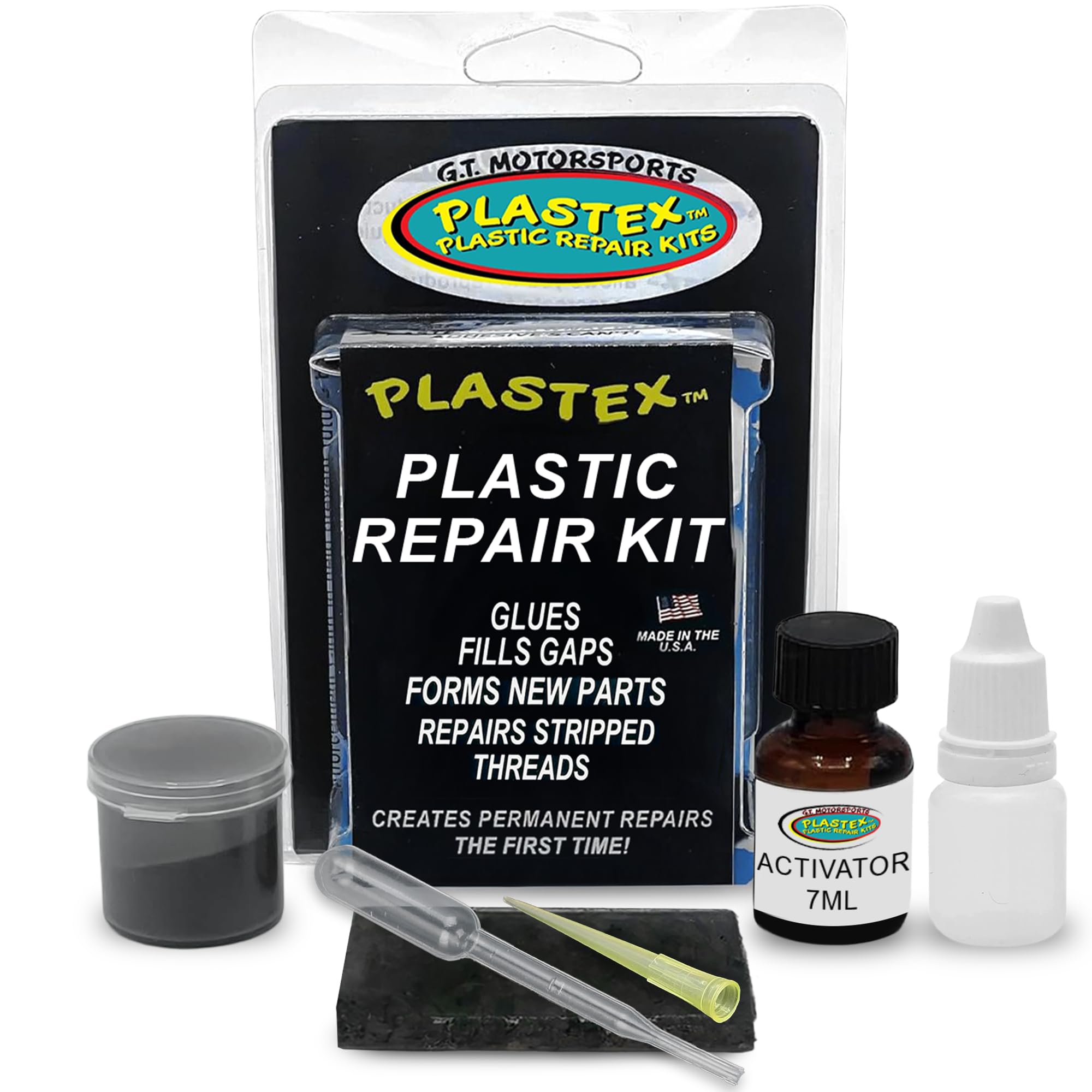
Plastex uses a two-step powder-and-activator system that eliminates the mixing ratio guesswork — simply apply the powder to the repair area and add the liquid activator. The material hardens within minutes and can be sanded, drilled, tapped, and painted. This makes it a solid option for rebuilding broken mounting tabs, repairing stripped threads in plastic fuel tank flanges, and filling small cracks on rigid plastic components.
The reusable molding bar included in the kit allows you to duplicate broken tabs and small parts, which is useful when a replacement plastic part is unavailable. For fuel tank applications, the repair is water-resistant and holds up well on rigid plastics like ABS and nylon. The small travel size is portable and fits in a toolbox drawer, making it a practical emergency repair kit for trailside or roadside fixes.
However, Plastex is not designed for flexible plastics or HDPE tanks. The bond strength is adequate for non-structural repairs and cosmetic restoration, but on a fuel tank experiencing flex and vibration, the repair may not have the same longevity as a dedicated sealer or plastic weld. The 7-milliliter volume is also small — enough for a single tab repair or a short crack, but not enough for large-area patching.
What works
- No mixing ratio — simple powder and activator
- Reusable molding bar for duplicating parts
- Compact size for emergency kits
What doesn’t
- Not suitable for flexible plastics or HDPE
- Small volume limits repair area
- Not designed for long-term fuel contact
Hardware & Specs Guide
Chemical Resistance and Fuel Compatibility
The most critical specification for a fuel tank repair kit is its chemical resistance to gasoline, diesel, and ethanol blends. Epoxies and sealers rated for hydrocarbon exposure contain high cross-link density resins that resist swelling and softening. Plastic welders bypass this issue entirely by using the parent material as filler, but the staples must be corrosion-resistant. Always verify that the cured product is labeled for direct fuel contact — otherwise, the repair may fail after repeated fuel cycling.
Curing Time and Working Temperature
Repair compounds require specific ambient temperatures to cure properly. Most epoxies and sealers demand temperatures above 60°F for optimal cross-linking, and full chemical resistance develops only after the complete cure cycle — often 24 to 72 hours. Fast-setting products like the 5-minute Starbond epoxy reach handling strength quickly but may not achieve full fuel resistance until the 24-hour mark. Cold or humid conditions extend cure times and can weaken the final bond.
Mechanical Strength and Flexibility
Fuel tanks expand, contract, and vibrate during operation. A rigid epoxy patch may crack when the tank wall flexes, while a flexible sealer can stretch without failing. Look for tensile or shear strength ratings above 2,000 psi for load-bearing repairs, and prioritize flexible formulations for thin-walled or large-area patches. Plastic welding delivers the highest mechanical strength because the bond is a fusion of the original material, but the skill of the operator significantly affects the result.
Surface Preparation Essentials
Every repair method demands a clean, dry, and roughened substrate. Fuel residue must be drained, and the tank should be aired or flushed to remove vapors. Abrading with 80–120 grit sandpaper creates a mechanical key for adhesives. For polyolefin plastics (HDPE, PP), flame treatment or a chemical primer may be necessary to raise surface energy. Skipping these steps is the single most common reason for repair failure, regardless of the product quality.
FAQ
Can I repair a plastic fuel tank with a standard epoxy?
How do I prepare a fuel tank surface before applying a repair kit?
What type of plastic are most fuel tanks made from?
Is a plastic welder better than epoxy for fuel tank cracks?
How long does a fuel tank plastic repair last?
Final Thoughts: The Verdict
For most buyers, the best fuel tank plastic repair kit winner is the KBS Coatings 5200 because it is purpose-engineered for fuel tank interiors and delivers a flexible, impermeable seal that resists ethanol blends and temperature cycling. If you need a fusion-strength repair for a structural crack, grab the RX WELD Plastic Welder. And for small over-the-road emergency patches, nothing beats the portability and simplicity of the Starbond 5 Minute Epoxy Pro Kit.

Certification: BSc in Mechanical Engineering
Education: Mechanical engineer
Lives In: 539 W Commerce St, Dallas, TX 75208, USA
Md Amir is an auto mechanic student and writer with over half a decade of experience in the automotive field. He has worked with top automotive brands such as Lexus, Quantum, and also owns two automotive blogs autocarneed.com and taxiwiz.com.