A gas-powered air compressor isn’t something you pick on a whim. The engine must start reliably in cold weather, the pump needs to sustain hours of continuous use, and the tank capacity dictates how many nailers or impact wrenches you can run simultaneously. Choosing wrong means downtime on the job or a unit that sits useless in the shop.
I’m Amir — the founder and writer behind Four Wheel Ask. My approach to analyzing gas-powered compressors involves cross-referencing CFM ratings against real duty-cycle demands, examining pump metallurgy and valve design, and aggregating long-term owner feedback across multiple seasons of use.
Whether you need a portable unit for framing sites or a stationary tank for shop tools, understanding displacement, PSI recovery times, and oil-lubrication systems separates a smart purchase from a costly mistake. This guide breaks down the best air compressor gas models available today based on performance data, build quality, and real-world reliability reports.
How To Choose The Best Air Compressor Gas
Selecting a gas-powered compressor demands evaluating factors that electric units don’t require: engine reliability, fuel system maintenance, pump material, and portability in rough terrain. The wrong combination wastes money on power you don’t need or leaves you stranded with a unit that can’t keep up.
Engine Selection: Beyond Horsepower Numbers
Honda GX series engines are the gold standard in this category for a reason — they start easily, run smoothly under load, and have a massive parts network. Some budget compressors use generic Chinese engines that may save money upfront but suffer from carburetor issues and shorter service life. Look for low-oil shutdown features and overhead valve designs for durability.
CFM Requirements: Matching Pump Output to Tools
Every pneumatic tool has a CFM requirement at a specific PSI. A framing nailer needs around 2-3 CFM at 90 PSI while a 1/2-inch impact wrench can consume 5+ CFM under continuous use. If you plan to run multiple tools simultaneously, add tool CFM requirements and look for a compressor that exceeds that total by at least 30% to avoid constant cycling.
Pump Construction: Cast Iron vs. Aluminum
Cast iron cylinders and pump heads dissipate heat better and resist wear over decades of use. Aluminum pumps are lighter and cheaper but can warp under sustained high-temperature operation. For professional or frequent use, a full cast iron pump with Swedish steel or ceramic valves is worth the premium. For intermittent DIY or light commercial work, aluminum pumps offer adequate service life at lower cost.
Tank Size and Portability Trade-offs
Larger tanks hold more stored air, reducing how often the engine needs to cycle on. But a 20-gallon tank with a heavy cast iron pump can weigh over 200 pounds. Wheelbarrow-style frames with pneumatic tires are essential for mobility on rough jobsites. Evaluate whether you need a stationary unit or one that follows you across framing projects.
Quick Comparison
On smaller screens, swipe sideways to see the full table.
| Model | Category | Best For | Key Spec | Amazon |
|---|---|---|---|---|
| Limodot LJ8170A | Electric | Quiet indoor DIY work | 8 Gal, 120 PSI, 68 dB | Amazon |
| ALL-TOP ATACR30G | 12V Portable | Off-road tire inflation | 12.35 CFM, 150 PSI, 26ft hose | Amazon |
| WIILAYOK 13 Gal | Electric | Garage spray painting & nailing | 13 Gal, 6 CFM, 115 PSI | Amazon |
| Viair 485C Platinum | 12V Portable | Extreme off-road continuous duty | 100% duty, 200 PSI, IP67 | Amazon |
| Metabo HPT EC2510E | Gas Wheelbarrow | Jobsite framing & roofing | 8 Gal, 145 PSI, Honda GX | Amazon |
| Metabo HPT EC2610EA | Gas Wheelbarrow | Running five nailers simultaneously | 9 Gal, 9.5 CFM, Honda GX200 | Amazon |
| Ingersoll-Rand SS3J5.5GH-WB | Gas Wheelbarrow | Heavy industrial continuous duty | 8 Gal, 135 PSI, 5.5 HP Honda | Amazon |
| NorthStar GX160 | Gas Wheelbarrow | Demanding commercial multi-tool use | 20 Gal, 13.7 CFM, Honda GX160 | Amazon |
| VEVOR 30 Gal | Gas Stationary | Workshop with high CFM demands | 30 Gal, 33 CFM, 115 PSI | Amazon |
In-Depth Reviews
1. Metabo HPT EC2510E

The Metabo HPT EC2510E represents the sweet spot where professional-grade reliability meets reasonable cost. Powered by a Honda GX engine paired with a cast-iron cylinder pump, this 8-gallon wheelbarrow compressor cycles from 116 to 145 PSI, ensuring tools never starve for air during continuous nailing or stapling tasks. The pump’s low oil carryover design extends tool life and reduces maintenance intervals.
Owner reports consistently highlight the cold-start reliability of the Honda GX power plant and the integrated control panel that protects gauges and regulators from jobsite damage. The 3/8-inch locking regulator comes pre-installed and provides precise pressure control for sensitive tasks like finish nailing alongside high-volume framing applications.
At 144 pounds with a wheelbarrow frame, the EC2510E is portable enough to move across rough terrain but stable enough for stationary use. The pneumatic throttle control reduces fuel consumption when air demand drops. For contractors who need a gas compressor that starts every time and powers through framing, roofing, and siding work, this Metabo HPT unit delivers exceptional value relative to its performance envelope.
What works
- Honda GX engine starts reliably in cold weather
- Cast iron pump with low oil carryover extends tool life
- Good PSI recovery time between tool cycles
- Protective baseplate keeps controls safe on jobsites
What doesn’t
- 8-gallon tank limits simultaneous high-CFM tool operation
- Heavier than some aluminum-pump competitors
- Oil changes required for pump longevity
2. Metabo HPT EC2610EA The Tank XL
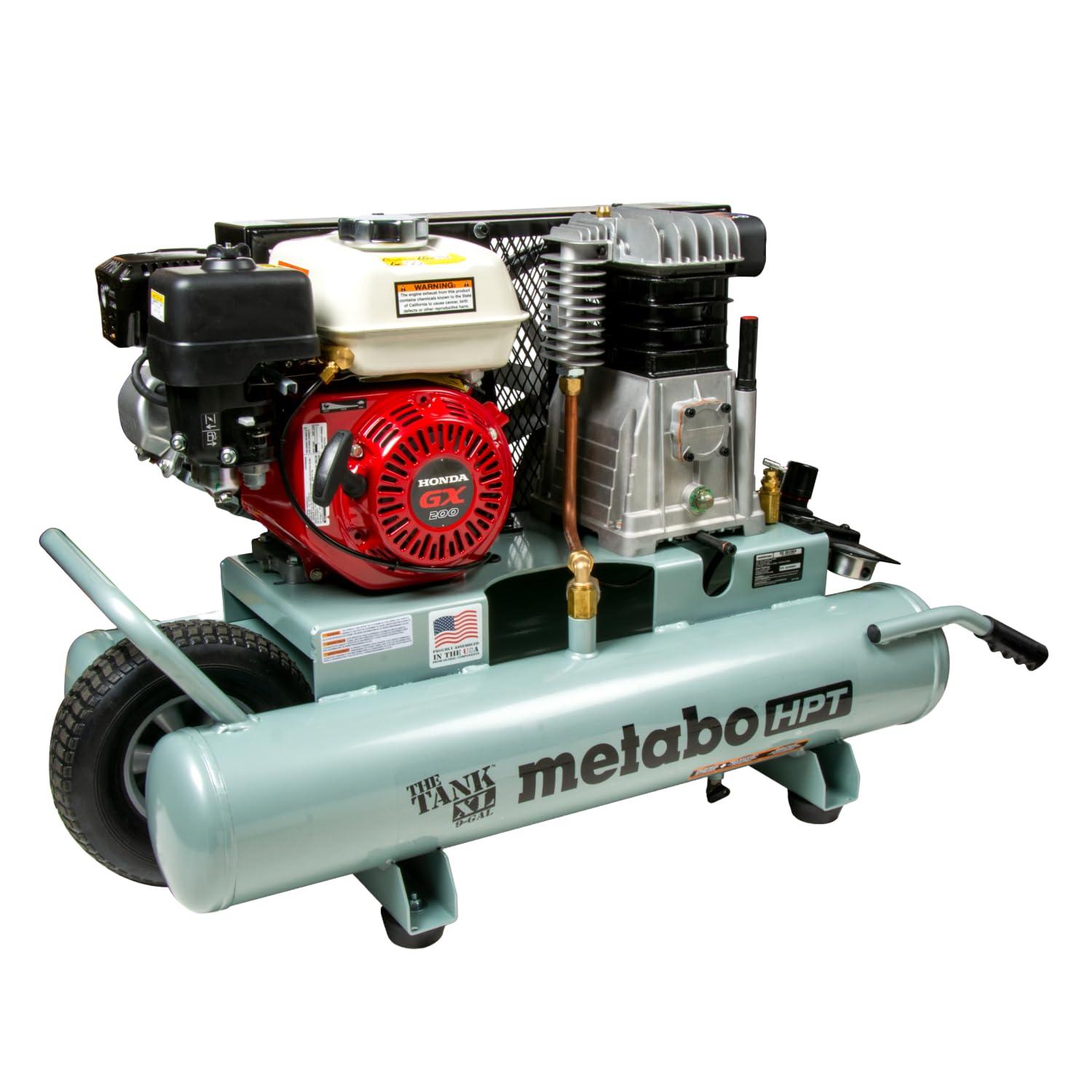
The Metabo HPT EC2610EA earns its “Tank XL” name by delivering 9.5 CFM at 90 PSI from a Honda GX200 engine, enough to run five framing nailers, five roofing nailers, or five siding nailers simultaneously without pressure drop. Assembled in the USA, this 9-gallon wheelbarrow compressor targets production-minded contractors who need consistent fastener-driving depth across multiple guns on large-scale projects.
The oil-lubricated pump includes an aftercooler that reduces discharge air temperature, which translates to less moisture in the air lines and longer tool life. The solid rubber maintenance-free tire eliminates flats on rough terrain, and the wheelbarrow frame balances the 159-pound weight for manageable movement across foundations and roof decks.
Pro Tools Reviews rated it the Best Small Air Compressor, and owner feedback emphasizes the lack of delay between trigger pulls — nails seat flush every time even with multiple operators. The two included 1/4-inch brass industrial couplers provide dual-tool connectivity right out of the box.
What works
- 9.5 CFM at 90 PSI handles five nailers at once
- Assembled in the USA with quality control
- Aftercooler reduces moisture in air lines
- Honda GX200 engine is a proven workhorse
What doesn’t
- Premium pricing reflects the Honda GX200 platform
- Heavy for a single operator to load into a truck bed
- Solid tire limits ride smoothness on rocky terrain
3. Ingersoll-Rand SS3J5.5GH-WB

The Ingersoll-Rand SS3J5.5GH-WB represents industrial-grade engineering in a wheelbarrow package. The 5.5-horsepower Honda engine drives a full cast-iron pump with 135 PSI maximum operating pressure and 100% continuous duty capability — meaning this compressor never needs to rest during a full workday. The twin pontoon design houses two tanks providing 8 gallons of total storage while lowering the center of gravity for stability on uneven terrain.
Two quick-disconnect fittings allow simultaneous tool operation, and the cast-iron pump construction includes hardened valve components rated for years of commercial service. At 226 pounds, this is not a lightweight unit, but the wheelbarrow frame with large pneumatic tires makes it mobile enough for daily jobsite movement.
Ingersoll-Rand’s warranty support is well-documented, and replacement parts remain available through a vast dealer network. The 0.825-gallon fuel tank provides extended run times between refueling stops, which production crews will appreciate on long framing days. This compressor is built for contractors who treat their equipment as capital investments.
What works
- 100% continuous duty cycle for production work
- Twin pontoon tanks improve stability and air storage
- Ingersoll-Rand dealer network for parts and service
- Cast iron construction with stainless steel valves
What doesn’t
- Very heavy at 226 pounds
- Premium price limits accessibility for occasional users
- Requires regular oil maintenance
4. NorthStar GX160

The NorthStar GX160 combines a 20-gallon horizontal tank with a full cast-iron pump driven by a Honda GX160 OHV engine, delivering 13.7 CFM at 90 PSI. This output class supports high-consumption tools like sanders, grinders, and multiple impact wrenches operating simultaneously. The V-style cylinder design enhances cooling efficiency, keeping discharge temperatures lower during extended runs.
The pump head is made from FC35 grade cast iron, with floating-type Swedish steel valves that significantly outlast standard reed valves in continuous-duty applications. The low-oil shutdown feature protects the Honda engine from operator error, a critical safety net on busy jobsites where multiple crew members handle equipment.
At 217 pounds with a horizontal tank configuration, this unit is more suited to stationary placement or controlled movement on flat surfaces. The 40-inch length fits well against a shop wall or in a trailer, and the 20-gallon reservoir provides ample buffer for tools with intermittent demand cycles. The NorthStar is a strong choice for commercial workshops needing reliable gas-powered air without the wheelbarrow-style portability.
What works
- 20-gallon tank provides excellent air reserve
- Swedish steel valves last significantly longer than standard
- Honda GX160 with low-oil shutdown
- V-style cylinders improve heat dissipation
What doesn’t
- Horizontal tank less portable than wheelbarrow designs
- Heavy for regular repositioning
- Pump requires diligent oil maintenance schedule
5. VEVOR 15HP 30 Gallon

The VEVOR 15HP gas-powered compressor targets users who need massive air volume — 33 CFM at 115 PSI from a 30-gallon tank. This output level supports sandblasting cabinets, high-volume spray guns, and multiple pneumatic tools simultaneously. The gas-driven piston pump uses cast-iron cylinders and frames to handle the stresses of high-pressure operation without deformation over time.
Dual air outlets allow two operators to work simultaneously, and the automatic low-oil shutdown protects the pump from catastrophic failure. Four smooth-rolling wheels provide mobility around the workshop, though at 271 pounds, this is primarily a stationary unit that can be moved between locations rather than carried across a jobsite.
The 30-gallon capacity means the engine cycles less frequently than smaller tanks, reducing fuel consumption and noise interruptions in shop environments. Owner feedback notes that the 15HP rating reflects peak power, and continuous output aligns with standard 1-stage pump expectations. For workshops with high CFM demands and access to outdoor ventilation, this VEVOR offers compelling capacity at a competitive investment point.
What works
- 33 CFM supports sandblasting and high-volume tools
- 30-gallon tank reduces cycling frequency
- Dual outlets for simultaneous two-tool operation
- Cast iron cylinders and frame for durability
What doesn’t
- Very heavy at 271 pounds
- Engine noise requires ear protection in enclosed spaces
- Horsepower rating is peak, not continuous
6. WIILAYOK 13 Gallon
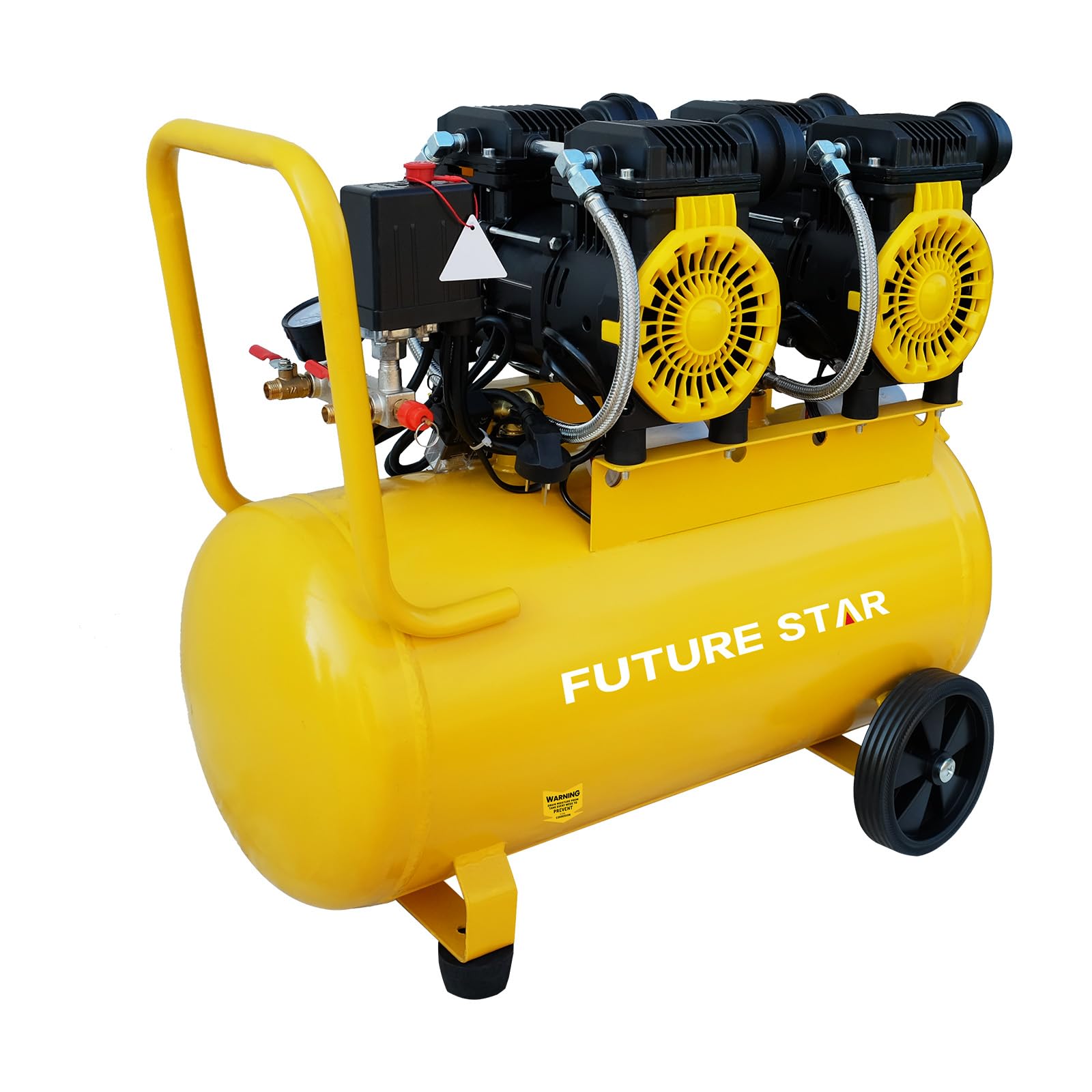
The WIILAYOK 13-gallon compressor is an electric model that competes with gas units in output but avoids fuel maintenance. The 3.7 HP motor delivers 6 CFM at 90 PSI, sufficient for framing nailers, spray painting, and bolting tasks. The oil-lubrication system reduces friction and extends component lifespan compared to oil-free designs, making this a strong option for shop use where electrical power is available.
The three-layer reinforced structure — thickened steel inner layer, plastic powder coating, and rust/wear-resistant outer layer — resists corrosion and leakage better than single-wall tanks. At 70 dB, it operates noticeably quieter than gas engines, which matters for indoor workshops or noise-sensitive environments.
With a top handle and bottom wheels, the 64-pound unit moves easily across smooth floors. The dual outlets allow simultaneous tool connection, and the automatic shut-off prevents over-pressurization. For buyers who want gas-comparable performance without engine maintenance, this electric alternative deserves consideration.
What works
- Oil-lubricated pump extends service life
- Quieter operation than gas engine alternatives
- Reinforced tank resists corrosion and leakage
- Dual outlets for two-tool operation
What doesn’t
- Requires electrical outlet, limiting remote jobsite use
- 6 CFM may not satisfy high-demand continuous tools
- Heavier than comparable tank sizes from competitors
7. Limodot LJ8170A

The Limodot LJ8170A is an electric compressor that solves the noise problem inherent to gas units. Operating at just 68 dB from a 1.7 HP induction motor running at 3240 RPM, this unit can run inside a home garage or workshop without disturbing neighbors or family members. The oil-free design eliminates the need for lubricant purchases and periodic oil changes.
The 8-gallon aluminum tank weighs only 37.5 pounds — dramatically lighter than equivalent steel tanks — while resisting rust and corrosion. The double-cylinder pump delivers 5.6 CFM at 40 PSI and 4.2 CFM at 90 PSI, adequate for brad nailers, staplers, airbrushes, and HVLP spray guns. For light-duty tasks where gas engine noise would be intrusive, this compressor offers a compelling alternative.
With a wheel kit for easy movement and a maximum pressure of 120 PSI, the LJ8170A handles typical DIY and light commercial applications. The cold-start capability of the oil-free design ensures reliable operation in unheated garages during winter. This is a specialist pick for buyers prioritizing quiet operation over the raw output of gas compressors.
What works
- Exceptionally quiet at 68 dB for indoor use
- Lightweight aluminum tank at 37.5 pounds
- Oil-free design reduces maintenance requirements
- Rust-resistant tank extends service life
What doesn’t
- Limited CFM output for high-demand tools
- Requires electrical outlet for operation
- Not suitable for multi-gun production framing
8. ALL-TOP ATACR30G

The ALL-TOP ATACR30G is a 12V dual-cylinder air compressor designed specifically for off-road tire inflation, delivering 12.35 CFM and a maximum 150 PSI. The digital inflator gun with pressure gauge allows precise tire filling — hold the handle to inflate, release to stop — eliminating the need to walk back and forth to the compressor switch. This workflow saves significant time when airing up four truck tires after a trail run.
The hollow metal shell with aluminum cylinders improves heat dissipation during extended operation, and the auto-thermal cut-off switch protects the motor from overheating damage. Four anti-vibration rubber feet keep the unit stable on uneven ground, and the sand-proof power switch prevents debris intrusion in dusty off-road environments.
With a 26-foot rubber air hose and three nozzle adapters plus a thumb lock adapter, the kit covers Schrader valves, Presta valves, and inflatables. The 2-year warranty and lifetime customer support from ALL-TOP’s overland-focused community provide reassurance for frequent off-road use. This compressor is purpose-built for overlanders, not for running pneumatic tools.
What works
- Digital inflator gun simplifies four-tire inflation workflow
- Dual cylinders with aluminum heads dissipate heat well
- Sand-proof switch and rubber feet suit off-road conditions
- 26-foot hose reaches all four truck tires without repositioning
What doesn’t
- 12V operation limited to vehicle battery capacity
- Not suitable for continuous pneumatic tool use
- Lower maximum horsepower limits sustained output
9. Viair 485C Platinum

The Viair 485C Platinum Gen 2 redefines what a compact 12V compressor can achieve — 100% duty cycle at 200 PSI means this unit can run continuously without overheating, a feat almost unheard of in portable compressors. Drawing only 23 amps while outputting 2.24 CFM at 0 PSI, it refills a 5-gallon tank from 165 to 200 PSI in just 2 minutes and 15 seconds.
The IP67 certification allows the compressor to withstand water immersion and dust ingress, critical for mounting in exposed vehicle locations. With the air filter relocated, this compressor operates reliably in mud, snow, and rain. The stainless steel construction resists corrosion in salt-spray environments, making it ideal for overland vehicles, service trucks, or marine applications.
This is a specialty tool for users who need continuous-duty onboard air in a compact form factor. The 485C does not come with a large storage tank — it’s designed to be plumbed into a vehicle’s existing air system or small auxiliary tank. For overlanders and off-road enthusiasts who want to run air lockers, inflate tires, and power air tools from a single onboard system, the Viair 485C is the definitive choice.
What works
- 100% duty cycle at 200 PSI for unlimited runtime
- IP67 certified for water and dust protection
- Compact size fits in tight vehicle installations
- Fast recovery time for small tank systems
What doesn’t
- Lower CFM output limits high-volume tool use
- Requires external tank for practical air storage
- No onboard storage or portability features included
Hardware & Specs Guide
CFM and PSI: The Performance Foundation
CFM (cubic feet per minute) measures the volume of air the pump moves at a given pressure. PSI (pounds per square inch) measures the pressure the air is stored at. Every tool requires a minimum CFM at a specific PSI — find the tool with the highest demand and ensure the compressor exceeds that number by at least 30%. A framing nailer typically needs 2-3 CFM at 90 PSI while a 1/2-inch impact wrench can require 5+ CFM under continuous use. Gas compressors generally offer higher CFM than electric because the engine produces more torque at the pump shaft.
Cast Iron vs. Aluminum Pump Construction
Full cast iron pumps — cylinder, head, and crankcase — dissipate heat more effectively and resist wear over decades of use. Swedish steel or ceramic valves extend service intervals compared to reed valves. Aluminum pumps are lighter and cheaper but can warp under sustained high-temperature operation, leading to compression loss. For professional or frequent use, prioritize cast iron: the Metabo HPT EC2510E and Ingersoll-Rand SS3J5.5GH-WB both feature full cast iron pumps with hardened valve components rated for daily commercial service.
Engine Selection: Honda GX vs. Alternatives
Honda GX series engines dominate the professional gas compressor market because of their overhead valve design, cast iron cylinder sleeves, and extensive dealer network for parts and service. GX engines feature low-oil shutdown, dual-element air filters, and fuel-efficient carburetion that starts reliably in cold weather. Alternative engines from Chinese manufacturers may reduce upfront costs but often suffer from carburetor issues, harder cold starts, and shorter service life. If you depend on the compressor for income, the Honda GX premium pays for itself in reduced downtime.
Duty Cycle and Recovery Time
Duty cycle refers to the percentage of time the pump can run in a given period. Gas compressors with 100% continuous duty — like the Ingersoll-Rand SS3J5.5GH-WB — can run all day without a cool-down period. Lower duty cycle units require rest intervals to prevent pump damage. Recovery time measures how quickly the compressor refills the tank after use. Faster recovery means less waiting and more productivity. Tank size directly affects recovery frequency — larger tanks require fewer cycles per hour, reducing engine wear and fuel consumption.
FAQ
What size gas air compressor do I need for framing nailers?
How long does a Honda GX engine last on a gas air compressor?
Can I use a gas air compressor indoors?
What is the difference between oil-lubricated and oil-free air compressors?
How do I transport a wheelbarrow gas air compressor safely?
Final Thoughts: The Verdict
For most buyers, the best air compressor gas winner is the Metabo HPT EC2510E because it combines a proven Honda GX engine, cast iron pump, and thoughtful wheelbarrow design at a price that delivers professional-grade reliability without the premium of the flagship Tank XL. If you need maximum CFM for simultaneous multi-gun operation, grab the Metabo HPT EC2610EA with its 9.5 CFM at 90 PSI output. And for non-stop industrial duty where 100% continuous operation is non-negotiable, nothing beats the Ingersoll-Rand SS3J5.5GH-WB with its 5.5 HP Honda engine and twin-tank cast iron pump design.

Certification: BSc in Mechanical Engineering
Education: Mechanical engineer
Lives In: 539 W Commerce St, Dallas, TX 75208, USA
Md Amir is an auto mechanic student and writer with over half a decade of experience in the automotive field. He has worked with top automotive brands such as Lexus, Quantum, and also owns two automotive blogs autocarneed.com and taxiwiz.com.