A gas motor kit can transform a standard bicycle into a practical commuter, but the market is flooded with inconsistent quality that separates a reliable build from a frustrating project. The difference between a week of fun and a season of problems often comes down to the cylinder casting, carburetor tuning, and the quality of the mounting hardware included in the box.
I’m Amir — the founder and writer behind Four Wheel Ask. My analysis focuses on cross-referencing technical specifications with long-term owner feedback to separate kits that deliver consistent performance from those that require constant wrenching.
After analyzing dozens of owner reports and specification sheets, this guide evaluates the absolute best bicycle gas motor kits for performance and build quality.
How To Choose The Best Bicycle Gas Motor Kits
Selecting the right kit requires looking past the marketing claims. The real performance of a 2-stroke bicycle engine depends on the quality of its castings, the precision of its carburetor, and the strength of its mounting brackets. A cheaper kit with poor fits will cost you more time and frustration than a properly assembled mid-range option.
Displacement and Real-World Speed
Displacement numbers like 80cc, 100cc, and 110cc are often estimates rather than exact measurements. Many kits labeled 100cc actually displace closer to 85cc when measured properly. The key difference is torque: a true 100cc engine pulls harder on hills and maintains cruising speed with less effort than an 80cc unit. However, top speed is limited more by the bike’s gearing and your weight than by the cc rating alone. Expect 25–35 mph stock from a well-tuned 80cc kit, and slightly more from a 100cc.
Build Quality Markers
The cylinder and piston assembly are the heart of the kit. Look for a single-piece cylinder with a cast-iron sleeve (labeled as an iron sleeve) rather than a plain alloy bore. The carburetor should have an adjustable main jet and idle air screw. Hardware matters significantly: 8mm mounting studs are stronger than the older 6mm standard. Check that the fuel tank is UV-resistant and that the spark plug wire is long enough to reach your frame. Poor instructions are a red flag, but a good kit compensates with better-organized parts and online support.
Compatibility and Frame Requirements
Most kits require a diamond-shaped V-frame with at least 10 inches of clearance between the bottom bracket and the top tube. Disc brakes and coaster brakes require different mounting approaches for the rear sprocket. Check your wheel diameter (26 or 28 inches) and ensure the kit’s sprocket fits your spokes. If your bike has a small frame or unusual geometry, you will likely need to modify or shave the frame mounts to fit the engine.
Quick Comparison
On smaller screens, swipe sideways to see the full table.
| Model | Category | Best For | Key Spec | Amazon |
|---|---|---|---|---|
| DNYSYSJ 100cc | Premium | Reliable All-Rounder | 8mm Mounts, Upgraded CDI | Amazon |
| IMAYCC 100cc Silver | Premium | High Speed Build | 3L Tank, 44T Sprocket | Amazon |
| H-YEEU 110cc | Performance | Maximum Power | 52mm Bore, Iron Sleeve | Amazon |
| IMAYCC 80cc Black | Mid-Range | Balanced Commute | 44T Sprocket, CDI Ignition | Amazon |
| Sange 100cc Black | Mid-Range | Quiet Operation | Low Noise, 50km/h Top | Amazon |
| Tipyoumall 100cc | Value | Economical Upgrade | 50mm Bore, 44T Sprocket | Amazon |
| Sange 80cc Red | Budget-Friendly | Ultra-Low Cost Entry | 80cc, 45km/h Speed | Amazon |
| Frederimo 100cc | Budget-Friendly | Simple Conversion | 100cc, Aluminum Alloy | Amazon |
| WBGANG 100cc | Entry-Level | First-Time Build | 100cc, 28 mph Top | Amazon |
In‑Depth Reviews
1. DNYSYSJ 100cc 2-Stroke Bicycle Engine Kit

The DNYSYSJ 100cc kit stands out because it combines fundamental quality upgrades—8mm engine mounts and a single-piece cylinder—with a tunable carburetor that actually works out of the box. Owner reports consistently mention that the engine runs well after a simple spark plug swap (E3.12) and that the seller provides responsive after-sale support for fitment issues. The kit is designed for standard 26- and 28-inch V-frame bikes, and the 44-tooth sprocket provides a good balance between acceleration and top speed.
One of the more common complaints across all budget kits is poor instructions, and the DNYSYSJ kit is no exception. The manual is sparse, but the kit compensates with better-organized hardware and a carburetor that includes a choke lever on the handlebars. Owners who replaced the rag joint mounting for the rear sprocket with a hub-mounted system reported a significant reduction in vibration. The fuel tank is UV-resistant and the upgraded CDI unit provides a cleaner spark, which helps with cold starts.
For a buyer who wants a reliable baseline without immediately upgrading half the components, this kit is the most balanced option on the market. It requires basic mechanical skill and patience during assembly, but the foundation is solid enough to provide a satisfying first build that will last for several seasons with proper maintenance.
What works
- Strong 8mm mounting hardware reduces vibration.
- Tunable carburetor with adjustable idle and mixture screws.
- Excellent seller support for returns and replacement parts.
What doesn’t
- Instructions are vague and lack detail for first-time builders.
- Fuel filter in the kit is fragile and may need replacement immediately.
2. IMAYCC 100cc Silver Bike Motor Kit

The IMAYCC 100cc kit is designed for builders who want speed. It comes with a 44-tooth rear sprocket and a large teardrop-style fuel tank that holds 3 liters, enough for extended rides between fill-ups. Owner data shows top speeds of 36–40 mph on a 26-inch mountain bike after break-in, with some builders reporting 53 mph on flat roads with a lightweight rider. The CDI ignition and single-cylinder 2-stroke engine are standard, but the quality control on this kit is noticeably better than the budget-tier options.
Installation is straightforward for anyone who has done a motorized bike build before. The parts are labeled clearly, and the included chain and tensioner are of decent quality. However, several owners note that the stock bolts should be replaced with stronger ones and that all mounting hardware must be secured with threadlocker. The chain tensioner is a weak point that can loosen over time and damage the spokes if not checked regularly. The speedometer included in the kit often has a dead battery on arrival.
This kit is best suited for a rider who understands that a 100cc engine on a bicycle frame requires constant attention to hardware tightness and carburetion. It offers good value for the price and rewards a careful builder with impressive performance. Those looking for a reliable daily commuter should plan to upgrade the sprocket mounting and chain tensioner during the initial build.
What works
- Large 3L tank reduces refueling frequency.
- Relatively clear instructions and labeled parts.
- Fast top speed potential after proper break-in and tuning.
What doesn’t
- Chain tensioner is weak and needs monitoring.
- Stock bolts are low quality and should be replaced.
3. H-YEEU 110cc 2-Stroke Bicycle Gasoline Engine Kit
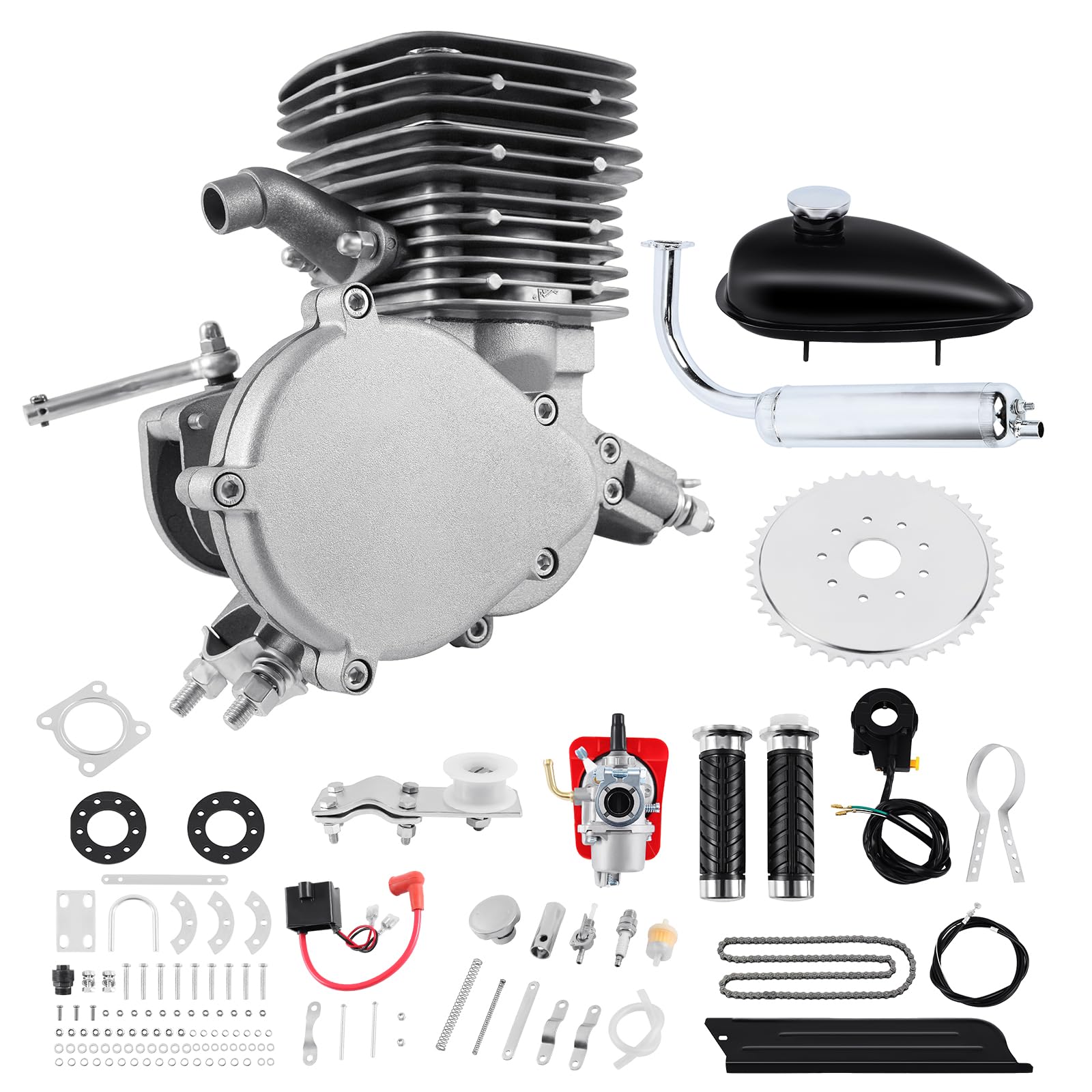
The H-YEEU 110cc kit is the most powerful option in this guide, with a true 52mm bore and a cast-iron cylinder sleeve that provides better heat dissipation and long-term durability. This engine displaces approximately 110cc, which is measurably larger than the 80cc and 100cc kits that often round up their specs. Owner reports confirm that the motor reliably carries a 230-pound rider on 20- and 35-mile tours without overheating, provided the builder follows the proper break-in procedure with a 30:1 fuel-oil mix.
The kit includes a larger sprocket (36-tooth), which prioritizes torque over top speed. This makes it an excellent choice for riders who live in hilly areas or who want to pull heavier loads. The build quality is a step above the budget kits, with better gaskets and a cylinder that doesn’t require immediate deburring. The iron sleeve means that if you do seize the piston, you can hone the cylinder rather than replacing the entire unit. The included muffler is functional but restrictive, and most performance-oriented builders will swap it for an expansion chamber.
This kit is not for beginners. The extra power requires a sturdy bike frame and a builder who understands how to tune a carburetor for altitude and temperature. The gear reduction bearings have been noted as a weak point in some units, but overall, the H-YEEU delivers the most power per dollar in this category. It is the best choice for anyone who values hill-climbing ability and long-distance cruising over outright speed.
What works
- Genuinely larger displacement with excellent torque for hills.
- Iron cylinder sleeve allows for rebuilds and better heat management.
- Proven reliability over hundreds of miles in owner reports.
What doesn’t
- Gear reduction bearings can fail prematurely.
- Some units arrive with internal issues that prevent starting.
4. IMAYCC 80cc Black Bike Motor Kit

The IMAYCC 80cc kit is a solid entry point for someone who wants a reliable motorized bike without jumping into the premium price tier. It comes with a standard 44-tooth sprocket and CDI ignition, and the 2.5L teardrop tank provides enough fuel for a day of commuting. Owner data indicates that after a proper break-in (30:1 mix for the first three tanks), the engine runs smoothly at 20-25 mph and can reach 40 mph with a lightweight rider on flat ground. The motor mounts are functional but fragile, and several builders recommend adding rubber shims between the mounts and the frame to reduce vibration.
The most common issue reported with this kit is the clutch. The clutch pin can be too short, leading to premature wear, and the muffler is prone to cracking or splitting. Experienced builders replace the muffler immediately and upgrade the clutch lever. The instructions are average, but searching YouTube for the specific brand provides enough guidance. The fuel lines tend to harden after a season and should be replaced annually. The included computer speedometer often has a dead battery.
This kit is ideal for a mechanically inclined first-time builder who is prepared to perform minor modifications and replacements during the assembly process. If you are willing to invest a few extra hours in upgrades, the IMAYCC 80cc can become a reliable daily rider. It holds up best on a steel-frame mountain bike and rewards attention to detail during assembly.
What works
- Good balance of price and reliability after break-in.
- Large tank for extended riding between fill-ups.
- Strong CDI ignition for reliable starting.
What doesn’t
- Muffler is weak and prone to cracking.
- Clutch pin may be too short, causing engagement issues.
5. Sange 100cc 2-Stroke Pedal Cycle Gas Motor Conversion Kit

The Sange 100cc kit markets itself as a quiet and refined option, and owner reports generally confirm that the noise and vibration levels are lower than many competing kits. It uses a standard 2-stroke 100cc engine with CDI ignition, but the engine mounts are designed to better isolate vibration from the frame. The kit includes a complete set of hardware and a fuel tank, and it fits most 26- and 28-inch V-frame bicycles. The advertised top speed of 50 km/h (31 mph) is realistic after break-in and tuning.
Quality control on this kit is inconsistent. Some owners report that the engine runs well immediately and requires only minor carburetor adjustments. Others received a unit with a cracked cylinder sleeve, a piston installed backwards, and loose hardware throughout the assembly. The instructions are below average, and the clutch lever is widely criticized as being dangerously loose and unreliable. The rear sprocket installation is difficult because the rag joint design requires precise centering, and the chain can rub the muffler on some frames.
This kit is best suited for a builder who has experience with 2-stroke engines and can inspect and correct quality issues before first start. The noise reduction is a real benefit for neighborhood riding, but the inconsistency in manufacturing means you may need to request a replacement or invest time in repairs. The value is present only if you are prepared to sort through the potential problems.
What works
- Quieter operation than many competitors.
- Strong power output that matches advertised speed claims.
- Complete kit with all necessary hardware included.
What doesn’t
- Inconsistent quality control across units.
- Clutch lever is loose and potentially unsafe.
6. Tipyoumall Upgraded 100cc 2-Stroke Bicycle Engine Kit

The Tipyoumall 100cc kit emphasizes fuel efficiency, claiming 150 miles per gallon, and it includes a 50mm bore single-piece cylinder designed for lower operating temperatures and easier starting. The upgraded carburetor features a choke lever on the handlebars and adjustable main and pilot jets, which is a notable advantage over fixed-jet competitors. Owner feedback indicates that the engine runs well initially, but longevity is a concern, with reports of head gasket failure on the first ride and the engine quitting altogether after a short period.
The mounting hardware is a clear upgrade from older 6mm kits, using 8mm studs that provide twice the clamping force. This helps reduce vibration, which is a common cause of hardware loosening on motorized bikes. The instructions are better than average and include detailed assembly steps. The kit includes a tool kit and a 44-tooth sprocket. However, several owners note that the sprocket is listed as 44-tooth in the description but shipped as 36-tooth, so verification upon arrival is essential.
This kit offers good features on paper at a competitive price point, but the quality control issues make it a gamble. If you get a good unit, it will be a reliable and fuel-efficient motor. If you get a bad one, the return process is the only option. It is best for a budget-conscious builder who is willing to inspect and potentially replace the head gasket and cylinder base gasket during assembly.
What works
- Upgraded 8mm mounting hardware for better stability.
- Tunable carburetor with handlebar choke lever.
- Detailed instructions compared to other budget kits.
What doesn’t
- Head gasket failures reported on first use.
- Sprocket size may differ from what is advertised.
7. Sange 80cc 2-Stroke Cycle Petrol Bike Gas Motor Kit

The Sange 80cc kit is one of the most affordable options on the market, and it serves as a true entry point for anyone curious about motorized bicycles without wanting to commit a larger budget. The engine is a standard 2-stroke 80cc unit that claims a top speed of 45 km/h (28 mph). Owner reports confirm that it can reach that speed with a lightweight rider on flat ground, and it is surprisingly capable for its small displacement. The kit fits most 26- and 28-inch V-frame bikes and includes all necessary hardware.
The quality control is poor compared to mid-range kits. Multiple owners report that the engine arrives with paint overspray inside the cylinder and piston, requiring a complete tear-down and cleaning before first start. The gas tank is prone to leaking at the weld seams, and the seller may not replace it. The rag joint for the rear sprocket is difficult to install and can damage spokes if not perfectly centered. The instructions are minimal and mostly pictorial.
This kit is a viable option only if you have experience rebuilding small engines and are prepared to spend 3-4 hours cleaning, deburring, and reassembling the motor before it ever runs. The value is there if you can do that work yourself, and several owners report riding these kits for 400 miles after sorting out the initial issues. For a first-time builder with no mechanical experience, this kit will be a frustrating project.
What works
- Extremely low entry cost for a motorized bike project.
- Engine can be surprisingly reliable after a thorough cleaning.
What doesn’t
- Engine arrives with paint and debris inside the cylinder.
- Gas tank quality is poor and may leak.
8. Frederimo 100cc 2-Stroke Bike Motor Kit

The Frederimo 100cc kit is priced competitively and includes a mix of aluminum, plastic, and steel components. The engine is a standard 2-stroke 100cc unit that fits 26- and 28-inch bikes. Owner feedback is mixed: some report that the engine started on the first pull and ran well for months, while others found that the carburetor would not allow the engine to run at all. The quality of the cylinder and piston appears to be average, but the hardware included is sufficient for a basic build.
The instructions are nearly worthless, as multiple owners mention they are small, unclear, and lack wiring guidance. Builders must rely on YouTube videos to complete the assembly. The clutch cable and throttle cable are of low quality and may need replacement during the first season. The kit includes a standard 44-tooth rear sprocket, but the rag joint design is fiddly. A significant positive is that the seller is responsive to issues, and some owners had their engines replaced quickly when problems arose.
This kit is for the absolute beginner who is buying their first kit and wants to learn the assembly process without spending a lot of money. It will likely require upgrades to the carburetor, cables, and sprocket mount to become a reliable daily rider. The potential is there, but the quality control makes it a project rather than a ready-to-install solution.
What works
- Low price makes it an accessible first project.
- Good seller support for replacing defective units.
What doesn’t
- Instructions are nearly incomprehensible.
- Carburetor quality is poor, causing running issues.
9. WBGANG 100cc 2-Stroke Bike Engine Kit
The WBGANG 100cc kit is the lowest-priced option in this guide, and it reflects that in its component quality. The engine is a standard 2-stroke 100cc unit with an advertised top speed of 28 mph. Owner reports are split: a group of builders report that the engine was easy to install, started reliably, and provided good low-end torque for pulling hills. Another group reports catastrophic failures such as the engine blowing up after two weeks of use, leaving them past the return window. The cylinder casting appears to be inconsistent, with some units running well and others failing quickly.
The kit includes a 0.53-gallon fuel tank, which limits range compared to larger tanks. The instructions are described as confusing and require basic motorcycle knowledge to complete the build. Owners recommend replacing all bolts with thread locker, buying a new chain, and swapping the clutch lever for a combined brake-clutch lever to avoid losing the front brake. The rag joint for the rear sprocket is difficult to center. Noise levels are advertised at 75 dB, which is relatively quiet for a 2-stroke.
This kit is a gamble. If you get a good unit, it is a solid value for the price. If you get a bad one, you will likely need to buy a replacement engine from a different brand. It is best suited for an experienced builder who can inspect the cylinder and piston before assembly and who is prepared to replace the most critical components immediately. For a first-time buyer, the risk is higher than the savings justify.
What works
- Very low entry price for a 100cc motor.
- Good low-end torque for hill climbing.
What doesn’t
- High risk of engine failure within weeks.
- Confusing instructions and poor quality control.
Hardware & Specs Guide
Engine Displacement and Power
The actual displacement of a 2-stroke bicycle engine is determined by its bore (cylinder diameter) and stroke (piston travel distance). A true 80cc engine has a bore of around 47mm, while a 100cc engine typically uses a 50mm bore. The 110cc engines, like the H-YEEU, use a 52mm bore. More displacement does not always mean more speed; it means more torque, which helps you accelerate and climb hills. Top speed is limited by the sprocket tooth count and your bike’s wheel diameter.
CDI Ignition and Tuning
Capacitor Discharge Ignition (CDI) systems provide a hotter spark than older points-based systems. Upgraded CDI units, like those in the DNYSYSJ and IMAYCC kits, improve starting reliability and allow for higher RPMs before misfiring. The spark plug gap should be set to 0.025–0.030 inches. Some builders upgrade to an E3.12 spark plug for better combustion. Proper ignition timing is factory-set, but the CDI module must be mounted away from heat sources.
Carburetor Tuning
The carburetor is the most critical component for engine performance. A tunable carburetor includes a main jet (controls fuel at full throttle), a pilot jet (controls fuel at idle), and an idle mixture screw. Kits with a choke lever on the handlebars are easier to start in cold weather. The fuel-air ratio during break-in should be 16:1 or 30:1 oil-to-gas (depending on the kit), then leaned to 40:1 after break-in. If the engine bogs at full throttle, the main jet is too rich; if it runs hot and seizes, it is too lean.
Mounting and Drive System
The engine is typically mounted to the bike frame using steel brackets that bolt to the down tube and seat tube. 8mm studs (found on better kits) are significantly stronger than 6mm studs. The rear sprocket attaches to the spokes using a rag joint or a hub-mounted adapter. Hub-mounted sprockets are far more reliable and prevent spoke damage. The chain tensioner must be adjusted to maintain proper chain slack. A loose chain can wrap around the rear sprocket and lock the wheel.
FAQ
How difficult is it to install a bicycle gas motor kit?
Can I install a motor kit on any bicycle?
What modifications should I make to the kit for reliability?
Final Thoughts: The Verdict
For most buyers, the best bicycle gas motor kits winner is the DNYSYSJ 100cc because it offers the best combination of build quality, tunability, and seller support without requiring expensive upgrades at the start. If you want maximum power for climbing hills, grab the H-YEEU 110cc. And for a budget-conscious entry into motorized bikes, nothing beats the IMAYCC 80cc after you address its common weak points during assembly.

Certification: BSc in Mechanical Engineering
Education: Mechanical engineer
Lives In: 539 W Commerce St, Dallas, TX 75208, USA
Md Amir is an auto mechanic student and writer with over half a decade of experience in the automotive field. He has worked with top automotive brands such as Lexus, Quantum, and also owns two automotive blogs autocarneed.com and taxiwiz.com.