A deep socket might look like a simple hunk of steel, but the difference between a socket that slips or rounds a fastener and one that bites down with confidence comes down to subtle engineering choices. Material grade, heat treatment, drive geometry, and coating all determine whether a socket becomes a lifetime tool or a frustrating weak link in your toolbox.
I’m Amir — the founder and writer behind Four Wheel Ask. My research focuses on comparing material specifications, manufacturing processes, and long-term owner feedback across automotive tool categories to identify which products deliver consistent performance under real working conditions.
After evaluating material quality, design, and owner feedback, this identifies the truly best 24 mm deep socket options worth your consideration.
How To Choose The Best 24 Mm Deep Socket
A 24 mm deep socket is a specialized tool commonly used for crankshaft bolts, harmonic balancers, suspension components, and larger lug nuts. Choosing the right one means understanding the interplay between material composition, drive size, and design features that affect fastener engagement.
Material & Build Quality
Socket steel falls into two primary categories: Chrome Vanadium (CR-V) and Chrome Molybdenum (CR-Mo). CR-V offers good strength and flexibility at a lower cost, making it the standard for most impact sockets. CR-Mo is tougher and more resistant to fracture under extreme torque, which is why premium and professional-grade sockets use it. Heat treatment protocols also matter — proprietary tempering processes can significantly повысить a socket’s torque ceiling without making it brittle. Look for manganese phosphate coatings for corrosion resistance, especially if you work in wet or oily conditions.
Drive Size Compatibility
A 24 mm deep socket is available in both 1/2-inch and 3/8-inch drive configurations. A 1/2-inch drive is the standard for impact work and provides the greatest torque transfer, making it ideal for breaking loose stubborn crankshaft or suspension bolts. A 3/8-inch drive offers better access in tight spaces and pairs well with compact impact wrenches, but it may not withstand the same peak torque as a 1/2-inch drive. Match the drive size to your most-used impact tool and the typical fastener locations you encounter.
Socket Design & Fastener Protection
Six-point sockets are the standard for high-torque applications because they distribute force across the fastener’s flats rather than the corners, reducing the risk of rounding. Advanced designs like WaveDrive (curved internal geometry) and radius corner designs take this further by shifting contact points to the strongest part of the fastener. A chamfered opening helps align the socket quickly onto the bolt, which matters when working in awkward engine bays or under-vehicle positions.
Quick Comparison
On smaller screens, swipe sideways to see the full table.
| Model | Category | Best For | Key Spec | Amazon |
|---|---|---|---|---|
| Williams JHWBMD-624 | Premium | Professional shop use, maximum durability | 3/8 in drive, chrome finish, 6-point SUPERTORQUE | Amazon |
| Sunluway 77070 | Specialty | GM LS engine crank bolt removal | 1/2 in drive, 40CR alloy steel, counter-weighted | Amazon |
| Capri Tools 5-5224 | Mid-Range | Impact work, corrosion resistance | 1/2 in drive, CR-Mo steel, WaveDrive design | Amazon |
| TIGHTSPOT IS38D24MM6-TW | Mid-Range | Tight access, impact driver use | 3/8 in drive, CR-V steel, radius corner design | Amazon |
| FOCMKEAS 24mm-150L | Budget | Extended reach, larger bolts | 1/2 in drive, 6 in length, CR-V steel | Amazon |
In‑Depth Reviews
1. Williams JHWBMD-624 SUPERTORQUE
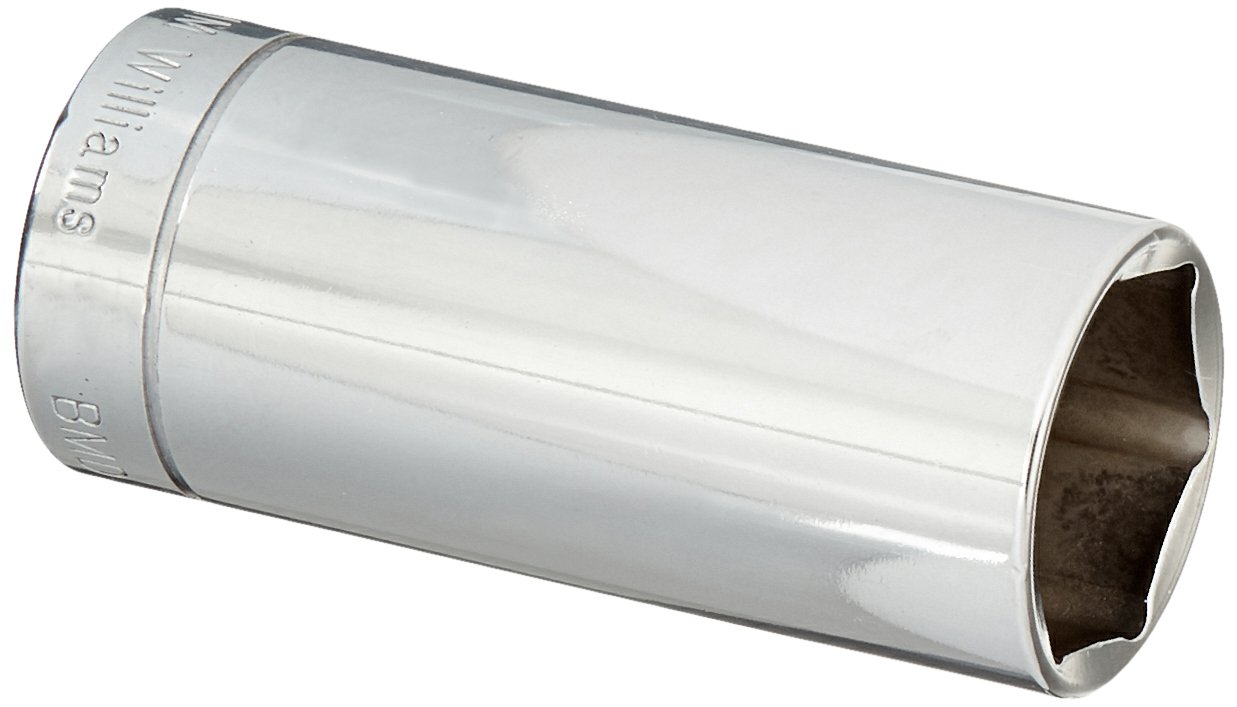
The Williams SUPERTORQUE line carries a heritage that stretches back over 140 years, and this 24 mm deep socket reflects that pedigree. Forged from Chrome Vanadium steel with a high-polished chrome finish, it is built to withstand repeated use in industrial and professional environments. The lobular internal geometry is engineered to deliver greater turning power while reducing deformation of the fastener — a design approach that prioritizes bolt preservation as much as torque delivery.
Owner feedback consistently highlights the American manufacturing quality and the socket’s slim profile, which allows it to reach into tighter engine compartments compared to bulkier impact-grade sockets. The 6-point broach depth of 9/16-inch and bolt clearance depth of 2-5/32-inch provide generous room for longer fasteners. Some users note that the size markings can be difficult to read at a glance, though once placed in a organized tray this becomes a minor concern.
For anyone who values precision fit and long-term durability over sheer impact resistance, the Williams represents a benchmark in 24 mm deep socket design. It is the same manufacturer behind Snap-On’s industrial line, making this essentially a badge-engineered professional socket at a more accessible price point.
What works
- Made in the USA with premium Chrome Vanadium steel
- SUPERTORQUE lobular design protects fasteners from rounding
- High-polished chrome resists corrosion and cleans easily
What doesn’t
- Size markings are small and can be hard to read quickly
- Not intended for high-torque impact use like impact-grade sockets
2. Sunluway 77070 Crank Bolt Socket
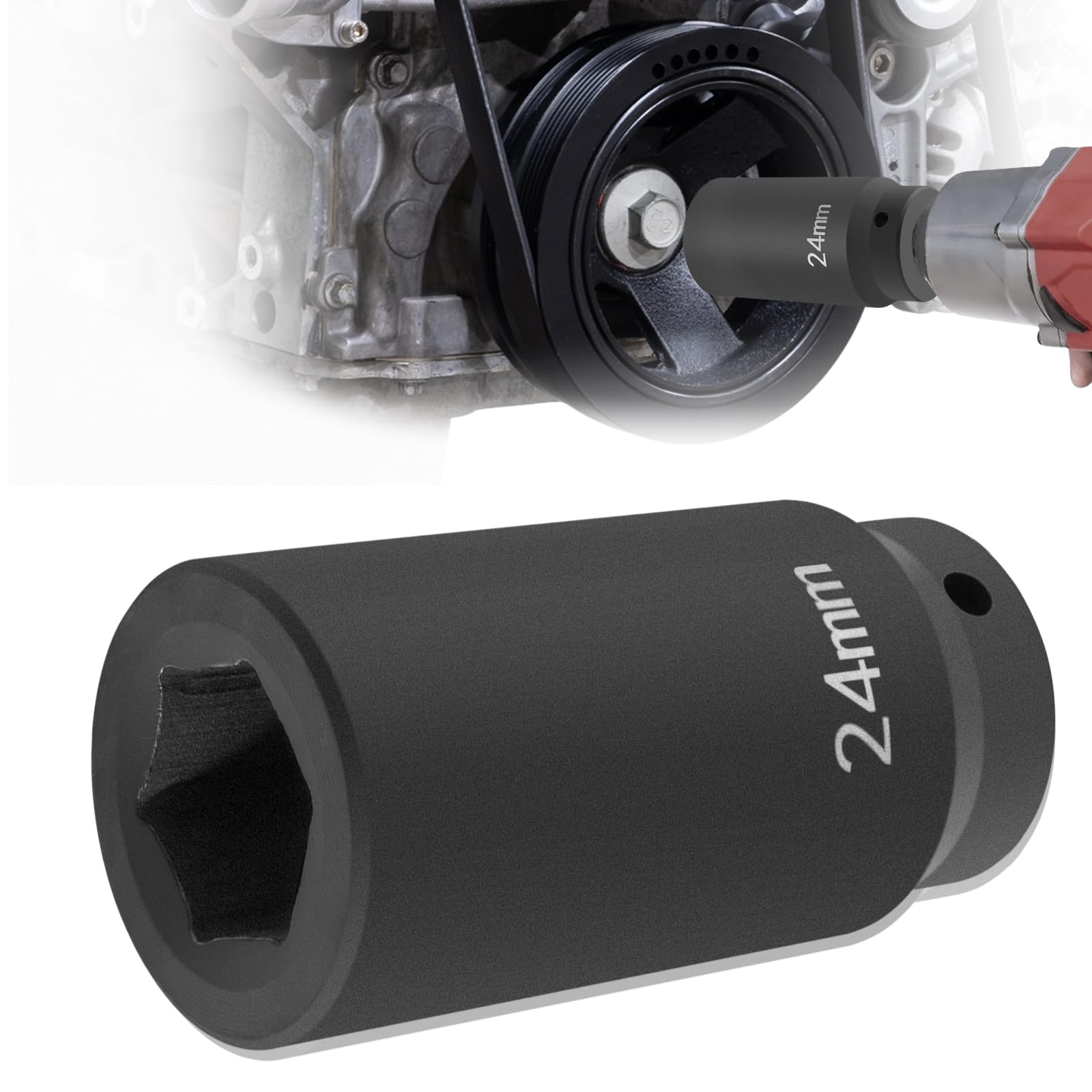
The Sunluway 77070 is not a general-purpose deep socket — it is a specialized tool designed for one notoriously difficult job: removing the harmonic balancer bolt on GM LS and LT engines. The counter-weighted geometry adds mass directly behind the fastener engagement area, reportedly delivering three times the momentum of a standard impact socket. This extra rotational mass helps break loose bolts that have been torqued to high specifications and corrosion-welded over years of service.
Constructed from heat-treated 40CR alloy steel with a 1/2-inch square drive, this socket is built to withstand the punishing cycle of impact wrench use. The 6-point contact design fits snugly into the head of the crank bolt, distributing force evenly across the flats to prevent slippage. Owners report that it makes short work of crank bolts that previously required a breaker bar and flywheel locking tool, and many note that it works equally well on other stubborn 24 mm fasteners beyond the LS platform.
While this socket excels at its intended application, its specialized nature means it may not be the best choice as a daily driver for general 24 mm tasks. The added mass and counter-weighted profile make it heavier and bulkier than a standard deep socket. For LS engine owners, however, this tool eliminates a significant frustration and justifies its place in the box.
What works
- Counter-weighted design delivers extra momentum for stubborn crank bolts
- Heat-treated 40CR alloy steel withstands heavy impact use
- Fraction of the cost of tool-truck branded alternatives
What doesn’t
- Specialized shape limits versatility for general 24 mm tasks
- Heavier and bulkier than a standard deep socket
3. Capri Tools 5-5224 Deep Impact Socket
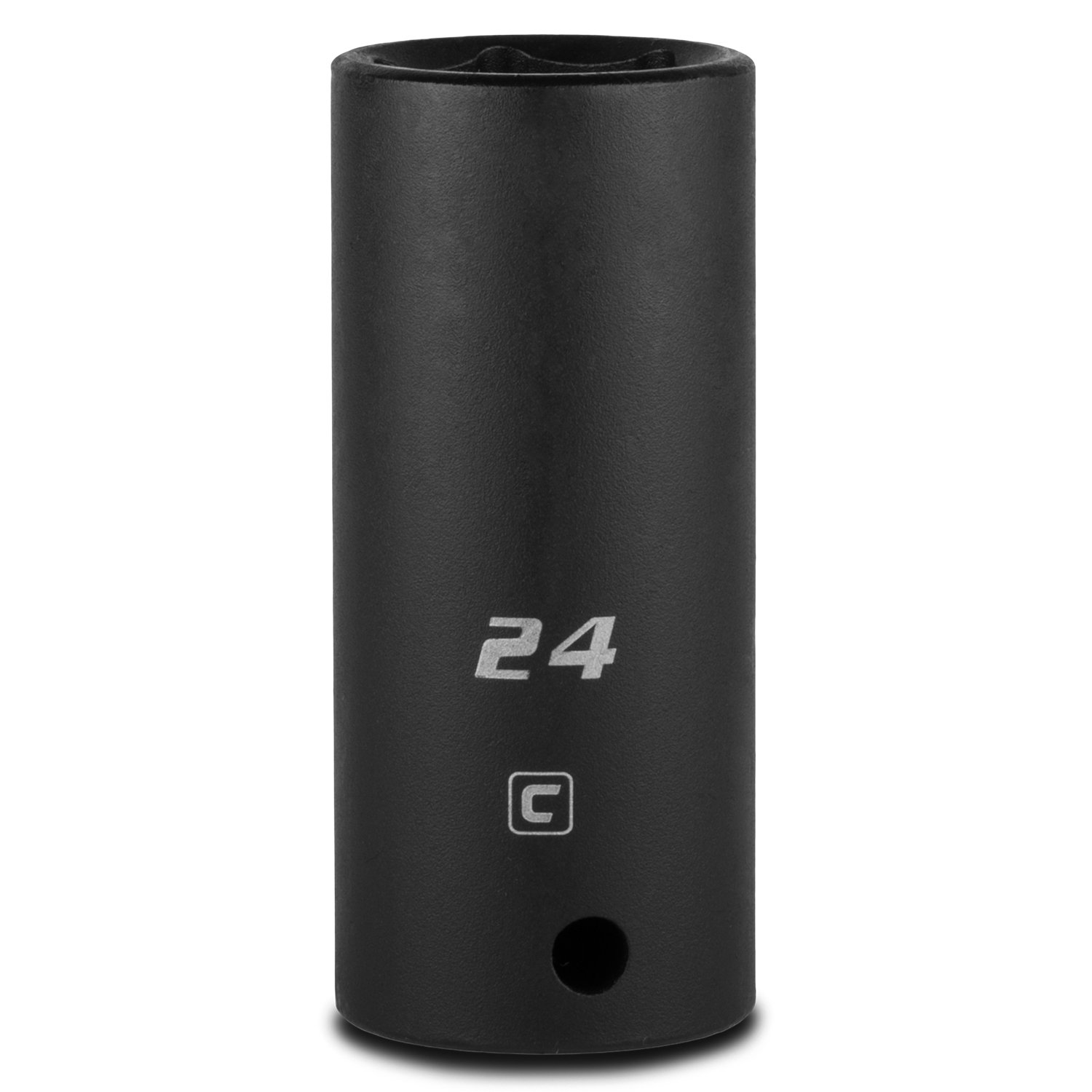
Capri Tools has built a reputation for offering professional-grade impact sockets at prices that undercut most competitors, and the 5-5224 in 24 mm is a strong example of that philosophy. The socket is forged from Chrome Molybdenum steel — a material choice typically reserved for higher-end impact tools — and treated with a proprietary heat treatment process designed to maximize torque capacity without introducing brittleness. The manganese phosphate coating provides superior corrosion protection compared to standard black oxide finishes.
The standout feature here is the WaveDrive internal geometry, which uses a curved contact surface to grip the fastener more tightly than a standard 6-point broach. This design reduces the risk of rounding worn or soft fasteners and distributes load more evenly across the engagement area. Owners consistently describe the build quality as sturdy and confidence-inspiring, with thick walls that hold up well under repeated impact use. The socket is also fully compatible with 1/2-inch drive impact wrenches.
Some users note that the lack of laser-etched size markings means the size is stamped on the side, which can wear over time with heavy use. The chromium-molybdenum construction and WaveDrive geometry make this a compelling choice for anyone who wants impact-rated toughness without paying premium prices. For general automotive work — suspension, brakes, and engine bay fasteners — this socket offers a strong blend of durability and fastener protection.
What works
- Chrome Molybdenum steel with proprietary heat treatment handles high torque
- WaveDrive design reduces fastener rounding
- Manganese phosphate coating resists rust and corrosion
What doesn’t
- Stamped size markings may fade with heavy use
- Limited to 1/2-inch drive only
4. TIGHTSPOT IS38D24MM6-TW Impact Socket
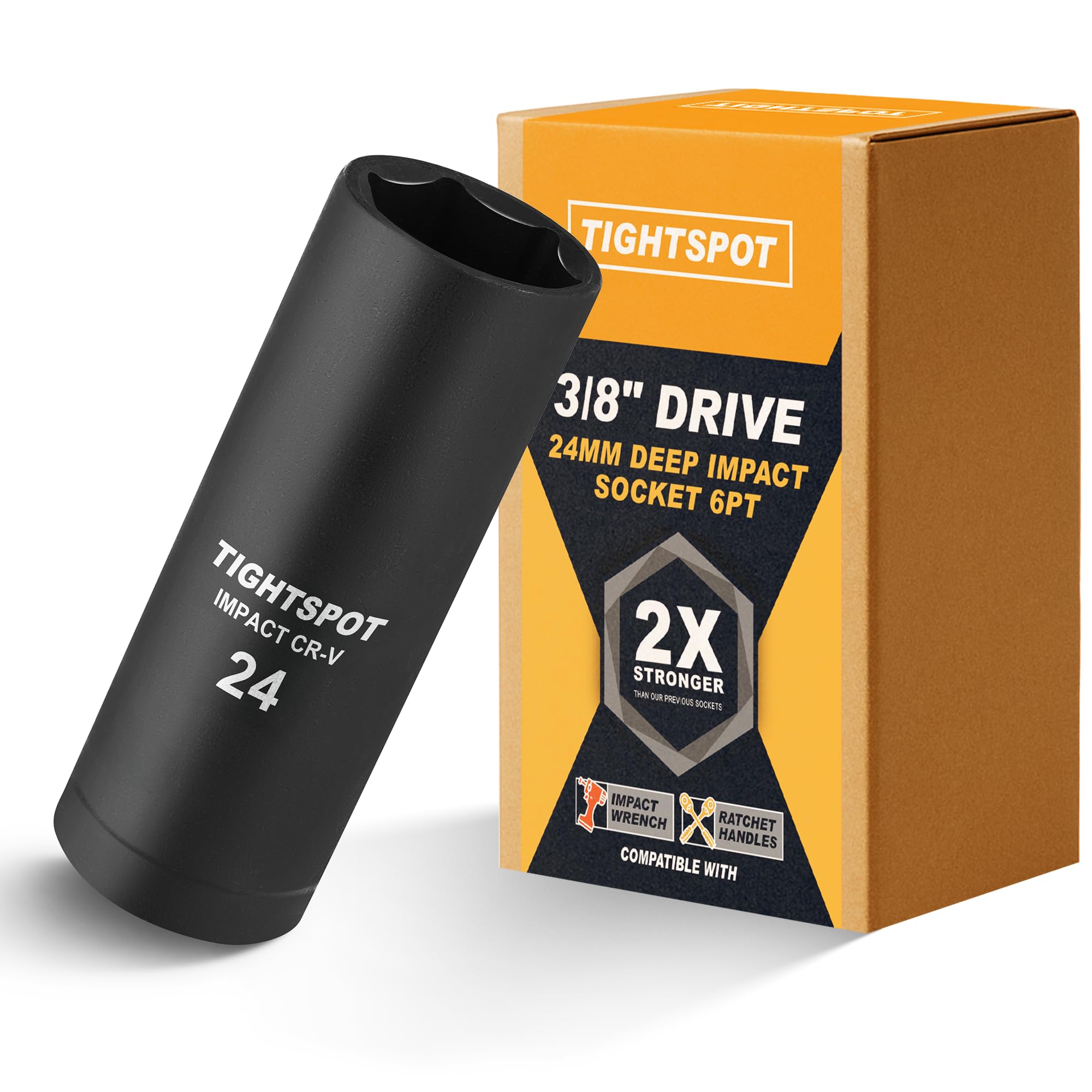
The TIGHTSPOT 24 mm deep impact socket targets a specific need: accessing fasteners in confined spaces where a bulkier 1/2-inch drive socket simply will not fit. Built with a 3/8-inch drive and aerospace-grade Chrome Vanadium steel, it was engineered to maintain high tensile strength while keeping the outer diameter as slim as possible. The manganese phosphate finish provides a corrosion-resistant surface that holds up to impact use better than a painted or plated socket.
The radius corner design shifts contact points away from the fastener corners and onto the flats, reducing the likelihood of rounding even under heavy torque. The chamfered opening helps guide the socket onto the bolt quickly — a small detail that matters when working blind or in awkward positions. Owners report using it successfully on lug nuts, coil spring bolts, and crankshaft applications with impact drivers, noting that it handles torque loads up to 300 ft-lb without issue.
One limitation is the 3/8-inch drive itself: while it offers better access, it may not be suitable for the highest-torque impact wrenches rated for 1/2-inch drive tools. The dual labeling — laser marked and permanently stamped — ensures the size remains readable even after years of service. For mechanics who frequently work in tight engine bays or suspension cavities, this socket provides a smart balance of reach, strength, and cost.
What works
- Compact 3/8-inch drive fits tight spaces where 1/2-inch sockets won’t
- Radius corner design protects fasteners from rounding
- Dual labeling (laser + stamped) ensures long-term readability
What doesn’t
- 3/8-inch drive limits maximum torque compared to 1/2-inch drive
- Not as deep as some 6-inch extended-length sockets
5. FOCMKEAS 24mm Deep Impact Socket
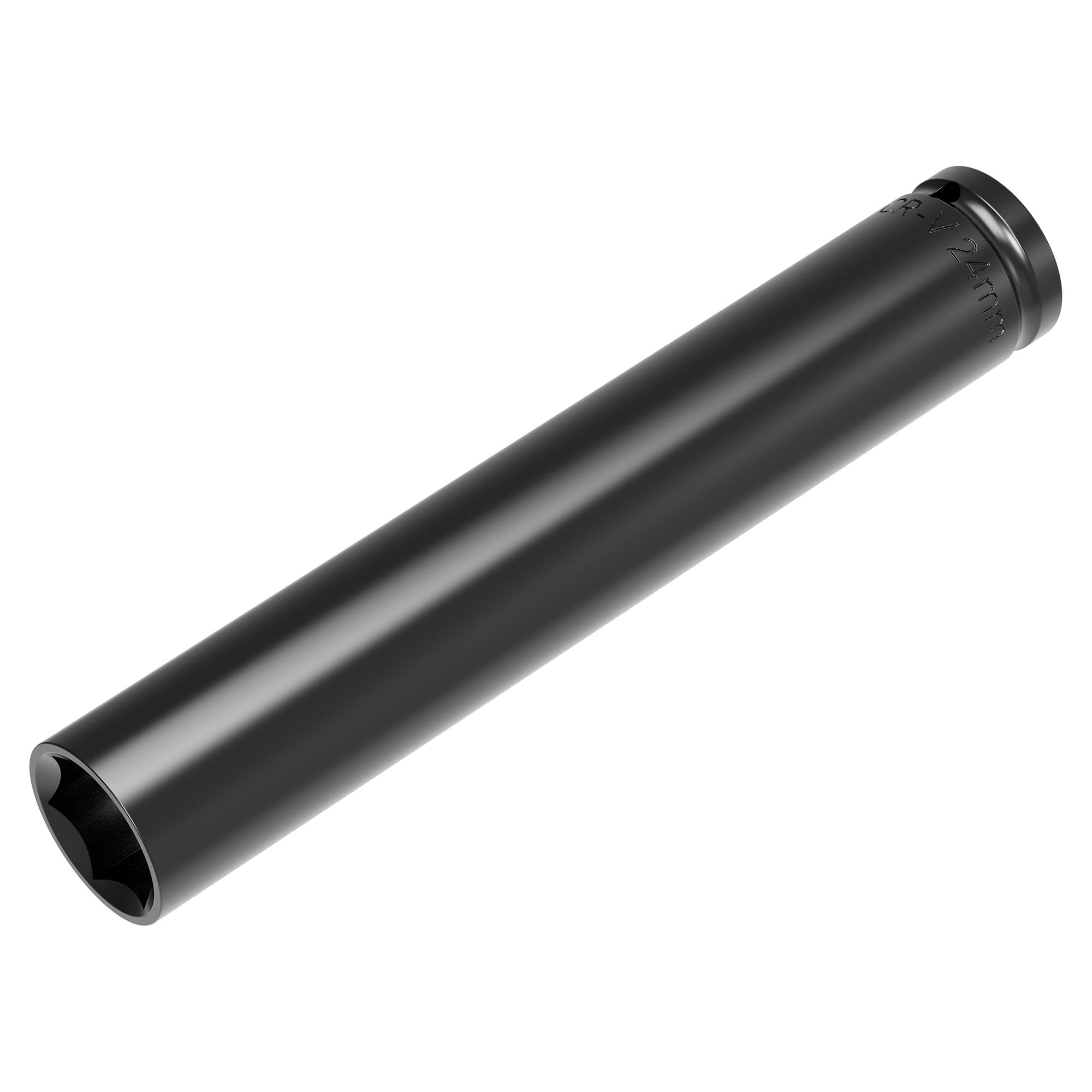
The FOCMKEAS 24 mm deep impact socket stands out primarily for its extended length — a full 6 inches from drive end to broach opening. This extra reach is critical for accessing recessed fasteners, such as harmonic balancer bolts on deep-set pulleys or suspension bolts buried within control arm pockets. The socket is forged from heat-treated Chrome Vanadium steel with an electrophoresis finish that provides consistent rust and corrosion protection.
The radius corner design is employed here as well, placing force on the fastener walls rather than the corners to improve torque transfer and reduce wear. A pinhole at the base allows for use with a locking pin for added security during high-torque applications. Owners report using it successfully on harmonic balancer bolts, tie rod ends, and lug nuts, noting that the extra length eliminates the need for a separate extension bar in many situations. The precision fit is consistently praised, with users confirming dead-on size accuracy.
At this price point, the trade-off is that the socket is made from Chrome Vanadium rather than the more impact-resistant Chrome Molybdenum found in some competitors. For most automotive work, CR-V offers sufficient strength, but professionals who regularly hammer on fasteners at the upper torque limits may want to step up to a CR-Mo option. The 1/2-inch drive and 6-inch length make this a versatile addition for anyone who needs extra reach without stacking extension bars.
What works
- 6-inch length provides extended reach for recessed fasteners
- Radius corner design reduces fastener wear
- Pinhole base accepts locking pin for secure high-torque use
What doesn’t
- Chrome Vanadium steel is less impact-resistant than Chrome Molybdenum
- Painted finish may wear faster than manganese phosphate coatings
Hardware & Specs Guide
Chrome Vanadium vs Chrome Molybdenum Steel
The material choice in a deep socket directly impacts its torque ceiling and durability. Chrome Vanadium (CR-V) is the industry standard for impact sockets because it offers a strong balance of tensile strength and flexibility at a reasonable cost. It performs well under most automotive conditions and is what the majority of mid-range sockets use. Chrome Molybdenum (CR-Mo) is a tougher alloy that absorbs higher peak loads without fracturing, making it the preferred material for professional and heavy-use impact sockets. CR-Mo sockets typically cost more but offer a wider safety margin when breaking loose rusted or overtightened fasteners. For a 24 mm socket, which often sees use on crankshaft and suspension bolts with high torque values, CR-Mo provides additional peace of mind.
Impact vs Chrome Sockets
Impact sockets are designed with thicker wall sections and are made from more ductile steel alloys to withstand the repeated shock loads of an impact wrench. They typically have a black oxide or manganese phosphate finish rather than a chrome plating, which can chip or crack under impact forces. Chrome sockets are intended for hand-tool use with ratchets and breaker bars. Using a chrome socket on an impact wrench can cause the socket to shatter, sending sharp fragments flying. All five sockets reviewed here are impact-rated or built to impact-grade specifications, which is the appropriate choice for a 24 mm deep socket given the high-torque applications it serves.
FAQ
What is the difference between a deep socket and a standard socket?
Can I use a 24 mm deep socket for lug nuts?
What does 6-point mean on a socket?
Final Thoughts: The Verdict
For most buyers, the best 24 mm deep socket winner is the Williams JHWBMD-624 because it combines premium US-made construction with SUPERTORQUE geometry that protects fasteners while delivering reliable torque transfer. If you need a specialized tool for GM LS engine work, grab the Sunluway 77070 with its counter-weighted design that makes stubborn crank bolts manageable. And for tight-access applications where a compact 3/8-inch drive is essential, nothing beats the TIGHTSPOT for balancing strength with a slim profile at a reasonable cost.

Certification: BSc in Mechanical Engineering
Education: Mechanical engineer
Lives In: 539 W Commerce St, Dallas, TX 75208, USA
Md Amir is an auto mechanic student and writer with over half a decade of experience in the automotive field. He has worked with top automotive brands such as Lexus, Quantum, and also owns two automotive blogs autocarneed.com and taxiwiz.com.