The jump from a factory stereo to a modern MP3 solution changes how you experience every drive, but the market is flooded with adapters that cut out, charge slowly, or sound hollow. Sorting signal stability from marketing hype requires a sharp eye on the chipset, the noise-cancellation circuitry, and the charging architecture — details most shoppers overlook until after the return window closes.
I’m Amir — the founder and writer behind Four Wheel Ask. I specialize in analyzing automotive audio specifications, comparing build quality across brands, and aggregating real owner feedback to identify the most reliable options on the market.
After carefully analyzing hundreds of owner reviews and comparing every spec from Bluetooth version to charging speed, I’ve found the models that earn the best car mp3 player title.
How To Choose The Best Car MP3 Player
Every adapter in this category performs the same basic job — pipe audio from your phone into your car’s speakers — but the execution varies wildly. Three factors separate the daily-driver winners from the frustration-inducing also-rans.
Bluetooth Version and Connection Stability
Newer Bluetooth revisions (5.3 and 5.4) bring lower latency, better coexistence with other wireless signals in the car, and faster reconnection when you re-enter the vehicle. A unit stuck on Bluetooth 5.0 can still work fine in open environments, but parked next to a dashcam or a second phone, you may hear stuttering or dropouts. Version alone doesn’t guarantee quality — the antenna design and chipset integration matter just as much — but it is the single most reliable spec to cross-reference against owner complaints about intermittent audio.
Noise Cancellation and Audio Processing
CVC (Clear Voice Capture) and DSP (Digital Signal Processing) are not marketing buzzwords when you take a call at 110 km/h. CVC 8.0 targets echo and wind rumble specifically, while DSP adjusts the audio envelope to suppress road and engine noise. Units that lack both will leave the person on the other end asking you to repeat yourself. For pure music listening, look for adapters that offer treble and bass adjustment — a feature often buried in the fine print but transformative for older car speakers that lack tonal balance.
Charging Architecture and Power Delivery
A car MP3 adapter that occupies your sole 12V port and delivers only trickle-charge current will leave your phone’s battery lower at the end of a long trip than when you started. Units with a dedicated USB-C PD (Power Delivery) port can push up to 30 watts, enough to fast-charge modern iPhones and Android flagships. The secondary USB-A port should support QC 3.0 at minimum. Avoid adapters that split a fixed total wattage between two ports — check that each port can deliver its rated output simultaneously.
Quick Comparison
On smaller screens, swipe sideways to see the full table.
| Model | Category | Best For | Key Spec | Amazon |
|---|---|---|---|---|
| Nulaxy 5.3 Car Adapter | FM Transmitter | Sound Quality | BT 5.3 / DSP+CVC / Vent Mount / QC3.0+PD | Amazon |
| LENCENT BT 5.4 Transmitter | FM Transmitter | Fast Charging | BT 5.4 / 48W (PD 30W) / 7-Color Light / CVC | Amazon |
| Nulaxy KM18 BT 5.4 | FM Transmitter | Visual Clarity | BT 5.4 / 1.44″ LCD / Gooseneck / AUX+TF | Amazon |
| ONN 2026 FM Transmitter | FM Transmitter | Budget LCD Display | BT 5.0 / 1.44″ LCD / Gooseneck / Dual USB | Amazon |
| COMSOON BT Receiver | AUX Adapter | AUX-Only Systems | BT 5.0 / CVC 8.0 / 16H Battery / Type-C | Amazon |
In‑Depth Reviews
1. Nulaxy Bluetooth 5.3 Car Adapter

The Nulaxy 5.3 adapter stands apart largely because of its vent-mount design, which lifts the screen and controls to eye level — a meaningful safety upgrade over units that dangle from the cigarette lighter. More importantly, it pairs Bluetooth 5.3 with dedicated DSP and CVC noise-cancellation processing, a combination that effectively filters out tire drone and wind buffeting during calls. Owner feedback consistently highlights the call clarity as the primary reason for choosing this unit over cheaper alternatives, and the treble-and-bass adjustment knobs let you tailor the output to match your car’s speaker character.
Charging is handled by an 18-watt QC 3.0 Type-A port and a 20-watt PD Type-C port, a split that provides genuine fast charging for two devices simultaneously rather than sharing a fixed power budget. The retractable cord extends to just over 51 inches, giving plenty of slack for rear-seat passengers. The atmosphere light can be switched off via a long press, a small but thoughtful detail for drivers who prefer a dark cabin at night.
Where the Nulaxy 5.3 falls short is the lack of a physical AUX input — it relies entirely on FM transmission, which can be susceptible to local radio interference in dense urban areas. Additionally, the vent clip is designed for horizontal slats; vertical vents may require a third-party mount adapter for a secure fit.
What works
- Exceptional DSP/CVC noise cancellation keeps calls clear at highway speeds
- Treble and bass knobs let you dial in the sound signature
- Vent-mount placement improves visibility and reduces cable clutter
What doesn’t
- No AUX input — FM-only output can pick up interference in crowded radio markets
- Vent clip does not fit vertical slats securely without an adapter
2. LENCENT Bluetooth 5.4 FM Transmitter

LENCENT’s latest transmitter leapfrogs the competition with Bluetooth 5.4, which delivers faster pairing and a notably more stable connection in RF-congested environments. The real headline, however, is the 48-watt total charging capacity split between a 30-watt PD USB-C port and an 18-watt QC 3.0 USB-A port — enough to fast-charge a laptop-grade tablet alongside a flagship smartphone without either port throttling. The unit also features CVC noise reduction on the microphone, and owner reports confirm that call recipients hear minimal road interference even with the windows down.
Audio playback supports three modes: Bluetooth streaming, TF card (up to 64 GB), and USB drive (up to 64 GB) with compatibility for WMA, MP3, WAV, APE, and FLAC formats. The inclusion of lossless codec support matters for listeners who keep a local library of high-bit-rate files rather than relying on streaming compression. The seven-color LED ambient lighting can be cycled or turned off completely, and the raised button design makes tactile control easy without glancing down from the road.
The main trade-off is the lack of an AUX input — this unit is FM-only, which means you need an empty FM frequency and are vulnerable to overlap from strong local stations. Additionally, the 48-watt rating is a cumulative maximum; simultaneous high-drain charging on both ports can cause the adapter to warm up significantly during extended use.
What works
- Bluetooth 5.4 provides class-leading connection stability and low latency
- 48-watt total charging with dedicated PD 30W and QC 18W ports
- Supports FLAC and APE lossless audio from USB and TF card
What doesn’t
- FM-only output — no AUX passthrough for interference-free sound
- Unit can run warm under sustained dual-port high-current charging
3. Nulaxy KM18 Bluetooth 5.4 Car Adapter

The KM18 is Nulaxy’s mid-range offering that brings Bluetooth 5.4 to a price point typically occupied by 5.0 and 5.1 adapters. The 1.44-inch LCD display is genuinely useful — it shows the FM frequency, incoming caller ID, car battery voltage, and music track information in a bright, legible font. The gooseneck arm is fully rotatable, letting you angle the screen toward the driver without fighting a fixed orientation. This is the only adapter in the mid-range tier that offers the latest Bluetooth revision alongside a physical display, making it a strong candidate for drivers who want modern connectivity without moving to a premium price bracket.
Noise cancellation is present but uses Nulaxy’s proprietary filtering rather than the dedicated CVC 8.0 chip found in the more expensive 5.3 model. Owner feedback indicates that call clarity is good at city speeds but begins to degrade above 100 km/h, which is consistent with a software-based noise gate rather than a hardware DSP solution. Music streaming via FM sounds clean on an open frequency, and the included AUX cable provides a wired fallback for environments where FM interference is problematic.
Charging is handled by a single USB-A fast-charge port — adequate for one device but a limitation for households with multiple phones. The voltage display is a nice bonus for monitoring alternator health, though it only updates when the adapter is powered on.
What works
- Bluetooth 5.4 at a price point that undercuts most competitors
- 1.44-inch LCD with battery voltage readout is genuinely useful
- Gooseneck design allows precise screen positioning
What doesn’t
- Single USB charging port limits multi-device convenience
- Noise cancellation software-based; call clarity drops at highway speeds
4. ONN Upgraded 2026 Bluetooth Car FM Transmitter
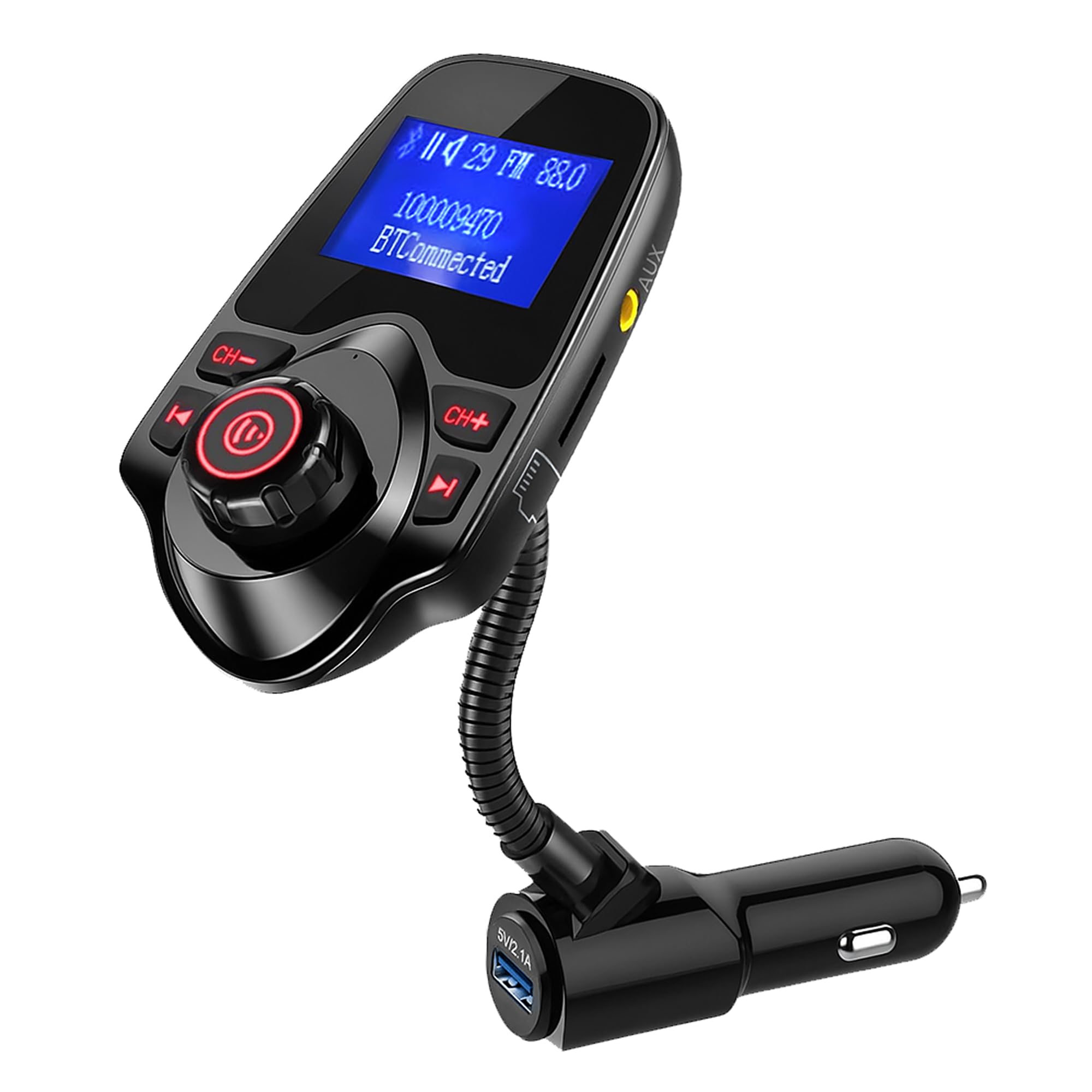
ONN’s 2026 revision brings a 1.44-inch LCD screen and a flexible gooseneck to the entry-level price tier, features that were previously reserved for more expensive models. The display shows incoming caller ID, FM frequency, and battery voltage in a clean layout, and the rotatable neck makes it easy to find a clear sightline without straining. Bluetooth 5.0 is the connectivity standard here — not the latest revision, but adequate for music streaming and hands-free calling in most driving environments.
The upgraded noise-suppression technology reduces static and road noise to a degree, but owner reports indicate it is not as effective as the dedicated CVC 8.0 or DSP chips found in the mid-range and premium units. Call quality is acceptable for short conversations in city traffic but requires raised voices at highway speeds. Dual USB ports support simultaneous fast charging for two devices, which is a surprising convenience at this price point and a direct advantage over single-port competitors in the same budget bracket.
Build quality is typical ABS plastic with a functional rather than premium feel. The gooseneck holds position well but the display is not as bright as the Nulaxy KM18, making it harder to read in direct sunlight. The lack of an AUX input means you are locked into FM transmission with its inherent signal variability.
What works
- Large 1.44-inch LCD with gooseneck at an entry-level price
- Dual USB ports for simultaneous device charging
- Bluetooth 5.0 provides stable basic connectivity
What doesn’t
- Noise suppression struggles at highway speeds
- Display brightness insufficient for direct sunlight readability
- No AUX input — FM-only with no wired backup
5. COMSOON Bluetooth Receiver for Car

The COMSOON takes a fundamentally different approach from the FM transmitters above — it is a Bluetooth-to-AUX receiver that plugs into your car’s 3.5 mm auxiliary input rather than broadcasting over radio frequencies. This avoids FM interference entirely and delivers clean, wired-quality audio to any stereo with an AUX jack. The unit is powered by a built-in lithium-ion battery rated for 16 hours of continuous playback, and it charges via USB-C in roughly 2.5 hours. It can also be used while charging, effectively turning it into a permanently wired adapter if you have a spare USB port nearby.
CVC 8.0 noise cancellation and a Digital Signal Processor handle call quality, and owner feedback confirms this is one of the best-performing sub-compact adapters for voice clarity. The built-in microphone picks up the driver’s voice clearly without requiring a separate mic unit. Dual-device pairing lets you stay connected to your phone for calls while a passenger streams music from a tablet, and the auto-reconnect feature links back to the last paired device as soon as it comes within range.
The obvious limitation is the dependency on a 3.5 mm AUX input — many vehicles produced after 2018 have eliminated the auxiliary jack entirely. Additionally, the device is a dongle that sits in your center console or cup holder rather than integrating into the dashboard, so it can slide around during hard cornering. There is no FM backup option, so cars without AUX are simply incompatible.
What works
- AUX connection delivers pure audio with zero FM interference
- CVC 8.0 and DSP provide outstanding call clarity for the size
- 16-hour battery life covers multiple days of commuting between charges
What doesn’t
- Requires a 3.5 mm AUX input — incompatible with many modern vehicles
- Loose dongle form factor slides around without a dedicated mount
Hardware & Specs Guide
Bluetooth Technology
Bluetooth 5.0 remains the baseline across most budget adapters, offering sufficient range and data rate for compressed music streaming. Bluetooth 5.3 and 5.4 introduce LE Audio, improved coexistence with Wi-Fi and other wireless devices inside the cabin, and lower latency for video playback. The practical difference: 5.0 units occasionally stutter when the phone is in a back pocket or bag; 5.3 and 5.4 units maintain a solid lock even with the phone in the trunk.
Noise Cancellation
CVC (Clear Voice Capture) 8.0 is a hardware-based noise suppression technology that actively filters wind, engine drone, and tire hum from the microphone input. DSP (Digital Signal Processing) works in tandem to clean up the audio envelope before it hits the speaker. Units that advertise “noise reduction” without specifying CVC or DSP are typically using a software gate that cuts out when ambient noise crosses a threshold — acceptable in quiet conditions but unreliable at highway speeds.
FM Transmission
FM transmitters modulate your audio onto an unused radio frequency that your car’s head unit picks up. The key variable is the transmitter’s output strength and the quality of its antenna. Strong transmitters hold a clean signal for 10–15 meters; weaker units break up as soon as you drive past a broadcast tower. The best strategy is to select a frequency at the extreme low or high end of the dial (88.1 or 107.9) where fewer licensed stations compete for space.
Power Delivery
USB Power Delivery (PD) and Qualcomm Quick Charge (QC) are the two dominant fast-charging standards in this category. PD 30 watts can replenish a modern iPhone or Samsung Galaxy from empty to 50 percent in roughly 30 minutes. QC 3.0 at 18 watts is slower but still meaningful. The critical spec to check is whether the adapter’s two ports share a single power controller — shared controllers drop to 5 watts per port when both are active — or if each port has an independent regulator that maintains full rated output.
FAQ
Will an FM transmitter work in any car?
What is the difference between Bluetooth 5.0 and 5.4 for car audio?
Can I use a car MP3 player while charging my phone at the same time?
Why does my FM transmitter sound worse in the city than on the highway?
Final Thoughts: The Verdict
For most buyers, the car mp3 player winner is the Nulaxy Bluetooth 5.3 Car Adapter because it combines genuine DSP/CVC noise cancellation, vent-mount ergonomics, and dual fast-charging ports at a price that undercuts premium alternatives. If you need the highest possible charging speed and the latest Bluetooth 5.4 standard, grab the LENCENT Bluetooth 5.4 FM Transmitter. And for vehicles with an AUX input where audio purity matters more than FM convenience, nothing beats the COMSOON Bluetooth Receiver.

Certification: BSc in Mechanical Engineering
Education: Mechanical engineer
Lives In: 539 W Commerce St, Dallas, TX 75208, USA
Md Amir is an auto mechanic student and writer with over half a decade of experience in the automotive field. He has worked with top automotive brands such as Lexus, Quantum, and also owns two automotive blogs autocarneed.com and taxiwiz.com.