Factory air conditioning systems in older vehicles, work trucks, or budget trims often fall short when the mercury climbs. An auxiliary fan delivers targeted airflow directly where it is needed most — rear passengers, pets, or a restless baby — without draining the alternator like a portable AC unit. Choosing the wrong one means dealing with flimsy clips, noisy motors, or cords that barely reach the socket.
I’m Amir — the founder and writer behind Four Wheel Ask. My approach combines deep analysis of product specifications, build quality assessments, and aggregation of verified owner feedback to identify which automotive accessories actually hold up over time.
After deep analysis of owner feedback and specs, I’ve identified the best electric fan automotive solutions that truly deliver for every driving need.
How To Choose The Best Electric Fan Automotive
Not all auxiliary vehicle fans deliver the same performance. The right choice depends on your vehicle type, power source preference, and the specific comfort needs of your passengers. Below are the three critical factors I evaluate before recommending any model.
Power Source and Cord Length
The power delivery method dictates where and how you install the fan. Cigarette lighter plugs (12V) draw directly from the vehicle electrical system and typically offer higher airflow, but the cord length determines placement flexibility. USB-powered fans work with any modern vehicle but top out at lower wattage, making them better for gentle circulation than heavy cooling. Rechargeable battery fans eliminate cord clutter but require periodic charging and add weight. Measure the distance from your intended mount location to the nearest power source before committing to a model.
Mounting System and Build Quality
A fan that rattles loose on the first pothole is worthless. Headrest clamps should use locking knobs rather than spring tension alone. Clip-on designs need rubber-lined jaws to avoid scratching seat posts or headrest bars. Inspect the pivot joints — plastic-on-plastic friction hinges wear out faster than those with metal inserts or ratcheting mechanisms. A sturdy clamp paired with a reinforced mount separates a one-season accessory from a multi-year tool.
Blade Size, Motor Type, and Noise
Blade diameter directly correlates with airflow volume. Four-inch fans work well for direct personal cooling in the backseat, while six-inch models can push air across an entire row. Brushless DC motors run quieter and last longer than brushed variants, though both introduce some whine at higher speeds. Check the noise rating: anything above 50 dB is noticeable during highway driving, while fans under 30 dB blend into road noise. Stepless speed regulators offer finer control than fixed-speed switches, letting you dial in the perfect balance between airflow and sound.
Quick Comparison
On smaller screens, swipe sideways to see the full table.
| Model | Category | Best For | Key Spec | Amazon |
|---|---|---|---|---|
| TRILINK Clip Fan | Rechargeable | Versatile cordless use | 8000mAh battery | Amazon |
| Hynoo Dual Head | 12V Dual | Durable rear-seat cooling | 2.5m cord | Amazon |
| XOOL 6-Inch | 12V Single | Max single-zone airflow | 6-inch blade | Amazon |
| Ouffun Dual USB | USB Dual | Ultra-quiet operation | Sub-20 dB noise | Amazon |
| QIFUN Dual 4-Inch | 12V Dual | Budget-friendly dual fan | Stepless speed dial | Amazon |
In‑Depth Reviews
1. TRILINK Small Clip on Fan with Remote Control

The TRILINK fan breaks away from the traditional 12V cigarette-lighter formula by packing an 8000mAh battery into a compact clip-on chassis. This cordless freedom means you can mount it on a baby stroller, a tent beam, a treadmill frame, or your vehicle headrest without routing any wires. The 5-inch blade paired with a brushless DC motor delivers five speed modes, with the top mode simulating oscillation to distribute air across a wider area.
Owner reports consistently praise the runtime — roughly 12 hours on low speed, enough for multiple road trips between charges. The included remote control operates from about 12 feet, making it easy to adjust airflow from the driver seat without fumbling. The LED display shows both battery level and current speed, removing guesswork. USB-C charging adds modern convenience, and the detachable grill simplifies cleaning when dust accumulates after summer use.
The clip base itself feels substantial with rubber-lined jaws that grip securely without scratching surfaces. At 490 grams, it stays put even on bumpy back roads. The 360-degree horizontal and 270-degree vertical rotation covers virtually any angle. Some owners note the remote is line-of-sight and range drops to around 5 feet in bright conditions, but the top-mounted button control provides a reliable backup.
What works
- Long battery life supports multi-day trips without charging
- Remote control adds convenience for driver-side adjustments
- Versatile mounting options beyond just vehicle use
What doesn’t
- Remote requires direct line-of-sight and has limited range
- Not as powerful as 12V wired fans on highest setting
2. Hynoo 12V Car Clip Fan

The Hynoo dual-head fan targets owners who need reliable rear-seat cooling without gimmicks. Each 4-inch head rotates 360 degrees vertically and 180 degrees horizontally, allowing independent directional control for two passengers. The big grip clamp uses a lock knob to tighten around seat headrest bars, and owners report it holds firm even on rough trails and side-by-side vehicles.
At 12V power with a 2.5-meter cigarette lighter cord, this fan reaches from the front socket to any seating row in most SUVs and trucks. The stepless speed dial lets you fine-tune airflow from a whisper to a strong breeze without fixed presets. Owners consistently note the build feels substantial compared to cheaper plastic alternatives, with one reviewer mounting it in a Can-Am side-by-side and reporting zero issues after extended use.
Noise levels are described as a gentle hum that does not disturb sleeping babies, though the fan has enough output to keep a backseat cool under the brutal Las Vegas summer sun. A minor ergonomic complaint involves the fan angle loosening slightly when the tightening knob is not fully torqued. The plug can also slide out of the lighter socket on very rough terrain, though this is manageable with a right-angle adapter or zip-tie retention.
What works
- Durable clamp holds securely on rough terrain
- Long cord provides flexible placement options
- Strong airflow suitable for extreme heat climates
What doesn’t
- Fan angle can drift if knob is not fully tightened
- Plug may disconnect on very bumpy roads
3. XOOL 12V 6-Inch Car Fan

When raw airflow volume matters more than dual-head flexibility, the XOOL 6-inch fan delivers the highest single-zone output in this lineup. The larger blade diameter moves significantly more air than the 4-inch competitors, making it the top choice for cooling an entire row or de-fogging windshield moisture on damp days. The stepless speed regulator provides infinite adjustment rather than preset steps, so you can find the exact airflow level you need.
The 360-degree tilt rotation covers any direction, and the big adjustable clamp fits headrest bars, desk edges, stroller frames, and tent poles. At under 50 dB noise output, it is audible but not intrusive — comparable to a loud conversation or road noise at highway speed. The powder-coated finish resists scratching, and the tight grid design keeps small fingers safe, a thoughtful touch for family vehicles.
Owners who use this fan in work trucks and RV setups report it holds up well over multiple seasons. The 12V cigarette lighter plug is compatible with all standard 12V sockets, though it will not work with 24V truck systems. The single-head design means less flexibility for dual-zone cooling compared to twin-fan models, but the trade-off is simpler installation and fewer moving parts that could fail over time.
What works
- Larger 6-inch blade moves substantially more air
- Stepless speed control offers precise airflow adjustment
- Versatile clamp fits multiple mounting locations
What doesn’t
- Single-head design limits rear-seat zone coverage
- Not compatible with 24V truck electrical systems
4. Ouffun Dual Head USB Vehicle Seat Fan
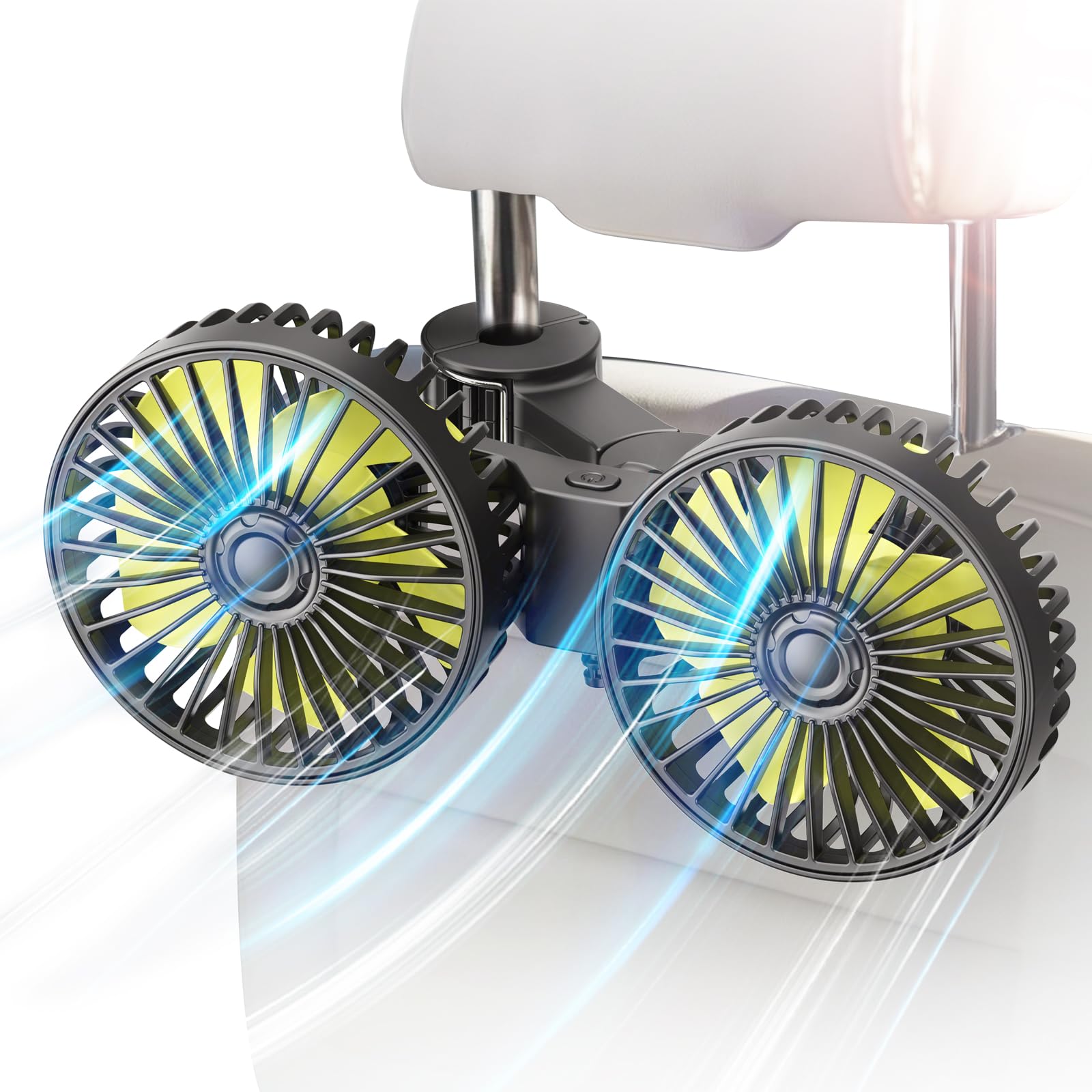
The Ouffun dual-head fan prioritizes near-silent operation with a brushless motor and 100 percent pure copper spindle that keeps noise under 20 dB. At that level, the fan is essentially inaudible over road noise, making it ideal for families with light sleepers or long-distance drivers who prefer a quiet cabin. The 5-blade vortex wind gathering technology produces a steady, consistent airflow rather than the choppy gusts typical of cheaper fans.
Three fixed speed settings offer simple control via touch-sensitive buttons, and the 360-degree adjustable base combined with 120-degree head rotation covers all seating positions. The foldable clip arms allow compact storage when the fan is not in use, and the 70.8-inch USB cable reaches easily to rear USB ports. The universal 5V/2A power requirement works with power banks, laptops, and any vehicle USB port, including both 12V and 24V systems.
Safety is clearly a design priority — the finely crafted grid prevents accidental blade contact, a critical feature for families with curious toddlers. The matte green finish blends into most interior color schemes. The trade-off for quiet operation is lower maximum airflow compared to 12V dual-head fans, so this model works best for gentle circulation rather than heavy cooling in extreme heat. Owners seeking max airflow may need to run it on speed three continuously.
What works
- Essentially silent operation below 20 dB
- Universal USB power works with any vehicle type
- Child-safe grid design prevents finger contact
What doesn’t
- Lower max airflow than 12V dual-head competitors
- Only three fixed speed settings, no stepless control
5. QIFUN 12V Car Fan for Rear Seat

The QIFUN dual-head fan delivers strong rear-seat cooling at a highly accessible price point, making it the gateway option for anyone who has never used an auxiliary vehicle fan. Each 4-inch head rotates 360 degrees independently, and the stepless speed dial provides infinite adjustment rather than fixed presets. The headrest mount secures with a lock knob that owners describe as tight and reliable, holding firm across multiple vehicles including minivans and SUVs.
The 5.87-foot cigarette lighter cord offers generous reach from the center console to third-row seats in most vehicles. Owners with minivans report buying three units to cover all rows, suggesting consistent satisfaction with the cooling output. The fan pulls moisture off the windshield on rainy days and helps eliminate pet odors, smoke, and dust, making it as much an air circulation tool as a cooling device.
Noise is present — owners describe it as noticeable but easily masked by music or conversation. The plastic construction feels durable enough for regular use, though this is not a premium build intended for heavy-duty off-road conditions. The swivel nut at the bottom requires hand tightening during installation, a minor step that ensures the clamp stays secure. For budget-conscious buyers who need dual-zone cooling without frills, this fan punches above its price class.
What works
- Dual heads provide independent rear-seat zone cooling
- Stepless speed dial offers flexible airflow adjustment
- Long power cord reaches third-row seats easily
What doesn’t
- Noticeable motor whine at higher speeds
- Pays for performance rather than premium materials
Hardware & Specs Guide
Blade Size and Airflow
Blade diameter directly determines how much air a fan can move. Four-inch blades work best for direct personal cooling in the backseat, while six-inch models push enough volume to cool an entire row. Dual-head fans split airflow between two zones but each head typically uses 4-inch blades. Matching blade size to your specific use case — personal spot cooling versus full cabin circulation — prevents disappointment.
Power Delivery: 12V vs USB vs Battery
Each power source carries distinct trade-offs. 12V cigarette lighter fans deliver the strongest, most consistent airflow and run indefinitely as long as the vehicle is on, but they add cord clutter. USB fans cap at lower wattage but work in any modern vehicle and can run from power banks. Rechargeable battery fans offer cordless freedom but require planning around charging cycles. For daily commuters with short trips, 12V remains the most reliable choice.
Mounting Systems
A fan is only as good as its mount. Lock-knob clamps that screw tight around headrest bars offer the most security on bumpy roads. Spring-loaded clips are easier to install but can slip over time. Rubber-lined jaws prevent scratching chrome or painted surfaces. Some mounts incorporate foldable arms for compact storage, a useful feature for vehicles with limited cargo space. Look for metal reinforcement at pivot points for long-term durability.
Noise and Motor Type
Brushless DC motors are quieter and last significantly longer than brushed alternatives. Noise levels below 30 dB blend into road noise, while anything above 50 dB is clearly audible. Stepless speed regulation allows you to find the quietest usable setting rather than being locked into noisy high-speed presets. Owners who use fans during baby naps or overnight drives should prioritize sub-30 dB models with brushless motors.
FAQ
Can I use a USB car fan with a 24V truck system?
How do I install a headrest clip fan without scratching my seats?
Will an auxiliary car fan drain my vehicle battery?
What is the best placement for a rear-seat car fan?
Final Thoughts: The Verdict
For most buyers, the best electric fan automotive winner is the TRILINK Clip Fan because it combines cordless flexibility, long battery life, and remote control convenience in a single versatile package. If you need maximum airflow for extreme heat, grab the XOOL 6-Inch Fan. And for near-silent operation in a family vehicle, nothing beats the Ouffun Dual Head Fan.

Certification: BSc in Mechanical Engineering
Education: Mechanical engineer
Lives In: 539 W Commerce St, Dallas, TX 75208, USA
Md Amir is an auto mechanic student and writer with over half a decade of experience in the automotive field. He has worked with top automotive brands such as Lexus, Quantum, and also owns two automotive blogs autocarneed.com and taxiwiz.com.