A lift pad that crumbles after six months or slips under load doesn’t just waste money — it puts vehicles and techs at risk. Between rubber compounds that vary wildly in density, bolt-on pucks for unibody cars, and universal blocks that claim to fit everything, the market is flooded with options that look identical on screen but perform nothing alike under a three-ton truck. The difference between a pad that lasts a decade and one that disintegrates in a year comes down to ply count, material formulation, and whether the mounting geometry actually matches your lift arms.
I’m Amir — the founder and writer behind Four Wheel Ask. I’ve spent years analyzing automotive lift equipment specifications and aggregating owner feedback across garage forums and commercial service facilities to separate durable designs from disposable knockoffs.
Whether you run a busy shop or maintain a personal garage, finding the best auto lift pads requires balancing material durability with exact fitment for your lift and vehicle.
How To Choose The Best Auto Lift Pads
Selecting the right lift pads is a mix of understanding your lift’s mounting pattern, the vehicles you service most often, and the material properties that determine how long a pad will hold its shape under repeated compression. Three factors separate a smart buy from a regret.
Material Matters: Ply, Solid Rubber, and Metal
Standard two-ply molded rubber pads compress and crack within a year in busy shops. Six-ply belted construction — layers of rubber bonded with reinforcing fabric — resists tearing and maintains thickness under load far longer. Solid natural rubber blocks offer excellent vibration damping and grip but add weight and can be overkill for lighter cars. Billet aluminum pucks, typically used for unibody sport cars, provide zero-compression lift points but require precise vehicle-specific fitment and stay permanently mounted.
Mounting Pattern and Shape
Most two-post lifts use a standard 3-3/4-inch mounting hole center spacing, but some European or older American lifts vary. Always measure your existing pad’s bolt pattern before ordering replacements. Octagon and square pads increase surface contact area for heavier vehicles, while round pads suit specific lift arm designs. Slip-on pads offer quick installation but can rotate under load if the rubber isn’t dense enough to grip the arm.
Load Ratings and Safety Margins
A pad rated for 3,000 pounds per pair might be adequate for a compact sedan but dangerous for a full-size SUV approaching 7,000 pounds. Look for pads that specify per-pad load capacity and aim for at least 1.5 times your heaviest vehicle’s corner weight. Thickness matters too — pads thinner than 3/8 inch under load risk metal-on-metal contact between the lift arm and the vehicle’s frame rail.
Quick Comparison
On smaller screens, swipe sideways to see the full table.
| Model | Category | Best For | Key Spec | Amazon |
|---|---|---|---|---|
| Auto Lift Parts 6-Ply | Replacement Pad | Busy shops needing durable 2-post lift pads | 5″ octagon, 6-ply belted rubber | Amazon |
| Racewill Solid Rubber Block | Spacer Pad | Extra lift height on 4-post lifts and jacks | 6.3″x4.75″x1″, 1800lb per pad | Amazon |
| ADTOPI Billet Aluminum Pucks | Jack Puck | Corvette, Porsche unibody protection | CNC billet aluminum, 4-pack | Amazon |
| Bolaxin Round Slip-On | Slip-On Pad | Bendpak and Dannmar lift owners | 5″ round, hard rubber slip-on | Amazon |
| OULEME Curved Leveler | Trailer Lifter | Tandem axle RV and trailer tire changes | 6″ lift, 35,000lb capacity, 2-pack | Amazon |
In-Depth Reviews
1. Auto Lift Parts Ultra Heavy Duty 6-Ply Rubber Arm Pads

This set of four octagon replacement pads uses six-ply belted rubber construction — three times the reinforcement of standard two-ply molded pads. The cross-section reveals distinct fabric layers that resist the compression set and edge tearing that destroy cheaper alternatives within a year of daily use. At 5 inches square with 3/8-inch maintained thickness under load, these pads provide a stable, non-slip grip point that protects vehicle frame rails from damage while keeping the lift arm securely positioned.
Compatibility spans Forward, Gemini, Eagle, Worth, American, Grand, and Tuxedo TP11KACD two-post lifts using the standard 3-3/4-inch mounting hole centers. The set arrives with all bolts, washers, and fasteners needed for same-day installation — no hardware store runs required. The die-cut octagon shape increases surface contact area compared to round pads, distributing weight more evenly across the lifting point for heavier trucks and SUVs.
Owner reports consistently highlight the visible ply layers as proof of quality, with many noting these pads outlasted three sets of molded rubber pads on the same lift. The Made in USA manufacturing adds confidence in material consistency, and the team behind the product has over five decades of collective experience with automotive lifts, providing technical support that generic resellers cannot match.
What works
- Six-ply belted construction resists compression and tearing far longer than molded pads
- Hardware included for immediate installation on most major two-post lift brands
- Octagon shape increases contact area for heavier vehicles
What doesn’t
- Belted rubber is stiffer than soft molded pads, offering less deformation to match curved frame rails
- Not compatible with slip-on or round pad lift arm designs
2. Racewill 4 Pack Solid Rubber Auto Lift Pads
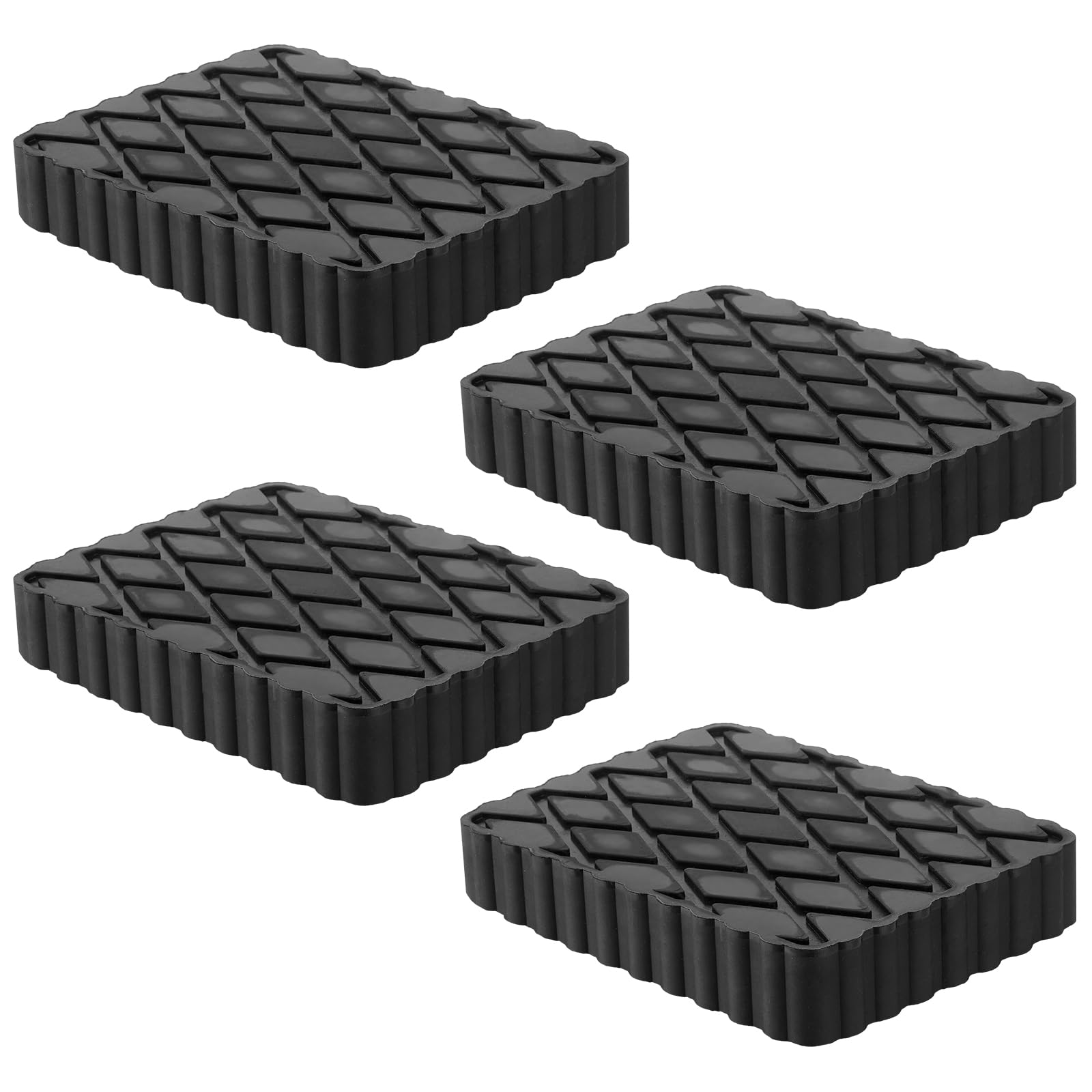
These solid natural rubber blocks measure 6-1/3 inches by 4-3/4 inches by 1 inch thick, offering a full inch of lift height that helps clear low-profile jacks and provides extra clearance for suspension components during service. The diamond-pattern surface on one side delivers aggressive grip against the vehicle’s frame rail, while the smooth reverse side reduces uneven pressure points that can dent or scratch underbody coatings on lighter vehicles.
Each pad supports up to 1,800 pounds, meaning a set of four can handle vehicles in the 7,000-pound range comfortably. The solid rubber formulation provides excellent vibration damping and won’t delaminate like belted pads can if the edges are cut during installation. These blocks work well on four-post lifts, rolling jacks, and underground lift systems where a stable spacer is needed rather than a permanent replacement pad.
The weight of this set — over 6.5 pounds — reflects the dense rubber compound used. Owners using them as risers on four-post lifts report that the natural rubber grips the lift platform without sliding and does not mark or stain the vehicle’s undercarriage. The 1-inch thickness is sufficient for most clearance needs, though lowered vehicles may still require a shallower approach angle when driving onto the blocks.
What works
- Solid natural rubber construction eliminates delamination risk
- Diamond anti-slip surface and smooth side offer dual-use flexibility
- High per-pad load capacity suits SUVs and light trucks
What doesn’t
- Not a direct replacement for two-post lift arm pads — designed as spacer blocks
- 1-inch thickness may be too tall for some low-rise lifts
3. ADTOPI Billet Aluminum Jack Pucks for Corvette and Porsche
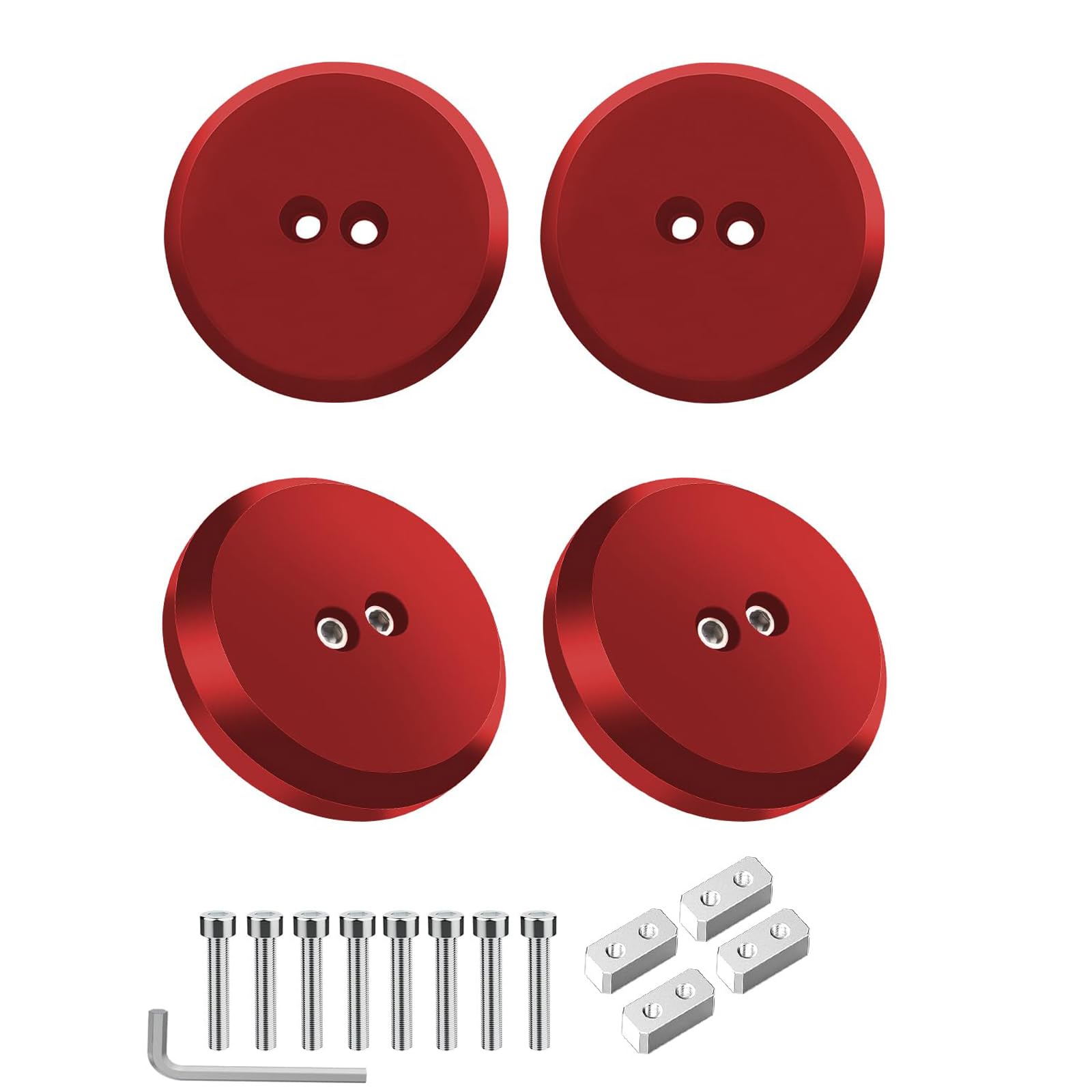
These CNC-machined billet aluminum pucks are designed specifically for the unibody pinch welds on Chevrolet Corvette C5 through C8 models, including Z06 and Grand Sport trims, as well as Porsche 944, 964, 993, 996, 997, 911, Boxster, and Cayman variants. The aluminum construction provides zero-compression lift points, meaning the puck does not deform under load — critical for protecting fiberglass and carbon fiber rocker panels that crack under point pressure from a standard floor jack saddle.
Each puck measures 2.94 inches in diameter and 0.62 inches thick, with beveled edges designed to prevent snagging on the ground in lowered vehicles. The bolt-on design allows permanent installation, eliminating the need to fish for the correct lift point every time the car goes on a jack or lift. A full set of four pucks with mounting hardware installs in about 20 minutes using basic hand tools.
The 2-year warranty and 4,000-pound load capacity reflect confidence in the billet aluminum structure. Owners of lowered Corvettes consistently note that the beveled edge clears speed bumps and driveway transitions without scraping, while the anodized red finish resists corrosion. The primary trade-off is that these pucks remain on the car at all times, which some owners find visually intrusive, and they are not compatible with vehicles that lack a defined pinch weld lift point.
What works
- Zero-compression billet aluminum protects fragile composite rocker panels
- Beveled edges prevent ground snagging on lowered suspensions
- Permanent bolt-on installation eliminates lift point guesswork
What doesn’t
- Requires one-time installation and remains visible on the vehicle
- Vehicle-specific fitment limits use to compatible Corvette and Porsche models only
4. Bolaxin Round Rubber Arm Pads for Bendpak and Dannmar Lifts

This set of four round rubber pads uses a slip-on design that fits over the existing lift arm without requiring any bolts or hardware. They are specifically shaped for Bendpak and Dannmar two-post lifts and rolling bridge jacks on four-post lifts, making them a direct replacement for OEM pads on those platforms. The hard rubber compound exceeds OEM specifications according to the manufacturer, offering a denser material that resists deformation better than the softer originals.
Each pad measures approximately 5 inches in diameter, matching the round arm design found on many Bendpak and Dannmar models across several production years. The slip-on installation takes seconds per pad — no tools, no alignment, no bolt torque — which makes them ideal for quick replacement in a busy shop environment. The 2.2-pound total set weight indicates a dense rubber formulation that stays seated on the arm during lift cycles.
Owner feedback from independent shops and home garage users confirms these pads fit snugly on standard Bendpak arms without excessive play. The rubber does not mark painted frame rails, and the round profile matches the lift point geometry these lifts were designed for. The primary limitation is that the round shape offers less surface contact area than an octagon or square pad, which can be a consideration for heavier vehicles where maximum weight distribution matters.
What works
- Tool-free slip-on installation takes seconds per pad
- Dense hard rubber exceeds OEM Bendpak and Dannmar specifications
- Lightweight set adds minimal weight to lift arms
What doesn’t
- Round shape provides less contact area than octagon or square alternatives
- Limited to lifts with round arm designs — not universal
5. OULEME Curved Leveling Blocks for RV and Trailer Tire Changes

These curved leveling blocks are engineered for a specific high-demand scenario: changing a tire on a tandem axle RV or trailer without needing a separate jack. The curved ramp design allows the user to drive the good tire onto the block, lifting the flat tire by up to 6 inches off the ground — enough clearance to remove and replace the wheel. Each pair supports trailers up to 35,000 pounds gross vehicle weight with tire diameters up to 32 inches.
The blocks are constructed from premium UV-resistant polymers with added anti-aging compounds, addressing the common failure mode of plastic levelers that become brittle after extended sun exposure. The double anti-slip system uses precise gear mesh between the leveler and the included chock, preventing the block from sliding out from under the tire during the tire change process. Thickened rubber non-slip pads on the contact surfaces further enhance grip on both the ground and the tire.
Owner reports from RV owners and trailer fleet operators emphasize the convenience of not needing to pack a separate bottle jack and jack stands for roadside tire changes. The 14.37-pound set weight reflects the robust polymer construction, and the gear mesh design has proven reliable on gravel, asphalt, and concrete surfaces. These blocks are not a substitute for traditional lift pads in a service bay, but they fill a critical gap for mobile or roadside lifting where a floor jack cannot be positioned safely.
What works
- Enables tire changes on tandem axle trailers without a jack
- UV-resistant polymers resist sun damage and maintain structural integrity
- Gear mesh anti-slip design between block and chock prevents sliding
What doesn’t
- Designed specifically for tandem axle trailers — not for standard passenger car lifting
- Heavier than most lift pad options at over 14 pounds per set
Hardware & Specs Guide
Ply Count and Reinforcement
Two-ply molded pads use two layers of rubber with minimal internal reinforcement. These compress and crack within 12 to 18 months in frequent-use settings. Six-ply belted pads integrate multiple fabric layers sandwiched between rubber, resisting compression set and edge tearing. The visible ply cross-section is a reliable indicator of quality — if you cannot see distinct layers, the pad is likely low-density molded rubber with a short service life.
Load Rating Per Pad vs Per Set
Manufacturers sometimes advertise a combined load rating for all four pads, which inflates the perceived capacity. A set rated for 12,000 pounds total is actually 3,000 pounds per pad. Calculate your heaviest vehicle’s gross weight, divide by four, and add a 1.5x safety margin. For a 7,000-pound SUV, each pad should support at least 2,625 pounds — meaning a set rated for 10,500 pounds total or higher.
Mounting Hole Spacing and Bolt Pattern
The standard for most two-post lifts is 3-3/4 inches center-to-center, but brands like Rotary, Challenger, and some older models use different spacing. Measure the distance between the two mounting bolts on your existing pad before ordering replacements. Ordering by lift brand name alone is risky — the same brand often changed hole spacing across production years.
Material Density and Shore Hardness
Softer rubber (Shore A 50-60) conforms better to irregular frame rail shapes but wears faster and can squirm under heavy side loads. Harder rubber (Shore A 70-80) resists deformation and lasts longer but transfers more vibration and may not grip as well on painted or oily surfaces. Billet aluminum offers zero compliance and maximum durability but requires precise fitment and can damage frame rails if the puck shifts during lifting.
FAQ
How do I know which lift pads fit my specific two-post lift?
Can I use solid rubber blocks as permanent replacements for worn lift pads?
What is the difference between a jack puck and a lift pad?
How often should lift pads be replaced in a commercial shop setting?
Final Thoughts: The Verdict
For most buyers, the best auto lift pads winner is the Auto Lift Parts 6-Ply Ultra Heavy Duty set because the six-ply belted construction and octagon contact area deliver the best balance of longevity, load distribution, and brand compatibility for busy two-post lifts. If you need extra lift height on a four-post or rolling jack, grab the Racewill Solid Rubber Blocks for their dense natural rubber and anti-slip diamond surface. And for protecting a Corvette or Porsche from pinch weld damage, nothing beats the ADTOPI Billet Aluminum Jack Pucks.

Certification: BSc in Mechanical Engineering
Education: Mechanical engineer
Lives In: 539 W Commerce St, Dallas, TX 75208, USA
Md Amir is an auto mechanic student and writer with over half a decade of experience in the automotive field. He has worked with top automotive brands such as Lexus, Quantum, and also owns two automotive blogs autocarneed.com and taxiwiz.com.