A mismatched car stereo harness turns a straightforward radio swap into a weekend-long headache. The difference between a clean plug-and-play install and a rats nest of spliced wires comes down to picking the correct connector for your specific make, model, and trim level. Every harness serves one purpose — bridging your new aftermarket head unit to the factory wiring without cutting a single OEM wire.
I’m Amir — the founder and writer behind Four Wheel Ask. My approach to evaluating car audio accessories involves cross-referencing technical specifications, analyzing copper-gauge integrity, and aggregating verified owner reports to separate the harnesses that deliver reliable signal transfer from those that introduce noise or fitment headaches.
Choosing the correct harness saves time and frustration. This guide breaks down the top options for the best car stereo harness based on real owner data.
How To Choose The Best Car Stereo Harness
A wiring harness is the bridge between your vehicle’s factory electrical architecture and your new aftermarket head unit. Selecting the wrong one means mismatched pinouts, missing power wires, or loss of factory features like chimes and steering wheel controls. Understanding three core factors eliminates the guesswork.
Connector Compatibility by Make and Year
Every automaker uses a unique connector shape and pin configuration that changes between model generations. A harness that fits a 2005 Ford F-150 will not work on a 2010 model. Always verify the fitment list against your exact vehicle year, trim, and whether the factory system uses an external amplifier. The product images typically show the vehicle compatibility guide — cross-reference that list before purchasing.
Wire Quality and Gauge
Harnesses built with pure copper or high-copper-content alloy deliver lower resistance and better signal transfer than aluminum-core wires. Pre-stripped leads and EIA-standard color coding simplify the connection process. Thinner gauge wire may work in a pinch but introduces voltage drop risk in systems pushing higher wattage aftermarket amplifiers.
Amplified Versus Non-Amplified Systems
Factory premium audio setups from Bose, Infinity, JBL, and others use external amplifiers that require a data-capable interface harness rather than a simple pass-through connector. Standard harnesses lack the data translation needed to trigger the factory amp, resulting in no sound or distorted output. Verify whether your vehicle uses an amplified system and choose a harness explicitly listed as compatible with that configuration.
Quick Comparison
On smaller screens, swipe sideways to see the full table.
| Model | Category | Best For | Key Spec | Amazon |
|---|---|---|---|---|
| Scosche GM2K-WP | Interface | Retaining SWC & chimes | Data-aware GM interface | Amazon |
| RED WOLF GM Kit | Wiring + Antenna | Broad GM family fitment | Pre-stripped copper leads | Amazon |
| RED WOLF Dodge Kit | Wiring + Antenna | Chrysler/Jeep/Dodge family | Pure copper, PVC shell | Amazon |
| Scosche FD16B | Standard Harness | Ford/Lincoln/Mazda/Nissan | EIA color-coded wires | Amazon |
| Pioneer AHH Harness | Pioneer Direct | Honda/Acura + Pioneer HU | Metra 70-1721 connector | Amazon |
In‑Depth Reviews
1. Scosche GM2K-WP Factory Stereo Replacement Interface
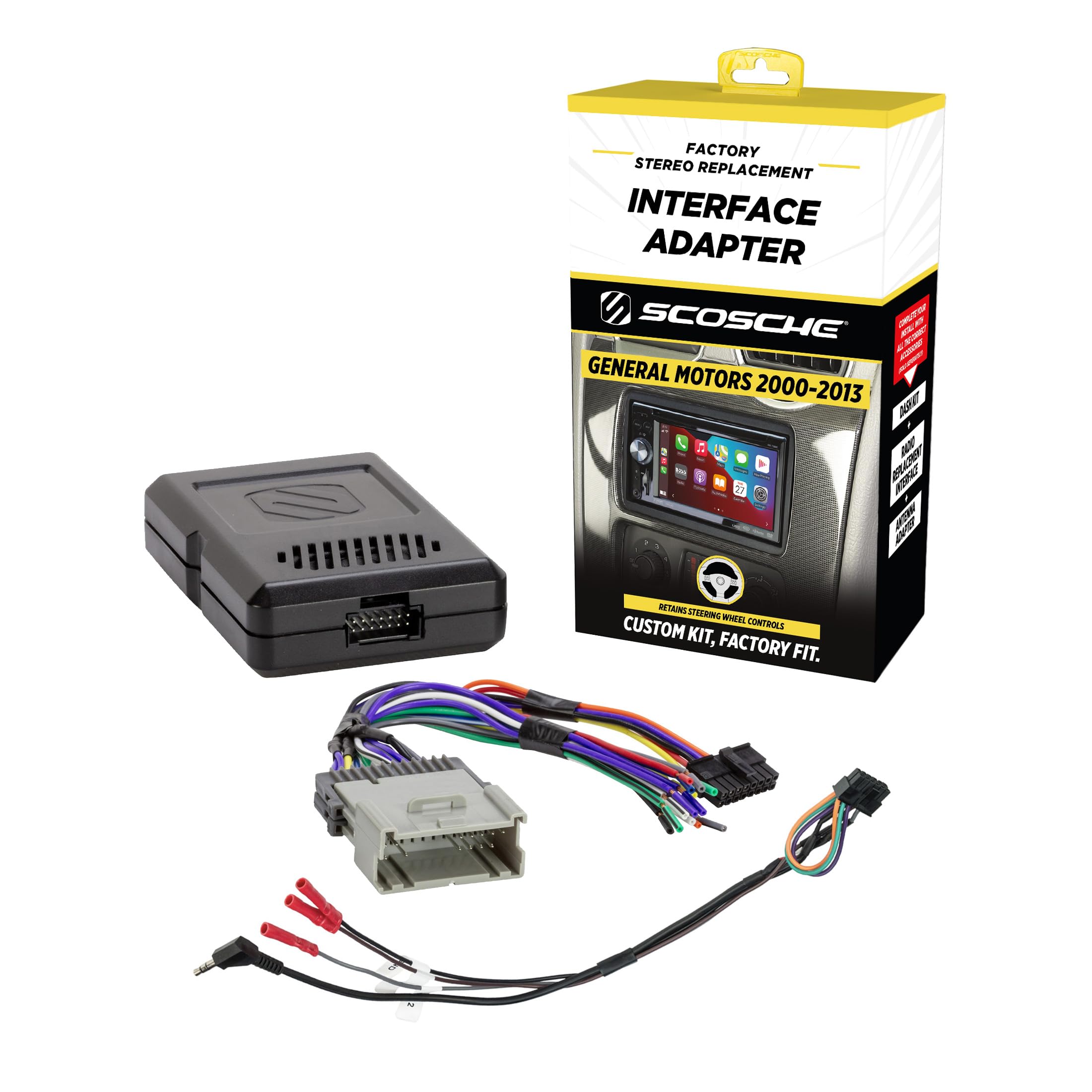
The Scosche GM2K-WP stands apart from standard pass-through harnesses because it actively communicates with the vehicle’s data bus. This interface translates signals between the factory wiring and an aftermarket head unit, preserving steering wheel controls, safety chimes, and factory amplifier integration. It covers a wide range of 2000-2013 GM vehicles, including Chevrolet, GMC, Buick, and Cadillac models, making it the most capable option for owners who refuse to lose factory functionality.
Build quality reflects Scosche’s reputation for durable automotive accessories. The housing uses ABS plastic rather than flimsy PVC, and the wire harness terminates in a standard color-coded connector that pairs directly with most aftermarket radios. Multiple verified reports confirm seamless installation on 2005-2007 Chevy Trailblazers and GMC Envoys, with owners noting that instructions are clear enough for a confident first-time installer. The interface also supports Apple CarPlay and Android Auto head units without additional adapters.
The primary limitation is incompatibility with Bose premium amplified systems in certain GM trucks and SUVs. Owners of 2004 Trailblazers with the Bose package reported that the factory amp does not trigger correctly, requiring a separate bypass module. Additionally, the OnStar retention is not supported, so users relying on that service will need to weigh the trade-off. For standard non-amplified GM vehicles, however, this interface delivers the most complete integration available at this tier.
What works
- Retains steering wheel controls and factory chimes
- Data-aware design works with modern aftermarket head units
- Durable ABS housing and clear installation instructions
What doesn’t
- Not compatible with Bose premium amplified systems
- Does not retain OnStar functionality
- Premium pricing reflects the advanced interface electronics
2. RED WOLF Radio Wiring Harness for Dodge/Jeep/Chrysler

RED WOLF’s harness for the Chrysler, Dodge, Jeep, and Mitsubishi families focuses on electrical integrity. The core conductors are pure copper rather than copper-clad aluminum, which reduces resistance and ensures consistent power delivery to the head unit. The pre-stripped wire ends save time during installation, and the flexible PVC jacket resists abrasion inside the dashboard cavity — a detail that matters when routing wires around sharp metal brackets.
Fitment covers a broad range including 2007-2016 Dodge Charger, Durango, Grand Caravan, 2008-2016 Jeep Grand Cherokee, Liberty, Wrangler, and 2008-2016 Chrysler Town & Country and 300 models. The harness also includes a separate ignition wire for vehicles where the OEM harness lacks a switched 12-volt line, a common issue in Chrysler platforms. Owners of 2009 Dodge Avengers and 2008-2013 Grand Caravans reported a straightforward hookup with basic splicing knowledge required only for the accessory power circuit.
Some fitment caveats exist. A verified 2008 Jeep Patriot owner reported that the connector shape did not match the factory socket despite the description listing compatibility, suggesting that certain trim levels or production mid-year changes may cause issues. The instruction documentation is minimal, and customer support is email-only with no phone or chat option. For standard Chrysler and Dodge models with verified fitment, the copper-core construction provides a reliable connection at a accessible entry point.
What works
- Pure copper conductors for low-resistance signal transfer
- Pre-stripped wire ends reduce prep time
- Includes separate ignition wire for Chrysler platforms
What doesn’t
- Fitment inconsistencies reported on some Jeep Patriot trims
- Minimal documentation, email-only support
- Basic wiring knowledge required for accessory power hookup
3. RED WOLF Radio Wiring Harness for GM Vehicles
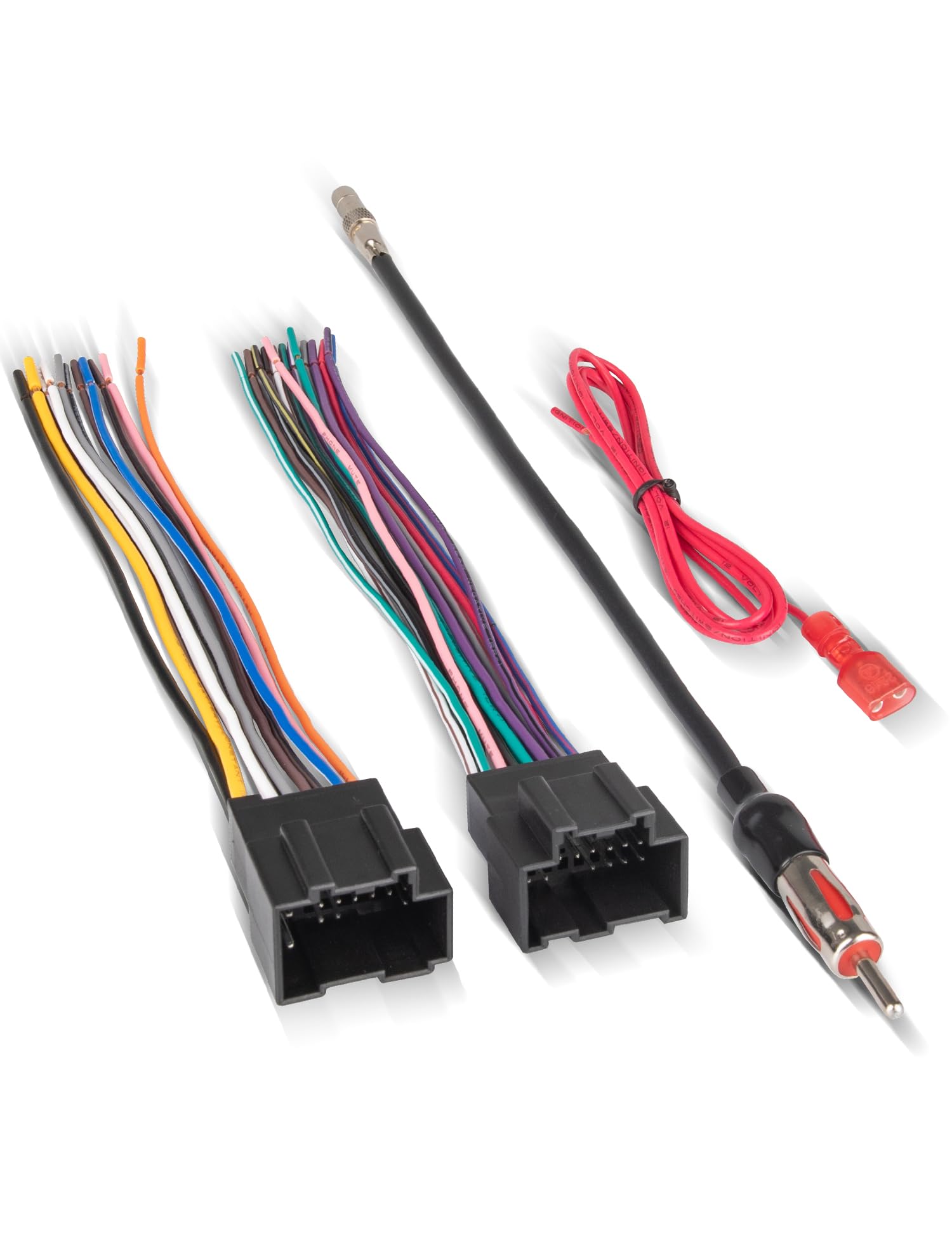
This RED WOLF kit delivers a two-in-one solution by pairing the main wiring harness with an antenna adapter, eliminating the need to source a separate Fakra-to-standard antenna connector. The coverage span is extensive — Chevrolet Silverado 1500-3500 (2007-2014), Suburban, Tahoe, Equinox, Impala, GMC Sierra, Yukon, Buick Enclave, Lucerne, Cadillac DTS, Escalade, and several Pontiac, Hummer, and Suzuki models. Owners of 2013 Chevrolet Silverado 2500s and 2017 Traverses reported that the color-coded wires aligned directly with their aftermarket head unit wiring, making the install essentially solder-free.
The copper-core wire construction provides solid conductivity, and the pre-stripped leads accept crimp connectors or solder with equal ease. A notable inclusion is the separate red ignition wire for vehicles where the factory harness does not carry a switched 12-volt signal — a common issue in GM platforms that otherwise leaves the radio unable to power off with the key. Multiple owners confirmed that running this wire to the vehicle’s ignition switch accessory terminal resolved the issue cleanly.
The main drawback is that the wire colors do not always match the factory GM wiring diagram exactly. A 2011 Chevy HHR owner noted that the speaker wire colors were confusing because the harness bundled door and tweeter channels together differently than expected, requiring a multimeter to confirm polarity. The kit also explicitly excludes compatibility with Bose, Infinity, and OnStar amplified systems, so owners of premium audio packages must look elsewhere. For standard non-amplified GM vehicles, the included antenna adapter adds genuine convenience.
What works
- Includes antenna adapter so no extra purchase needed
- Pre-stripped copper wires for clean connections
- Separate ignition wire solves GM power-off issues
What doesn’t
- Wire colors may not match factory diagram exactly
- Not compatible with Bose or Infinity amplified systems
- Some GM models require additional ignition wire routing
4. Scosche FD16B Stereo Wiring Harness
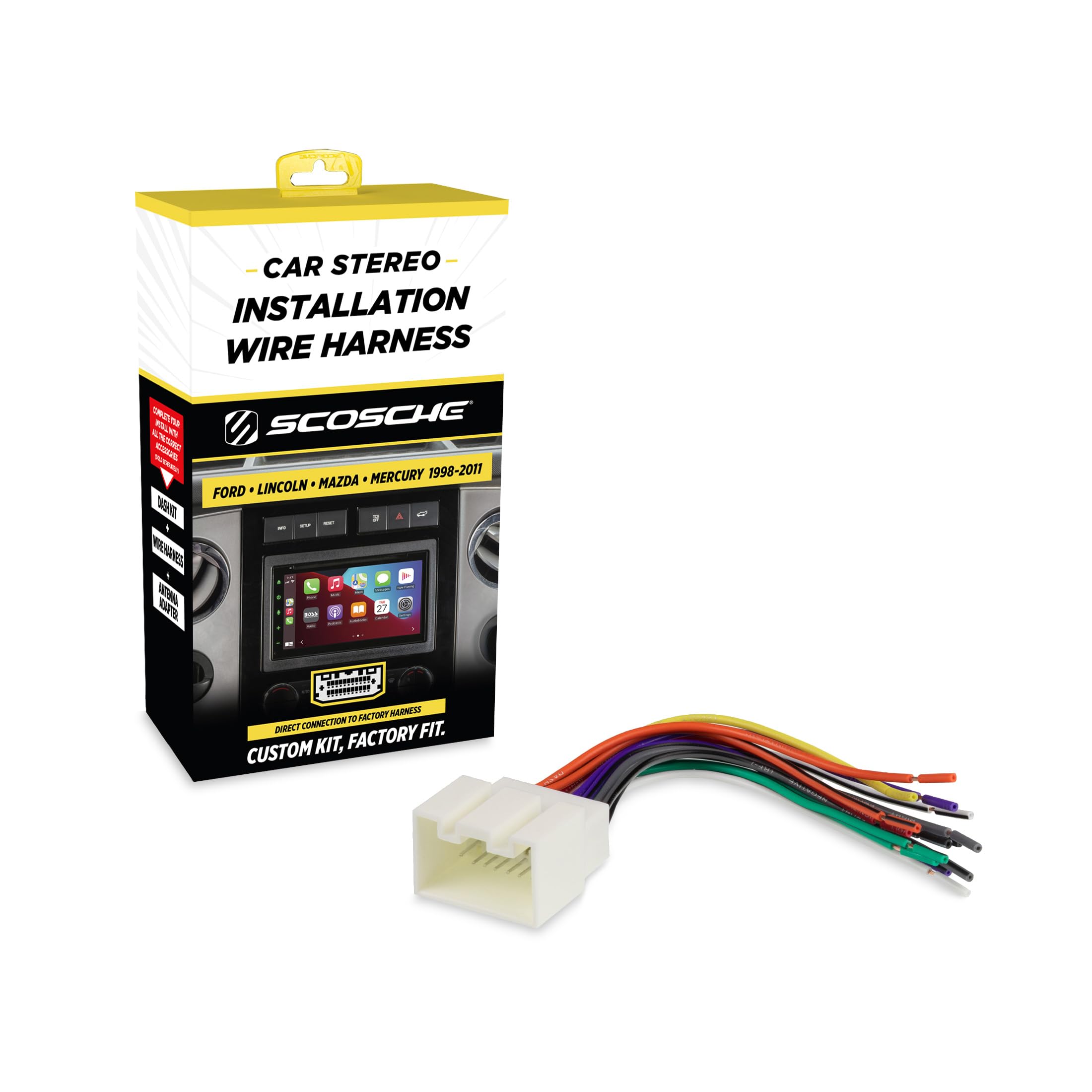
The Scosche FD16B is a no-frills wiring harness built around simplicity and broad coverage for Ford, Lincoln, Mazda, Mercury, and Nissan vehicles from 1998 through 2011. The EIA industry-standard color coding means the wire functions match the aftermarket head unit harness directly — yellow for battery, red for accessory, black for ground, and gray/white/green/purple pairs for speakers — so no diagram interpretation is needed. Owners of Ford Escapes, F-150s, and Focus models consistently report that the colors line up perfectly with their new radio harness.
The connector snaps into the factory radio plug securely with a positive locking tab that prevents accidental disconnection. Scosche backs this harness with a limited lifetime warranty and lifetime technical support, which adds peace of mind for a component that typically outlives the vehicle. The compact dimensions (0.75 x 4.25 x 7.5 inches) fit easily behind the dashboard without bunching, and the lightweight 22-gram build reduces strain on the factory connector.
One owner noted that the wires are slightly thinner than those found on a Pioneer DEH-series harness, recommending soldering over crimping to ensure a robust mechanical bond. The harness is also explicitly incompatible with factory amplified systems, so owners of vehicles with premium audio packages should verify their setup before purchasing. For standard non-amplified Ford, Lincoln, Mazda, Mercury, and Nissan applications, the FD16B delivers a straightforward, color-matched connection at a reasonable entry point.
What works
- EIA color-coded wires match aftermarket head units directly
- Lifetime warranty with lifetime tech support included
- Compact size fits easily behind the dashboard
What doesn’t
- Wires are slightly thinner than premium harness options
- Not compatible with factory amplified audio systems
- Limited to 1998-2011 Ford, Lincoln, Mazda, Mercury, Nissan
5. Pioneer AHH Aftermarket Radio Install Harness

This harness from AutoHarnessHouse solves a specific compatibility problem: it bridges a Pioneer aftermarket head unit to the factory wiring of 1998-2008 Honda and Acura vehicles. The unique value proposition is that it provides steering wheel control signal wires, reverse signal, vehicle speed sense, and parking brake wires directly from the Pioneer connector — signals that many generic harnesses omit. Owners of 2003 Acura RSX Type S and 2000 Honda VAMOS (Japanese import) reported a true plug-and-play experience with zero wire cutting required.
The connector uses the Metra 70-1721 interface type, which is widely recognized in the aftermarket industry. The harness terminates in a Pioneer-specific connector, meaning it only works with Pioneer radios — this is intentional specialization rather than a limitation. The included steering wheel control wire connects to the AXXESS ASWC-1 adapter, and the dedicated 12-volt and ground wires supply power to the SWC interface without tapping into other circuits. The build uses copper and aluminum conductors with PVC, TPE, and PE insulation rated for automotive interior temperatures.
Some users found that the connector edges required light sanding to lock properly into certain JVC head units, confirming that this harness is optimized for Pioneer decks specifically. A 2002 Honda Odyssey owner noted that Bluetooth functionality requires connecting the parking brake wire, which can be difficult to reach under the dash without removing additional trim. The harness also does not support factory-amplified Bose systems in higher-trim Acura models. For Honda and Acura owners installing a Pioneer radio, this is the most direct path to a clean integration.
What works
- True plug-and-play for Pioneer head units in Honda/Acura
- Includes SWC, reverse, VSS, and parking brake wires
- Works with Japanese import vehicles using Honda wiring
What doesn’t
- Designed exclusively for Pioneer radios only
- Connector may need light sanding for non-Pioneer decks
- Not compatible with factory Bose amplified systems
Hardware & Specs Guide
Wire Gauge and Conductor Material
The conductor material directly affects current-carrying capacity and signal integrity. Pure copper wire offers the lowest resistance per gauge size, making it the preferred choice for aftermarket head units that draw higher current during peak output. Copper-clad aluminum (CCA) wire costs less but introduces higher resistance and runs hotter under load. Most premium harnesses in this category use 18-20 AWG stranded copper conductors with PVC insulation rated to 80 degrees Celsius. Pre-stripped leads approximately 1/4 inch long reduce installation time and improve crimp reliability compared to harnesses that require stripping each wire individually.
Connector Types and Fitment Considerations
Automakers use proprietary multi-pin connector shapes that change between generations and trim levels. The most common interfaces include Metra 70-xxxx series for domestic vehicles and Japanese-standard 16-pin or 20-pin connectors for Asian imports. A harness that fits a 2006 model may not physically lock into a 2008 facelift due to subtle tab position changes. Antenna connectors also vary — Fakra (round, color-coded) dominates modern GM and European vehicles, while older Japanese and domestic radios use the standard Motorola-style single plug. Always confirm both the power/speaker connector shape and the antenna connector type before purchasing.
FAQ
What is a car stereo wiring harness and why do I need one?
How do I know which harness fits my specific car?
Do I need a special harness for a factory amplified system?
Can I use any harness if I solder the wires myself?
What does the ignition wire do and why do some harnesses include a separate one?
Final Thoughts: The Verdict
For most buyers, the best car stereo harness winner is the Scosche GM2K-WP because it retains steering wheel controls and factory chimes while supporting modern aftermarket head units. If you need a harness for a Chrysler, Dodge, or Jeep with pure copper conductors, grab the RED WOLF Chrysler/Dodge/Jeep Kit. And for Honda and Acura owners installing a Pioneer radio, nothing beats the direct-fit simplicity of the Pioneer AHH Harness.

Certification: BSc in Mechanical Engineering
Education: Mechanical engineer
Lives In: 539 W Commerce St, Dallas, TX 75208, USA
Md Amir is an auto mechanic student and writer with over half a decade of experience in the automotive field. He has worked with top automotive brands such as Lexus, Quantum, and also owns two automotive blogs autocarneed.com and taxiwiz.com.