Loose trim, flapping weatherstripping, and rattling body panels aren’t just annoyances — they signal a bond failure that will only get worse with every mile of vibration and every temperature swing. The difference between a repair that lasts a month and one that outlasts the car comes down to choosing the right chemistry for the job, not just grabbing whatever tube is closest.
I’m Amir — the founder and writer behind Four Wheel Ask. I’ve spent years tracking adhesive data sheets, cross-referencing owner-reported failures, and studying how different formulations behave under heat cycles, moisture, and road stress so you don’t have to gamble on a fix that lets go at highway speed.
After carefully analyzing owner feedback and lab data across seven leading candidates, the best auto trim glue choices here represent the most reliable solutions for lasting trim repairs.
How To Choose The Best Auto Trim Glue
Selecting the wrong adhesive for auto trim work is the fastest route to a second repair. Trim pieces live in a harsh micro-environment: UV exposure, interior cabin heat that can exceed 180°F, constant vibration, and occasional moisture intrusion. Understanding three core factors separates a permanent fix from a repeat headache.
Chemistry Type: Polyurethane vs. Cyanoacrylate vs. Contact Adhesive
Polyurethane adhesives excel at filling gaps and absorbing vibration, making them the standard for windshield bonding and heavy trim pieces that need structural hold. Cyanoacrylate gels cure fast and bond tightly to plastics and rubber, but they lack gap-filling ability — surfaces must mate cleanly. Contact adhesives, often spray-applied, work best for large surface-area bonds like headliners, carpeting, and vinyl wraps where clamping is impractical.
Cure Time and Working Window
Fast-curing formulas let you close the repair quickly, but they leave zero room for adjustment. Slower-curing polyurethanes give you 15–30 minutes to position trim before the bond sets, which matters for complex pieces like windshield moldings or door beltline trim. Always check the advertised fixture time against your skill level and the part’s complexity.
Temperature and Fluid Resistance
Trim glue inside a cabin or engine bay must withstand thermal cycling without turning brittle. Look for formulations rated to at least 200°F if the bond sits near a dashboard, defroster vent, or underhood area. Oil and solvent resistance matters for door trim that contacts weatherstripping and for any bond near engine fluids or washer solvent paths.
Quick Comparison
On smaller screens, swipe sideways to see the full table.
| Model | Category | Best For | Key Spec | Amazon |
|---|---|---|---|---|
| Loctite 37532 Black Weatherstrip | Contact Adhesive | Door & trunk weatherstrip | 5 fl oz tube, 7-day full cure, solvent-resistant | Amazon |
| FORTIVO PU Windshield Adhesive | Polyurethane | Glass-to-body trim bonding | 310 ml cartridge, 24-hr cure, no primer needed | Amazon |
| KRAFTPROTZ Super Glue Gel XXL | Cyanoacrylate | Plastic trim, brackets, mirror housings | 1.76 oz gel, heatproof to 230°F, oil-resistant | Amazon |
| 3M Hi-Strength 94 ET Spray | Contact Spray | Large surface laminations & carpet | 19.75 oz can, 60-min open time, low VOC | Amazon |
| DAP Weldwood Landau Top & Trim | Contact Adhesive | Headliners, upholstery, vinyl tops | 1 gal spray-grade, high heat-resistant | Amazon |
| DURVOL Windshield Adhesive | Polyurethane | Window trim & RV glass | Single tube, 24-hr cure, waterproof | Amazon |
| Berkland Seam Sealer White | Urethane | Body panel seams & weld joints | 10.5 fl oz cartridge, paintable in 30 min | Amazon |
In‑Depth Reviews
1. Loctite 37532 Black Weatherstrip Adhesive

Loctite’s black weatherstrip adhesive has earned its reputation through decades of consistent performance on door seals, trunk gaskets, and convertible top moldings. The solvent-based formulation penetrates porous rubber and foam weatherstripping deeply, creating a permanent mechanical bond rather than a surface-level grip that peels under summer heat. Owner reports consistently show successful reattachment of aged seals on vehicles ranging from BMW 650i trunks to vintage truck doors, with the black color blending invisibly into factory weatherstripping.
The tube format allows controlled bead application along narrow seal channels, and the medium viscosity stays put on vertical surfaces without running or sagging during cure. Full cure takes up to seven days, but fixture occurs quickly enough that parts stay in place with minimal tape support after 30 minutes. Resistance to gasoline, kerosene, and antifreeze means this adhesive won’t degrade if it contacts fluids near the engine bay or fuel filler area — a critical advantage over general-purpose glues that soften when exposed to hydrocarbons.
Surface preparation remains the limiting factor: Loctite’s bond strength drops sharply if the substrate carries silicone residue or old adhesive fragments. Owners who report failures almost always cite inadequate cleaning or application to damp surfaces. Used correctly, this tube handles multiple trim repairs and stores well between uses if the nozzle is capped tightly.
What works
- Solvent resistance exceeds most trim adhesives on the market
- Black color matches factory weatherstripping without visible residue
- Medium viscosity allows vertical application without sag
What doesn’t
- Full seven-day cure is longer than polyurethane alternatives
- Requires meticulous surface prep for reliable bond strength
2. FORTIVO Polyurethane Windshield Adhesive

FORTIVO’s polyurethane windshield adhesive delivers the structural bonding strength needed for glass-to-body trim attachment without requiring a separate primer step — a significant time saver compared to conventional two-part windshield urethanes. The non-sagging formula supports vertical and overhead application, making it equally suitable for rear window moldings, RV skylight trim, and side glass channel bonding. Owner feedback highlights successful use on tractor windows, stove glass hinges, and boat portlights in addition to automotive windshield work, indicating genuine versatility.
The 310 ml cartridge feeds into any standard caulking gun and includes gloves and an applicator tip, lowering the entry barrier for DIY users who don’t want to source additional tools. Cured material trims cleanly with a razor blade after 24 hours, and excess can be shaped during application before skinning occurs. Reviews note reliable adhesion when applied at temperatures as low as 40°F without heating the cartridge — a meaningful advantage for winter garage work.
The primary trade-off involves the pressurized caulking gun requirement: users expecting a squeeze tube will need to buy or borrow one. Additionally, the material’s aggressive tack makes placement errors difficult to correct once the bead contacts the substrate. First-time users should practice on scrap glass or metal before committing to the final installation.
What works
- Primer-free application saves prep time and reduces chemical exposure
- Non-sag formula holds position on overhead and vertical surfaces
- Cured material remains flexible enough to absorb vibration without cracking
What doesn’t
- Requires a separate caulking gun; not a squeeze-and-apply tube
- Aggressive tack leaves no margin for repositioning mistakes
3. KRAFTPROTZ Automotive Super Glue Gel XXL
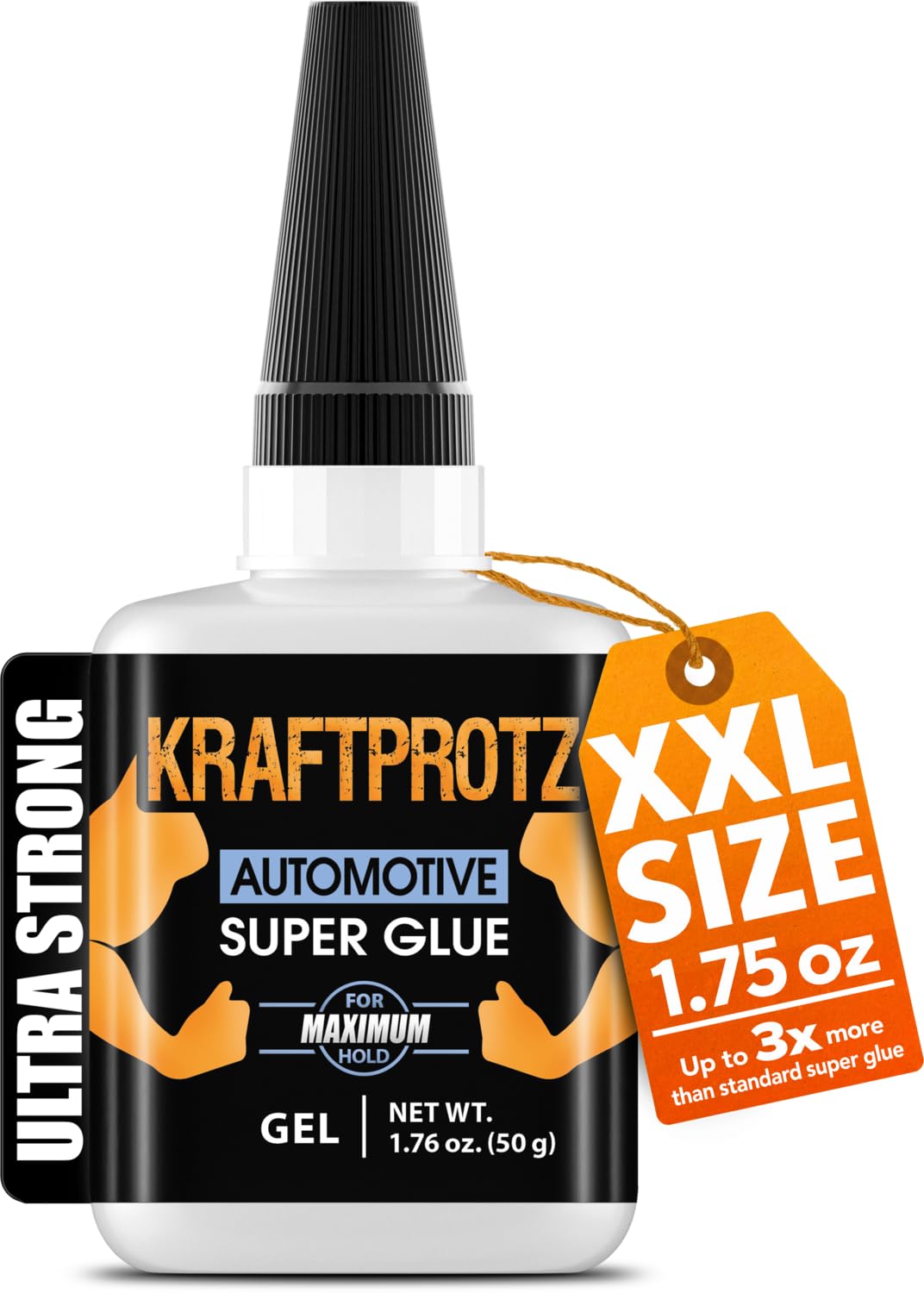
KRAFTPROTZ engineered this cyanoacrylate gel specifically for automotive environments where thin super glues fail under vibration and heat. The no-drop gel consistency stays exactly where applied, making it ideal for reattaching dashboard trim clips, mirror housings, fender brackets, and interior chrome accents that require precise placement without runoff. Owner reports include successfully repairing a front bumper separation on a Golf R, reattaching peeling chrome grilles, and fixing torn rubber door seals — applications that demand both gap-filling ability and fast fixture.
The 1.76-ounce bottle holds roughly three times the volume of standard automotive super glue tubes, translating to multiple repairs from a single purchase. Heat resistance rated to 230°F covers underhood components and dashboard attachments near defroster vents, while oil resistance protects bonds in engine bays and around fluid reservoirs. The anti-clog tip design prevents nozzle blockage between uses, a practical consideration for infrequent repairs that span weeks or months.
The gel hardens more slowly than thin cyanoacrylate formulations, offering roughly 30–45 seconds of adjustment time before the bond sets permanently. This works in the user’s favor for positioning but requires patience during clamping. Users applying thick beads to large gaps should expect longer cure times near the center of the bead and plan accordingly.
What works
- No-drip gel formulation prevents messy runoff on vertical trim pieces
- XXL bottle provides exceptional value for multiple repair sessions
- Heat resistance to 230°F covers engine bay and interior applications
What doesn’t
- Gel consistency leaves visible residue if applied carelessly
- Not suitable for gap-filling where surfaces don’t mate closely
4. 3M Hi-Strength 94 ET Spray Adhesive

3M’s Hi-Strength 94 ET represents the spray-contact adhesive benchmark for automotive interior work, particularly for bonding carpet, fabric headliners, foam padding, and laminate panels to metal or plastic substrates. The low-VOC formulation meets GREENGUARD certification standards and contributes to LEED credits, making it a defensible choice for enclosed workspace environments where air quality matters. The 60-minute open time window is unusually generous for a contact adhesive, allowing careful alignment of large trim panels before the bond becomes permanent.
Owner feedback consistently highlights the aggressive tack that develops during the 30-minute drying period after spraying both surfaces. Once the solvent flashes off and the two coated surfaces meet, the bond requires significant force to separate — exactly what you want for headliner fabric that must stay taught against a curved roof panel through summer heat. Users report successful marine carpet installations, van insulation projects, and foam soundproofing in cold storage environments where lesser adhesives lose grip.
The trade-offs center on application logistics. The spray pattern produces airborne overspray that settles on surrounding surfaces, requiring thorough masking of adjacent trim and glass. The solvent odor, while lower than industrial predecessors, still demands adequate ventilation or a respirator. Cans require upright storage and nozzle cleaning between uses to prevent clogging.
What works
- Long 60-minute open time allows careful positioning of large trim panels
- Low-VOC formulation reduces workspace health risks
- Exceptional tack bonds foam and fabric permanently to metal surfaces
What doesn’t
- Spray overspray requires comprehensive masking of surrounding areas
- Solvent odor still necessitates good ventilation despite low-VOC rating
5. DAP Weldwood Landau Top & Trim Contact Adhesive

DAP Weldwood’s Landau Top & Trim adhesive occupies a specific but indispensable niche: bonding automotive upholstery, vinyl roof materials, foam-backed headliners, and door panel fabric where heat resistance and water resistance are non-negotiable. The one-gallon spray-grade format is designed for siphon-feed spray guns, delivering consistent coverage across large surface areas without the can-to-can variability of aerosol formats. Owner reports consistently show successful headliner installations that remain tight through summer heat cycles that cause lesser adhesives to delaminate.
The solvent-based contact adhesive forms a permanent bond when both coated surfaces are allowed to dry to the touch before mating — a standard contact-cement process that rewards patience and proper technique. High heat resistance prevents sagging or release in vehicles parked in direct sun, while water resistance protects bonds in convertible tops, boat upholstery, and marine-grade vinyl installations. Reviews note particular success bonding carpet and vinyl in boat interiors, where moisture exposure would destroy water-soluble adhesives within weeks.
This product demands a higher skill investment than a simple tube adhesive. Users need a spray gun setup or must transfer the liquid to a suitable applicator. The solvent is highly flammable and requires explosion-proof ventilation during application. First-time upholstery workers should test on scrap material before committing to a full headliner installation.
What works
- Gallon format provides substantial coverage for full interior projects
- High heat resistance prevents bond failure in direct sun exposure
- Water-resistant formula supports marine and convertible top repairs
What doesn’t
- Requires spray gun equipment; not a ready-to-use aerosol can
- Highly flammable solvent demands strict safety protocols during application
6. DURVOL Auto Glass Urethane Windshield Adhesive
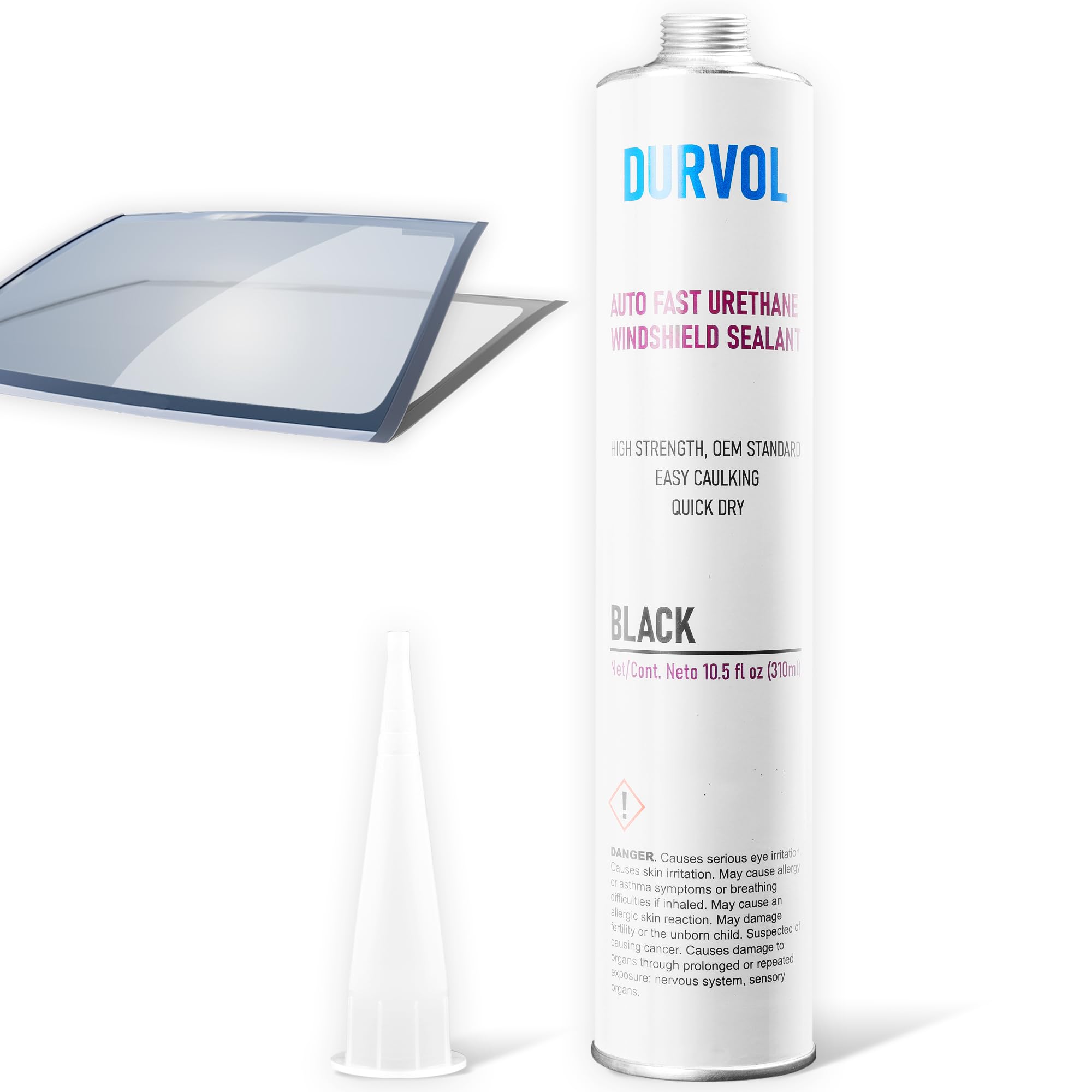
DURVOL’s urethane windshield adhesive delivers the core performance requirements of a glass-to-body bonding agent — impact absorption, vibration damping, and watertight sealing — in a single tube format that keeps the entry cost accessible for DIY windshield and trim repairs. The one-component polyurethane formula requires no mixing and cures via atmospheric moisture, simplifying the application process for users who don’t want to manage two-part systems. Owner feedback confirms successful use on 1973 Monte Carlo window trim, Ford side moldings, and FRS body trim alongside the primary windshield bonding role.
The fast-curing formulation reduces the time between application and road use compared to slow-cure urethanes, with fixture occurring sufficiently within a few hours to prevent windshield creep or trim sagging on vertical glass. Weather resistance spans both hot and cold extremes, maintaining bond integrity through seasonal temperature swings without becoming brittle in winter or softening in summer. The medium viscosity allows controlled bead application without dripping onto painted surfaces or interior trim.
Users report that the tube requires warming before use in cold weather — the material thickens significantly below 60°F and won’t flow properly without heat. This isn’t unusual for urethane adhesives, but it’s worth factoring in for winter garage work. Additionally, the single-tube quantity limits coverage to smaller jobs; large windshield installations may require multiple tubes.
What works
- One-component urethane eliminates mixing steps and pot life concerns
- Fast cure allows same-day road use for trim and glass repairs
- Waterproof seal protects against moisture intrusion in rain channels
What doesn’t
- Tube thickens in cold weather and must be warmed before use
- Single tube provides limited coverage for full windshield installations
7. Berkland Polyurethane Seam Sealer White

Berkland’s polyurethane seam sealer bridges the gap between body panel restoration and trim attachment, offering a paintable, flexible compound that seals weld joints, gap transitions, and trim channel interfaces without shrinking or cracking over time. The white color accepts automotive primer and topcoat within 30 minutes of application, allowing bodywork to proceed on the same day without overnight delays. Owners report excellent results sealing inner fender welds on British sports car restorations, RV roof seams, and truck bed joints where flexibility prevents stress cracks from road vibration.
The urethane formulation bonds equally well to bare steel, primed surfaces, and already-painted panels — a practical advantage when working on partially stripped restoration projects or spot repairs on existing paint. The single 10.5-ounce cartridge fits standard caulking guns and includes nitrile gloves and an application tip. Customer feedback spanning 19 months of service shows no leaks or bond failures on exterior seams exposed to rain and temperature cycling.
The seam sealer’s thicker consistency requires more hand pressure during application than a typical caulk, and the white color may not suit every trim application where black or clear is preferred for visual continuity. Users expecting a runny or self-leveling formula should note that this material stays exactly where applied and requires tooling for a smooth finish.
What works
- Paints over in 30 minutes, enabling same-day bodywork progression
- Flexibility prevents cracking under road vibration and temperature swings
- Adheres to bare, primed, and painted metal without special preparation
What doesn’t
- White color may not match dark trim without painting over it
- Thick consistency requires significant hand pressure during application
Hardware & Specs Guide
Polyurethane Adhesives
Polyurethane chemistries dominate the automotive trim bonding space for one reason: they absorb vibration without losing grip. These adhesives cure via moisture in the air, meaning they work best when applied in moderate humidity and fail prematurely in arid conditions unless the substrate is lightly misted. Cure times range from 24 hours for fast formulations to a full week for heavy-duty windshield urethanes. Polyurethane bonds are flexible after cure—typically retaining 20–30 percent elongation before breaking—which prevents stress fractures at the bond line when the car body flexes over bumps or during thermal expansion.
Cyanoacrylate Gels (Automotive Grade)
Automotive-grade cyanoacrylate gels differ from hardware-store super glues primarily in their impact resistance and heat tolerance. Standard CA glues become brittle at temperatures above 180°F and shatter under vibration, whereas automotive-formulated gels include rubber tougheners that maintain bond integrity up to 230°F. The gel consistency fills gaps up to 0.5 mm, but larger gaps require a polyurethane or epoxy alternative. Fixture time runs 30–60 seconds, with full cure in 24 hours. These are ideal for small trim pieces, emblems, and interior clips where clamping is difficult.
Contact Adhesives (Spray & Brush)
Contact adhesives bond by coating both surfaces, allowing the solvent to flash off, then pressing the two coated faces together. The bond forms instantly and permanently — there is no repositioning window once the surfaces touch. This makes contact adhesives the default choice for headliners, carpeting, and vinyl upholstery where the entire surface area receives adhesive coverage. Spray-grade contact adhesives offer the most even distribution, while brush-grade allows thicker buildup on porous substrates. Cure time is effectively immediate upon mating, though full solvent evaporation takes 24–72 hours depending on coating thickness.
Temperature Ratings & Fluid Resistance
Every trim adhesive listed carries a service temperature range that dictates where it can live long-term. Interior trim adhesives should withstand at least 180°F continuously, as vehicle cabins in direct sun routinely exceed this during summer. Underhood and exterior trim adhesives need 230°F minimum. Fluid resistance — particularly to gasoline, motor oil, brake fluid, and washer solvent — varies widely between chemistries. Polyurethanes resist dilute acids and alkalis but soften in concentrated solvents. Cyanoacrylates resist gasoline and oil well. Contact adhesives generally tolerate water and mild detergents but degrade in fuel contact.
FAQ
Can I use regular super glue for auto trim repairs?
How do I prepare the surface before applying trim glue?
What’s the difference between urethane and silicone for trim bonding?
How long should I wait before driving after applying trim glue?
Can I paint over auto trim glue after it cures?
Final Thoughts: The Verdict
For most buyers, the best auto trim glue winner is the Loctite 37532 Black Weatherstrip Adhesive because it combines solvent resistance, vertical hold, and a factory-matching black finish that works across the widest range of door, trunk, and molding repairs. If you need fast-curing glass-to-body bonding, grab the FORTIVO Polyurethane Windshield Adhesive for its primer-free application and vibration-damping strength. And for precise plastic trim and bracket repairs where no-drip gel control matters most, nothing beats the KRAFTPROTZ Automotive Super Glue Gel XXL.

Certification: BSc in Mechanical Engineering
Education: Mechanical engineer
Lives In: 539 W Commerce St, Dallas, TX 75208, USA
Md Amir is an auto mechanic student and writer with over half a decade of experience in the automotive field. He has worked with top automotive brands such as Lexus, Quantum, and also owns two automotive blogs autocarneed.com and taxiwiz.com.