Dialing in the correct fuel pressure on a carbureted engine separates a crisp throttle response from a soggy, fuel-starved stumble or an overflowing float bowl disaster. A gauge that lies or fails under hood heat turns tuning into guesswork, wasting hours and parts.
I’m Amir — the founder and writer behind Four Wheel Ask. My approach focuses on cross-referencing technical specifications, analyzing build quality indicators like liquid filling and thread materials, and aggregating long-term owner feedback to separate gauges that perform from those that just look the part.
Whether you are setting up a Holley on a street car or diagnosing a pressure drop on a vintage motorcycle, the right tool delivers repeatable data you can trust. After analyzing owner reports and technical specs, the most accurate and durable option for any carbureted engine is a best carburetor fuel pressure gauge.
How To Choose The Best Carburetor Fuel Pressure Gauge
Carbureted fuel systems operate at low pressure — typically 4.5 to 9 PSI — so a gauge that reads accurately in that narrow window is critical. Beyond the needle sweep, material quality, damping method, and thread compatibility determine whether a gauge survives daily engine bay heat or fails within months.
Mechanical vs. Liquid-Filled Damping
Dry mechanical gauges rely on a bourdon tube and pointer assembly. They are simple and cheap, but engine vibration causes the needle to flutter, making readings hard to trust. Liquid-filled gauges use glycerin or silicone oil to dampen pointer movement. This extends service life and delivers a steady, readable needle even on a lumpy cam idle. For carburetor tuning, liquid-filled is the baseline for accuracy.
Scale Range and Resolution
A gauge that reads 0–15 PSI gives you full needle sweep across the usable carburetor range. Wide-range gauges (0–100 PSI) crowd the critical 4–9 PSI zone into a tiny arc, making half-pound adjustments nearly impossible to read. Stick with a 0–15 PSI scale for carbureted applications — anything larger is designed for EFI systems and will frustrate your tuning efforts.
Thread Size and Fitting Compatibility
Almost all carburetor fuel pressure gauges use a 1/8″ NPT male fitting. This threads directly into pressure regulators, carburetor inlet ports, or test tee fittings. Some performance gauges use -4AN thread for braided line installations. Verify your regulator or fuel log port before buying — adapters exist, but each threaded joint introduces a potential leak point.
Quick Comparison
On smaller screens, swipe sideways to see the full table.
| Model | Category | Best For | Key Spec | Amazon |
|---|---|---|---|---|
| Auto Meter 4411 Ultra-Lite | Premium | High-end street & strip builds | 2-5/8″ dial, -4AN thread, incandescent lighting | Amazon |
| Aeromotive 15632 | Premium | Vibration-prone underhood use | 1.5″ dial, 0–15 PSI, liquid filled, equalizer valve | Amazon |
| Holley Adjustable Regulator Kit | Performance | Complete regulator + gauge setup | 4.5–9 PSI range, 0–15 PSI gauge, 3/8″ NPT port | Amazon |
| Auto Meter 2172 Autogage | Design | Compact installs & dash mounting | 1.5″ dial, 0–15 PSI, liquid dampened, 1/8″ NPT | Amazon |
| Orion Motor Tech Test Kit | Value | Diagnostic fuel pressure testing | 0–140 PSI, multi-adapter kit, shockproof casing | Amazon |
| BARTOO 8AN Dual Feed | Performance | Holley 4150 dual-feed applications | 8AN line kit, integrated gauge, braided stainless | Amazon |
| LVOUP Adjustable Regulator Kit | Value | Budget regulator + gauge combo | 1–5 PSI adjustable, 0–15 PSI gauge, zinc alloy body | Amazon |
| Mr. Gasket 1561 | Budget | Simple low-pressure monitoring | 1.5″ dial, 0–15 PSI, 270° sweep, chrome bezel | Amazon |
| Marshall Instruments MSB00100 | Value | Oil or fuel pressure in engine bay | 1.5″ dial, 0–100 PSI, liquid filled, 1/8″ NPT | Amazon |
| Russell/Edelbrock RUS-650350 | Design | Matching Edelbrock/Russell systems | 1.5″ dial, blue background, 1/8″ NPT, steel case | Amazon |
| QuickCar Racing 611-9015 | Budget | Initial carburetor setup & tuning | 1.5″ mini dial, 0–15 PSI, liquid filled, white face | Amazon |
In‑Depth Reviews
1. Auto Meter 4411 Ultra-Lite Mechanical Fuel Pressure Gauge
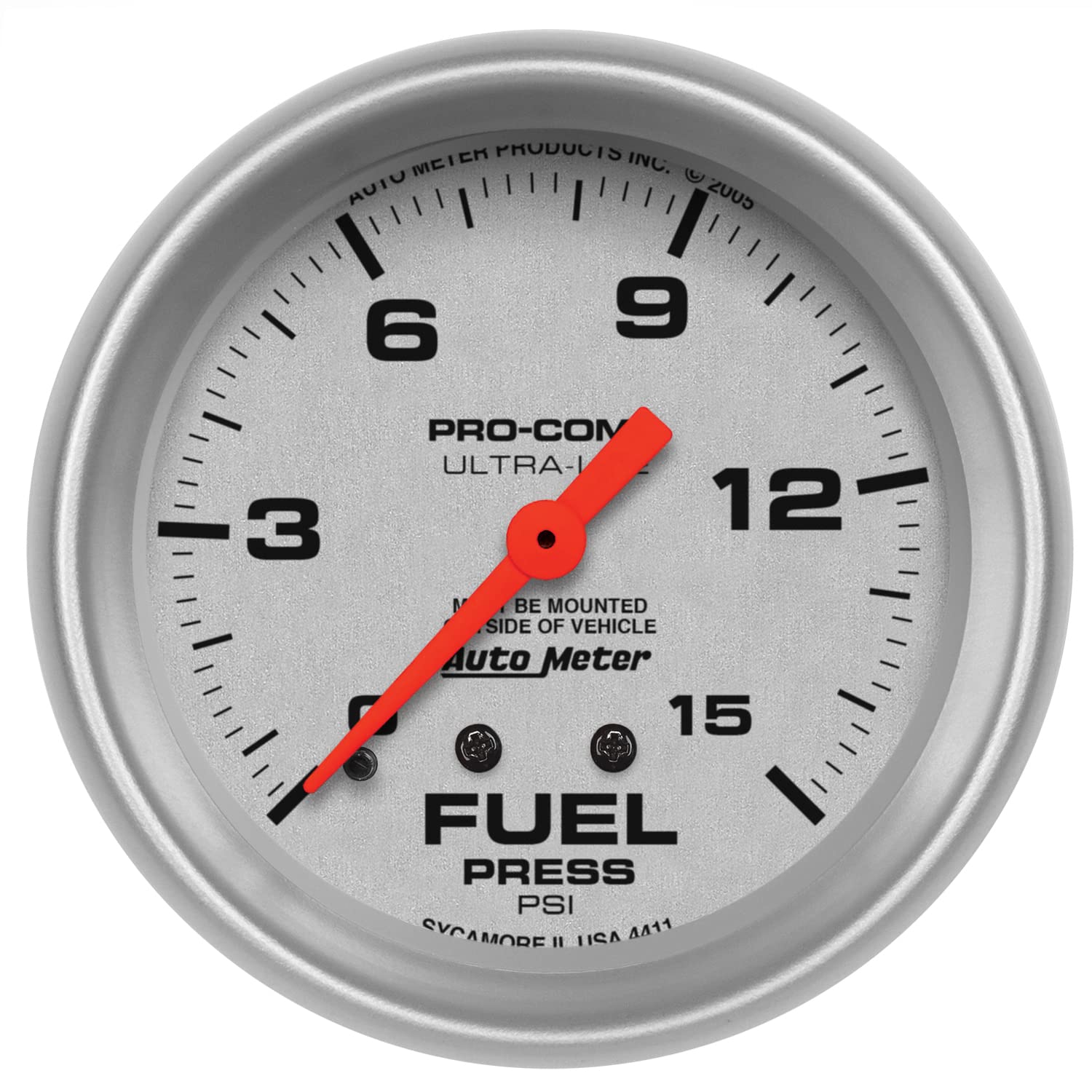
Auto Meter’s Ultra-Lite series has anchored professional dashboards for decades, and the 4411 delivers race-proven mechanical accuracy without relying on vehicle electrical systems. The 2-5/8″ dial offers excellent readability at a glance, and the -4AN male thread integrates directly into braided fuel line systems common on serious carbureted builds. Traditional incandescent perimeter lighting provides consistent visibility during night tuning sessions.
Build quality is where this gauge separates itself from budget offerings. The precision bourdon tube movement is housed in a durable plastic case rated for harsh underhood and in-dash environments. The kit includes bulb and socket assemblies, red and green bulb covers, and all mounting hardware — a complete package that reduces installation friction. Owner reports consistently cite zero mechanical failures over multiple years of street and track use.
The primary trade-off is size. At 2-5/8″, this gauge requires dedicated panel space and will not fit snugly into crowded regulator posts or small gauge pods. Buyers who need a compact inline monitor for tight engine bays may prefer a 1.5″ option. For a permanent dashboard mount on a performance vehicle, the 4411 sets the standard for long-term reliability and readability.
What works
- Proven race-grade mechanical movement with no electrical draw
- Large dial face allows precise pressure readings at speed
- Comprehensive kit includes lighting and mounting hardware
What doesn’t
- Larger diameter requires dedicated panel space
- Mechanical damping means needle may flicker on rough engines
2. Aeromotive 15632 Fuel Pressure Gauge 0–15 PSI

Aeromotive’s 15632 is a purpose-built underhood gauge designed to survive the vibration, heat, and contamination that kill lesser instruments. The liquid-filled case uses a thick glycerin dampening fluid that silences needle flutter even when mounted directly next to a mechanical fuel pump on a big-cam V8. The integral equalizer valve is a standout feature — it automatically vents the case to atmospheric pressure, preventing internal pressure buildup that causes false zero shifts as the engine bay heats up.
The 1.5″ diameter dial keeps the footprint small enough to mount on a regulator or fuel log without crowding adjacent fittings. The 1/8″ NPT male fitting threads directly into standard regulator gauge ports, and the stainless steel case resists corrosion from fuel exposure and road salt. Owner feedback highlights the gauge maintaining accuracy over multiple seasons, with several reviewers noting it outlasted three previous budget gauges in the same mounting location.
The main limitation is the 0–15 PSI scale, which is ideal for carbureted setups but useless for EFI systems requiring 40–60 PSI readings. Additionally, the liquid fill can leak if the case vent is damaged during installation. For carbureted engines where steady, trustworthy pressure data is non-negotiable, the Aeromotive 15632 is a benchmark of engineering refinement.
What works
- Liquid-filled damping delivers rock-steady needle under vibration
- Equalizer valve maintains zero accuracy across temperature swings
- Compact 1.5″ dial fits tight regulator and fuel log locations
What doesn’t
- 0–15 PSI scale limits use to carbureted applications only
- Liquid fill can leak if vent valve is mishandled during install
3. Holley Adjustable Fuel Pressure Regulator & Liquid-Filled Gauge Kit

Holley engineers designed this kit as a complete fuel pressure management solution for carbureted engines, pairing a precision adjustable regulator with a dedicated 0–15 PSI liquid-filled gauge. The regulator adjusts smoothly from 4.5 to 9 PSI via a threaded dial on top, covering the entire operating window for Holley, Quick Fuel, and Demon carburetors. The integrated 3/8″ NPT gauge port accepts the included 1.75″ liquid-filled gauge for real-time monitoring.
Build quality reflects Holley’s decades of fuel system expertise. The regulator body is machined from billet aluminum with a corrosion-resistant finish, and the internal diaphragm assembly delivers repeatable pressure settings without creep. The liquid-filled gauge features a stainless steel case and 1/8″ NPT connection, providing vibration-resistant readings that remain stable during hard launches and sustained high-RPM operation. Owner reports from street and strip applications consistently praise the kit for dialing in consistent air-fuel ratios.
The most common complaint is that fittings are not included in the box — buyers must source the reducer fitting (Holley 617-6157) and appropriate fuel line adapters separately. This adds cost and delays installation for those who expect a turnkey kit. For performance builders who already have AN fittings on hand, this combination delivers Holley-grade pressure control at a competitive package price.
What works
- Precise 4.5–9 PSI adjustment range covers all carbureted applications
- Liquid-filled gauge provides steady readings under load
- Billet aluminum regulator body resists corrosion and wear
What doesn’t
- Fittings and reducer not included — additional purchase required
- Some units reported defective out of box with non-adjustable pressure
4. Auto Meter 2172 Autogage Fuel Pressure Gauge

Auto Meter’s Autogage line brings professional-grade damping technology into a compact, budget-friendly package. The 2172 shares the same liquid-dampened movement found in the company’s race series gauges, providing smooth pointer travel and extended service life in high-vibration environments. The 1.5″ diameter and 1/8″ NPT male back fitting make it a direct replacement for factory regulator gauges or a clean addition to tight gauge panels.
The liquid-filled design uses a glycerin charge that effectively absorbs engine vibration, keeping the needle steady at idle and under load. Owner reviews consistently note that the gauge reads accurately out of the box and maintains calibration over months of daily driving. The vent valve on top allows the user to re-zero the gauge when atmospheric pressure changes, a feature usually reserved for more expensive instruments.
Some users report that the plastic case feels less substantial than Auto Meter’s Ultra-Lite or Phantom lines, and the lack of included lighting hardware limits mounting options for night use. The gauge also requires periodic re-bleeding of the liquid fill to maintain zero accuracy. For a well-damped, compact gauge that fits standard pods and regulator ports, the 2172 offers strong value without sacrificing core performance.
What works
- Liquid-dampened movement eliminates needle flutter on rough engines
- Compact 1.5″ size fits tight regulator and panel locations
- User-accessible vent valve allows re-zeroing for altitude changes
What doesn’t
- Plastic case feels less durable than full-metal gauge bodies
- No lighting kit included for nighttime visibility
5. Orion Motor Tech Fuel Pressure Test Kit
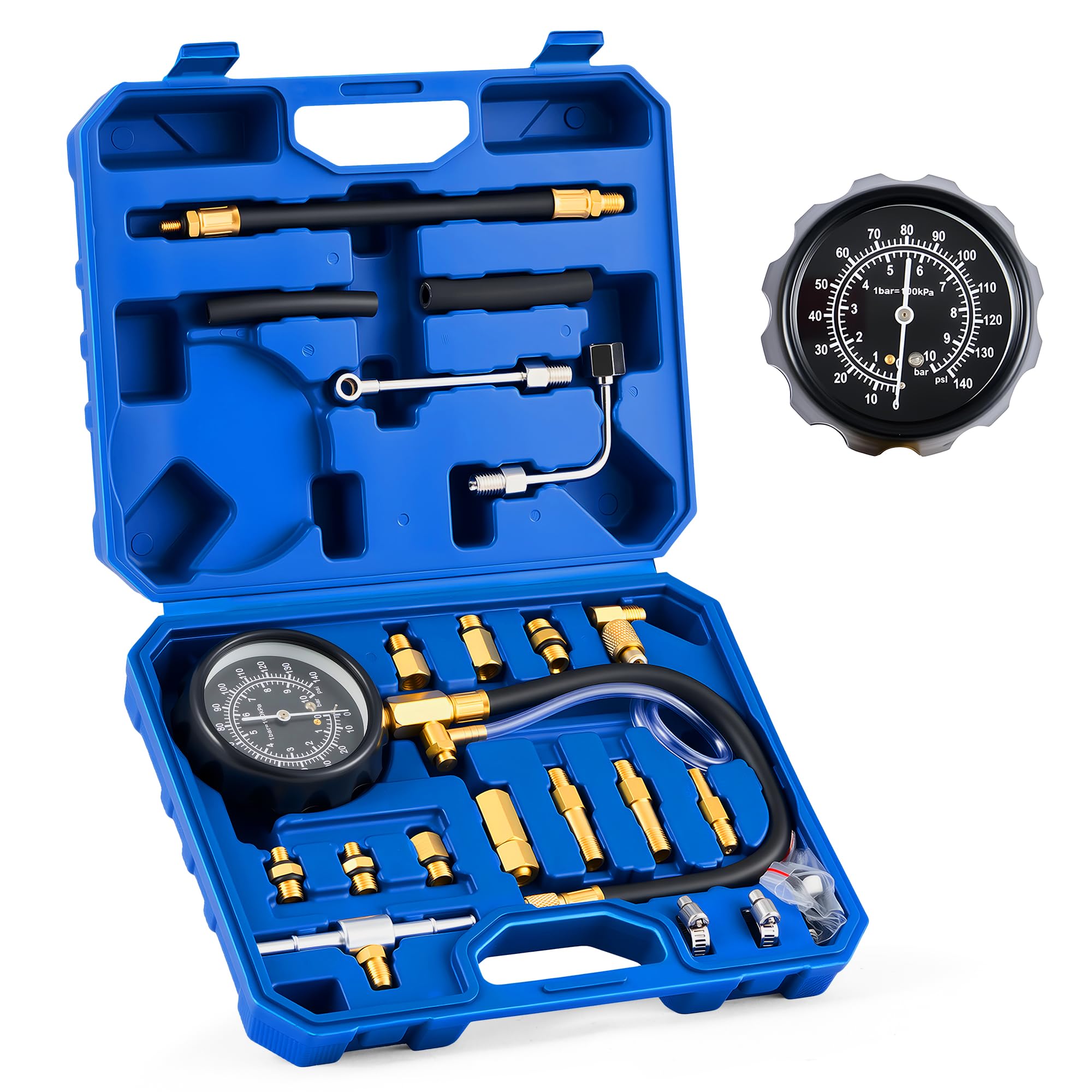
Orion Motor Tech’s fuel pressure test kit is a comprehensive diagnostic tool that covers both carbureted and EFI systems. The dual-movement gauge reads from 0–140 PSI with a shockproof rubber casing, making it suitable for everything from low-pressure carburetor testing to high-pressure fuel injection diagnostics. The kit includes a 15-inch hose for Schrader valve connections, an 8-inch hose for M6 ports, and adapters ranging from M8 to M14.
The real strength of this kit is the breadth of included components. Brass and aluminum adapters resist corrosion, reinforced rubber hoses handle up to 300 PSI burst pressure, and the blow-molded storage case keeps everything organized. Owner feedback highlights its ability to quickly diagnose failing fuel pumps on domestic trucks, import cars, and motorcycles using the included Schrader valve connector. The adjustable dial allows for easy calibration verification before each use.
The downside for carburetor specialists is that the gauge scale is optimized for EFI pressures — the 0–140 PSI sweep makes the critical 4–9 PSI zone difficult to read precisely. The flexible tubing and push-in connectors are designed for diagnostic port access, not permanent underhood mounting. This is a diagnostic kit for troubleshooting, not a permanent fuel pressure monitor for a carbureted build.
What works
- Comprehensive adapter set covers Schrader, M6, and M8–M14 ports
- Shockproof rubber casing protects gauge during diagnostic use
- Dual-scale 0–140 PSI works for both carbureted and EFI systems
What doesn’t
- Wide 140 PSI scale makes low-pressure readings less precise
- Not designed for permanent engine bay installation
6. BARTOO 8AN Carburetor Dual Feed Fuel Line with Pressure Gauge
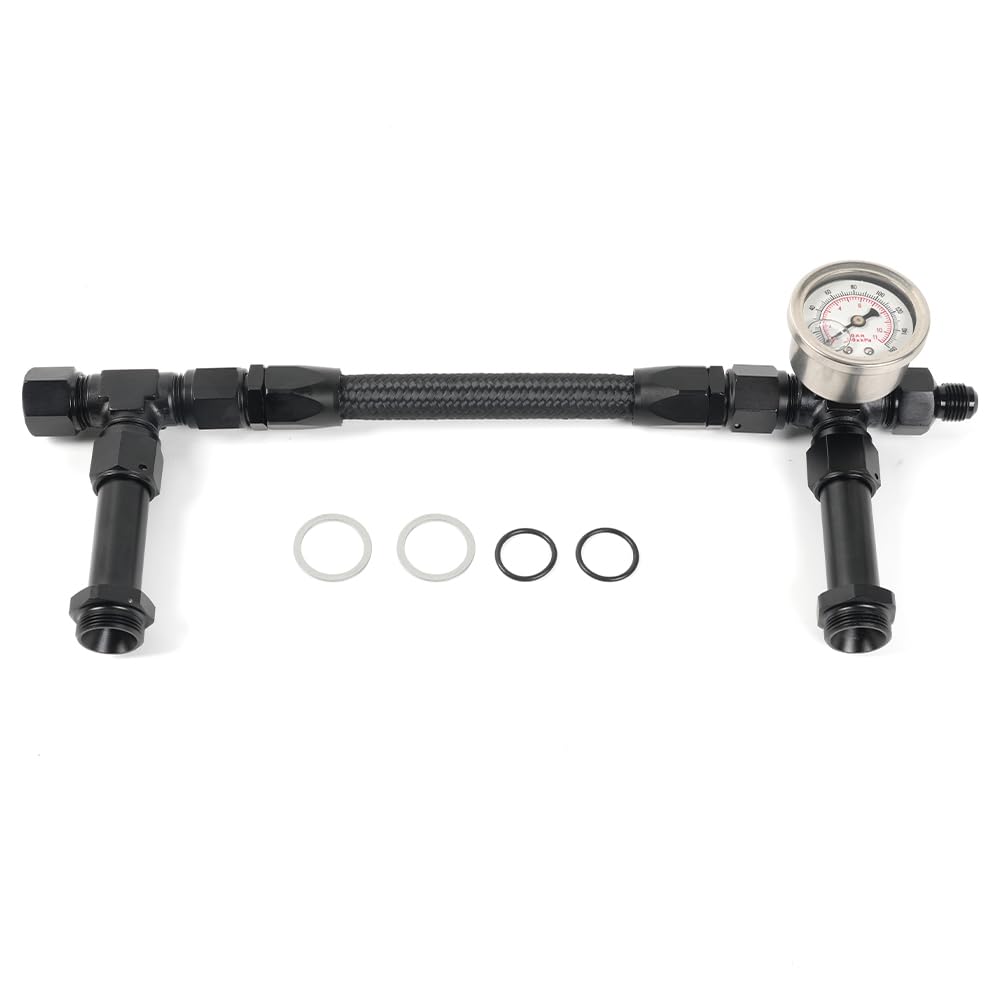
BARTOO’s dual-feed fuel line kit is designed specifically for Holley 4150 carburetors and compatible brands like Quick Fuel and AED. The kit pre-assembles two black anodized aluminum fuel rails with a stainless steel braided hose and an integrated pressure gauge, simplifying installation. The gauge provides a continuous pressure reading directly at the carburetor inlet, allowing real-time tuning feedback without tapping into the regulator port.
The construction prioritizes heat resistance and corrosion protection. The aluminum rails feature a black anodized finish that resists oxidation and fuel staining, while the nylon fiber-braided stainless hose handles underhood temperatures without softening or kinking. Owner feedback notes that the kit cleans up the engine compartment appearance while delivering smooth, even fuel distribution to both carburetor bowls — a key advantage for high-horsepower applications.
The primary issue involves the supplied gauge, which several buyers report is calibrated for high-pressure EFI ranges rather than the 0–15 PSI window needed for carburetors. The gauge starts at 10 PSI, making sub-10 PSI readings unreliable. Replacing the gauge with a proper 0–15 PSI unit solves the problem but adds cost. For builders who want a clean dual-feed setup and are willing to swap the gauge, the hardware quality is excellent.
What works
- Complete pre-assembled dual-feed kit simplifies installation
- Black anodized aluminum and braided stainless deliver long engine bay life
- Integrated gauge monitors pressure directly at carburetor inlet
What doesn’t
- Included gauge reads high-pressure range, not carburetor-friendly 0–15 PSI
- Sealing may require thread tape or sealant on hose ends
7. LVOUP Manual Adjustable 1–5 PSI Fuel Pressure Regulator with Gauge Kit

LVOUP’s regulator kit targets budget-conscious builders who need both pressure adjustment and monitoring in a single package. The deadhead-style regulator adjusts from 1 to 5 PSI via a chrome dial on top, allowing fine control for single or twin carburetor setups. The included 0–15 PSI gauge provides direct pressure feedback, enabling precise dial-in without additional tools. The zinc alloy body offers decent corrosion resistance for the price point.
The kit shines in low-pressure applications such as small-block V8s with mild cams, vintage inline-six engines, and marine carburetor systems. Owner reviews from boat owners highlight successful installation on in-line fuel systems with no leaks and accurate adjustment. The compact footprint fits easily into tight engine bays, and the numbered adjustment dial allows repeatable settings between tuning sessions. Several buyers report achieving stable idle and consistent WOT fuel delivery after switching from non-adjustable regulators.
Quality control is inconsistent, with multiple reviews citing units that leak from the adjustment mechanism or fail to maintain set pressure under load. The included gauge has a reported failure rate that causes false high readings, making troubleshooting difficult. Maximum input pressure is limited to 7 PSI, restricting use with high-output mechanical pumps. For budget builds that require gentle fuel delivery, this kit can work — but expect to potentially replace components.
What works
- Complete regulator and gauge combo at a competitive package price
- Numbered adjustment dial enables repeatable pressure settings
- Zinc alloy body holds up well in marine and mild underhood environments
What doesn’t
- Inconsistent QC with reported leak and pressure creep issues
- Limited to 7 PSI max input — not suitable for high-output pumps
8. Mr. Gasket 1561 Fuel Pressure Gauge

Mr. Gasket’s 1561 is a straightforward, no-frills fuel pressure gauge that focuses on the essentials: accurate 0–15 PSI readings with half-pound increments for precise carburetor tuning. The 270-degree sweep provides a wide needle arc that makes small pressure changes easy to spot, and the white face with black numbers offers excellent contrast for quick glances. The chrome bezel adds a period-correct aesthetic that suits classic muscle cars and vintage trucks.
The gauge uses a dry mechanical movement, which keeps the price entry-level but introduces needle flutter on engines with aggressive cam profiles. Owner feedback shows that the gauge holds calibration well in low-vibration applications like daily drivers and mild street machines. The 1/8″ NPT female port accepts standard regulator fittings, and the plastic case keeps weight to just 0.04 kg — useful for panel mounting without heavy support bracketry.
Durability reports are mixed. Some users report the gauge surviving years of service, while others note that engine bay heat causes the plastic lens to fog or the internals to drift after extended use. The dry movement means the needle dances at idle on built engines, making steady readings difficult. For a simple, low-cost monitor on a stock or mildly modified carbureted engine, the Mr. Gasket 1561 offers functional value with clear trade-offs in refinement.
What works
- Wide 270° sweep makes half-PSI adjustments easy to read
- Inexpensive entry point for basic fuel pressure monitoring
- Chrome bezel and white face match classic engine bay aesthetics
What doesn’t
- Dry mechanical movement flutters on high-cam or rough-idle engines
- Plastic lens can fog with prolonged exposure to fuel vapor
9. Marshall Instruments MSB00100 Liquid Filled Fuel/Oil Pressure Gauge

Marshall Instruments has built a reputation for American-made precision gauges, and the MSB00100 exemplifies their commitment to liquid-filled damping at a competitive price. The 1.5″ dial and 0–100 PSI range make it a versatile option for monitoring both fuel and oil pressure in carbureted and moderate-pressure systems. The liquid filling effectively dampens vibration, delivering a steady needle even when mounted directly on a mechanical pump or valve cover.
Build quality is a clear step above budget competitors. The brass and stainless steel internal construction resists corrosion from ethanol-blended fuels, and the black case with white pointer provides high contrast readability. Owner reviews consistently rate the gauge highly, with many describing it as a direct replacement for failed dry gauges on fuel pressure regulators and oil filter housings. The 1/8″ NPT center-back connection simplifies installation in panels and regulator ports alike.
The 0–100 PSI scale is the primary limitation for carburetor specialists. The usable 4–9 PSI zone occupies a small fraction of the dial face, making fine pressure adjustments harder to read compared to a dedicated 0–15 PSI gauge. The range is better suited for oil pressure monitoring or EFI fuel systems. For buyers who need a single gauge for dual-purpose monitoring, this is a solid choice, but carburetor tuners will want a more focused scale.
What works
- Liquid-filled damping provides stable readings on vibrating engines
- Brass and stainless internals resist ethanol fuel corrosion
- Versatile 0–100 PSI range works for fuel or oil pressure monitoring
What doesn’t
- 100 PSI scale compresses carburetor pressure range into a small arc
- Center-back connection may not fit some regulator side ports without adapters
10. Russell/Edelbrock RUS-650350 Fuel Pressure Gauge

Engineered by Edelbrock’s performance R&D team and branded under the Russell fuel systems line, the RUS-650350 pairs a distinctive dark blue dial face with a durable steel case for a clean, professional look in any engine bay. The gauge reads from 0–15 PSI with a 1/8″ NPT male fitting, making it a direct drop-in replacement for standard regulator-mounted gauges. The included hose simplifies remote mounting for better visibility.
The steel case construction provides better impact resistance than plastic-bodied alternatives, and the dark blue background with white lettering offers a unique aesthetic that complements Edelbrock valve covers and air cleaners. Owner feedback highlights that the gauge reads accurately on first startup and maintains calibration through the break-in period. The packaging includes protective foam, and several buyers noted that the gauge arrived in perfect condition despite shipping.
Long-term reliability reports are split. While many owners report years of accurate service, a significant minority describe gauge failure within months, with the needle sticking at a false reading or the internal mechanism failing to return to zero. The plastic lens can become cloudy if exposed to fuel splash, reducing readability. For a style-matched gauge in an Edelbrock-equipped engine bay, the RUS-650350 delivers visual appeal, but durability appears inconsistent.
What works
- Dark blue dial face matches Edelbrock components for a cohesive look
- Steel case offers better impact resistance than plastic gauges
- Included hose enables flexible mounting away from hot engine surfaces
What doesn’t
- Inconsistent QC with some units failing within months
- Plastic lens clouds easily with direct fuel exposure
11. QuickCar Racing Products 611-9015 Mini Fuel Pressure Gauge

QuickCar’s 611-9015 is a compact, liquid-filled mini gauge designed specifically for carburetor initial setup and basic pressure monitoring. The 1.5″ diameter and 0–15 PSI scale provide the correct range for carbureted engines, and the white face with full sweep offers clear readability despite the small size. The mechanical movement with liquid fill aims to dampen vibration for steadier readings than dry mini gauges.
The brass, glass, and stainless steel construction is a step above the all-plastic competition at this price tier. The 1/8″ NPT thread connects directly to standard regulator ports, and the lightweight 0.22-pound body puts minimal strain on fittings. Owner reviews on initial accuracy are positive, with several users reporting that the gauge matches their known regulator settings within half a PSI right out of the box — useful for baseline carburetor setup.
Durability is the weak point. Multiple owners report the liquid fill leaking out through the rubber vent plug when the gauge is mounted horizontally, leaving fluid spots inside the lens and causing the needle to become unreadable. One review describes a seal failure before the vehicle was even driven, and the 30-day Amazon return window means failures beyond that period become out-of-pocket replacements. For occasional setup use and strict vertical mounting, this gauge offers functional low-cost utility.
What works
- Liquid-filled movement dampens needle flutter at idle
- Brass and stainless internals resist fuel corrosion
- Correct 0–15 PSI scale for carburetor tuning applications
What doesn’t
- Liquid fill leaks from vent plug in horizontal mount positions
- Mixed durability reports with some seals failing before use
Hardware & Specs Guide
Liquid-Filled Damping
Glycerin or silicone oil inside the gauge case dampens pointer movement caused by engine vibration. This keeps the needle steady at idle and under load, enabling precise pressure readings. Liquid-filled gauges also resist internal corrosion because the fluid displaces moisture-laden air. The trade-off is potential leakage if the case vent is damaged or the gauge is mounted in an orientation that stresses the fill plug.
1/8″ NPT Thread Standard
Almost all carburetor fuel pressure gauges use 1/8″ National Pipe Taper (NPT) male threads. This threads into regulator gauge ports, carburetor inlet logs, and test tee fittings. NPT threads seal via mechanical deformation of the threads themselves — pipe thread sealant or PTFE tape is recommended to prevent fuel leaks at the connection point.
0–15 PSI Scale Range
Carbureted fuel systems operate between 4.5 and 9 PSI. A 0–15 PSI gauge dedicates the majority of its dial face to this window, allowing half-PSI resolution for precise adjustments. Wide-range gauges (0–100 PSI or higher) compress this critical zone into a tiny arc, making fine tuning difficult and increasing the risk of misreading pressure changes.
-4AN Thread Option
Some performance gauges use -4AN male threads instead of 1/8″ NPT. This standard is common on braided stainless fuel line systems and direct-mount regulator ports. -4AN connections use a 37-degree flare sealing surface rather than thread deformation, which can reduce leak potential in high-vibration environments. Adapters are available to convert between -4AN and 1/8″ NPT.
FAQ
What PSI range do I need for a carburetor fuel pressure gauge?
Can I use an EFI fuel pressure gauge on a carbureted engine?
Why does my fuel pressure gauge needle bounce at idle?
Do I need thread sealant on the gauge fitting?
Final Thoughts: The Verdict
For most carbureted engine builders, the best carburetor fuel pressure gauge winner is the Auto Meter 4411 Ultra-Lite because it combines race-proven mechanical accuracy, a large readable dial, and comprehensive installation hardware in a package that owners trust for years. If you need a compact vibration-resistant gauge for tight regulator mounting, grab the Aeromotive 15632. And for a complete pressure regulation and monitoring system, nothing beats the Holley Adjustable Regulator and Gauge Kit.

Certification: BSc in Mechanical Engineering
Education: Mechanical engineer
Lives In: 539 W Commerce St, Dallas, TX 75208, USA
Md Amir is an auto mechanic student and writer with over half a decade of experience in the automotive field. He has worked with top automotive brands such as Lexus, Quantum, and also owns two automotive blogs autocarneed.com and taxiwiz.com.