A parking lot door ding, a hailstorm’s aftermath, or a mysterious crease on the quarter panel — these blemishes can drop a vehicle’s resale value and nag at any owner’s pride. The difference between a permanent eyesore and a like-new finish comes down to having the right tool for the specific damage profile. Many skip the body shop entirely with a well-chosen kit, but the market is flooded with options that range from genuinely effective to frustratingly cheap.
I’m Amir — the founder and writer behind Four Wheel Ask. I’ve spent years analyzing product specifications, studying owner-reported outcomes, and comparing build quality across hundreds of body repair tools to identify what actually delivers consistent results.
From minor door dings to deeper dents, a quality best car dent remover saves hundreds in body shop costs while protecting your vehicle’s original paint finish.
How To Choose The Best Car Dent Remover
Car dent removers fall into three main mechanical families — glue-based pullers, slide hammers, and push-style rod systems. Each works best on specific dent types, panel locations, and damage severity. Understanding these categories before shopping prevents wasted money on a kit that simply doesn’t have the right tool for your dent.
Glue Pulling Systems
These kits use hot-melt adhesive applied to plastic tabs or bridges, then pull the dent outward. They excel on shallow dents on flat or gently curved panels — think door skins, hoods, and roof sections. The glue’s holding strength and the quality of the pull tabs directly determine success. Many budget kits ship with low-grade glue that fails under tension, so aftermarket glue stick upgrades are common among experienced users.
Slide Hammer and Bridge Puller Tools
Slide hammers use a weighted mass that slides along a shaft to generate impact force, transferred to the dent via a screw tip or glue tab. Bridge pullers create a steady, controlled outward pull. These tools handle medium to large dents and creases that glue-alone methods struggle to budge. The weight of the hammer, the threading quality, and the number of included tip attachments matter most here.
Rod and Pick Systems
These kits consist of steel rods with interchangeable tips that push the dent from behind the panel. They require access holes or removal of interior trim. Rods are the preferred tool for hail damage, door dings on vertical panels, and creases where pulling from the outside risks paint damage. Key specs include rod material (spring steel vs. stainless), tip variety, and whether the rod bends under pressure or maintains stiffness for precise control.
Quick Comparison
On smaller screens, swipe sideways to see the full table.
| Model | Category | Best For | Key Spec | Amazon |
|---|---|---|---|---|
| CYGOODS 22 Pcs Rods | Rod Kit | Professional hail repair | Spring steel with 7 interchangeable tips | Amazon |
| XtremepowerUS 13 LBS | Slide Hammer | Heavy crease removal | 13 lb solid steel shaft | Amazon |
| Houshan 6 Pcs + 20 Tips | Rod System | Door ding precision | Stainless steel with rubber awl heads | Amazon |
| CYGOODS Fender Lifter | Curved Rod | Fender and side panel repair | Stainless steel curved crowbar design | Amazon |
| C&T 7 Piece | Hammer & Dolly | Traditional body work | Carbon steel hammers + 4 dollies | Amazon |
| GLISTON Slide Hammer | Slide Hammer | DIY hail dent pulling | 2-in-1 T-bar + 16 glue tabs | Amazon |
| SWANLAKE 7 Piece | Hammer & Dolly | Collision repair starter | Forged carbon steel + 4 dollies | Amazon |
| Srepat 101pcs | Glue Pulling | All-in-one DIY bundle | Adjustable bridge puller + glue gun | Amazon |
| DIQDI 129pcs | PDR System | Complete tool ecosystem | Gold lifter + bridge + T-bar + air wedges | Amazon |
| 97PCS Auto Body Kit | Glue Pulling | Budget-friendly starter set | Golden lifter + slide hammer T-bar | Amazon |
| Super PDR Bridge Kit | Bridge Puller | Entry-level small dent repair | Arched bridge + 6 prismatic pull rods | Amazon |
In‑Depth Reviews
1. CYGOODS 22 Pcs Car Dent Repair Rods

This 22-piece rod kit from CYGOODS represents a meaningful upgrade in construction philosophy. The rods are forged from hard spring steel rather than standard stainless, which provides substantially greater stiffness during push repairs. The G3 rod features a replaceable head system with seven stainless steel tips that thread onto an M8 screw, effectively offering 14 different concave and convex profiles for matching various dent geometries.
The set covers the full range of dent sizes — from small door dings to larger linear creases and hail damage patterns. Owner reports consistently note that the springs steel construction resists bending during aggressive pushes, which is the primary failure point of cheaper rod sets. The inclusion of both metal and plastic tip options allows the user to choose between aggressive metal displacement and paint-safe gentle persuasion depending on the panel’s condition.
Some users noted that the thinnest rod can still flex under heavy load on tight curves, requiring careful control to avoid over-correction. A few tips arrived with minor surface rust according to isolated reports, though the overall build quality across the set is rated well above its market tier. For anyone serious about learning PDR techniques, this kit provides the rigidity and tip variety needed to develop proper metal-moving skills.
What works
- Hard spring steel resists bending far better than stainless alternatives
- Replaceable rod head system offers 14 tip profiles
- Covers small dings through large hail damage patterns
What doesn’t
- Thinnest rod can flex under heavy push loads on tight curves
- Isolated reports of minor surface rust on some tips
2. XtremepowerUS 13 LBS Dent Puller Slide Hammer

The XtremepowerUS slide hammer stands apart from the dozens of lightweight pullers on the market due to its 13-pound solid steel shaft and deep precision threading. This is a tool designed for real force application — the mass delivers enough impact energy to pull creases and deep dents that lighter systems cannot budge. The knurled handle provides a reliable grip even with oily hands, and the long shaft allows the user to generate a powerful swing arc without contacting the vehicle’s body.
Owner feedback from professional collision technicians indicates this kit includes more attachment tips than comparable Snap-On, Matco, or Mac tools at a fraction of the investment. The ability to work without removing interior panels saves significant labor time on door and quarter panel repairs. The included blow-molded case keeps the shaft, tips, and accessories organized for transport between jobs or storage in a shop drawer.
A small number of users reported the plastic case arriving damaged during shipping, though the tool itself received consistent praise for build quality. The slide hammer is best suited for larger dents and creases — owners looking for precision hail-ding work will still want a separate rod kit. For anyone dealing with significant collision damage or deep body creases, this is the most capable pulling tool in this comparison.
What works
- 13-pound solid steel shaft delivers exceptional pulling force
- More tips included than professional brands costing several times more
- Works without removing interior panels on most vehicles
What doesn’t
- Plastic case can arrive cracked in transit
- Overkill for small door dings and shallow hail damage
3. Houshan Paintless Dent Repair Tools 6 Pieces with Awl Heads

The Houshan kit takes a different approach from the CYGOODS set by prioritizing tip variety over rod count. Three stainless steel rods combine with 20 interchangeable awl heads — 12 made from rubber for paint-safe contact and eight from metal for more aggressive displacement. This design philosophy allows the user to select the exact contact profile needed for each dent without switching rods, which speeds up workflow on multi-dent repairs like hail damage.
The stainless steel construction offers corrosion resistance that keeps the rods looking new after repeated use, a practical advantage in humid shop environments. The rods are intentionally built with a slight degree of flexibility — several experienced PDR practitioners noted this helps avoid over-pulling by allowing the rod to absorb some force rather than transmitting it all directly to the panel. The rubber awl heads are particularly effective on painted surfaces where preserving the clear coat is the priority.
A few owners reported that some tips arrived with surface rust already present, suggesting quality control inconsistency in the storage or packaging process. The rods are also slightly thicker than some competing sets, which can make them difficult to insert through tight access gaps behind door panels or window seals. For learners and intermediate users focused on paint-preserving techniques, the Houshan set offers strong value through its tip diversity.
What works
- 20 tip options cover an unusually wide range of dent profiles
- Rubber awl heads protect paint during gentle persuasion
- Stainless steel resists rust far better than carbon alternatives
What doesn’t
- Some tips arrived with pre-existing surface rust
- Rod thickness limits access through tight panel gaps
4. CYGOODS Car Auto Dent Removal Fender Lifter Curved Rod Kit

This CYGOODS kit is purpose-built for a specific repair zone — the fender and side panel area where curvature and structural bracing make standard straight-rod access difficult. The large curved crowbar-style rod is the standout piece, designed to reach behind fender contours that flat tools cannot navigate. The set also includes a rubber mallet for working out small irregular damage and a selection of knockdown tools for post-pull refinement.
The flat bar is constructed from stainless steel with a bending range that closely matches typical fender geometries. Owners without prior PDR experience reported achieving roughly 80% restoration on fender dents after watching basic tutorial videos, which speaks to the tool’s intuitive leverage design. The kit is universal across vehicle makes and can also be used on motorcycles, refrigerators, and other metal surfaces with similar curvature challenges.
The primary limitation is scope — this is not a general-purpose PDR kit. It excels on fenders and side panels but lacks the straight rods and wide tip selection needed for hoods, roofs, or door centers. Several users noted the need to pair this with a separate rod kit for comprehensive coverage. The knockdown tools included are functional but basic compared to dedicated PDR punch sets. For fender-focused repairs, this is the most efficient option available.
What works
- Curved crowbar rod perfectly matches fender access angles
- Stainless steel construction resists bending and rust
- Beginner-friendly design with quick learning curve for fender work
What doesn’t
- Limited to fender and side panel applications
- Knockdown tools are basic quality compared to dedicated sets
5. C&T Auto Body Repair Tool Kit 7 Piece
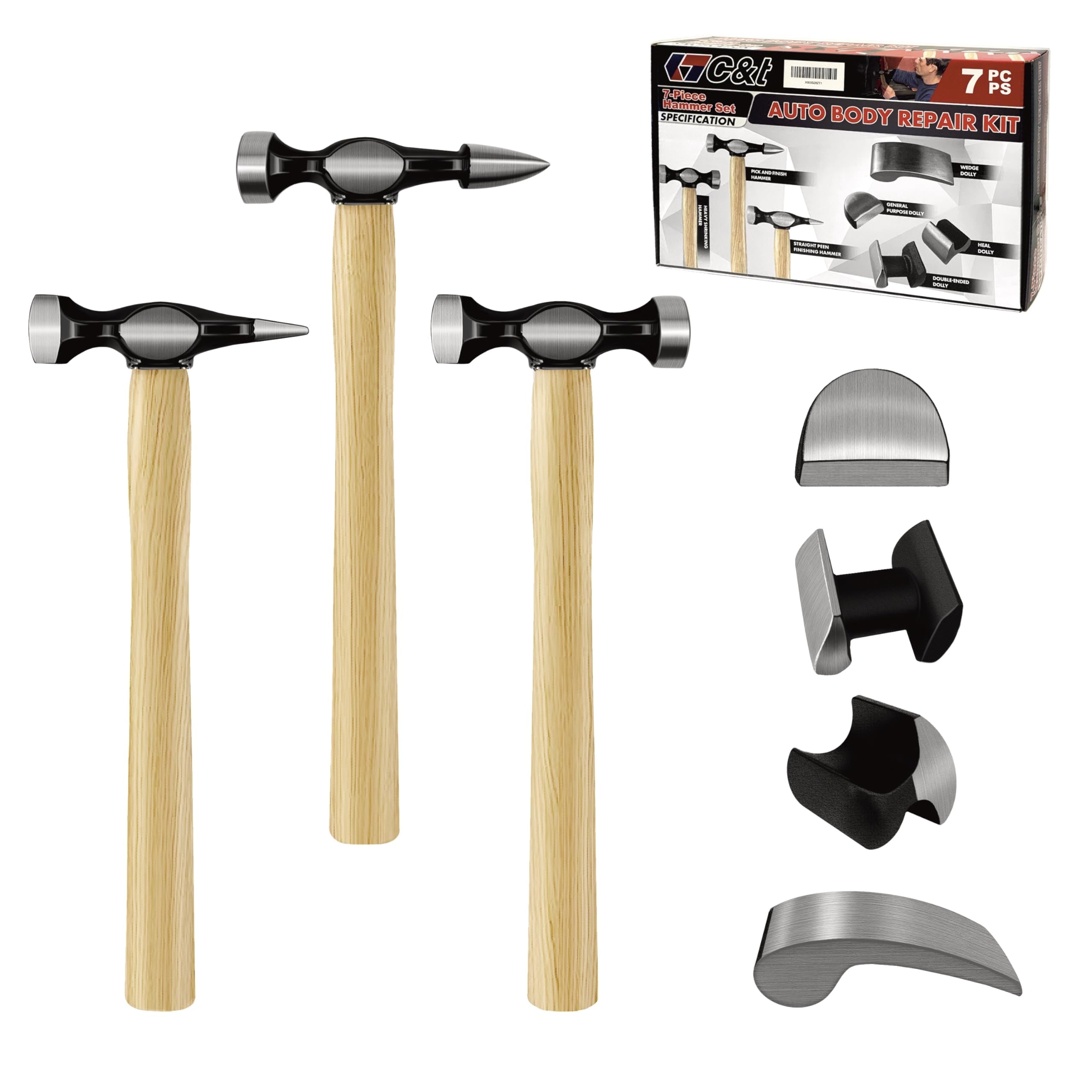
The C&T 7-piece set earns its strong reputation through straightforward execution — forged carbon steel, heat-tempered for durability, with a rust-resistant coating that holds up under daily use. The kit includes a standard bumping hammer, a pick and finish hammer, a reverse curve hammer, plus four specialized dollies: curved, utility, double-end hand, and shrink. This combination covers the core hammer-and-dolly techniques that form the foundation of traditional auto body repair.
The set holds the #1 Best Seller rank in Body Hammers & Dollies on Amazon, a position supported by over 500 ratings. Owner reports consistently describe the tools as feeling solid in hand, with the hardwood handles providing adequate vibration absorption for extended sessions. The box packaging keeps everything organized and protected, though some users noted the coating on the striking faces is thicker than ideal and may benefit from light sanding to expose bare metal for better control.
A few users pointed out that the heel dolly in their set had an unusually pronounced dome shape, and the general consensus is that these tools are best suited for DIY and beginner use rather than professional daily abuse. The hammers lack the waffle-pattern striking face that some experienced body workers prefer for certain metal-shaping tasks. For the DIYer looking to learn proper hammer-and-dolly techniques, this set delivers excellent build quality at a working-person’s investment level.
What works
- Forged carbon steel with heat tempering and rust-resistant coating
- Four-dolly selection covers all common body contour shapes
- Strong customer satisfaction record with #1 category ranking
What doesn’t
- Thick clear coat on striking faces may need sanding for best performance
- Heel dolly shape inconsistencies reported in some units
6. GLISTON Auto Body Dent Repair Tools Slide Hammer Kit

The GLISTON kit combines a 2-in-1 slide hammer and T-bar puller with 16 thickened black glue tabs, aiming to be a complete pulling solution for DIY users. The lever-action design of the T-bar makes it effective on thin Asian-market car body panels and light metal surfaces like refrigerator doors. Owner reports highlight successful results on a Miata roof dent and several appliance repairs where the alternative was a costly service call.
The kit includes a carry bag for organization, which is a practical touch for users who move between vehicles or store tools in tight garage spaces. The glue tabs are wider and thicker than the industry standard, which provides a larger bonding surface for better grip on shallow dents. The slide hammer mechanism allows the user to switch between steady pull and impact modes depending on the dent’s resistance level and depth.
Some owners noted the included glue sticks are too small for standard hot glue guns, requiring either a separate glue gun purchase or a switch to aftermarket glue sticks. The plastic pull tabs flex noticeably under heavy load, which one reviewer deducted a star for. The kit performs best on lighter body panels and smaller dents — heavier structural panels like truck frames or thick sedan quarter panels exceed its effective range.
What works
- 2-in-1 T-bar and slide hammer offers pull method flexibility
- Thickened glue tabs provide strong surface area for bonding
- Carry bag improves portability and storage organization
What doesn’t
- Included glue sticks are too small for many standard glue guns
- Plastic pull tabs flex under high tension loads
7. SWANLAKE 7 Piece Auto Body Repair Kit
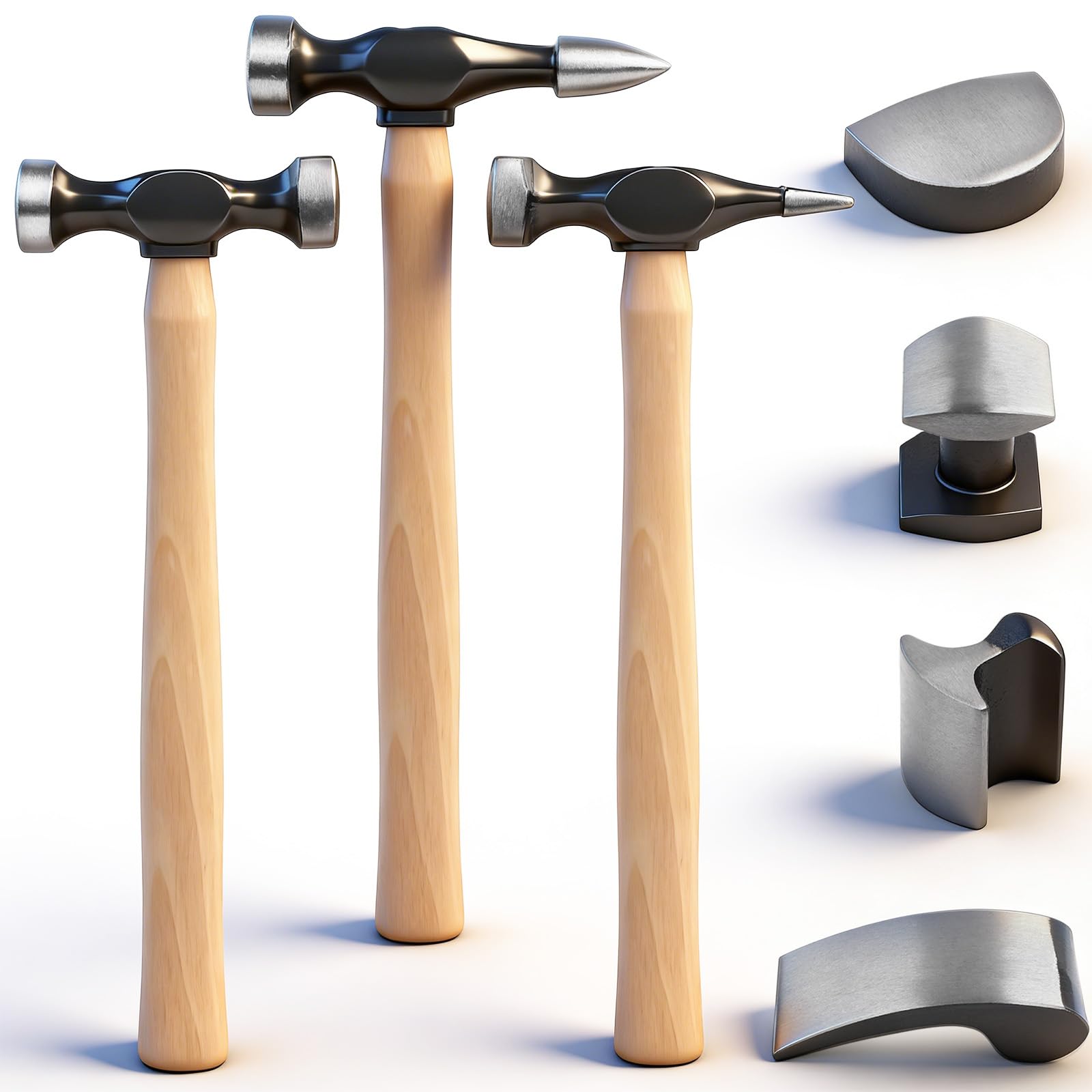
The SWANLAKE 7-piece set mirrors the C&T kit in tool count but differentiates itself through handle design and steel composition. The hammer heads are forged from heat-tempered carbon steel with a rust-resistant coating, and the hardwood handles are shaped for comfort during extended use. The set includes bumping, pick, reverse curve hammers plus four dollies, providing the essential tooling for both major collision repair and precision dent finishing.
Owner feedback from auto body restorers indicates the spoon in this set is thicker than standard, which experienced users consider a benefit for heavier metal-shaping tasks. One buyer reported that their boss praised the set’s quality after comparing it with more expensive alternatives in a professional shop. The cardboard box packaging is functional but basic — it keeps tools organized during shipping but lacks the durability of a dedicated storage case for long-term shop use.
A small number of users experienced handle breakage after missed strikes, though this is a risk with any hardwood-handled hammer during body work. The dollies are functional but not precision-ground to the tolerance of professional-grade sets costing significantly more. For the occasional user who needs legitimate hammer-and-dolly capability without the professional price tag, the SWANLAKE set delivers credible performance.
What works
- Heat-tempered carbon steel holds up to daily shop use
- Thicker spoon shape preferred by experienced restorers
- Hardwood handles absorb impact vibration effectively
What doesn’t
- Cardboard packaging is not a long-term storage solution
- Handle breakage possible on severely missed strikes
8. Srepat 101pcs Paintless Dent Repair Tool Dent Puller Kit

The Srepat 101-piece kit is built around an adjustable bridge puller that can be configured to different dent widths, making it one of the more versatile glue-pulling systems in this comparison. The bridge’s width adjustment allows the user to match the tool’s footprint to the dent’s diameter, distributing pull force evenly across the damage zone rather than concentrating it at a single point. This design reduces the risk of over-pulling or creating a secondary bulge around the repair area.
The kit includes a full glue gun, multiple tab shapes, a plastic hammer for post-pull refinement, and a tap-down pen for addressing high spots. Owner reports indicate the kit successfully reduced a roof dent to near-invisibility after careful work — a result that saved several hundred dollars compared to professional PDR. The ergonomic grip on the puller is comfortable for repeated use, and the variety of tab shapes covers most common dent profiles found on cars and household appliances.
Some users found that their damage was too severe for the glue-pulling approach, which is a limitation of any glue-based system rather than this specific kit. The included plastic hammer is lightweight and suitable only for minor contour adjustments. For DIY users tackling smaller dents and door dings, this kit provides everything needed in a single purchase without requiring additional tools or aftermarket glue.
What works
- Adjustable bridge puller distributes force evenly across dent width
- Complete 101-piece bundle includes glue gun and tap-down tools
- Ergonomic grip design improves comfort during multiple pulls
What doesn’t
- Glue-pulling approach struggles with severe or creased damage
- Included plastic hammer is too light for serious metal adjustment
9. DIQDI 129pcs Dent Repair Kit Paintless Dent Removal System

The DIQDI 129-piece kit is the most comprehensive glue-based PDR ecosystem in this lineup, featuring a three-tool pulling strategy: the Gold Lifter for small dents, a Bridge Puller for medium damage, and a heavy-duty 2-in-1 T-Bar with slide hammer for large pulls. This tiered approach allows the user to select the appropriate tool based on dent size and resistance, rather than forcing a one-size-fits-all solution. The inclusion of air wedge bags for panel access is a thoughtful addition that many competing kits omit.
The kit ships with a fast-heating glue gun, rubber hammer, tap-down pen, and panel removal tools — essentially everything required for a complete PDR workflow. The paint-safe rubber bases on the pullers protect the vehicle’s finish during operation, and the hot-melt glue is formulated to dissolve completely with 75% or higher rubbing alcohol, leaving no residue. Owners who used the full system reported extracting up to 90% of the damage from dented doors, with results that required deliberate searching to detect.
Quality control concerns appear in the feedback — some users experienced poor glue adhesion and components that loosened during use. A portion of reviewers found the kit underwhelming for the piece count, noting that many included items are small accessories rather than core tools. The 129-piece count inflates the perceived value, but the core pulling tools themselves are well-designed for their intended purpose. For buyers who want every possible accessory in one box, this kit delivers breadth if not perfectly consistent depth.
What works
- Three-tier pulling system matched to dent size categories
- Air wedge bags and panel tools included for complete workflow
- Alcohol-soluble glue leaves no paint damage when removed correctly
What doesn’t
- Inconsistent glue adhesion reported in some units
- High piece count includes many small filler accessories
10. 97PCS Auto Body Dent Repair Tool Kit with Golden Lifter

This 97-piece kit positions itself as a complete starter package for paintless dent removal, centered around a golden lifter tool and a slide hammer T-bar puller. The golden lifter is a dedicated small-dent tool that works well on shallow impacts where precision matters more than raw force. The T-bar puller complements it for larger dents that require a broader pulling surface and more aggressive tension. Owner reports consistently note that the kit successfully removed noticeable dents from newer vehicles, saving the cost of a professional PDR visit.
The glue gun delivers consistent melting temperature for the included sticks, and the plastic tab selection covers multiple dent shapes and sizes. Several owners described the kit as having a few genuinely useful tools surrounded by filler items like basic gloves, suction cups, and microfiber cloths that inflate the piece count. The T-bar puller head has a reported tendency to loosen after repeated use, with one owner applying Loctite to solve the issue. The golden lifter received more consistent praise for its effectiveness on small to medium dents.
A small but notable number of users reported complete failure with the glue tabs pulling off the plastic before the dent moved, suggesting batch inconsistency in the adhesive provided. The plastic silver attachment on the golden lifter shows warping after limited use, raising questions about long-term durability. For the DIY user who wants a broad tool selection and is willing to potentially upgrade the glue and a few attachments, this kit offers enough functional core tools to justify the investment.
What works
- Golden lifter excels on small to medium shallow dents
- T-bar puller provides wide pulling surface for larger damage
- Broad tool selection covers most basic PDR needs in one box
What doesn’t
- T-bar puller head loosens during use; may need thread locker
- Plastic attachment on lifter shows warping after limited use
11. Super PDR Dent Puller Kit with Bridge Puller

The Super PDR kit uses an arched bridge puller design that allows the user to adjust the spacing and rotate the pull button to better match the dent’s shape. The bridge’s rubber base pads protect the vehicle’s paint during operation, and the six prismatic pull rods are designed to create a stronger mechanical bond with the hot-melt glue. The kit is marketed toward both novices and experienced users, with a claimed 99% dent removal success rate within 30 minutes, though real-world results vary based on dent severity and user technique.
Owner reports are split between genuine satisfaction and notable frustration. Several users successfully reduced grocery cart dings and sharp creases by up to 95%, leaving only a barely perceptible depression that required deliberate searching to find. One user paired the kit with Gorilla-brand glue sticks for stronger adhesion and reported excellent results on multiple dents. The ergonomic leverage principle used in the bridge design does reduce the physical effort required compared to straight-pull systems.
A substantial number of users experienced the glue popping off before the dent moved, even after careful surface cleaning and heating. The included adhesive was widely cited as the weakest link in the system. Removing residual glue from the paint surface was also reported as more difficult than expected, requiring hair dryers, rubbing alcohol, and significant scraping effort. For buyers willing to invest in aftermarket glue sticks and exercise patience, the bridge puller itself is a capable tool, but the kit as shipped requires upgrades to achieve consistent results.
What works
- Arched bridge design provides adjustable pulling geometry for different dent shapes
- Ergonomic leverage reduces physical effort during pulling
- Rubber base pads protect paint from scratching during use
What doesn’t
- Included glue sticks lack sufficient holding strength for many dents
- Glue residue removal requires significant effort and supplies
Hardware & Specs Guide
Rod Construction Materials
Rod-based dent removers use either spring steel or stainless steel. Spring steel offers greater stiffness and resistance to bending under heavy push loads, making it preferable for deep dents and creases where precise force transmission matters. Stainless steel provides better corrosion resistance and a slight degree of flex that can help prevent over-correction on shallow dings. Rod diameter ranges from roughly 4mm to 8mm — thinner rods access tight panel gaps but flex more, while thicker rods offer control but struggle with restricted access.
Glue Bond Strength
The adhesive used in glue-pulling systems is the single most important factor in repair success. Professional-grade hot-melt glue achieves bond strengths above 1,500 PSI, while budget sticks often fall below 800 PSI, causing the tab to release before the dent moves. Many kits ship with low-grade glue that users replace with aftermarket sticks. Applying glue at the correct temperature — typically between 350°F and 380°F — and allowing proper cooling time (3-5 minutes) directly correlates with pull success rates. Alcohol concentration of 75% or higher is required for clean residue removal.
Slide Hammer Weight and Impact
Slide hammer effectiveness scales with mass and shaft length. A 13-pound hammer like the XtremepowerUS generates substantially more impact force than the 5- to 8-pound hammers found in budget kits. Longer shafts allow a wider swing arc, increasing the velocity and energy transferred to the dent. The tip attachment threading must be precisely machined to prevent cross-threading during high-impact use. Professional shops typically use 10- to 15-pound hammers for structural pulls and reserve lighter units for cosmetic dents.
Hammer and Dolly Metallurgy
Traditional body hammers rely on forged carbon steel with heat tempering to maintain striking face integrity. The hardness rating — typically between 45 and 55 on the Rockwell C scale — determines how well the face resists deformation during repeated strikes. Dollies must be ground to precise contours matching common body curves; the most useful sets include curved, utility, double-end, and shrink dollies. A rust-resistant coating extends tool life in humid garage environments, though the coating on striking faces often requires light sanding to expose bare metal for optimal control.
FAQ
Can a dent remover fix hail damage on a car roof?
What size dent can a DIY kit realistically remove?
Will a dent puller damage my car’s paint?
How long does it take to learn paintless dent removal?
Can I use a dent remover on a refrigerator or washing machine?
Final Thoughts: The Verdict
For most buyers, the best car dent remover winner is the CYGOODS 22 Pcs Rod Kit because it delivers professional-grade spring steel construction and tip versatility that covers the widest range of dent types without relying on consumable glue. If you value brute pulling power for deep creases and heavy damage, grab the XtremepowerUS 13 LBS Slide Hammer. And for traditional hammer-and-dolly work where you want the best value per tool, nothing beats the C&T 7 Piece Kit at its price point.

Certification: BSc in Mechanical Engineering
Education: Mechanical engineer
Lives In: 539 W Commerce St, Dallas, TX 75208, USA
Md Amir is an auto mechanic student and writer with over half a decade of experience in the automotive field. He has worked with top automotive brands such as Lexus, Quantum, and also owns two automotive blogs autocarneed.com and taxiwiz.com.