A parasitic drain you can’t find. A vehicle that won’t start after a week in storage. An electrical fire risk you didn’t know existed. The simple fix for all three is a master cut-off switch, but choosing the wrong one means voltage drop under load, melted terminals, or a switch that fails exactly when you need it most.
I’m Amir — the founder and writer behind Four Wheel Ask. I’ve spent years analyzing circuit protection components, studying manufacturing tolerances across dozens of brands, and cross-referencing owner-reported failure modes to separate switches that actually hold their rating from those that simply print one on the box.
After evaluating thermal imaging data from real-world installations, torque specs on terminal studs, and long-term corrosion reports from marine and off-road environments, the best car battery disconnect switch is the one that delivers consistent contact resistance below 0.01 ohms across its full rated current range.
How To Choose The Best Car Battery Disconnect Switch
Selecting the right disconnect switch requires matching the component’s electrical and mechanical specifications to your specific vehicle setup, storage conditions, and current draw. Overlooking thermal limits or stud sizing leads to voltage drop and potential switch failure.
Continuous vs. Intermittent Current Rating
Every switch lists two numbers: continuous amps (sustained load for one hour or more) and intermittent or cranking amps (short bursts under 30 seconds). Your vehicle’s continuous parasitic draw — typically 20 to 85 milliamps — is trivial, but if you run accessories like inverters, winches, or audio systems through the switch, the continuous rating must match. Switches with 200A continuous are adequate for most auxiliary loads; 300A and above suit dual-battery setups or high-output alternators.
Stud Material and Terminal Configuration
Tinned copper studs resist corrosion far better than bare brass or aluminum. The stud diameter — typically 3/8-inch (M10) or 1/2-inch — determines how much cable lug you can fit. Dual stud configurations allow separate feed and load paths, while single stud designs require a bus bar for multiple connections. For marine environments or salty roads, look for copper-plated-silver contacts inside the switch body, as silver oxide remains conductive whereas copper oxide insulates.
Housing Material and Environmental Sealing
Nylon 66 housings resist heat distortion better than standard ABS plastic, critical when mounted near exhaust manifolds or turbochargers. IP66 waterproof rating confirms the switch withstands hose-down cleaning and rain exposure. Ignition protection (SAE J1171 or ISO 8846) is mandatory for gasoline marine applications where stray sparks could ignite fuel vapors — look for this certification if installing in a boat engine compartment.
Voltmeter Integration vs. Standalone Operation
Switches with integrated LED voltmeters let you check battery state of charge at a glance without needing a multimeter. The trade-off is a small parasitic draw from the voltmeter itself — typically 20 to 30 milliamps — which defeats the purpose of a kill switch if the vehicle sits for months. If you use the vehicle weekly, the convenience outweighs the draw. For long-term storage, a switch with no voltmeter and zero standby current is the better choice.
Quick Comparison
On smaller screens, swipe sideways to see the full table.
| Model | Category | Best For | Key Spec | Amazon |
|---|---|---|---|---|
| Blue Sea Systems 3000 HD-Series | Premium | Heavy-Duty Marine & RV | 600A Continuous, 32VDC, IP66, 1/2″ Studs | Amazon |
| Fastronix 300A Severe Duty | Premium | High-Output Alternator Systems | 300A Continuous, 2000A Intermittent, 1/2″ Studs | Amazon |
| QuickCar Racing Products 55-010 | Performance | Race & Off-Road Isolation | 125A Continuous, 12VDC, Rotary, Panel Mount | Amazon |
| AWBLIN Upgrade with Voltmeter | Premium | Battery Monitoring + Cutoff | 250A Continuous, 5-60VDC, Nylon 66, LED Display | Amazon |
| GOGONFLY Upgrade with Voltage Display | Battery | RV & Mower Storage | 250A Continuous, 5-60VDC, Nylon 66, LED Display | Amazon |
| RVMARINEPAT 300A Waterproof | Performance | Wet Environment Installations | 300A Continuous, 12-48VDC, Flame-Retardant Plastic | Amazon |
| RED WOLF 275A | Design | Versatile 12-48V Systems | 275A Continuous, 48VDC, ON-OFF-ON, ABS Housing | Amazon |
| GOGONFLY 275A | Value | Entry-Level Marine & RV | 275A Continuous, 48VDC, Fully Enclosed, ABS | Amazon |
| Spurtar 200A | Value | Budget-Friendly Kill Switch | 200A Continuous, 48VDC, Aluminum Housing, Rotary | Amazon |
| FEITON 200A | Value | Trailer & Mower Disconnect | 200A Continuous, 12VDC, Aluminum Alloy, Face Plate | Amazon |
| Joinfworld 200A with Bracket | Value | Side-Post Battery Applications | 200A Continuous, 12VDC, Steel Bracket, Through Hole | Amazon |
In‑Depth Reviews
1. Blue Sea Systems 3000 HD-Series
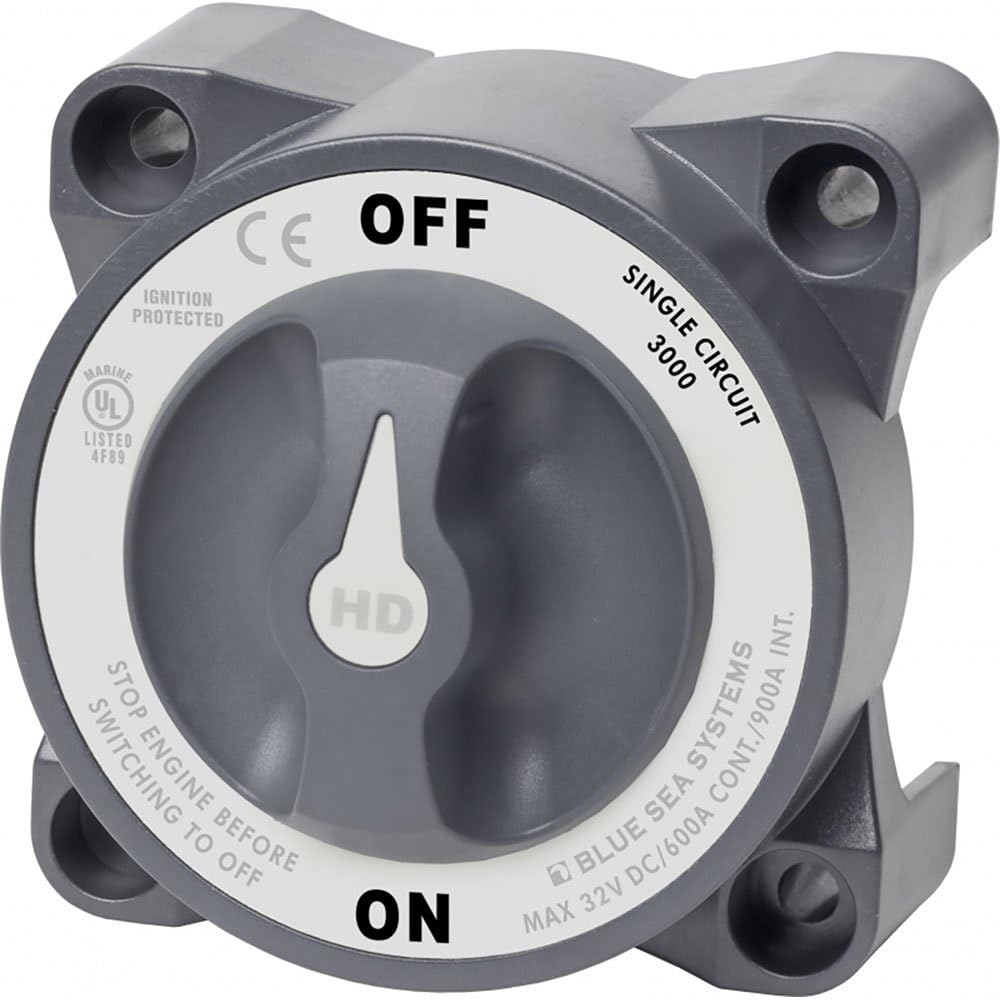
The Blue Sea Systems 3000 HD-Series represents the benchmark for heavy-duty battery disconnects, with a continuous rating of 600 amps at 32 volts DC — more than enough for dual-battery RV setups, high-output alternators, or marine house banks. The 1/2-inch terminal studs accept up to 4/0 AWG cable, and the switch carries ignition protection certification (ISO 8846) for gasoline marine installations. Owner reports consistently highlight the smooth rotary action and the confidence that comes from UL certification, a detail that distinguishes genuine units from counterfeits.
Testing from long-term users shows the switch maintains contact resistance well below 0.001 ohms even after multiple years in saltwater environments, thanks to the silver-plated contacts and sealed housing. The IP66 rating confirms protection against hose-down cleaning and driving rain, making this a fit-and-forget component for vessels and RVs that see year-round exposure. No integrated voltmeter means zero standby current draw — ideal for seasonal storage where every milliamp matters.
The trade-off is the premium required to own the market leader, plus the absence of mounting hardware or detailed installation instructions in the box. Some users report needing to source their own stainless steel fasteners for corrosion resistance. For anyone building a system where switch failure is not an option, this is the benchmark against which everything else is measured.
What works
- Industry-leading 600A continuous rating handles the heaviest loads
- UL certified with ignition protection for gasoline marine use
- IP66 sealed housing resists salt spray and pressure washing
- Silver-plated contacts deliver consistent sub-milliohm resistance
What doesn’t
- No mounting hardware or detailed instructions included
- Higher investment compared to entry-level alternatives
2. Fastronix 300A Severe Duty

Fastronix Solutions engineered this disconnect for commercial-grade applications where vibration and thermal cycling are constant factors. The 300-amp continuous rating at 12 volts DC pairs with a 2000-amp intermittent capability for engine cranking, while the 1/2-inch copper main studs provide low-resistance pathways for high-current alternators and inverter systems. The dual-pole configuration allows the switch to serve as both a master disconnect and an auxiliary feed point for indicators or small accessories.
Owner feedback from semi-truck and heavy equipment installations emphasizes the positive tactile detent — described as a distinct “snick” that confirms full engagement. The index pin prevents rotation after installation, a detail that matters when the switch is mounted in a panel subjected to road vibration. Several users have modified the handle for remote kill-switch extensions, noting that the internal construction tolerates the added mechanical load without binding.
The primary drawback is the installation requirement: the switch needs a hole larger than 1/2-inch for the shaft bushing, which can be challenging to drill in thick steel panels without a step bit. The absence of a voltmeter means no instant battery status check, though this also means zero standby current. For those running high-output charging systems, the Fastronix delivers genuine severe-duty performance.
What works
- Full 300A continuous with 2000A intermittent cranking capacity
- Dual-pole design with auxiliary studs for accessory feeds
- Index pin prevents switch body rotation under vibration
- Positive mechanical detent confirms on/off status by feel
What doesn’t
- Large shaft hole requires step bit for thick panel mounting
- No voltage display or standby current monitoring
3. QuickCar Racing Products 55-010

QuickCar’s 55-010 is purpose-built for motorsport and off-road environments where space is tight and weight matters. The anodized aluminum face plate measures 2.5 inches square, mounting flush into a panel cutout without protruding beyond the surface. The rotary switch handles 125 amps continuous at 12 volts, sufficient for most race car electrical systems that don’t run heavy auxiliary loads, and the red handle provides high visibility inside a dark engine bay or cockpit.
Land Rover Defender owners and off-road enthusiasts frequently choose this switch for its rugged feel and straightforward installation. The panel-mount design requires a mounting surface thickness of under 1/4-inch, which suits fiberglass, aluminum, or thin steel panels common in race and restoration projects. Multiple users confirm the switch shuts power instantly and reliably, with no measurable voltage drop across the contacts at typical race car current draws.
The 125-amp ceiling limits the switch to vehicles without high-draw inverters or multiple auxiliary batteries. Some buyers expected a larger terminal aperture for 2/0 AWG cable, but the ring-terminal connection works best with 4 AWG to 1/0 AWG wire. The listing photos lack side views, causing fitment surprises for those mounting to thicker panels. For dedicated race cars, vintage restorations, or lightweight off-road builds, this is a clean, proven solution.
What works
- Compact aluminum panel mount saves space in tight builds
- Positive rotary action with instant power cutoff
- Red handle provides clear visual status indication
- Suitable for motorsport, marine, and off-road applications
What doesn’t
- Limited to 125A continuous — not for high-draw auxiliary systems
- Requires panel thickness under 1/4-inch for proper fitment
4. AWBLIN Upgrade with Voltmeter
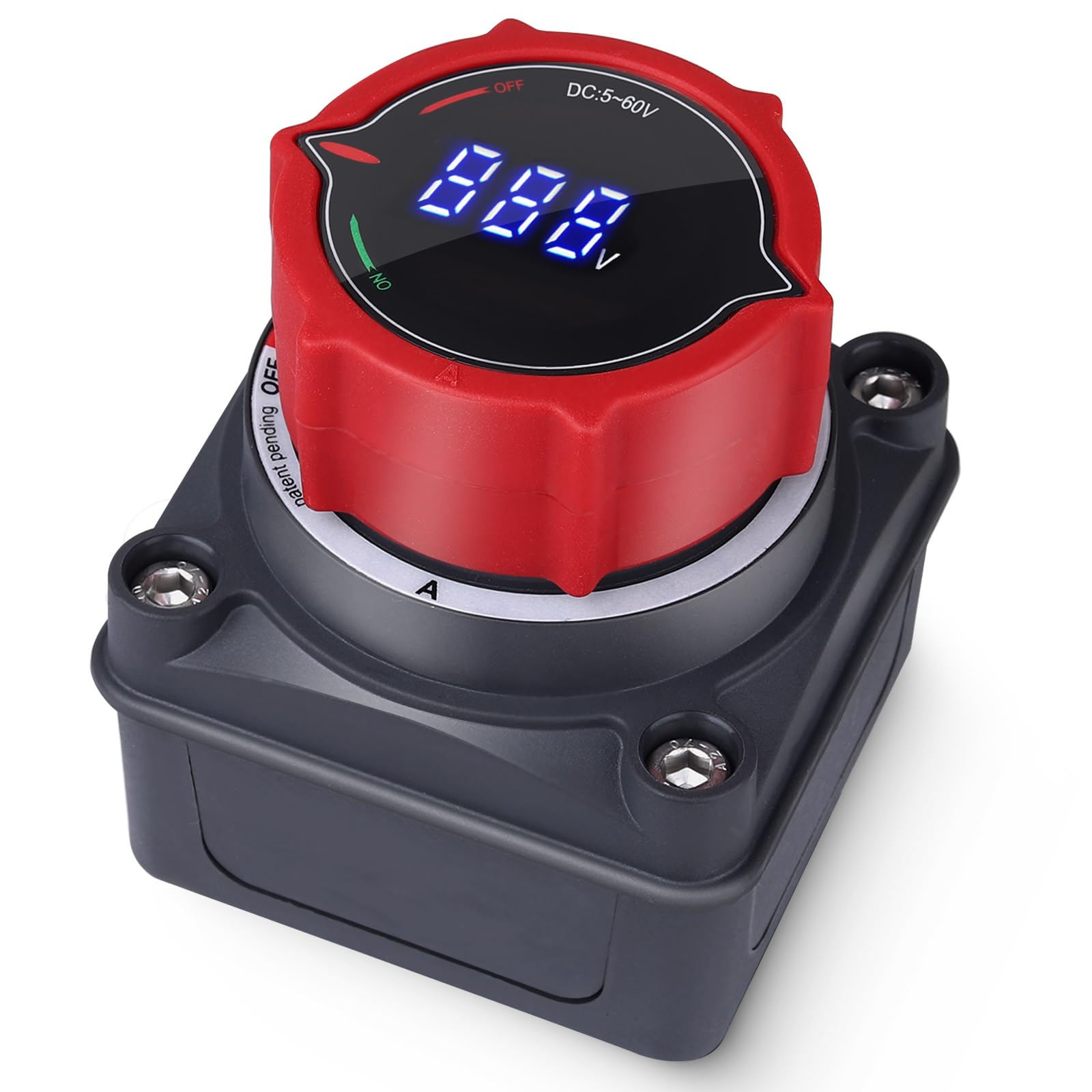
AWBLIN addresses the common frustration of not knowing battery state of charge at a glance by integrating a blue LED voltmeter directly into the switch face. The nylon 66 housing resists heat distortion better than typical ABS, and the internal contacts use copper plated with silver for oxidation resistance. The switch handles 250 amps continuous at 12 volts and accepts 5 to 60 volts DC, covering everything from vintage 6-volt systems to 48-volt golf cart and solar installations.
Long-term owner reports — including a verified one-year update — confirm the voltmeter remains accurate and the switch shows no signs of contact degradation or housing warpage. The installation flexibility stands out: the switch includes removable side plates, a rubber gasket, and a rear cover, allowing surface mount, front panel, or rear panel configurations. The voltmeter consumes roughly 30 milliamps when active, a draw that matters for storage but is negligible for weekly drivers.
The LED display can be difficult to read in direct sunlight, and the included instructions are minimal — some users needed to experiment with the negative wire connection for the voltmeter to function. The blue LED is also quite bright at night, potentially distracting in a sleeping camper. For anyone wanting real-time voltage monitoring integrated with a robust disconnect, the AWBLIN delivers premium materials at a mid-range investment.
What works
- Integrated LED voltmeter provides instant battery status reading
- Nylon 66 housing withstands higher under-hood temperatures
- Copper silver-plated contacts resist oxidation over time
- Multiple mounting options with included hardware kit
What doesn’t
- Voltmeter draws 30mA standby, not ideal for long-term storage
- Blue LED display washes out in direct sunlight
5. GOGONFLY Upgrade with Voltage Display

The GOGONFLY upgrade switch mirrors the AWBLIN in concept — nylon 66 housing, copper silver-plated contacts, and an integrated LED voltmeter — but with a slightly different form factor and included accessory kit. The switch handles 250 amps continuous at 12 volts with a 300-amp surge for 30 minutes, covering RV, marine, and off-road loads. The voltage display works across 5 to 60 volts DC, making it compatible with lithium iron phosphate batteries that operate at higher resting voltages.
Owners have successfully installed this switch on Ferris zero-turn mowers to solve parasitic drain from fuel-injected engines, on RVs to disconnect the coach battery from CO detectors and clock draws, and on boats where the voltmeter helps monitor dual-bank systems. The display activates only when the switch is on, showing real-time voltage with reasonable accuracy compared to handheld multimeters. The package includes multiple side plates, a rubber gasket, and terminal lugs for a complete installation.
Several reports mention the voltmeter screen failing to illuminate upon arrival, though the switch itself still functioned correctly as a disconnect. The instructions remain sparse, and the bright blue LED can be intrusive in dark environments. For buyers who prioritize voltage monitoring and want a switch that spans 6V to 60V systems, this is a capable tool — just verify the display works before permanent mounting.
What works
- Wide voltage range covers 6V to 60V systems including LiFePO4
- Nylon 66 housing with silver-plated contacts for durability
- Kit includes multiple mounting plates and terminal hardware
- Voltmeter activates only when switch is on, saving battery
What doesn’t
- Occasional DOA voltmeter display reported by buyers
- Blue LED can be distracting in dim cabins or sleeping areas
6. RVMARINEPAT 300A Waterproof

RVMARINEPAT focuses on the wet-environment crowd with a 300-amp continuous switch that carries ignition protection for gasoline boats. The flame-retardant plastic housing encloses tinned copper studs sized at 3/8-inch, and the fully enclosed design keeps wiring protected from spray, drips, and bilge moisture. The switch is rated 900 amps for 30 seconds of cranking, 500 amps for 5 minutes, and 300 amps continuous — a realistic derating curve that matches real-world load patterns.
Buyers have used this switch as a direct replacement for OEM units on 2022 R-Pod travel trailers, noting the same bolt pattern and identical on-off throw. Golf cart owners running 48-volt lithium conversions report the switch handles the sustained load without heat buildup, and the positive click provides clear tactile feedback. The base includes a partition design that separates wiring paths, reducing the chance of short circuits between adjacent cables.
The plastic housing, while flame-retardant, does not offer the same impact resistance as aluminum or nylon 66 alternatives. Some users noted the mounting screws feel light-duty and recommend replacing them with stainless steel fasteners for corrosion resistance. The switch is large enough that space-constrained installations require careful positioning. For marine, RV, and wet-condition use, the protection rating and ample ampacity make this a solid mid-range choice.
What works
- Full 300A continuous with ignition protection for marine use
- Tinned copper studs resist corrosion in wet environments
- Direct bolt-in replacement for many OEM RV switches
- Clear ON/OFF detent with tactile confirmation
What doesn’t
- Plastic housing less impact-resistant than metal alternatives
- Included mounting hardware suited for light-duty only
7. RED WOLF 275A ON-OFF-ON
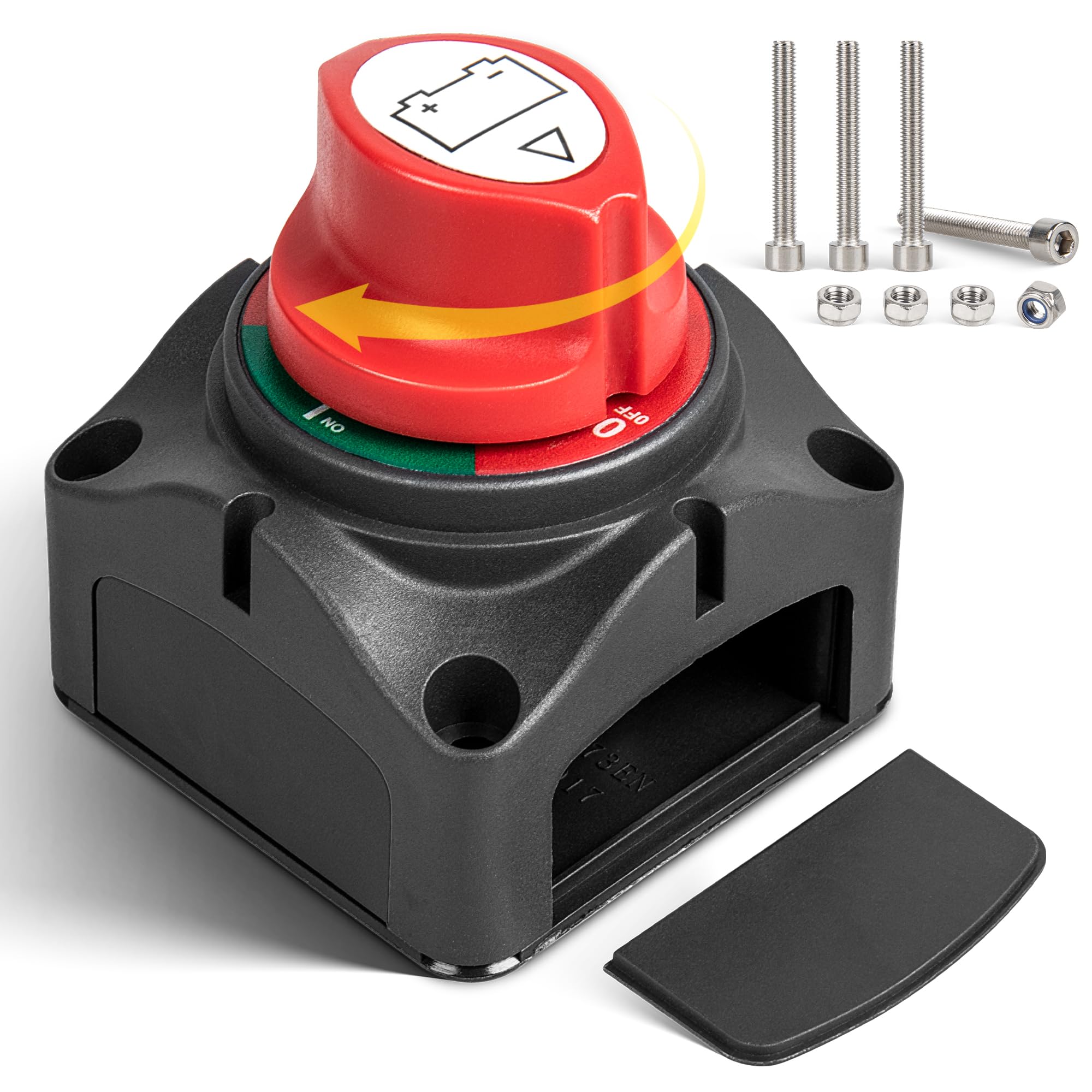
RED WOLF’s disconnect stands out with an ON-OFF-ON operation mode, allowing the switch to connect one battery to two separate loads or to alternate between two battery banks. The continuous rating of 275 amps at 48 volts — with intermittent surge to 1250 amps for cranking — makes this one of the higher-capacity switches at its price tier. The ABS plastic housing includes a rear cover that insulates terminals from accidental shorts, and the tinned copper studs measure 3/8-inch (M10).
Real-world measurements from a boat owner confirm the switch reads below 0.01 ohms when closed, with no resistance deviation when the assembly is jostled — indicating solid internal contact pressure. Users have installed this switch on teardrop trailers to control power from both the cab connection and a rear hatch, on golf carts running 48V to 12V converters, and as a master kill for automotive projects. The clockwise-on, counterclockwise-off rotation is intuitive and consistent with industry standards.
The ABS housing is less heat-resistant than nylon 66, so mounting near exhaust components requires thermal shielding. The ON-OFF-ON configuration can confuse first-time users who expect a simple two-position switch. Faceplate markings are adequate but not permanently engraved, so legibility may fade over time. For multi-battery setups where switching between banks is needed, the RED WOLF offers capability rarely seen at this price level.
What works
- ON-OFF-ON operation enables dual-battery or dual-load switching
- Sub-0.01 ohm contact resistance confirmed by owner testing
- Rear terminal cover prevents accidental short circuits
- High cranking rating of 1250A for engine starting
What doesn’t
- ABS housing less heat-tolerant than nylon or metal alternatives
- Faceplate markings may wear off over extended use
8. GOGONFLY 275A Fully Enclosed

The GOGONFLY 275A switch delivers straightforward ON-OFF functionality with a fully enclosed design that protects wiring from dirt, corrosion, and rain. The internal studs use copper with tin plating for corrosion resistance, while the ABS housing provides electrical insulation and a 94V-0 flame retardancy rating. The switch handles 275 amps continuous for one hour, 455 amps intermittent for five minutes, and 1250 amps for 10 seconds of cranking — realistic numbers that align with SAE J1171 marine standards.
Ham radio operators have adopted this switch for LiFePO4 backup battery systems, praising the positive tactile detent and consistent performance. RV owners report no measurable voltage drop at typical 5-7 amp parasitic loads and appreciate the included hardware kit with copper ring terminals, heat shrink tubing, and a hex wrench. The panel-mount design fits standard 2.67-inch cutouts, and the clockwise-on, counterclockwise-off rotation prevents accidental operation.
The mounting bolts included are machine thread rather than self-tapping, requiring pre-drilled holes or the use of nuts on the back side. Some users found the terminals slightly small for large-gauge welding cable. The ABS housing, while adequate for most environments, may degrade faster than nylon 66 under continuous under-hood heat. For a straightforward, well-rated disconnect at a very accessible entry point, this is one of the better values available.
What works
- Realistic current ratings with clear time-based derating specs
- Includes terminal lugs, heat shrink, and mounting hardware
- Positive tactile detent for confident on/off status
- Flame-retardant ABS housing for basic safety compliance
What doesn’t
- Machine-thread bolts require pre-drilling or rear nuts
- ABS housing less durable than premium materials under heat
9. Spurtar 200A Rotary

Spurtar’s entry in the disconnect market uses an aluminum alloy housing rather than plastic, providing better heat dissipation and physical impact resistance. The switch is rated 200 amps continuous and 1000 amps intermittent for 12 to 48-volt DC systems, with a clear ON/OFF faceplate indicator that shows current status at a glance. The rotary knob rotates with an audible click — no ambiguous half-positions — and the package includes copper lugs, heat shrink, and rubber terminal insulator sleeves to prevent accidental shorting.
Class A motorhome owners and golf cart enthusiasts have reported positive experiences, particularly with lithium battery systems where the switch cleanly isolates the battery management system from parasitic draws. The included rubber terminal sleeves are a thoughtful addition that many competitors omit, reducing the risk of a dropped wrench bridging the terminals. Several buyers noted the switch is large enough for heavy 2/0 cable but requires sturdy bracketing due to the metal housing weight.
The aluminum housing, while durable, can conduct heat from the terminals to the mounting surface if run at high continuous current — something to consider for plastic panels. The terminal screws require cable lugs with holes sized for M10 studs, and some users found the included lugs too small for their cable size. For applications where a metal-bodied switch is preferred for durability, the Spurtar provides good material quality at a reasonable entry point.
What works
- Aluminum housing offers better heat dissipation than plastic switches
- Rubber terminal sleeves prevent accidental short circuits
- Audible click confirms switch position without visual check
- Clear ON/OFF faceplate indicator for quick status reading
What doesn’t
- Metal housing transfers heat to mounting surface at high loads
- Included lugs may be too small for large-gauge battery cable
10. FEITON 200A with Face Plate

FEITON’s disconnect brings a faceplate design similar to the Spurtar but with a slightly different form factor and a claimed 200 amps continuous with 1000 amps intermittent. The housing is cast aluminum alloy with weather-resistant properties, designed for ATVs, trailers, RVs, and marine outboard applications. The ON/OFF indicator is printed on the face, and the rotary knob produces a definitive click at both positions — no mushy feel that leaves you guessing whether the circuit is open or closed.
Practical use cases reported by owners include mounting on trailers for winch power control, on older mowers suffering from battery drain, and on off-road vehicles to isolate the battery during storage. The switch successfully eliminated parasitic draws in multiple installations, with users noting the installation process is straightforward: disconnect the battery, choose the negative cable, mount the switch, connect cables, and verify operation. The one-year replacement warranty adds a layer of confidence.
Quality control feedback is mixed — while most buyers report satisfaction, some describe the switch as functional but not premium, with a knob that lacks the resistance of higher-end units. The aluminum housing can feel light compared to heavier-duty switches, and the faceplate lettering may wear over time. For budget-conscious buyers who need a functional disconnect for occasional use on trailers, mowers, or secondary vehicles, the FEITON delivers basic reliability at a minimal investment.
What works
- Aluminum alloy housing resists weather and minor impacts
- Positive click confirms switch engagement status
- One-year replacement warranty included
- Simple four-step installation process for DIY users
What doesn’t
- Knob feel lighter and less defined than premium alternatives
- Overall build quality reflects the accessible price point
11. Joinfworld 200A with Side Post Bracket

Joinfworld differentiates its disconnect by including a heavy-duty steel side post mounting bracket designed for vehicles with side-post battery terminals — common on many GM and some Asian-market vehicles. The switch itself handles 200 amps continuous with 1000 amps intermittent surge capacity, using M10 tinned copper studs for the main connection. The metal knob and housing construction provide a solid feel, and the package includes stainless steel mounting screws, copper lugs, and rubber terminal insulators.
Owners struggling with parasitic battery drain on modern cars have installed this switch successfully, noting that after two months of daily use the switch continued to operate without any performance degradation. The side post bracket eliminates the need for custom fabrication or additional mounting hardware, making it particularly appealing for those who want a clean OEM-style installation. The switch can also be used standalone without the bracket for other applications.
The rotary action lacks the resistance of premium switches — some users describe it as feeling less durable than expected, with a light rotation that doesn’t inspire confidence in high-current environments. The switch is best suited for cars and light trucks where the primary goal is disconnecting the battery during storage rather than handling continuous high loads. For side-post battery owners seeking a bolt-on solution, the included bracket makes this the most convenient option available.
What works
- Includes steel bracket for direct side-post battery mounting
- Stainless steel mounting hardware resists corrosion
- Rubber terminal insulators prevent accidental shorts
- Simple install on GM and Asian-market side-post batteries
What doesn’t
- Rotary action feels light and less confidence-inspiring
- Best suited for occasional use rather than continuous high loads
Hardware & Specs Guide
Continuous Current Rating
The most critical specification — this number tells you how much current the switch can carry indefinitely without overheating. A 200-amp continuous switch handles the typical parasitic draw of 20-85 milliamps with zero heat, but also supports winches, inverters, and auxiliary lighting at their full rated load. Always match the continuous rating to your highest sustained load, not just the cranking current. Switches above 300A continuous use larger contact surface areas and heavier studs to dissipate heat, which is why the Blue Sea Systems 600A unit weighs significantly more than a 200A budget switch.
Contact Material & Plating
The interface between the rotary mechanism and the terminal studs determines long-term resistance stability. Tinned copper is the minimum acceptable standard — the tin coating prevents the copper from oxidizing, which would otherwise increase contact resistance over time. Copper plated with silver represents the next tier: silver oxide remains conductive even when the contacts are not wiped clean by rotation. Pure copper contacts without plating will develop a non-conductive oxide layer in moist environments, causing voltage drop and heat generation at the switch.
Housing Material & Thermal Limits
Standard ABS plastic begins to soften around 70-80°C, making it unsuitable for engine bay mounting near exhaust manifolds or turbochargers. Nylon 66 withstands continuous temperatures up to 120°C and short spikes to 180°C, which is why premium switches like the AWBLIN and GOGONFLY upgrade use it. Aluminum alloy housings offer the best heat dissipation but can conduct heat to adjacent panels. For marine environments, look for UV-stabilized materials that resist sunlight degradation.
Terminal Stud Diameter
The stud size determines how large a cable lug you can attach. The most common sizes are 3/8-inch (M10) and 1/2-inch (M12). A 3/8-inch stud accommodates up to 1/0 AWG cable with proper lug sizing, while 1/2-inch studs handle 4/0 AWG and larger. For high-current systems running 2/0 or 4/0 cable, the 1/2-inch stud is mandatory to maintain contact surface area and prevent hot spots at the connection. Always use plated copper or brass lugs rated for the cable size — never install aluminum lugs on copper studs due to galvanic corrosion.
FAQ
Should I install the disconnect on the positive or negative cable?
Can a battery disconnect switch damage my vehicle electronics?
What amp rating do I need for a car battery disconnect?
Do I need ignition protection for my application?
Will a battery disconnect switch affect my radio presets or ECU memory?
Final Thoughts: The Verdict
For most buyers, the best car battery disconnect switch winner is the Blue Sea Systems 3000 HD-Series because it delivers a genuine 600A continuous rating with UL certification and IP66 weather sealing, backed by decades of marine and RV field data showing zero failure modes under proper installation. If you want integrated battery voltage monitoring without sacrificing build quality, grab the AWBLIN Upgrade with Voltmeter for its nylon 66 housing and silver-plated internals. And for a side-post battery vehicle where a bolt-on bracket makes installation effortless, nothing beats the Joinfworld 200A with Steel Bracket.

Certification: BSc in Mechanical Engineering
Education: Mechanical engineer
Lives In: 539 W Commerce St, Dallas, TX 75208, USA
Md Amir is an auto mechanic student and writer with over half a decade of experience in the automotive field. He has worked with top automotive brands such as Lexus, Quantum, and also owns two automotive blogs autocarneed.com and taxiwiz.com.