That grinding click instead of a roar from your side-by-side tells you everything: your UTV battery has given up, likely at the worst possible moment miles from the trailer. Whether you are fighting mud in a Polaris RZR, hauling feed in a Kawasaki Mule, or pushing snow with a Can-Am, the battery is the single component that decides whether your day starts or stalls. Lead-acid units that served your grandfather’s tractor simply cannot handle the parasitic drain of modern EFI systems, winch loads, and LED light bars that UTV owners demand.
I’m Amir — the founder and writer behind Four Wheel Ask. I have spent years analyzing battery chemistry, cold cranking amp data, and real owner durability reports across powersports applications to separate marketing wattage from real-world starting power.
This guide breaks down the top contenders across AGM and lithium chemistries to help you pick the right best utv battery for your machine, riding style, and budget without guessing or overpaying.
How To Choose The Best UTV Battery
Selecting a UTV battery is not the same as buying one for a car. Side-by-sides endure constant vibration, temperature swings from sub-freezing dawn rides to 140°F engine bay heat, and electrical loads that spike when you push a winch button. Prioritize the factors below to match the battery to your machine’s actual demands.
Cold Cranking Amps vs. Reserve Capacity
Cold cranking amps (CCA) measure the battery’s ability to spin a cold engine. A high-compression 1000cc twin-cylinder UTV needs serious CCA to overcome compression on a 20°F morning. Reserve capacity (minutes the battery can sustain a 25-amp load) matters more if you run winches, lights, and sound systems with the engine off. AGM batteries traditionally offer balanced numbers, while lithium units deliver massive CCA in a smaller case but often list lower amp-hour ratings — the trade-off of lighter chemistry.
Lithium vs. AGM Chemistry
LiFePO4 lithium batteries save 8–12 pounds, crank faster, and recharge quicker than any lead-acid alternative. They also require a charging system that outputs below 15 volts, typically found on modern EFI-equipped UTVs. Older machines with unregulated stators may overcharge and damage lithium packs. AGM absorbed glass mat batteries handle overcharging better, tolerate higher vibration without internal damage, and cost significantly less upfront. If your UTV lives in extreme cold and you store it uncharged for months, AGM remains the safer bet.
BMS Protection and Voltage Monitoring
A lithium battery without a robust Battery Management System (BMS) is a fire risk. The BMS balances individual cells, prevents over-discharge, and shuts down the battery under over-temperature or short-circuit conditions. Premium lithium picks now include LCD voltage readouts so you can monitor state of charge from the battery case — a feature that matters when you are running accessories and need to know if you have enough left to start. AGM batteries have no BMS, so their voltage drops linearly, giving you a clearer reading with a standard multimeter.
Quick Comparison
On smaller screens, swipe sideways to see the full table.
| Model | Category | Best For | Key Spec | Amazon |
|---|---|---|---|---|
| Antigravity ATX12-HD | Lithium | Built-in jump start | Re-Start Technology, 8Ah | Amazon |
| Odyssey ODS-AGM28L | AGM | Extreme cycles | 70% longer cycle life, 24.5 lb | Amazon |
| TYKOOL LFP20L-BS-PRO | Lithium | High-draw accessories | 600CCA, 12Ah, 4.2 lb | Amazon |
| Optima 34 REDTOP | AGM | Vibration resistance | 800 CCA, SpiralCell, 50 Ah | Amazon |
| Anti-Gravity AG-ATZ-10-RS | Lithium | Re-Start backup | Built-in jump start button | Amazon |
| TYKOOL LFP14-BS-STD | Lithium | Weight savings | 400CCA, 8Ah, 3.3 lb | Amazon |
| MARXON Group 34 | AGM | Passenger car backup | 55Ah, 650CCA, Start-Stop | Amazon |
| Yuasa YUAM3RH2S | AGM | Budget ATV/UTV | 180CCA, 10Ah, dry charge | Amazon |
| Odyssey PC625 | AGM | Compact powersports | 220CCA, fast recharge | Amazon |
In‑Depth Reviews
1. Antigravity ATX12-HD

The Antigravity ATX12-HD is the only UTV battery with a built-in jump start button — no jumper cables, no second vehicle, no tow start. The Re-Start feature uses a reserve of power stored in the BMS that you can release by pressing a button on the battery case. For riders who work their machines deep in the woods or on job sites, this single feature eliminates the most common stranded scenario: a drained battery from leaving the key on or running accessories too long.
At 3 pounds and roughly 8Ah, this lithium pack delivers performance that rivals AGM batteries twice its weight. The Quad Terminal design fits both polarity orientations by rotating the battery 180 degrees, making it a direct drop-in for most UTV, ATV, and motorcycle applications. The case dimensions (5.9 x 3.4 x 5.2 inches) match standard group sizes, so you will not need adapter brackets or shims.
The BMS provides full protection against over-charge, over-discharge, and over-temperature, which is critical when using a lithium battery in a UTV that sees extreme heat under the hood. Charging is roughly five times faster than lead-acid — a practical advantage if you do short trips and need the battery to recover quickly. Some users report that the built-in voltage readout would be a welcome addition but the existing LCD indicator provides a simple state-of-charge check.
What works
- Integrated Re-Start jump start button is a genuine trail-saver
- Quad Terminal design fits left or right polarity without adapter cables
- Ultra-light build reduces vehicle weight by nearly 10 pounds versus AGM
What doesn’t
- Does not include an LCD voltage display, only simple indicator LEDs
- Premium price reflects the Re-Start feature; most riders pay for insurance they may never use
2. Odyssey Battery ODS-AGM28L
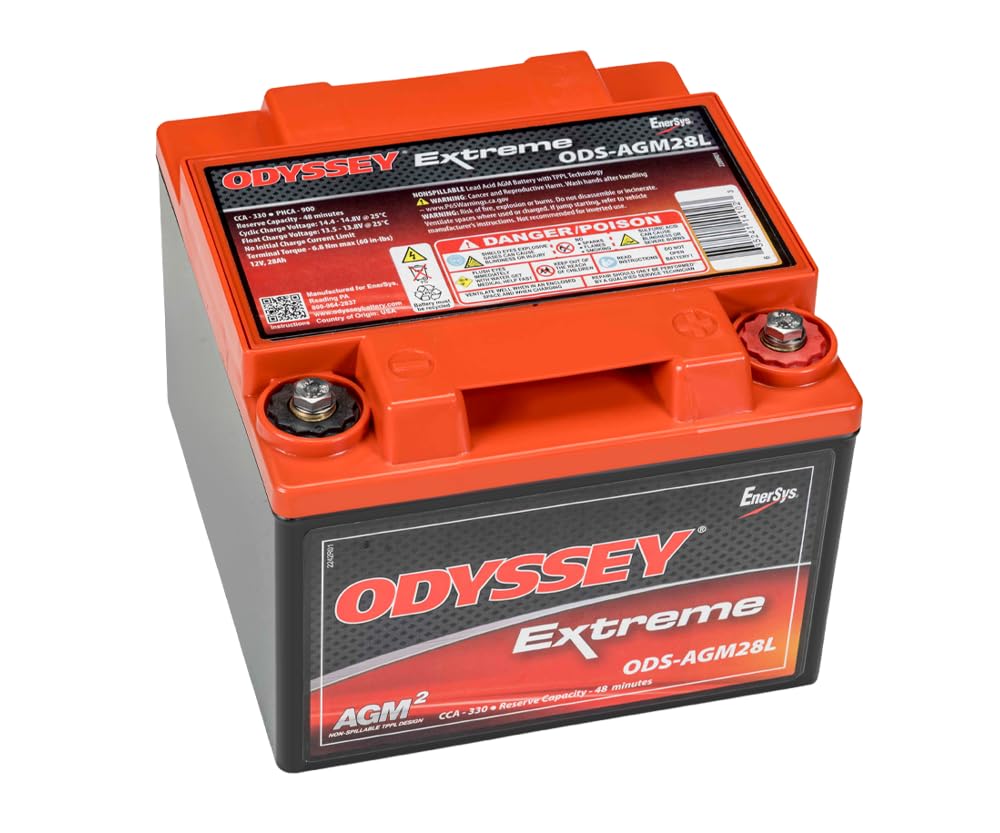
The Odyssey ODS-AGM28L represents the absolute peak of lead-acid engineering. Odyssey claims 70% longer cycle life than conventional deep-cycle AGM batteries, and independent testing backs that up — these units commonly last 6 to 8 years in high-vibration applications like farm UTVs and construction site buggies. The 24.5-pound weight is substantial but the trade-off is a dense, vibration-resistant block that refuses to quit under constant pounding.
This battery uses thin plate pure lead (TPPL) technology, which allows faster recharge acceptance than standard AGM designs. If your UTV has a high-output alternator, the Odyssey recharges fully in half the time of a typical sealed lead-acid battery. The 12V, 28 amp-hour rating provides strong reserve capacity for winch cycles and accessory loads without voltage sagging below the ECU cut-off threshold.
The AGM28L features M6 threaded terminals that accept ring terminals cleanly, a detail that matters when you are wiring aftermarket lights or a fuse block. It ships fully charged and sealed — no acid filling required. The main drawback is the weight, which makes it less attractive for racing or dune applications where every pound counts. For heavy-use utility machines that need reliable starting day after day, this is the pick.
What works
- Industry-leading cycle life for AGM; regularly outlasts other sealed lead-acid batteries
- Fast recharge acceptance works well with high-output charging systems
- M6 threaded terminals simplify adding accessory wiring
What doesn’t
- Weighs over 24 pounds — significant penalty for weight-sensitive applications
- Higher initial cost than standard AGM batteries; requires multi-year ownership to pay off
3. TYKOOL LFP20L-BS-PRO
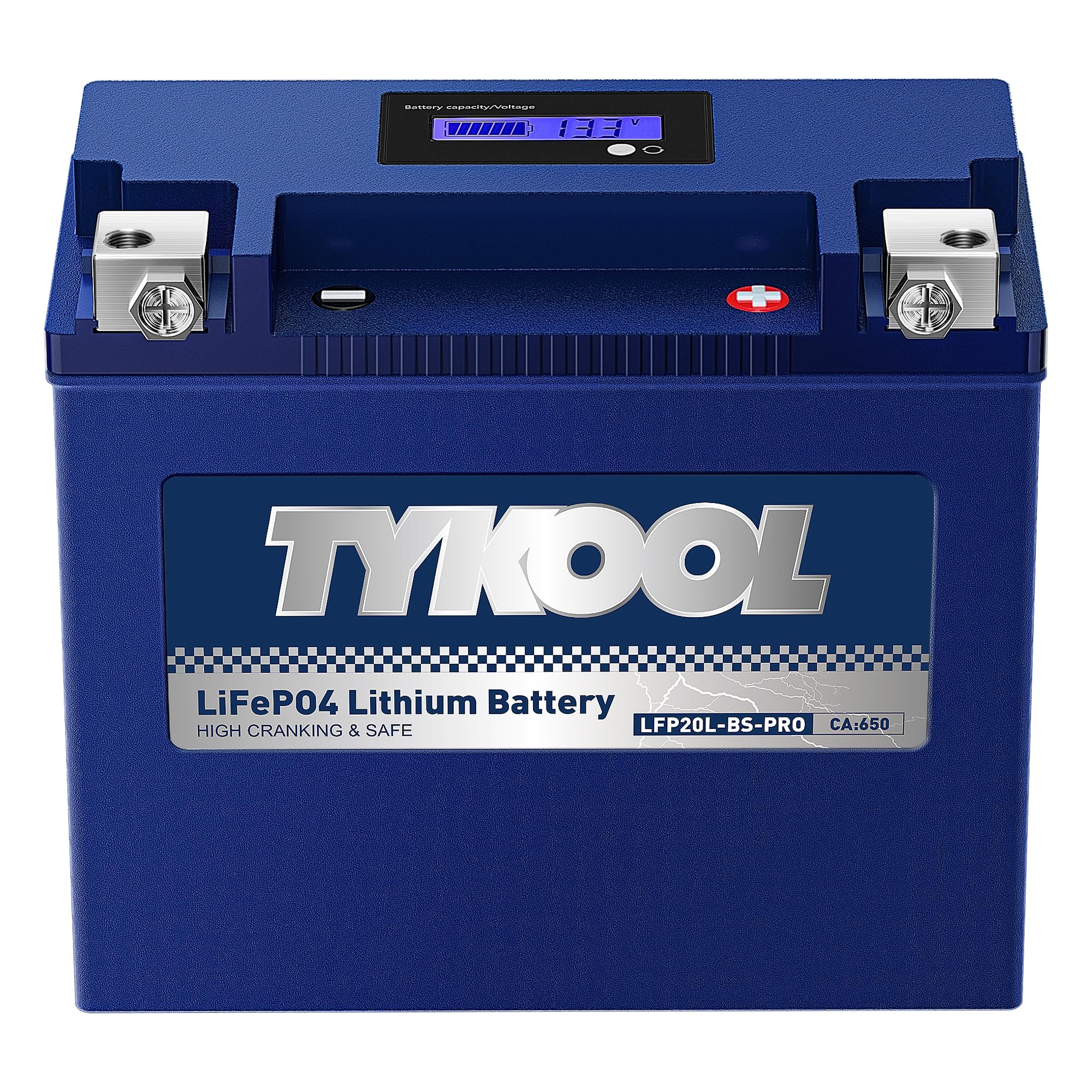
The TYKOOL LFP20L-BS-PRO packs 600CCA into a 4.2-pound case that drops directly into the YTX20HL-BS and GYZ20L sizes common on Polaris Ranger XP 1000, Sportsman 850, and many Kawasaki Teryx models. Twelve amp-hours of LiFePO4 capacity provide enough reserve to run a winch through multiple pulls without dropping voltage below starting threshold. The LCD digital readout shows voltage to 0.1V accuracy, giving you a precise gauge of remaining charge.
The IP66 waterproof rating and vibration-isolated internal architecture are critical for UTVs that cross creeks, plow snow, or bounce over rock gardens. This unit is built to survive what would kill a conventional flooded battery in one season: constant jolts, submersion, and extreme temperature swings from -4°F to 140°F. The 1.2Ah cells are matched and balanced by a smart BMS that performs 2500+ cycles under normal use.
TYKOOL specifies that this battery requires a charging system with regulated output below 15.0 volts. Most Polaris, Can-Am, and Kawasaki UTVs built after 2010 meet this standard, but older models with basic rectifier-regulators may exceed safe lithium voltage. Use only a dedicated LiFePO4 charger for maintenance — pulse-repair modes on standard chargers can damage the BMS. The weight reduction alone transforms handling on technical trails.
What works
- 600CCA starting power in a 4.2-pound package — exceptional power-to-weight ratio
- LCD voltage readout provides real-time charge status without a multimeter
- IP66 waterproof casing and vibration isolation for extreme off-road conditions
What doesn’t
- Requires charging system under 15V; not compatible with some older unregulated stators
- Dedicated LiFePO4 charger needed for optimal long-term maintenance
4. Optima 34 REDTOP

The Optima REDTOP 34 is the most recognized name in automotive and powersports starting batteries, and for good reason. SpiralCell technology wraps 99.99% pure lead plates into cylindrical cells that resist vibration fifteen times better than standard flooded batteries. In a UTV that sees constant pounding from trail obstacles and high-speed whoops, that vibration resistance directly translates to longer service life — up to three times longer than a conventional flooded battery.
With 800 cold cranking amps and 50 amp-hours of capacity, the REDTOP handles high-compression 1000cc twin-cylinder engines with authority. The 100-minute reserve capacity means you can run a winch, LED light bar, and cooling fan simultaneously for several minutes without falling below starting voltage. SAE automotive posts make it a direct fit for UTVs that accept the Group 34 form factor, though some applications may need a post adapter.
This battery is completely maintenance-free and can be mounted in nearly any orientation except inverted, which offers flexibility for tight engine bays. The 37.9-pound weight is the heaviest on this list, but the durability record of Optima REDTOP batteries in agricultural, construction, and off-road use is unmatched. If you want the most proven starting battery that simply works for a decade with zero fuss, this is it.
What works
- SpiralCell technology provides class-leading vibration resistance for UTV abuse
- 800 CCA handles the largest UTV engines even in extreme cold
- Proven 8–10 year lifespan in moderate-use applications
What doesn’t
- Heavy at 37.9 pounds — significant weight penalty for performance builds
- Not a deep-cycle battery; repeated deep discharges will shorten lifespan
5. Anti-Gravity AG-ATZ-10-RS

The Anti-Gravity AG-ATZ-10-RS brings the same Re-Start jump start technology found in the larger ATX12-HD but in a more compact case that fits tight ATV and small UTV battery trays. At 2.6 pounds and roughly 3.6 inches tall, it fits applications where height clearance is an issue — certain Honda Pioneer models and older Kawasaki Mules have notoriously tight compartments that reject taller batteries.
The lithium iron phosphate chemistry delivers roughly 300–400 CCA depending on temperature, which is enough for single-cylinder and twin-cylinder engines up to about 800cc. The built-in Re-Start button works the same way as the larger ATX12-HD: the BMS holds back a reserve charge, and pressing the button releases it for one last start attempt. For owners who occasionally leave their light bar or radio on while parked, this feature removes the need to carry a separate jump pack.
This battery includes anti-theft bracket screws and foam padding to fill oversized trays, but some UTVs may require minor shimming. The BMS includes full cell balancing and temperature protection, though the unit does not have an LCD voltage display — you get a simple push-button and LED indicator. It is the lightest lithium option here and makes the most sense for riders who want emergency backup without adding bulk.
What works
- Compact dimensions fit tight battery compartments where taller units won’t
- Re-Start button provides emergency reserve without needing jumper cables
- Ultra-light at 2.6 pounds — virtually no weight penalty
What doesn’t
- CCA output is lower than larger lithium units; may struggle with big-bore twins in extreme cold
- No LCD readout — only a simple LED indicator for charge state
6. TYKOOL LFP14-BS-STD
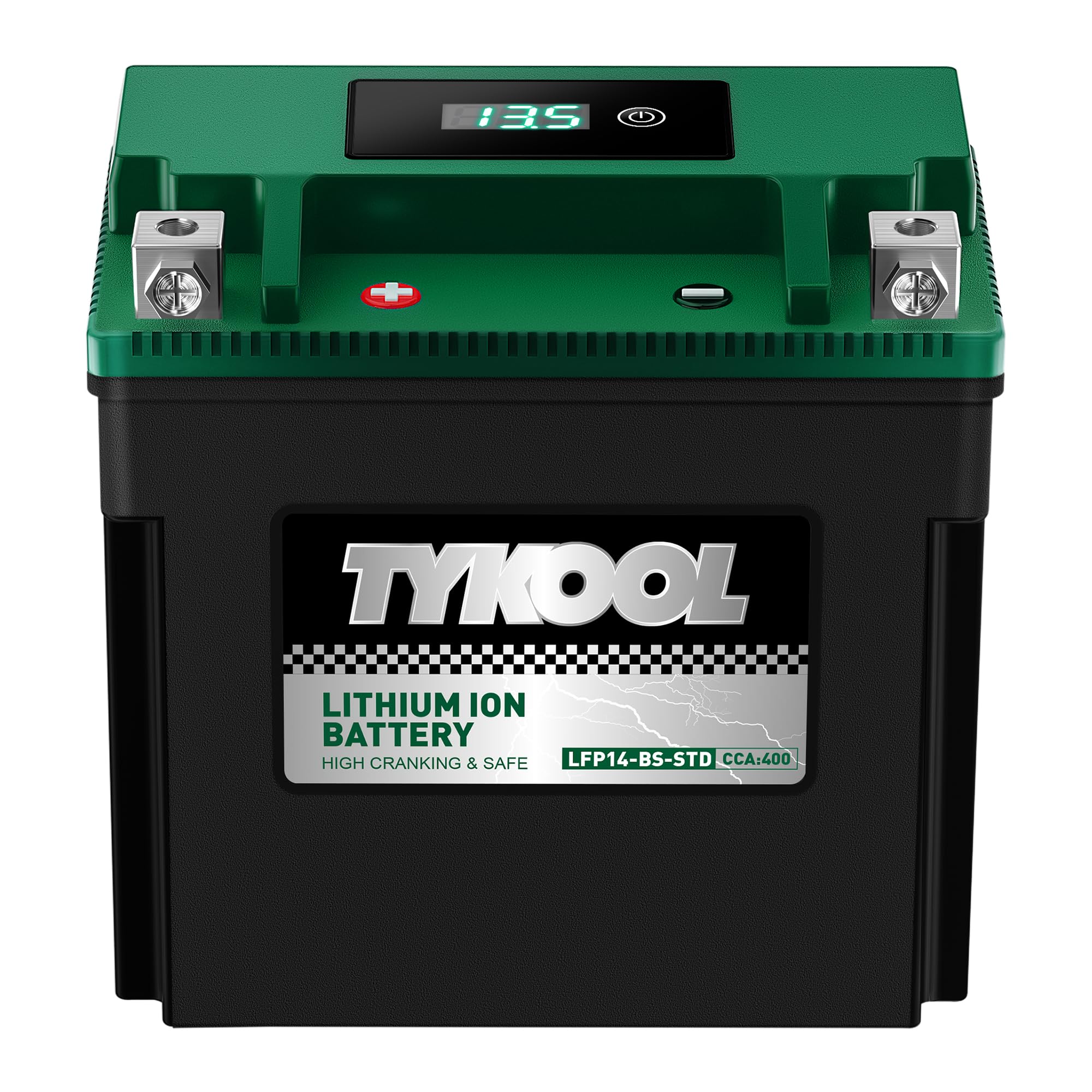
The TYKOOL LFP14-BS-STD is a budget-conscious entry to lithium that still delivers 400CCA and weighs only 3.3 pounds — a fraction of the 9–10 pound AGM it replaces. This battery fits the standard YTX14-BS footprint used on a wide range of powersports machines including the Honda Rancher 420, Polaris Sportsman 500, and Kawasaki Brute Force 750. The LCD digital readout is a standout feature at this price point, providing 0.1V voltage monitoring that helps you avoid over-discharge scenarios.
The 8 amp-hour capacity is adequate for starting and light accessory use, but this is not the battery to pair with a high-draw winch or heavy LED array. The IP66 casing keeps water and dust out during creek crossings and dusty trail rides, and the smart BMS manages cell balancing across the expected 2500+ life cycles. The voltage cut-off is set at 15.0V, so it requires the same regulated charging system as other lithium packs.
Compatibility is broad: it replaces over 40 OEM part numbers including Yuasa, Deka, and Interstate equivalents. The included terminal hardware fits both standard and metric bolt sizes. Some owners report that the LCD screen is bright enough to read in direct sunlight, a practical advantage when you are trying to check voltage in the middle of a trail ride. The main limitation is the 400CCA ceiling — this battery will fire smaller singles and twins reliably but may falter on big 1000cc engines in freezing weather.
What works
- Excellent value for a lithium battery with integrated LCD voltage display
- Drops into YTX14-BS applications with zero modification needed
- Weighs 3.3 pounds — saves significant weight over stock AGM
What doesn’t
- 8Ah capacity limits heavy accessory use; avoid if running winches or large light bars
- 400CCA may struggle with large-displacement engines in sub-freezing temperatures
7. MARXON Group 34

The MARXON Group 34 is primarily designed for passenger cars with start-stop systems, but its 650CCA and 55Ah capacity make it a viable replacement for UTVs that accept the BCI Group 34 form factor. The AGM construction is maintenance-free and spill-proof, and the patented alloy composition is engineered to resist corrosion and leakage. For utility UTVs that spend more time idling or running auxiliary equipment than trail riding, the deep-cycle characteristics of this battery provide a decent balance of starting power and reserve capacity.
The 55 amp-hour rating offers meaningful energy storage for running pumps, spreaders, or sprayers on a farm UTV. The charging acceptance is listed as 40% faster than standard SLA batteries, which helps when the battery needs to recover quickly between short work intervals. The 42-pound weight is heavy for a powersports battery, but for machines where weight is not a primary concern — like a Kawasaki Mule or John Deere Gator — the extra mass translates into robust physical construction.
MARXON provides a three-year service commitment with US-based support, which is better than many budget battery brands. The A1 terminal layout matches most side-post applications but may not fit UTVs that require top-post SAE connections without adapter cables. This is a solid mid-range option for utility UTV owners who want AGM reliability without paying the premium for a powersports-specific brand, as long as the dimensions fit their tray.
What works
- 55Ah capacity provides strong reserve for accessory-heavy utility use
- Faster charge acceptance than conventional SLA batteries
- Three-year US-based warranty support is a solid safety net
What doesn’t
- Heavy at 42 pounds; not ideal for sport or race UTVs
- Terminal configuration may require adapters for some UTV applications
8. Yuasa YUAM3RH2S

The Yuasa YUAM3RH2S is a classic entry-level AGM battery that ships dry with a separate bottle of acid. You fill and seal it yourself, which means the battery has never been charged before installation — the plates are pristine and the lifespan starts from the moment you activate it. With 180CCA and 10 amp-hours, this battery is best suited for smaller UTVs, ATVs, and entry-level scooters where engine displacement stays under 400cc and electrical demands are minimal.
Yuasa’s lead-calcium alloy technology holds specific gravity more than three times longer than conventional batteries, which reduces the rate of sulfation during storage. This matters for seasonal UTV owners who let their machine sit for months between hunting trips or summer riding. The absorbed glass mat separators keep the acid fully contained — you can mount this battery in any position except inverted without leakage.
The main limitation is the 180CCA rating, which will struggle with large-bore twin-cylinder engines, especially in cold weather. This battery also requires you to fill and charge it before first use — a process that takes 30 minutes with the included acid bottle and a basic charger. For a simple farm buggy or youth UTV that needs a cheap, reliable replacement, this Yuasa gets the job done at a price that leaves room for other upgrades.
What works
- Dry-charge design ensures fresh plates and maximum lifespan from first start
- Totally sealed and spill-proof once activated — safe for any mounting orientation
- Budget-friendly entry point for small-displacement UTVs and ATVs
What doesn’t
- Requires filling acid and initial charging — not ready out of the box
- 180CCA is insufficient for larger engines; limited to sub-400cc applications
9. Odyssey PC625
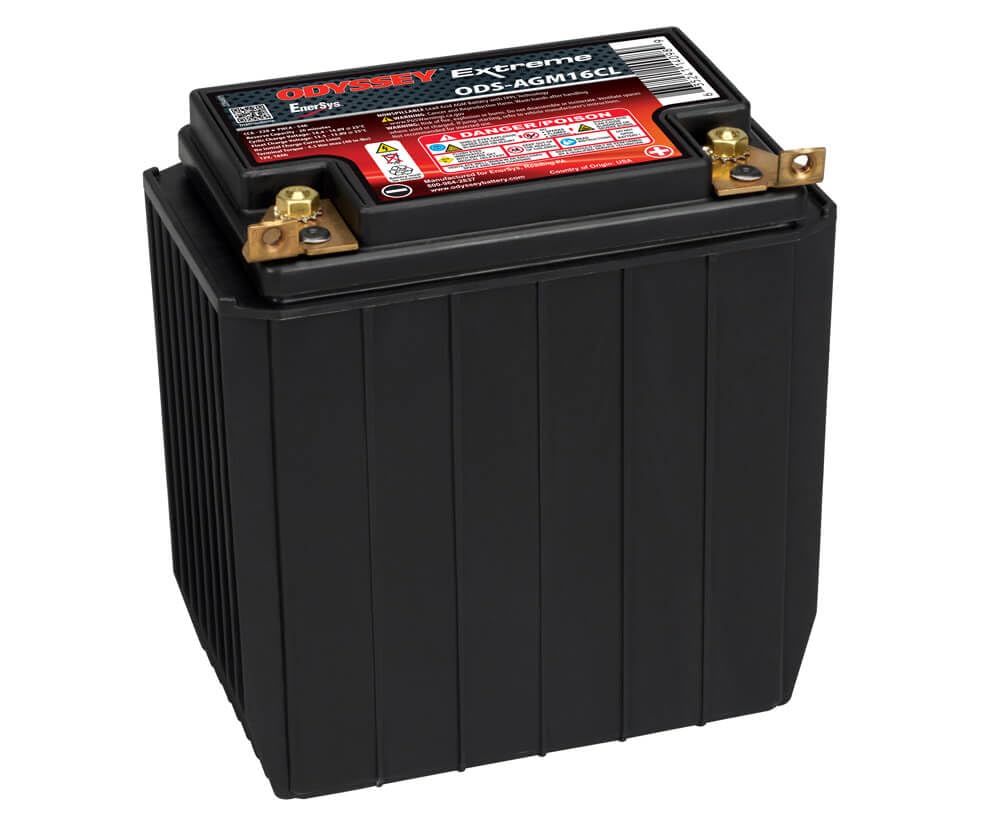
The Odyssey PC625 is a compact AGM battery that fits a niche: tight battery compartments in small UTVs, snowmobiles, and personal watercraft where space is at a premium. At 13.2 pounds and roughly 6.9 x 3.4 x 5.3 inches, it slides into trays that reject larger Group 24 or Group 34 batteries. The 220CCA rating is modest but delivered through Odyssey’s TPPL design, which provides a stable voltage curve and the highest recharge efficiency of any sealed lead battery on the market.
The cycle life advantage of this battery is significant: Odyssey claims 70% longer cycle life than conventional deep-cycle batteries. For a UTV that is used daily for work, this translates into a battery that outlasts standard AGM replacements by several years. The vibration-resistant design uses compression-fit internal components that absorb high-impact shock, a feature that matters when your side-by-side sees rocky trails or construction site duty.
The main downside is the limited 220CCA capacity — this battery is designed for applications where engine displacement stays under 600cc and ambient temperatures do not dip below freezing regularly. The PC625 also has special shipping restrictions and cannot be returned once shipped, which means you need to verify your dimensions carefully before purchasing. For small UTVs like a Polaris Ace or youth-oriented models, this battery offers Odyssey reliability in a compact form factor.
What works
- Compact dimensions fit tight small-UTV and snowmobile battery trays perfectly
- TPPL technology delivers recharge efficiency unmatched by standard AGM
- Vibration-resistant internal design survives high-impact off-road use
What doesn’t
- 220CCA limits application to smaller engines; not for big twins
- Non-returnable shipping policy requires accurate fitment verification before purchase
Hardware & Specs Guide
Cold Cranking Amps (CCA)
CCA measures how many amps a battery can deliver at 0°F for 30 seconds while maintaining at least 7.2 volts. For UTVs with 500cc to 1000cc engines, look for 350–800 CCA depending on climate and compression. Lithium batteries often list CCA higher than their physical size suggests due to their flat voltage discharge curve, but their output drops more sharply than AGM in extreme cold. If you ride below 0°F regularly, choose an AGM with at least 600 CCA or a lithium battery with a heated BMS option.
Amp-Hours (Ah) and Reserve Capacity
Amp-hours represent total energy storage, while reserve capacity tells you how many minutes the battery can sustain a 25-amp load before dropping below 10.5 volts. A UTV with a winch and LED light bar needs at least 20Ah or 40 minutes reserve capacity to perform multiple winch pulls without stalling. Lithium batteries typically list lower Ah numbers but are more efficient at delivering that energy because their voltage stays higher under load — a 12Ah lithium can start a UTV that requires more total energy than a 12Ah AGM can provide under the same conditions.
BMS (Battery Management System)
The BMS is the brain inside any lithium battery. It balances individual cell voltages, prevents over-charge (above 14.6V for LiFePO4), stops over-discharge (below 10V), and shuts down the battery if internal temperature exceeds safe limits. A quality BMS also provides a low-voltage cut-off that preserves enough reserve power for the Re-Start or jump start feature found on premium lithium batteries. AGM batteries do not have a BMS — they rely on the vehicle’s charging system to regulate voltage, which makes them simpler but also less tolerant of charging faults.
Physical Group Size and Terminal Configuration
UTV battery trays vary wildly between brands and even between model years of the same vehicle. The BCI Group 34 (10.06 x 6.88 x 7.88 inches) is the most common full-size UTV form factor, but many smaller machines use YTX14-BS or YTX20HL-BS sizes. Terminal type matters: SAE automotive posts fit most Group 34 applications, while U1 and bolt-type terminals are common on ATV and small-UTV sizes. Always measure your existing battery tray depth, width, and terminal orientation before ordering — a battery that is 1/2 inch too tall will not fit under the seat or hood.
FAQ
Can I replace my UTV’s AGM battery with a lithium battery without modifying anything?
Why does my UTV battery keep dying in winter storage?
How many CCA do I actually need for a 1000cc UTV engine?
Is it safe to mount a UTV battery on its side?
Will a higher CCA battery damage my UTV’s starter or wiring?
Final Thoughts: The Verdict
For most buyers, the best utv battery winner is the Antigravity ATX12-HD because it combines premium lithium weight savings with the built-in Re-Start jump start feature — a genuine safety net that no other battery matches. If you want vibration-proof AGM reliability with class-leading cycle life, grab the Odyssey ODS-AGM28L. And for heavy accessory use on a Polaris Ranger or Kawasaki Teryx, nothing beats the TYKOOL LFP20L-BS-PRO with its 12Ah capacity and LCD voltage monitoring.

Certification: BSc in Mechanical Engineering
Education: Mechanical engineer
Lives In: 539 W Commerce St, Dallas, TX 75208, USA
Md Amir is an auto mechanic student and writer with over half a decade of experience in the automotive field. He has worked with top automotive brands such as Lexus, Quantum, and also owns two automotive blogs autocarneed.com and taxiwiz.com.