A motorcycle that refuses to start after a week in the garage is not a mechanical failure—it is a charging gap. The small batteries used in modern bikes self-discharge faster than car batteries, and parasitic draws from alarms, clocks, or ECU memory drain them further. Without a dedicated maintenance device, you are gambling on every cold morning and every spring season.
I’m Amir — the founder and writer behind Four Wheel Ask. I have spent years analyzing battery charger specifications, comparing charging algorithms, and aggregating long-term owner feedback from motorcycle forums and technical communities to understand what actually keeps a battery healthy through months of storage.
Whether you ride a liter bike, a vintage bobber, or a dual-sport, the charging device you choose must match your battery chemistry, your storage duration, and your willingness to trust automatic electronics. For riders who demand uncompromising reliability, selecting the right best trickle charger for motorcycle ensures your battery stays healthy through long storage periods.
How To Choose The Best Trickle Charger For Motorcycle
Selecting a trickle charger for a motorcycle is not the same as picking one for a car. Motorcycle batteries typically range from 2Ah to 20Ah, and their smaller size makes them more sensitive to current levels and charging voltage. The wrong device can overheat, overcharge, or fail to detect a deeply discharged cell. Focus on three core areas before buying.
Amperage Rating and Battery Size
A 0.75A to 1A charger is the sweet spot for most motorcycle batteries between 2Ah and 20Ah. Charging a 10Ah battery at 0.8A takes roughly 12 to 14 hours from a deeply discharged state, which is well within safe timeframes. Higher amperage units, such as 3A or 5A, work for larger batteries but can generate excessive heat on small motorcycle batteries if the charger lacks intelligent current limiting. Always match the charger output to your battery’s recommended charge rate, typically found on the battery label or in the owner manual.
Smart Multi-Stage Charging vs. Passive Trickle
Passive trickle chargers deliver a fixed current continuously, which risks overcharging and boiling the electrolyte if left connected for weeks. Smart chargers use multi-stage profiles — bulk, absorption, float, and often a desulfation pulse — to bring the battery to full charge and then maintain it at a safe voltage indefinitely. Devices that advertise automatic temperature compensation also adjust voltage based on ambient conditions, preventing undercharging in cold garages and overcharging in hot sheds.
Battery Chemistry Compatibility
Lead-acid, AGM, Gel, and lithium-ion (LiFePO4) batteries each require distinct charging voltage thresholds and current profiles. A standard charger built for flooded lead-acid may damage a lithium battery by delivering an absorption voltage too high for the cells. Look for units with dedicated lithium modes or explicit compatibility lists that include LiFePO4. Some chargers also feature force mode, which jump-starts deeply discharged batteries that have dropped below 1 volt, a common scenario after months of neglect.
Quick Comparison
On smaller screens, swipe sideways to see the full table.
| Model | Category | Best For | Key Spec | Amazon |
|---|---|---|---|---|
| NOCO GENIUS1 | Smart Charger | All-around reliability | 1A, 6V/12V, desulfator | Amazon |
| CTEK US 0.8 | Premium Maintainer | Long-term float charging | 0.8A, 6-step program | Amazon |
| OptiMate3 | Powersport Specialist | Deep recovery | 0.8A, 7-step, sealed | Amazon |
| Battery Tender Junior | Entry-Level Maintainer | Simple plug-and-forget | 0.75A, 4-step program | Amazon |
| ECO-WORTHY 12V 5A | High-Amp Charger | Large batteries & lithium | 5A, LCD, LiFePO4 mode | Amazon |
| NEXPEAK 4-Pack 1.75A | Multi-Unit Pack | Multiple vehicle fleets | 1.75A, LCD, pulse repair | Amazon |
| Aorika 2 Pack 3A | Budget Twin Pack | Cost-conscious buyers | 3A, 6V/12V, repair mode | Amazon |
In-Depth Reviews
1. NOCO GENIUS1

NOCO has refined the compact charger formula with the GENIUS1, a unit that measures just over six inches tall and weighs about a pound but delivers more power than its predecessor while shrinking the footprint by more than a third. The housing feels dense and well-sealed, and the integrated eyelet terminals make permanent installation on a motorcycle straightforward — you can leave the ring terminals bolted to the battery and simply click the quick-connect when it is time to charge.
The charging logic covers 6V and 12V lead-acid chemistries including AGM, Gel, SLA, and VRLA, plus lithium-ion LiFePO4, which is rare at this price level. The thermal sensor dynamically adjusts voltage based on ambient temperature, so a battery sitting in an unheated garage during a January freeze still receives the correct absorption voltage without risk of undercharging. Users report that the desulfation pulse recovers batteries that conventional maintainers had written off, and the Force Mode feature can charge batteries reading as low as zero volts.
Owner feedback consistently praises the GENIUS1 for reviving batteries that sat dead for months, though some note that the clamp leads are relatively short at about 110 inches. The three-year warranty and US-based design support add confidence. For the vast majority of motorcycle owners who want one device that handles every battery type and every storage scenario, this is the anchor choice.
What works
- Compact size fits tight garage spaces and onboard mounting
- Full desulfation and force mode for deeply discharged batteries
- Temperature compensation prevents overcharge in hot weather
What doesn’t
- Output cord could be longer for tall motorcycle handlebars
- No LCD screen for real-time voltage display
2. CTEK US 0.8

CTEK has built a reputation in the European automotive segment for sophisticated charging algorithms, and the US 0.8 brings that engineering into a package sized for powersport batteries. The unit is fully automatic with six distinct steps — desulfation, bulk, absorption, analysis, float, and pulse maintenance — that cycle through without any user intervention. The case is splash-proof and dust-resistant, making it suitable for damp garage environments or even outdoor covered storage.
One of the standout traits of the US 0.8 is its clean voltage delivery with no surges or spikes, a critical factor for modern motorcycles with sensitive ECUs, digital dashboards, and alarm systems. There is no need to disconnect the battery from the bike during charging, which eliminates the hassle of resetting clock and trip data. The included eyelet connector allows for a semi-permanent wiring setup, and the alligator clips work well for quick hookups. The unit is designed for batteries from 1.2Ah to 32Ah for charging and up to 100Ah for maintenance, which covers everything from a small dirt bike to a touring machine.
Long-term owners in the review data report units lasting seven years or more without failure, and the five-year warranty supports that durability claim. The only friction point is that the eyelet terminal holes are slightly undersized, requiring a minor drill adjustment for some aftermarket battery bolts. For riders who prioritize clean electronics protection and long-term build quality over raw amperage, the CTEK US 0.8 delivers a noticeably refined charging experience.
What works
- Clean voltage output protects sensitive motorcycle electronics
- Splash-proof housing handles damp garage environments
- Five-year warranty reflects long-term reliability
What doesn’t
- Eyelet terminal holes may need enlargement for some battery bolts
- Higher price point than comparable 0.8A chargers
3. OptiMate3

OptiMate holds a unique position in the motorcycle charging ecosystem: the device is recommended by Honda, Yamaha, Kawasaki, KTM, and Husqvarna, as well as lithium battery manufacturers Antigravity, Super-B, and Earth-X. That level of OEM endorsement suggests the charging profile has been validated against the specific demands of powersport batteries, including the high-vibration environment and the narrow voltage tolerances of modern starter batteries.
The OptiMate3 uses a seven-step program that includes a battery-saving recovery mode designed to bring back batteries that other chargers reject. The algorithm first tests the battery to determine if it is serviceable, then applies a desulfation pulse, followed by bulk charge, absorption, analysis, and a true float maintenance mode. If the battery fails the initial test, the charger indicates a fault rather than forcing current into a damaged cell, which prevents the user from wasting time on a battery that needs replacement. The fully sealed case protects against spillage and light rain, and the SAE connector with integrated fuse is standard on many motorcycles for quick connection.
Users who switched from cheaper chargers to the OptiMate3 frequently report a noticeable improvement in cold-weather starting and overall battery lifespan. The unit is slightly larger than the NOCO or CTEK options, and the 0.8A output means charging a deeply depleted battery takes overnight, but the reliability feedback is overwhelmingly positive. For riders who want the charger that motorcycle manufacturers themselves trust, the OptiMate3 is the most specialized option on this list.
What works
- OEM-approved by Honda, Yamaha, Kawasaki, KTM
- Seven-step algorithm recovers deeply discharged batteries
- Fully sealed case withstands garage moisture
What doesn’t
- Charging speed is slow for larger batteries above 20Ah
- Physical footprint is bulkier than competing 0.8A units
4. Battery Tender Junior
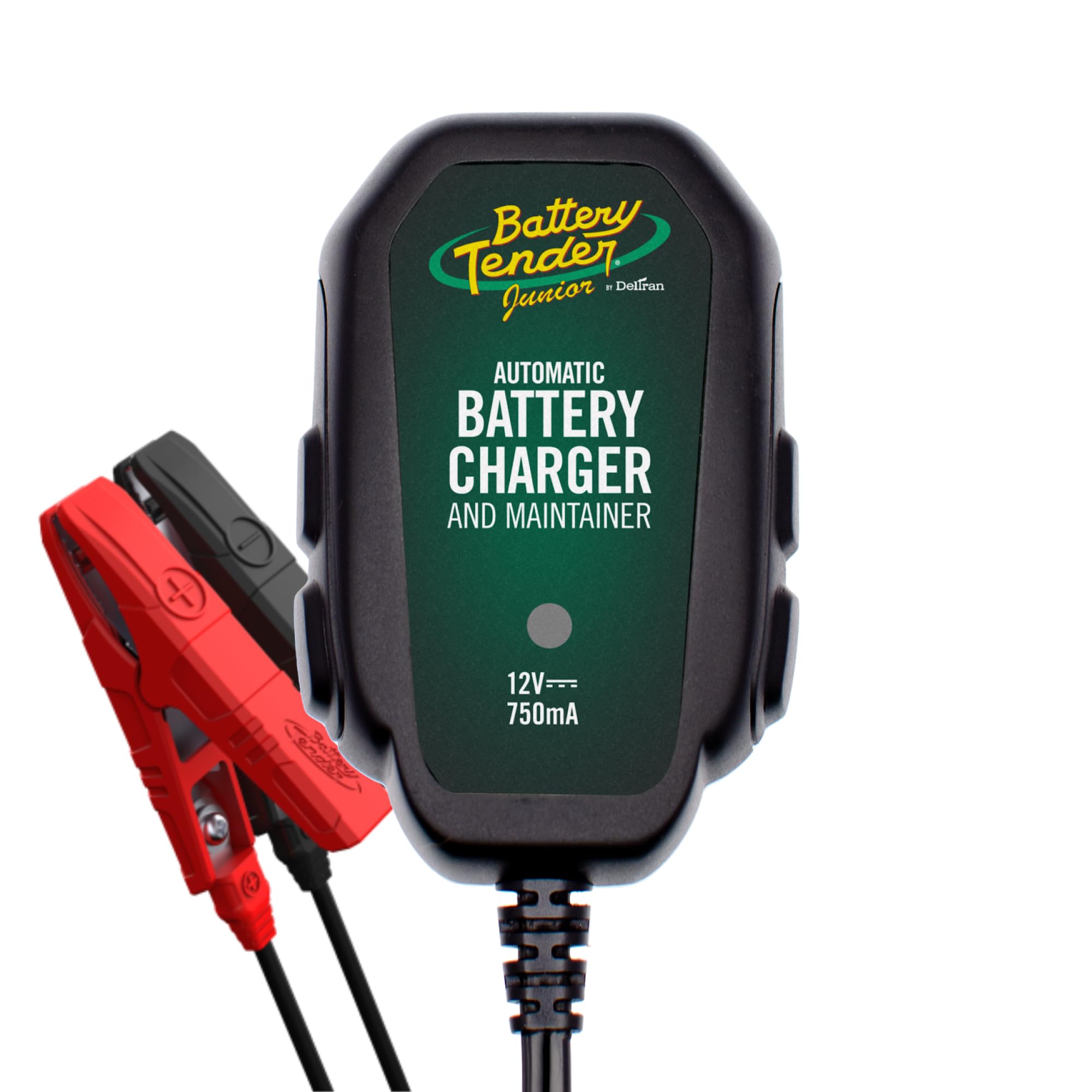
The Battery Tender Junior is arguably the most recognizable name in powersport battery maintenance, and its longevity in the market is a direct result of a simple, proven formula. The unit delivers 750mA through a four-step charging program — initialization, bulk charge, absorption mode, and float mode — that reliably brings a 12V lead-acid battery to full charge and holds it without overcharging. The spark-proof circuitry and automatic reversed hook-up detection add a layer of safety that matters when working in dim garage lighting.
The hardware is incredibly compact at roughly the size of a smartphone, and the included fused-ring terminal harness allows permanent attachment to the battery for effortless seasonal connection. The two-color LED provides basic status feedback: red for charging, green for fully charged. There is no desulfation mode, no lithium compatibility, and no temperature compensation, which means this charger is best suited for standard lead-acid and AGM batteries that are already in decent health rather than deeply sulfated units. The 12-foot output cord provides generous reach for bikes parked against a garage wall.
Owner reports consistently highlight the reliability — many users own four or more units for different vehicles and report years of trouble-free service. The five-year warranty and lifetime customer support from Deltran further reduce the long-term cost. For the rider who wants a dead-simple, trustworthy maintainer for a standard lead-acid battery and does not need multi-chemistry flexibility, the Battery Tender Junior remains a benchmark in the entry-level segment.
What works
- Proven reliability with years of positive owner feedback
- Spark-proof circuitry prevents dangerous connection sparks
- Very compact and lightweight for under-seat storage
What doesn’t
- No lithium battery support or desulfation mode
- Low 750mA output is slow for larger batteries
5. ECO-WORTHY 12V 5A

The ECO-WORTHY 12V 5A charger occupies a different use case than the sub-1A maintainers above: this is a charger that can replenish a deeply discharged battery in hours, not overnight, while still offering a float mode for long-term maintenance. The 5A output is aggressive for a small motorcycle battery, but the smart charging logic automatically tailors the current to the battery’s state, switching between bulk, absorption, and float modes without user intervention.
The integrated LCD displays voltage, current, and charging progress in real time, which is a practical advantage for owners who want to monitor battery health rather than rely on a single LED. The unit supports both lead-acid and lithium LiFePO4 chemistries with dedicated charging profiles, and the SAE connector comes with a 10A fuse for overcurrent protection. The compact blue-and-black housing measures under three inches thick, making it easy to store or mount near a workbench. Users note that the charger runs slightly warm during extended operation, though this is within normal parameters for a 5A unit.
Review data shows the ECO-WORTHY works particularly well for riders who own both a motorcycle and a larger vehicle such as a boat or RV, since the 5A output can handle deep-cycle batteries up to 100Ah. The automatic voltage detection for 6V and 12V systems adds versatility. The primary consideration is that 5A is more current than a typical 10Ah motorcycle battery needs, so the charger must be used in smart mode rather than as a fixed-current device to avoid stress on small cells.
What works
- LCD screen provides clear voltage and current feedback
- Dedicated lithium LiFePO4 charging profile
- Fast 5A output charges larger batteries quickly
What doesn’t
- Runs warmer than lower-amperage maintainers
- 5A output may be excessive for very small motorcycle batteries
6. NEXPEAK 4-Pack 1.75A

The NEXPEAK 4-Pack delivers four independent 1.75A chargers in a single purchase, making it the most practical option for households with multiple motorcycles, ATVs, lawn tractors, or classic cars. Each unit includes a digital LCD screen that displays charging percentage, voltage, and current, giving the user real-time visibility into battery condition. The 1.75A output is high enough to charge a motorcycle battery in a few hours but low enough to be safe for long-term maintenance when used in trickle mode.
Each charger features a seven-stage program that includes desulfurization, trickle charging, constant current, constant voltage, detection, compensation, and floating charge. The pulse repair mode attempts to restore old or idle batteries by breaking down sulfate crystals on the lead plates, a feature typically found on more expensive single-unit chargers. The 6.6-foot SAE cord with detachable alligator and ring connectors provides flexibility for different battery locations, and the charger automatically locks in the current mode during a power outage, resuming operation when power is restored.
Owners report that the connectors on all four units require a firm push to fully seat, which is a minor ergonomic complaint but not a functional one. The chargers are designed for lead-acid batteries only, so lithium owners will need to look elsewhere. For the rider who manages a small fleet of vehicles and wants individual dedicated chargers for each battery rather than swapping cables, the NEXPEAK 4-Pack offers an exceptional value proposition with solid feature density per unit.
What works
- Four chargers in one package for multi-vehicle households
- LCD screen on each unit for real-time charging data
- Seven-stage program with pulse repair mode
What doesn’t
- No lithium battery compatibility
- Connectors require significant force to mate securely
7. Aorika 2 Pack 3A
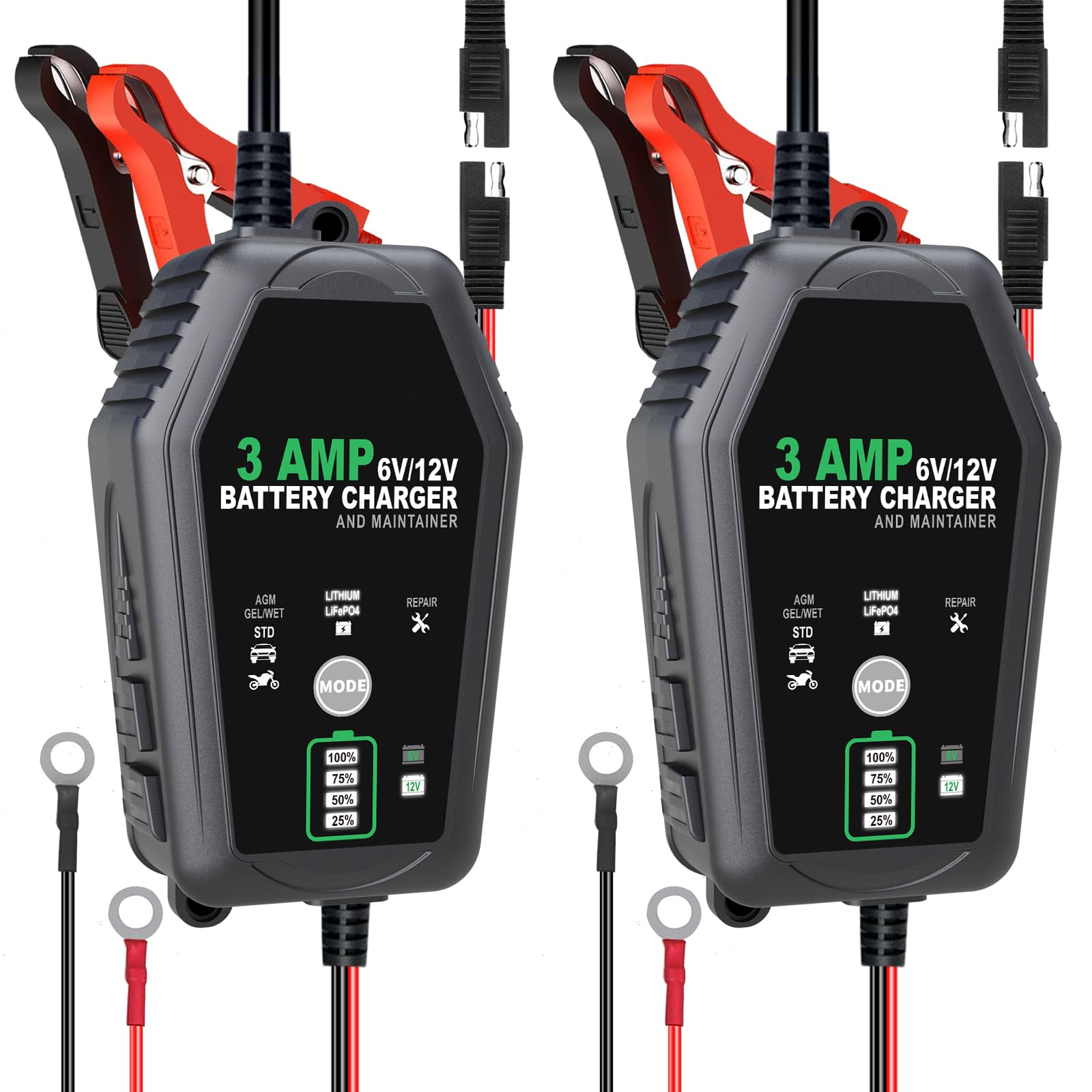
The Aorika 2 Pack offers two 3A smart chargers at a combined price that undercuts most single-unit competitors, making it a compelling entry point for budget-conscious buyers. Each charger automatically detects 6V or 12V systems and adjusts the charging current accordingly, supporting lead-acid chemistries including AGM, Gel, SLA, flooded, VRLA, EFB, and MF, as well as lithium and LiFePO4 batteries. The ABS flame-retardant shell adds a layer of safety for unattended operation.
The charging logic includes automatic temperature detection that adjusts output for winter and summer conditions, plus overcharge, overcurrent, over-temperature, reverse polarity, and short circuit protections. The repair mode uses pulse technology to attempt recovery of aged lead-acid batteries, though the manufacturer notes it cannot restore batteries that are severely damaged or completely dead. The package includes ring terminals and alligator clips for each charger, allowing one unit to be permanently wired while the other remains portable.
User feedback highlights that the charger runs warm during extended operation, and the voltage detection can occasionally misinterpret a deeply discharged 12V battery as 6V, requiring a manual button hold to force 12V mode. The instructions recommend unplugging the charger once the battery reaches full charge rather than leaving it connected indefinitely, which is a limitation compared to true automatic maintainers. For riders on a strict budget who need two chargers for different vehicles, the Aorika 2 Pack provides functional smart charging at a fraction of the per-unit cost of premium brands.
What works
- Two chargers included at a very accessible price point
- Broad compatibility with lead-acid and lithium chemistries
- Temperature-adjusted charging for seasonal changes
What doesn’t
- Voltage detection can misread deeply discharged 12V batteries as 6V
- Not designed for indefinite connected maintenance
Hardware & Specs Guide
Amperage Ratings
The amperage rating determines how quickly a charger can replenish a battery. For motorcycle batteries typically ranging from 2Ah to 20Ah, a 0.75A to 1A charger provides a safe overnight charge without generating excessive heat. Higher amperage chargers in the 3A to 5A range charge faster but require smart current limiting to avoid stressing small batteries. A good rule of thumb is to choose a charger with an amp rating no higher than one-tenth of the battery’s amp-hour capacity for routine maintenance, though smart chargers with multi-stage profiles can safely exceed this ratio by tapering the current automatically.
Charging Stages
Modern smart chargers follow a multi-stage sequence that optimizes battery health. The bulk stage delivers maximum current until the battery reaches approximately 80% charge. The absorption stage then holds voltage constant while current gradually drops. The float stage reduces voltage to a safe maintenance level typically around 13.2V to 13.6V for lead-acid batteries, preventing overcharge while compensating for self-discharge. Premium chargers add desulfation pulses before bulk charging and periodic analysis steps to verify battery health. Devices with six or seven stages provide more granular control than basic four-stage units.
Battery Chemistry Modes
Lead-acid, AGM, Gel, and lithium iron phosphate (LiFePO4) batteries each require specific voltage thresholds. Flooded lead-acid cells typically charge at 14.4V to 14.8V, while AGM batteries peak around 14.1V to 14.4V. Gel batteries are more sensitive and should not exceed 14.0V to avoid damage. LiFePO4 batteries require a lower absorption voltage around 14.2V to 14.6V and must never enter a traditional lead-acid desulfation mode. A charger with dedicated chemistry modes automatically selects the correct profile, eliminating the risk of selecting the wrong voltage manually.
Safety Protections
Look for reverse polarity protection, which prevents damage if the clamps are accidentally connected backwards. Spark-proof circuitry eliminates visible sparks during connection, a critical safety feature when working near fuel vapors in a garage. Over-temperature protection reduces output if the charger exceeds safe internal temperatures. Short circuit protection shuts down the output if the leads touch each other. Automatic float mode transition ensures the charger does not continue delivering bulk current after the battery reaches full charge, which would cause gassing and water loss in flooded batteries.
FAQ
What amp trickle charger should I use for a motorcycle battery?
Can I leave a trickle charger on my motorcycle battery all winter?
What is the difference between a trickle charger and a battery maintainer?
Do I need to disconnect the motorcycle battery to use a charger?
Final Thoughts: The Verdict
For most buyers, the best trickle charger for motorcycle winner is the NOCO GENIUS1 because it combines compact size, multi-chemistry compatibility, desulfation capability, and temperature compensation at a reasonable price that outperforms nearly every competitor in its class. If you prioritize ultra-clean power delivery for sensitive electronics, grab the CTEK US 0.8. And for a proven, dead-simple maintainer with decades of owner trust, nothing beats the Battery Tender Junior for standard lead-acid batteries.

Certification: BSc in Mechanical Engineering
Education: Mechanical engineer
Lives In: 539 W Commerce St, Dallas, TX 75208, USA
Md Amir is an auto mechanic student and writer with over half a decade of experience in the automotive field. He has worked with top automotive brands such as Lexus, Quantum, and also owns two automotive blogs autocarneed.com and taxiwiz.com.