A single rock chip on your hood or a scratch from a careless parking lot door can ruin the entire look of your car. Left untreated, that blemish invites moisture and corrosion, turning a cosmetic annoyance into a structural headache. The right touch-up paint pen seals the damage before rust takes hold and restores a factory-fresh appearance without a body shop visit.
I’m Amir — the founder and writer behind Four Wheel Ask. My approach to automotive paint repair focuses on color-code verification, applicator design analysis, and long-term durability assessments drawn from thousands of owner reports across multiple vehicle brands.
Selecting the best touch up paint pen for cars requires careful evaluation of color match precision, applicator design quality, and long-term durability of the paint.
How To Choose The Best Touch Up Paint Pen For Cars
Not all touch-up paint pens deliver the same result. A poor match draws more attention than the original scratch. Understanding the variables — color coding, applicator type, and paint formulation — separates a seamless repair from a blotchy eyesore. Focus on these three factors before you buy.
Decode Your Vehicle’s Color Code
Every manufacturer stamps a unique alphanumeric paint code on a placard inside the driver door jamb, glove box, or under the hood. That code — not a visual guess — is the only reliable way to match factory paint. Metallic, pearl, and tri-coat finishes add complexity because the flake size and orientation change the appearance under sunlight. Pens that reference the exact OEM code and finish type (gloss, metallic, pearl) consistently outperform generic shades.
Evaluate Applicator Design for Your Damage Type
Pen-style tips work well for thin, linear scratches because they deposit paint precisely along the groove. Brush applicators cover wider rock-chip clusters more efficiently but require a steadier hand to avoid pooling. Some kits now include micro-applicators that bridge the gap — they allow dabbing over small chips without leaving stroke marks. For deep damage that exposes bare metal, a dual-tip system with both a fine needle and a brush gives you the most control across different repair zones.
Assess Paint Chemistry and Drying Behavior
Oil-based paints level out slowly and remain workable longer, which helps beginners correct mistakes before the coat sets. Water-based formulations dry faster but demand quicker application and layering. Metallic and pearl paints require a clear topcoat to lock in the gloss and protect the flake from UV fading. Pens that advertise rust-proofing and waterproof properties also indicate a more robust resin package that adheres to bare metal and resists chipping again during subsequent washes.
Quick Comparison
On smaller screens, swipe sideways to see the full table.
| Model | Category | Best For | Key Spec | Amazon |
|---|---|---|---|---|
| COSLAKE Carbonized Gray Metallic | Mid-Range | Ford Touch-Ups | 12 mL, Metallic Finish | Amazon |
| PARTS4EV Velocity Blue Metallic | Premium | Ford Color Match | 0.41 oz, Metallic Finish | Amazon |
| SYOAUTO Pearl White PPSW | Mid-Range | Tesla Repair | 0.4 oz, Pearl Gloss | Amazon |
| RSACET Classic Silver Metallic 1F7 | Premium | Toyota Models | 0.41 oz, Metallic Finish | Amazon |
| TESTOR GLS Black Gloss Marker | Budget | General Use | 1/3 oz, Oil-Based | Amazon |
In‑Depth Reviews
1. COSLAKE Carbonized Gray Metallic (M7) for Ford
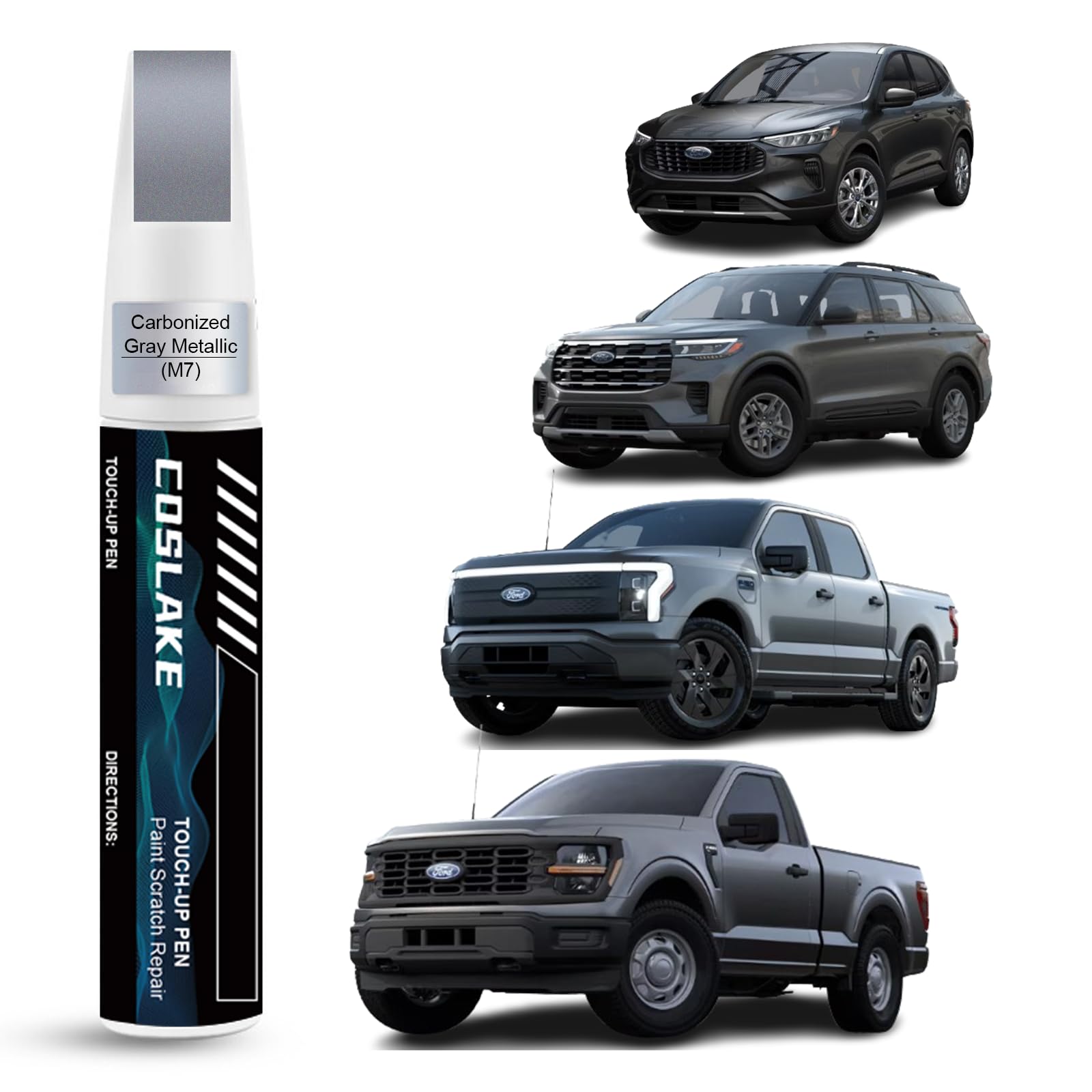
The COSLAKE formulation targets the Ford color code M7 (Carbonized Gray Metallic) with a 12 mL bottle that includes both a pen-tip and a brush applicator plus two disposable micro-applicators. Owner reports consistently highlight a near-invisible repair on factory paint — one verified review noted that Oxford White matched so perfectly the owner could not locate the touched-up area afterward. The metallic flake dispersion aligns closely with OEM tri-coat behavior, which is unusual at this price tier.
Dry time hovers around 5 to 10 minutes between coats, and the paint builds opacity after two thin layers. The included micro-applicators give you better control on small rock chips than a brush alone would allow. Multiple Ford owners across F-150, Bronco, Mustang, and Super Duty trims reported successful color matches with Cactus Gray and Tri-Coat White variants as well, suggesting the color-code calibration is consistent across the brand lineup.
The main limitation is that deeper scratches requiring primer underneath will still show a slight texture difference because the paint self-levels only to a moderate degree. Larger surface areas — anything beyond a few inches — demand wet-sanding and polishing to achieve a truly flush finish, which this kit does not include. For typical road rash and chip clusters, the COSLAKE pen delivers the most reliable factory-matched result in the mid-range bracket.
What works
- Exceptional color-match accuracy verified across multiple Ford paint codes
- Dual applicator system (pen, brush, micro-applicator) handles different scratch geometries
- Fast 5-10 minute inter-coat dry time speeds up multi-layer repairs
What doesn’t
- Self-leveling is limited; deeper scratches require wet-sanding for a flush finish
- Not a perfect 100% match on every metallic variant — slight shade variation reported on some panels
2. PARTS4EV Velocity Blue Metallic (E7) for Ford
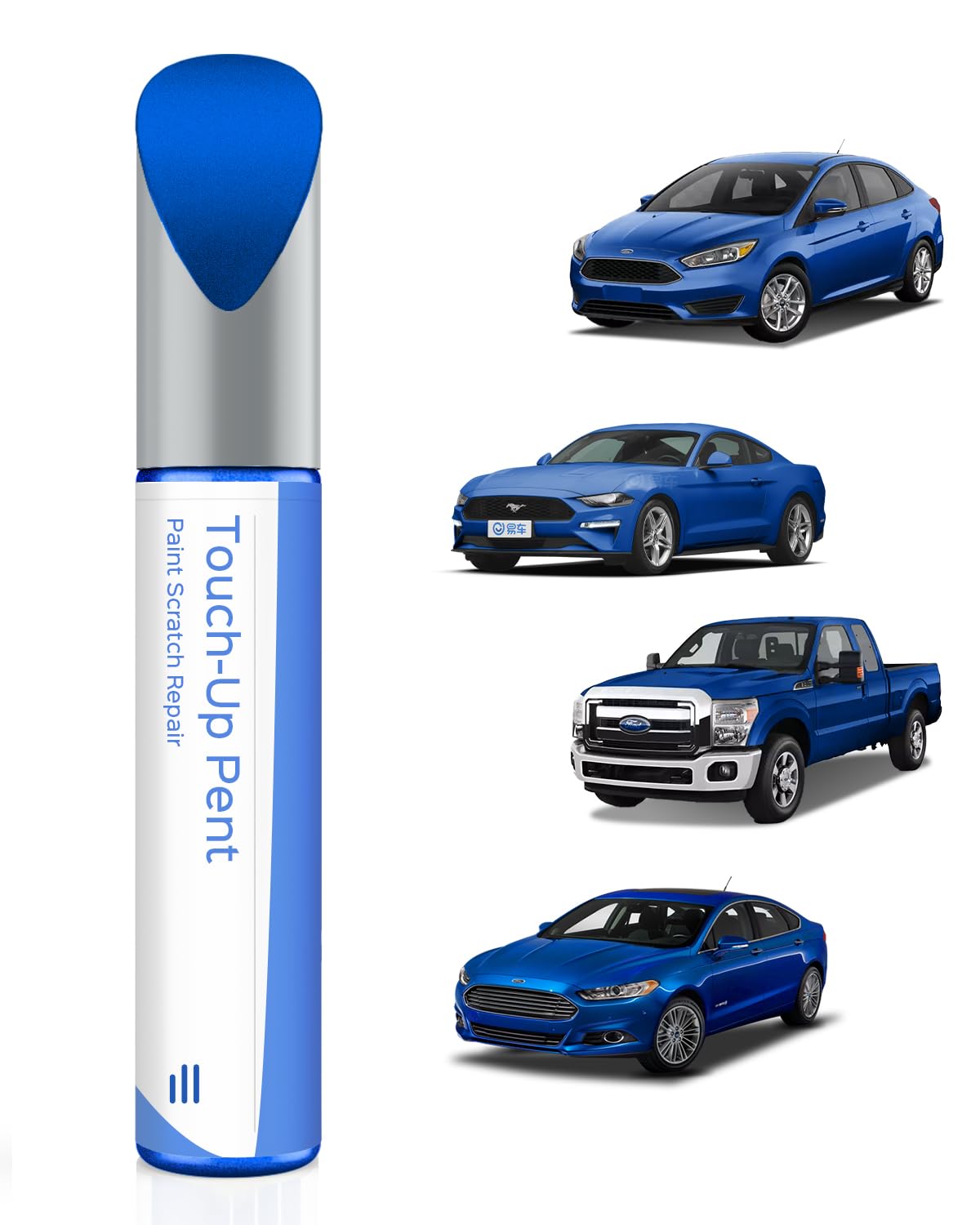
The PARTS4EV pen targets the Ford E7 Velocity Blue code used across Bronco, F-150, Mustang, Ranger, and Super Duty models. A verified owner with a 2024 Ford Mustang in D4 Rapid Red reported that the color match was so accurate the repair became indistinguishable from the surrounding factory paint — even on a raised meteor-chip crater that exposed bare metal. The metallic flake suspension in this formulation appears denser than typical aftermarket pens, which helps it blend into the OEM clear-coat layer.
Application requires three straightforward steps: clean the surface, shake for 30 seconds, and apply. The paint consistency leans toward the thin side — some owners noted that 4 to 5 coats were necessary to fully cover deep chips on Velocity Blue panels. The thinness, however, prevents the blobbing problem that plagues thicker paints, making it easier to build up layers gradually without creating a raised edge. The pen design delivers steady flow control along linear scratches without skipping.
The temperature tolerance claimed by the manufacturer — high and low extreme endurance — adds confidence for owners in harsh climates where thermal cycling can cause touch-up paint to crack or peel. One downside is that the paint dries slightly lighter than the wet application color, a common trait among metallic formulations that lack a separate clear coat layer. A final clear topcoat applied manually resolves this shift for owners seeking a perfect factory-refresh look.
What works
- Very accurate color match reported on multiple Ford paint codes including D4 Rapid Red
- Thin consistency prevents blobbing and allows gradual multi-layer buildup
- Engineered for extreme temperature endurance to prevent cracking or peeling
What doesn’t
- Requires 4-5 coats for deep chips, extending total repair time
- Dries slightly lighter than wet application — a clear topcoat is recommended for perfect blending
3. SYOAUTO Pearl White (PPSW) for Tesla

SYOAUTO engineered this pen specifically for Tesla Model Y, 3, X, and S in Pearl White (PPSW code). The kit includes both a brush and a pen tip, and the formulation mimics the pearl flake orientation found in Tesla’s factory multi-coat white. Verified owners consistently praise the color-match accuracy — one review noted the pearl flake size and metallic density were indistinguishable from the original paint on a 2023 Model Y. The kit also includes a separate pearl topcoat layer that replicates the factory tri-coat structure.
The application process requires shaking for about 2 minutes to fully suspend the pearl particles, then applying in thin layers with a 10-minute dry time between coats. The dual-stage system — a white base coat followed by a pearl overlay — is essential for achieving the depth that makes Tesla’s pearl white look cohesive. Owners who skipped the pearl topcoat reported a flat white appearance that stood out against the surrounding panels. When both stages are applied correctly, the repair blends nearly invisibly.
One notable drawback is that color match consistency varies depending on the specific Tesla paint batch. Owners with earlier 2018-2020 Model 3s reported a slight mismatch, while newer 2022+ vehicles showed better alignment. The kit also does not include a clear sealer, so the pearl topcoat remains exposed to UV and wash chemicals without additional protection. A separate ceramic or wax layer applied after full curing improves longevity for daily-driven Teslas.
What works
- Dual-stage pearl system replicates Tesla factory tri-coat depth and flake appearance
- Brush and pen combo offers flexibility for both small chips and linear scratches
- Close color match on 2022+ Tesla Pearl White models with minimal visible transition
What doesn’t
- Match accuracy varies by production year — earlier Teslas may show shade differences
- No clear sealer included; exposed pearl layer needs additional UV protection
4. RSACET Classic Silver Metallic (1F7) for Toyota
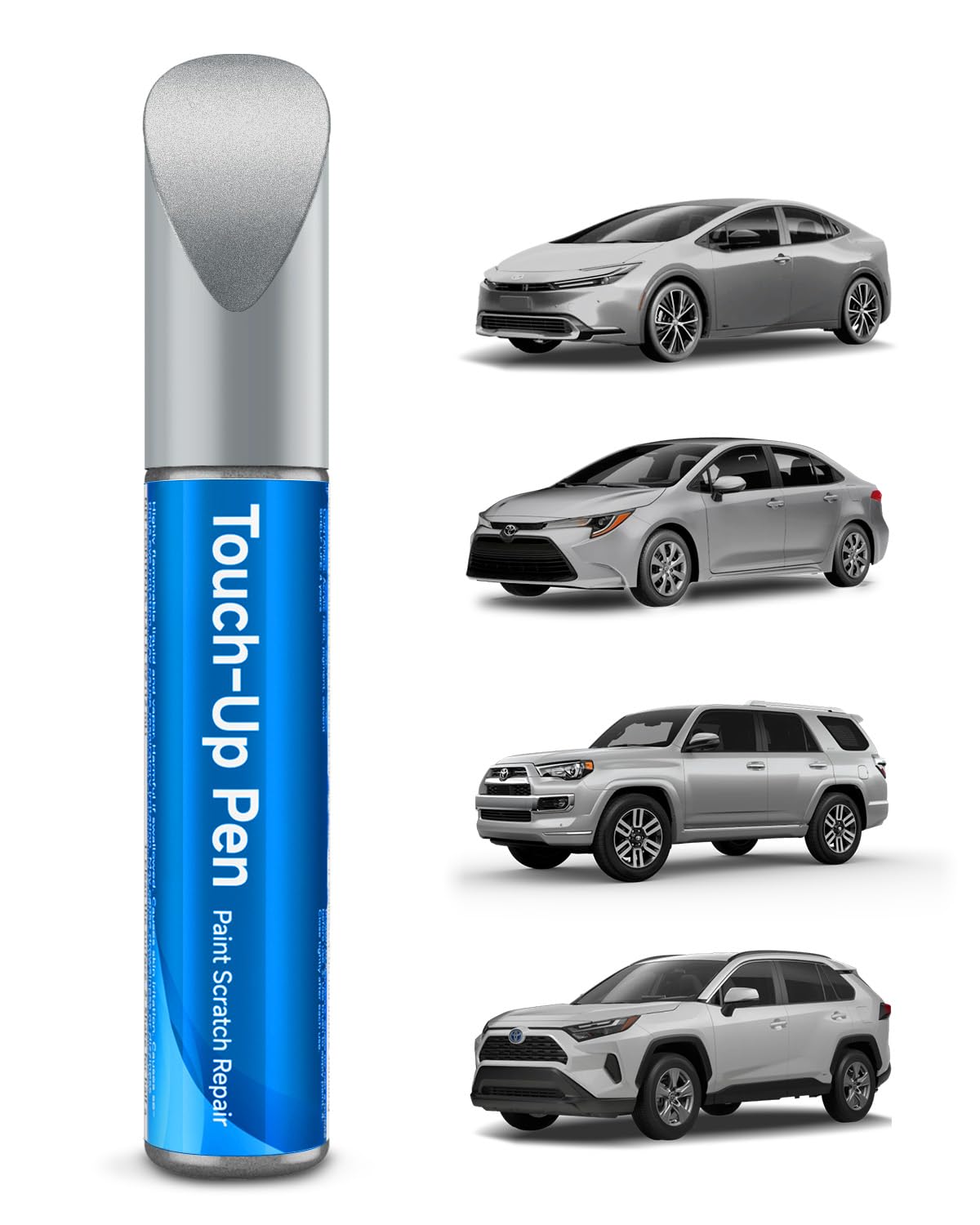
The RSACET pen is formulated for the Toyota 1F7 Classic Silver Metallic code found on 4Runner, Corolla, RAV4, Prius, Land Cruiser, and Yaris models. The pen design incorporates a built-in brush tip that delivers paint at a controlled rate, reducing the risk of over-application on small chips. Owner feedback indicates that the color match is very close to factory silver on most Toyota generations, with one verified 4Runner owner noting a seamless blend on a 2020 model with 50,000 miles of sun exposure.
The paint viscosity runs thin — multiple owners mentioned that even after vigorous shaking the pigment concentration remained low, requiring several coats to achieve full opacity. The manufacturer recommends a 24-hour full-cure time, which is significantly longer than the competition. This extended cure period allows the metallic flake to settle into a uniform orientation, reducing the streaky appearance that silver paints often exhibit when rushed. Patience during the curing process directly correlates with the final visual quality.
A notable concern is color-match inconsistency on certain Toyota model-year variants. One owner reported that the 1F7 formulation appeared noticeably lighter than the factory paint on a 2019 Corolla, requiring a full refund from the seller. The seller in that case issued a refund promptly, indicating responsive customer service. For best results, testing the paint on a hidden panel or scrap metal before applying to visible areas is strongly advised — a precaution the manufacturer explicitly recommends in the product instructions.
What works
- Close color match on most Toyota 1F7 Classic Silver vehicles with good metallic flake alignment
- Built-in brush tip controls paint flow and reduces pooling on small chips
- Responsive seller support for color-match issues, including full refunds when needed
What doesn’t
- Paint viscosity is thin — requires multiple coats and a full 24-hour cure for best results
- Some model-year variants show a lighter shade mismatch that may not be acceptable
5. TESTOR GLS 2547C Black Gloss Marker

TESTOR’s gloss black marker is a refillable, oil-based paint pen originally designed for modeling and hobby work, but it has found a solid following among car owners for small black trim and wheel touch-ups. The 1/3-ounce cylinder delivers a consistent gloss finish that matches factory black plastic trim and gloss-black wheels — one verified owner used it on a 2018 Civic Sport Hatch wheel with results described as great. The oil base dries to a hard, durable surface that resists chipping after installation.
The pen tip is felt-like and delivers paint through capillary action, which works well for fine lines but can clog if the cap is left off for extended periods. Dry time is roughly one hour to the touch, with full hardness developing over 24 hours. Because the paint is oil-based rather than automotive-grade urethane, it does not chemically bond with existing clear coat the way a dedicated car paint pen would. For plastic trim and unpainted accessories this is irrelevant, but on painted body panels the adhesion is less permanent.
The biggest limitation is color — only gloss black is available, which restricts this pen to very specific use cases. It is not a color-matched automotive paint and should not be used to repair bodywork on metallic or pearl finishes. For owners with black plastic trim, interior scratches, or gloss-black rims, however, the TESTOR marker offers a reliable and refillable solution for a fraction of the cost of brand-specific kits. The refillable design also reduces waste over disposable pens.
What works
- Excellent gloss black match for plastic trim, wheels, and interior components
- Refillable design reduces waste and extends usable life significantly
- Oil-based formula dries hard and resists chipping on non-painted surfaces
What doesn’t
- Not a color-matched automotive paint — unsuitable for body panel repairs
- Felt tip can clog if cap is left off; requires careful storage and maintenance
Hardware & Specs Guide
Color Code Verification
Every vehicle manufacturer assigns a unique paint code located on the driver door jamb, inside the glove box, or under the hood. That code — not a visual guess — is the only reliable way to match factory paint. Metallic and pearl finishes add complexity because flake size and orientation change appearance under different lighting. Pens that reference the exact OEM code and finish type consistently outperform generic shades.
Applicator Design
Pen-style tips work best for thin linear scratches because they deposit paint precisely along the groove. Brush applicators cover wider rock-chip clusters more efficiently but require a steadier hand. Dual-tip kits with both a fine needle and a brush give you the most control across different repair zones. Micro-applicators allow dabbing over small chips without leaving stroke marks.
Paint Chemistry
Oil-based paints level out slowly and remain workable longer, which helps beginners correct mistakes before the coat sets. Water-based formulations dry faster but demand quicker application. Metallic and pearl paints require a clear topcoat to lock in the gloss and protect the flake from UV fading. Rust-proofing and waterproof properties indicate a more robust resin package that adheres to bare metal.
Drying and Curing Times
Inter-coat dry times range from 5 minutes to 1 hour depending on the formulation, while full cure can take 24 hours. Faster drying paints allow quicker multi-layer buildup but increase the risk of brush strokes if applied too slowly. Longer cure periods allow metallic flake to settle into uniform orientation, reducing streaky appearance. Always follow the manufacturer’s recommended cure time before washing or waxing.
FAQ
How do I find the right paint color code for my car?
Can touch-up paint fix deep scratches that show bare metal?
How many coats of touch-up paint should I apply?
Final Thoughts: The Verdict
For most buyers, the best touch up paint pen for cars winner is the COSLAKE Carbonized Gray Metallic because it combines factory-accurate color matching with a versatile dual-applicator system at a reasonable price point. If you need a precision pearl match for a Tesla, grab the SYOAUTO Pearl White PPSW for its dedicated two-stage pearl system. And for budget-minded owners with black trim or wheel touch-ups, nothing beats the refillable simplicity of the TESTOR Black Gloss Marker.

Certification: BSc in Mechanical Engineering
Education: Mechanical engineer
Lives In: 539 W Commerce St, Dallas, TX 75208, USA
Md Amir is an auto mechanic student and writer with over half a decade of experience in the automotive field. He has worked with top automotive brands such as Lexus, Quantum, and also owns two automotive blogs autocarneed.com and taxiwiz.com.