Compressing a coil spring with the wrong tool turns a routine strut replacement into a genuine safety gamble — bent rods, slipping hooks, and sudden releases have sent more than a few DIYers scrambling for cover. The difference between a controlled job and a dangerous failure comes down to build quality, jaw design, and whether the compressor can handle the spring rate of your specific vehicle without flexing or binding under load.
I’m Amir — the founder and writer behind Four Wheel Ask. My work focuses on cross-referencing technical specifications, studying failure reports across hundreds of owner reviews, and evaluating how each tool’s material choice and thread design hold up under repeated compression cycles so you don’t have to guess which one won’t buckle on the second use.
After evaluating dozens of models across multiple vehicle types, this guide identifies the best strut spring compressor for safe and efficient suspension work.
How To Choose The Best Strut Spring Compressor
Selecting a strut spring compressor involves more than just picking the heaviest-looking option. The right tool balances load capacity, jaw design, thread quality, and safety features to match the vehicles you actually work on. Below are the key factors that separate a reliable compressor from a hazard waiting to happen.
Compressor Type: Hook, Fork, or Wall-Mounted
Hook-style compressors use two threaded rods with claw-like hooks that grab opposite sides of the spring. They are the most common entry-level design but require careful alignment and are prone to bowing under high tension. Fork-style compressors use interchangeable yokes that cradle the spring coils from below, providing better stability and less lateral movement during compression. Wall-mounted units like the Branick 7600 bolt to a shop wall and use a mechanical screw mechanism to compress the strut assembly as a whole, offering the highest safety margin and fastest workflow for frequent use. For most home mechanics, a fork-style compressor offers the best balance of safety and versatility.
Load Capacity and Safety Margins
Every spring compressor has a rated maximum load, typically expressed in kilograms or pounds. A common mistake is buying a tool rated just at or slightly above the spring force of your vehicle. Springs under compression store significant energy, and a compressor operating near its limit is more likely to bend, strip threads, or fail catastrophically. Aim for a compressor with at least double the expected spring load. For most passenger cars and light SUVs, a capacity of 1,000 kg is adequate. For full-size trucks and heavy SUVs, look for 4,000 kg or more to maintain a comfortable safety margin during compression.
Thread Quality and Impact Wrench Compatibility
The threaded rod is the most stressed component in any compressor. Look for heat-treated steel rods with clean, consistent threading. Many budget compressors warn explicitly against using an impact wrench because the sudden torque can strip the threads or snap the rod. Higher-end models like the Amerbm 2010ATH include overload protection pins that break before the rod fails, allowing safe impact wrench use. If you plan to do multiple strut jobs, an impact-rated compressor saves significant time. Regardless of the tool, always lubricate the threads before each use to reduce friction and prevent galling.
Jaw or Yoke Versatility
Different vehicles use different spring diameters and coil spacing. Compressors that include multiple interchangeable yokes or adjustable hooks offer broader compatibility. Fork-style sets typically include three pairs of yokes ranging from roughly 2.5 inches to over 8 inches in diameter. Verify that the yoke sizes cover both the upper and lower spring seats of your target vehicles. Some compressors also include conical spring adapters for Mercedes or BMW applications. If you work on a mix of imports, trucks, and domestic sedans, a multi-yoke kit is the most practical choice.
Quick Comparison
On smaller screens, swipe sideways to see the full table.
| Model | Category | Best For | Key Spec | Amazon |
|---|---|---|---|---|
| Amerbm 2010ATH | Fork Style | Impact-rated safety & speed | 9921 lb capacity, 3 yokes | Amazon |
| Branick 7600 | Wall Mounted | High-volume shop use | 98 lbs, all steel, no adaptors | Amazon |
| OTC 7045B | Hook Style | Domestic RWD coil springs | Self-aligning, 2 plate sizes | Amazon |
| VEVOR XC4027A | Fork Style | Versatility & protective features | 4500 kg capacity, 3 yokes | Amazon |
| 8MILELAKE | Fork Style | DIYers wanting organized kit | 4487 kg max force, 3 jaws | Amazon |
| DAYUAN YT-98037-Blu | Fork Style | Budget buyers needing range | 4487 kg max force, 3 jaw sets | Amazon |
| Shankly B1025 | Hook Style | Occasional light-duty use | 1000 kg capacity, 23-280 mm jaw | Amazon |
In‑Depth Reviews
1. Amerbm 2010ATH Heavy Duty Macpherson Strut Spring Compressor
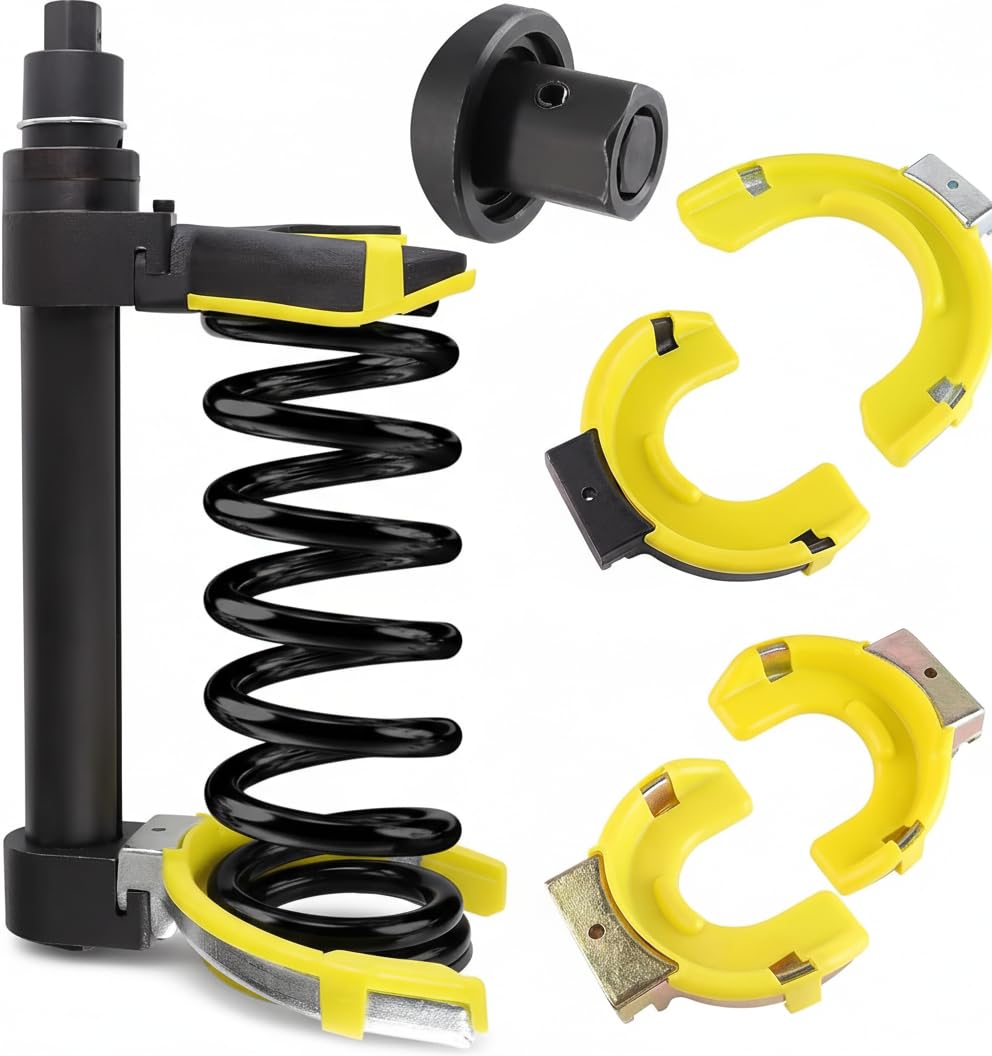
The Amerbm 2010ATH stands apart from nearly every other fork-style compressor because it was engineered from the ground up to accept impact wrench operation. An overload protection pin is built into the spindle: if the applied torque exceeds safe limits, the pin shears before the rod or frame can fail, giving the operator a clear mechanical warning instead of a catastrophic break. The three pairs of yokes cover spring diameters from 2.6 to 8.3 inches, and the 9921-pound load capacity provides ample headroom for full-size trucks, heavy SUVs, and even UTV springs without the frame flexing or bowing under tension.
For owners who have worked with conventional hook-style compressors that require alternating quarter-turns and constant visual inspection, the Amerbm feels like a fundamentally different class of tool. The single-sided compression screw applies force evenly through the central spindle, and the yokes grip the spring coils with heavy-duty safety lips that prevent the spring from walking sideways during compression. The kit includes a molded carrying case, alignment screws, and clear instructions emphasizing thread lubrication before every use. Experienced DIYers and professionals alike have reported completing strut assemblies in a fraction of the time compared to twin-screw designs.
One minor criticism is that the safety pin that retains the compression screw can work loose during operation, requiring occasional reinsertion. A few owners also noted that the yoke cups, while robust, are not coated, so minor surface rust can develop if stored in a humid garage without the case. These are small trade-offs for a tool that allows safe impact wrench use and delivers the structural integrity needed for repeated heavy-duty jobs. For anyone planning to service multiple vehicles or tackle truck springs regularly, the Amerbm 2010ATH is the most capable portable compressor at this price.
What works
- Impact wrench rated with overload protection pin for faster operation
- Massive 9921 lb capacity handles trucks and heavy SUVs without flex
- Three yoke sizes cover a wide range of spring diameters
What doesn’t
- Retention pin for the compression screw can loosen during use
- Uncoated yoke surfaces may develop surface rust if stored improperly
2. Branick 7600 Strut Spring Compressor

The Branick 7600 is a wall-mounted shop compressor that completely redefines the workflow of strut service. Instead of clamping individual spring coils, the unit accepts the entire strut assembly — spring, shock, and top hat — and compresses the spring by turning a heavy-duty acme thread screw. This design eliminates the need to align separate hooks or yokes on individual coils, and the multi-position hooks allow the operator to accommodate a broad range of strut diameters without adaptors. The 98-pound all-steel frame provides a rock-solid foundation that simply does not flex, even under the high spring rates of large SUVs and pickup trucks.
Every aspect of the Branick 7600 prioritizes safety and repeatability. The four adjustable hooks engage the spring at evenly spaced points, distributing the compression load symmetrically and preventing the spring from kicking out sideways. The threaded acme rod moves smoothly and holds position without back-driving, so the operator can stop at any point and work on the top nut without the spring re-expanding unexpectedly. Owners have reported using the 7600 on F-150, Durango, and Silverado struts with complete confidence, noting that the tool makes jobs that previously required two people and constant vigilance feel like a single-person bench task.
The most obvious barrier is the investment required — this compressor sits at the top of the price spectrum, and its wall-mounted design means it occupies permanent shop space. It is not portable, so it will not travel between garages or fit in a mobile tool kit. Some owners also note that the base unit ships without pre-drilled mounting holes, so you will need to measure and drill your own bolt pattern. For a dedicated home workshop or professional shop where strut work is a regular occurrence, the Branick 7600 is the safest, fastest, and most confidence-inspiring spring compressor available.
What works
- Compresses the entire strut assembly for a safer, more controlled process
- Rock-solid all-steel frame eliminates flex under heavy spring loads
- Multi-position hooks fit a wide range of diameters without adaptors
What doesn’t
- Requires wall space and permanent mounting; not portable
- Premium investment may be hard to justify for occasional use
3. OTC 7045B Front Coil Spring Compressor

The OTC 7045B is a specialized tool designed for a specific but common application: front coil springs on late-model rear-wheel-drive domestic vehicles. Rather than using interchangeable yokes or external hooks, this compressor employs four case-hardened self-aligning plates that seat directly against the spring coils. Two plates have a 3-3/8-inch inner diameter and two have a 4-inch inner diameter, giving the operator the ability to match the plate size to the coil diameter for optimal load distribution. The self-aligning feature ensures that as the spring compresses, the plates pivot slightly to maintain full contact, reducing the risk of the spring slipping out of position.
Experienced mechanics have praised the OTC 7045B for its reliability on Crown Victorias, Chevrolet sedans, and full-size trucks. The inclusion of four plates rather than two provides a more stable compression platform than most hook-style tools, and the case-hardened surface resists galling and wear over repeated use. The tool is backed by OTC’s lifetime limited warranty, which reflects the manufacturer’s confidence in the design. Owners who have used the rental-style twin-screw compressors describe the OTC as being in a completely different class in terms of build precision and peace of mind.
The trade-off is application specificity. The tool is not designed for MacPherson strut assemblies where the spring is integrated with the shock, and it will not work on Mercedes-Benz vehicles. The plate sizes are fixed, so it cannot accommodate very large or very small coil diameters outside the two provided options. For DIYers who work primarily on older domestic cars and trucks, the OTC 7045B is a long-term investment that pays for itself in safety and ease. For those needing broader vehicle coverage, a fork-style compressor may be more practical.
What works
- Self-aligning plates maintain full contact and reduce slippage risk
- Lifetime warranty from a trusted professional tool brand
- Case-hardened plates resist wear and last through many jobs
What doesn’t
- Limited to domestic RWD front coil springs; not for MacPherson struts
- Fixed plate sizes cannot accommodate unusual spring diameters
4. VEVOR XC4027A Strut Spring Compressor Set

The VEVOR XC4027A brings thoughtful safety engineering to the mid-range fork-style category. Each yoke is fitted with a spring-loaded safety tongue that acts as a mechanical catch, preventing the compressed spring from detaching even if the threaded rod loses tension. The kit also includes yellow protective sleeves that slide over the yoke arms to prevent scratching the spring coating or the shock body during installation. With a rated load capacity of 4,500 kg (roughly 9,921 lbs), the compressor has more than enough overhead for full-size trucks and SUVs, and the three interchangeable yokes cover spring diameters from 2.6 to 8.3 inches.
Owners have reported successful use on vehicles ranging from a 2018 BMW X3 to a 2014 Ford F-150 with spring code U. The heat-treated #45 steel construction and reinforced threaded rod resist bending even under heavy compression, and the hex bolt at the top is compatible with a standard 7/8-inch socket. The kit comes in a blow-molded carrying case that keeps all three yoke pairs, the compression cylinder, and the hardware organized. Users consistently note that the VEVOR feels more substantial than its price suggests, and the safety tongues provide an extra layer of confidence during the compression process.
A few owners have mentioned that the yoke cups are narrower than expected, requiring careful positioning on springs with tight coil spacing. The protective sleeves, while helpful for preventing scratches, can create interference on some shock shaft covers and may need to be removed. These are minor considerations for a tool that offers professional-grade load capacity, triple-yoke versatility, and integrated safety features at a mid-range price. For the home mechanic who wants a fork-style compressor that feels secure on both import sedans and domestic trucks, the VEVOR is a standout option.
What works
- Safety tongues on yokes prevent spring detachment under tension
- 4,500 kg capacity provides generous overhead for large vehicles
- Included carrying case keeps all components organized
What doesn’t
- Yoke cups are relatively narrow for some tight coil spacing
- Protective sleeves may interfere with certain shock shaft covers
5. 8MILELAKE Macpherson Strut Spring Compressor Kit

The 8MILELAKE compressor has been a consistent performer in the mid-range fork-style category for years, and its longevity on the market speaks to the durability of the design. The kit includes three pairs of interchangeable jaws spanning 65-125 mm, 88-160 mm, and 126-212 mm, along with a single compression rod, an adjustment hook, and six fixing screws. The jaws are machined from heat-treated steel and coated with a corrosion-resistant finish. The tool carries an SGS test report certifying a maximum force of 4,487 kg, substantially exceeding what most passenger vehicles and light trucks will ever require.
Long-term owners and hobbyist mechanics with decades of experience have noted that the 8MILELAKE feels noticeably more substantial than the twin-screw rental compressors commonly found at auto parts stores. The single-screw design applies even pressure without the bowing or binding that plagues two-rod systems, and the jaw engagement is positive enough that the spring stays centered throughout the compression stroke. The kit is organized in a compact storage case, making it easy to transport between jobs. Several reviewers specifically mentioned using it on Jeeps, BMWs, and older domestic sedans with consistent results.
The most common failure point reported is the jaw casting itself — a small number of owners have experienced the jaw breaking under load, typically on the first or second use. This appears to be a quality-control variance rather than a systemic design flaw, but it is worth inspecting the jaws for any visible casting voids before putting them under tension. Additionally, the instructions warn against using an impact driver, so the compression process must be done manually with a ratchet. For the DIYer who wants a capable fork-style compressor at a reasonable cost and is willing to inspect for casting defects, the 8MILELAKE delivers strong value.
What works
- SGS-certified 4,487 kg capacity handles most vehicles with margin
- Three jaw sizes accommodate a wide range of spring diameters
- Corrosion-resistant finish and organized carrying case included
What doesn’t
- Occasional casting defects in jaws reported by a few owners
- Not compatible with impact wrenches; manual ratchet only
6. DAYUAN YT-98037-Blu Macpherson Strut Spring Compressor
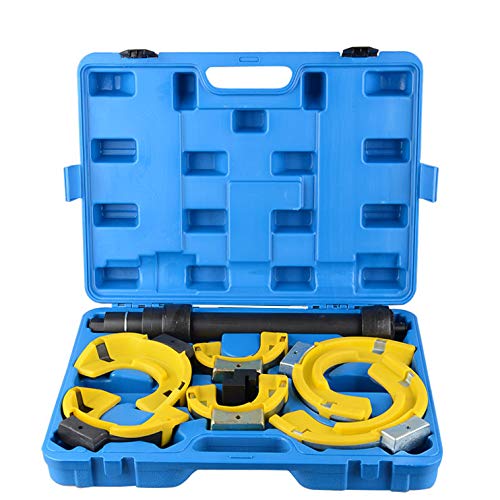
The DAYUAN YT-98037-Blu follows the same basic fork-style architecture as the 8MILELAKE and VEVOR kits but packages it with a slightly different jaw set and a focus on ease of setup. The kit includes three interchangeable jaw pairs: 65-125 mm, 88-160 mm, and 126-212 mm, all stored in a fitted blow-molded case. The tool carries an SGS test report with a maximum force rating of 4,487 kg, matching the 8MILELAKE in capacity. The compression screw comes pre-lubricated from the factory, reducing the initial setup friction and allowing the operator to start working immediately after unpacking.
Owners have reported successful use on a range of vehicles including the S550 Mustang, where the largest jaws were required to reach the spring coils. The tool is noted for its sturdy feel and the confidence it inspires during compression — the yokes grip firmly without slipping, and the single-screw mechanism applies pressure smoothly. The kit weighs 34 pounds, which gives it a solid, substantial feel on the bench. Several users mentioned that the organized case makes it easy to keep all three jaw sizes readily accessible, and the pre-applied lubrication is a thoughtful touch that saves time on the first job.
The most significant concern with the DAYUAN is a small number of reports describing the tool breaking on the first use, with one experienced mechanic noting that a casting failed catastrophically during compression. This failure pattern mirrors the quality-control variance seen in the 8MILELAKE, and it suggests that careful inspection before use is essential. The manufacturer explicitly warns against using an impact wrench, and the tool should only be operated with a hand ratchet. For buyers on a tighter budget who are comfortable inspecting castings and are willing to accept the manual-only operation, the DAYUAN offers competitive capacity and a complete kit.
What works
- SGS-certified 4,487 kg capacity with three interchangeable jaw sizes
- Pre-lubricated threads reduce initial setup friction
- Sturdy 34-pound frame inspires confidence during compression
What doesn’t
- Occasional casting failures reported on first use
- Manual ratchet only; impact wrench use strictly prohibited
7. Shankly B1025 Heavy Duty Spring Compressor Tool

The Shankly B1025 is a hook-style compressor that takes a different approach from the fork-style kits dominating the mid-range. Rather than interchangeable yokes, it uses two independent threaded rods with hardened steel hooks that clamp onto individual spring coils. The jaw capacity ranges from 23 mm to 280 mm, giving it the widest theoretical coverage of any tool in this guide. The frame is built from rugged steel with a claimed 1,000 kg maximum capacity per pair, and the hooks use hex nuts for tightening rather than the threaded knobs found on cheaper hook-style tools.
Several owners have successfully used the Shankly on full-size trucks, including a 2009 Silverado 1500 and a 2009 Ram 1500, noting that the hooks held firmly once properly seated. The wide jaw range allows the tool to accommodate both small car springs and large truck coils with the same set of hooks. The tool weighs under 7 pounds, making it one of the lightest compressors available, and its compact size allows it to fit into tight wheel wells where larger fork-style compressors may not reach. For those who need a portable tool for occasional spring work, the low weight is a genuine advantage.
The hook-style design carries inherent safety risks compared to fork-style compressors. The two independent rods must be tightened evenly in alternating increments to prevent the spring from cocking sideways, and the hooks can shift position if not seated squarely on the coil. The manufacturer explicitly warns against using an impact gun and stresses the importance of greasing the threads thoroughly before each use. A few owners noted that the hooks felt less secure than the fork-style yokes they had used previously, and the tool requires more attention and care during operation. For light-duty use on smaller vehicles by an experienced operator, the Shankly is an affordable entry point, but it demands respect and careful technique.
What works
- Extremely wide 23-280 mm jaw range fits almost any spring size
- Lightweight at under 7 pounds for easy portability
- Hardened steel hooks with hex nut tightening for secure grip
What doesn’t
- Hook-style design requires more skill and even tightening to prevent cocking
- Not recommended for impact wrench use; manual only
- Lighter build may feel less secure on high-tension springs
Hardware & Specs Guide
Load Capacity & Safety Margins
The rated load capacity of a spring compressor is the maximum force it can apply before structural failure becomes a risk. Entry-level hook-style compressors like the Shankly B1025 are typically rated around 1,000 kg, which is sufficient for compact cars and many sedans but leaves little safety margin for large trucks or SUVs. Fork-style compressors from brands like VEVOR, 8MILELAKE, and DAYUAN are certified at 4,487-4,500 kg, offering four times the overhead and a much wider safety envelope. The Amerbm 2010ATH matches this with a 4,500 kg (9,921 lb) rating while adding impact-wrench compatibility. The Branick 7600, as a wall-mounted unit, relies on its massive steel frame and acme screw rather than a discrete load rating, but its real-world capacity exceeds any portable compressor. Always choose a compressor with at least 2x the estimated spring load of your heaviest vehicle to maintain a safe operating margin.
Material & Thread Quality
The threaded rod is the single most stressed component in any spring compressor, and its material quality directly determines the tool’s lifespan and safety. Compressors made from #45 heat-treated steel, such as the VEVOR and Amerbm models, offer the best combination of strength and fatigue resistance. The threading should be cleanly machined, not rolled, to minimize friction and prevent galling during high-load turns. Some budget compressors use lower-grade steel that can stretch or strip after only a few compression cycles. The yoke or jaw material is equally important: case-hardened steel resists deformation at the contact points where the spring exerts its highest localized pressure. Always lubricate the threads with grease before each use — this single maintenance step dramatically reduces thread wear and prevents the rod from seizing under load.
Jaw & Yoke Compatibility
The spring diameter and coil spacing vary significantly across vehicle platforms. Fork-style compressors with three interchangeable yoke pairs offer the broadest compatibility, typically covering spring diameters from roughly 65 mm to 212 mm. This range accommodates most passenger cars, SUVs, and light trucks. The VEVOR and Amerbm kits extend coverage slightly wider, up to 8.3 inches (211 mm), while the 8MILELAKE and DAYUAN stop at 212 mm. Hook-style compressors like the Shankly offer a much wider single-range jaw opening (23-280 mm) but rely on the operator to position each hook precisely on the coil, which can be less secure than a cradle-style yoke. For vehicles with conical springs or uneven coil spacing, a fork-style compressor with multiple yoke sizes provides more reliable grip and even load distribution.
Impact Wrench Compatibility
Most spring compressors explicitly prohibit impact wrench use because the sudden torque can strip threads or snap the rod before the operator can react. The Amerbm 2010ATH is the notable exception in this guide, featuring an overload protection pin that shears at a safe threshold, allowing the use of an impact wrench for rapid compression and decompression. All other compressors reviewed — including the VEVOR, 8MILELAKE, DAYUAN, Shankly, and both OTC and Branick — require manual operation with a hand ratchet or breaker bar. Using an impact wrench on a non-rated compressor voids any safety certification and dramatically increases the risk of catastrophic failure. If speed is a priority for high-volume work, the Amerbm’s impact-rated design is a genuine time-saver, but for occasional use, manual operation with consistent lubrication is perfectly adequate and safer.
FAQ
Can I use a spring compressor with an impact wrench?
What is the difference between hook-style and fork-style spring compressors?
How much load capacity do I really need for my vehicle?
Is a wall-mounted strut spring compressor worth the investment for a home garage?
Final Thoughts: The Verdict
For most buyers, the best strut spring compressor winner is the Amerbm 2010ATH because it combines impact-wrench compatibility, overload protection, and a 9,921-pound capacity in a well-designed fork-style package that suits both DIYers and professionals. If you want uncompromising safety and the fastest possible workflow for frequent shop use, grab the Branick 7600. And for a value-conscious mid-range option with triple-yoke versatility, nothing beats the VEVOR XC4027A.

Certification: BSc in Mechanical Engineering
Education: Mechanical engineer
Lives In: 539 W Commerce St, Dallas, TX 75208, USA
Md Amir is an auto mechanic student and writer with over half a decade of experience in the automotive field. He has worked with top automotive brands such as Lexus, Quantum, and also owns two automotive blogs autocarneed.com and taxiwiz.com.