Rust on a car is more than cosmetic damage — it’s a structural threat that spreads silently beneath paint, along frame rails, and inside cavities you cannot see. Choosing the wrong remover can etch clear coats, leave toxic residue, or fail to stop recurrence, turning a simple fix into costly bodywork.
I’m Amir — the founder and writer behind Four Wheel Ask. My approach focuses on automotive chemical analysis, comparing active ingredients, application methods, and real owner reports across hundreds of formulations to separate marketing claims from actual corrosion control.
Surface preparation, pH safety, and long-term protection matter far more than brand names. After evaluating dozens of formulations, I’ve identified the top-performing options for any budget in this guide to the best rust remover for cars.
How To Choose The Best Rust Remover For Cars
Selecting the right rust removal product depends on three factors: surface type, rust severity, and your willingness to strip and repaint. The wrong chemistry can damage clear coats, leave a surface too slick to paint, or neutralize rust only temporarily.
Acid vs. Acid-Free Formulations
Phosphoric acid converters react with iron oxide to create a stable black layer that can be painted. Acid-free formulas use chelation or water-based chemistry to dissolve rust without etching sound metal. Acid-free options are safer on clear coats, chrome, and aluminum, while acid-based converters bond tightly to heavily rusted steel.
Spray, Soak, or Gel Application
Spray-on formulas work best for brake dust fallout and light surface rust on vertical panels. Gel cling formulas stay on curved surfaces longer, ideal for wheel wells and fender edges. Soak-only products deliver the deepest penetration for heavily rusted parts, brackets, and tools but require full immersion.
Converter vs. Remover vs. Inhibitor
Converters chemically alter rust into a paintable primer layer; they do not remove rust. Removers dissolve rust down to bare metal, requiring immediate priming. Inhibitors create a barrier to prevent new rust from forming. Many premium products combine two or all three functions for a complete corrosion management strategy.
Quick Comparison
On smaller screens, swipe sideways to see the full table.
| Model | Category | Best For | Key Spec | Amazon |
|---|---|---|---|---|
| CARPRO IronX | Mid | Paint decontamination & brake dust | Acid-free, pH neutral, 17 oz spray | Amazon |
| Evapo-Rust Original | Premium | Heavy soak restoration | Non-toxic, biodegradable, 3.5 gal | Amazon |
| Metal Rescue | Premium | No-scrub soaking | Non-acid, safe on skin, 1 gal | Amazon |
| Griot’s Garage Iron & Fallout | Premium | Vertical surface gel cling | pH-balanced, color-changing gel, 35 oz | Amazon |
| Eastwood Internal Frame | Premium | Frame cavity protection | Converter & prevention, 14 oz aerosol | Amazon |
| CorrosionX Heavy Duty | Mid | Extreme weather barrier | Self-healing, 5-yr indoor, 12 oz aerosol | Amazon |
| JENOLITE Original | Mid | Fast-acting industrial removal | Bare metal in 30 min, 500 ml spray | Amazon |
| Meuvcol 2-in-1 Converter | Value | Multi-surface chassis coating | Matte black, 35 oz, brushable | Amazon |
| Custom Shop Barrier Bond | Value | No-prep rust conversion | Spray-on converter, 10 oz aerosol | Amazon |
| Sunnyside Ready-Strip | Budget | Indoor multi-surface light rust | Non-corrosive, odorless, quart spray | Amazon |
| Rust911 Ultra Concentrate | Value | High-volume restoration | 16x concentrate, 1 gal makes 16 gal | Amazon |
In‑Depth Reviews
1. CARPRO IronX Iron Remover Lemon Scent 500ml
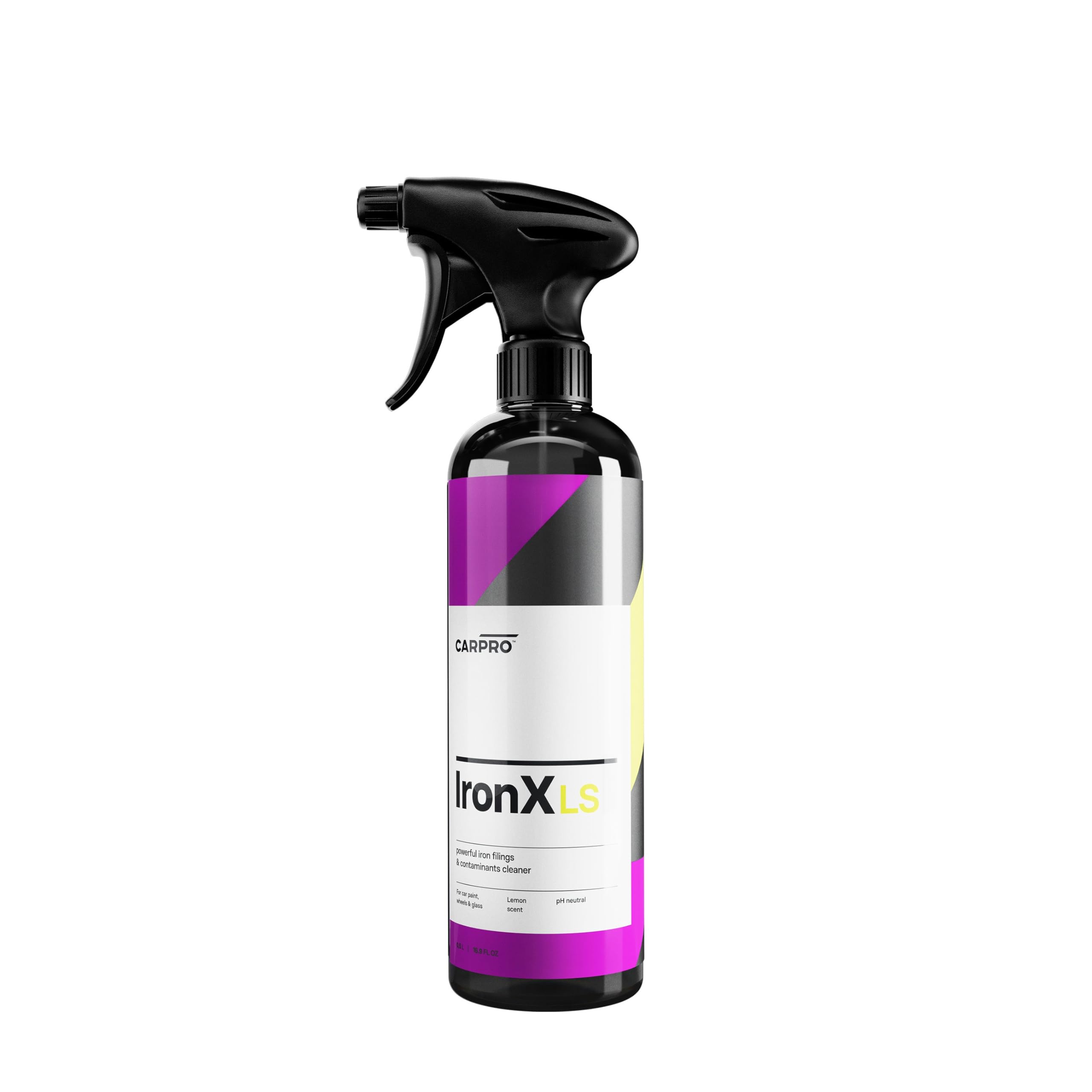
CARPRO upgraded this formula to be 10% more potent than its predecessor while maintaining an acid-free, pH-neutral profile that will not etch clear coats or damage polished metals. The lemon-scented spray reacts with embedded ferrous particles — brake dust, rail dust, industrial fallout — turning purple as it dissolves contamination that clay bars alone cannot reach. This makes it a go-to for detailers who need to decontaminate paint before polishing or coating.
The 500 ml sprayer delivers enough coverage for several full-car treatments, and the formula is safe on wheels, glass, chrome, and painted surfaces. Unlike aggressive acid-based removers, IronX will not cause clear coat haze or require immediate neutralization. The production date stamp on the bottle helps users confirm freshness, which matters because the active chelating agents degrade over time.
Professional detailers and coating installers rely on IronX as a standard pre-treatment step because it removes the invisible iron contamination that causes clear coat failure and rust spotting. For daily drivers and weekend enthusiasts alike, this product delivers professional-grade decontamination without the risk of surface damage.
What works
- Safe on clear coat, chrome, and glass without etching
- Color-changing action confirms that contamination is being removed
- Pleasant citrus scent compared to sulfur-based competitors
What doesn’t
- Not designed for heavy flaking rust or thick corrosion layers
- Requires thorough rinsing and can leave residue if over-applied
2. Evapo-Rust Original Super Safe Rust Remover 3.5 Gallon

Evapo-Rust is widely considered the benchmark for acid-free, water-based rust removal. The 3.5-gallon pail includes a dip basket and enough solution to fully submerge brake calipers, brackets, tools, and small suspension parts. The formula uses chelation chemistry to selectively dissolve iron oxide without attacking the underlying sound metal, leaving a bare surface that requires immediate priming or coating.
This product contains no acids, bases, solvents, or VOCs, and it is safe on skin and eyes — no gloves or respirator required during use. The solution works best as a full immersion soak — simply place the part in the pail and wait minutes to hours depending on rust severity. After removal, rinse with water and the part is ready for paint or protective coating.
Owners consistently report excellent results on cast iron cookware restoration, antique tool revival, and automotive fastener cleaning. The absence of fumes makes it suitable for indoor workshop use. The 3.5-gallon size is ideal for anyone with multiple rusted parts to restore, though the upfront investment reflects the volume.
What works
- Completely non-toxic and safe for indoor use without ventilation
- Dip basket and pail design simplify batch part restoration
- Leaves bare metal without etching or dimensional loss
What doesn’t
- Requires full immersion; not effective as a spray or wipe
- Solution darkens with use and must be replaced periodically
3. Metal Rescue Rust Remover 1 Gallon

Metal Rescue offers a no-scrub soaking approach that requires virtually no labor — just submerge the rusted part in a plastic container and let chemistry do the work. The formula contains no acids or caustics, making it safe on skin and safe for drain disposal in most municipalities. Reaction times range from five minutes for light surface rust to 24 hours for thick, crusted corrosion.
This product does not compromise the mechanical properties of the metal, so it is safe for threaded fasteners, bearings, and machined surfaces. The one-gallon size is manageable for individual part restoration while still providing enough depth to cover brake rotors, wrenches, and small brackets. Users report that the liquid remains effective through multiple soak cycles before needing replacement.
The key limitation is that Metal Rescue is designed exclusively for immersion — it will not work as a spray or wipe. For larger panels or chassis sections that cannot be removed and submerged, a converter or gel-based remover would be more practical. But for anyone restoring individual components, this is one of the most convenient, acid-free options available.
What works
- Truly labor-free — no brushing or agitation required
- Safe on skin, non-toxic, and drain-safe in most areas
- Reusable through multiple soak cycles for economy
What doesn’t
- Ineffective as a spray; requires full submersion
- Slower on heavy rust compared to acid-based alternatives
4. Griot’s Garage Iron and Fallout Remover 10948, 35oz

Griot’s Garage differentiates this iron remover with a gel formula designed to cling to vertical surfaces — door panels, quarter panels, tailgates — where liquid sprays would run off before doing their job. The pH-balanced gel dissolves bonded iron and fallout debris that clay bars miss, and it changes color as it works, giving clear visual confirmation of contamination removal.
The 35-ounce bottle provides generous coverage for multiple treatments, and the citrus scent is a welcome improvement over the sulfur smell common in iron removers. Griot’s formula is safe on paint, wheels, glass, chrome, and stainless steel trim when used as directed. The gel consistency also helps it linger on wheel barrels and spoke crevices where brake dust accumulates most stubbornly.
Detailers appreciate that this product reduces the need for aggressive claying, which can mar soft clear coats. As a pre-wax or pre-coating decontamination step, the gel format offers superior dwell time on tall vehicles like SUVs and trucks. The trade-off is that the gel requires more thorough rinsing than a liquid spray.
What works
- Gel clings to vertical panels for extended dwell time
- Color-changing action confirms contamination is removed
- Pleasant citrus scent and pH-balanced for clear coat safety
What doesn’t
- Gel residue demands thorough rinsing to avoid streaks
- Not effective on heavy flaking rust or bare metal corrosion
5. Eastwood Internal Frame Coating Aerosol, 14 oz

Eastwood designed this aerosol specifically for treating the inside of frame rails, rocker panels, and boxed sections where rust forms from the inside out. The formula combines a rust converter with a protective coating, chemically neutralizing existing corrosion while sealing the surface against moisture. The included extension tube allows users to inject the spray deep into frame cavities through existing bolt holes and openings.
This product eliminates the need for future cavity maintenance by creating a flexible, waterproof barrier that will not crack or flake under vibration. The black gloss finish provides a professional look inside wheel wells and underbody areas. Full cure requires 24 hours, after which the coating can be painted over if desired.
Eastwood is a trusted name among restoration builders and off-road enthusiasts who deal with rust-prone frame structures. The aerosol format makes it far easier to reach internal cavity surfaces than brush-on products. Users should wear proper respiratory protection and apply in a well-ventilated area, as with any aerosol coating.
What works
- Extension tube reaches deep into frame cavities and rockers
- Combines converter and sealer in one application step
- Flexible film resists cracking under chassis movement
What doesn’t
- VOC content requires proper ventilation and respirator use
- Intended primarily for internal cavity treatment, not exterior panels
6. CorrosionX Heavy Duty Anti Rust Spray, 12 oz

CorrosionX Heavy Duty sets itself apart with a self-healing barrier that reflows over scratches and abrasions, maintaining a continuous protective seal without reapplication. The polar bonding technology locks the formula onto metal surfaces at the molecular level, blocking moisture and oxygen even in saltwater environments. The 12-ounce aerosol delivers a dripless spray that clings to vertical and overhead surfaces without running.
The manufacturer claims up to five years of indoor protection and two years outdoors, which is exceptional for a spray-on rust inhibitor. This product is particularly useful for battery terminals, grounding lugs, trailer hitches, and marine equipment exposed to constant moisture. The formula remains flexible and will not crack, flake, or wash away under pressure washing.
Unlike waxy coatings that harden and degrade, CorrosionX stays chemically active and self-heals over the life of the application. Users report excellent results on boat trailers, farm equipment, and off-road vehicles that see harsh conditions. For extreme environment protection where rust forms quickly, this spray provides a durable, long-term barrier.
What works
- Self-healing barrier reflows over scratches without reapplication
- Withstands pressure washing and saltwater exposure
- Polar bonding prevents hidden electrolysis and galvanic corrosion
What doesn’t
- Not a rust remover — only prevents new rust formation
- Aerosol can has limited coverage per 12 oz serving
7. JENOLITE Original Rust Remover for Metal, 500 ml

JENOLITE has been a trusted name in rust removal since 1939, and this fast-acting liquid formula lives up to that heritage. The industrial-strength chemical destroys rust down to bare metal quickly, with most applications ready for priming in about 30 minutes. The 500 ml trigger spray covers approximately 43 square feet, making it economical for treating body panels, chassis sections, and marine equipment.
The formula also removes light oxide films left after shot or grit blasting, giving metal a clean surface profile for paint adhesion. Application is simple — spray, brush, or immerse — and the product works on automotive bodywork, machinery, railings, tools, and garden furniture. Users report that JENOLITE cuts through rust faster than many consumer-grade competitors while remaining affordable enough for frequent use.
One consideration is that this is a stronger chemical compared to acid-free alternatives, so it requires basic safety precautions — gloves and eye protection. The trigger spray format makes it easy to target specific rust spots without overspray, and the fast action minimizes dwell time. For workshop use where speed matters, JENOLITE delivers reliable results.
What works
- Fast rust removal — bare metal ready in approximately 30 minutes
- Versatile application — spray, brush, or immersion
- Proven brand with decades of industrial and automotive use
What doesn’t
- Strong chemical requires gloves and eye protection
- Not pH-neutral; may affect surrounding painted surfaces
8. Meuvcol 2-in-1 Rust Converter & Metal Primer, 35 oz
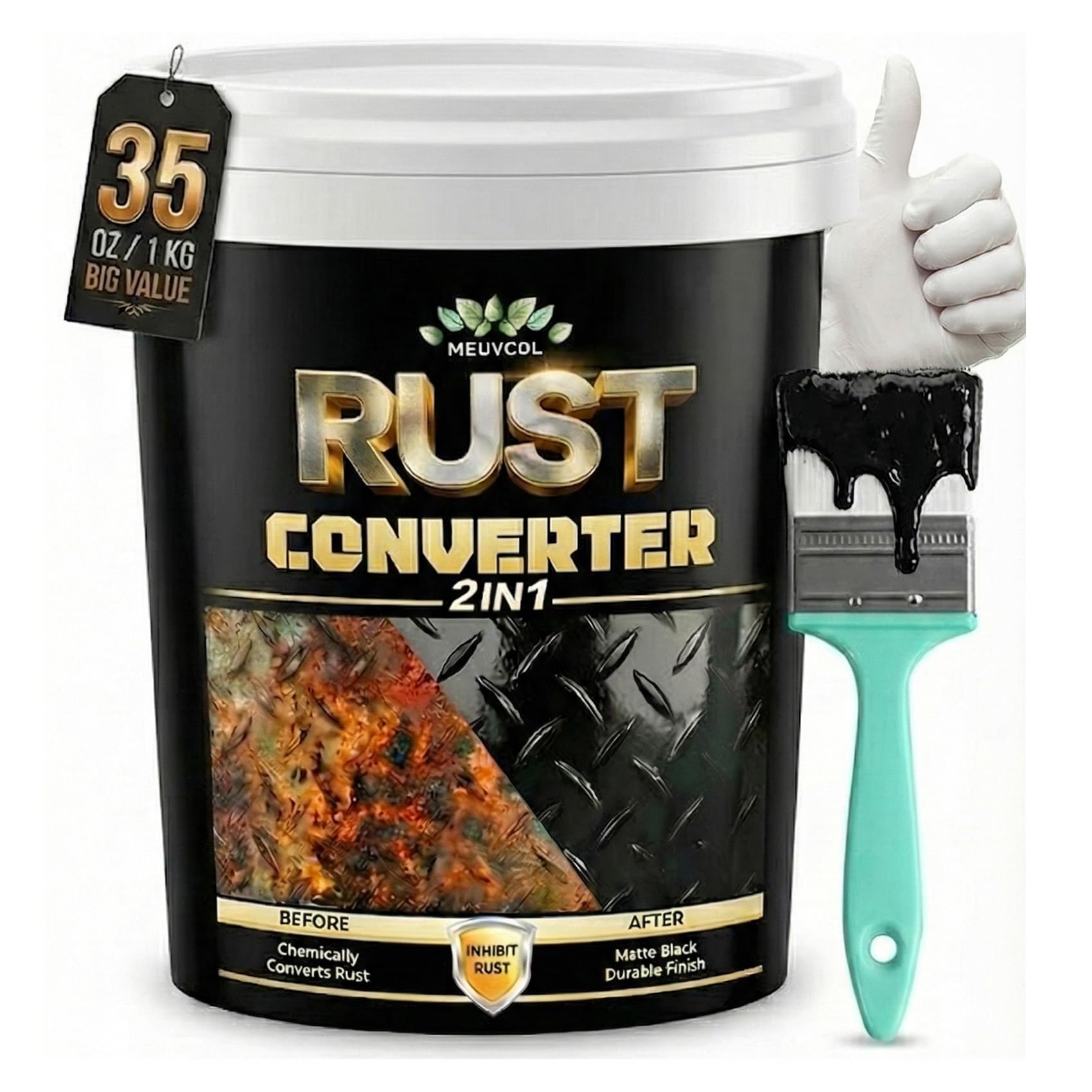
Meuvcol’s 2-in-1 Rust Converter combines chemical rust neutralization with a durable matte black primer in a single application. The formula transforms existing rust into a stable, inert barrier while sealing the surface against moisture and oxygen. This product is designed for automotive frames, truck chassis, trailers, farm equipment, and marine applications where long-term corrosion resistance is critical.
The 35-ounce container includes a brush, gloves, and application manual, making it a complete kit for DIY restoration. The coating is waterproof and heat-resistant, suitable for underbody components that face road salt and temperature extremes. Multiple thin coats are recommended for best results, with 24 hours of drying time between applications.
What sets Meuvcol apart is its oxygen isolation capability — it physically blocks water and air from reaching the metal surface, preventing new rust from forming. Users report that it performs comparably to premium rust encapsulators at a more accessible price point. The matte finish provides a professional appearance on chassis components and underbody panels.
What works
- Combines converter and primer in one application step
- Includes brush, gloves, and manual for complete DIY kit
- Waterproof and heat-resistant for underbody use
What doesn’t
- Requires 24 hours drying between coats
- Brush application may leave streaks on large flat panels
9. Custom Shop Barrier Bond Rust Converter, 10 oz
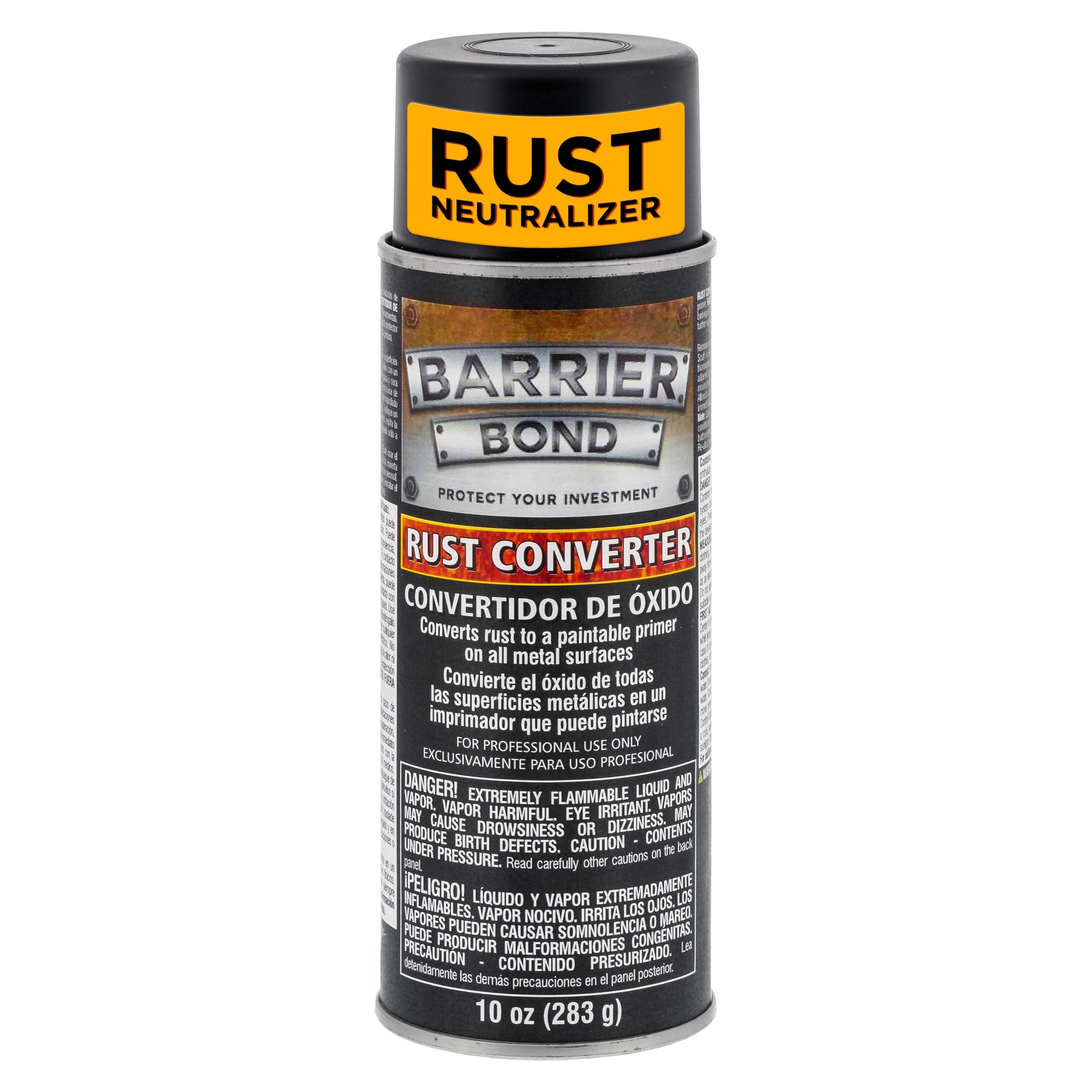
Barrier Bond Rust Off is a straightforward rust converter that transforms rusted surfaces into a protective black barrier without sanding or scraping. The formula chemically neutralizes iron oxide and creates an inert layer that prevents re-oxidation. Minimal surface preparation is required — just wire brush loose rust and spray directly onto the affected area.
This converter doubles as a primer that is ready for paint after 24 hours, or it can be left as a permanent protective coating. The 10-ounce aerosol reaches tight spaces and complex geometries where brush application would be impractical. It works on vehicles, tools, fences, roofs, and industrial equipment, making it a versatile addition to any workshop.
Users appreciate the convenience of spray-on conversion for hard-to-reach areas like frame crossmembers, suspension components, and fender edges. The black finish provides a clean appearance without standing out against underbody coatings. For budget-conscious buyers who need quick results without extensive prep work, Barrier Bond delivers functional value.
What works
- No sanding or scraping required before application
- Spray format reaches tight spaces and complex geometries
- Functions as both converter and primer for paint readiness
What doesn’t
- 10 oz can is small; multiple cans needed for large areas
- Not effective on heavy, flaking rust without prior wire brushing
10. Sunnyside 66732 Ready-Strip Rust Remover, Quart

Sunnyside Ready-Strip is a water-based, non-corrosive rust remover that safely lifts rust stains and light corrosion from most surfaces without damaging the underlying material. It contains no phosphoric or hydrochloric acid, making it suitable for indoor use with minimal odor. The quart trigger spray bottle is ready to use straight from the container, ideal for spot treatment on tools, automotive trim, and household items.
The environmentally safe formula is biodegradable and does not require special disposal procedures. It works on metal, plastic, and painted surfaces where acidic removers would cause damage. The lack of harsh fumes means it can be used in a home garage or basement workshop without respiratory concerns.
This product is best suited for light surface rust and stain removal rather than heavy corrosion. Users report good results on chrome bumpers, lawn tools, and garden furniture with minimal scrubbing. For heavy automotive rust on frames or body panels, a stronger converter or acid-based remover would be required, but for light-duty indoor use, Sunnyside provides a safe and straightforward solution.
What works
- Non-corrosive formula safe on painted surfaces and chrome
- Odorless and biodegradable — ideal for indoor applications
- Ready-to-use trigger spray with no mixing required
What doesn’t
- Not effective on thick or heavy rust layers
- Slow acting compared to acid-based or industrial formulas
11. Rust911 Rust Remover Ultra Concentrate, 1 Gallon

Rust911 Ultra Concentrate delivers professional-grade rust removal in a highly economical format — one gallon of concentrate mixes with up to 15 parts water to produce 16 gallons of working solution. The acid-free, neutral-pH formula dissolves rust through chelation rather than acid etching, making it safe on sound metal, skin-friendly, and environmentally responsible. It is designed for immersion soaking of automotive parts, tools, farm equipment, and machinery.
The concentrated formulation has a shelf life of up to five years when stored unmixed, allowing users to prepare only the volume needed for each project. The solution is reusable until it darkens significantly, extending the value further. Rust911 effectively removes oxides from steel, iron, cast iron, brass, bronze, and even brightens galvanized and copper surfaces.
Users note that Rust911 excels on heavy rust deposits such as mill scale and thick corrosion, though it requires full immersion — it will not work as a spray. The neutral pH means no risk of hydrogen embrittlement on high-strength steel components. For restorers and workshops processing high volumes of rusted parts, this concentrate offers the lowest per-gallon cost in the category.
What works
- Ultra-concentrate yields 16 gallons of working solution per gallon
- Acid-free and non-toxic with long storage life
- Reusable solution extends value for high-volume work
What doesn’t
- Effective only in immersion soak — not for spray application
- Requires mixing and proper container for storage
Hardware & Specs Guide
Acid-Based vs. Acid-Free Chemistry
Acid-based rust removers (phosphoric, hydrochloric, oxalic) chemically dissolve iron oxide quickly but can etch bare metal, damage clear coats, and require neutralization. Acid-free alternatives use chelation — a binding process that lifts rust without attacking the underlying substrate. Acid-free formulas are safer for painted surfaces, chrome, and aluminum, while acid-based options are more effective on heavy, flaking rust on bare steel where surface etching is acceptable.
Soak vs. Spray vs. Gel Delivery
Soak-only products (Metal Rescue, Evapo-Rust, Rust911) require full immersion and provide the deepest penetration, ideal for removable parts. Spray-on formulas (CARPRO IronX, JENOLITE) work on fixed panels and light contamination but have shorter dwell times. Gel formulas (Griot’s Garage) cling to vertical surfaces, making them the best choice for door panels, quarter panels, and wheel faces where runoff is a concern.
Concentrate Ratios and Yield
Some rust removers ship as ready-to-use formulas, while concentrates like Rust911 require dilution with water before use. A 16:1 concentrate ratio dramatically reduces per-gallon cost but adds a mixing step and requires a dedicated plastic container for immersion. Ready-to-use sprays offer convenience at a higher cost per ounce. For restoration shops treating dozens of parts, concentrate economics are compelling.
Surface Preparation Requirements
Rust converters (Custom Shop Barrier Bond, Meuvcol 2-in-1) require only loose rust removal via wire brushing before application. Rust removers generally require clean, grease-free surfaces for best results. All paint-ready surfaces — whether achieved by converter or remover — must be primed or coated within the manufacturer’s window (typically 24 hours) to prevent flash rusting on bare metal.
FAQ
Can I use a rust remover on painted surfaces?
What is the difference between a rust remover and a rust converter?
Do I need to sand or grind before applying a rust converter?
Can rust removers damage aluminum or chrome surfaces?
How long does it take for a rust converter to cure before painting?
Final Thoughts: The Verdict
For most buyers, the best rust remover for cars winner is the CARPRO IronX because it delivers professional-grade decontamination without risking clear coat damage, making it the safest choice for daily drivers and enthusiasts alike. If you need heavy-duty soak restoration for rusty parts and tools, grab the Evapo-Rust Original 3.5 Gallon. And for rust conversion on exposed chassis sections and frames, nothing beats the Meuvcol 2-in-1 Rust Converter for its complete kit and durable waterproof barrier.

Certification: BSc in Mechanical Engineering
Education: Mechanical engineer
Lives In: 539 W Commerce St, Dallas, TX 75208, USA
Md Amir is an auto mechanic student and writer with over half a decade of experience in the automotive field. He has worked with top automotive brands such as Lexus, Quantum, and also owns two automotive blogs autocarneed.com and taxiwiz.com.