The wrong geometry, a heavy frame, or confusing components can turn your first season on pavement into a frustrating experience instead of the liberating release a road bike should deliver. The difference between a bike you love and one you regret comes down to fit, drivetrain clarity, and brake confidence — three pillars that separate the keepers from the trade-ins.
I’m Amir — the founder and writer behind Four Wheel Ask. I spend my time analyzing market trends, comparing component specifications, and aggregating real owner feedback to identify the best value in every category.
A well-chosen entry-level machine should inspire miles, not intimidate with complexity. Whether that means a lightweight aluminum frame with reliable Shimano gearing or a carbon upgrade that grows with your fitness, the right best road bike for beginner female balances approachable geometry with components that won’t need upgrading after your first century ride.
How To Choose The Best Road Bike For Beginner Female
Selecting a first road bike requires balancing fit, component quality, and intended use. Three factors dominate the decision for new riders entering the sport.
Frame Geometry and Standover Height
A road bike with a relaxed, endurance-oriented geometry places the rider in a slightly more upright position, reducing strain on the lower back and neck during longer rides. Standover height — the clearance between the top tube and the rider’s inseam — must allow both feet to plant confidently at stops. Aluminum frames dominate the entry-to-mid tier for their stiffness-to-weight ratio, while carbon fiber absorbs vibration at a higher cost.
Drivetrain and Groupset Priority
Shimano groupsets (Claris, Sora, Tiagra) represent the industry standard for reliable shifting at the beginner level. Claris offers 16 speeds with proven durability; Sora adds an extra cog for tighter gear spacing. MicroShift components appear on some value-oriented builds and function well after proper tuning. Avoid bikes with budget-brand shifters that skip or require constant adjustment.
Brake Type and Stopping Confidence
Caliper brakes remain common on entry road bikes and provide adequate stopping power in dry conditions for riders under 150 pounds. Mechanical disc brakes offer superior modulation and perform consistently in wet weather or on descents, though they add weight and require occasional pad adjustment. Hydraulic disc brakes, while rare at this price point, deliver the best feel and power.
Quick Comparison
On smaller screens, swipe sideways to see the full table.
| Model | Category | Best For | Key Spec | Amazon |
|---|---|---|---|---|
| Tommaso Imola | Road | Best Overall for beginners | Shimano Claris 24-Speed | Amazon |
| SAVADECK Carbon Disc | Road | Carbon frame upgrade | Shimano SORA 18-Speed Disc | Amazon |
| Schwinn Phocus 1600 | Road | Budget-friendly entry | Shimano 14-Speed | Amazon |
| Tommaso La Forma | Hybrid | Commuter versatility | Aluminum/Carbon Hybrid | Amazon |
| Schwinn Network 3.5 | Hybrid | Upright comfort rides | 21-Speed Suspension Fork | Amazon |
| Cybervelo 1000 | Electric | Assisted commuting | 1000W Peak Motor / 80 Mi | Amazon |
| Wooken Fat Tire | Electric | All-terrain versatility | 1000W / 48V 13Ah Battery | Amazon |
In‑Depth Reviews
1. Tommaso Imola Sport Road Bike

The Tommaso Imola occupies a sweet spot in the beginner road bike segment — it pairs a genuine Shimano Claris 24-speed groupset with a sport-oriented aluminum frame that keeps weight manageable without sacrificing stiffness. Owner reports consistently note that the shifting becomes intuitive after a short learning curve, and the frame geometry suits riders who want a balance between reach and stability. Multiple users logged over a thousand miles across multiple seasons without mechanical issues beyond normal wear on consumables.
Build quality stands out at this price tier. Comments highlight clean welds, a durable paint finish, and hardware that doesn’t round off during assembly. The stock saddle and pedals are functional but commonly replaced by riders who spend long hours in the saddle — a predictable upgrade point on any bike at this level. The Claris derailleurs respond well to the initial cable stretch adjustment that all new bikes require.
Height recommendations center around the medium frame fitting riders near 5’10”, though Tommaso offers multiple sizes. Some owners noted the lack of assembly instructions and the need for basic tools to mount the front wheel, handlebars, and pedals. The absence of a kickstand is standard for road bikes. After initial tuning, the bike holds its adjustments well across seasons.
What works
- Genuine Shimano Claris groupset for reliable, crisp shifting
- High-quality frame construction with smooth welds and durable paint
- Proven long-term reliability — multiple owners report 1000-plus problem-free miles
- Sport geometry that feels responsive without being overly aggressive for newcomers
What doesn’t
- Stock saddle and pedals are basic and often swapped by frequent riders
- No assembly instructions included; mechanical familiarity is helpful
- Rear derailleur often needs factory adjustment before first ride
2. SAVADECK Carbon Disc Road Bike

The SAVADECK Carbon Disc Road Bike delivers a genuine Japanese TORAY T800 carbon frame and fork at a price point where aluminum is the norm, making it a compelling option for the beginner who wants room to grow. The fully internal cable routing cleans up the cockpit silhouette and reduces wind drag, while the Shimano SORA R3000 18-speed drivetrain provides smooth, dependable gear changes. The bike ships nearly fully assembled, and owners report arriving well ahead of estimated delivery dates.
Weight sits at approximately 21.1 pounds for a complete build, which is impressive for a disc-brake road bike at this level. The Continental 700x25c tires offer solid grip and puncture resistance on mixed pavement. Owner feedback highlights the smoothness of the shifting once the derailleurs are properly indexed, though the front derailleur sometimes arrives out of alignment. The oil-pull mechanical disc brakes deliver balanced stopping power with easy pad adjustment.
Several owners noted that assembly requires mechanical patience — the instructions are not exhaustive, and finer adjustments such as brake alignment and derailleur indexing benefit from prior experience. The stock pedals, saddle, and brake pads are functional but represent the most common upgrade targets. A handful of reports mention missing small hardware pieces, though customer service typically resolved these quickly. The frame flexion provides a noticeably comfortable ride compared to stiffer alloy frames.
What works
- Authentic TORAY T800 carbon frame at a price that undercuts most competitors
- Ultra-lightweight build around 21 pounds with disc brakes
- Smooth, comfortable ride quality with good vibration damping
- Continental tires provide confidence on varied road surfaces
What doesn’t
- Assembly requires mechanical know-how for proper derailleur and brake tuning
- Stock pedals, saddle, and brake pads are budget-tier and best upgraded
- Some units arrive with minor alignment issues or missing hardware
3. Schwinn Phocus 1600 Road Bike

The Schwinn Phocus 1600 is a no-frills entry point into road cycling that prioritizes affordability and immediate rideability. The aluminum frame with a steel road fork keeps the build light enough for daily fitness rides, and the 700c wheels accommodate riders from 5’4″ to 6’2″ depending on frame size. The 14-speed drivetrain uses a Shimano rear derailleur paired with MicroShift shifters integrated into the brake levers, which simplifies the cockpit for new riders who don’t need a steep gear range.
Owner reports consistently describe the bike as fast and nimble once properly tuned, with several riders comfortably covering 20 miles per day. The alloy caliper brakes provide adequate stopping power in dry conditions, though some owners noted the brake pads require a break-in period to eliminate initial squeal. The oversized 700c x 28c tires on lightweight alloy rims deliver a smooth ride on pavement and absorb minor road imperfections better than narrower tires.
Assembly is the most frequently cited challenge. The bike requires 30 to 60 minutes of work, and the derailleurs in particular need significant adjustment to shift cleanly. Several owners recommend budgeting for a professional tune at a local shop. A small number of units arrived with cosmetic defects or mechanical issues such as stripped crank threads, which underscores the importance of inspecting the bike promptly upon delivery. For riders with basic mechanical skills, this bike offers strong value.
What works
- Lightweight aluminum frame delivers a responsive ride for daily fitness use
- Wide 28c tires provide comfort and stability on varied pavement
- Integrated MicroShift shifter-brake levers simplify cockpit for newcomers
- Attractive color options with a classic road bike silhouette
What doesn’t
- Derailleurs arrive poorly tuned and require significant adjustment
- Stock tires use Schroeder valves that are harder to pump than Presta
- Quality control varies — some units have cosmetic or mechanical defects
4. Tommaso La Forma Hybrid Bike

The Tommaso La Forma blurs the line between road bike and commuter hybrid, offering a lightweight aluminum frame with carbon elements that appeal to riders who want speed without the aggressive drop-bar position. The bike arrives nearly fully assembled — owners report needing only to mount the front wheel, adjust the handlebar height, and attach pedals. The drivetrain and brakes function correctly out of the box in most cases, a meaningful advantage for buyers who prefer not to tinker.
Build quality draws consistent praise. The frame includes threaded mounts for water bottle cages and a rear rack, making it a practical choice for riders who want to carry gear. The supplied touch-up paint and a signed tuning note from the builder indicate attention to detail uncommon at this price level. Owner reports highlight smooth gear changes and clean stopping power from the linear pull brakes, with no hesitation or slipping after weeks of daily commuting use.
One ergonomic concern emerged repeatedly: the seat post does not lower fully because the bottle cage bolts protrude into the seat tube, which may prevent shorter riders from achieving an ideal saddle height. The bike lacks a kickstand, and some owners found the grips slippery under heavy use. Overall, the La Forma suits the rider who wants a near-turnkey experience with versatile mounting options for accessories.
What works
- Almost fully assembled out of the box — minimal mechanical work required
- Excellent build quality with thoughtful details like touch-up paint and tuning notes
- Mounts for racks and bottle cages add practical commuting versatility
- Lightweight feel that splits the difference between road and hybrid efficiency
What doesn’t
- Seat post can’t lower fully due to bottle cage bolt interference
- No kickstand included; grips may slide on longer rides
- Some units have had tube defects requiring warranty resolution
5. Schwinn Network 3.5 Hybrid Bike

The Schwinn Network 3.5 is a comfort-oriented hybrid that trades road-bike aggression for an upright riding position and suspension fork, making it an appealing choice for the beginner who prioritizes back-friendly posture over aerodynamic speed. The aluminum frame keeps weight reasonable, and the 21-speed twist-shift drivetrain offers a wide gear range for tackling hills without the learning curve of drop-bar shifters. The bike fits riders from 5’5″ to 5’9″ per the manufacturer’s chart.
Owner feedback emphasizes the ease of assembly and the value proposition. Several taller and heavier riders (up to 215 pounds) reported that the bike held up well over years of daily multi-mile use. The linear pull brakes provide confident stopping power, though some owners found the front brake rubbing against the rim due to wheel alignment issues out of the box. The swept-back handlebar and high-rise stem create a naturally relaxed arm position that reduces shoulder fatigue.
Size accuracy drew mixed reviews. Riders at the shorter end of the stated range found that the seat at its lowest setting still required a tiptoe stance at stops, which can be unsettling for a new rider. The generic manual covers multiple Schwinn models and lacks model-specific torque values or adjustment guidance. A small number of owners experienced chain slippage or shifter breakage after minor falls, suggesting the twist-shifter mechanism is less robust than trigger shifters on more expensive bikes.
What works
- Upright geometry with suspension fork reduces back and neck strain on longer rides
- Wide 21-speed range with easy twist-shift operation for hill climbing
- Durable aluminum frame supports riders up to 215 pounds over years of use
- Quick assembly with basic tools; good packaging protection during shipping
What doesn’t
- Standover height may be too tall for shorter riders even at lowest seat setting
- Generic multi-model manual lacks specific torque and adjustment details
- Twist shifters are less durable than trigger shifters in the event of a fall
6. Cybervelo 1000 Electric Bike

The Cybervelo 1000 shifts the conversation from pedal power to assisted commuting, offering a 1000-watt peak brushless motor paired with a 7-speed transmission for riders who want to tackle hills and headwinds without arriving exhausted. The 48V removable battery claims up to 80 miles on pedal-assist mode, and the step-through frame geometry accommodates riders of varying heights. The color LCD display shows real-time speed, battery level, assist mode, and mileage.
Owner experiences highlight the build quality and customer service responsiveness. The bike ships 90 percent assembled, and most owners completed setup within 30 minutes. The throttle and pedal-assist modes work smoothly, with multiple riders noting that the battery barely depletes after 10 miles of mixed use. The front suspension fork and saddle shock absorption deliver a comfortable ride on paved roads and light trails. The pink color option received particular praise for its aesthetic appeal.
Several owners mentioned that the throttle struggles on steep inclines, though pedal assist provides ample climbing power. The 59.5-pound weight is substantial, making it difficult to lift onto a bike rack or carry up stairs. A few reports of minor paint chips from chain contact during shipping were resolved through customer service. The metal handlebar and seat adjustment bolts require considerable force to loosen, which may frustrate riders without a full tool kit.
What works
- Powerful 1000W peak motor provides strong acceleration and hill-climbing capability
- Long battery range suits daily commuting needs without frequent charging
- Step-through frame and comfortable suspension setup welcome new riders
- Responsive customer service resolves shipping and hardware concerns quickly
What doesn’t
- Throttle-only mode lacks torque on steep inclines
- Heavy 59.5-pound build is cumbersome for transport and storage
- Saddle and handlebar adjustment bolts are exceptionally tight from the factory
7. Wooken Electric Bike Fat Tire
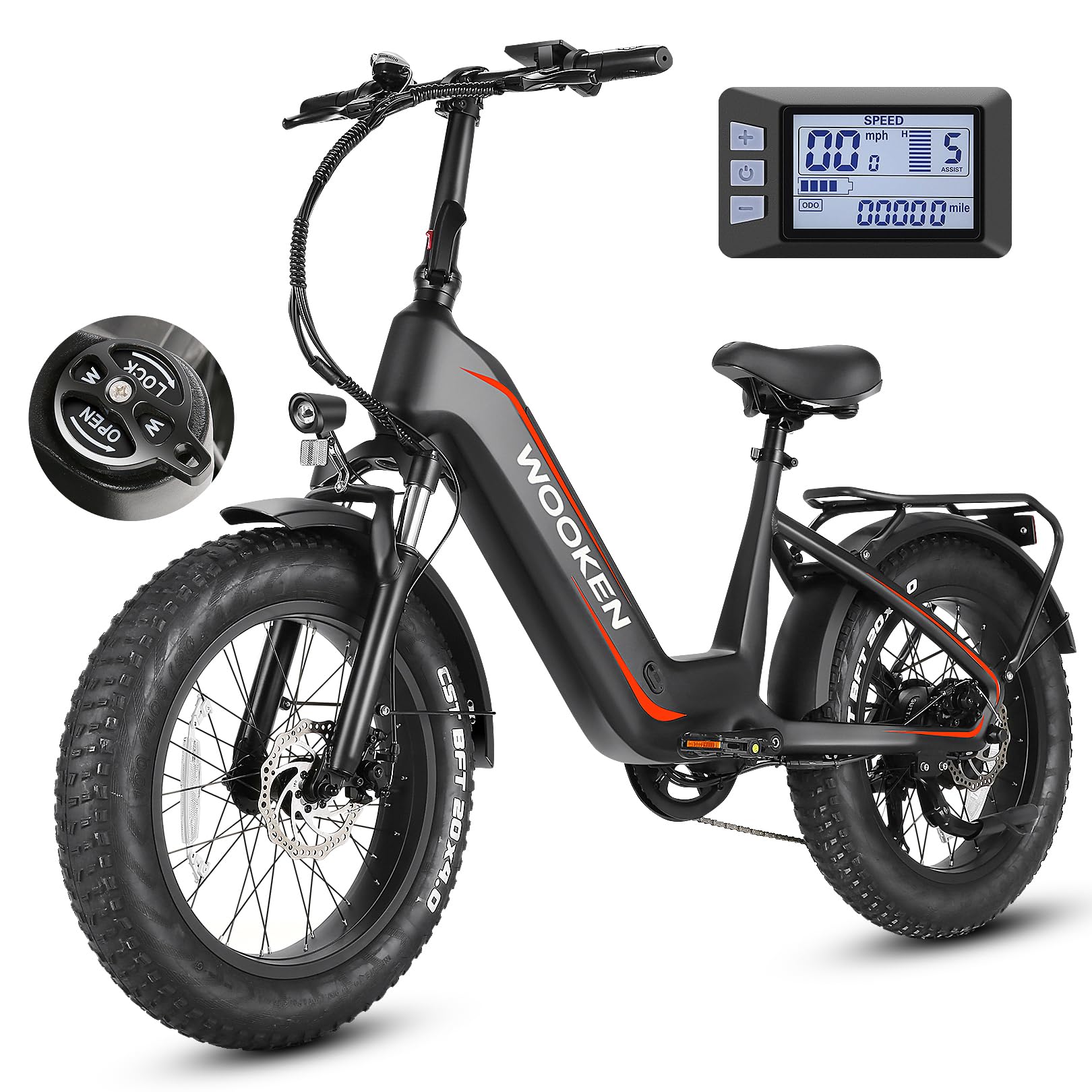
The Wooken Electric Bike takes a different approach with its 20-inch by 4.0-inch fat tires and step-through aluminum frame, targeting riders who want electric assistance on loose surfaces such as sand, snow, or gravel. The 48V 13Ah removable battery delivers up to 60 miles in pedal-assist mode, and the 1000-watt peak motor pushes the bike to 20 mph. The SGS certification to UL 2849 and UL 2271 provides a layer of safety verification that is rare at this price tier.
Owner impressions are overwhelmingly positive regarding value and build quality. The bike feels solid and well-constructed, with no creaks or rattles during operation. The 3-plus-1 working modes (pedal assist, pure electric, classic pedal, and push mode) offer flexibility for different terrain and fitness levels. The rear rack accommodates a passenger or cargo, and the step-through frame simplifies mounting and dismounting for riders with limited mobility.
Cornering performance drew criticism, particularly from taller riders who found the geometry unstable at higher speeds. The stock tires are thin-walled and prone to pinch flats on sharp impacts — multiple owners replaced them with aftermarket tires for improved durability. The bike lacks a dedicated rear brake light, relying instead on a red reflector. Battery replacement availability is uncertain, with some owners unable to locate spare batteries from the manufacturer.
What works
- Fat tires provide excellent traction on sand, snow, gravel, and pavement
- SGS certified to UL 2849 and UL 2271 for battery and electrical safety
- Step-through aluminum frame is easy to mount with minimal leg lift
- Strong 1000W motor and long-range battery suit all-terrain exploration
What doesn’t
- Stock tires are thin and prone to pinch flats on sharp bumps
- Cornering stability is poor, especially for taller riders
- No dedicated rear brake light; replacement batteries are hard to find
Hardware & Specs Guide
Frame Materials
Aluminum is the dominant frame material for road bikes at the beginner level because it offers a high stiffness-to-weight ratio without the cost of carbon fiber. Hydroformed aluminum tubes with smooth welds indicate a quality build. Carbon fiber frames, such as the TORAY T800 used on the SAVADECK, absorb road vibration better and save weight but require careful inspection for impact damage over time. Steel forks appear on budget models and add weight while improving durability and compliance.
Drivetrain Groupsets
Shimano Claris (16-speed) and SORA (18-speed) are the entry-level groupsets that define the quality floor for reliable shifting. Both use cable-actuated derailleurs that require periodic adjustment but deliver consistent performance when tuned. MicroShift components, found on some value builds, use similar design principles and can shift well after proper setup. The number of speeds matters less than the quality of the shift mechanism — a well-tuned 14-speed bike outshifts a poorly adjusted 24-speed bike every time.
Brake Systems
Caliper brakes are the lightest and simplest option, but they lose stopping power in wet conditions. Mechanical disc brakes use a cable to actuate the caliper and offer better modulation and wet-weather performance at the cost of added weight. Hydraulic disc brakes, rarely found on beginner-focused road bikes under four figures, provide the best feel and require the least hand force. Pad compound also matters — sintered metallic pads last longer, while organic resin pads offer better initial bite in dry conditions.
Wheel and Tire Fit
700c wheels are the standard for road and hybrid bikes. Tire width directly affects ride comfort and rolling resistance: 23-25mm tires prioritize speed and aerodynamics, while 28-32mm tires improve comfort and puncture resistance. Wider tires at lower pressures reduce vibration without the weight penalty of a suspension system. Beginners are often better served by 28c tires that forgive imperfect road surfaces and provide more stable cornering at moderate speeds.
FAQ
What frame size should a beginner female rider choose?
Should a beginner buy a road bike with drop bars or flat bars?
Is assembly by a professional bike shop necessary?
What accessories should a beginner female road rider prioritize?
How often should a new road bike be serviced?
Final Thoughts: The Verdict
For most buyers, the best road bike for beginner female winner is the Tommaso Imola because it combines a genuine Shimano Claris groupset with a well-constructed aluminum frame at a price that leaves room for essential accessories and a professional tune. If you want a carbon fiber upgrade for long-term growth, grab the SAVADECK Carbon Disc. And for the budget-conscious rider who values simplicity over spec sheets, the Schwinn Phocus 1600 delivers real road bike performance after a proper setup session.

Certification: BSc in Mechanical Engineering
Education: Mechanical engineer
Lives In: 539 W Commerce St, Dallas, TX 75208, USA
Md Amir is an auto mechanic student and writer with over half a decade of experience in the automotive field. He has worked with top automotive brands such as Lexus, Quantum, and also owns two automotive blogs autocarneed.com and taxiwiz.com.