A poor resonator choice turns your daily drive into an endless assault of drone and rasp. The right one cleans up the audio signature without choking flow, but the market is flooded with thin-walled cans that rust out or fail to cancel the frequencies that matter most. Sorting the effective sound tuners from the noise-making decorations requires a look under the skin at core design, material grade, and real-world owner reports.
I’m Amir — the founder and writer behind Four Wheel Ask. My research focuses on cross-referencing manufacturer material specifications with long-term owner experiences to identify which resonator designs deliver genuine acoustic improvement without sacrificing exhaust velocity or structural longevity.
After analyzing material composition, design efficiency, and verified owner feedback, this guide identifies the best resonator exhaust for eliminating drone while maintaining peak exhaust flow.
How To Choose The Best Resonator Exhaust
Selecting a resonator goes beyond picking a cylinder that fits your pipe. The internal architecture, material composition, and dimensional matching all determine whether the part cleans up the sound or simply adds another restriction point. Understanding these three variables separates a successful upgrade from a frustrating reinstallation.
Material Quality: Stainless Steel vs. Aluminized Steel
The external environment under a vehicle is brutal — road salt, moisture, and temperature cycles accelerate corrosion on any unprotected metal. T304 stainless steel offers the highest resistance to rust and maintains structural integrity at high exhaust temperatures, making it the preferred choice for long-term installations. Aluminized steel provides a lower-cost alternative with decent corrosion protection for regions without heavy salt exposure, but the coating can degrade at weld points and exposed edges over time.
Internal Design: Straight-Through vs. Chambered Construction
Straight-through resonators use a perforated core surrounded by sound-absorbing material — typically fiberglass or stainless steel mesh — to cancel specific frequencies while allowing exhaust gases to pass with minimal restriction. This design preserves flow and horsepower better than chambered units, which rely on reflected sound waves and internal baffles that create backpressure. For modern engines, the straight-through approach delivers the best balance of noise reduction and performance retention.
Fitment and Sizing: Inlet Diameter and Body Length
Matching the resonator’s inlet and outlet diameter to your existing exhaust pipe is critical — a mismatch requires adapters that can introduce leaks or turbulence. Body length and case diameter also affect sound tuning: longer bodies generally provide deeper tone attenuation, while shorter units target higher-frequency rasp. Measuring your available space under the chassis before purchasing prevents clearance issues during installation.
Quick Comparison
On smaller screens, swipe sideways to see the full table.
| Model | Category | Best For | Key Spec | Amazon |
|---|---|---|---|---|
| Vibrant 1792 | Stainless Steel | Sound Quality & Flow | 2.5″ Inlet, T304 SS, 12″ Length | Amazon |
| Walker 21398 | Direct Fit | OE Replacement | 2.25″ Outlet, Aluminized Steel | Amazon |
| A-KARCK 4″ | Universal | Drone Reduction | 4″ Inlet, Stainless Steel, 30″ Length | Amazon |
| Vibrant 1140 | Ultra Quiet | Maximum Dampening | 2.25″ Inlet, T304 SS, 13.75″ Length | Amazon |
| JY Performance 5″ | Diesel | Heavy Duty Trucks | 5″ Inlet, Stainless Steel, TIG Welded | Amazon |
| Upower 4″ | Universal | Entry Level Build | 4″ Inlet, Stainless/Fiberglass, 30″ | Amazon |
| Walker 21690 | OE Muffler | Budget Repair | 3″ Inlet, Stainless Steel, Bolt-On | Amazon |
In-Depth Reviews
1. Vibrant Performance 1792 Bottle Style Resonator
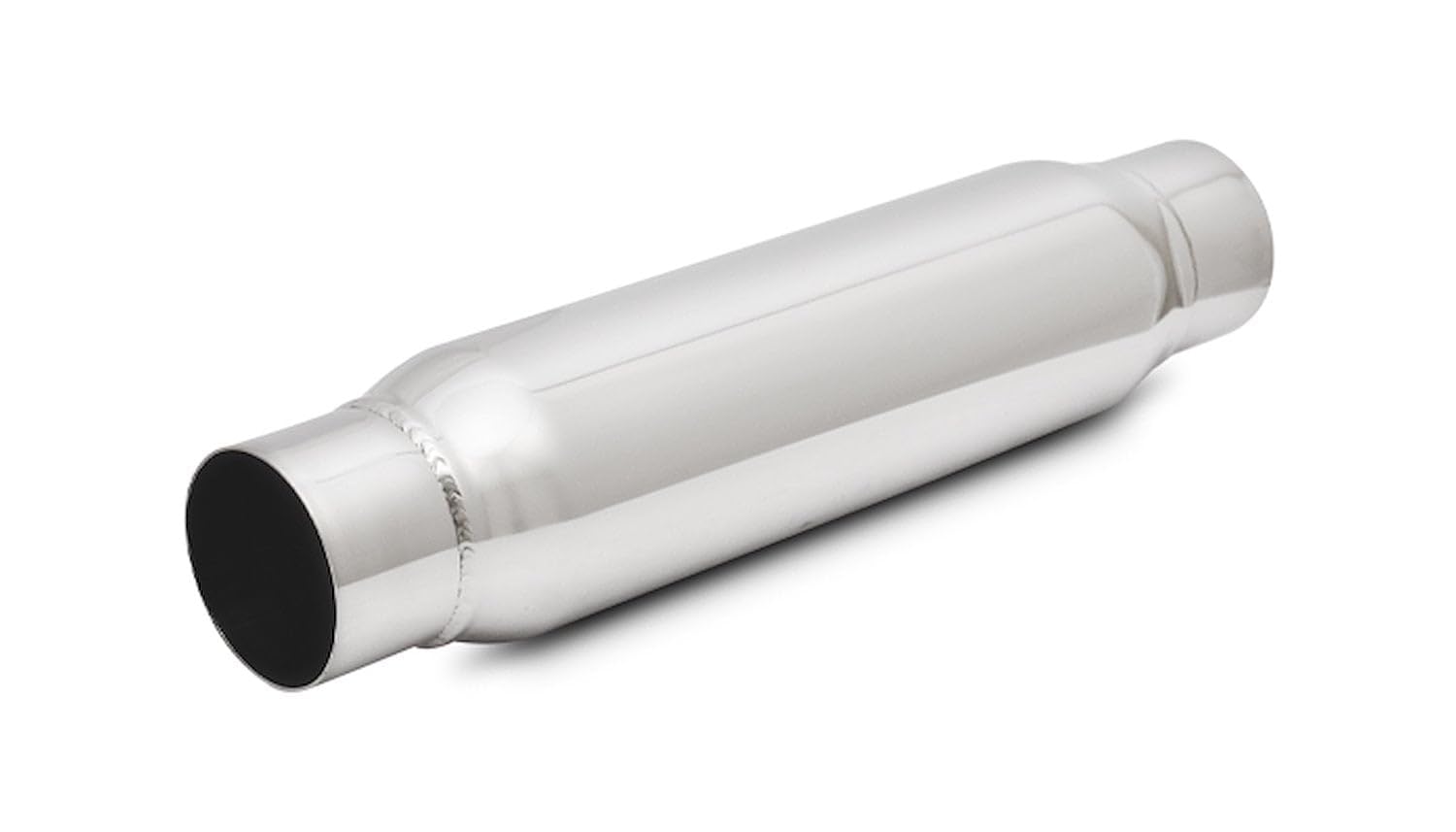
The Vibrant Performance 1792 is a benchmark in the resonator category, engineered with a true straight-through perforated core that cancels unwanted frequencies without creating a bottleneck in the exhaust stream. Constructed from T304 stainless steel, this unit withstands high exhaust temperatures and resists corrosion far better than aluminized alternatives. The 2.5-inch inlet and outlet dimensions make it a natural fit for a wide range of aftermarket exhaust systems, while the 4-inch round body and 12-inch overall length keep packaging manageable under most chassis layouts.
Owner reports consistently highlight the 1792’s ability to eliminate rasp and harsh upper-range noise while leaving the natural character of the engine intact. The bottle-style shape provides a broad frequency cancellation band, which means it handles both low-end drone and high-pitch resonance effectively. Unlike budget resonators that rely on thin internal packing that burns out, the 1792 uses a dense core design that maintains its acoustic properties over extended use.
The only compromise is the vehicle-specific fitment designation, which means you should verify clearance and pipe alignment before committing. However, for those building a performance exhaust that needs clean sound tuning without sacrificing flow, this resonator consistently outperforms options at higher price points.
What works
- True straight-through core preserves exhaust velocity and horsepower
- T304 stainless steel construction resists corrosion and high heat
- Compact 12-inch length fits tight underbody spaces
What doesn’t
- Vehicle-specific fitment requires verification before purchase
- Only available in 2.5-inch inlet/outlet configuration
2. Walker 21398 Direct Fit Exhaust Resonator

The Walker 21398 is a direct-fit resonator designed for specific GM platforms, including the Buick LaCrosse, Buick Allure, and Chevrolet Impala from the 2005-2009 model years. Rather than forcing a universal can into place, this unit uses OE-style hangers, brackets, and flange configurations that bolt directly to the factory exhaust routing. The aluminized steel construction provides corrosion resistance appropriate for moderate climates, while the OE-style louvered tubes help reduce radiated noise to deliver a sound profile close to the original system.
Installation data from owners confirms that the bolt-on design eliminates the need for welding or custom fabrication on compatible vehicles. The 2.25-inch outlet diameter matches the factory pipe size on the listed platforms, so the system maintains consistent flow without step-down adapters. Walker’s use of thick flanges and reinforced brackets addresses a common failure point on aftermarket resonators — the joints where the canister meets the piping.
The trade-off is that the aluminized steel shell is less durable than T304 stainless in high-salt or high-humidity regions, and the direct-fit nature limits its application to the specific vehicle list. For owners of compatible GM sedans looking for a straightforward OE-grade replacement, this resonator eliminates guesswork and installation complexity.
What works
- True bolt-on installation with OE-style hangers and brackets
- Aluminized steel construction resists corrosion in normal conditions
- Engineered to match factory sound levels
What doesn’t
- Vehicle-specific fitment limited to select GM models
- Aluminized steel less durable than T304 stainless long-term
3. A-KARCK 4″ Inlet Exhaust Resonator
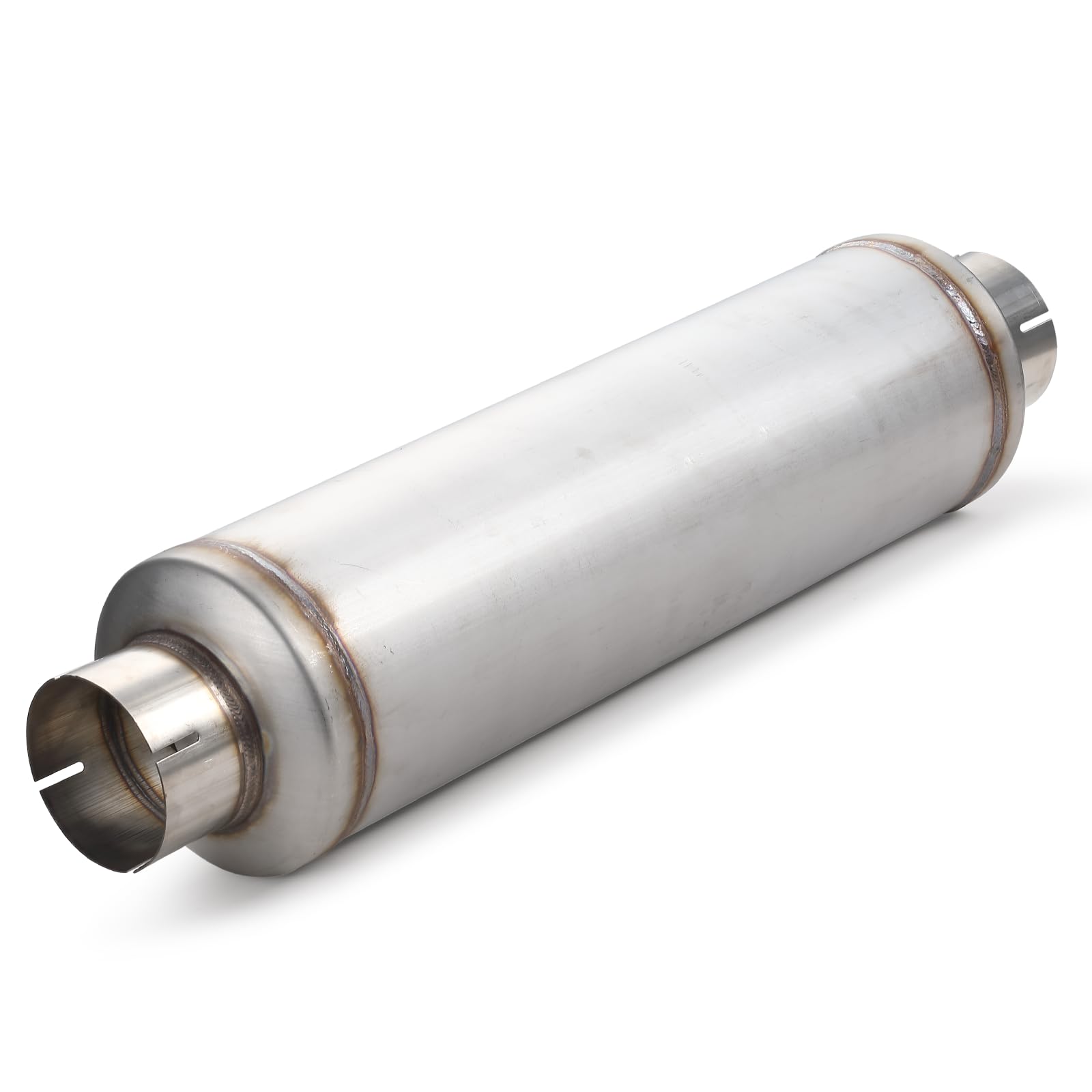
The A-KARCK 4-inch resonator targets a specific acoustic problem: cleaning up the raspy, high-frequency noise that plagues many aftermarket exhaust systems. With a 4-inch inner diameter inlet and outlet, a 30-inch overall length, and a 7-inch round body, this is a substantial unit designed for larger exhaust piping commonly found on trucks and high-performance builds. The straight-through design ensures that the added length does not create excessive backpressure, allowing the engine to breathe freely while the internal core attenuates harsh tones.
Owner feedback emphasizes the transformation in exhaust note after installation — the resonator delivers a noticeably deeper, throatier tone without the metallic ring that cheap straight-pipes produce. The stainless steel construction provides long-term durability against rust and thermal cycling, and the universal fitment means it can be welded into virtually any 4-inch exhaust system. The one-year warranty from the manufacturer adds a layer of confidence for a part that sees extreme temperature conditions.
The main consideration is the physical size — at 30 inches long, this resonator requires adequate underbody space for installation. Some owners have noted that the weight (approximately 6.7 kg) should be supported properly with additional hangers to prevent stress on the exhaust joints.
What works
- Effectively eliminates rasp and delivers a deeper tone
- Straight-through core maintains flow on high-horsepower builds
- Stainless steel construction with one-year warranty
What doesn’t
- Long 30-inch body requires ample underbody space
- Heavier than comparable smaller resonators
4. Vibrant Performance 1140 2.25″ Ultra Quiet Resonator

The Vibrant Performance 1140 is the most aggressive sound-dampening resonator in this lineup, purpose-built for drivers who want maximum noise reduction without compromising exhaust flow. Its 6.5-inch by 4.75-inch oval body and 9.75-inch internal length house a true straight-through perforated core wrapped in dense acoustic packing, targeting both low-frequency drone and high-frequency rasp simultaneously. The T304 stainless steel construction ensures this resonator will outlast the vehicle it is installed on, even in harsh winter climates where road salt is prevalent.
What sets the 1140 apart from standard resonators is its broad frequency cancellation range. Owners report that it tames exhaust systems that other resonators could not quiet effectively, making it a go-to choice for turbocharged builds, V8 swaps, and any application where cabin drone is a persistent issue. The 2.25-inch inlet and outlet diameter is ideal for stock exhaust pipes on many sedans and coupes, and the compact 13.75-inch overall length simplifies placement in tight chassis.
The premium price reflects the material quality and acoustic engineering, but for those who prioritize a refined cabin experience without gutting performance, the 1140 delivers results that budget resonators cannot match. The 30-day manufacturer warranty is shorter than some competitors, but the build quality rarely requires claims.
What works
- Exceptional broad-frequency noise cancellation reduces both drone and rasp
- T304 stainless steel provides maximum corrosion resistance
- Oval body fits tighter spaces than round resonators
What doesn’t
- Higher investment compared to entry-level resonators
- Limited to 2.25-inch inlet/outlet sizing
5. JY Performance 5 Inch Muffler Diesel Resonator
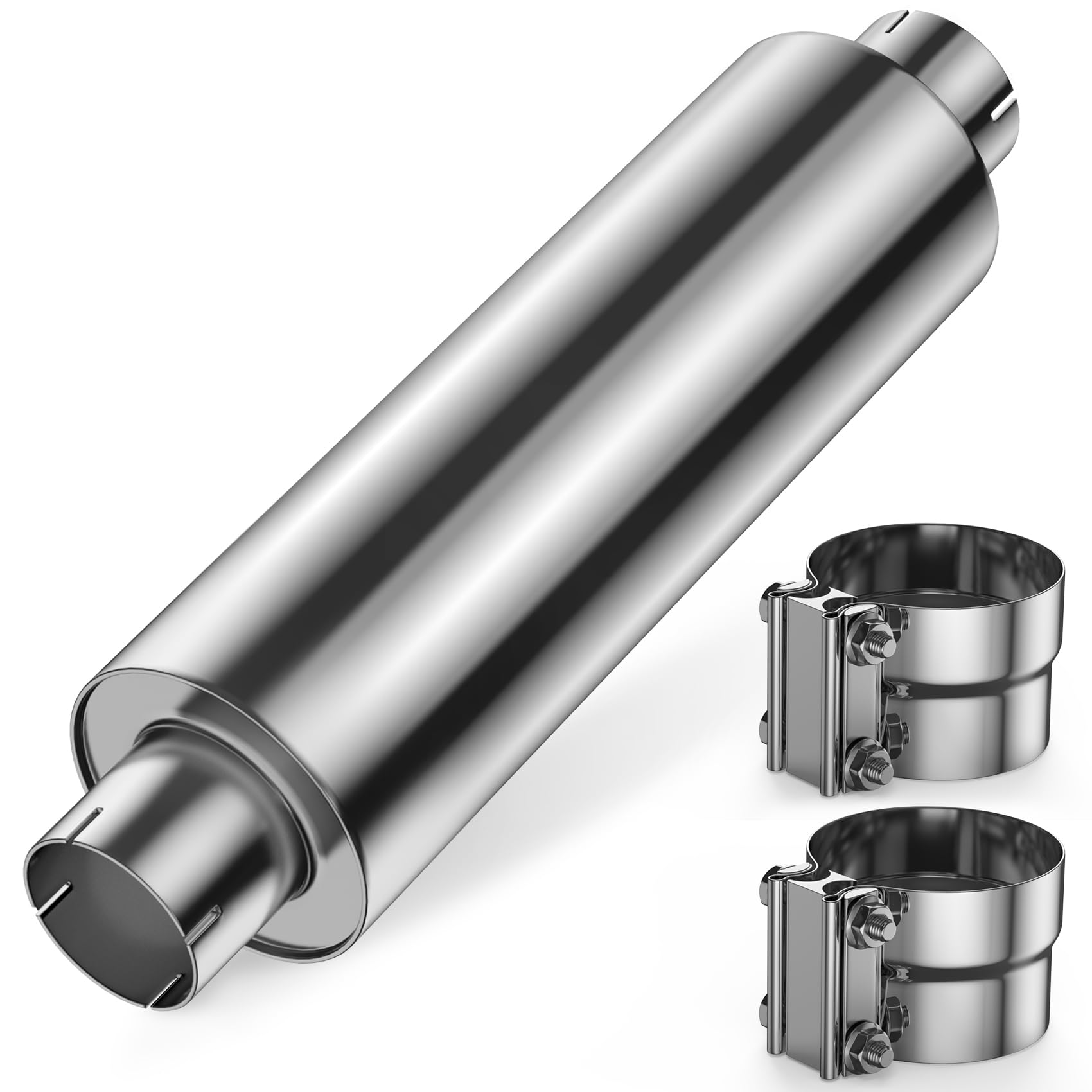
The JY Performance 5-inch resonator is built for the heavy-duty diesel segment, where exhaust volumes and temperatures far exceed those of gasoline engines. With a 5-inch inner diameter inlet and outlet, an 8-inch round body, and a 30-inch overall length, this unit handles the massive flow requirements of turbo-diesel trucks without creating a restriction point. The straight-through design with TIG welding ensures structural integrity under high exhaust pressure, while the stainless steel construction with a polished surface finish resists the corrosive soot and moisture that diesel exhaust produces.
Owner data shows that this resonator effectively absorbs the interior resonance that plagues many diesel trucks after exhaust modifications, cleaning up the cabin sound without robbing the engine of its low-end torque. The inclusion of two clamps simplifies installation for those who prefer a clamp-on approach rather than full welding, though a welded joint provides a more permanent seal. The polished body also adds a visual upgrade for exposed exhaust systems on lifted trucks.
The primary limitation is the 5-inch sizing, which restricts this unit to heavy-duty applications — it will not fit standard gasoline exhaust systems without significant pipe reduction. Additionally, the 6-month warranty is shorter than some competitors, though the build quality generally holds up well in diesel service.
What works
- TIG-welded construction handles high-pressure diesel exhaust
- Polished stainless steel resists corrosion and adds visual appeal
- Includes clamps for flexible installation options
What doesn’t
- 5-inch sizing limits compatibility to heavy-duty diesel systems
- Shorter warranty period compared to some competitors
6. Upower 4″ Inlet Diesel Exhaust Muffler Resonator

The Upower 4-inch resonator offers an entry point into exhaust sound tuning at a accessible price bracket. Designed around a straight-through core with Continuous Roving Fiberglass (CRF) technology, it targets unwanted interior resonance while maintaining unrestricted exhaust flow. The 7-inch round body and 30-inch overall length mirror the dimensions of higher-priced competitors, and the 4-inch inlet and outlet sizing fits universal aftermarket exhaust piping common on both diesel and large-displacement gasoline builds.
The 100 percent welded design eliminates the leak points that plague cheap crimped resonators, and the stainless steel outer shell provides reasonable corrosion protection for the price point. Owners who have installed this unit on budget truck exhausts report a noticeable reduction in cab drone and a cleaner exhaust note overall. The ability to use either end as an inlet simplifies installation — there is no directional restriction.
The fiberglass packing inside is effective for sound absorption but will degrade faster than stainless steel mesh under extreme heat conditions, which is a consideration for high-performance or heavily modified engines. For daily-driven trucks and SUVs that see moderate exhaust temperatures, this resonator delivers solid acoustic improvement at a budget that leaves room for other upgrades.
What works
- Budget-friendly entry point for exhaust sound tuning
- Straight-through design preserves flow on moderate builds
- Non-directional installation simplifies welding placement
What doesn’t
- Fiberglass packing degrades faster under extreme heat
- Stainless steel grade not specified for long-term corrosion data
7. DRiV Walker Exhaust Muffler – 21690

The Walker 21690 is a vehicle-specific muffler designed primarily for the Chevrolet Equinox from 2010 through 2017 and compatible newer models. While marketed as a muffler, its spun-locked head design and internal drainage system share engineering principles with dedicated resonators, making it a viable option for owners seeking a factory-style sound profile on a budget. The 3-inch inlet size matches the Equinox OEM exhaust routing, and the stainless steel construction provides corrosion resistance at a price point that undercuts most aftermarket universal options.
Installation data confirms that the OE-style hangers, brackets, and pipe routings allow for a straightforward bolt-on process without welding, which is a significant advantage for DIY owners without access to fabrication equipment. The louvered tubes and domed heads are engineered to deliver the acoustic signature that the vehicle left the factory with — not a sporty upgrade, but a return to intended noise levels. The internal drainage system also helps extend service life by preventing moisture accumulation inside the shell.
The main limitation is the narrow vehicle compatibility — this part is not a universal solution and will only fit the listed Chevrolet and Buick platforms with the correct 3-inch inlet configuration. Owners seeking a performance-oriented sound change should look elsewhere, but for those restoring factory acoustics on a budget, this is a practical and durable choice.
What works
- True bolt-on installation with no welding required
- Stainless steel construction at a budget-friendly investment
- Internal drainage system extends service life
What doesn’t
- Vehicle-specific fitment limited to Equinox and related GM models
- Designed for factory sound levels, not performance tuning
Hardware & Specs Guide
Stainless Steel Construction
The material grade of a resonator directly determines its lifespan in the exhaust environment. T304 stainless steel contains 18 percent chromium and 8 percent nickel, providing superior resistance to rust, pitting, and high-temperature oxidation. Aluminized steel uses a hot-dip aluminum-silicon coating that protects the base metal — it performs well in dry climates but can fail at weld seams and edges after repeated thermal cycling. For vehicles in salt-belt regions or high-humidity areas, the T304 upgrade justifies the additional investment through extended service life.
Straight-Through Perforated Core Design
The internal architecture of a resonator determines its acoustic tuning and flow characteristics. A straight-through perforated core allows exhaust gases to pass through a center tube with minimal obstruction while sound waves pass through the perforations into an outer chamber filled with acoustic packing material. This design cancels specific frequencies without creating backpressure, preserving engine efficiency and horsepower. The density and material of the packing — fiberglass for lower cost, stainless steel mesh for durability — determine how long the acoustic properties remain consistent over thousands of miles.
FAQ
What does a resonator exhaust do that a muffler does not?
Will a resonator exhaust reduce horsepower?
How do I know if a universal resonator fits my vehicle?
Final Thoughts: The Verdict
For most buyers, the best resonator exhaust winner is the Vibrant Performance 1792 because it combines T304 stainless steel durability, a true straight-through core, and compact dimensions that fit a wide range of applications without breaking the budget. If you need a direct-fit OE replacement for a compatible GM sedan, grab the Walker 21398. And for maximum cabin comfort on a high-performance build, nothing beats the sound-dampening capability of the Vibrant Performance 1140.

Certification: BSc in Mechanical Engineering
Education: Mechanical engineer
Lives In: 539 W Commerce St, Dallas, TX 75208, USA
Md Amir is an auto mechanic student and writer with over half a decade of experience in the automotive field. He has worked with top automotive brands such as Lexus, Quantum, and also owns two automotive blogs autocarneed.com and taxiwiz.com.