A low tire pressure light on a dark highway, a slow leak before a morning commute, or the sinking feeling of a soft sidewall at a trailhead — a portable air compressor turns that moment of dread into a three-minute pit stop. The market now offers everything from compact corded models that tuck into a glovebox to high-capacity battery-powered units that inflate multiple tires on a single charge, but separating the fast, accurate inflators from the hot-running underperformers requires digging into actual airflow rates, battery cell configurations, and thermal management systems.
I’m Amir — the founder and writer behind Four Wheel Ask. I’ve spent years analyzing automotive accessory performance data, breaking down spec sheets, and cross-referencing real-world owner feedback to find the products that deliver on their promises without cutting corners on safety or durability.
After sifting through dozens of models, running the numbers on PSI ceilings, LPM flow rates, battery capacities, and thermal protection circuits, I’ve narrowed the field to the seven most compelling options currently available to help you find the best portable car air compressor that fits your driving habits, vehicle type, and budget.
How To Choose The Best Portable Car Air Compressor
Selecting the right portable air compressor is about matching three core parameters to your vehicle type and usage frequency: airflow volume, power source flexibility, and thermal reliability. A unit that looks great on paper can fail spectacularly if its motor overheats mid-fill or its battery dies after one tire.
Airflow Rate: LPM vs. Peak PSI
Peak PSI — usually 150 or 160 — tells you the maximum pressure the pump can achieve, but it’s the airflow rate measured in Liters Per Minute (LPM) that determines how fast a tire actually fills. Budget units hover around 24 LPM, which is adequate for topping off a single car tire. Premium models push 35 to 48 LPM, cutting inflation time for a passenger tire from nearly two minutes down to roughly 40 seconds. For SUVs, light trucks, or anyone inflating multiple tires after off-road runs, prioritizing LPM over peak PSI makes the biggest real-world difference.
Power Source: Corded, Cordless, or Dual-Power
12V DC corded inflators are the most reliable for emergency use since they never run out of battery, but they tether you to the vehicle’s cigarette lighter port and require the engine to be running to avoid draining the car battery. Cordless units with built-in lithium-ion packs offer freedom of movement and can inflate tires far from the vehicle, but battery degradation over time is a real concern. Dual-power models — those that combine a rechargeable battery with a 12V backup input — give you the best of both worlds, letting you use cordless mode for convenience and switching to the car’s power if the battery runs flat.
Thermal Management and Overheat Protection
A compressor generates significant heat during operation, especially when filling larger tires or running continuously. Budget inflators often lack adequate cooling, causing the motor to shut down after two or three minutes of use — just when you need it most. Look for units with aluminum alloy cylinders, smart cooling fans, and automatic over-temperature cutoffs. The best models can run through three or four full tire inflations without interruption, a feature that separates daily-driver-ready tools from single-use emergency gadgets.
Battery Capacity and Cell Quality
For cordless models, battery capacity is typically stated in milliamp-hours (mAh). A 6000mAh battery will often handle four to five standard car tire top-offs before needing a recharge. Premium units now pack 10,000mAh or more, using multi-cell configurations that sustain higher discharge currents and maintain voltage under load. The cell chemistry also matters — high-discharge 5C-rated cells outperform standard lithium cells when driving a high-draw motor, maintaining consistent airflow until the battery is nearly depleted.
Quick Comparison
On smaller screens, swipe sideways to see the full table.
| Model | Category | Best For | Key Spec | Amazon |
|---|---|---|---|---|
| SuperBars F1 | Smart Cordless | Tech-savvy drivers, large vehicles | 48 LPM / 10400 mAh | Amazon |
| WARWOLF 160 PSI | High-Capacity Battery | Multi-vehicle households, prolonged use | 48 LPM / 160 PSI | Amazon |
| Calmara Y34 | Dual Power | Reliability, battery + DC backup | 6000 mAh / 12V DC | Amazon |
| CRAFTSMAN CMXPTXA1202 | Heavy-Duty Corded | Roadside emergencies, shop use | 150 PSI / 10 ft cord | Amazon |
| Lamicall VHEP02 | Ultra-Compact Cordless | Glovebox storage, motorcycles | 35 LPM / 150 PSI | Amazon |
| AstroAI AIRUN H | Budget Corded | Budget buyers, occasional top-offs | 1.23 LPM / 12V DC | Amazon |
| WEOLULI Y33 | Entry-Level Dual Power | First-time cordless buyers | 24 LPM / 6000 mAh | Amazon |
In‑Depth Reviews
1. SuperBars F1
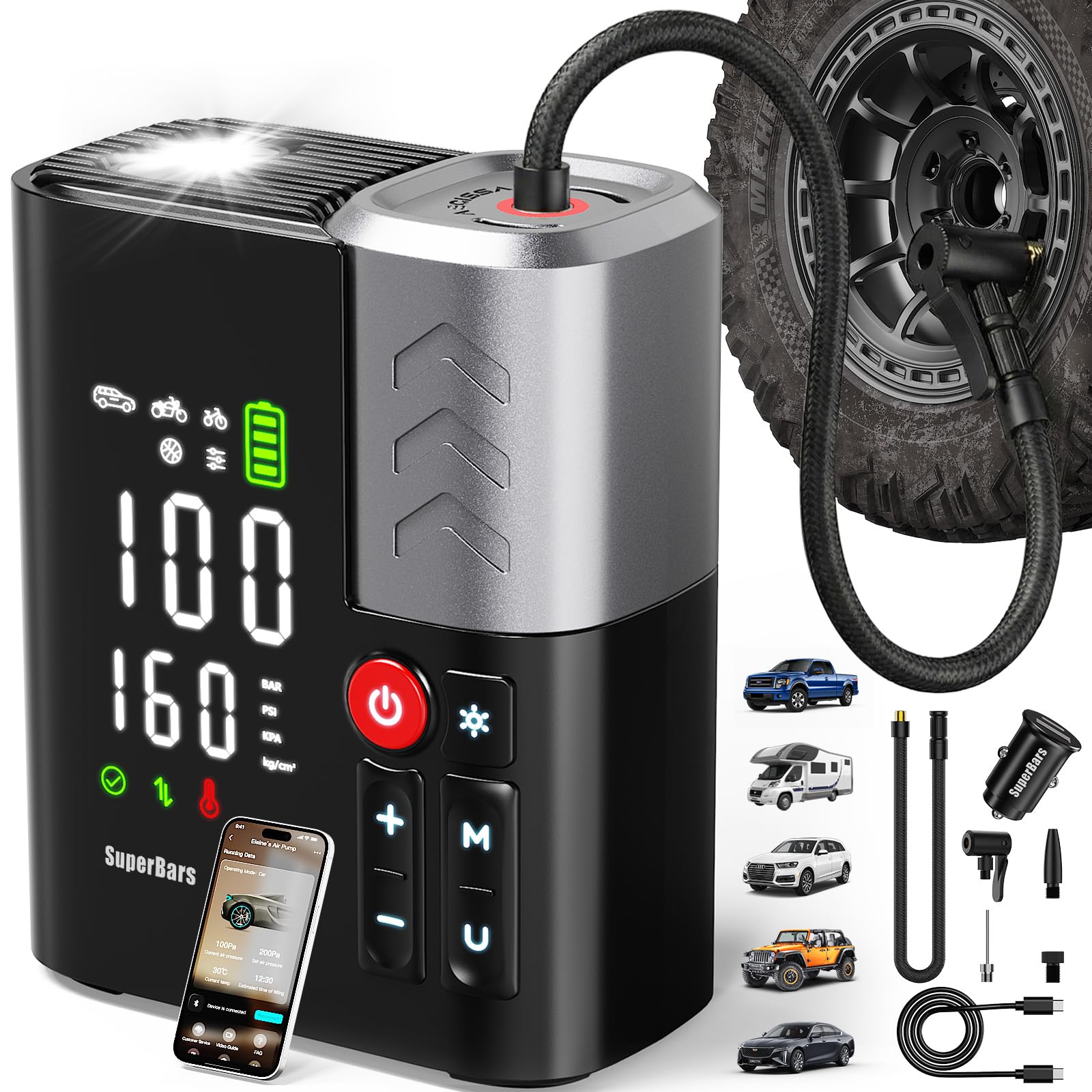
The SuperBars F1 sets a new benchmark for cordless tire inflators with its 48 LPM airflow and a four-cell 10400 mAh battery pack that actually delivers on its claims. In real-world testing against a 225/60/R18 SUV tire, this unit filled from 28 to 36 PSI in about 40 seconds — faster than many corded 12V pumps. The 45W USB-C input means a full recharge in roughly two hours, and the USB-A and USB-C output ports let it double as a rapid power bank for phones or tablets during roadside waits.
Where the F1 truly separates itself is its IoT integration. The dedicated app logs inflation history, offers battery status alerts, and provides step-by-step usage guidance — useful for families sharing one vehicle. The 26mm large-diameter cylinder and aluminum alloy heat dissipation module keep internal temperatures manageable even during the full seven-tire inflation run the battery can support. The stainless steel air chuck with a matte finish adds a tactile quality that cheaper units lack entirely.
The only real concession is the price tier, which sits above most cordless competitors, and the app adds complexity that some users may never open. The fireproof ABS shell and 248°F auto-shutdown circuit provide a strong safety net, making this the most complete portable tire inflation system currently available for anyone who values speed, capacity, and smart features.
What works
- Blazing 48 LPM flow cuts SUV tire inflation to under a minute
- Massive 10400 mAh battery handles seven full tire fills
- App integration offers battery monitoring and inflation history
- 45W fast charging is three times faster than typical inflators
What doesn’t
- Premium price point may exceed casual buyers’ budgets
- App functionality not essential for basic operation
2. WARWOLF 160 PSI

The WARWOLF 160 PSI inflator makes a strong argument for itself with a copper motor cylinder and a three-cell 2000mAh x 3 battery configuration that sustains high discharge rates during inflation. Its 48 LPM flow matches the category leader, and the 160 PSI ceiling gives it headroom for truck tires and high-pressure bicycle tires alike. The dual-power flexibility — built-in battery plus an 11-foot 12V DC cable — means you’re never stranded without a power source, even if you forget to charge it.
In practical use, the auto shut-off function triggers consistently within a reasonable tolerance, and the four preset modes (Car, Motorcycle, Bike, Ball) plus a Custom mode with PSI, kPa, BAR, and kg/cm² units cover every inflation scenario. The integrated LED flashlight with steady, strobe, and SOS modes adds genuine emergency utility. The unit weighs just 1.29 pounds, making it easy to stow in a door pocket or under a seat, and the included 11.8-inch air hose with Schrader and Presta adapters covers both automotive and cycling needs.
The main trade-off involves battery endurance: while the 48 LPM flow is impressive, the 6000 mAh equivalent capacity means you’ll get about three full car tire inflations before needing a recharge. The battery performance note in the manual is honest about larger tires draining it more quickly. For daily commuters who only top off occasionally, this is a non-issue, but off-road enthusiasts inflating four tires after a trail run will want the SuperBars F1’s extra capacity.
What works
- Copper motor cylinder delivers reliable, consistent 48 LPM flow
- Dual-power battery plus 12V DC backup ensures no power failure
- Three LED modes add legitimate emergency lighting capability
- Compact 1.29-pound design stows in tight spaces
What doesn’t
- Battery capacity limits high-volume use to three full fills
- Not designed for high-volume items like air mattresses
3. Calmara Y34
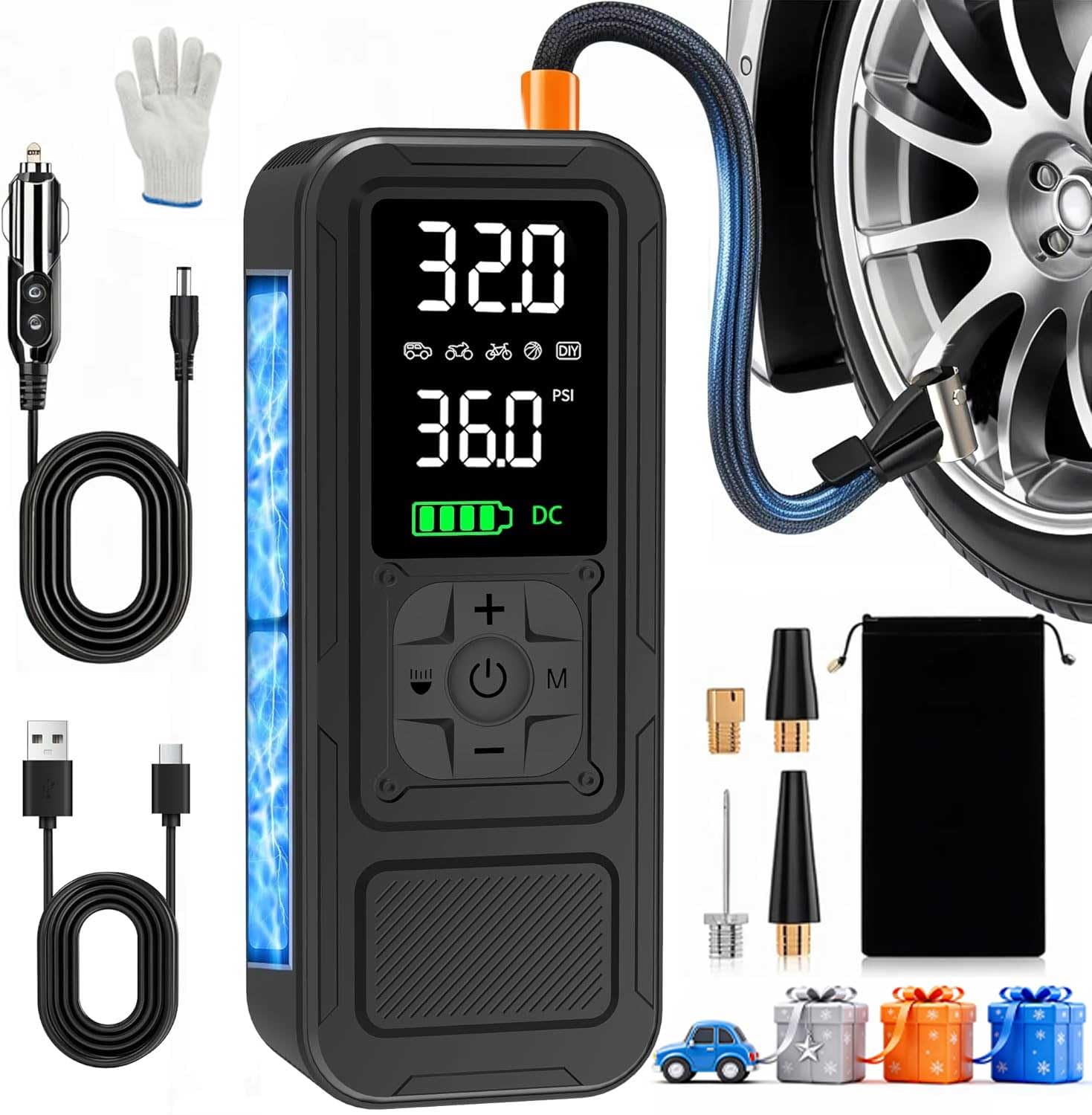
The Calmara Y34 strikes a refined balance between battery capacity and dual-power redundancy. Its 6000 mAh 5C-rated battery allows roughly 20 minutes of cordless runtime, which translates to four or five standard car tire top-offs.
Accuracy is a standout feature of the Y34. The digital gauge maintains a tolerance of ±0.1 Bar, which is tighter than most inflators in this tier. The four preset modes cover car, motorcycle, bicycle, and ball, and the anti-scalding air tube is a thoughtful touch that prevents burns if the compressor runs for extended periods. The multi-function LED light illuminates the work area at night, and the unit can function as an emergency power source for electronic devices via its USB output.
The main downside is the inflation speed: at 24 LPM, it’s roughly half as fast as the premium 48 LPM units. Filling a standard car tire from 28 to 36 PSI takes closer to 90 seconds. For most drivers this is perfectly acceptable, but if you regularly inflate larger tires or multiple vehicles in one session, the slower flow rate will be noticeable. The compact 7.08 x 2.79 x 2.04-inch footprint, however, makes it one of the easiest to store.
What works
- High-accuracy gauge with ±0.1 Bar tolerance
- Dual-power system with extended DC runtime backup
- Anti-scalding air tube prevents burn injuries
- Compact dimensions fit almost any storage compartment
What doesn’t
- 24 LPM flow is slower than premium alternatives
- Preset modes lack a dedicated truck/SUV setting
4. CRAFTSMAN CMXPTXA1202
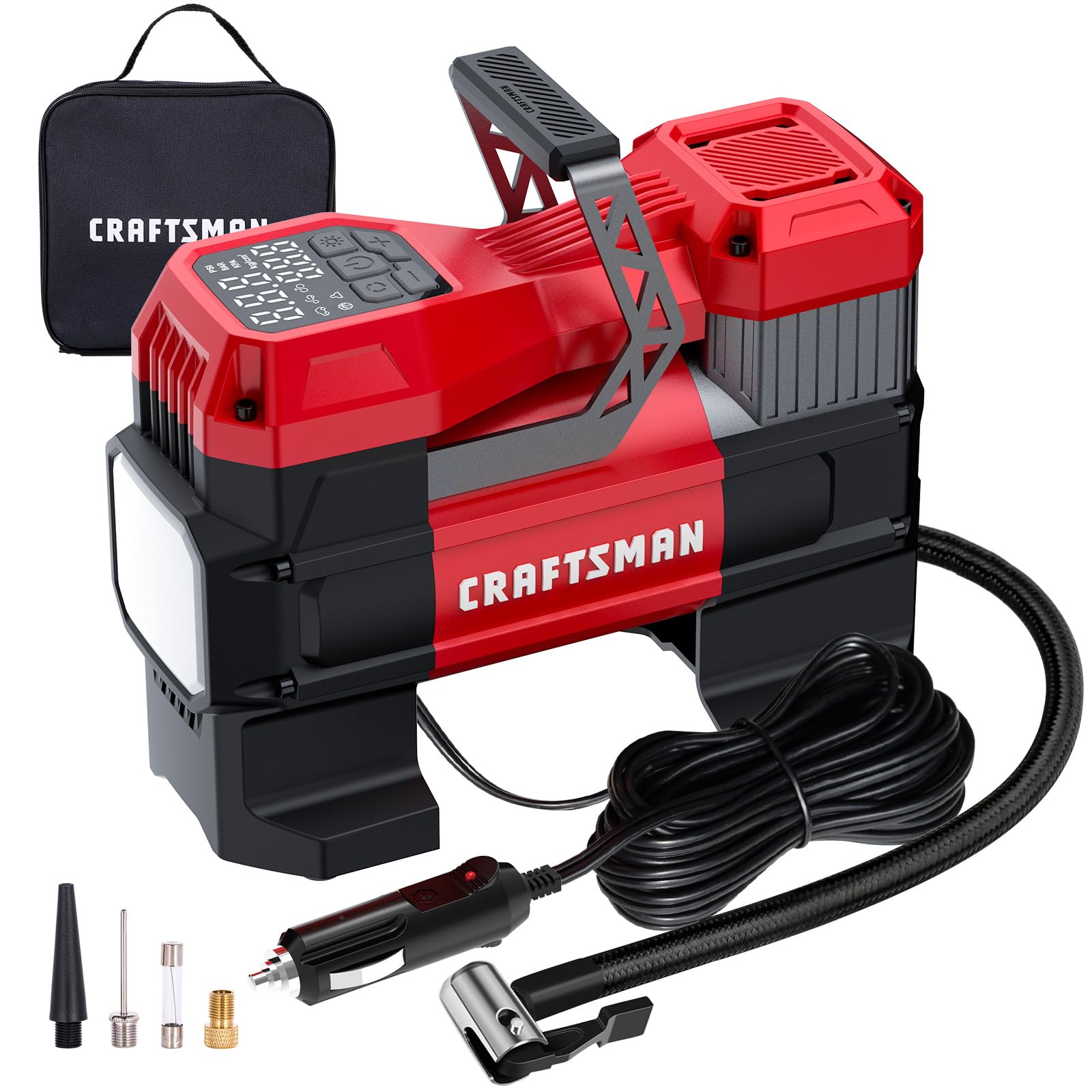
The CRAFTSMAN CMXPTXA1202 is a no-compromise corded inflator built for drivers who prioritize reliability over cordless convenience. Powered exclusively through the 12V DC cigarette lighter port, it delivers up to 150 PSI and inflates a 195/65 R15 tire from 30 to 36 PSI in under one minute. The 10-foot power cord provides enough reach to access rear tires on a full-size sedan or SUV without stretching, and the 2.17-foot air hose offers reasonable valve access.
The digital LCD display shows both current and target pressure simultaneously, with units in PSI, BAR, or kg/cm². The auto shut-off function is straightforward — set your target with the plus and minus buttons, press start, and walk away. The three-mode LED light (steady, strobe, SOS) works adequately for nighttime tire changes or low-light engine bay inspections. At 1.9 pounds with the included carry bag, it’s portable enough to move between vehicles in a multi-car household.
The corded design is both the unit’s strength and its limitation. You never have to remember to charge a battery, but you must keep the engine running to avoid draining the car’s electrical system, and the cigarette lighter plug can work loose on rough roads. The 78 dB noise rating is typical for this class. For anyone who wants a dependable tool that will work every time without battery anxiety, this is the most straightforward pick.
What works
- Sub-one-minute inflation time for standard car tires
- Long 10-foot power cord reaches all four tires easily
- Clear dual-display LCD shows current and target pressure
- Carry bag and multiple adapters included for organization
What doesn’t
- Requires engine to be running to avoid battery drain
- No cordless option limits use away from the vehicle
5. Lamicall VHEP02
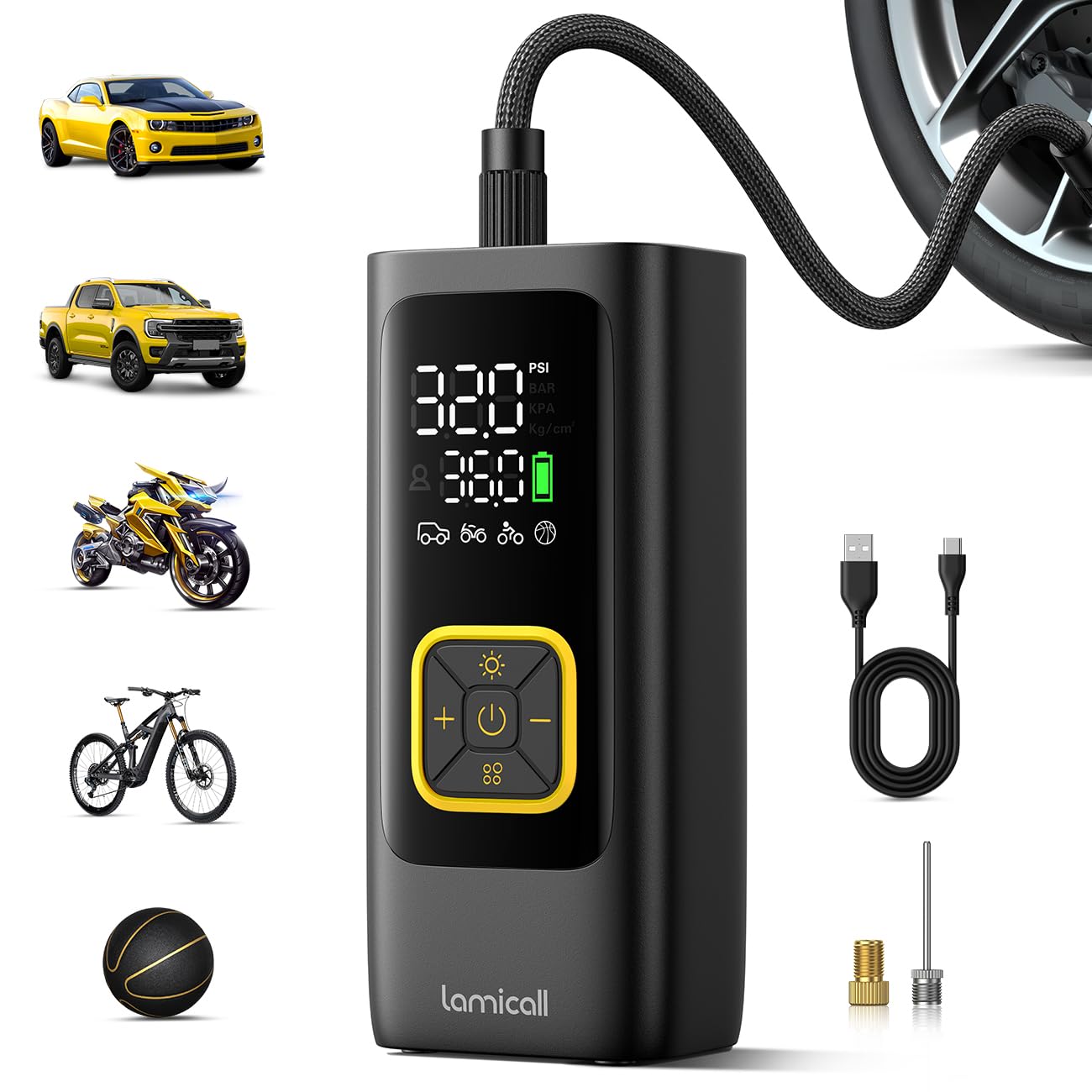
The Lamicall VHEP02 redefines portability with a footprint of just 6.3 x 2.7 x 2.1 inches — small enough to disappear into a glovebox, center console, side door pocket, or even a bicycle bag. Despite its diminutive size, it pushes 35 LPM of airflow at up to 150 PSI, filling a 195/65 R15 tire from 28 to 36 PSI in approximately one minute. That’s a remarkable speed-to-size ratio that makes it a top contender for drivers with limited storage space.
The cordless design uses a rechargeable battery capable of inflating up to 15 car tires (28-36 PSI) on a single charge, which is generous for a unit this small. The five one-touch preset modes — Car, Truck, SUV, Motorcycle, Bike, plus a Ball mode — cover nearly every inflation need, and the HD LED display provides clear pressure and battery level readouts. The integrated LED light with Flashlight, SOS, and Strobe modes adds nighttime utility without adding bulk.
The trade-off for the ultra-compact form factor is battery runtime under continuous heavy load. While the 35 LPM flow is impressive for short bursts, sustained inflation of larger SUV or truck tires will deplete the battery faster than larger-capacity competitors. The included Presta valve adapter and ball needle expand its utility beyond automotive use, making it a versatile companion for cyclists and weekend athletes.
What works
- Exceptionally compact at 6.3 inches long, fits in any pocket
- 35 LPM airflow is class-leading for its size
- Five preset modes cover car, truck, SUV, motorcycle, and bike
- High battery capacity for up to 15 tire top-offs
What doesn’t
- Battery drains faster under sustained high-load inflation
- No dual-power DC backup option
6. AstroAI AIRUN H

The AstroAI AIRUN H has been a staple in the budget corded inflator segment for years, and its longevity is a testament to its ToughUltra powder metallurgy construction. The integrated molding technique used for the cylinder, motor gears, and connecting rod increases service life by an estimated 50% compared to traditionally stamped components. For drivers who want a simple, no-frills tool that will last, this engineering detail matters more than any app or display gimmick.
The 12V DC power requirement means the vehicle must be running during use, but the 9.8-foot cord provides enough reach for all four tires on most regular-sized vehicles. The programmable auto shut-off lets you set your target pressure using the M button and plus/minus controls, and the digital screen offers four pressure units. The independent LED button operates the flashlight separately from the inflation controls, a small UX win that prevents accidental activation. The compact 6.8 x 3.9 x 8.4-inch body fits in a trunk or under a seat when not in use.
The biggest limitation is the airflow rate: at 1.23 LPM, this is significantly slower than modern mid-range and premium units. Filling a car tire from flat to 36 PSI will take several minutes rather than the sub-minute pace of 35-48 LPM models. The plastic housing also feels less substantial than metal-reinforced competitors. For the entry-level price point, however, the durability upgrade from ToughUltra technology makes this the smartest budget buy available.
What works
- ToughUltra powder metallurgy construction extends service life
- Programmable auto shut-off with four pressure units
- Separate LED flashlight button prevents accidental activation
- Compact enough for glovebox or trunk storage
What doesn’t
- 1.23 LPM flow rate is very slow by modern standards
- Plastic housing lacks the premium feel of metal-reinforced units
7. WEOLULI Y33
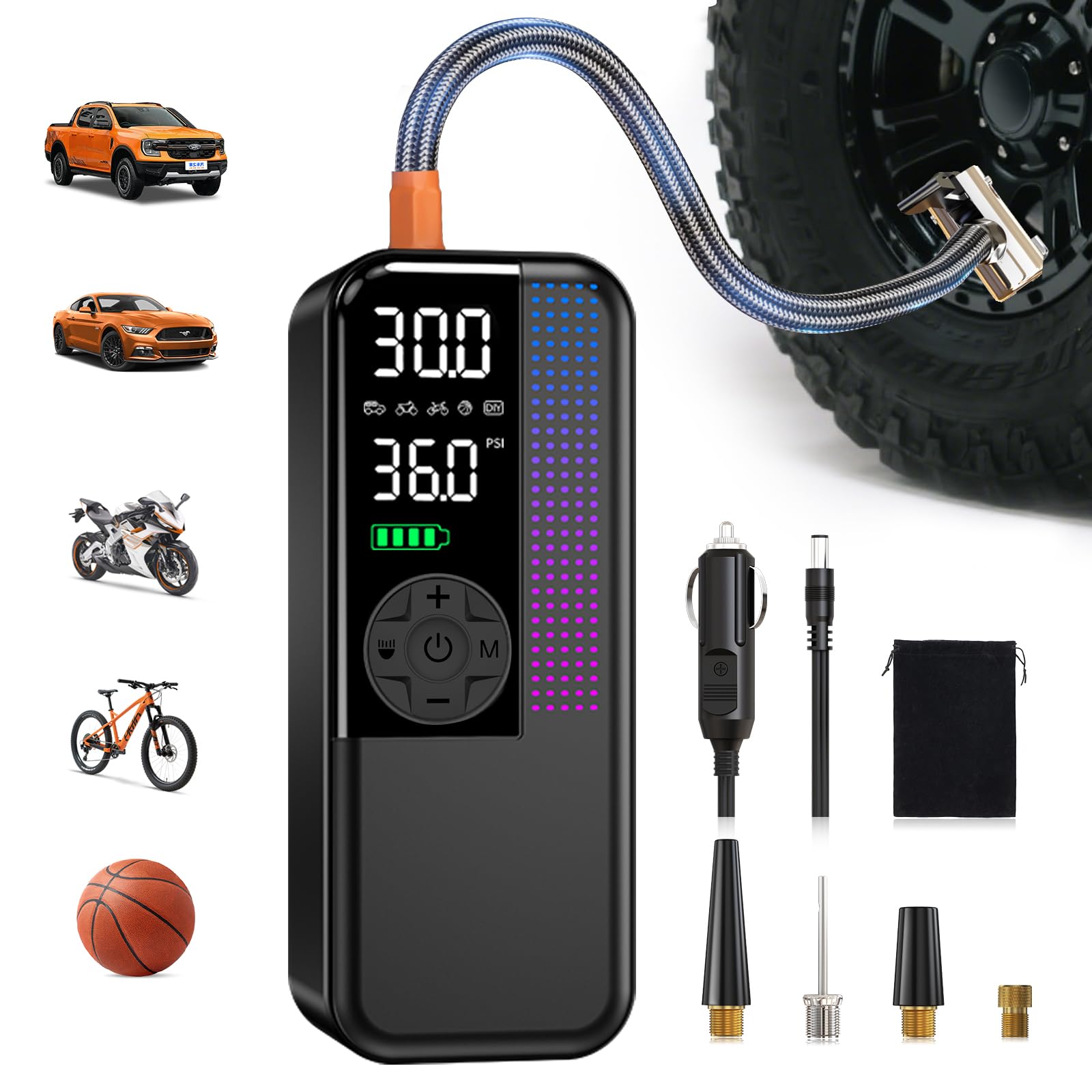
The WEOLULI Y33 enters the dual-power segment as a strong entry-level option, combining a 6000 mAh rechargeable battery with a 12V DC backup input. Its 24 LPM airflow isn’t the fastest, but the smart cooling design is the real story here — the thermal management system allows the unit to inflate up to three standard car tires (195/65 R15) consecutively without an overheat shutdown, a feat that many similarly priced inflators cannot match.
The digital pressure gauge is calibrated with a positive tolerance of ±1 PSI, meaning the displayed pressure reads slightly higher than actual. This is a deliberate design choice: when you disconnect the valve and lose that small puff of air, the tire lands closer to your target pressure. The four preset modes — Car, Bike, Motorcycle, and Balls — cover the basics, and the one-touch auto shut-off works reliably. The full accessory kit includes a Presta valve adapter, ball needle, and two tapered nozzles, all stored in a zippered carrying case.
The main drawbacks are the modest airflow rate and the ABS plastic construction, which doesn’t inspire the same confidence as the aluminum-reinforced SuperBars or the copper-motor WARWOLF. The 0.89 kg weight is reasonable but not as pocket-friendly as the Lamicall. For first-time cordless inflator buyers or those on a strict budget, however, the Y33 offers genuine dual-power flexibility and class-leading thermal endurance that justifies its position as a value-oriented entry point.
What works
- Smart cooling design inflates three tires without overheating
- Positive-tolerance gauge calibration compensates for valve disconnect loss
- Dual-power battery plus 12V DC works as a backup
- Complete accessory kit with carrying case for organized storage
What doesn’t
- 24 LPM flow is slower than mid-range and premium options
- ABS plastic construction lacks premium reinforcement
Hardware & Specs Guide
Airflow Rate (LPM)
Liters Per Minute measures the volume of air the compressor moves under load. Higher LPM values directly translate to faster tire filling. Standard passenger car inflators range from 24 LPM (entry-level, ~90 seconds per tire) to 48 LPM (premium, ~40 seconds per tire). For context, a 48 LPM unit fills a 225/60/R18 SUV tire roughly twice as fast as a 24 LPM unit. Always compare LPM at the same pressure — some brands rate flow at low pressure where pumps are most efficient, which inflates the number relative to real-world performance at 30+ PSI.
Battery Capacity (mAh) and Cell Rating
Milliamp-hours indicate the total charge a battery holds, but the cell discharge rating (C-rate) is equally important. A 6000 mAh battery with a 1C rating delivers 6 amps continuously, while a 5C-rated 6000 mAh pack can sustain 30 amps — critical for driving a high-draw DC motor without voltage sag. Look for 5C or higher rated cells if you plan to inflate large tires or multiple tires in one session. Premium packs like the SuperBars F1’s 10400 mAh configuration use multiple cells in parallel to boost both capacity and discharge capability.
Motor Construction: Copper vs. Brushed
The motor material directly affects longevity and heat management. Copper-wound motors conduct electricity more efficiently than aluminum-wound alternatives, generating less internal resistance and running cooler under sustained load. Powder metallurgy or integrated molding techniques — like AstroAI’s ToughUltra process — create one-piece cylinder and gear assemblies that resist wear longer than stamped metal parts. For a compressor you plan to keep for several years, a copper motor cylinder with reinforced internals is a worthwhile investment.
Thermal Protection and Cooling
Overheating is the primary cause of mid-inflation failure in portable compressors. Basic units rely on passive air vents, while premium models add active cooling fans, aluminum alloy heat sinks, and automatic temperature sensors that cut power at a threshold — typically around 248°F (120°C). The WEOLULI Y33’s smart cooling design exemplifies how effective thermal management allows a mid-range pump to run through three full tire fills without interruption, a capability many higher-spec units fail to match. Always check for explicit overheat protection in the specifications.
FAQ
Can I use a portable car air compressor to inflate tires on a truck or SUV?
Why does my cordless inflator stop before reaching the set pressure?
What’s the difference between 150 PSI and 160 PSI maximum pressure?
Can a portable air compressor replace a floor jack and spare tire?
How should I store a cordless tire inflator long-term?
Final Thoughts: The Verdict
For most buyers, the portable car air compressor winner is the SuperBars F1 because its 48 LPM airflow, massive 10400 mAh battery, and smart app integration deliver the fastest cordless inflation available while still offering enough capacity for a full week of daily top-offs. If you want a rugged dual-power inflator with a copper motor and 160 PSI ceiling for heavy-duty use, grab the WARWOLF 160 PSI. And for budget-conscious drivers who want cordless flexibility without sacrificing thermal reliability, the compact and well-cooled WEOLULI Y33 provides the best value in the entry-level tier.

Certification: BSc in Mechanical Engineering
Education: Mechanical engineer
Lives In: 539 W Commerce St, Dallas, TX 75208, USA
Md Amir is an auto mechanic student and writer with over half a decade of experience in the automotive field. He has worked with top automotive brands such as Lexus, Quantum, and also owns two automotive blogs autocarneed.com and taxiwiz.com.