Without the right chemistry, a quick wax job will only mask the damage for a few weeks before the dull haze returns, forcing you to start over.
I’m Amir — the founder and writer behind Four Wheel Ask. I’ve spent years analyzing fiberglass restoration chemistry, from marine-grade polymers to breathable sealants, and cross-referencing real-world owner feedback to find which formulas actually bond with oxidized gelcoat instead of just sitting on top of it.
Whether you’re prepping for a cross-country trip or just trying to erase years of sun damage, this guide walks through the top contenders to help you find the right polish for fiberglass rv for your specific level of oxidation and your preferred application method.
How To Choose The Best Polish For Fiberglass RV
Fiberglass RV gelcoat is softer than automotive clear coat, so aggressive compounds can burn through it in seconds. The right polish must match the oxidation depth, the available applicator tool, and your patience for multiple coats. Here are the three key factors to consider before buying.
Oxidation Severity & Abrasiveness Level
If you can run your hand over the fiberglass and feel a chalky residue, you’re dealing with moderate to heavy oxidation. That calls for a polish with fine abrasive particles (around 2000 grit or a light cutting compound) to level the degraded surface. For light haze or water spots, a one-step cleaner wax with micro-abrasives is sufficient. Using a non-abrasive sealant on heavy oxidation will lock the chalkiness under a transparent layer—making the haze permanent.
Application Method Compatibility
Large RV panels make hand application labor-intensive, but some thick paste waxes require firm pressure to break down properly. Rotary polishers with wool pads work best for heavy cutting compounds, while dual-action polishers are safer for one-step cleaner waxes on gelcoat. If you plan to apply by hand, choose a liquid or paste that spreads thin and wipes off without caking, otherwise you’ll spend hours buffing fingernail-sized sections.
Bonding Chemistry & UV Resistance
Traditional carnauba waxes sit on top of the gelcoat and degrade within weeks under intense sun. Polymer-based sealants and acrylic formulas can chemically bond with the porous fiberglass surface, creating a barrier that lasts months to years. Look for products that list specific UV inhibitors and water-beading longevity in their technical specs—those are the formulas that survive parking-lot exposure and rain without streaking.
Quick Comparison
On smaller screens, swipe sideways to see the full table.
| Model | Category | Best For | Key Spec | Amazon |
|---|---|---|---|---|
| Collinite 885 Fleetwax | Paste Wax | Durable UV protection on mild oxidation | 12 oz, carnauba + polymer | Amazon |
| Meguiar’s Flagship M6132 | Cleaner Wax | One-step defect removal on light haze | 32 oz, micro-abrasive + polymer | Amazon |
| 3M Perfect-It 36110 | Light Cutting Polish | Surface scratch removal with a DA polisher | 1 quart, two-stage with wool pad | Amazon |
| Poli Glow Restoration Kit | Polymer System | Complete restoration of heavy oxidation | 32 oz polish + 32 oz prep | Amazon |
| Wizards Shine Master 11036 | Sealant + Polish | Long-term breathable protection for show finish | 128 oz, no silicone, polymer resin | Amazon |
In‑Depth Reviews
1. Collinite 885 Fleetwax

Collinite 885 is a marine-grade paste wax that blends carnauba with synthetic polymers specifically for fiberglass and gelcoat—the same chemistry used on saltwater fishing boats that bake under direct sun for entire seasons. The 12-ounce container covers multiple RV applications because the wax spreads extremely thin, and the water-beading effect is visible immediately after buffing.
Its standout feature is UV and salt protection: the polymer matrix cross-links onto the gelcoat’s pores rather than just forming a surface film, so a single application resists streaking and fading for roughly six months on an RV that stays outdoors. Application by hand requires moderate elbow grease—the paste stiffens in cooler temperatures—but it levels cleanly without leaving powdery residue in panel gaps.
For owners dealing with mild oxidation who want a low-maintenance product that won’t require reapplication every wash cycle, this is the most cost-effective long-term option available. It is not a heavy cutter—severe chalking should be handled with a dedicated compound first—but as a durable protective wax on prepped gelcoat, it outperforms nearly everything at its price tier.
What works
- Extraordinary longevity on outdoor-stored RVs
- Strong water beading that lasts through multiple rainfalls
What doesn’t
- Paste consistency stiffens in cold weather, making application harder
- Not abrasive enough to remove heavy oxidation or deep chalking
2. Meguiar’s Flagship Premium Cleaner Wax M6132
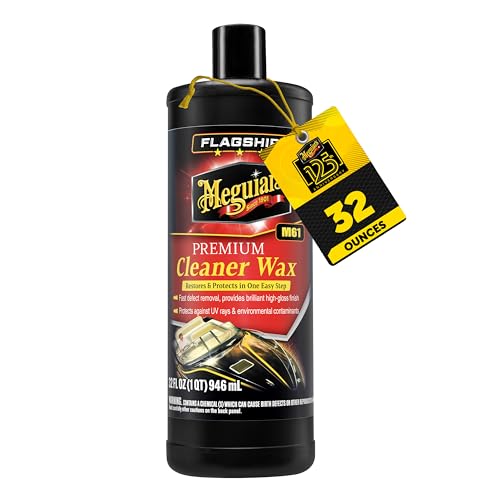
Meguiar’s Flagship is a one-step liquid cleaner wax that combines fine micro-abrasives with UV-blocking polymers—designed to remove light oxidation, water spots, and minor swirl marks while laying down a protective layer in a single pass. The 32-ounce bottle gives generous coverage on a full Class A motorhome, and the liquid formulation works well with a DA polisher or by hand without caking up on the pad.
Gelcoat-safe and usable in direct sunlight, it’s the most forgiving option for RV owners who don’t want to chase shade or work in strict temperature windows. The abrasives are fine enough that they won’t scratch the gelcoat even if you apply heavy pressure, yet they cut through light chalky layers effectively enough to restore gloss that conventional waxes can’t revive.
Where this product truly shines is convenience: it removes defects and protects in the same step, cutting your wash-to-detail time roughly in half compared to using a compound followed by a standalone wax. The downside is that the protection layer isn’t as thick as a dedicated marine wax—you’ll want to reapply every two to three months if the RV lives under direct sun full-time.
What works
- One-step cleaning and waxing saves significant time
- Safe for gelcoat and can be applied in direct sunlight
What doesn’t
- Protection durability is shorter than dedicated waxes
- Not effective for heavy oxidation or deep gelcoat crazing
3. 3M Perfect-It Gelcoat Light Cutting Polish + Wax 36110

3M Perfect-It is a professional-grade light cutting polish designed specifically for gelcoat and fiberglass, making it the go-to choice when you need to remove actual scratches—not just haze—from your RV’s panels. The aluminum oxide abrasives in this quart-sized formula are engineered to cut through light to moderate oxidation, surface etching, and swirl marks left by improper washing techniques, while the integrated wax component leaves behind a decent initial shine.
This product is best paired with a rotary polisher and a yellow 3M wool pad, as recommended by the manufacturer, because the abrasives require machine speed to break down properly. Hand application is possible for small touch-up areas, but you won’t get the uniform cutting action needed for consistent gloss on large flat surfaces. The cutting action is aggressive enough that you should tape off decals and adjacent clear-coated sections to avoid burn-through.
Where this polish falls short is standalone durability—the wax included in the formula is designed to be a temporary protectant rather than a long-term sealant. Most users follow up with a dedicated marine wax or sealant after the cutting stage, adding an extra step. For owners who need to remove visible scratches before winterizing or selling their RV, this is the most effective cutter in the lineup.
What works
- Effectively removes scratches and swirl marks from gelcoat
- Professional-grade chemistry that finishes well with a rotary polisher
What doesn’t
- Requires a DA or rotary polisher for proper application; hand-use is limited
- Wax component is temporary and needs a follow-up sealant
4. Poli Glow Boat & RV Restoration Fiberglass Kit
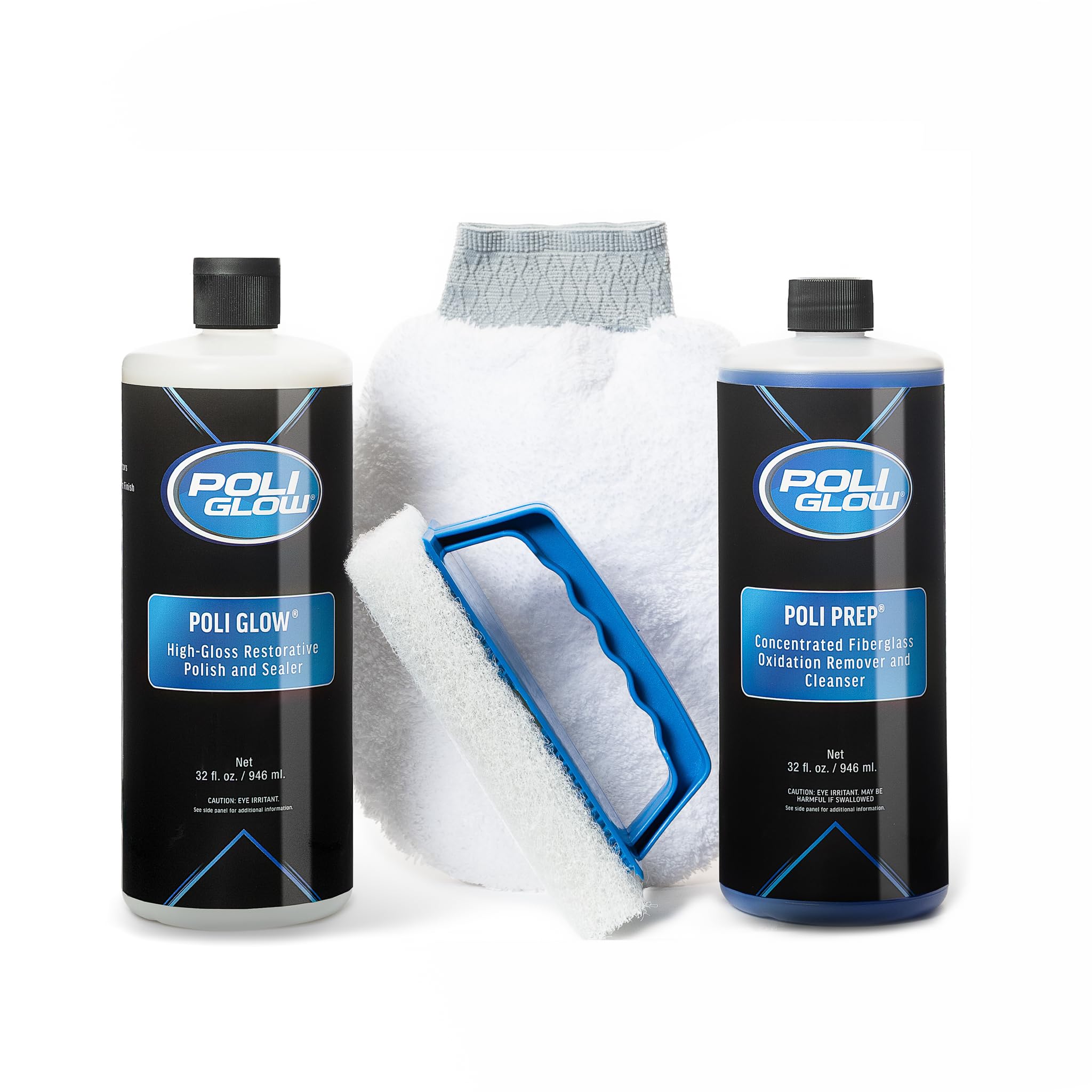
Poli Glow takes a fundamentally different approach from traditional waxes: its acrylic polymer formula is designed to absorb into the porous fiberglass and chemically seal the surface from within, rather than sitting on top as a sacrificial coating. This makes it a genuine restoration system for heavily oxidized RVs where conventional waxes can’t bond because the gelcoat is too degraded to hold them.
The kit includes a Poli Prep cleaner that strips old wax, oxidation residue, and contaminants before you apply the Poli Glow itself. A minimum of six coats is recommended, each building a cumulative layer of gloss—the process takes about two hours on a typical travel trailer but delivers a wet-look finish that can last up to six years with proper care and annual maintenance coats. Application is done by hand with the included mitt applicator; no machine polishing is needed, which is a huge plus for owners without detailing equipment.
The trade-off is the initial labor: you must follow the multi-step process exactly, including waiting times between coats, or the finish can cloud. The price point is significantly higher than single-bottle waxes, but the per-application cost is low given that one kit covers an entire 30-foot RV and the results don’t wash off after a few weeks. For owners with chalky, faded fiberglass that nothing else seems to fix, this is the most reliable solution available.
What works
- Penetrates and seals heavily oxidized gelcoat better than any wax
- Finish can last for years if maintenance coats are applied annually
What doesn’t
- Requires multiple coats and strict procedural adherence
- Higher upfront investment compared to traditional polish products
5. Wizards Shine Master Polish and Breathable Sealant – 1 Gallon
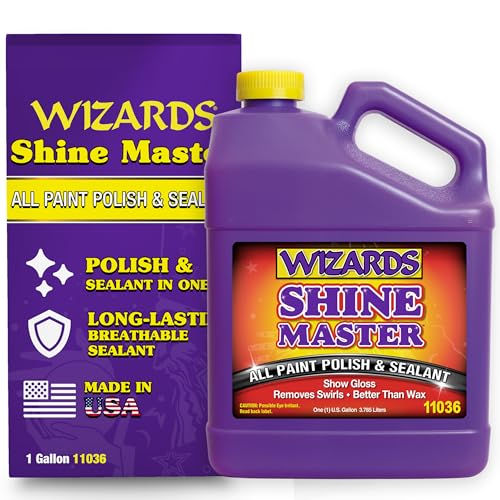
Wizards Shine Master is a polymer-based polish that doubles as a breathable sealant, specifically formulated without free silicone or carnauba wax that can leave a greasy film on fiberglass and gelcoat. The 1-gallon container offers the highest volume-to-value ratio in this guide, making it a smart choice for RV owners who maintain multiple vehicles or who need to apply frequent seasonal coats over large coach surfaces.
Its breathable polymer chemistry allows moisture vapor from the fiberglass substrate to escape without lifting the coating, preventing the osmotic blistering that can occur under non-breathable sealants on older RVs. Applied with firm pressure, the fine abrasives remove dead paint and light oxidation while leaving a clarity that rivals dedicated show-car polishes. It works equally well by hand or with a machine, although machine application on gelcoat produces noticeably deeper gloss.
The primary limitation is that Shine Master is not designed for severe oxidation—it’s a restoration polish for moderately faded surfaces, not a heavy cutter like the 3M product. Additionally, the gallon size is bulky for storage, and the liquid consistency can drip if you’re not careful with a handheld applicator. For motorhome owners who want a single product that polishes and protects without multiple steps, the gallon value is hard to beat.
What works
- Breathable polymer prevents moisture trapping under the sealant layer
- Excellent value with 128 ounces of usable product per gallon
What doesn’t
- Not aggressive enough for heavy oxidation or deep scratches
- Liquid consistency can be messy during hand application
Application & Chemistry Guide
Abrasiveness Grit vs. Gelcoat Thickness
Fiberglass RV gelcoat averages around 15 to 20 mils thick when new, but oxidation can thin that layer significantly. Light cutting polishes (approximately 2000 grit equivalent) are safe for general restoration. Heavy compounds (1000 grit or below) should only be used with a rotary polisher and thickness gauge—burning through the gelcoat exposes the underlying chopped strand mat, requiring a full respray.
Polymer Cross-Linking vs. Topical Wax
Topical carnauba waxes sit as a hydrophobic film on the surface and degrade rapidly under UV exposure, typically lasting 4-6 weeks. Polymer sealants and acrylic formulas chemically cross-link with the fiberglass pores, creating a bonded layer that resists wash-off. Breathable polymers (like those in Wizards Shine Master) allow vapor passage, which prevents osmotic blisters on older gelcoat that has micro-cracks.
FAQ
Can I use automotive polish on my fiberglass RV instead of a marine-specific product?
How do I know if my RV’s fiberglass needs a cutting polish versus a cleaner wax?
Is it safe to apply multiple coats of polymer sealant like Poli Glow?
Final Thoughts: The Verdict
For most RV owners, the clear winner for the polish for fiberglass rv category is the Poli Glow Restoration Kit because it chemically bonds with heavily oxidized gelcoat and provides multi-year protection without requiring machine buffing. If you want a fast one-step application for light haze on a weekend trip, grab the Meguiar’s Flagship M6132. And for professional-grade scratch removal before a show or sale, nothing beats the 3M Perfect-It 36110.

Certification: BSc in Mechanical Engineering
Education: Mechanical engineer
Lives In: 539 W Commerce St, Dallas, TX 75208, USA
Md Amir is an auto mechanic student and writer with over half a decade of experience in the automotive field. He has worked with top automotive brands such as Lexus, Quantum, and also owns two automotive blogs autocarneed.com and taxiwiz.com.