Choosing riding pants is not about looking the part — it is about what happens when your leg meets asphalt at highway speed. Standard denim shreds in less than half a second at 35 mph, leaving your skin as the only layer between bone and the road. Motorcycle-specific pants are engineered with abrasion-resistant fabrics, impact-absorbing armor, and thoughtful ergonomics designed for the seated riding position, making them the most critical piece of protective gear many riders overlook.
I’m Amir — the founder and writer behind Four Wheel Ask. I’ve spent years analyzing market data, reviewing technical specifications, and aggregating owner feedback from thousands of real-world riders to understand what actually works across different riding styles and budgets.
The goal is simple — help you cut through the marketing noise to find the best pants for motorcycle riding that match your specific needs, whether you commute daily, tour cross-country, or hit the dirt on weekends.
How To Choose The Best Pants For Motorcycle Riding
The sheer variety of riding pants — from armored jeans to textile overpants to full-grain leather — can be overwhelming. But the decision boils down to three pillars: abrasion resistance, impact protection, and fit ergonomics. Understanding these categories will prevent you from overpaying for features you do not need or underspending on protection that could save your skin.
Abrasion Resistance — The Fabric Decides Your Slide Time
The material is your first line of defense against road rash. Cordura nylon (typically 600D to 1680D) and full-grain leather offer the highest abrasion resistance, with leather providing the best slide protection but minimal breathability. Heavyweight denim (14 oz or higher) with Kevlar or UHMWPE lining offers a good middle ground for street riders who want a casual look. Avoid any pant without a stated denier or fabric weight — if the manufacturer does not publish this number, they likely do not want you testing it.
Impact Protection — CE Armor Is Not Optional
CE-rated armor absorbs kinetic energy from impacts against pavement and debris. Level 1 armor absorbs up to 50% of impact force, while Level 2 armor (stiffer, more foam) absorbs over 70%. Knee armor is the minimum requirement, but hip armor (often sold separately or removable) protects against femoral head fractures — the most common crash injury for riders over 40. Check whether the armor pockets are adjustable vertically; fixed pockets often misalign with your knees in the seated riding position.
Fit and Riding Position — Standing Fit vs Seated Fit
Pants designed for sport bikes have a shorter front rise and a more aggressive pre-curved knee to match the tucked riding posture. Adventure and dual-sport pants prioritize a taller torso and adjustable waist tabs to accommodate standing on pegs. Overpants are cut looser to fit over street clothes and often include full-length side zippers for easy on/off over boots. If the knee armor sits too high or too low while you are straddling the bike standing still, it will be completely misaligned at highway speed — always test the seated fit.
Quick Comparison
On smaller screens, swipe sideways to see the full table.
| Model | Category | Best For | Key Spec | Amazon |
|---|---|---|---|---|
| Alpinestars 1 Straight Leg | Leather/Sport | Precise sport bike fit | CE Level 2 knee armor | Amazon |
| KLIM Dakar OTB | Dual-Sport | Off-road endurance | 1460D Cordura shell | Amazon |
| SHIMA Rider Airforce | Jeans | Street/casual wear | Kevlar-lined denim | Amazon |
| Noru Kuro Leather | Leather | Style + ventilation | Full-grain perforated leather | Amazon |
| WICKED STOCK Riding Jeans | Jeans | True-to-size denim fit | 14oz denim + CE Level 2 | Amazon |
| ILM PF1 Winter Overpants | Overpants | Cold weather layering | Detachable quilted liner | Amazon |
| HWK Dual Sport | Textile/ADV | Versatile entry-level ADV | Removable thermal liner | Amazon |
| JAG Dual Sport | Textile/ADV | Budget dual-sport fit | Water-resistant Cordura | Amazon |
| COMMUTER Leather Jacket | Jacket | Premium gear (jacket) | 1.2-1.3mm buffalo leather | Amazon |
In‑Depth Reviews
1. Alpinestars 1 Straight Leg

The Alpinestars 1 Straight Leg is the benchmark for sport bike-specific riding pants. The full-grain leather chassis provides top-tier abrasion resistance, while the CE Level 2 knee armor delivers high-impact absorption that exceeds the minimum safety standard. The pre-curved leg geometry is designed for the aggressive forward lean of a sport bike, meaning the armor aligns perfectly when you are in the riding position — not standing at a stoplight.
Anatomically, these pants run slightly slim in the thighs and are cut shorter in the inseam. Riders between 6 feet and 6 feet 2 inches report that the knee pads sit low while standing but snap into the correct position the moment they swing a leg over the bike. This is by design for sport riding, but taller riders may need the 34-length inseam variant. The straight-leg opening fits over track boots without bunching.
Ventilation is minimal — there are no perforations or zip vents, which makes these pants less ideal for summer commutes above 80 degrees. For canyon carving or track days where protection and precise fit matter more than airflow, the 1 Straight Leg earns its premium reputation through proven durability and seamless armor integration.
What works
- CE Level 2 knee armor sits perfectly in sport riding position
- Full-grain leather offers maximum slide protection
- Straight-leg cut works with track boots
What doesn’t
- No ventilation zippers or perforations for warm weather
- Slim thigh fit may not suit muscular builds
- Knee armor feels low when standing upright
2. KLIM Men’s Dakar OTB

The KLIM Dakar OTB is engineered for riders who split time between pavement and dirt and demand a pant that handles both extremes. The 1460D Cordura shell is among the toughest fabrics used in motorcycle apparel — significantly more abrasion-resistant than standard 600D textile pants. The over-the-boot (OTB) cuff design keeps debris out when crossing streams or riding through muddy two-track, while the integrated knee armor provides consistent coverage on standing descents.
Weight is the trade-off. The heavy-duty fabric and dual-layer construction make these pants notably heavier than comparable adventure models from lighter-weight brands. Riders who stand for long sections report the weight pulling on the waist, though the adjustable waist tabs and articulated knees mitigate fatigue on shorter trips. The fit is generous through the hips and thighs, accommodating base layers and knee braces without restriction.
Water resistance is impressive out of the box — the fabric beaded water effectively during sustained rain rides, though the DWR finish will require periodic reapplication. For dual-sport riders who prioritize durability over packability and do not mind the heft, the Dakar OTB delivers a level of long-term reliability that justifies the investment across thousands of mixed-terrain miles.
What works
- 1460D Cordura shell resists abrasion exceptionally well
- OTB cuff keeps dirt and water out on trails
- True-to-size fit with room for knee braces
What doesn’t
- Very heavy compared to other ADV pants
- Limited ventilation — runs warm in direct sun
- Snug waist fit for taller riders when seated
3. SHIMA Rider Motorcycle Jeans
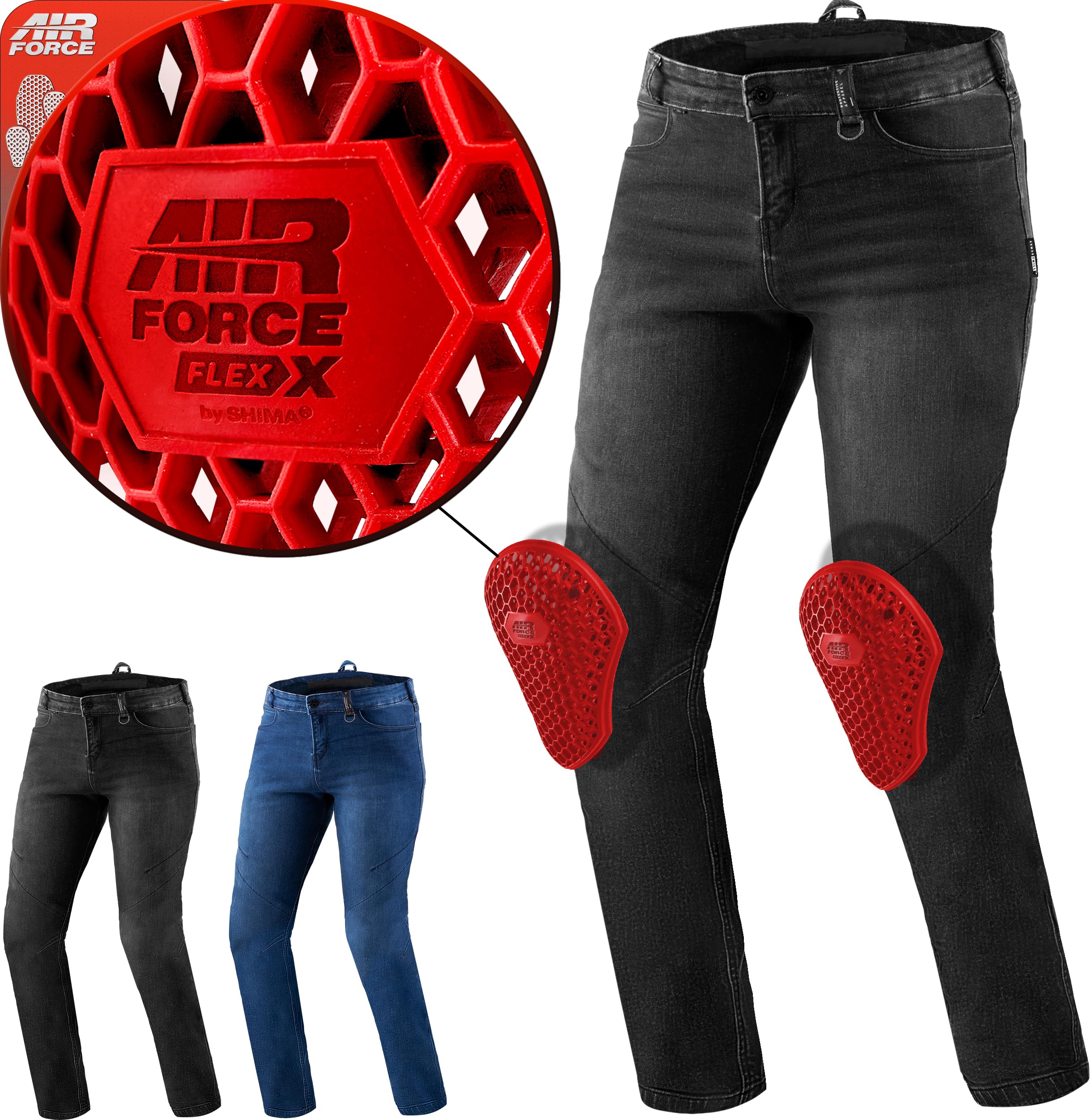
The SHIMA Rider Airforce jeans occupy a sweet spot for street riders who want the look and feel of casual denim without sacrificing protection. The Kevlar lining runs through the seat, hips, and knees — the three zones most likely to contact pavement in a slide. The CE-rated knee protectors are vertically adjustable via internal pockets, allowing riders of different heights to align the armor with their patella while seated on the bike.
The denim itself is a heavyweight 14 oz cotton that feels substantial compared to standard fashion jeans. The straight-leg cut fits over most casual boots and look unremarkable off the bike, making them suitable for commuters who transition from the saddle to the office or café without drawing attention. Riders report that the knee armor stays in place even during longer rides, a common failure point in cheaper armored jeans where the pads drift downward.
One notable omission is the lack of hip armor pockets — the pants ship with only knee protectors. Riders seeking full hip protection will need to add third-party pads or look at models with integrated hip pockets. For the price, the SHIMA Rider delivers strong abrasion coverage and adjustable knee armor, making it a compelling mid-range choice for street-focused riders.
What works
- Kevlar lining covers seat, hips, and knees
- Adjustable knee armor height for proper seated alignment
- Heavyweight denim looks like regular jeans
What doesn’t
- No hip armor pockets included
- Sizing runs slightly small in waist for some builds
- Limited inseam length options
4. Noru Kuro Leather Motorcycle Pants

The Noru Kuro Leather Pants solve a persistent problem in full-grain leather gear — heat management. The perforated leather panels on the front of the thighs and behind the knees allow significant airflow, keeping the rider noticeably cooler than solid leather pants during summer rides. The leather itself is a supple full-grain hide that feels premium from the first wear, with minimal break-in stiffness compared to budget leather options.
The integrated knee and shin protectors are CE-rated and cover the full front of the lower leg, offering protection that extends below the knee joint — a detail often overlooked by leather pants that only cover the kneecap. The fit is athletic through the waist and thigh, with a moderate taper at the ankle that works over most sport boots. The waist closure uses a single-button-and-zipper system that feels secure without being overly bulky under a jacket.
The perforation that makes these pants comfortable in warm weather becomes a liability below 40 degrees. Cold air penetrates the holes rapidly, and even base layers struggle to block the draft at highway speeds. Riders who ride through autumn and winter will need to pair these with thermal leggings or heated liners. For warm-weather riders who refuse to sacrifice the abrasion protection of leather, the Noru Kuro offers the best compromise between cooling and coverage.
What works
- Perforated leather provides substantial airflow
- CE-rated knee and shin coverage extends below the cap
- High-grade full-grain leather with minimal break-in
What doesn’t
- Cold air rushes through perforations below 40°F
- Limited to slim/athletic thigh fit
- No hip armor or pockets for add-on pads
5. WICKED STOCK Men’s Riding Pants

The WICKED STOCK riding jeans solve one of the most frustrating issues in armored denim: fit. Many armored jeans run either too tight to accommodate armor or too baggy to look normal off the bike. These jeans are cut true to standard American jean sizing — riders report that a 36×34 fits identically to their everyday Wranglers or Levis, right down to the waist and inseam measurements. The 14 oz denim has a soft, broken-in feel out of the box while still providing meaningful abrasion resistance.
The CE Level 2 armor in the knees is a rare find at this price point. Level 2 certification requires the pad to transmit less than 20 kN of force, compared to Level 1’s 30 kN threshold. The knee pockets are adjustable vertically, and the armor sits flat against the leg without protruding unnaturally. The hip area includes zippered pockets that can accept third-party hip armor, a feature often missing from jeans in this segment.
The only real drawback is the limited color selection — currently limited to dark blue and black. Riders looking for lighter washes or tapered skinny-fit cuts will not find that here. The straight-leg cut works best for cruiser, standard, and adventure riders who prefer a classic denim silhouette. For a straightforward, well-fitting, and well-protected pair of riding jeans, WICKED STOCK delivers exactly what it promises.
What works
- CE Level 2 knee armor at a mid-range price
- True-to-standard-jean sizing eliminates guesswork
- Soft 14oz denim breaks in quickly
What doesn’t
- Limited to dark blue and black color options
- No tapered or skinny fit available
- Hip armor pockets need separate pad purchase
6. ILM Detachable Winter Riding Pants PF1

The ILM PF1 overpants are designed for one job — keeping you warm and protected in cold weather without requiring you to change out of your work or street pants underneath. The detachable quilted thermal liner adds significant insulation, and when combined with the water-resistant outer shell, these pants effectively block wind chill down to freezing temperatures. The full-leg side zippers run from ankle to hip, allowing the pants to be taken on and off over bulky boots and layered clothing without removing your boots.
The CE-rated knee armor is accessible through external zippered pockets, making it easy to remove or upgrade the pads without struggling with internal liners. The waist features velcro side adjusters that allow the fit to be tightened or loosened depending on how many layers you are wearing underneath. Riders report that the zipper pull is large enough to operate with thick winter gloves — a small detail that makes a big difference at a rest stop in 30-degree weather.
Fit tends to run slightly small in the waist and thigh, particularly when the thermal liner is installed. Riders between sizes should size up to avoid compression against base layers. The pants are bulky enough that they are not ideal for warm-weather use, even with the liner removed, because the outer shell lacks ventilation zippers. As a cold-dedicated overpant, however, the PF1 punches well above its price bracket for warmth retention and on/off convenience.
What works
- Detachable thermal liner provides serious cold-weather insulation
- Full-leg zippers allow quick on/off over boots
- Armor accessible from external pockets
What doesn’t
- Runs small with liner installed — size up recommended
- No ventilation zippers for warmer days
- Bulky shell limits range of motion on sport bike
7. HWK Dual Sport Motorcycle Pants

HWK’s Dual Sport pants have become a staple in the entry-level adventure segment by offering an impressive feature set at a budget-friendly price point. The outer shell is constructed from water-resistant Cordura textile, and the pants include a removable thermal liner that transforms them from a three-season textile pant into a cold-weather option. The knee armor is CE-rated and positioned to stay aligned whether you are sitting or standing on pegs, which is a common failure in cheaper dual-sport pants.
The pants feature a tall rise and adjustable waist tabs, which make them compatible with a wide range of body types and allow for easy layering over base layers or under riding jackets. The multiple pockets — including two zippered hand pockets and two cargo pockets — are genuinely useful for storing toll money, phone, or keys when off the bike. The internal waist adjusters provide a custom fit without external straps that can catch on branches or wind at speed.
Ventilation is adequate but not exceptional. There are no large intake vents on the thighs, so airflow relies on the mesh liner and the ability to roll up the legs when stopped. In the hottest summer conditions, the lack of dedicated venting becomes noticeable. For mixed-season riders who do most of their riding between 50 and 80 degrees and want one pant that handles everything from commuting to light trail riding, the HWK Dual Sport is a remarkably competent choice for the price.
What works
- Removable thermal liner extends use into cold weather
- Good fit for standing and seated dual-sport riding
- Multiple functional pockets for daily carry
What doesn’t
- Limited thigh ventilation for hot summer days
- Armor is adequate but not Level 2 rated
- Shell fabric feels stiff before break-in
8. JAG Motorcycle Protective Pants

The JAG Protective Pants aim to provide a functional shell for riders on a tight budget who need something that fits over street clothes and provides basic protection. The water-resistant Cordura fabric does a reasonable job of blocking light rain and wind, and the included knee and hip armor pads offer some impact coverage. The pants are cut generously to fit over work pants or jeans, and the multiple adjustment straps at the waist, thigh, calf, and ankle allow for a surprising degree of customization.
The armor pads themselves are the weakest link — reviewers consistently note that while the pads cover the right zones, the density and thickness fall short of CE Level 2 protection. The good news is that the armor pockets are standard size, meaning riders can swap in higher-grade pads from brands like D3O or Forcefield for around the cost of a lunch. The base Cordura shell is well-stitched and shows no loose threads or weak seams out of the box.
These pants are not suitable for sport bike riding. The cut is designed for upright touring, dual-sport, or cruiser postures, and the fabric lacks the articulation needed for a deep tuck. The white contrast stitching also stands out against most jackets, which may bother riders who prefer a coordinated look. For occasional riders who need a basic overpant for short commutes or light trail use and are willing to upgrade the armor, the JAG pants serve as a serviceable entry point.
What works
- Water-resistant Cordura shell blocks light rain
- Multiple adjustment points for customized fit
- Armor pockets accept standard replacement pads
What doesn’t
- Stock armor is low-density, needs upgrading
- Cut is too bulky for sport bike riding posture
- White stitching may clash with jacket colors
9. COMMUTER Buffalo Leather Jacket
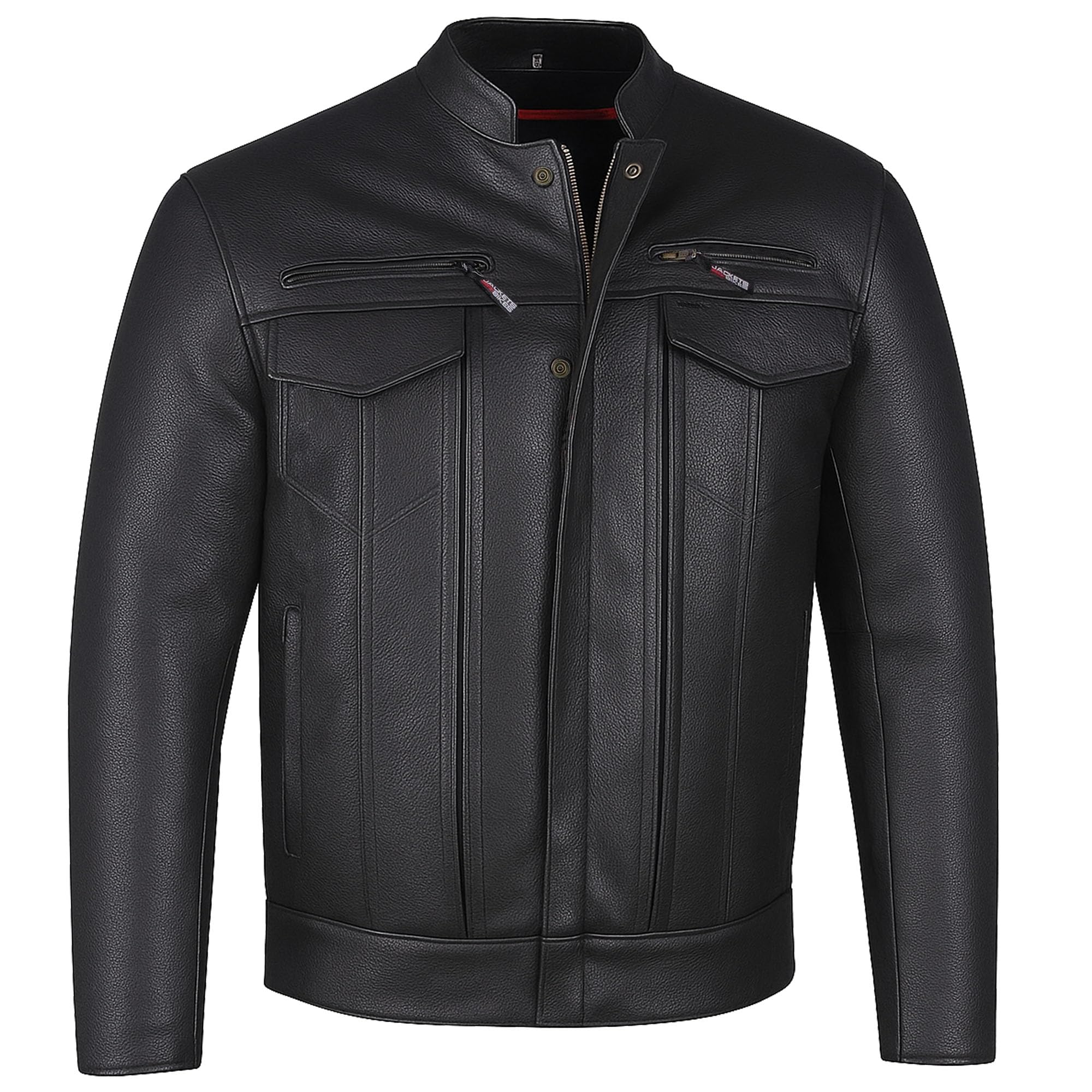
The COMMUTER jacket from Jackets4Bikes is built from 1.2 to 1.3 mm premium buffalo leather, which offers significantly higher tear resistance than cowhide of the same thickness while remaining flexible enough for all-day wear. The jacket ships with a full set of five CE-rated armor pieces — shoulders, elbows, and back — all of which are removable for cleaning or replacement. The buffalo leather has a natural grain texture that develops character over time without the cracking associated with corrected-grain leathers.
The jacket is loaded with practical features that exceed what is typically found at this tier: eight total pockets including two secure interior pockets, a full-sleeve zip-out thermal quilted liner for winter riding, and four ventilation zippers (two chest, two back) that create noticeable airflow when open. The YKK zippers throughout are the same brand used by premium European leather jacket makers, and the action back panel provides extra stretch when reaching for the handlebars on a cruiser or standard bike.
The sizing runs large. Riders who normally wear a large should order a medium unless they plan to layer heavily underneath. The back panel is a large, blank leather surface that is ideal for DIY patches or club affiliation customization. For riders who want a single jacket that handles temperatures from the high 30s into the low 80s without looking like a track suit, the COMMUTER delivers exceptional value in pure materials and protection density.
What works
- Buffalo leather is tougher than cowhide at same thickness
- 5-piece CE armor is pre-installed and removable
- Ventilation zippers and thermal liner cover four seasons
What doesn’t
- Sizing runs large — most riders need to size down
- Heavy weight compared to textile or mesh jackets
- Large back panel may not suit minimalists
Hardware & Specs Guide
Abrasion-Resistant Fabric Weights
The denier (D) rating of textile fabrics directly correlates to slide-test abrasion resistance. Standard 600D Cordura is the baseline for most mid-range pants — it survives roughly 2 to 3 seconds of asphalt contact at highway speed. At 1680D ballistic nylon or 1460D Cordura, the slide time extends to 5 seconds or more. Leather pants are measured by hide thickness in millimeters: 1.0 mm is the legal minimum, 1.2 to 1.3 mm is the standard for quality riding gear, and 1.4 mm or thicker approaches race-spec protection. Denim riding jeans use 14 oz or heavier cotton combined with aramid (Kevlar) or UHMWPE fiber liners — the lining weight matters more than the outer denim for abrasion.
CE Armor Levels and Placement
CE Level 1 armor transmits a maximum of 30 kN of impact force through the pad, while Level 2 transmits 20 kN or less. The difference is noticeable in a hard knee strike against pavement — Level 2 reduces the risk of patellar fracture significantly. Knee armor should be adjustable vertically by at least 2 inches to match the rider’s seated knee position. Hip armor, though optional, is critical for preventing femoral head fractures: look for pants with dedicated hip pockets rather than relying on generic thigh foam. Back armor in jackets uses the same scale, with Level 2 now mandated by most track day organizations for upper body protection.
FAQ
Can I wear regular jeans under overpants for cold weather riding?
Why do knee pads feel low when standing but correct when seated?
What is the difference between textile pants and riding jeans for abrasion?
How do I clean perforated leather riding pants?
Do I need hip armor if I ride mostly on surface streets under 40 mph?
Final Thoughts: The Verdict
For most buyers, the best pants for motorcycle riding winner is the Alpinestars 1 Straight Leg because its full-grain leather chassis, CE Level 2 knee armor, and sport-optimized ergonomics set the standard for protection and fit. If you need a do-it-all adventure pant that handles pavement and dirt equally well, the KLIM Dakar OTB delivers the most durable fabric in the dual-sport category. And for the rider who refuses to compromise on everyday style but insists on proper impact protection, the WICKED STOCK riding jeans offer true-to-size fit with Level 2 armor at a mid-range price that is tough to beat.

Certification: BSc in Mechanical Engineering
Education: Mechanical engineer
Lives In: 539 W Commerce St, Dallas, TX 75208, USA
Md Amir is an auto mechanic student and writer with over half a decade of experience in the automotive field. He has worked with top automotive brands such as Lexus, Quantum, and also owns two automotive blogs autocarneed.com and taxiwiz.com.