Choosing the wrong viscosity or neglecting additive chemistry in a heavy-duty diesel engine shortens rebuild intervals, drops fuel economy, and leaves critical components vulnerable to soot-induced wear. The lubricant you pour into a semi truck engine must withstand sustained high temperatures, resist shear under continuous load, and neutralize acids formed during combustion — all while keeping particulate filters and EGR systems functioning properly.
I’m Amir — the founder and writer behind Four Wheel Ask. My work focuses on breaking down heavy-duty lubricant specifications, decoding additive packages, and cross-referencing real-world performance data from fleet operators and long-haul owner reports to identify what truly protects high-mileage diesel engines over extended drain intervals.
Drawing from extensive analysis of field data and owner feedback across thousands of miles, I’ve identified the best oil for semi trucks for maximum engine protection and longevity.
How To Choose The Best Oil For Semi Trucks
Selecting the right lubricant for a semi truck goes far beyond grabbing the first jug of 15W-40 on the shelf. The oil you choose directly impacts engine longevity, fuel consumption, emission system health, and overall operating costs. Understanding the key specifications and how they apply to your specific engine and duty cycle is the difference between a reliable workhorse and a costly overhaul.
Viscosity Grade: 15W-40 vs 5W-40
Most over-the-road semi trucks operate on SAE 15W-40 for its proven balance of high-temperature protection and cold-start capability. This viscosity provides robust oil film thickness at operating temperatures while still allowing adequate flow during startup in moderate climates. For fleets that operate in sub-zero conditions or require faster oil circulation during cold starts, SAE 5W-40 delivers improved pumpability without sacrificing high-temperature shear stability. Always consult the engine manufacturer’s approved viscosity list before switching grades.
API Service Category: CK-4, CJ-4, and CI-4 Explained
The American Petroleum Institute (API) designates service categories that indicate the oil’s compatibility with emission control systems. CK-4 is the current standard for modern diesel engines equipped with diesel particulate filters (DPF) and selective catalytic reduction (SCR) systems. CJ-4 remains backward-compatible for older engines and provides adequate protection for pre-2010 models. CI-4 oils suit pre-2007 engines without aftertreatment devices. Using the wrong category can clog DPFs, reduce catalyst efficiency, or void warranty coverage.
Base Oil Type: Conventional vs Full Synthetic
Conventional diesel oils offer reliable protection at a lower cost and are well-suited for engines operating on standard drain intervals in moderate climates. Full synthetic formulations provide superior thermal stability, better低温 flow characteristics, enhanced resistance to oxidation, and extended drain capability — often reaching 30,000 to 100,000 miles depending on the product and application. For high-mileage engines, severe service conditions, or extended intervals, the additional investment in synthetic oil typically pays for itself through reduced wear and longer component life.
Key Additives: TBN, Moly, Boron, and Soot Control
Total Base Number (TBN) measures the oil’s ability to neutralize acidic combustion byproducts. A higher initial TBN (12–15) indicates longer-lasting acid protection for extended drains. Friction modifiers such as molybdenum and boron reduce metal-to-metal contact, lower operating temperatures, and improve fuel efficiency. Advanced soot-dispersant chemistry keeps contaminants suspended in the oil rather than settling as sludge, which is critical for engines with high exhaust gas recirculation (EGR) rates. Always verify additive levels match your engine manufacturer’s minimum requirements.
Quick Comparison
On smaller screens, swipe sideways to see the full table.
| Model | Category | Best For | Key Spec | Amazon |
|---|---|---|---|---|
| Mobil 1 Turbo Diesel Truck 5W-40 | Full Synthetic | All-Around Protection | 5W-40, CK-4 | Amazon |
| Royal Purple 04154 15W-40 | Synthetic Blend | Wear & Fuel Economy | 15W-40, API CI-4 | Amazon |
| Lucas Oil 10076 15W-40 Magnum | Conventional | Pre-2007 Engines | 15W-40, CI-4 | Amazon |
| Motorcraft 10W-30 (XO10W305Q3SD) | Conventional | Ford OEM Spec | 10W-30, API SN | Amazon |
| Delo 400 XSP 5W-40 | Full Synthetic | Extreme Cold Start | 5W-40, CK-4 | Amazon |
| Hot Shot’s Secret Green Diamond 15W-40 | Full Synthetic | Fuel Economy Boost | 15W-40, CK-4 | Amazon |
| Shell Rotella T4 Triple Protection 15W-40 | Conventional | Triple Protection Value | 15W-40, CK-4 | Amazon |
| Schaeffer SynShield 15W-40 | Conventional Plus | Severe Duty Wear | 15W-40, CK-4 | Amazon |
| Mobil 1 Delvac 1300 Super 15W-40 | Conventional | Fleet Reliability | 15W-40, CK-4 | Amazon |
| Triax Fleet Supreme 15W-40 | Full Synthetic | Extended Drain Intervals | 15W-40, CK-4 | Amazon |
| Royal Purple 05154 15W-40 (5 Gal) | Full Synthetic | Bulk Premium Protection | 15W-40, API CI-4 | Amazon |
In‑Depth Reviews
1. Mobil 1 Turbo Diesel Truck Full Synthetic 5W-40

Mobil 1 Turbo Diesel Truck 5W-40 is formulated for modern low-emission diesel engines and meets or exceeds the specifications of major truck manufacturers, making it a versatile choice for mixed fleets operating both gas and diesel equipment. Its full synthetic base provides exceptional thermal stability and resistance to viscosity breakdown under sustained high-load operation, which is critical for semi trucks running long-haul routes.
Owner feedback consistently highlights reduced engine noise and smoother idle after switching to this formulation, particularly in turbo-diesel engines where valve train chatter is a common concern. The oil’s low-temperature pumpability ensures reliable cold starts, while its high-temperature deposit control keeps pistons and rings clean over extended drain intervals. Multiple reports document sustained performance beyond 8,000 miles in mixed fleet testing without measurable loss in shear stability.
For fleet managers looking for a single oil that covers both modern DPF-equipped trucks and older diesel platforms, this Mobil 1 formulation delivers laboratory-grade protection with real-world durability. The additive package is designed to reduce low-temperature sludge buildup and high-temperature deposits simultaneously, addressing the two most common failure modes in heavy-duty diesel lubrication.
What works
- Quieter engine operation reported across multiple diesel platforms
- Excellent thermal stability for extended drain intervals
- Versatile mixed-fleet compatibility
What doesn’t
- 5W-40 may not be ideal for extreme heat climates compared to 15W-40
- Some users prefer a higher TBN for very long drains
2. Delo 400 XSP SAE Heavy Duty Synthetic Diesel Engine Oil 5W-40

Chevron’s Delo 400 XSP is engineered for extreme低温 performance without sacrificing high-temperature film strength, making it a strong contender for semi trucks operating in northern climates or regions with severe seasonal temperature swings. Its synthetic formulation promotes consistent cold engine starting in sub-zero conditions while maintaining robust viscosity at operating temperature, a balance that few conventional oils can match.
Owner data from high-mileage 7.3 Powerstroke and Duramax applications shows significant reductions in oil consumption and crankcase temperature after switching to XSP. One report noted a 30°F drop in crankcase temperature combined with cleaner spark plugs and easier first-pull starts in small engines used alongside the truck. The oil’s thermal stability also reduces the rate of viscosity shear under heavy load, keeping oil pressure stable during extended grades.
For fleet operators who run a mix of heavy-duty diesel trucks and ancillary gas-powered equipment, Delo 400 XSP’s universal compatibility simplifies inventory management. The CK-4 formulation is backward-compatible with CJ-4 and CI-4 applications, and the high TBN reserve supports drain intervals that align with modern maintenance schedules.
What works
- Excellent cold-start performance in sub-zero conditions
- Reduced crankcase operating temperature reported
- High TBN reserve for longer drain capability
What doesn’t
- Requires longer warm-up for optimal flow compared to some competitors
- Premium pricing compared to conventional 15W-40 options
3. Hot Shot’s Secret Green Diamond 15W-40 Full Synthetic

Hot Shot’s Secret Green Diamond uses a proprietary blend of Group III base oils combined with FR3 nanotechnology to create a lubricant that reduces friction at the molecular level. The manufacturer claims up to 3% fuel economy improvement and 71% reduction in wear compared to CJ-4 spec oils, figures that align with independent user reports from LLY Duramax and 6.7 Cummins platforms.
Real-world data from a 265,000-mile Duramax showed fuel economy climbing from 18 to 22 MPG at highway speeds after switching, while a 6.7 Cummins owner noted higher oil pressure and quieter idle after hot cycles compared to Amsoil. The CK-4 additive package with patented nanotechnology targets the fine crevices of engine components to create smoother surfaces that minimize metal-to-metal contact, which is especially beneficial for high-mileage engines with existing wear patterns.
Durability testing at 14,000 miles of hard hauling and off-road operation showed additive packages intact and viscosity unchanged, indicating strong shear stability under severe service. The FR3 technology also appears to improve throttle response and cold-start behavior, with multiple owners reporting noticeably quieter engine operation within the first oil change interval.
What works
- Measurable fuel economy improvement in real-world use
- Strong shear stability during severe service conditions
- Quieter engine operation reported across multiple diesel platforms
What doesn’t
- Premium pricing places it above standard synthetic options
- Some users note stronger exhaust odor due to high zinc content
4. Schaeffer Manufacturing Co. SynShield 15W-40 Diesel Engine Oil

Schaeffer SynShield stands out for its proprietary friction modification using micronized molybdenum and penetrate additives that bond to metal surfaces for reduced wear during boundary lubrication events. This is particularly relevant for semi trucks that experience frequent stop-and-go operation or heavy loading from a standstill, where oil film thickness is momentarily compromised.
Owners of 2002 Duramax and 2001 7.3 Powerstroke engines report that SynShield virtually eliminates the characteristic diesel tick and rattle at both idle and acceleration, with one user noting a 5 PSI increase in oil pressure at idle. The improvement in engine smoothness and noise reduction is consistently cited across platforms, with several long-term users reporting sustained benefits over multiple oil change intervals.
The formulation offers strong oxidation control and viscosity retention throughout the drain interval, with soot-dispersing capability that keeps deposits suspended rather than settling on critical surfaces. For older high-mileage engines — those with 200,000 miles or more — the enhanced wear protection and cleaning action can restore compression and reduce blow-by over successive oil changes.
What works
- Noticeable reduction in diesel engine noise and vibration
- Micron moly additive provides exceptional wear protection
- Strong deposit control for high-mileage engines
What doesn’t
- Premium price point limits accessibility for budget-focused fleets
- Availability can be inconsistent through retail channels
5. Triax Fleet Supreme 15W-40 API CK-4 Full Synthetic (5 Gallon)
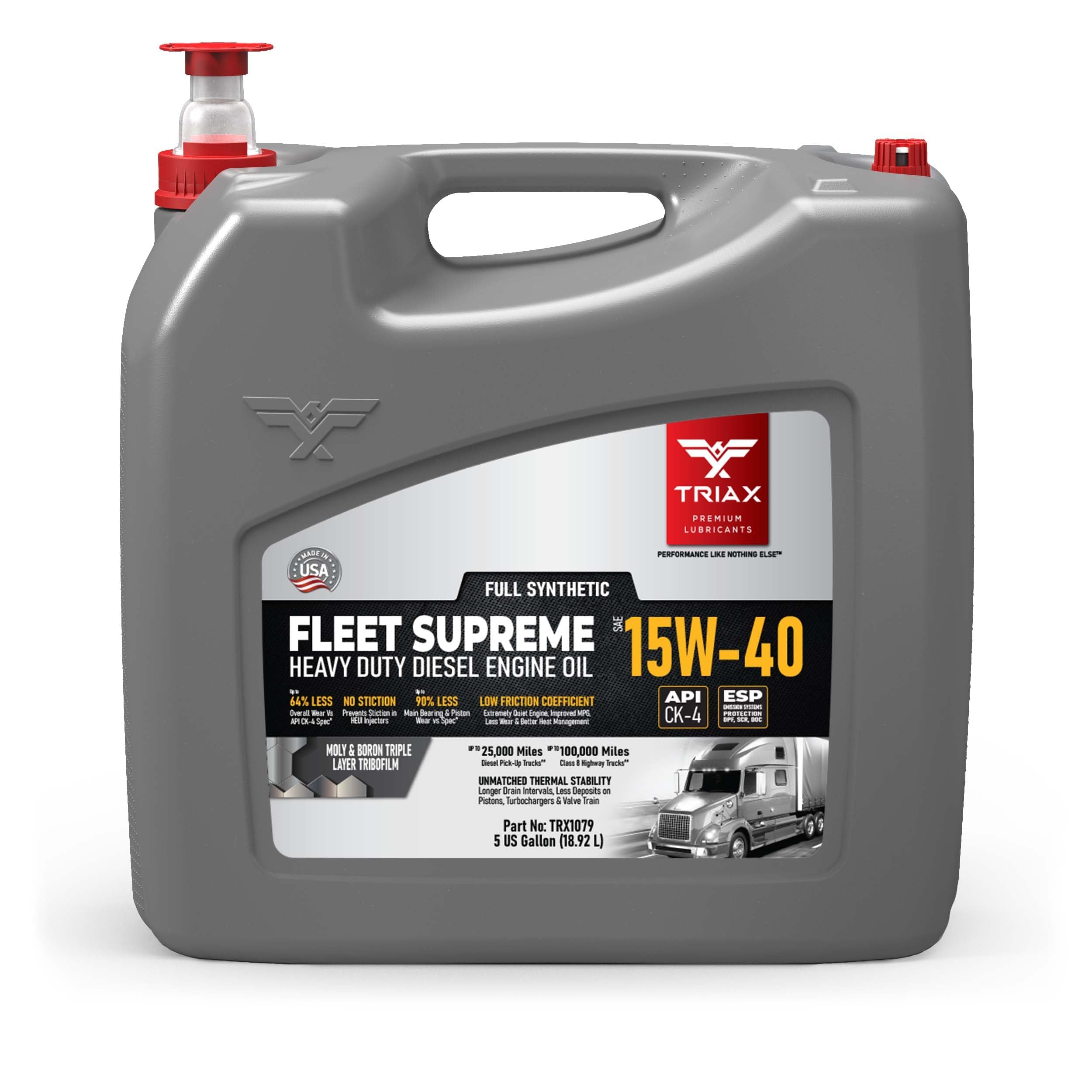
Triax Fleet Supreme is formulated with nano-boron and moly friction modifiers that deliver up to 48% lower wear compared to industry standards, according to the manufacturer’s testing. The CK-4 full synthetic base supports drain intervals exceeding 100,000 miles for highway semi trucks and 30,000 miles for super-duty pickups, making it one of the most extended-drain-capable oils on the market.
Field data from a 2020 F-250 6.7L Powerstroke running Triax for five consecutive years shows consistently green oil analysis reports with additive depletion below 20% at 15,000-mile intervals. Semi truck operators have pushed intervals to 70,000–90,000 miles with analysis confirming viscosity stays in spec and no additional stabilizer is needed. The oil also demonstrates exceptional cold-flow properties, with reliable startups reported at -20°F.
The 5-gallon pail format is cost-efficient for fleets that perform their own maintenance, and the shear stability of the formulation means oil pressure remains consistent under heavy load and high ambient temperatures. Owners also note lower operating temperatures — typically 8–10°F cooler — which contributes to longer component life and reduced thermal stress on seals and gaskets.
What works
- Industry-leading extended drain capability backed by oil analysis
- Superior cold-start performance down to -20°F
- Lower operating temperatures reported by users
What doesn’t
- Large 5-gallon pail may be excessive for single-truck owners
- Premium cost per gallon requires commitment to extended drains for ROI
6. Royal Purple 05154 API-Licensed SAE 15W-40 High Performance Synthetic (5 Gallon)

Royal Purple’s 15W-40 synthetic formulation is engineered around its proprietary Synerlec additive technology, which forms a chemically bonded film on metal surfaces for enhanced wear protection beyond what traditional additives provide. The API CI-4 rating makes it suitable for a broad range of diesel engines, particularly those operating in severe service conditions where boundary lubrication is frequent.
User reports from the 5-gallon bulk format highlight consistent 3 MPG fuel economy improvements after switching from conventional diesel oil, with one mechanic-recommended case documenting sustained use since 2012 without any measurable engine wear. The oil’s compatibility with ethanol-blended fuels and catalytic emission systems adds versatility for operators who run both diesel and gas equipment in their fleet.
The 5-gallon container provides cost savings for high-volume users, and the formulation’s corrosion protection is particularly valuable for engines that experience extended idle periods or seasonal storage. While the CI-4 specification predates CK-4, Royal Purple’s additive chemistry still meets the wear and deposit control requirements of many modern diesel engines not equipped with DPF systems.
What works
- Proven fuel economy improvement in real-world use
- Bulk 5-gallon format offers value for fleet operators
- Superior corrosion protection for idle or stored equipment
What doesn’t
- CI-4 rating limits use in modern DPF-equipped trucks
- Premium pricing even in bulk format
7. Royal Purple 04154 SAE 15W-40 Oil, 1 Gallon

The 1-gallon format of Royal Purple’s SAE 15W-40 offers the same Synerlec additive chemistry as the bulk version at a more accessible entry point for owner-operators who want premium wear protection without committing to a 5-gallon pail. The synthetic blend formulation provides enhanced film strength compared to conventional oils while maintaining compatibility with catalytic emission systems and ethanol-blended fuels.
Owner feedback consistently emphasizes the fuel economy improvement — multiple users report gains of 2–3 MPG after switching, with one mechanic-recommended case showing sustained benefits since 2012. The oil’s universal fit and vehicle-specific compatibility across a wide range of diesel engines make it a reliable choice for mixed fleets or owner-operators running older semi trucks without aftertreatment systems.
While the CI-4 rating limits its application in modern DPF-equipped trucks, the oil’s wear protection and corrosion resistance make it an excellent choice for pre-2007 diesel engines, agricultural equipment, and stationary generators that share the same viscosity requirements. The 1-gallon jug is convenient for topping off between changes or servicing smaller diesel engines.
What works
- Demonstrated fuel economy gains of 2–3 MPG
- Synerlec additive technology for enhanced wear protection
- Convenient 1-gallon format for single-truck owners
What doesn’t
- CI-4 rating not compatible with modern DPF emissions systems
- Price per gallon is higher than conventional alternatives
8. Shell Rotella T4 Triple Protection 15W-40 Diesel Engine Oil (2.5 Gallon)
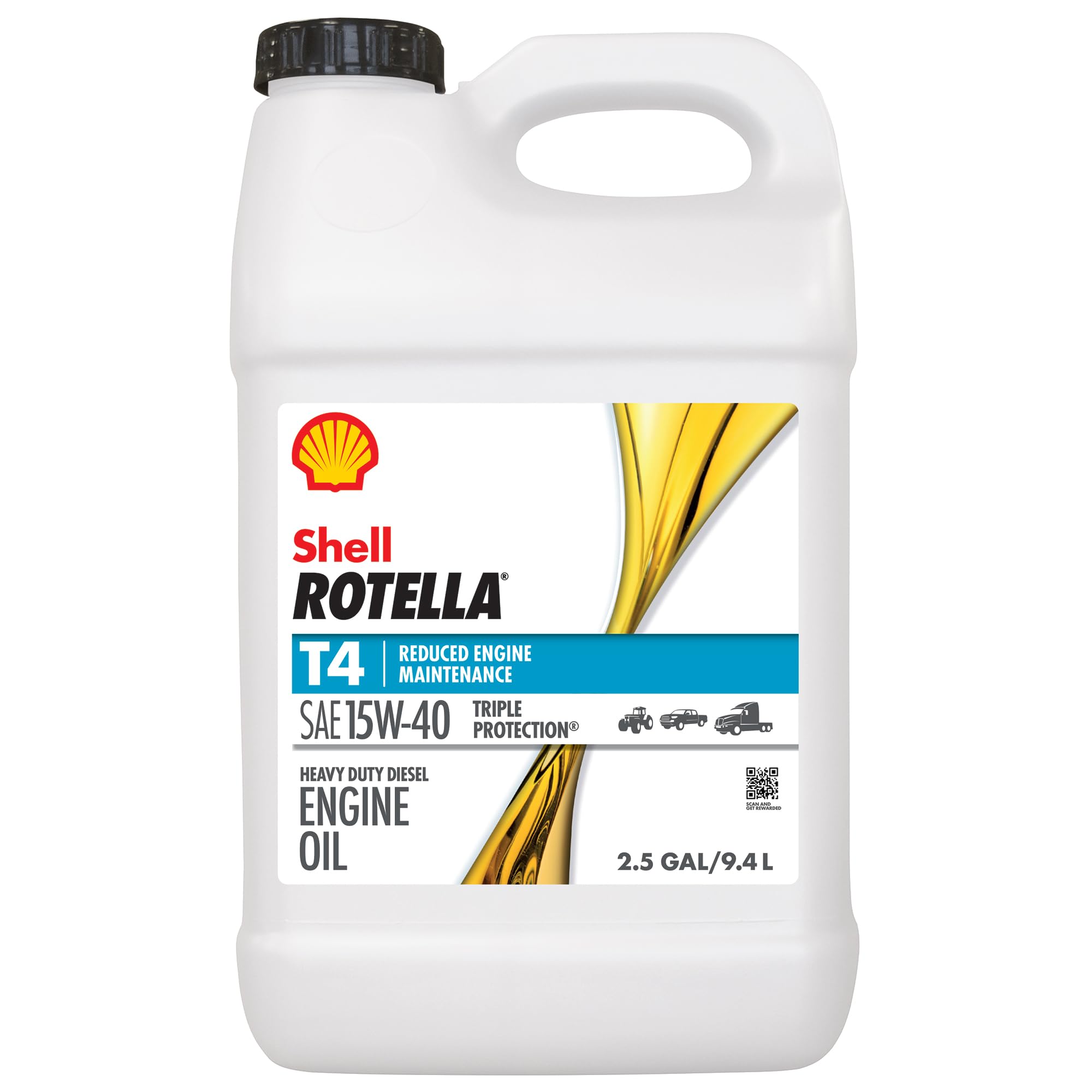
Shell Rotella T4 Triple Protection is formulated with advanced additive technology and a synthetic base oil blend to protect against wear, deposits, and oil breakdown — the three primary failure modes in heavy-duty diesel lubrication. The CK-4 rating ensures compatibility with modern emission-controlled engines equipped with EGR and diesel particulate filters, making it a solid choice for semi trucks from the past decade.
User feedback from a 1993 F-250 7.3 IDI owner confirms the 2.5-gallon size perfectly covers a single oil change with minimal waste, while a separate report from a farm tractor operator notes reliable performance in mixed diesel equipment. The enhanced shear stability helps maintain consistent oil pressure throughout the drain interval, and the deposit control formulation keeps piston rings and valve trains clean under sustained load.
One owner transitioning from synthetic back to Rotella T4 in an older SBC 350 noted that oil consumption stopped entirely, demonstrating that conventional viscosity can sometimes better match the clearances of well-worn engines. The 2.5-gallon container strikes a practical balance between bulk savings and manageable handling for DIY maintenance.
What works
- CK-4 rating compatible with modern DPF-equipped trucks
- Triple Protection technology for wear, deposits, and breakdown
- 2.5-gallon size offers value and convenience
What doesn’t
- Conventional base may require shorter drain intervals vs full synthetic
- Some containers have reported leak issues during shipping
9. Mobil 1 Delvac 1300 Super 15W-40 Diesel Engine Oil (4 Gallon Pack)

Mobil Delvac 1300 Super has been a staple in heavy-duty diesel maintenance for decades, and the 4-gallon pack format delivers a proven formulation at a cost-effective bulk price. The additive system is engineered specifically for extended engine life in 15W-40 applications, with stronger detergency and soot-handling capability compared to earlier Delvac generations.
Long-term Duramax owners who have run Delvac 1300 for years report no sludge buildup or major oil degradation, and several note that the price per gallon through this multipack is consistently the best available compared to local auto parts stores. Powerstroke 7.3 owners also confirm the oil meets their engine’s demanding requirements without any issues related to viscosity loss or wear.
The 4-gallon pack provides enough oil for most heavy-duty diesel trucks that require 12–16 quarts per change, with enough leftover for top-offs between intervals. While it is a conventional formulation, the Delvac additive package provides robust protection for standard drain intervals and is particularly well-suited for fleet operations where cost predictability matters.
What works
- Proven long-term reliability in Duramax and Powerstroke engines
- Cost-effective bulk pricing for fleet operators
- Strong soot-handling capability for standard drain intervals
What doesn’t
- Conventional formulation limits extended drain capability
- Not ideal for extreme cold start conditions compared to 5W-40
10. Lucas Oil 10076 SAE 15W-40 API CI-4 Magnum Heavy Duty Motor Oil (1 Gallon)

Lucas Oil Magnum 15W-40 is formulated with a high TBN (Total Base Number) specifically for engines operating on high-sulfur fuels or older engines without diesel particulate filters. The CI-4 rating targets pre-2007 diesel engines, making it a specialized choice for vintage semi trucks, agricultural equipment, and off-road machinery that predates modern emission controls.
User reports from Dixie Chopper mower owners — where the oil is specified for both hydrostatic drive and engine — confirm that the formulation meets demanding OEM requirements for equipment that operates at sustained high RPM. While the price point is higher than some conventional 15W-40 options, users note that availability in big-box stores is limited, making online sourcing the primary channel.
The high TBN formulation provides extended acid-neutralizing capacity, which is particularly beneficial for engines that idle extensively or operate under heavy load for long periods. Lucas’s additive package also focuses on reducing dry starts through better film adhesion, which protects critical bearing surfaces during the first seconds of operation after overnight shutdown.
What works
- High TBN for extended acid neutralization in severe service
- Designed for pre-2007 diesel engines with high-sulfur fuels
- Reduces dry start wear with strong film adhesion
What doesn’t
- CI-4 rating incompatible with DPF-equipped trucks
- Higher price per gallon than comparable conventional oils
11. Motorcraft Oil Engine 10W-30 (XO10W305Q3SD)

Motorcraft’s 10W-30 engine oil is the factory-fill specification for many Ford Powerstroke diesel engines, offering guaranteed compatibility with Ford’s engineering tolerances and recommended maintenance schedules. For semi trucks built by Ford or operating Ford-sourced diesel engines, this oil eliminates any guesswork regarding viscosity and additive package requirements.
Owner feedback from Ford truck owners confirms that the 5-quart format aligns with many Ford diesel oil change capacities, and the OEM formulation provides peace of mind for warranty retention. One user noted that after verifying the Motorcraft labeling was authentic, they ordered additional jugs for future changes, indicating confidence in the genuine OEM product.
While 10W-30 is less common in heavy-duty over-the-road semi trucks compared to 15W-40, it is specified for certain Ford diesel applications where lower viscosity improves fuel economy and cold-start flow. The conventional formulation is best suited for standard drain intervals and moderate operating conditions rather than severe-service or extended-drain applications.
What works
- Genuine OEM formulation for Ford diesel engines
- Warranty-compliant specification for Powerstroke applications
- Convenient 5-quart size aligned with many Ford oil capacities
What doesn’t
- 10W-30 viscosity may not suit heavy-load or high-heat operation
- Conventional base limits extended drain intervals
Hardware & Specs Guide
Viscosity Grade Selection
SAE 15W-40 is the industry-standard viscosity for heavy-duty diesel engines because it provides sufficient film thickness at operating temperatures up to 250°F while maintaining pumpability during cold starts down to about 10°F. SAE 5W-40 offers improved flow at sub-zero temperatures without sacrificing high-temperature protection, making it ideal for fleets operating in northern climates or engines requiring faster oil circulation during startup. Always cross-reference the engine manufacturer’s approved viscosity list — using a grade outside the recommended range can reduce fuel economy, accelerate wear, or void warranty coverage.
API Service Categories
The API service category (CK-4, CJ-4, CI-4) indicates the oil’s compatibility with emission control systems. CK-4 is designed for engines with DPF and SCR systems, offering lower ash content and improved soot handling compared to earlier categories. CJ-4 provides backward compatibility for pre-2010 engines, while CI-4 suits pre-2007 engines without aftertreatment. Using a lower category in a modern engine can clog the DPF and increase backpressure. Using a higher category in an older engine is generally safe but may not provide the higher TBN levels that older engines benefit from.
TBN and Acid Neutralization
Total Base Number (TBN) measures the oil’s reserve alkalinity for neutralizing acidic combustion byproducts. A higher TBN (12–15) is beneficial for extended drain intervals and engines operating on high-sulfur fuel. As TBN depletes during the oil change interval, the oil loses its ability to protect against corrosion and bearing wear. Oil analysis labs track TBN depletion rate to determine optimal drain intervals. Heavy-duty diesel oils typically start with TBN in the 10–15 range, and replacement is recommended when TBN drops below half the initial value.
Shear Stability and Film Strength
Shear stability refers to the oil’s ability to maintain viscosity under mechanical stress as it passes through tight clearances in bearings, piston rings, and the oil pump. Oils with poor shear stability experience permanent viscosity loss, leading to reduced film thickness and increased metal-to-metal contact. Full synthetic formulations generally offer superior shear stability compared to conventional oils, maintaining their viscosity grade longer under sustained high-load operation. This is critical for semi trucks that spend extended periods at highway speeds with high oil temperatures.
FAQ
What viscosity oil is best for semi trucks?
Can I use synthetic oil in my semi truck?
How often should I change oil in a semi truck?
What does CK-4 mean on diesel oil?
Can I use 15W-40 oil in a semi truck that calls for 5W-40?
Is Rotella T4 good for semi trucks?
Final Thoughts: The Verdict
For most semi truck operators, the oil for semi trucks winner is the Mobil 1 Turbo Diesel Truck 5W-40 because it delivers full synthetic protection, CK-4 compatibility, and proven noise reduction across a wide range of diesel engines at a price point that works for both owner-operators and fleets. If you need extreme cold-start capability and reduced crankcase temperatures, grab the Delo 400 XSP 5W-40. And for maximum extended drain intervals with oil analysis validation, nothing beats the Triax Fleet Supreme 15W-40.

Certification: BSc in Mechanical Engineering
Education: Mechanical engineer
Lives In: 539 W Commerce St, Dallas, TX 75208, USA
Md Amir is an auto mechanic student and writer with over half a decade of experience in the automotive field. He has worked with top automotive brands such as Lexus, Quantum, and also owns two automotive blogs autocarneed.com and taxiwiz.com.