Motorcycle engines live harder than car engines — higher RPMs, shared oil sumps with the transmission, and wet clutches that demand specific friction properties. Picking the wrong viscosity or an oil lacking JASO certification can cause slipping clutches, increased wear, and premature engine failure. This guide cuts through the marketing to identify the formulations that actually protect your bike.
I’m Amir — the founder and writer behind Four Wheel Ask. I spend my time studying motorcycle oil specifications, analyzing viscosity data, flash points, and additive packages, and cross-referencing owner feedback across thousands of forum posts and verified purchases to determine which products deliver real protection.
Whether you ride a cruiser, sportbike, or adventure tourer, matching the correct oil to your engine’s requirements is non-negotiable. Understanding viscosity grades and JASO MA2 ratings helps you choose the best oil for motorcycle that protects performance and reliability.
How To Choose The Best Oil For Motorcycle
Motorcycle oil must lubricate the engine, transmission, and wet clutch simultaneously. Selecting the wrong type can lead to clutch slip, gear wear, or inadequate engine protection. Focus on three core factors: viscosity grade, JASO certification, and base oil type.
Viscosity Grade — Matching the Climate and Engine Design
Manufacturers specify a viscosity range, such as 10W-40 or 20W-50, based on bearing clearances and expected operating temperatures. Using a grade thinner than recommended reduces film strength at high heat; using a grade thicker than specified can restrict oil flow during cold starts. Always follow the owner’s manual for the base recommendation, then adjust for extreme ambient temperatures.
JASO MA and MA2 Certification — Wet Clutch Compatibility
The Japanese Automotive Standards Organization created the JASO MA and MA2 ratings specifically for motorcycle oils. These certifications ensure the oil contains friction modifiers that allow wet clutches to engage properly without slipping. Automotive oils often contain friction modifiers that reduce fuel economy in cars but cause clutch slip in bikes. Only oils labeled JASO MA or MA2 should be used in motorcycles with wet clutches.
Synthetic vs. Mineral — Base Oil Performance
Full synthetic oils use PAO and ester base stocks that resist thermal breakdown and maintain viscosity across a wider temperature range compared to mineral oils. Synthetics also offer superior shear stability, which matters because motorcycle transmissions shear oil molecules more aggressively than car engines. Mineral oils can be adequate for older engines with looser tolerances, but modern engines generally benefit from synthetic or semi-synthetic blends.
Quick Comparison
On smaller screens, swipe sideways to see the full table.
| Model | Category | Best For | Key Spec | Amazon |
|---|---|---|---|---|
| Liqui Moly Motorbike 4T | Full Synthetic | Street bikes & cruisers | 20W-50, 4L, JASO MA2 | Amazon |
| Red Line 42504 | Full Synthetic | Big-Twin & high-performance V-twins | 20W-50, 1 qt, 2200 ppm ZDDP | Amazon |
| Yamaha Yamalube | Mineral | OEM-recommended replacement | 20W-50, 1 gal, JASO MA | Amazon |
| Kimpex 10W40 Moto/ATV | Synthetic Blend | ATVs & entry-level street bikes | 10W-40, 3.78L, 4-stroke | Amazon |
| Royal Purple Max Cycle | Full Synthetic | Budget-conscious synthetic buyers | 10W-40, 1 qt, Synerlec additive | Amazon |
In‑Depth Reviews
1. Liqui Moly Motorbike 4T SAE 20W-50 Street

Liqui Moly has built a reputation in the European automotive aftermarket for precision-engineered lubricants, and the Motorbike 4T Street formulation carries that standard into motorcycle applications. This 20W-50 full synthetic uses a high-quality PAO and ester base stock blend that maintains film stability under sustained high-temperature operation — a critical factor for air-cooled engines that see elevated oil temps during long highway runs. The 4-liter jug provides enough volume for most twin-cylinder engines with some left over for top-ups between changes.
The additive package includes high shear stability to resist viscosity breakdown from transmission gear meshing, plus detergents that prevent black sludge formation in engines that see intermittent use. Liqui Moly explicitly confirms wet clutch compatibility, and the flash point of 230 degrees Celsius indicates low volatility, meaning less oil consumption between changes. For riders running catalytic converters, this oil is verified as converter-safe, eliminating a common compatibility concern with high-zinc formulations.
Owner reports consistently highlight smooth clutch engagement and stable hot idle pressure after extended rides. The 20W-50 viscosity suits a wide range of Harley-Davidson, Triumph, and metric cruiser engines that specify heavier oil. While the upfront cost per liter is higher than mineral alternatives, the extended drain interval potential and reduced wear make the total cost of ownership competitive for riders who keep their bikes long-term.
What works
- Excellent shear stability for transmission protection
- High flash point reduces oil consumption
- Catalytic converter safe and wet clutch compatible
What doesn’t
- Premium price per quart compared to blends
- 4-liter jug may be oversized for single-cylinder engines
2. Red Line 42504 20W50 Motorcycle Oil

Red Line has been formulating ester-based synthetic oils since 1979, and the 42504 is purpose-built for Big-Twin V-twin engines including Milwaukee-Eight, Twin Cam, and Evolution platforms. The ester base stock naturally forms a dipolar film that clings to metal surfaces better than conventional PAO synthetics, providing immediate protection during cold starts when oil pressure has not yet fully built. This characteristic is especially valuable for engines that sit for weeks between rides.
The ZDDP concentration of 2200 ppm is notably higher than many off-the-shelf motorcycle oils, delivering robust anti-wear protection for flat-tappet camshafts that experience high point-contact loads. Red Line blends specific friction modifiers that are compatible with wet clutches, meeting JASO MA and MA2 requirements. The 20W-50 viscosity is designed to maintain film strength at the elevated oil temperatures common in large-displacement air-cooled V-twins.
Track-day and heavy-touring riders report consistent oil pressure readings even after sustained high-RPM operation. The ester base also provides natural detergency that helps keep piston rings clean and free from sticking. Some owners note that the ester formulation can cause slight seal swelling initially, which is normal and stabilizes after the first oil change cycle.
What works
- Ester base provides exceptional film strength at high heat
- High ZDDP concentration protects flat-tappet cams
- Proven formulation for Big-Twin V-twin engines
What doesn’t
- Ester formulation may cause minor seal swelling initially
- Quart bottles require multiple units for an oil change
3. Yamaha Yamalube All Purpose 4-Stroke Engine Oil
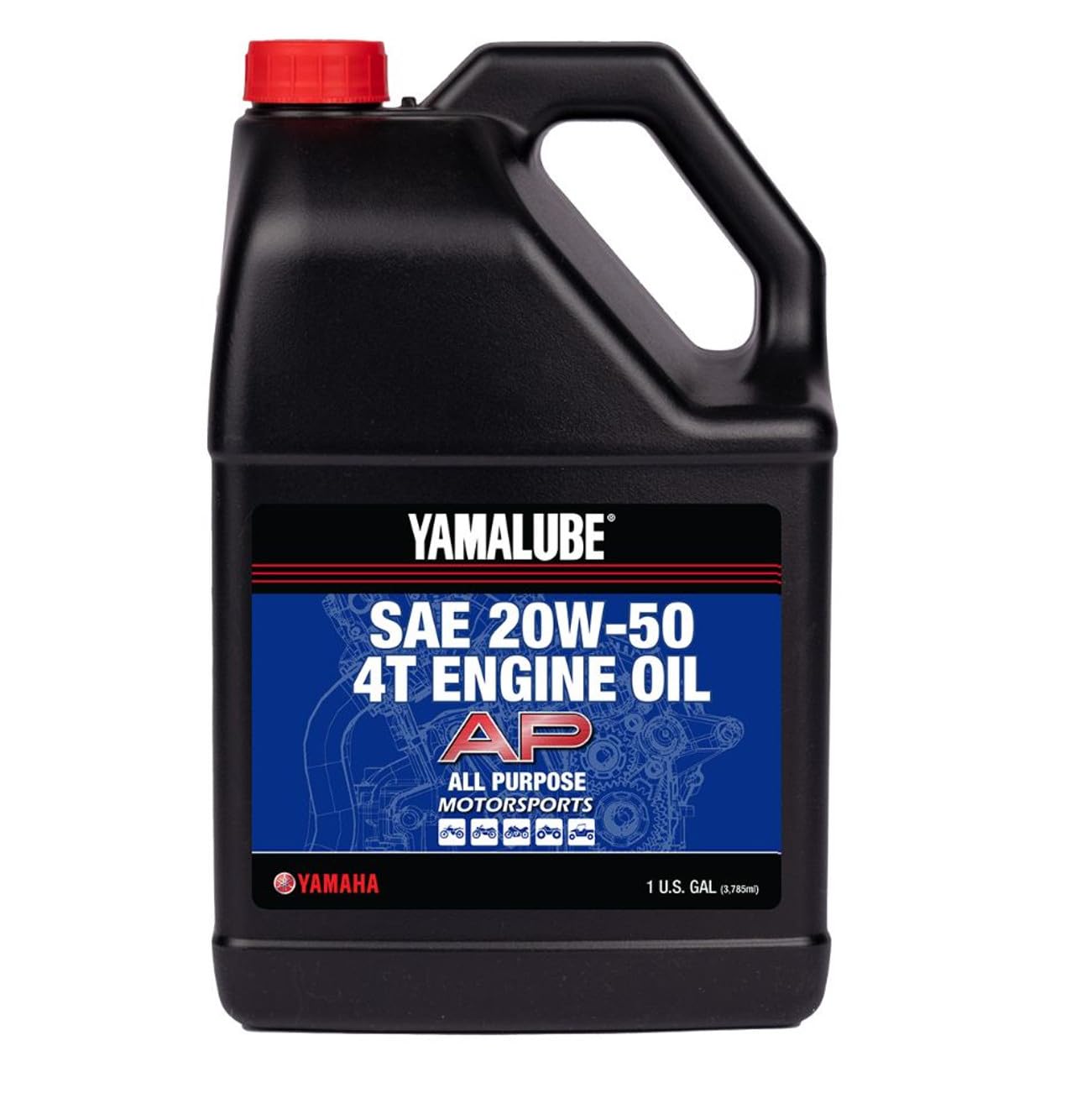
Yamalube is the OEM-formulated lubricant developed by Yamaha specifically for their four-stroke motorcycle, ATV, and scooter engines. This All Purpose 20W-50 is a performance-blended mineral oil that meets or exceeds JASO MA requirements, which is the highest certified motorcycle engine oil rating that ensures proper wet clutch engagement. The gallon container provides enough volume for multiple oil changes on smaller-displacement bikes or a single fill on larger twins with a sump.
The mineral base oil is formulated with an additive package that prioritizes clutch compatibility and gear protection over extreme extended drain intervals. The 236-degree Celsius flash point indicates good thermal stability for a mineral oil, and the formulation is tested for compatibility with Yamaha engine seals and gaskets. For riders who prefer to use manufacturer-specified lubricants during the warranty period, this oil provides documented compliance with Yamaha maintenance requirements.
Owner feedback highlights consistent shifting feel and clutch action throughout the oil change interval, with no noticeable degradation in performance. The mineral formulation requires more frequent changes than synthetics — typically 3,000 to 4,000 miles depending on riding conditions. Budget-conscious riders who change oil regularly will find the per-gallon cost competitive, though the lack of synthetic base stock means less protection under extreme high-temperature operation.
What works
- OEM-formulated specifically for Yamaha engines
- JASO MA certified for wet clutch compatibility
- Gallon size offers good value per quart
What doesn’t
- Mineral base requires shorter drain intervals
- Not optimized for extreme high-temperature or track use
4. Kimpex 10W40 Moto/ATV 4-Stroke Engine Oil

Kimpex is a well-established name in the powersports aftermarket, and their 10W40 4-stroke oil is a synthetic blend designed for ATVs, street bikes, and UTVs. The 3.78-liter jug provides a practical volume for smaller engines that require roughly 3 to 4 quarts per oil change, reducing waste compared to buying multiple quart bottles. The synthetic blend formulation sits between conventional mineral oil and full synthetic, offering improved thermal stability over mineral oil at a lower cost than full synthetics.
The 10W-40 viscosity grade is one of the most common specifications for Japanese and European middleweight motorcycles, making this oil suitable for a wide range of bikes from 250cc to 750cc. Kimpex formulates this oil for 4-stroke engines with wet clutches, though the certification details are less prominently advertised compared to major brands. The flash point data is not explicitly published, but owner reports indicate acceptable oil consumption rates under normal street riding conditions.
Value-focused riders and ATV owners who change oil frequently will appreciate the cost-effective pricing of this synthetic blend. The oil performs well in moderate climates and typical street riding scenarios, though riders who push their bikes hard at the track or in extreme heat may notice faster viscosity breakdown compared to full synthetic options. For general commuting and recreational riding, this oil delivers dependable protection at a budget-friendly price point.
What works
- Synthetic blend improves thermal stability over mineral oil
- 3.78-liter jug size reduces packaging waste
- Compatible with ATV, street bike, and UTV applications
What doesn’t
- Less thermal resistance than full synthetic formulations
- JASO certification details not prominently listed
5. Royal Purple Max Cycle 10W-40 Synthetic

Royal Purple’s Max Cycle 10W-40 is a full synthetic motorcycle oil built around the company’s proprietary Synerlec additive technology, which is designed to reduce friction and improve film strength beyond what conventional synthetic base stocks alone can achieve. The 1-quart bottle size makes this oil accessible for single-bike owners who prefer to buy exactly what they need for each oil change rather than storing large containers. The formulation is vehicle-specific, meaning it is engineered to meet the demands of motorcycle engines rather than generic automotive applications.
The additive package provides rust and corrosion protection, which is particularly beneficial for motorcycles that experience seasonal storage or operate in humid environments. Royal Purple claims greater wear protection and increased performance through reduced internal friction, and the flash point of 204 degrees Celsius indicates adequate thermal stability for normal street riding. The 10W-40 viscosity suits a broad range of middleweight sport, standard, and cruiser models that specify this grade in their owner manuals.
Entry-level synthetic buyers and riders transitioning from conventional oil will appreciate the full synthetic performance at a competitive price point. The oil’s detergent chemistry helps keep engines clean and efficient between changes. Some owners note that the purple color makes leak detection easier, though this is a cosmetic benefit rather than a performance feature. For riders seeking a reliable full synthetic without paying premium-brand pricing, this oil offers a solid balance of protection and affordability.
What works
- Synerlec additive technology reduces internal friction
- Rust and corrosion protection for seasonal storage
- Full synthetic performance at a competitive price
What doesn’t
- Quart size requires multiple bottles for larger engines
- Flash point lower than some premium competitors
Hardware & Specs Guide
Viscosity Grades Explained
The SAE J300 viscosity rating indicates how an oil flows at specific temperatures. The first number with a “W” (winter) measures cold-cranking viscosity — lower numbers flow better in cold starts. The second number measures high-temperature viscosity at operating temperature. A 10W-40 flows well in cold weather and maintains adequate film strength at operating temperature, while 20W-50 is thicker and suited for high-heat air-cooled engines with looser bearing clearances. Always match the viscosity grade to your owner’s manual specification rather than choosing based on climate alone.
JASO MA and MA2 Certification
The Japanese Automotive Standards Organization developed the JASO MA and MA2 standards to identify oils with friction characteristics appropriate for wet clutches. MA2 is a tighter specification than MA, requiring a higher dynamic friction coefficient to prevent clutch slip under hard acceleration. Oils without JASO certification should be avoided in motorcycles with wet clutches, as automotive oils often contain friction modifiers that cause clutch slippage and premature wear. Harley-Davidson and many European manufacturers explicitly require JASO MA or MA2 oils.
Additive Packages and ZDDP
Zinc dialkyl dithiophosphate (ZDDP) is an anti-wear additive that forms a protective layer on metal surfaces under high pressure. Motorcycle oils typically contain 1200 to 2200 ppm of ZDDP, with higher concentrations beneficial for flat-tappet camshafts found in many V-twin and older engines. However, excessive ZDDP can damage catalytic converters over time, so riders with modern emissions-controlled bikes should choose oils with balanced additive levels that meet both wear protection and converter compatibility requirements.
Synthetic vs. Mineral Base Oils
Full synthetic motorcycle oils use polyalphaolefin (PAO) and ester base stocks that resist thermal breakdown, maintain viscosity under shear, and extend drain intervals compared to mineral oils. Esters provide superior film adhesion for cold-start protection. Mineral oils, while adequate for engines with looser tolerances and frequent change schedules, degrade faster under high-temperature operation. Semi-synthetic blends offer a middle ground, combining mineral base stock with a percentage of synthetic for improved thermal stability at a lower cost than full synthetics.
FAQ
What viscosity oil should I use in my motorcycle?
What is JASO MA certification and why does it matter?
Can I use car oil in my motorcycle?
How often should I change motorcycle oil?
Final Thoughts: The Verdict
For most buyers, the best oil for motorcycle winner is the Liqui Moly Motorbike 4T because it combines full synthetic protection, JASO MA2 certification, and excellent shear stability in a versatile 20W-50 grade that suits a wide range of street bikes and cruisers. If you want maximum camshaft protection for a Big-Twin V-twin, grab the Red Line 42504 with its 2200 ppm ZDDP concentration. And for a budget-friendly synthetic option, nothing beats the Royal Purple Max Cycle for riders seeking full synthetic performance without paying premium-brand pricing.

Certification: BSc in Mechanical Engineering
Education: Mechanical engineer
Lives In: 539 W Commerce St, Dallas, TX 75208, USA
Md Amir is an auto mechanic student and writer with over half a decade of experience in the automotive field. He has worked with top automotive brands such as Lexus, Quantum, and also owns two automotive blogs autocarneed.com and taxiwiz.com.