Choosing the wrong O2 sensor plug means exhaust leaks, failed emissions, and wasted labor. Thread pitch, material heat rating, and weld compatibility determine whether that new bung seals for years or fails within weeks.
I’m Amir — the founder and writer behind Four Wheel Ask. My research focuses on cross-referencing OEM thread standards, material heat tolerance data, and long-term owner feedback to separate parts that hold up from those that cause repeat failures.
Whether you are welding a new bung into a header or replacing a corroded factory unit, thread accuracy and heat tolerance define the best o2 sensor plug.
How To Choose The Best O2 Sensor Plug
An O2 sensor plug must seal exhaust gas under extreme temperature cycles while allowing the sensor to read accurately. Three factors separate a reliable part from a chronic leaker: thread specification, material heat rating, and installation method. Understanding these prevents buying a part that strips, corrodes, or fails to seal.
Thread Pitch and Fitment
The overwhelming standard for oxygen sensor threads is M18 x 1.5, though some older or specific applications use M12 x 1.25. A sensor plug with the wrong thread pitch will either cross-thread and ruin the bung or fail to seat, causing an exhaust leak. Always verify your vehicle’s thread specification before purchasing, and consider a thread chaser tool if you are cleaning up a damaged port.
Material Composition and Heat Tolerance
Sensor plugs and weld bungs are typically made from mild steel, alloy steel, or stainless steel. Mild steel is easiest to weld and most affordable, but it can rust over time. Alloy steel offers better corrosion resistance and higher heat tolerance — important for exhaust components that see repeated thermal cycles. The upper temperature rating on a plug should exceed 1,000 degrees Fahrenheit to handle exhaust gas heat without degrading.
Weld Bungs vs Direct-Fit Sensors vs Tools
A weld bung and plug set is ideal for custom exhaust fabrication or adding a sensor port where none exists. Direct-fit O2 sensors replace the entire unit including the plug and wiring harness, best for restoration of factory systems. Sensor removal tools and thread chasers are essential if you are working with corroded or damaged threads. Choose based on whether you are building, repairing, or maintaining.
Quick Comparison
On smaller screens, swipe sideways to see the full table.
| Model | Category | Best For | Key Spec | Amazon |
|---|---|---|---|---|
| Walker Products 350-34039 | Sensor | Direct factory replacement | 4-wire, platinum electrodes | Amazon |
| RANSOTO 15717 Set of 4 | Sensor | Fleet or multi-vehicle coverage | Upstream/downstream, Ford/Lincoln/Mazda | Amazon |
| JGR Stepped Weld Bungs 5-Pack | Bung/Plug | Custom exhaust fabrication | M18 x 1.5, stepped design, mild steel | Amazon |
| AMAAM Steel Bungs 10-Pack | Bung/Plug | Bulk bung supply for shops | M18 x 1.5, machined steel, 10 count | Amazon |
| Zlirfy O2 Sensor Socket Set | Tool | Removal and thread repair | Cr-V steel, includes thread chaser | Amazon |
In‑Depth Reviews
1. Walker Products 350-34039 Oxygen Sensor 4-Wire Direct Fit

The Walker Products 350-34039 represents the OEM-replacement standard for O2 sensor plugs, delivering a complete 4-wire direct-fit solution. Its gas-permeable platinum electrode layer ensures accurate air-fuel ratio readings, while the protective coating resists erosion from combustion residue and exhaust particulates. For anyone restoring factory emissions performance without guesswork, this sensor eliminates the potential for thread mismatch or seal failure.
This unit functions as both a sensor and a sealed plug assembly, with a flange mount that matches original equipment fitment. The ceramic and metal construction withstands continuous exhaust heat, and the integrated wiring harness simplifies installation to a plug-and-play procedure. Walker Products has a well-documented reputation for meeting or exceeding OE specifications across multiple vehicle platforms.
Owner feedback consistently highlights the reliability of the platinum sensing element and the corrosion-resistant coating as key differentiators versus budget alternatives. The trade-off is that this is a single sensor, not a multi-pack, so buyers covering multiple vehicles will need to purchase individually. For a one-vehicle restoration or repair, this is the most dependable choice.
What works
- Platinum electrode layer delivers precise air-fuel readings
- Protective coating prevents electrode erosion from exhaust residue
- Direct-fit flange mount ensures OE-level sealing
What doesn’t
- Single-unit purchase limits value for multi-vehicle jobs
- Requires verifying Amazon Confirmed Fit for exact vehicle compatibility
2. RANSOTO 15717 O2 Oxygen Sensor Downstream Upstream Set of 4

The RANSOTO 15717 set delivers four O2 sensors — both upstream and downstream positions — covering a vast range of Ford, Lincoln, Mercury, Mazda, and even select Jaguar and Aston Martin models from 1990 through 2014. This breadth of compatibility makes it a practical solution for shops or owners maintaining multiple vehicles from the Ford family. Each sensor functions as a sealed plug unit, threaded into the exhaust bung to monitor oxygen content.
Built with ceramic and metal construction, these sensors are designed for flange mount installation and use a push-pull output type. The set includes replacement part numbers such as 15716, 15718, 15664, and ZZC318861, allowing direct cross-reference for common Ford applications. The one-year warranty and satisfaction guarantee reduce the risk of buying multi-packs sight unseen.
Owner reports indicate that the set provides consistent readings across all four sensors, with no significant drift or early failure in standard driving conditions. The main consideration is verifying that all four positions on your specific vehicle match the thread type and wiring configuration. Some users note that the included documentation could be more detailed regarding model year cutoffs.
What works
- Four-sensor set provides complete coverage for upstream and downstream positions
- Broad compatibility across Ford, Lincoln, Mazda, and Mercury families
- One-year warranty with satisfaction guarantee protects the purchase
What doesn’t
- Vehicle fitment verification is essential before ordering
- Included documentation could offer more specific model year guidance
3. JGR O2 Oxygen Sensor Stepped Weld Bungs 5 Bungs/5 Plugs M18 x 1.5
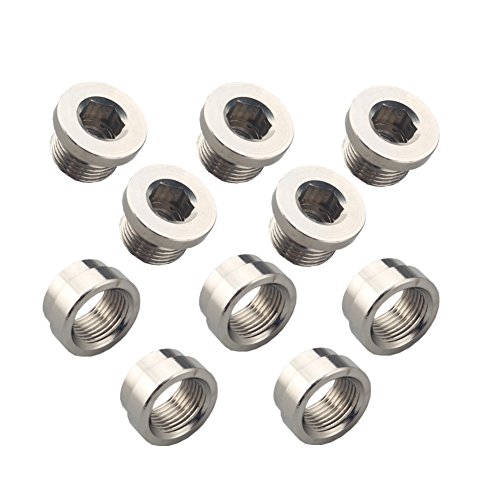
The JGR stepped weld bung set is purpose-built for custom exhaust fabrication where adding an O2 sensor port requires a welded-in threaded base. Each bung and plug uses the standard M18 x 1.5 thread, and the stepped design allows the bung to seat flush against the exhaust pipe wall for a clean weld joint. The included plug seals the port when no sensor is installed, making this a complete solution for headers, downpipes, or custom exhaust sections.
Manufactured from mild steel with an upper temperature rating of 1,500 degrees Fahrenheit, these bungs handle extreme exhaust heat without warping or thread distortion. The five-pack quantity supports multiple sensor locations or provides spares for future projects. Welders report that the steel accepts MIG and TIG welding readily with minimal splatter, and the threads remain clean and clear after welding with proper preparation.
The main trade-off with mild steel is susceptibility to surface rust over time, particularly in regions with road salt or high humidity. A coat of high-temperature exhaust paint or ceramic coating mitigates this. For fabricators who need a reliable, heat-tolerant threaded port at a practical per-unit cost, this set delivers.
What works
- Stepped design creates a clean, flush weld joint against exhaust pipe
- 1,500°F temperature rating handles extreme exhaust heat
- Five bungs and five plugs provide complete port-and-seal capability
What doesn’t
- Mild steel will develop surface rust without additional coating
- Threads require wire brush cleaning after welding to remove spatter
4. AMAAM O2 Oxygen Sensor Fitting Plugs or Weld Bungs 10-Pack Steel M18 x 1.5

The AMAAM 10-pack of steel weld bungs and plugs targets high-volume users — exhaust shops, custom fabricators, and DIY enthusiasts with multiple projects. Each bung is machined to the M18 x 1.5 thread standard, and the exterior is finished with a machined surface that accepts welding filler cleanly. The pack includes both the bung for welding into the exhaust and the threaded plug for sealing the port when a sensor is not installed.
At just under 9 ounces total weight for the set, these bungs are lightweight yet robust enough for standard exhaust system pressures and temperatures. The machined steel construction provides a solid threaded interface that resists stripping during sensor installation and removal cycles. For shop use where multiple bungs are consumed regularly, the per-unit cost is significantly lower than buying individual bungs.
The primary consideration is that these are steel, not stainless, so outdoor or corrosion-prone environments require additional protective measures. Some users report that the threads benefit from a light tap with a thread chaser before sensor installation to ensure smooth engagement. For shops that value quantity and consistent thread quality, this pack is a cost-effective inventory staple.
What works
- 10-pack provides excellent per-unit value for high-volume work
- Machined steel construction with standard M18 x 1.5 threads
- Includes both bungs and plugs for complete port and seal use
What doesn’t
- Steel material requires corrosion protection in harsh environments
- Threads may need chasing before first sensor installation
5. Zlirfy 5PCS Oxygen Sensor Removers Automotive Socket Wrench Tool and Thread Chaser Set

The Zlirfy tool set is built from high-strength chromium-vanadium steel with a phosphating and electroplating finish to resist oxidation and rust. It includes three socket configurations — one deep-draw 3/8-inch drive socket for removing sensors with wire harnesses still attached, a thin-profile crowbar socket for tight spaces, and an offset design for angled access. The set also includes M18 x 1.5 and M12 x 1.25 thread chasers for cleaning and repairing damaged threads before installing a new sensor or plug.
The side-cut design on the sockets allows cable access from any angle, preventing wire damage during removal. A hard storage box keeps the tools organized and protected between uses. This set is applicable for removing, inspecting, replacing, and installing both heated and non-heated O2 sensors and vacuum switches on most computer-controlled engine vehicles.
The limitation is that this is a tool set, not a sensor plug or bung — it assists with installation and removal but does not include any sealing components. Some users mention that the offset socket could be longer for extremely recessed sensor locations. For anyone who needs to free a seized sensor or clean up threads before installing a new plug, this kit fills the gap without breaking the budget.
What works
- Cr-V steel construction with corrosion-resistant finish
- Includes M18 and M12 thread chasers for thread repair
- Three socket configurations cover multiple access angles
What doesn’t
- Tool set only — no sensor plugs or bungs included
- Offset socket could be longer for deeply recessed sensors
Hardware & Specs Guide
Thread Standards and Sizing
The universal standard for oxygen sensor threads is M18 x 1.5, an 18-millimeter diameter with a 1.5-millimeter thread pitch. Some older or specialized applications use M12 x 1.25, primarily on Honda, Acura, and certain Asian-market vehicles. Using the correct thread pitch is non-negotiable — cross-threading an M18 sensor into an M12 bung or vice versa causes permanent damage to both components. Always verify your vehicle’s thread specification against the part number before installation. A thread chaser tool (M18 x 1.5 and M12 x 1.25) is a worthwhile investment for cleaning up corroded or damaged threads before seating a new plug or sensor.
Material Heat Tolerance
O2 sensor plugs and bungs are exposed to exhaust gas temperatures that can exceed 1,200 degrees Fahrenheit during normal operation and spike higher under load. Mild steel, the most common material for affordable weld bungs, handles up to approximately 1,500 degrees Fahrenheit and is easy to weld but susceptible to corrosion. Alloy steel and stainless steel offer improved oxidation resistance and can sustain higher temperatures without scaling. The protective coating on premium sensor plugs — such as the platinum electrode layer on Walker Products sensors — prevents electrode erosion from combustion byproducts. For long-term reliability in salt-belt climates, consider stainless steel bungs or apply high-temperature ceramic coating to mild steel components.
FAQ
What thread size is standard for O2 sensor plugs?
Can I weld an O2 sensor plug directly to my exhaust pipe?
How do I remove a stuck or seized O2 sensor?
Final Thoughts: The Verdict
For most buyers, the best o2 sensor plug winner is the Walker Products 350-34039 because it combines direct-fit convenience with platinum electrode accuracy and protective coating — the complete package for a reliable OEM-grade replacement. If you need multiple sensors for a Ford-family fleet, grab the RANSOTO 15717 Set of 4. And for custom exhaust fabrication where you are welding in new ports, nothing beats the JGR Stepped Weld Bungs 5-Pack for thread accuracy and heat tolerance.

Certification: BSc in Mechanical Engineering
Education: Mechanical engineer
Lives In: 539 W Commerce St, Dallas, TX 75208, USA
Md Amir is an auto mechanic student and writer with over half a decade of experience in the automotive field. He has worked with top automotive brands such as Lexus, Quantum, and also owns two automotive blogs autocarneed.com and taxiwiz.com.