Mounting a camera to your motorcycle changes the game for documenting rides, capturing scenic routes, and keeping a rolling record of road incidents. The difference between blurry, unusable footage and crisp, cinematic clips comes down to three things: sensor quality, stabilization hardware, and how the camera handles wind noise and vibration at highway speeds.
I’m Amir — the founder and writer behind Four Wheel Ask. I’ve spent years digging through specification sheets, analyzing frame-rate trade-offs, and cross-referencing owner feedback to understand what separates a durable motorcycle camera from one that fails after a single rainy commute.
Whether you ride a sportbike or a touring cruiser, finding the best motorcycle action camera means weighing image quality, stabilization, and mounting options against your specific riding needs alone.
How To Choose The Best Motorcycle Action Camera
Motorcycle action cameras face unique challenges that car dash cams never encounter: constant vibration, direct wind blast, extreme temperature swings, and the need for a secure yet removable mount. Understanding the key differentiators helps narrow the field.
Sensor Size and Low-Light Performance
A larger sensor — typically 1/1.9-inch or bigger — captures more light per pixel, which directly impacts how usable your footage is during twilight rides or under heavy cloud cover. Cameras using Sony STARVIS sensors are particularly well-regarded in owner forums for retaining detail in shadow areas without blowing out highlights from oncoming headlights.
Stabilization Technology
Mechanical (gimbal-based) and electronic (EIS/HyperSmooth/FlowState) stabilization both aim to cancel out handlebar vibration, but they work differently. Electronic stabilization crops the sensor and uses gyroscope data to shift the capture area, which works well for most street riding. For off-road or hard-tail bikes, look for cameras with horizon-lock features that keep the frame level even during leans.
Mounting Systems and Vibration Damping
A camera is only as good as its mount. Helmet chin mounts offer the best rider perspective, while handlebar and mirror mounts provide a bike-forward view. Look for mounts with rubber vibration dampers between the camera and the hard mount point — this simple part can make the difference between silky footage and unusable jello-effect video.
Weather Sealing and Battery Endurance
Motorcycle riding exposes electronics to rain, road grit, and temperature swings from freezing mornings to hot asphalt afternoons. Cameras with an IP67 or IP69K rating can handle full submersion and pressure washing. Battery life at 4K resolution typically runs 1-2 hours, so riders covering longer distances should prioritize units with external power input or hot-swappable batteries.
Quick Comparison
On smaller screens, swipe sideways to see the full table.
| Model | Category | Best For | Key Spec | Amazon |
|---|---|---|---|---|
| Vantrue F1 | Dash Cam | Dual-camera security | 4K + 1080P, IP67 | Amazon |
| GoPro HERO13 Black | Action Cam | High-end video quality | 5.3K60, HB-Lens | Amazon |
| Insta360 X3 | 360 Camera | Reframing flexibility | 5.7K 360, FlowState | Amazon |
| LBW MT600 Pro | GPS/Display | Navigation + recording | 6in QLED, Dual 1080P | Amazon |
| AKASO 360 | 360 Camera | Entry-level 360 video | 5.7K 360, 48MP | Amazon |
| GoPro Hero Black | Action Cam | Compact daily use | 4K30, HyperSmooth | Amazon |
| RunCam Helmet Cam | Helmet Cam | Bendable helmet mount | 4K, 6hr battery | Amazon |
| AKEEYO AKY-710S | Dash Cam | Budget dual recording | 2K55fps, IP66 | Amazon |
| AKASO EK7000 | Action Cam | Budget 4K starter kit | 4K30, 64GB bundle | Amazon |
In‑Depth Reviews
1. Vantrue F1 Motorcycle 4K Dash Cam

The Vantrue F1 is a purpose-built motorcycle dash cam system with a modular design — the main DVR unit hides under the seat or in a tail pack while the front and rear cameras mount on the bike exterior. This separation means the recording brain stays protected from weather, while the camera modules handle the elements with full IP67 sealing. The front camera captures 4K at 30 fps using Sony STARVIS sensor technology, and the rear camera delivers 1080P at 30 fps, giving you license-plate-level detail from both directions.
GPS and mileage tracking are embedded into the video file, which adds a layer of forensic evidence in the event of an incident. The companion app supports 5 GHz Wi-Fi for fast downloads and OTA firmware updates, so you never need to pull the SD card to apply improvements. The wired remote control lets you lock footage or snap a photo without taking your hands off the bars — a safety detail that standalone action cameras rarely offer.
Owner reports consistently praise the build quality and the confidence that comes from having a hardwired system that starts recording the moment the bike turns on. The 160-degree wide-angle lenses cover three lanes of traffic, and the G-sensor automatically protects collision footage from being overwritten. This is the closest thing to a black box for your motorcycle.
What works
- Fully weather-sealed front/rear cameras
- GPS route data embedded in video
- Wired remote for one-touch file lock
What doesn’t
- No built-in display for live preview
- Installation requires fairing removal
2. GoPro HERO13 Black

The GoPro HERO13 Black represents the current pinnacle of action camera engineering, with a 5.3K sensor that captures 91 percent more resolution than standard 4K. For motorcycle riders, the real advantage lies in the HB-Series lens system — the Ultra Wide Lens Mod delivers an immersive POV that captures both the road ahead and the instrument cluster, while the Macro Lens Mod is less relevant for riding but speaks to the camera’s versatility across use cases.
Burst Slo-Mo is the standout feature for capturing dramatic corner exits or obstacle avoidance maneuvers. The camera can slow action to 13x normal speed at lower resolutions, and even at 5.3K it offers 4x slow-motion playback. The Enduro battery included in the box extends cold-weather recording time, which matters for riders who start their day in sub-freezing conditions. Waterproofing to 33 feet without a housing means you can mount the camera anywhere on the bike without worrying about a separate waterproof case.
Community feedback highlights the HyperSmooth stabilization as the gold standard for handlebar-mounted footage, effectively canceling out the high-frequency vibration that ruins budget-camera clips. The Quik app ecosystem makes editing and sharing straightforward, though some users note the app connection can be finicky during firmware updates. For riders who want the absolute best image quality and have the budget to match, this is the benchmark.
What works
- Best-in-class stabilization for bar mount
- Interchangeable lens system for different POV
- Excellent low-light sensor performance
What doesn’t
- Premium price point well above mid-range
- Battery life limited at highest settings
3. Insta360 X3 128 GB Vlog Kit

The Insta360 X3 brings a fundamentally different approach to motorcycle recording: instead of choosing a direction, you capture everything and pick the angle later. The dual-lens system records 5.7K 360-degree video, and in the Insta360 app you can reframe the footage as a standard wide-shot video, a third-person drone-style clip, or a hyperlapse. For group rides, this means you can pull multiple camera angles from a single pass.
FlowState stabilization and Horizon Lock work together to keep the horizon level even when the bike leans into corners — a capability that standard action cameras struggle with because they rely on cropping rather than spherical data. The Invisible Selfie Stick effect lets you mount the camera on a short extension and have it disappear from the frame, creating the illusion of a chase drone. This works exceptionally well for riders who film themselves from a tail or side mount.
The 128 GB vlog kit includes a selfie stick and a high-speed memory card, so the out-of-box experience is complete. Owner reviews frequently mention the “shoot first, frame later” workflow as a game-changer for ride documentation, since you never miss a moment while fiddling with the camera angle. The trade-off is that 360 video files are large and require more processing power, and the X3 is not as rugged as a dedicated motorcycle dash cam.
What works
- Reframe footage after the ride
- Horizon Lock stays level through corners
- Invisible selfie stick effect for chase shots
What doesn’t
- Large file sizes require fast storage
- No hardwired power option for long tours
4. LBW MT600 Pro 6″ Portable Motorcycle CarPlay
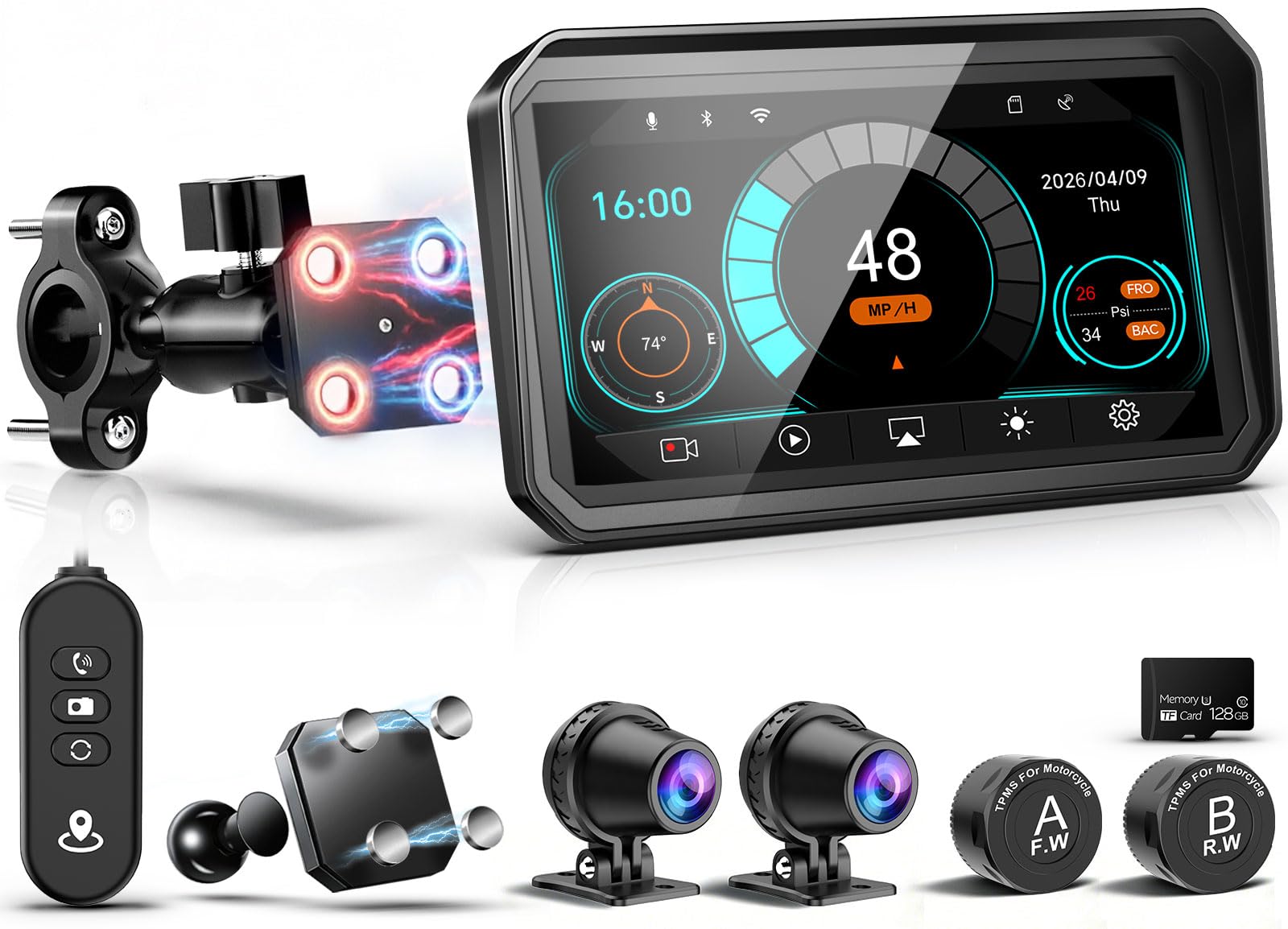
The LBW MT600 Pro is an all-in-one navigation and recording system that combines a 6-inch QLED touchscreen, wireless Apple CarPlay and Android Auto, and dual 1080P dash cameras into a single quick-release module. The 1200-nit brightness rating means the display remains readable even under direct sunlight — a common pain point with cheaper units. The IP69K waterproof rating exceeds most dedicated action cameras, ensuring the electronics survive monsoon rain or a pressure-wash after a muddy ride.
The magnetic quick-release bracket is the defining feature for motorcycle use. You snap the unit into place before the ride and remove it in seconds when parked, eliminating the theft concerns that come with fixed-mounted GPS units. The built-in front and rear cameras are always recording when the unit is docked, and the G-sensor automatically locks footage upon impact. An included 128 GB SD card means you start recording immediately without an additional purchase.
TPMS (tire pressure monitoring) sensors add a layer of safety that no action camera provides. Owner feedback on the MT600 Pro highlights the convenience of having navigation, music, camera, and tire data in one screen, though some users report the unit can be difficult to see with polarized sunglasses. For riders who want GPS and a dash cam in a single theft-proof package, this delivers exceptional functional density.
What works
- Integrated navigation, recording, and TPMS
- Quick-release magnetic mount for theft prevention
- IP69K waterproof rating
What doesn’t
- Camera quality limited to 1080P
- Display can be washed out with polarized lenses
5. AKASO 360 Weatherproof 360° Camera
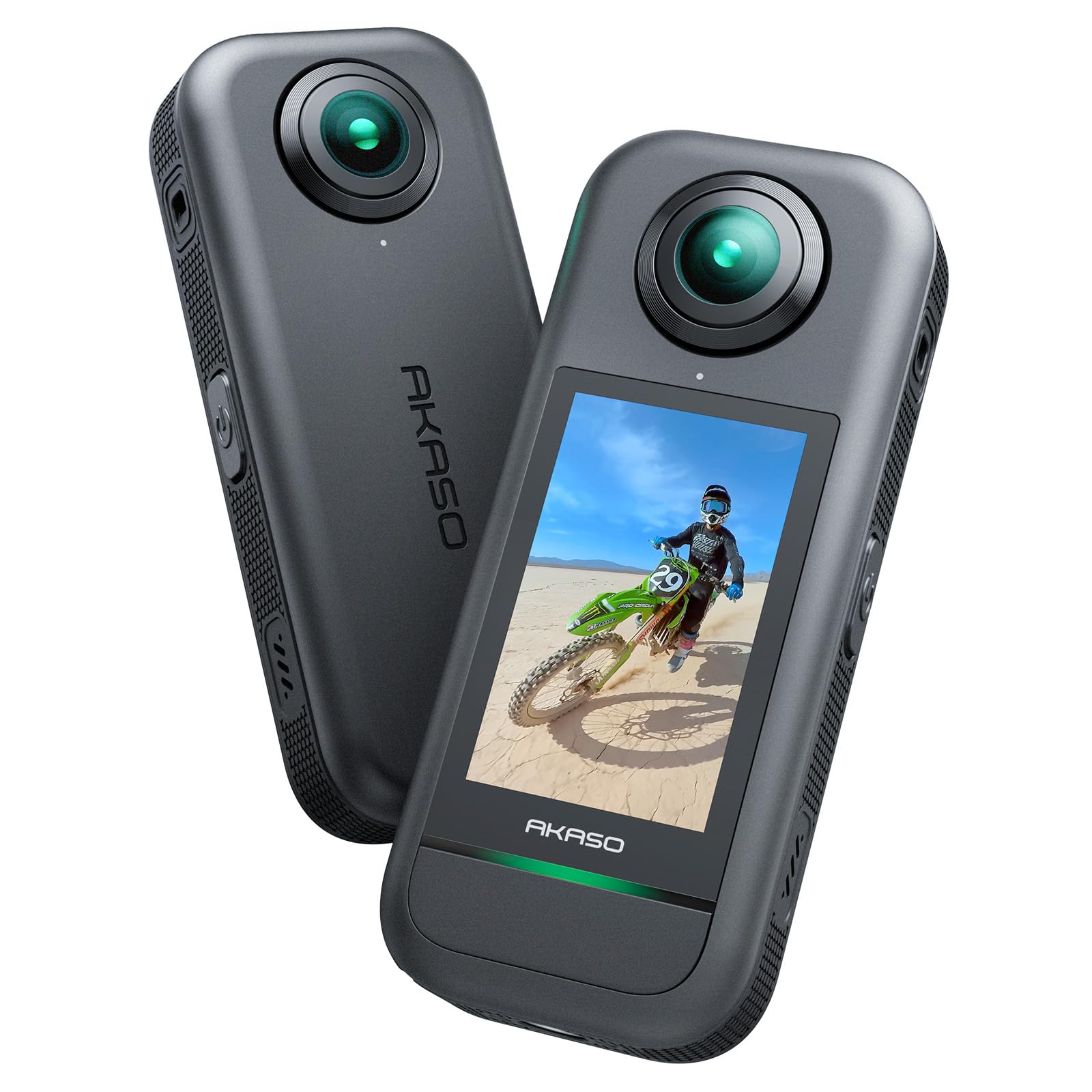
The AKASO 360 brings 360-degree capture to a significantly lower price point than the Insta360 X3, making it the most accessible way for riders to experiment with spherical video. Dual 1/2-inch 48-megapixel sensors stitch together 5.7K 360 video, and the companion app’s AI-powered reframing tools let you pull standard wide-angle clips from the sphere after the ride. The 72-megapixel 360 photo mode offers the highest still resolution in this comparison.
360-degree Horizon Lock keeps the footage level regardless of how the camera rotates on the mount, which is particularly valuable for off-road or adventure touring where the camera frequently shifts position. The Invisible Selfie Stick effect works well for third-person riding shots, and the AI subject tracking can follow you automatically within the 360 sphere — useful for solo riders who want a dynamic shot without a camera operator.
Owner reviews specifically from motorcyclists note that the AKASO 360 delivers a compelling entry point into 360 filmmaking without the premium markup of the established brands. The main compromises are in low-light performance — the smaller sensors struggle compared to the Insta360 X3 — and the app interface still has rough edges relative to more mature platforms. For riders curious about 360 video who want to test the format without a large investment, this is the logical starting point.
What works
- Most affordable 5.7K 360 camera available
- 72MP 360 photo resolution
- AI subject tracking for solo riders
What doesn’t
- Low-light video quality is limited
- App ecosystem less polished than competitors
6. GoPro Hero Black Compact 4K

The GoPro Hero Black Compact is a stripped-down version of the flagship HERO13, designed for users who want GoPro reliability and HyperSmooth stabilization without paying for the highest-end sensor. It records 4K at 30 fps and 2.7K at 60 fps for smooth slow-motion playback, and it uses the same HyperSmooth stabilization algorithm that made the brand famous. The 12-megapixel still resolution is lower than competitors, but the image processing pipeline produces consistently usable results across varying light conditions.
Waterproof to 33 feet without a housing is a practical advantage for motorcycle mounting — you can leave the camera on the bike during a sudden downpour without worrying about sealing. Voice control with 11 supported languages allows hands-free operation while riding, though wind noise can interfere at higher speeds. The bundle includes a 50-in-1 accessory kit and a 64 GB memory card, providing everything needed to start recording immediately.
User feedback from motorcycle enthusiasts notes that the compact form factor fits well under helmet chin mounts without the bulky profile of larger cameras. The 1-hour battery life at high settings is a limitation for long tours, but the USB-C charging lets you top up during fuel stops. For riders who want proven stabilization and a vast accessory ecosystem at a more accessible price than the HERO13, this is a solid middle ground.
What works
- Compact size for helmet mounting
- Proven HyperSmooth stabilization
- Bundle includes all necessary accessories
What doesn’t
- Only 12MP still photos
- Battery life limited at 4K30 setting
7. RunCam Helmet Camera 4K Bendable

The RunCam Helmet Camera takes a radically different approach to the action camera form factor by replacing the standard rigid body with a flexible stalk that positions the lens wherever you need it. The camera mounts directly to the helmet using a slider and adhesive pad, and the bendable tube lets you aim the lens at the road ahead, your handlebars, or even backward for a rear-facing view. This design eliminates the need for multiple mounts and allows on-the-fly angle adjustments.
One-touch recording with vibration alerts means you never need to look at the camera to confirm it’s rolling — the vibration pulse tells you the camera is recording or the battery is low. The 6-hour battery life at 1080P is among the longest in this comparison, making it suitable for all-day rides without recharging. The RunCam app provides Wi-Fi preview and file transfer, though the connection is basic compared to GoPro or Insta360 apps.
Reviews from airsoft and motorcycle communities highlight the camera’s ability to survive impacts and maintain position on rough terrain. The audio quality is a known limitation — the tiny SMD microphone gets overwhelmed by wind noise above 50 mph, and there is no external mic input. For riders who prioritize helmet-mounted convenience and long battery life over audio fidelity, the RunCam offers a unique set of trade-offs that no other camera in this list replicates.
What works
- Bendable stalk for precise aim
- Excellent 6-hour battery endurance
- Vibration alerts for recording status
What doesn’t
- Weak microphone at highway speeds
- No external mic input
8. AKEEYO AKY-710S Motorcycle Camera

The AKEEYO AKY-710S is a compact motorcycle camera that focuses on dedicated riding use cases rather than general action filming. It uses a Sony STARVIS IMX335 sensor that records 2K resolution at a smooth 55 fps, with the ability to upscale to 4K at 28 fps. The 142-degree wide-angle lens provides adequate coverage for single-lane awareness, and the IP66-equivalent rating (advertised as IP67) protects against rain and dust during normal riding conditions.
Parking surveillance is a rare feature at this price point — the camera enters a standby mode when the bike is parked and begins recording if the G-sensor detects motion or impact. The 1800 mAh battery delivers over 4.5 hours of 1080P recording, which covers most day rides without needing external power. The Wi-Fi app provides live preview and file downloads, though setup requires disconnecting from your home Wi-Fi network first, which some owners found confusing.
Owner feedback is mixed but instructive: positive reviews highlight the value proposition and loop-recording stability, while negative reviews report battery charging failures after several weeks of use. The variance suggests quality control inconsistencies across production batches. For riders willing to test a budget unit and potentially work through initial setup quirks, the AKY-710S offers a feature set that punches above its price class, with the caveat that long-term reliability is less assured than established brands.
What works
- STARVIS sensor for low-light performance
- Parking surveillance mode
- Long 1800 mAh battery life
What doesn’t
- Mixed reliability reports from owners
- Wi-Fi setup requires network disconnection
9. AKASO EK7000 4K Action Camera

The AKASO EK7000 is the most affordable 4K action camera in this roundup, targeting riders who want to test helmet or handlebar recording without committing serious money. It records 4K at 30 fps with built-in electronic image stabilization and captures 20-megapixel still photos. The included waterproof case extends depth rating to 131 feet, far beyond what any rider needs, but the kit also bundles a wrist remote, a 64 GB memory card, and a full accessory kit — everything you need to start recording immediately.
The wrist 2.4 GHz remote control is a standout inclusion at this price tier, allowing you to start/stop recording without reaching for the camera. The 4X digital zoom is usable in well-lit conditions but introduces visible artifacts in low light. Wi-Fi connectivity works with the AKASO GO app for preview and file transfer, though the app experience is basic compared to GoPro or Insta360 platforms. The 131-foot waterproof case provides peace of mind for riders in wet climates
Owner reviews consistently describe the EK7000 as a “great starter camera” with “decent quality for the price.” The image quality is sufficient for daytime recreational recording and social media sharing, but the EIS stabilization is not as effective as HyperSmooth or FlowState — expect some vibration artifacts on bar mounts without additional dampening. For riders on a tight budget who want to learn what works for their riding style before investing in premium gear, the EK7000 is the most cost-effective entry point available.
What works
- Complete kit with remote and 64GB card
- Affordable entry point for new riders
- Deep waterproof rating with case
What doesn’t
- Stabilization struggles on bar mounts
- App interface is basic and slow
Hardware & Specs Guide
Sensor Technology
The image sensor is the heart of any action camera. Sony STARVIS and STARVIS 2 sensors dominate the premium segment for their back-illuminated architecture that captures more light in low conditions. Larger 1/1.9-inch sensors outperform the standard 1/2.3-inch sensors found in budget cameras, particularly in twilight and tunnel scenarios. The sensor directly dictates usable frame rates at each resolution setting.
Stabilization Types
Electronic Image Stabilization (EIS) crops the sensor and uses gyroscopic data to counter-move the frame. GoPro’s HyperSmooth, Insta360’s FlowState, and generic EIS all rely on this principle, but effectiveness varies dramatically. Horizon Lock adds a gyroscopic leveling layer that keeps the horizon steady during leans — essential for motorcycle footage where the camera tilts with the bike. Mechanical gimbals offer the best stabilization but add weight and complexity.
Weather Sealing Standards
IP67 means the camera can survive submersion in one meter of water for 30 minutes. IP69K extends this to high-temperature, high-pressure water jets. For motorcycle use, any camera without at least IP66 will likely fail during a heavy rain. Sealed battery compartments and waterproof USB port covers are critical inspection points before mounting on a bike exposed to the elements.
Mounting and Vibration Isolation
The mount system determines footage quality as much as the camera itself. Rigid metal mounts transmit every engine vibration directly into the camera. Rubber vibration dampers, articulated arms, and 3M VHB tape all help isolate the camera from high-frequency shake. Helmet chin mounts produce the most stable footage because the rider’s body acts as a natural vibration damper, while handlebar mounts require the most aggressive stabilization.
FAQ
What is the best resolution for a motorcycle action camera?
Should I mount the camera on my helmet or handlebars?
How important is waterproofing for motorcycle cameras?
Can I use a standard action camera as a motorcycle dash cam?
How much storage do I need for a full day of riding?
Final Thoughts: The Verdict
For most buyers, the best motorcycle action camera winner is the Vantrue F1 because it delivers dedicated dash cam functionality with weather-sealed dual cameras, GPS tracking, and automatic recording — everything a rider needs for security and documentation without daily setup. If you want cinematic reframing flexibility, grab the Insta360 X3 for its 360-degree capture and Horizon Lock. And for all-day navigation plus recording in a theft-proof package, nothing beats the LBW MT600 Pro.

Certification: BSc in Mechanical Engineering
Education: Mechanical engineer
Lives In: 539 W Commerce St, Dallas, TX 75208, USA
Md Amir is an auto mechanic student and writer with over half a decade of experience in the automotive field. He has worked with top automotive brands such as Lexus, Quantum, and also owns two automotive blogs autocarneed.com and taxiwiz.com.