Rust never sleeps, but the right chemistry can send it packing. The market is flooded with sprays, soaks, converters, and inhibitors — each promising bare metal and lasting protection. Sorting through the hype to find a formulation that actually dissolves oxidation without damaging the underlying surface is where most buyers get stuck.
I’m Amir — the founder and writer behind Four Wheel Ask. My approach combines deep market research with careful analysis of product specifications, build quality data, and aggregated owner feedback to separate legitimate rust solutions from marketing claims.
Whether you are restoring a classic car, refreshing old tools, or protecting equipment from salt spray, the chemistry of rust removal matters. After analyzing dozens of rust removal formulas and owner reports, I identified what truly works for restoring metal with the best metal rust remover.
How To Choose The Best Metal Rust Remover
Selecting the right rust remover depends on the severity of corrosion, the type of metal, and whether you plan to paint or seal the surface afterward. The wrong choice can waste time or even damage the part you are trying to save. Understanding the three main categories — removers, converters, and inhibitors — is the first step toward a lasting repair.
Remover vs. Converter vs. Inhibitor
Rust removers chemically dissolve iron oxide and wash it away, leaving bare metal behind. Converters transform rust into a stable, paintable black layer without removing the base material. Inhibitors create a protective barrier that prevents oxygen and moisture from reaching the surface. Many products combine two or three functions, but specialized formulations almost always outperform all-in-one solutions on tough jobs.
Application Method Matters
Spray-on formulas offer convenience for small parts and vertical surfaces. Soak baths provide the deepest penetration for heavily corroded tools, fasteners, and brackets. Brush-on gels work well for irregular shapes and spot repairs. Choose a method that matches the geometry of your project — a trigger spray will struggle with intricate cast iron crevices that a submersion bath handles easily.
Safety and Surface Compatibility
Acid-based products remove rust quickly but can etch or weaken base metal if left on too long. Chelating agents like those found in biodegradable formulas are gentler and safer for painted surfaces, plastics, and rubber, though they require longer contact times. Always test on an inconspicuous area first, and follow manufacturer dwell times to avoid damaging the part.
Quick Comparison
On smaller screens, swipe sideways to see the full table.
| Model | Category | Best For | Key Spec | Amazon |
|---|---|---|---|---|
| Evapo-Rust 5 Gal | Premium | Deep soak restoration | Biodegradable chelating formula | Amazon |
| CorrosionX Heavy Duty | Performance | Marine and outdoor protection | Self-healing barrier, 5 yr indoor | Amazon |
| Rust-Oleum Dissolver | Value | Quick dissolving of light rust | 10–30 min removal, reusable | Amazon |
| Metal Rescue | Premium | Safe no-scrub soaking | Non-toxic, no acids | Amazon |
| TotalBoat Rust Primer | Design | Rust conversion for large areas | 500 sq ft/gal coverage | Amazon |
| OSPHO Metal Treatment | Premium | Rust conversion and priming | 200 sq ft/gal coverage | Amazon |
| CorrosionX Rust Inhibitor | Performance | Electronics and marine gear | Dielectric, 39k volt rating | Amazon |
| Meuvcol Rust Converter | Value | Heavy-duty coating and sealing | 35 oz, waterproof seal | Amazon |
| JENOLITE Original | Design | Fast spray-on rust removal | 30 min to bare metal | Amazon |
| KRUD KUTTER MR32 | Value | DIY spray-and-wipe projects | Water-based, 1 yr protection | Amazon |
| Trick Shot 3-in-1 | Performance | Penetrating lubricant and cleaner | Soy-based, USDA bio-based | Amazon |
In‑Depth Reviews
1. Evapo-Rust The Original Heavy Duty Rust Remover, 5 Gallons

Evapo-Rust has earned a reputation as the benchmark for chelating rust removers, and the data backs it up. This water-based formula chemically bonds with iron oxide and lifts it away from the metal without acids, caustics, or toxic fumes. Owner reports consistently describe results that border on alchemy — heavily rusted hand tools, chain binders, and even a thirty-year-old moped gas tank emerged looking factory fresh after a twelve-to-forty-hour soak.
The formulation is non-toxic, non-flammable, and safe on plastic, rubber, and painted surfaces, which makes it a versatile choice for complex assemblies you cannot fully disassemble. Users note that the fluid turns yellow with use and gradually loses potency after three or four heavy sessions, but the five-gallon bucket provides enough volume for multiple restoration rounds. A faint sulfur odor is present, though it is far milder than the acrid smell of acid-based competitors.
Where this product truly separates itself is the labor-free process — no scrubbing, no wire brushing, no abrasive pads. Submerge the part, wait, and rinse. For restorers who value their time and want predictable, repeatable results on valuable components, Evapo-Rust remains the gold standard. The only practical limitation is the need for a container large enough to fully submerge the part, which can be a challenge for oversized items like body panels or frames.
What works
- Non-toxic and safe on non-metal materials
- Requires zero scrubbing or sanding
- Reusable across multiple soak sessions
What doesn’t
- Requires full submersion for best results
- Potency declines after several uses
2. CorrosionX Heavy Duty Anti Rust Spray, 12oz Aerosol

CorrosionX Heavy Duty is not a rust remover in the traditional sense — it is a corrosion inhibitor that creates a thick, self-healing barrier capable of lasting up to five years indoors. The polar-bonding technology locks onto metal surfaces at a molecular level, displacing moisture and preventing electrolysis in marine and automotive environments where salt and humidity accelerate decay. Owner feedback highlights its effectiveness on boat trailers, truck frames, and electrical connections that live in constant contact with seawater.
The aerosol delivers a dripless, goopy coating that stays flexible and refuses to crack or flake under vibration. Users report that a single application on a boat trailer survived multiple launches and pressure washes without breaking down. The trade-off is cosmetic — the thick residue attracts dirt and turns surfaces into a grime magnet, which matters less for undercarriages and more for visible components. Gloves are essential because the coating is tenacious on skin.
For anyone needing long-term outdoor rust protection rather than spot removal, this spray is a legitimate set-and-forget solution. The U.S. Navy qualification adds a layer of credibility that few consumer-grade products can claim. Just plan for the messy application and the need to reapply if the coating is mechanically disturbed in high-wear areas.
What works
- Self-healing barrier lasts years outdoors
- Excellent for marine and heavy-duty use
- Withstands pressure washing and rain
What doesn’t
- Thick coating attracts dirt and grime
- Not designed for rust removal
3. Rust-Oleum Rust Dissolver Soak & Bath, 1 Gallon

Rust-Oleum brings its formulation expertise to a water-based dissolver that works in ten to thirty minutes on medium to light corrosion. The standout feature here is the reusable formula — users report straining and reusing the same batch multiple times, which drives the effective cost per job well below single-use competitors. Owner reports confirm it restores cast iron handles, garage door hardware, and rusty tools with minimal odor compared to acid-based alternatives.
The application is flexible: you can either submerge small parts or brush the liquid onto vertical surfaces and let gravity do the work. A light pine scent is present, but it is not offensive enough to require a respirator for casual use. Some users noted that stubborn patches of heavy rust required a second application, and leaving parts submerged too long can lift paint from adjacent surfaces, so dwell time monitoring is important.
For the DIYer who needs a reliable, low-odor rust remover that handles a mix of light and moderate corrosion jobs without breaking the bank, this gallon jug delivers strong value. The reusability factor makes it a smart choice for anyone working through a pile of rusty tools or hardware in a weekend session.
What works
- Fast action on light to medium rust
- Reusable formula extends value
- Mild scent, good for indoor use
What doesn’t
- Struggles with heavy, thick rust layers
- Can strip paint if over-soaked
4. Metal Rescue Rust Remover, 1 Gallon

Metal Rescue positions itself as the safest option in the rust removal category, and the specifications justify that claim. The formula contains no acids, no caustics, and no toxic chemicals — it is biodegradable, safe on skin, and can be poured down household drains in most jurisdictions. Owner reports describe soaking antique radio parts, moped gas tanks, and decades-old welder fuel tanks with results that range from impressive to astonishing. A forty-hour soak removed ten years of accumulated rust from a fuel tank interior, leaving the metal clean enough to reuse without lining.
The process is almost absurdly simple: submerge the part in a plastic container, wait five minutes to twenty-four hours depending on rust severity, and rinse. No scrubbing, no brushing, no fumes. Users note that the product appears and smells like water, which makes it easy to work with in confined spaces. The main drawback is the cost per gallon and the fact that the solution loses effectiveness over time as it absorbs rust, making it less economical for very large projects.
For restorers working on delicate or valuable parts where acid damage is a genuine concern — think carburetors, vintage tools, or parts with integrated plastic or rubber components — Metal Rescue provides peace of mind alongside performance. It is also an excellent choice for indoor use where ventilation is limited.
What works
- Completely non-toxic and biodegradable
- Safe on plastic, rubber, and paint
- No odor, ideal for indoor use
What doesn’t
- Higher cost per gallon than acid options
- Effectiveness declines as rust load increases
5. TotalBoat Rust Primer Converter, 1 Gallon
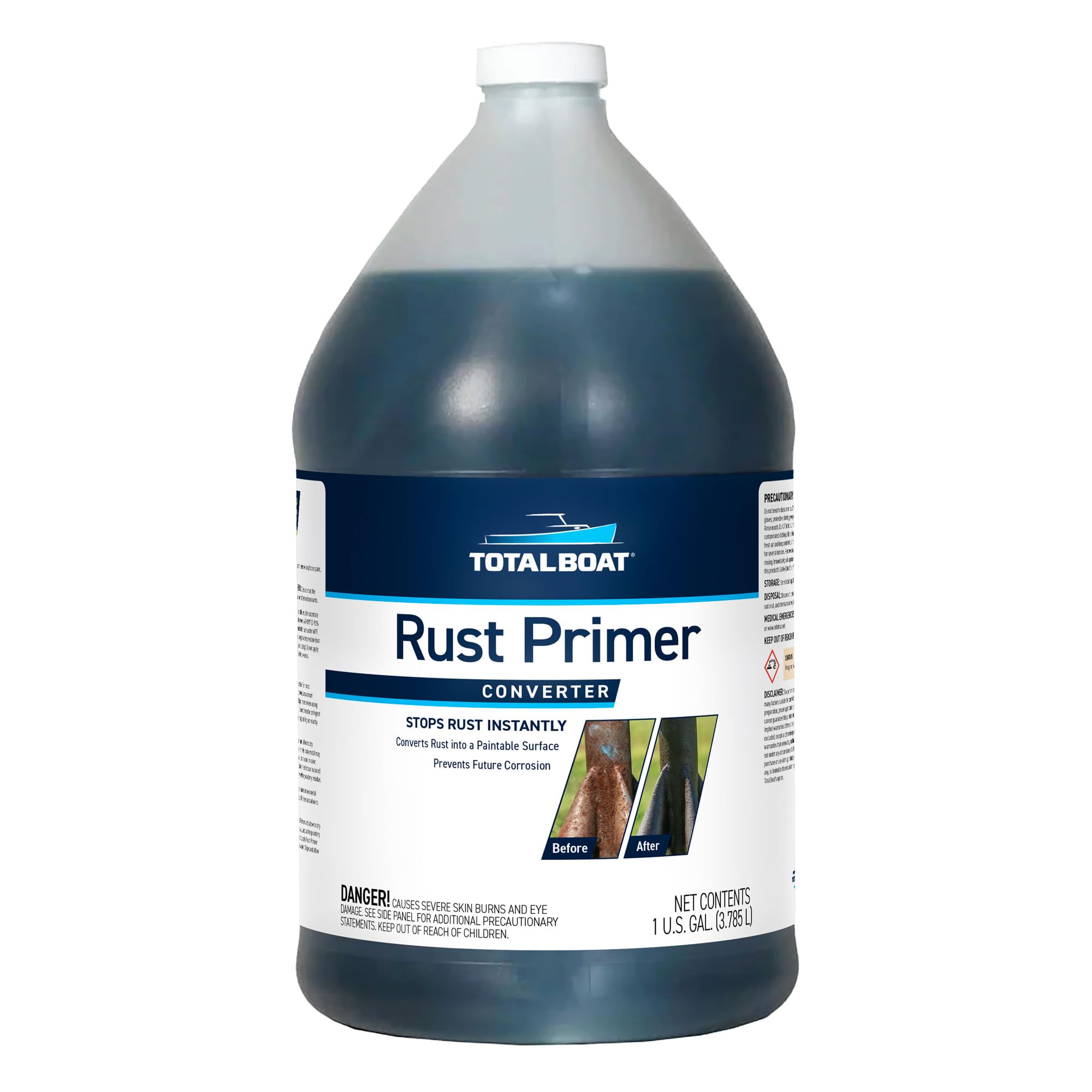
TotalBoat Rust Primer is a phosphoric acid-based converter that chemically transforms iron oxide into an inert, paintable layer. It is not a remover — it stabilizes the rust and seals it beneath a matte black coating that bonds with subsequent paint layers. The water-thin formula achieves remarkable coverage at five hundred square feet per gallon, making it one of the most economical options for large-scale projects like trailers, truck frames, and marine structures.
Owner feedback from the restoration community is notably positive. One user detailed its use on a classic Mustang, praising how the thin liquid wicked into pinch welds and door cavities where brush-on products cannot reach. The application requires a wire brush to remove loose flaking rust first, then the converter does the rest. It fizzes on contact, signaling the chemical reaction, and dries to a hard, waterproof finish overnight.
The formula is thin enough to spray through a garden sprayer, which speeds up large-area work considerably. However, the acidic nature means it will stain concrete and should be kept away from painted surfaces. Some users reported that applying paint directly over the dried converter without proper washing led to peeling, so following the manufacturer’s rinse and prep instructions is critical for long-term adhesion.
What works
- Massive coverage at low cost per square foot
- Penetrates tight spots and crevices
- Dries to a hard, paintable finish
What doesn’t
- Requires thorough rinsing before painting
- Acidic formula stains concrete
6. OSPHO Metal Treatment Coating, 1 Gallon

OSPHO has been a staple in the marine and automotive restoration world for decades, and its formula remains largely unchanged because it works. The phosphoric acid solution converts rust into a hard, black iron phosphate coating that serves as both a treatment and a primer. Owner reports consistently describe it as the go-to product for boat trailers, tractors, and vehicle frames that live in salt-prone environments.
Application is straightforward — pressure wash the surface, apply OSPHO with a cheap brush or spray bottle, let it dry for twenty-four hours, and watch the rust turn black. A white powdery residue forms after curing, which owners recommend brushing off before applying an epoxy primer for maximum adhesion. Users report that a single treatment on a thirty-year-old tractor and tiller kept rust at bay for three years with no signs of return.
The gallon size covers approximately two hundred square feet, which is ample for a full truck frame or a small boat trailer. The strong chemical smell requires ventilation, and the product has a tendency to leak during shipping — several reviewers noted damaged packaging. Despite these handling quirks, OSPHO remains a trusted choice for professionals who need a predictable, repeatable rust conversion process on large metal surfaces.
What works
- Proven long-term rust conversion
- Easy brush or spray application
- Excellent for marine and heavy equipment
What doesn’t
- Strong chemical odor requires ventilation
- Shipping leaks reported by multiple users
7. CorrosionX Rust Inhibitor, 16oz Aerosol

CorrosionX in the 16-ounce aerosol format is the same trusted chemistry found in the heavy-duty version, but tuned for precision applications and electronics protection. The dielectric film is rated at over 39,000 volts, making it safe to use on battery terminals, sensors, and circuit boards where moisture displacement is critical. Owner feedback from former Navy personnel confirms its pedigree — it was used on aircraft connectors to prevent galvanic corrosion in salt-laden environments.
The formulation creeps along threads and into tight clearances, displacing moisture and leaving a thin, lubricating film that resists washout. Users report reviving rusted chains, stuck fasteners, and corroded electrical connections that other penetrants could not free. It doubles as a CLP for firearms, which speaks to its versatility in the workshop. The self-healing property means that if the coating is scratched, it flows back to reseal the exposed area.
Price per ounce is higher than general-purpose rust inhibitors, but the mil-spec qualification and the breadth of applications — from outboard motors to farm equipment — justify the investment for anyone who needs a single product that does everything. The main limitation is that it is a preventive and penetrant, not a rust remover, so existing heavy corrosion needs to be addressed before application.
What works
- Military-grade corrosion protection
- Safe on electronics and sensors
- Self-healing film reseals after scratches
What doesn’t
- Not designed for removing existing rust
- Premium price per ounce
8. Meuvcol 2 in 1 Rust Converter & Metal Primer, 35 oz
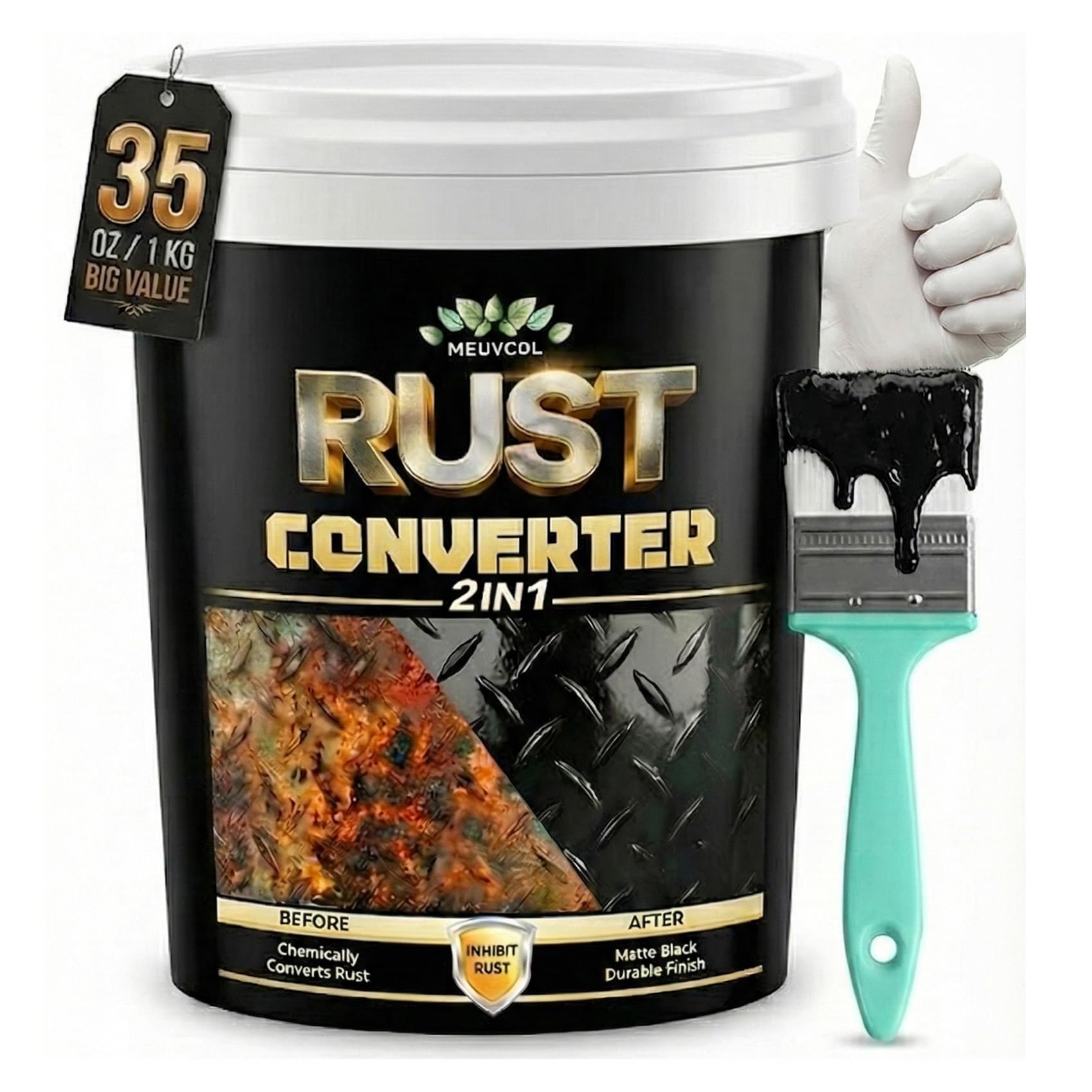
Meuvcol combines rust conversion and primer in a single thick, paint-like liquid that seals out moisture and oxygen. Unlike thin wash-type converters, this formula builds a durable matte black film that can be left as a finished coating or used as a base for top paint. Owner reports highlight its performance on antique metal statues, truck components, and non-potable water tanks, with users praising the easy brush-on application and the included gloves and brush.
The coating dries to a hard, chip-resistant finish that bonds aggressively to rusted surfaces. Users who applied it to a rusty trailer frame reported that after two months of outdoor exposure, there was no chipping or peeling. The formula is waterproof and rated for both indoor and outdoor use, making it suitable for everything from garden tools to automotive chassis work. The strong smell during application is the main comfort trade-off.
At thirty-five fluid ounces with brush and gloves included, the value proposition is strong for DIYers who want a one-step solution rather than a multi-product system. Just note that it is a converter, not a remover — the rust stays in place, transformed into a stable black layer. For parts where preserving original metal thickness matters, this approach is preferable to aggressive chemical removal.
What works
- Thick, durable coating resists chipping
- Includes brush and gloves
- Waterproof for outdoor use
What doesn’t
- Strong odor during application
- Not a remover, rust remains in place
9. JENOLITE Original Rust Remover for Metal, 500ml Trigger Spray

Jenolite is a British brand with roots dating back to 1939, and this trigger spray formulation reflects decades of refinement in rust removal chemistry. The liquid is designed for fast action — spray it on, wait about thirty minutes, and rinse to reveal bare metal. Owner reports confirm strong performance on automotive brake parts, machinery, and garden furniture, with users noting that soaking heavily rusted components for twenty-four hours produced excellent results even on locked-up hardware.
The coverage is generous, with one liter rated for approximately eighty-six square feet, making the 500ml bottle suitable for multiple small-to-medium projects. The application method is flexible: spray, brush, or fully immerse depending on the part geometry. Users who immersed rusty brake components reported that the solution freed parts that were completely seized, restoring full function without damaging the base metal.
The most consistent criticism across owner feedback is the included trigger sprayer, which multiple users described as leaking or failing entirely. This is a packaging flaw rather than a chemistry issue, and decanting the liquid into a separate spray bottle solves the problem. For buyers who want a fast-acting, acid-based rust remover with a proven track record and are willing to swap the sprayer, Jenolite delivers reliable results.
What works
- Fast rust removal in about 30 minutes
- Good coverage for small-to-medium parts
- Proven brand with decades of history
What doesn’t
- Included sprayer often leaks or fails
- Some users report inconsistent results on heavy rust
10. KRUD KUTTER MR32 The Must For Rust, 32-Ounce Trigger Spray

KRUD KUTTER MR32 is a water-based formula that combines rust removal and inhibition in a single spray step, making it one of the most convenient options for quick DIY jobs. The chemistry penetrates into surface voids and dissolves oxidation through chemical action rather than abrasion. Owner reports confirm that it works effectively on car parts, tools, hinges, and even shower heads when multiple applications are combined with light scrubbing between coats.
The trigger spray bottle allows direct application to vertical surfaces without runoff, and the coverage is rated at twelve square feet per bottle. Users who tested it against four other rust removers ranked it best overall, noting that it does not eat into the base metal the way aggressive acid-based products can. The manufacturer claims the treated surface stays rust-free for up to a year, though several reviewers emphasized that a protective topcoat is still necessary for long-term outdoor exposure.
The main drawbacks are the strong chemical odor — which requires good ventilation — and the need for patience on heavily corroded parts. Multiple spray-and-wait cycles with intermediate wire brushing are needed for thick rust. The formula also left light staining on some steel rods that required light sanding to remove. For small projects and spot treatments where ease of use is the priority, this is a solid entry-level choice.
What works
- Convenient spray-on application
- Does not damage base metal
- Provides temporary rust inhibition
What doesn’t
- Strong smell requires ventilation
- Multiple applications needed for heavy rust
11. Trick Shot 3-in-1 Penetrating Lubricant Oil, 16 oz

Trick Shot is a plant-based penetrating oil that functions as a rust remover, lubricant, and corrosion inhibitor in one formula. The soybean-based chemistry is 96 percent biobased and carries USDA certification, making it a compelling option for users who want to avoid petroleum distillates. Owner feedback from marine environments is particularly strong — one user reported that it freed a fully rusted-stuck umbrella gear base after a few minutes of application, restoring function that other penetrants could not touch.
The formula is non-flammable and carries an NSF H1 food-safe rating, meaning it is approved for incidental food contact in commercial kitchens and processing facilities. Users compare its penetrating ability favorably against WD-40 and Kroil, with several stating it outperforms both on stubborn seized bolts and threaded fasteners. The mild vegetable scent is a welcome change from the harsh chemical odors typical of penetrating oils.
The trade-off is that this is first and foremost a penetrant and lubricant, not a dedicated rust remover. It excels at freeing rusted mechanical assemblies and preventing future corrosion, but it will not dissolve heavy rust scale the way a dedicated chemical remover or converter will. For workshops that need a single, safe, multi-purpose fluid for maintenance and light rust remediation, Trick Shot offers a unique value proposition with its food-safe credentials.
What works
- Non-flammable and food-safe rated
- Excellent penetrating ability on seized parts
- Mild, pleasant scent
What doesn’t
- Not a heavy-duty rust remover
- Higher cost than petroleum-based alternatives
Hardware & Specs Guide
Chemical Formulations Explained
Rust removers generally fall into two chemical families: acid-based and chelating. Acid formulas — typically phosphoric, oxalic, or hydrochloric — work quickly by dissolving iron oxide but can etch the base metal if left on too long. Chelating agents use organic molecules that bond with iron ions and lift them away, offering a gentler action that is safer for delicate parts, plated surfaces, and adjacent non-metal materials. Converter formulas use phosphoric acid to turn rust into iron phosphate, a stable black layer that can be painted directly. The choice depends on whether you need complete removal, surface conversion, or long-term prevention.
Application Methods
Spray-on products offer convenience for vertical surfaces and spot treatments but generally provide thinner coverage that requires multiple passes for heavy rust. Soak baths deliver the most thorough results because the liquid surrounds the part and works on all surfaces simultaneously — ideal for fasteners, small tools, and brackets. Brush-on gels and thick liquids work well for irregular shapes and large flat areas where runoff is a concern. Always match the method to the part geometry: a carburetor with internal passages benefits from full immersion, while a truck frame is better served by brushing or spraying.
Surface Preparation
No rust remover can work effectively through a layer of grease, oil, or loose flaking paint. Wire brushing or pressure washing to remove loose debris before applying any chemical treatment is essential for consistent results. For converters, the surface should be evenly rusted — patchy rust and clean metal will cure to different appearances. After chemical treatment, most formulas require a thorough water rinse to stop the reaction, followed by immediate drying to prevent flash rusting. A final wipe with a solvent removes any residue before primer or paint.
Post-Treatment Protection
Bare metal that has been chemically stripped of rust is highly reactive and will begin oxidizing again within hours if left unprotected. A corrosion inhibitor, primer, or clear sealant should be applied as soon as the surface is dry. For parts that were soaked in a chelating remover, a light oil or wax coating provides temporary protection until permanent paint or plating is applied. Converted surfaces — those treated with phosphoric acid formulas — are more stable but still benefit from a topcoat in outdoor or high-moisture environments. The best rust removal is always followed by rust prevention.
FAQ
What is the difference between a rust remover and a rust converter?
Can I use a rust remover on painted surfaces?
How long should I leave a rust remover on the metal?
Are there any metals that rust removers should not be used on?
How do I dispose of used rust remover liquid?
Final Thoughts: The Verdict
For most buyers, the best metal rust remover winner is the Evapo-Rust 5-Gallon because it combines zero-labor submersion with non-toxic safety and reusability that no other product matches at this performance level. If you need a heavy-duty outdoor corrosion barrier, grab the CorrosionX Heavy Duty for its self-healing, years-long protection. And for large-area rust conversion with unbeatable coverage, nothing beats the TotalBoat Rust Primer Converter at five hundred square feet per gallon.

Certification: BSc in Mechanical Engineering
Education: Mechanical engineer
Lives In: 539 W Commerce St, Dallas, TX 75208, USA
Md Amir is an auto mechanic student and writer with over half a decade of experience in the automotive field. He has worked with top automotive brands such as Lexus, Quantum, and also owns two automotive blogs autocarneed.com and taxiwiz.com.