The air inside your car can be two to five times more polluted than the air outside, thanks to off-gassing from plastics, recirculated exhaust fumes, and trapped allergens that settle into upholstery. A dedicated filtration unit is the only reliable way to cut through that haze — and choosing the wrong one means wasted space, poor airflow, or a filter that simply does not capture the particles you are breathing.
I’m Amir — the founder and writer behind Four Wheel Ask. My work focuses on breaking down filter efficiency data, airflow engineering, and long-term owner feedback to separate marketing claims from real-world performance in the automotive air quality space.
Comprehensive analysis of True HEPA filters, activated carbon layers, and owner-reported feedback reveals the top models for achieving cleaner, healthier in-vehicle air with the best hepa car air purifier.
How To Choose The Best HEPA Car Air Purifier
Selecting a purifier for a vehicle cabin is different from buying one for a living room. Space is limited, power comes from a 12 V or USB source, and the unit must endure temperature swings and vibration. Three factors separate effective models from disappointments.
Filter grade and particle retention
True HEPA (H13 or higher) captures 99.97 % of particles at 0.3 microns, but many portable units labeled HEPA actually use HEPA-type media that performs worse. For car use, look for an H13 rating or a verified CADR test. Activated carbon is equally important because cabin odors, VOCs from dashboards, and exhaust gases require chemical adsorption that HEPA alone cannot handle.
Airflow and cabin coverage
A purifier that moves too little air will never clean the cabin effectively. Check the Clean Air Delivery Rate — a CADR of 15 m³/h or higher is adequate for a standard passenger car. For larger SUVs or vans, consider a unit rated for at least 30 m³/h. Also note that recirculation mode on your car’s HVAC helps the purifier work faster by limiting outside contamination.
Installation and power source
Cup holder models are convenient but often sacrifice filter size. Headrest-mounted units keep floor space clear but may interfere with rear passengers. Hardwired 12 V models that auto-start with the ignition offer the best user experience. Battery-powered portable units add flexibility for cross-vehicle use but require regular charging.
Quick Comparison
On smaller screens, swipe sideways to see the full table.
| Model | Category | Best For | Key Spec | Amazon |
|---|---|---|---|---|
| IQAir Atem Car | Car Purifier | Premium in-car filtration | HyperHEPA, 0.003 micron | Amazon |
| LEVOIT Core 300-P | Home & Car | Dual-purpose room & cabin | CADR 143 CFM, 56 W motor | Amazon |
| LUFTRUM C3500 | Home & Car | Large vehicle or SUV cabins | Dual H13 HEPA, 300 CFM | Amazon |
| Chuboor PJ01 | Home & Car | Budget-friendly large room | H13 HEPA, 1200 sq ft | Amazon |
| Philips GoPure GP5212 | Car Purifier | Compact vehicle installation | SelectFilter Plus, 16 m³/h | Amazon |
| PuroAir 100i | Home & Car | Pet owners and allergy relief | Wi‑Fi, 550 sq ft coverage | Amazon |
| Tolife Air Purifier | Home & Car | Quiet bedroom or cabin use | Washable pre-filter, 1095 sq ft | Amazon |
| LUFTRUM Car Purifier | Car Purifier | Automatic ignition sync | H13 HEPA, PM2.5 sensor | Amazon |
| GOODAIR Purifier Bag | Passive Carbon | Non-electric odor control | 75 g activated carbon | Amazon |
| Prasky HEPA Purifier | Home & Car | Entry-level portable unit | H13 HEPA, 600 sq ft | Amazon |
| Pure Enrichment PureBaby | Portable | Travel and stroller use | True HEPA, 12 h battery | Amazon |
In-Depth Reviews
1. IQAir Atem Car

The IQAir Atem Car uses the brand’s proprietary HyperHEPA technology to capture particles as small as 0.003 microns — roughly 100 times smaller than what standard True HEPA filters target. This makes it one of the few portable units capable of removing ultrafine particles from diesel exhaust, brake dust, and chemical off-gassing inside the cabin. The bladeless design and 360-degree intake allow it to draw air from every direction without creating noticeable drafts.
Owner reports consistently highlight its ability to reduce lingering smoke odors, perfume sensitivity, and general stuffiness in vehicles of all sizes. The included headrest mount keeps the unit off the floor and out of cup holders, though some users note that the mount hardware feels expensive for what it is. The companion app provides real-time filter life tracking and fan speed adjustment, but a few owners flag that the Bluetooth connection requires location permissions to function.
Filter replacement intervals vary widely depending on usage — some owners report changing the HyperHEPA cartridge twice a year, while others get closer to twelve months. Replacement filters carry a significant cost, and the unit’s premium positioning means it is not a casual impulse buy. For drivers who want the highest certified filtration efficiency available in a car-specific package, the Atem Car remains the benchmark.
What works
- Exceptional 0.003 micron particle capture verified by independent testing
- Quiet bladeless operation suitable for overnight use
- Headrest mount keeps cabin floor clear
What doesn’t
- High upfront and replacement filter costs
- Bluetooth app requires location services to pair
- Mount adapter sold separately for some vehicles
2. LEVOIT Core 300-P

The LEVOIT Core 300-P has become a staple in the home air purification space, and its compact 8.7-inch footprint makes it equally viable for car use when parked or during longer drives. The 56 W high-torque motor delivers a CADR of 143 CFM for smoke, 153 CFM for dust, and 167 CFM for pollen — figures that surpass many dedicated car purifiers. The 3-in-1 filter combines a pre-filter, True HEPA media, and activated carbon to handle both particulates and odors.
Owner feedback across thousands of verified purchases points to consistent performance against pet dander, cooking smells, and seasonal allergens. The Sleep Mode drops noise to around 24 dB, which is low enough to run undisturbed in a cabin or bedroom. Users also appreciate the ability to choose specialized replacement filters, including a Toxin Absorber for VOCs and a Smoke Remover variant for wildfire or cigarette smoke.
The unit is AC-powered, so it requires an inverter or a household outlet when used in a vehicle. That limitation makes it more of a hybrid solution than a dedicated car purifier. Some owners note that the filter life indicator is based on runtime rather than actual particle load, which can lead to premature replacement prompts in dusty environments. Overall, it is a versatile purifier that pulls double duty well.
What works
- Verified AHAM CADR ratings exceed many larger units
- Multiple specialized filter options for different contaminants
- Very quiet sleep mode for overnight use
What doesn’t
- AC power limits true in-car portability
- Filter replacement indicator runs on time, not sensor data
- Small filter surface area requires more frequent changes
3. LUFTRUM C3500
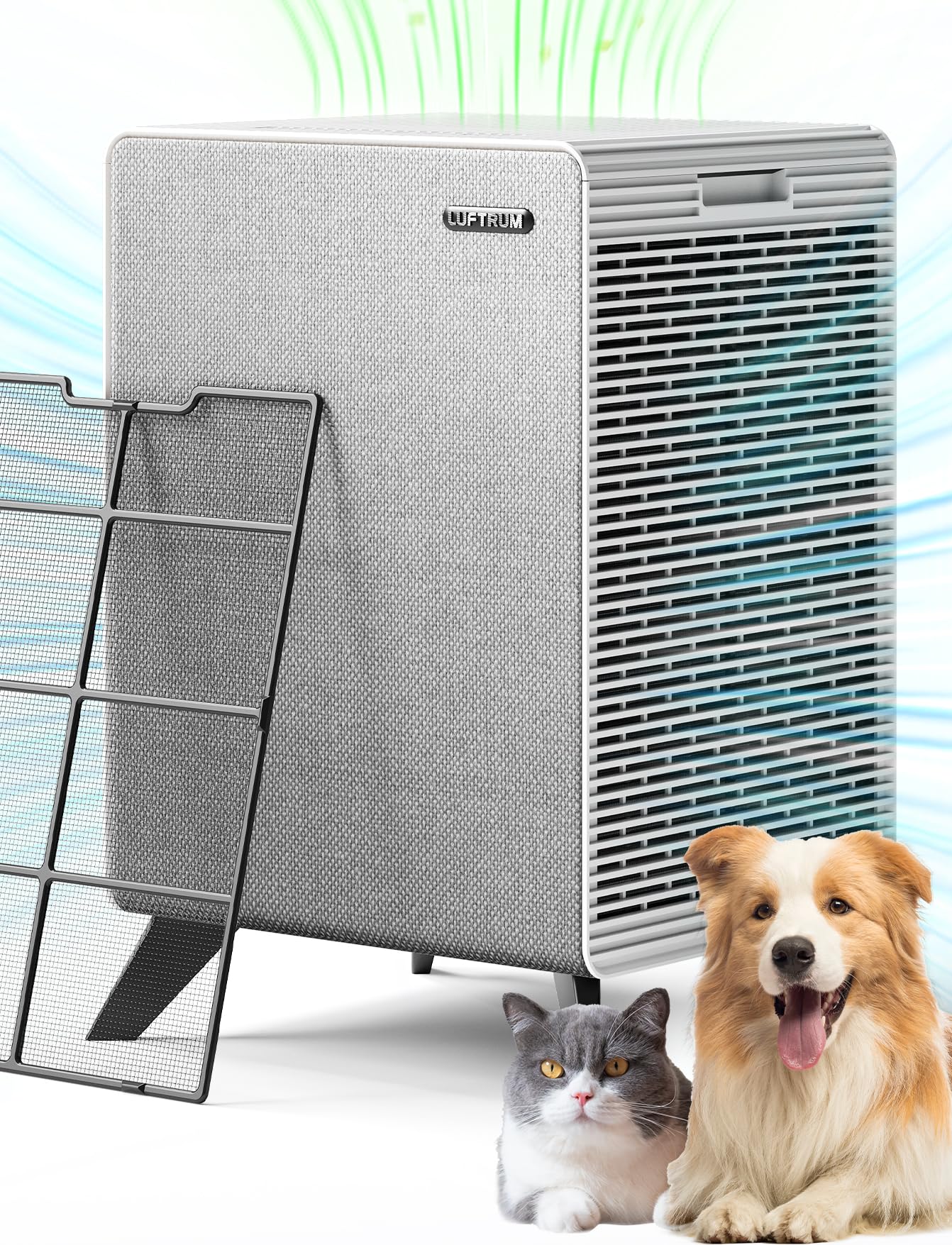
The LUFTRUM C3500 stands out for its dual True H13 HEPA filter configuration, which effectively doubles the filtration surface area compared to single-filter designs. With a CADR of 300 CFM, it can cycle the air in a 350 sq ft space every ten minutes, making it a strong candidate for larger vehicles, RVs, or van conversions. The 48-blade centrifugal fan moves substantial airflow while keeping noise at a claimed 20 dB in sleep mode.
Users report immediate improvement in kitchen odors and pet smells during home use, and the same performance translates well to enclosed vehicle cabins. The PM2.5 sensor provides real-time air quality feedback on the control panel and automatically adjusts fan speed in auto mode. The washable pre-filter captures larger debris like pet hair before it reaches the main filters, extending their service life.
At 12 pounds and a 14.4-inch depth, this is not a unit you toss into a glove box. It is designed for semi-permanent placement in a large cabin or RV rather than daily transfer between vehicles. A few owners mention that the touch panel is sensitive enough that children or pets can accidentally change settings. The dual filters also mean replacement costs are higher than single-filter competitors.
What works
- Dual H13 HEPA filters provide exceptional particle capture
- Real-time PM2.5 sensor with auto fan adjustment
- Washable pre-filter reduces main filter replacement frequency
What doesn’t
- Large and heavy for vehicle use
- Touch panel can be accidentally activated
- Dual replacement filters increase ongoing costs
4. Chuboor PJ01
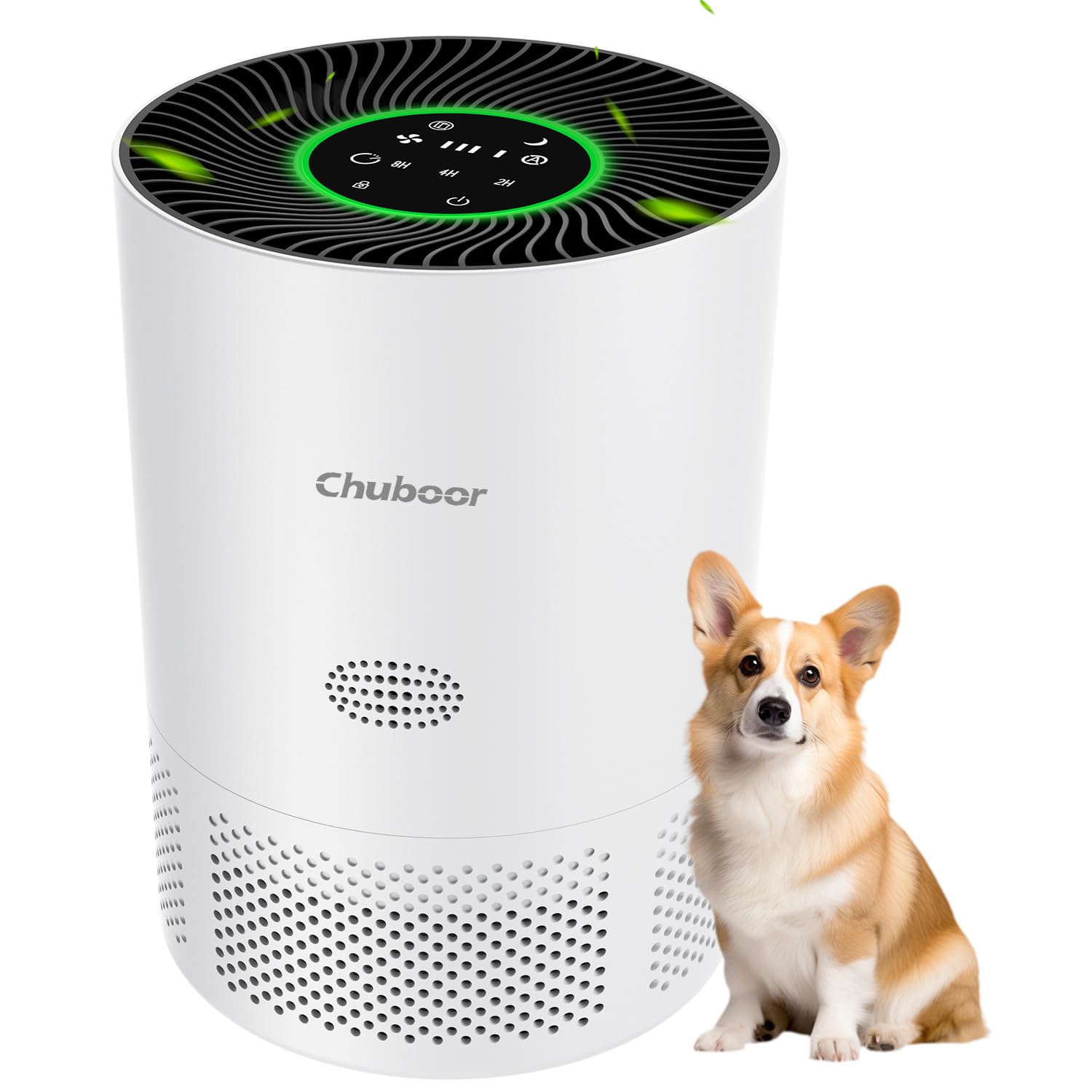
The Chuboor PJ01 packs an H13 True HEPA filter, a 360-degree air intake, and coverage rated up to 1200 sq ft into a chassis that measures just over eight inches square. The 3-stage filtration system captures dust, pollen, smoke, and pet dander, while the activated carbon layer tackles VOCs and cooking odors. Six fan speeds plus an auto mode that adjusts based on the built-in air quality sensor give users granular control over purification intensity.
Owner reviews frequently mention the noticeable reduction in stuffiness and allergen symptoms within days of use. The sleep mode operates at 25 dB, quiet enough for bedrooms or overnight car camping. The filter replacement indicator uses a red light to signal when media needs changing, typically every three to four months depending on usage conditions. Several users also praise the child lock feature for households with young children.
The unit is AC-powered, which again requires an inverter for car use. Some owners note that the buttons on the control panel are slightly misaligned with the printed labels, causing initial confusion during setup. The highest fan speed produces noticeable noise, but lower speeds remain unobtrusive. For the price, the PJ01 delivers strong specs that rival more expensive competitors.
What works
- H13 True HEPA with 360-degree intake for even airflow
- Auto mode adjusts speed based on real-time air quality
- Child lock and sleep mode add family-friendly versatility
What doesn’t
- AC power limits true in-car mobility
- Control panel labels slightly misaligned
- Highest fan setting generates audible noise
5. Philips GoPure GP5212

The Philips GoPure GP5212 is engineered specifically for automotive use, with a 12 V adapter that automatically powers the unit on and off with the vehicle’s ignition. Its SelectFilter Plus technology uses a 3-layer filtration system that includes a HESA layer designed to neutralize harmful gases such as toluene, formaldehyde, and other VOCs commonly found in new car interiors. The CADR of 16 m³/h is calibrated for standard passenger cabins and can filter 50 % of the air in under ten minutes.
Many owners find the installation straightforward, with a 12-foot cable that allows routing to armrests, headrests, or under-seat locations. The two-speed fan is quiet enough to be inaudible over road noise at highway speeds, and the filter replacement indicator takes the guesswork out of maintenance. Airmid Healthgroup certification adds credibility to its allergen and bacteria reduction claims.
Some users struggle with the mounting strap design — the headrest strap is too short for thicker bench-style seats found in trucks and older vehicles. The unit also shuts off after two hours of continuous operation, which requires manual restart for extended drives. A few owners report that the plastic housing can develop a squeak over time, though this is not a widespread issue.
What works
- Auto start/stop with vehicle ignition for effortless use
- HESA layer captures VOCs and formaldehyde effectively
- Compact footprint fits multiple mounting locations
What doesn’t
- Two-hour auto shut-off requires manual restart on long trips
- Headrest strap too short for thicker bench seats
- Some units develop housing squeak over time
6. PuroAir 100i
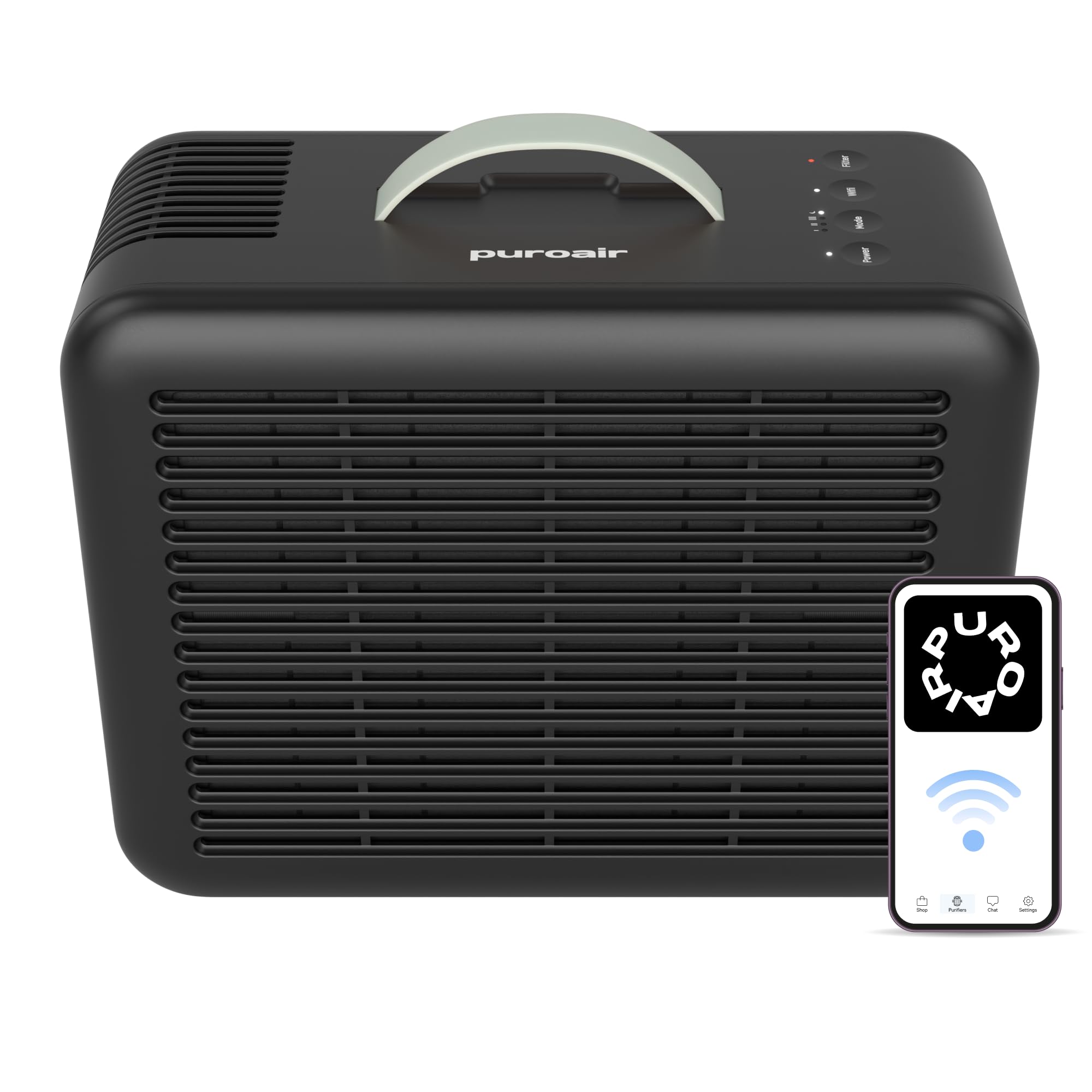
The PuroAir 100i integrates Wi‑Fi connectivity into a compact HEPA chassis, allowing users to control fan speed, monitor filter life, and set schedules from a smartphone app. The 3-stage filtration system — pre-filter, True HEPA, and activated carbon — captures up to 99.9 % of airborne pollutants down to 0.1 microns. Coverage is rated at 550 sq ft, which is ample for any passenger vehicle and most small apartments.
Owner reviews frequently highlight the immediate improvement in air freshness after cooking or when pets are present. The auto mode uses an air quality sensor to adjust fan speed, and the sleep mode keeps noise around 24 dB for undisturbed rest. Setup takes roughly seven minutes via the PuroAir app, and the unit remembers Wi‑Fi credentials even after power loss.
The 100i relies on AC power, so vehicle use requires an inverter. Some users wish the replacement filter cost was lower, though the filter life typically extends to six months under normal use. The app, while convenient, occasionally loses connection if the unit is placed in a metal enclosure or far from the router. For those who prioritize app-based control, it is a capable smart purifier.
What works
- Full smart home integration with Wi‑Fi and app control
- 3‑stage True HEPA with 0.1 micron particle retention
- Quiet sleep mode ideal for overnight use
What doesn’t
- AC power limits direct in-car use
- App connectivity can drop in metal-rich environments
- Replacement filters represent ongoing investment
7. Tolife Air Purifier
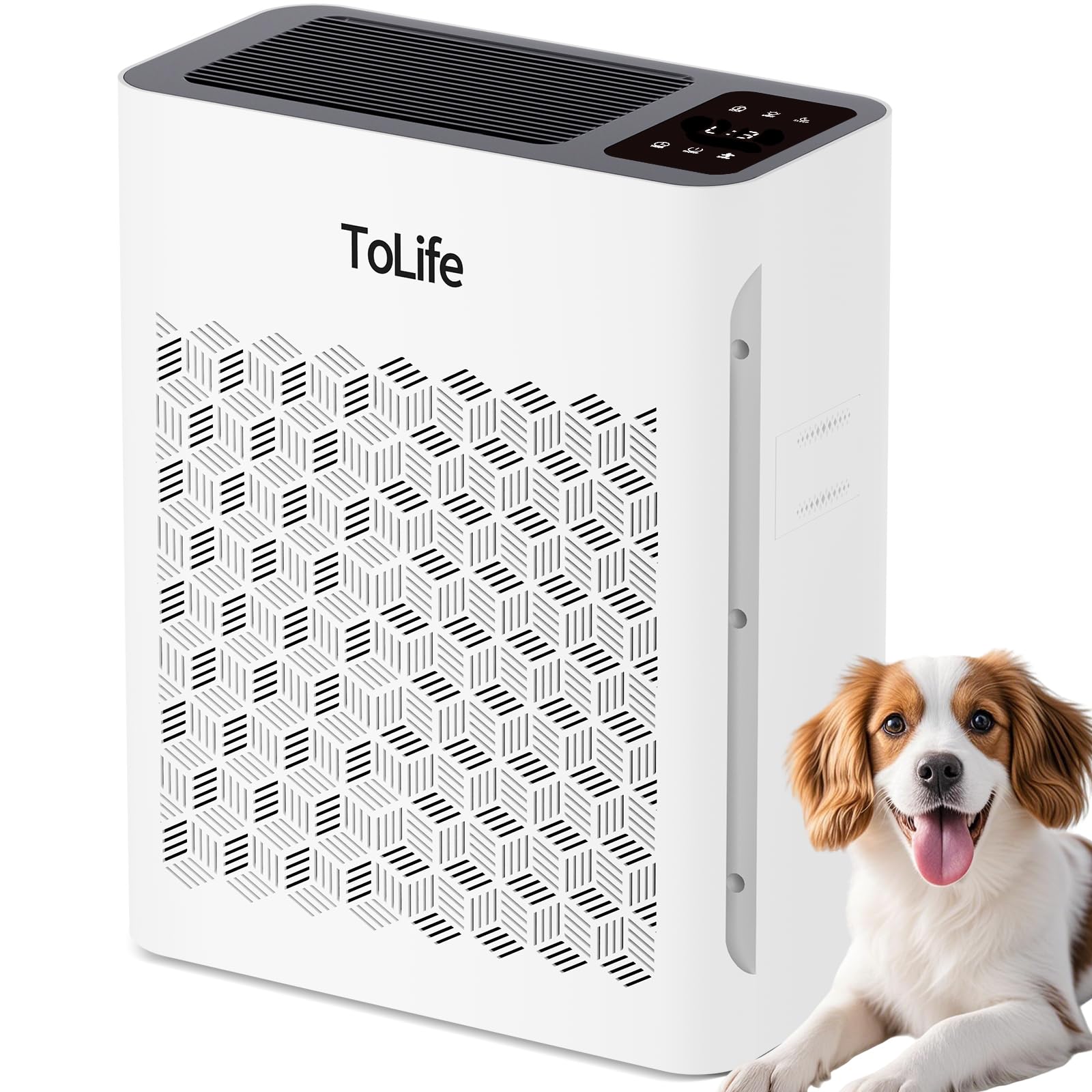
The Tolife Air Purifier focuses on minimalist design and quiet operation, with a washable pre-filter that captures pet hair and dander before they reach the main H13 HEPA media. The unit covers up to 1095 sq ft, and its 45 W motor provides strong circulation without the visual clutter of indicator lights — the front panel keeps all lighting off during normal operation for a distraction-free experience.
Customer reports consistently cite the improved breathing and reduced sneezing within days of use, especially in homes with cats or dogs. The three fan speeds are straightforward to adjust via button control, and the 2-4-6-8 hour timer allows energy-conscious scheduling. Several owners mention that the air feels noticeably cleaner and that dust accumulation on surfaces decreases over time.
Some users note that the actual noise at the lowest setting is closer to 50 dB than the advertised 23 dB, which can be noticeable in a quiet cabin. The unit lacks a remote control or smart features, so all adjustments must be made manually on the device. The replacement filters are inexpensive — around the cost of a fast-food meal each — which offsets the higher noise floor for budget-conscious buyers.
What works
- Washable pre-filter reduces main filter replacements
- Clean, indicator-free design suits light-sensitive sleepers
- Low replacement filter cost compared to competitors
What doesn’t
- Lowest fan speed louder than advertised rating
- No remote or smart home connectivity
- UV and auto modes removed from newer units
8. LUFTRUM Car Air Purifier

This LUFTRUM model is purpose-built for the car, with a Swedish-designed chassis wrapped in high-grade cloth and a built-in PM2.5 sensor that displays real-time air quality on the front panel. The 4-stage filtration system — pre-filter, True HEPA, activated carbon, and an additional fine-filter layer — removes 99.9 % of particles down to 0.1 microns. The double-rotating duct design allows adjustable airflow direction, and the unit automatically powers on and off with the vehicle’s ignition.
Owners in dry, dusty climates report significant relief from allergy symptoms, with the dust sensor triggering higher fan speeds when particulate levels rise. The 4 W motor is energy-efficient and virtually silent at lower settings, while the highest speed produces enough airflow to feel a noticeable breeze from the dash. The 3-meter power cable provides flexibility for mounting behind the center console or under a seat.
The unit is relatively slim at under three inches thick, but mounting on the dashboard can be tricky without the optional suction cup attachment. Some users wish the cord were longer for rear-seat installation. The Scandinavian aesthetic divides opinion — some find it premium, others think the cloth finish feels less durable than hard plastic alternatives.
What works
- Integrated PM2.5 sensor with real-time display
- Automatic ignition start/stop for effortless operation
- 4‑stage filtration captures extremely fine particles
What doesn’t
- Mounting options require additional accessories for secure fit
- Power cord may be too short for rear-seat placement
- Cloth finish may wear differently than plastic enclosures
9. GOODAIR HEPA Car Air Purifier Bag
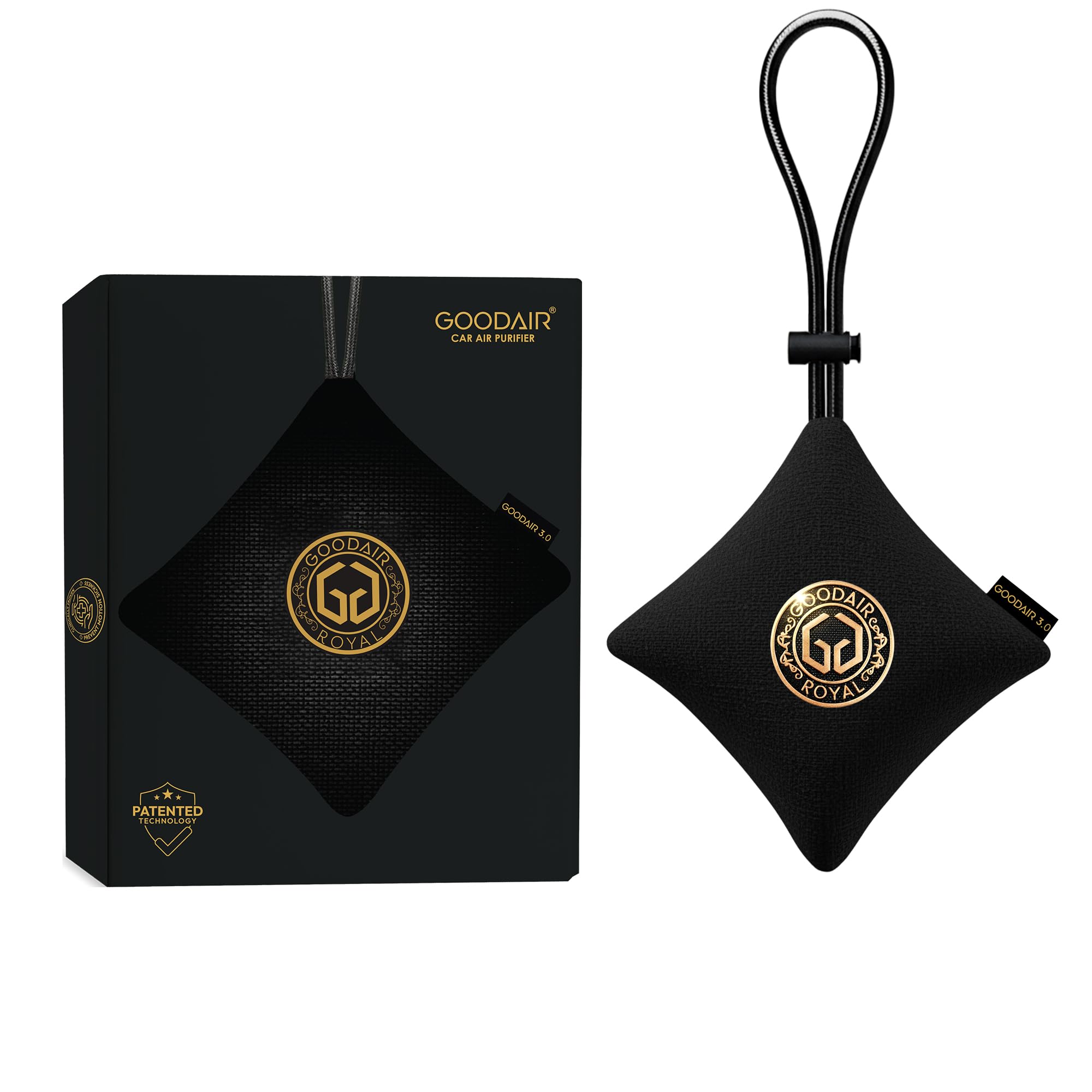
The GOODAIR Purifier Bag takes a completely different approach — no fan, no electricity, just 75 grams of activated carbon in a fabric pouch that hangs from the rearview mirror. It relies on passive adsorption to capture VOCs, smoke, and odors as air naturally circulates through the cabin. The carbon media is impregnated with advanced technology designed to neutralize toxic gases without releasing any chemical fragrances.
Doctor-recommended and marketed as a chemical-free solution, the bag has a dedicated following among owners who want to avoid ozone, ionizers, or any powered device in their vehicle. Users report that it effectively removes lingering food smells and pet odors within a week of installation. The pouch is effective for up to 18 months depending on exposure, and recharging it in direct sunlight for one to two hours each month maintains performance.
Several owners caution that the bag is odorless and provides no active feedback, making it difficult to know when the carbon is saturated. It does nothing for particulate matter like pollen or dust, which limits its utility for allergy sufferers. The hanging design can also obstruct visibility if placed too low on the mirror. For those whose primary concern is chemical odor absorption, it is a viable zero-power option.
What works
- Zero electricity consumption and silent operation
- Effective at neutralizing VOCs, smoke, and odors
- Lasts up to 18 months with monthly sunlight recharge
What doesn’t
- No particulate filtration for dust, pollen, or allergens
- No indicator to signal when carbon is saturated
- Hanging placement can partially obstruct windshield view
10. Prasky HEPA Air Purifier
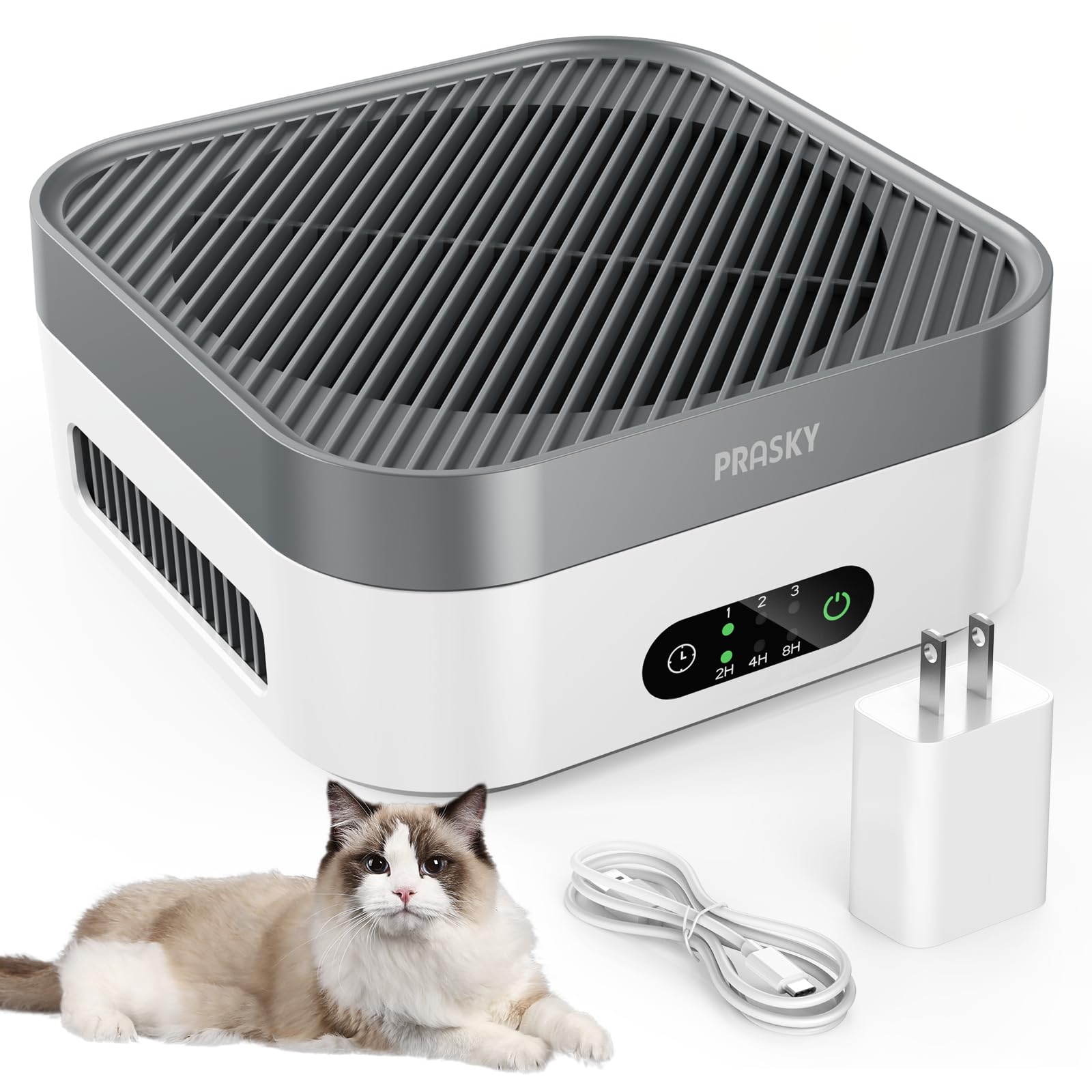
The Prasky HEPA Air Purifier offers an entry point into H13 True HEPA filtration at a budget-friendly price point. Its 3-stage system — pre-filter, H13 True HEPA, and fibrous carbon filter — targets dust, smoke, pet dander, and light household odors. The unit covers up to 600 sq ft and refreshes air four times per hour in a 230 sq ft room. Type-C charging makes it easy to power from a car’s USB port or a standard phone adapter.
Owner reviews highlight the whisper-quiet operation at 16 dB on the lowest setting, making it suitable for bedrooms or overnight car use. The touch panel includes a 2H-4H-8H timer, and the magnetic top cover allows tool-free filter access. The compact 7.5-inch square footprint fits in cup holders, on dashboards, or in small nooks without dominating the space.
Reliability concerns surface in the customer feedback — several units arrived with non-functional buttons or failed to turn on, and some owners report that the filter shows no visible accumulation after weeks of use, suggesting limited airflow. Customer service responsiveness appears mixed, with some users receiving free replacements while others struggled to get support. It is a reasonable starter unit for those who want to test HEPA filtration before committing to a more expensive model.
What works
- Extremely quiet operation at 16 dB on low setting
- Type-C charging compatible with car USB ports
- Compact size fits easily in small spaces
What doesn’t
- Inconsistent quality control with some defective units
- Limited airflow may not effectively clean larger cabins
- Filter shows little visible debris, raising efficacy questions
11. Pure Enrichment PureBaby On-the-Go

The Pure Enrichment PureBaby is a cordless, rechargeable air purifier designed for travel and small spaces — it cleans up to 6 sq ft in 12 minutes, making it best suited for car seats, strollers, cribs, or individual workstations. The 2-stage filtration system uses an activated carbon pre-filter followed by a True HEPA filter that captures 99.97 % of airborne pollutants. The rechargeable battery provides up to 12 hours of runtime, and the whisper-quiet operation measures around 5 dB on the lowest setting.
Parents report noticeable improvements in air quality around infants, particularly in dusty winter conditions or during respiratory infections. The multi-use clamp rotates 360 degrees and attaches to strollers, car seats, high chairs, and playpens. The unit doubles as a small fan with three speed settings, providing gentle cooling in warm weather. Weighing less than six ounces, it is easy to pack in a diaper bag.
Some owners find the airflow too weak to make a meaningful difference in any space larger than a car seat footprint, and a few describe the fan output as nearly nonexistent. The premium pricing relative to its coverage area limits its value compared to larger portable units. It is a niche product for those who need targeted, baby-safe filtration in very confined spaces rather than whole-cabin purification.
What works
- Fully cordless with 12-hour rechargeable battery
- Versatile 360-degree clamp for multiple mounting options
- Lightweight and compact for travel use
What doesn’t
- Very limited coverage area restricts use to tiny spaces
- Weak airflow on lower settings may not satisfy some users
- Premium pricing relative to the small coverage footprint
Hardware & Specs Guide
True HEPA vs HEPA-Type
True HEPA (H13/H14) must capture 99.97 % of particles at 0.3 microns to meet regulatory standards. HEPA-type or HEPA-like filters often capture only 80–90 % at the same particle size. For car use where particle concentrations spike quickly, True HEPA or HyperHEPA provides a measurable health advantage, especially for allergy and asthma sufferers.
CADR and Cabin Matching
The Clean Air Delivery Rate tells you how many cubic feet of air the unit cleans per minute. For a standard sedan cabin (roughly 100–120 cu ft), a CADR of 50 CFM or higher is adequate. Larger trucks or vans benefit from 100+ CFM. Ignoring CADR leads to units that run continuously without ever fully cycling the cabin air.
Activated Carbon and VOCs
Activated carbon media adsorbs gaseous pollutants like benzene, formaldehyde, and toluene that off-gas from dashboards and upholstery. Look for carbon weight measured in grams — heavier carbon beds last longer and adsorb more. Some units use carbon-impregnated foam, which is less effective than granular or pelletized carbon.
Power Source Trade-Offs
Hardwired 12 V units with ignition detection offer set-and-forget convenience but are vehicle-specific. USB-powered models are portable but limited by the 5 V, 2.1 A standard. Battery-powered units give total placement freedom but require ongoing charging discipline. Passive carbon bags use no power but handle only chemical odors, not particulates.
FAQ
Can a HEPA car air purifier remove smoke odors?
Where should I mount a car air purifier for best results?
How often should I replace the filter in a car air purifier?
Do car air purifiers help with allergy symptoms?
Is a HEPA car air purifier worth the investment?
Final Thoughts: The Verdict
For most buyers, the best hepa car air purifier winner is the IQAir Atem Car because it delivers the highest certified filtration efficiency in a vehicle-optimized form factor with minimal noise. If you want smart connectivity and dual home-and-car flexibility, grab the PuroAir 100i. And for a straightforward, no-fuss 12 V installation that auto-starts with your engine, nothing beats the Philips GoPure GP5212.

Certification: BSc in Mechanical Engineering
Education: Mechanical engineer
Lives In: 539 W Commerce St, Dallas, TX 75208, USA
Md Amir is an auto mechanic student and writer with over half a decade of experience in the automotive field. He has worked with top automotive brands such as Lexus, Quantum, and also owns two automotive blogs autocarneed.com and taxiwiz.com.