Nothing ages a vehicle’s front end faster than hazy, yellowed headlight lenses. What started as a clear polycarbonate shield slowly clouds under UV exposure, cutting night-time beam output and making even a well-maintained car look neglected. A dedicated restoration kit reverses that damage without a trip to the body shop.
I’m Amir — the founder and writer behind Four Wheel Ask. I’ve spent years analyzing automotive detailing chemistry and owner-reported long-term results to separate the kits that truly bond with the lens plastic from those that fade after a single car wash.
This guide breaks down the five best options on the market so you can pick a best headlight cleaning kit that delivers lasting clarity without the guesswork.
How To Choose The Best Headlight Cleaning Kit
The right restoration kit bridges the gap between a temporary polish and a permanent repair. Three factors determine which kit truly restores the lens rather than just masking the haze for a few weeks.
Coating Chemistry: Ceramic vs. Standard Sealant
A standard sealant lays a polymer film over the plastic that sheds water but degrades under UV within a few months. Ceramic coatings, by contrast, chemically cross-link with the polycarbonate surface, forming a hard, UV-absorbing barrier that can outlast your ownership period. If you want a single application to stick for years, prioritize kits that include a ceramic wipe as the final step.
Sanding Grit Progression
Light haze might only need a 3000-grit refinement, but deep yellowing and pitting call for a multi-stage approach starting as low as 500 or 800 grit. The best kits provide at least three grit levels — coarse (500–1000), medium (2000–3000), and fine (5000) — so you can both carve out oxidation and then polish the plastic back to an optical-grade finish.
Drill-Powered vs. Hand-Applied
Drill-powered systems use a backing pad and hook-and-loop discs to spin abrasives at consistent speed, which prevents the uneven pressure that hand sanding can create. Hand-applied kits are safer for beginners and eliminate the risk of burning through the clear coat or overheating the plastic, but they require more elbow grease on heavily crusted lenses. Choose a drill-based kit for speed and uniformity; choose a hand-applied kit for precision and safety on delicate lenses.
Quick Comparison
On smaller screens, swipe sideways to see the full table.
| Model | Category | Best For | Key Spec | Amazon |
|---|---|---|---|---|
| CERAKOTE Ceramic Headlight Restoration Kit | Ceramic Wipe | One-time, long-term restoration | Ceramic coating wipes | Amazon |
| Rain-X 610153 Headlight Restoration Kit | Drill System | Consistent, professional results | Sealant wipe + drill attachments | Amazon |
| 3M Headlight Lens Restoration System 39008 | Drill System | Heavy-duty oxidation removal | 500/800/3000 grit discs | Amazon |
| Meguiar’s Ultimate Headlight Restoration Kit | Hand Sanding | No-tool, mild to heavy oxidation | 1000/3000 grit discs | Amazon |
| POLIWELL Headlight Restoration Kit 24Pack | Drill System | Budget-friendly multi-lens kit | 800-5000 grit discs | Amazon |
In‑Depth Reviews
1. CERAKOTE Ceramic Headlight Restoration Kit

Cerakote’s kit is a three-step process that skips power tools entirely. Eight oxidation-removing wipes handle step one, a sanding kit targets deep pitting in step two, and the two ceramic coating wipes in step three chemically bond a UV-blocking layer to the polycarbonate. The ceramic finish is the star here — it cross-links with the plastic rather than sitting on top, which is why the manufacturer guarantees it as long as you own the vehicle.
Each wipe in step one is pre-saturated with an abrasive compound that strips moderate haze without requiring a separate spray or liquid. For lenses that are heavily yellowed, the included sanding materials (not traditional discs but abrasive pads) let you work the surface before the ceramic locks the clarity in. The entire process takes about 30 minutes for both headlights.
The kit is light on sanding media compared to multi-disc systems — you get roughly two pitted lenses’ worth of material before the ceramic wipes run out. For most daily drivers, that is exactly enough. If your lenses are deeply scratched rather than just yellowed, a drill-based system with more grit options may edge it out, but for long-term protection, this ceramic approach is unmatched.
What works
- Ceramic coating provides durable UV protection that outlasts polymer sealants
- Completely tool-free — no drill or rotary buffer needed
- Fast 30-minute total application time
What doesn’t
- Sanding media is thinner than dedicated disc-based kits
- Only enough wipes for one full restoration on two standard lenses
2. Rain-X 610153 Headlight Restoration Kit

Rain-X takes a drill-based approach with dedicated sanding and polishing attachments that spin at consistent speed, eliminating the hand-pressure variation that can leave wavy surfaces. The kit includes a sanding disc for coarse removal, a polishing pad to refine the plastic, and a protective sealant wipe that deposits a water-repelling polymer film to extend the restoration life.
The sealant wipe is the practical benefit here — after you sand and polish with the drill, the wipe lays down a clear layer that sheds road grime and resists UV re-yellowing. Rain-X positions this as a “long-lasting” formula, though the sealant is a polymer rather than a ceramic, so its life span is measured in months rather than years. The trade-off is a much faster application than a ceramic cure cycle.
Where this kit truly shines is consistency. Because the drill spins the pad at a uniform speed, you avoid the uneven circular scratches that hand sanding sometimes leaves. The included drill attachments are generously sized for most standard household drills, and the backing pad holds the disc securely without slipping during high-speed operation. For a driver who wants professional-level surface uniformity, this is the pick.
What works
- Drill-powered sanding and polishing deliver consistent, swirl-free results
- Sealant wipe protects against re-yellowing after restoration
- Easy to use for both beginners and experienced DIYers
What doesn’t
- Polymer sealant does not last as long as a ceramic coating
- Requires a drill — not ideal for tool-free use
3. 3M Headlight Lens Restoration System 39008

3M’s restoration system is a straightforward drill-powered kit built for the heaviest oxidation. It includes six 500-grit gold sanding discs, four 800-grit white finishing discs, one Trizact refining disc, a rubbing compound, and a disc pad holder. The grit range starts aggressively at 500 and climbs to 3000 equivalent, meaning you can cut through deep yellowing and pitting that gentler kits would struggle to touch.
The Trizact disc is the key differentiator — it uses micro-replication technology that gradually breaks down as you sand, leaving a progressively finer finish without needing to swap discs as frequently. This both reduces swirl marks and speeds up the overall process. After the final Trizact pass, the included rubbing compound restores optical clarity before you add your own headlight sealant or wax.
This kit does not include any final protective coating wipe. You will need to supply your own sealant or ceramic coating after you finish sanding. That makes it a better fit for detailers who already have a preferred UV protectant and want a pure sanding system rather than an all-in-one. For raw cutting power on badly degraded lenses, there is no better option in this price tier.
What works
- Aggressive 500-grit start handles heavily pitted and yellowed lenses
- Trizact disc self-refines for fewer disc changes and less swirl
- Drill-powered system ensures uniform cutting pressure
What doesn’t
- No final UV sealant or ceramic wipe included
- Requires a drill and separate protectant purchase
4. Meguiar’s Ultimate Headlight Restoration Kit
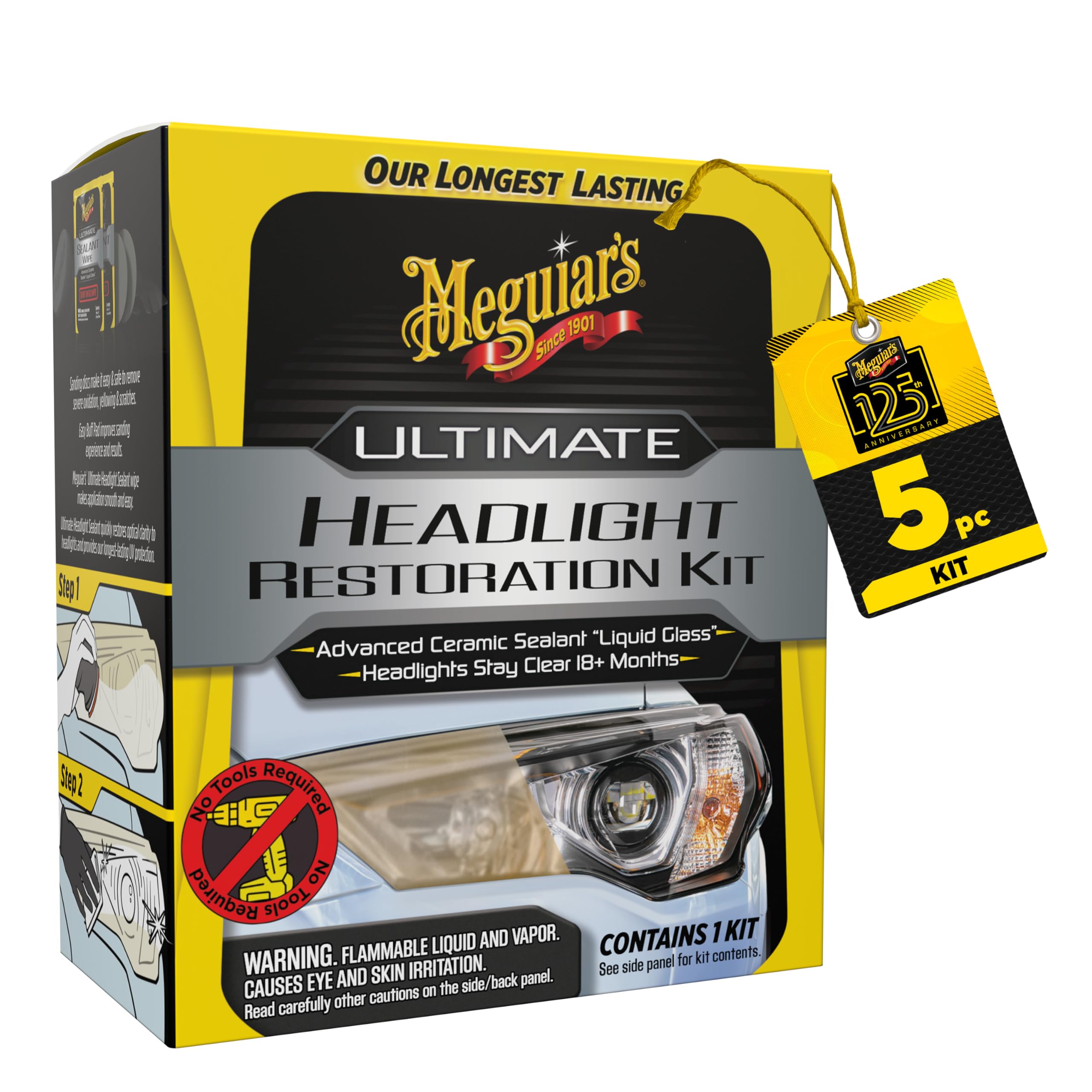
Meguiar’s kit is a hand-sanding solution that pairs two grades of abrasive discs — 1000 grit and 3000 grit — with pre-saturated sealant wipes. The 1000 grit removes the bulk oxidation and yellowing, while the 3000 grit refines the surface to a haze-free finish. After sanding, the included wipes deposit a clear polymer sealant that Meguiar’s rates for over 18 months of protection against re-oxidation.
The pre-saturated wipes are the real convenience feature. After wet-sanding the lenses, you wipe on the sealant and let it dry crystal clear. No mixing, no measuring, no separate applicator pad. The sealant is a polymer-based formula rather than ceramic, but the 18-month durability claim puts it well ahead of most standard clear-coat wipes. For a no-tool kit, the clarity improvement on mild to moderate haze is impressive.
Because this is a hand-sanding system, you control the pressure entirely. That makes it safer on older or thin lenses where a drill could burn through the plastic. The included sanding discs are adhesive-backed and fit a standard 3-inch backing pad if you want to switch to a drill later, but the kit is designed for manual use. For the owner who wants a tool-free restoration with long-lasting sealant, this is the smartest value on the list.
What works
- Pre-saturated sealant wipes offer easy 18+ month UV protection
- Two-grit sanding progression handles mild to heavy yellowing
- Completely tool-free — safe for thin or delicate lenses
What doesn’t
- Hand sanding requires more effort and time than drill systems
- Sealant is polymer, not ceramic, so life is limited to about 18 months
5. POLIWELL Headlight Restoration Kit 24Pack

The POLIWELL kit packs 24 pieces into a single box, making it the most content-rich option on the list. You get four each of 1000, 3000, and 5000 grit sanding discs, two 800-grit scrubber pads, a back-up sanding pad, a drill attachment, a foam interface pad, polishing compound, UV coating, masking tape, and a spray bottle. That is enough material for multiple restorations or for tackling fog lights and tail lights alongside the headlights.
The grit progression from 800 up to 5000 allows very aggressive initial cutting to remove deep oxidation, followed by a fine polish that restores optical clarity. The included UV coating is a liquid that you apply with a cloth after sanding and polishing, providing a protective layer against future yellowing. The polishing compound is pre-mixed and works well with the foam pad on a drill to bring out a glass-like finish.
Build quality on the sanding discs is decent for the price point, though the grit adhesion is not quite as consistent as premium brands like 3M. Some users report the 5000-grit discs wearing out faster than expected on a full restoration. For the budget-conscious DIYer who needs to do multiple vehicles or multiple lights, this kit offers the most bang per dollar, but expect to replace the finer grit discs more frequently during heavy use.
What works
- High disc count restores multiple lenses or multiple vehicles
- Full 800–5000 grit range handles both heavy and fine polishing
- Includes UV coating, polishing compound, and masking tape
What doesn’t
- Finer grit discs wear faster than premium alternatives
- Requires a drill — not a standalone hand-sanding kit
Hardware & Specs Guide
Grit Progression Levels
The grit number tells you how coarse the abrasive is. Lower numbers (500–800) aggressively remove deep oxidation and pitting. Mid-range grits (1000–3000) refine the surface and remove scratches left by the coarse stage. High-number grits (5000+) polish the plastic to a glossy, optical-grade finish. A kit that skips from coarse to fine without a mid-grit step often leaves visible swirl marks.
UV Coating Chemistry
Two types of final protection dominate the market: polymer sealants and ceramic coatings. Polymer sealants bond to the surface layer and typically last 6 to 18 months before reapplication is needed. Ceramic coatings chemically cross-link with the polycarbonate and form a hard, UV-absorbing shell that can last several years. The trade-off is that ceramic kits usually require more meticulous surface preparation to bond properly.
FAQ
Can a headlight cleaning kit fix pitted or scratched lenses?
How long does a headlight restoration last before yellowing returns?
Is it better to use a drill-based kit or a hand-sanding kit?
Will a restoration kit work on fog lights or tail lights?
Final Thoughts: The Verdict
For most buyers, the best headlight cleaning kit winner is the CERAKOTE Ceramic Headlight Restoration Kit because its ceramic coating chemically bonds to the lens, delivering UV protection that lasts as long as you own the vehicle without needing any power tools. If you want drill-powered uniformity and professional-grade surface finish, grab the Rain-X 610153 Headlight Restoration Kit. And for the toughest heavy oxidation where cutting power matters most, nothing beats the 3M Headlight Lens Restoration System 39008.

Certification: BSc in Mechanical Engineering
Education: Mechanical engineer
Lives In: 539 W Commerce St, Dallas, TX 75208, USA
Md Amir is an auto mechanic student and writer with over half a decade of experience in the automotive field. He has worked with top automotive brands such as Lexus, Quantum, and also owns two automotive blogs autocarneed.com and taxiwiz.com.